Written by: Anish Rao, Head of Growth, Listen Labs
Key Takeaways for QSR and Beverage Teams
- Traditional QSR concept testing and beverage taste testing timelines of 4–8 weeks create delays that force brand teams to lock launch decisions before insights arrive.
- AI-moderated platforms compress every stage of the concept journey, from idea screen through pre-launch validation, into 24-hour cycles while maintaining quality through behavioral monitoring and adaptive probing.
- Multimodal emotional intelligence features capture unstated reactions like genuine delight versus polite approval, reducing the social desirability bias that distorts conventional survey data in food and beverage research.
- Enterprise-grade safeguards including SOC 2 Type II, ISO certifications, participant frequency caps, and zero data usage for model training keep AI research aligned with the security and validity standards required for proprietary innovation pipelines.
- Listen Labs enables QSR and beverage teams to move from brief to stakeholder-ready deliverables in under 24 hours—pilot the platform on your next live study.
Typical Timelines for Fast Food Concept Testing
Traditional in-depth interview (IDI) projects for QSR concept testing typically take several weeks. The fieldwork stage is the primary bottleneck. A skilled moderator can conduct perhaps 8-10 in-depth interviews per day, which forces sequential scheduling and compounds delays. Traditional focus groups add facility scheduling and geographic coordination, so multiple groups often require several weeks.
Timelines stretch even further across full innovation pipelines. A complete concept journey from idea screen through positioning validation traditionally takes 4-12 weeks (often 6-8 weeks) under sequential R&D-to-marketing handoff models. The total consumer research timeline across all four gates, including idea screen, concept validation, pre-development confirmation, and pre-launch, typically takes 6-12 weeks under agency-led methods.
A global fast-food brand historically needed several weeks to complete advertising effectiveness research before adopting AI-powered behavioral analytics. That benchmark shows how campaign validation timelines mirror concept testing timelines across the QSR category.
AI-moderated platforms restructure every stage of that pipeline. Each gate of the concept journey completes in 24 hours with AI moderation, which compresses the full four-gate journey from months to days.
Beverage Taste Testing Timelines and Emotional Insight Gaps
Beverage research faces even longer timelines than concept testing. Sensory and central-location tests (CLTs) for beverage products sit at the slower end of the research spectrum. Traditional CLT design, facility booking, participant recruitment, and analysis can take several weeks for agency-led qualitative work. A flavor consultancy model, where clients ship physical samples for professional palate review, delivers expert feedback within one week of receiving product samples.
The deeper challenge in beverage research is capturing unstated reactions. Food and beverage consumption is driven by taste, emotion, memory, social context, health aspiration, and cultural identity, factors that are notoriously difficult to capture through conventional survey instruments alone. Consumers consistently over-report healthy eating intentions and under-report indulgent consumption, which introduces social desirability bias and distorts findings.
AI-moderated interviews close this gap through multimodal signal capture. Listen Labs’ Emotional Intelligence feature analyzes tone of voice, word choice, and subconscious micro-expressions to surface emotions that transcripts alone miss. The system builds on Ekman’s universal emotions framework, the same standard used in clinical psychology. For a beverage team testing two reformulation candidates, this means knowing not just which option scored higher on a hedonic scale, but which one triggered genuine delight versus polite approval, traceable to the exact timestamp and verbatim quote.
A major snack brand validated reformulation concepts using an AI-powered platform, completing the work faster and at significantly lower cost than with traditional specialty panels. See how Listen Labs captures emotional and sensory reactions in under 24 hours.
Faster QSR Research Without Sacrificing Quality
Speed without quality controls is not a viable trade. The concern is legitimate. AI matches traditional panels on the top-performing option 80–85% of the time with consistent rank ordering, but accuracy gaps widen in categories driven by physical product experience such as taste, texture, and aroma. AI works best for screening and iteration, while final high-stakes decisions still rely on physical product experience.
Teams do not need to choose between speed and rigor. They need to apply the right method at the right gate. Listen Labs is built for exactly that balance. The platform has run over 1 million AI-powered customer interviews for companies including Microsoft, Perplexity, and Sweetgreen, with quality maintained through three structural safeguards.
First, Listen Atlas, the platform’s AI recruitment orchestration layer, draws from a global network of 30M verified respondents across 45+ countries and matches on behavioral and intent data rather than self-reported demographics. This behavioral matching creates a strong quality foundation. Second, Quality Guard monitors every interview in real time across video, voice, content, and device signals to detect fraud, low-effort responses, and mismatched profiles, catching issues that would slip through demographic screening alone. Participants are capped at three studies per month, which removes professional survey-takers who might otherwise erode data quality.
Third, the platform holds SOC 2 Type II, ISO 27001, ISO 27701, and ISO 42001 certifications, and customer data is never used for AI model training. These controls work together as a layered system that protects sample quality, operational integrity, and data security.
Two anonymized F&B-relevant outcomes show this system in practice. A CPG brand used Listen Labs to surface where product claims felt exaggerated or unclear before market launch. The team received 250+ interviews with quantified themes and verbatim proof in hours, which directly shaped product and brand strategy. Separately, switching to Listen Labs AI-moderated interviews let one consumer brand capture hundreds of candid, one-to-one conversations overnight, a volume that would have required weeks of sequential human-moderated sessions.
Qualitative sample sizes for AI-moderated studies have increased substantially. This shift reflects the collapse of the old depth-versus-scale trade-off that previously forced QSR teams to choose between statistically meaningful samples and rich consumer conversations.
Inside a 24-Hour Consumer Research Cycle in 2026
The end-to-end workflow on Listen Labs starts with AI-assisted study design. A brand manager describes research goals in natural language, and the platform drafts structured objectives, questions, and probing context in seconds. Advanced stimuli options, including images, video, audio, PDFs, prototypes, or live URLs, support monadic or sequential concept randomization, which is standard for menu and packaging tests.
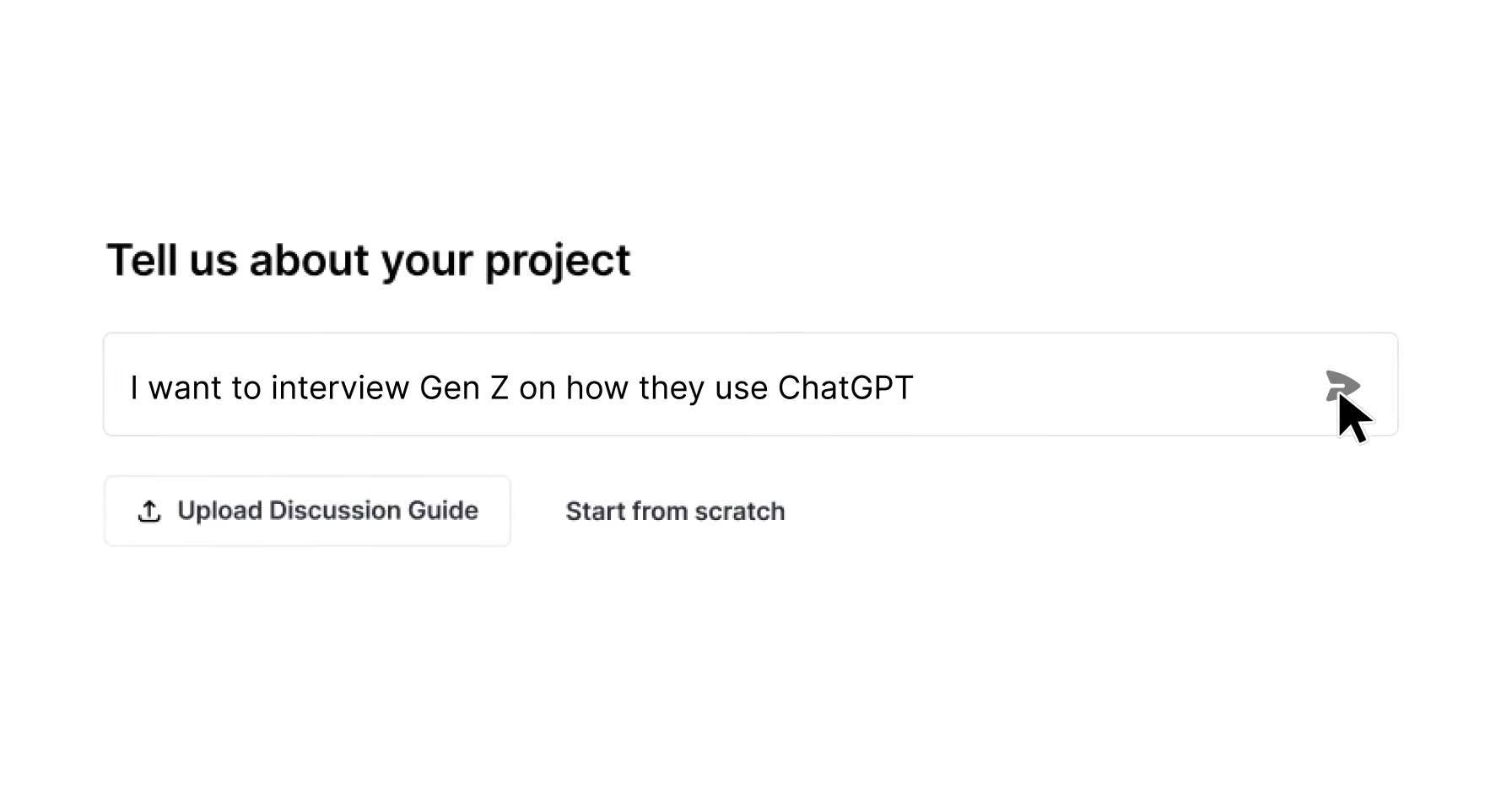
Once the study launches, Listen Atlas recruits from the 30M+ verified respondent network and matches participants to the exact audience profile, such as category buyers, regional consumers, or specific dietary segments, without the 1–2 week recruitment lag that defines traditional timelines. Because recruitment happens in hours rather than weeks, the AI interviewer can begin conversations the same day. The system conducts hundreds of interviews in parallel while traditional studies would still be scheduling their first participant.
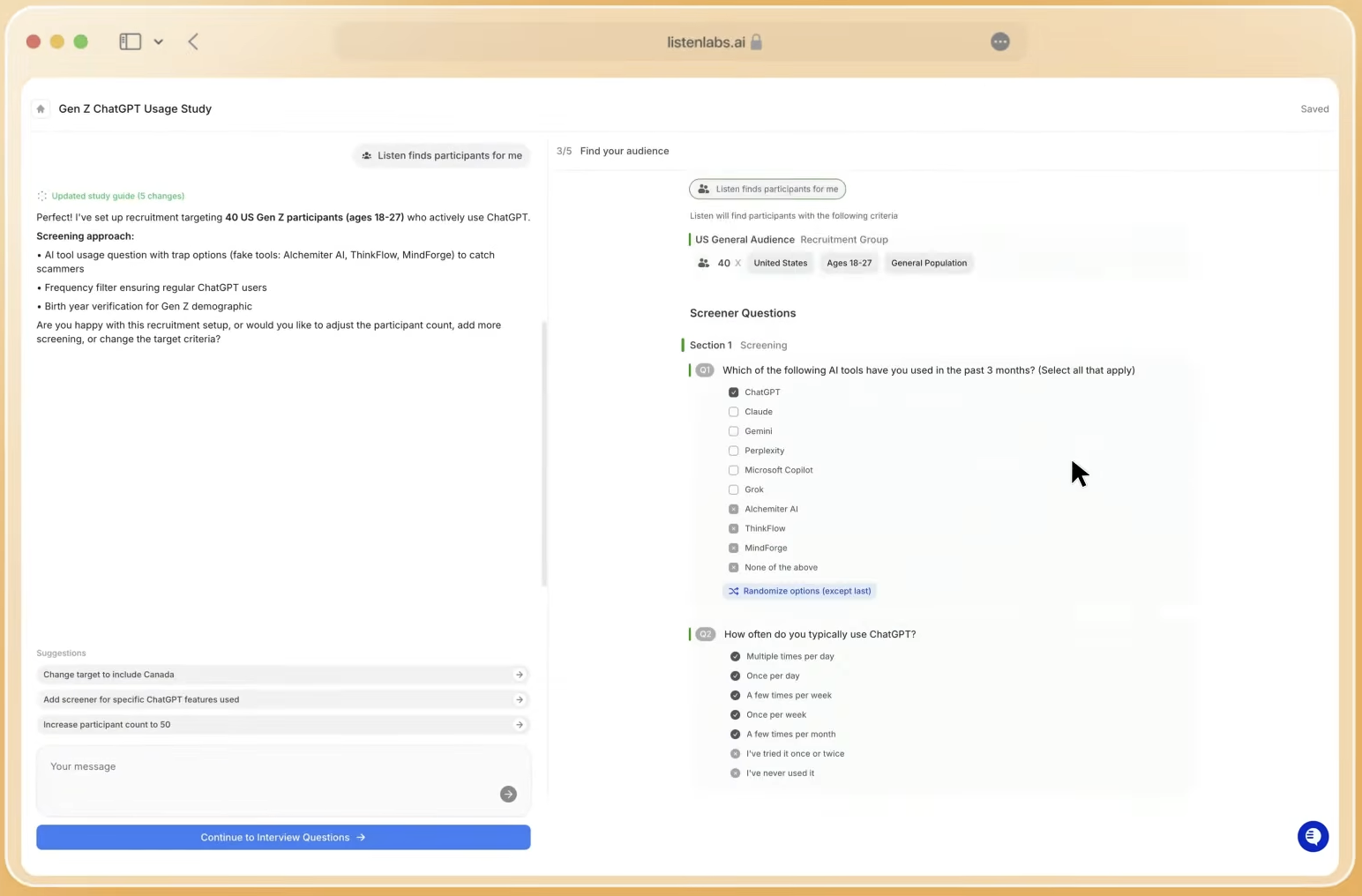
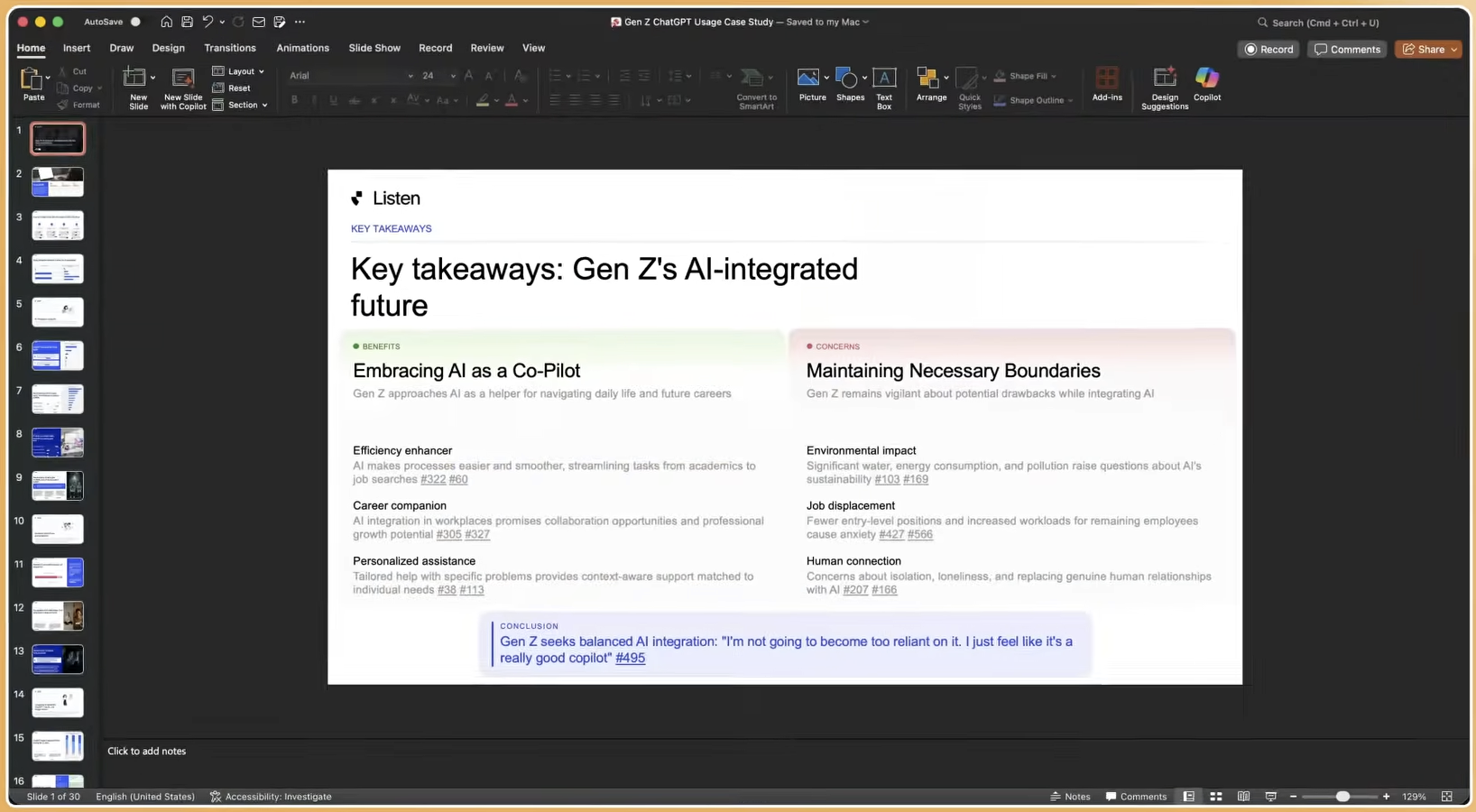
This simultaneity enables same-day analysis. The platform analyzes transcripts for themes and generates quantitative insights as interviews complete, instead of waiting for sequential fieldwork to finish. The Research Agent then processes all interview data and separates signal from noise using proprietary data from tens of thousands of completed studies. One researcher ran a full buying intent analysis across three user segments in under a minute.
Deliverables such as branded slide decks, memo-style reports, video highlight reels, and statistical charts are generated automatically. The Research Agent generates a slide deck in a company’s branded template and a downloadable report, ready for stakeholder presentation the same day the study launched. Median time-from-question-to-decision dropped from 6.2 weeks to 2.1 days for AI-moderated studies per Greenbook’s GRIT 2025 benchmarks, as AI removes the sequential handoff latency from transcription, coding, and synthesis.
Quality and Trust for Enterprise Food and Beverage Teams
Enterprise adoption of any AI research platform depends on three questions. Teams need to know whether the data is real, whether it is secure, and whether the platform respects participant welfare.
On data integrity, Listen Labs operates no commodity quantitative panels. Quality Guard’s real-time behavioral monitoring covers video, voice, content, and device signals, with a reputation scoring system that compounds across every interview the platform conducts. This flywheel strengthens audience quality over time in a way competitors cannot easily replicate. Participant frequency limits of no more than three studies per month per participant prevent panel fatigue and incentive-driven responses.
On security, the platform maintains 256-bit encryption and the enterprise-grade certifications described earlier. Customer data is never used for AI model training, which is a non-negotiable requirement for enterprise F&B teams handling proprietary innovation pipelines.
On participant welfare and research validity, with qual-at-scale, the old trade-off between depth and scale is no longer a barrier. The Listen Labs in-house research team, with 50+ years of combined expertise, continuously reviews and refines the methodology framework. That oversight ensures that speed does not erode the adaptive, probing conversation quality that makes qualitative consumer research valuable.
Readiness Checklist for a 24-Hour Pilot
Before launching a pilot, QSR and beverage insights teams benefit from mapping four internal readiness factors against their current research operations. These four factors determine whether your organization can run 24-hour research cycles without creating internal bottlenecks.
- Data governance: Confirm that your organization’s data handling policies accommodate AI-moderated video interviews and cloud-based analysis. Listen Labs’ SOC 2 and ISO certifications cover the platform side, while internal legal review of data residency requirements typically takes one to two weeks.
- Stakeholder buy-in: Identify one or two internal champions, typically a VP of Consumer Insights or a Brand Manager with an active launch deadline, who can sponsor a scoped pilot and translate speed-to-insight metrics into business outcomes leadership recognizes.
- Pilot scope: Select a study type with a clear success benchmark. Options include a concept test with a known historical timeline, a taste-test validation with a defined sample size, or a campaign direction study with a pending creative decision. Scoped pilots produce the most actionable comparison data.
- Bring-your-own-participants option: Decide whether to use your own consumers. If your brand maintains a consumer panel or CRM segment, Listen Labs supports self-recruitment at reduced cost, which helps when proprietary audience access is a priority.
Walk through a pilot scoping conversation with the Listen Labs team.
Next Steps for QSR and Beverage Insights Leaders
The most productive starting point for any QSR or beverage team is an honest audit of where research bottlenecks are costing launch windows. Map the last three to five studies your team completed. Track how many calendar days elapsed between brief and readout, how many of those days were fieldwork versus sequential handoffs, and how many decisions were made before findings arrived. That audit usually surfaces one or two study types, such as concept testing, taste-test validation, or campaign direction, where a 24-hour turnaround would have materially changed the outcome.
From there, a scoped pilot on a live study with a real deadline is the fastest way to evaluate whether AI-moderated consumer interviews meet your team’s quality bar. With proven scale across enterprise clients, the platform is designed to integrate into existing research workflows rather than replace them.
Bring a live research question and the Listen Labs team will walk through exactly how the platform would approach it, from study design through same-day deliverables.
Frequently Asked Questions
How does AI-moderated consumer research maintain depth when running hundreds of interviews simultaneously?
AI-moderated interviews on Listen Labs use dynamic follow-up logic, the same adaptive probing a trained human moderator applies when a participant gives a short or ambiguous answer. Each conversation is personalized in real time based on the participant’s responses, not a fixed script. The platform also captures multimodal signals, including video, audio, text, and screen recordings. Emotional Intelligence evaluates these signals against Ekman’s universal emotions framework to surface reactions that transcripts alone miss. A study with 200 simultaneous interviews therefore delivers the conversational depth of a small-sample qualitative study, with the added benefit of statistically meaningful patterns across segments.
Can Listen Labs reach the specific consumer segments QSR and beverage brands need, such as regional buyers or dietary cohorts?
Yes. Listen Atlas, the platform’s AI recruitment orchestration layer, matches participants across behavioral and intent data, not just self-reported demographics. It draws from a global network of 30 million verified respondents across 45+ countries and 100+ languages. A dedicated recruitment operations team handles hard-to-reach segments, including consumers below 1% incidence rate. For QSR and beverage use cases, this capability supports recruiting recent category purchasers, regional flavor preference cohorts, or specific dietary segments without the 1–2 week panel sourcing delays that characterize traditional recruitment. Organizations can also self-recruit from their own consumer panels at reduced cost.
What deliverables does a QSR or beverage team receive at the end of a Listen Labs study?
The Research Agent generates a full suite of stakeholder-ready outputs automatically. Teams receive branded PowerPoint slide decks, memo-style reports, video highlight reels of the most emotionally significant or thematically relevant moments, statistical charts and significance tests, and segmentation breakdowns by demographics, cohorts, or custom audience groups. Every insight links back to the underlying response data, including verbatim quotes, timestamps, and the reasoning behind each emotional or thematic label, so teams can interrogate findings rather than accept summaries. Custom reports can be generated by asking any question in natural language, and all deliverables are available the same day the study completes.
Is customer data used to train Listen Labs’ AI models?
No. Customer data is never used for AI model training. Listen Labs maintains enterprise-grade security with 256-bit encryption and holds SOC 2 Type II, GDPR, ISO 27001, ISO 27701, and ISO 42001 certifications. For F&B teams running proprietary innovation research, including unreleased menu concepts, reformulation data, or pre-launch campaign directions, this policy functions as a structural protection rather than a preference. The platform also supports enterprise SSO for access management.
How does Listen Labs handle research questions that require physical product experience, such as in-home taste tests?
For concept-level screening, flavor ranking, claim validation, and campaign direction, AI-moderated interviews deliver results in under 24 hours without requiring physical product. For studies where physical product experience is central, including in-home usage tests (IHUTs), sensory evaluation of finished goods, or packaging interaction, Listen Labs supports diary-style and ethnographic study formats. Participants engage with products in their natural environment and report back through AI-moderated video interviews over a defined period.
This approach captures the contextual and emotional data that central-location tests often miss while preserving the speed and scale advantages of AI moderation. The platform’s study design tools support stimuli upload, branching logic, and mixed-method formats that combine qualitative depth with quantitative scales.