
Written by: Anish Rao, Head of Growth, Listen Labs
Key Takeaways
- Traditional brand tracking software reports metric movements but rarely explains why those shifts occur, so teams commission separate qualitative studies after the fact.
- Conversational brand trackers close this diagnostic gap by pairing constant quantitative questions with AI-moderated open-ended interviews in the same wave, so metrics and explanations arrive together.
- Listen Pulse connects every KPI shift to verbatim quotes, video clips, and emotion signals derived from tone, word choice, and micro-expressions, revealing the real reasons behind brand perception changes.
- Continuous theme monitoring and traceability features surface emerging competitive threats and cultural shifts before they show up as KPI declines, giving teams time to act proactively.
The Problem: Traditional Trackers Show Movement Without Meaning
Traditional brand trackers suffer from four structural limitations that compound each other and slow decision-making.
Wave-based cadence delays. YouGov BrandIndex is a daily brand tracking tool that conducts interviews every day and updates metrics continuously. Many survey-panel trackers instead run on 6- to 12-week cycles, so metric movements arrive too late for timely campaign or positioning decisions. By the time a quarterly report lands, the underlying shift has often been building for months.
Pre-set questions miss emerging themes. Survey-only panels are designed for 5–15 minute quantitative exercises in which panelists click through rating scales and multiple-choice questions. These formats produce metric-level data but only shallow diagnostic insight. When a new competitor enters the category or a cultural moment reshapes brand associations, a fixed question set rarely surfaces it.
Absence of emotional signals. The emotional drivers behind brand preference and how customers describe a brand remain invisible to quantitative survey trackers, which prioritize scale over depth. Two brands can post identical NPS scores while triggering entirely different emotional responses.
Fragmented workflows. To understand the cause of a metric shift, teams need deeper qualitative research beyond the quantitative tracker itself. That need usually means a separate study, a separate vendor, and a separate timeline, which often adds weeks to a process that is already lagging.
These delays compound the other limitations. By the time qualitative findings arrive to explain a metric shift, teams have already spent agency fees, tracker subscriptions, and reporting time monitoring and acting on what is frequently statistical noise, while the real explanatory signal sits in a qualitative study that has not yet been commissioned.
Conversational Brand Trackers Combine Metrics with Live Explanations
A conversational brand tracker keeps the same quantitative questions constant wave over wave to protect trend integrity while adding AI-moderated open-ended interviews to every wave. Metrics and the reasons behind them arrive together in a single delivery instead of weeks apart.
Listen Pulse is Listen Labs’ version of this model and shows how the approach works in practice. It runs the same study with the same screeners wave after wave, then analyzes open-ended answers, sorts them into themes, quantifies each theme, and charts those themes next to the KPIs teams already report. Core questions stay constant to keep the trend line clean. Timely add-on questions cover new campaigns, competitors, or news events without breaking historical comparability. Pulse can deploy alongside an existing tracker or as the primary tracking system and integrates directly with Qualtrics and Decipher.
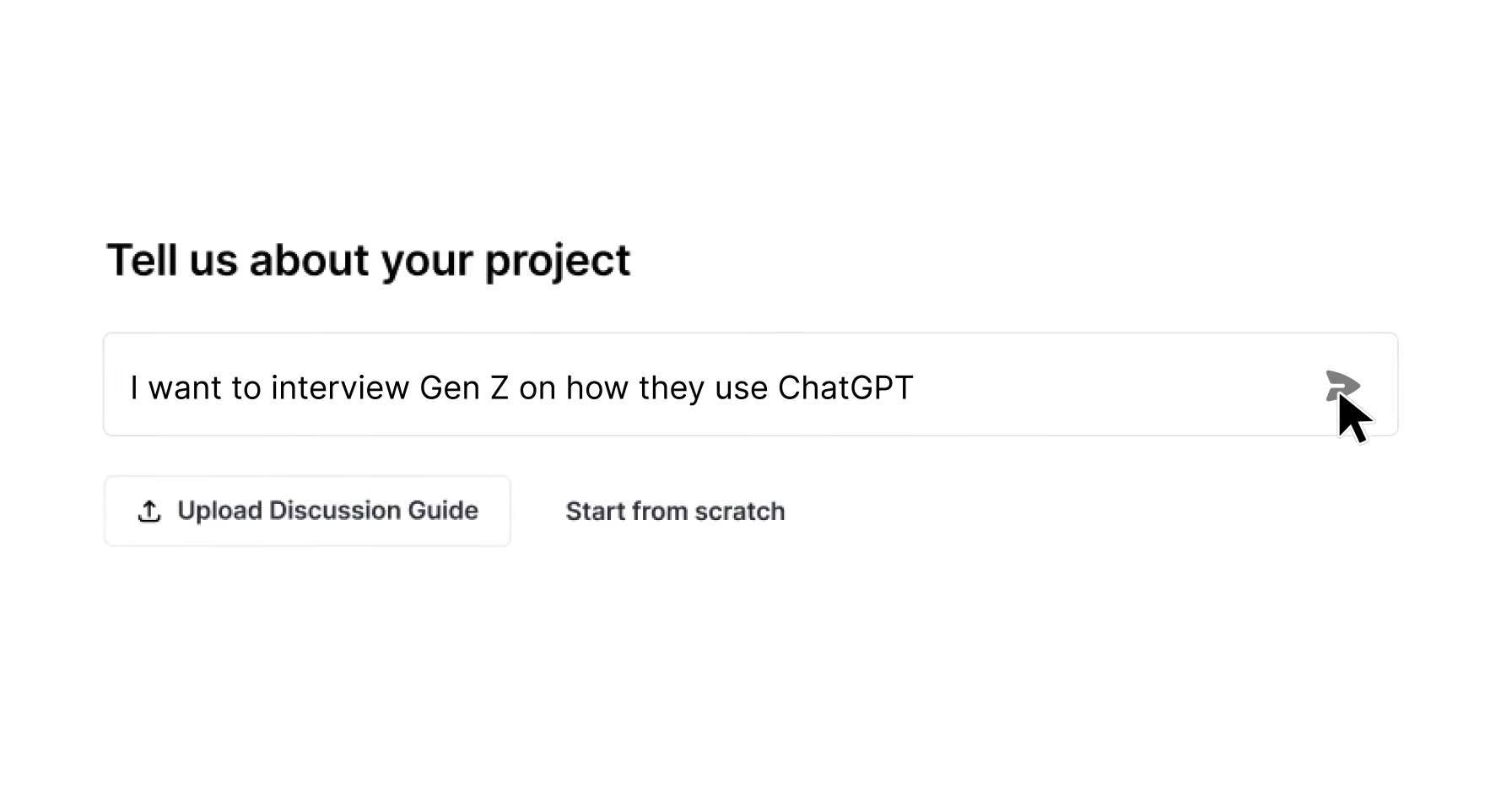
See how Listen Pulse pairs every KPI with qualitative context in a live demo.
How Listen Pulse Runs a Conversational Brand Tracker
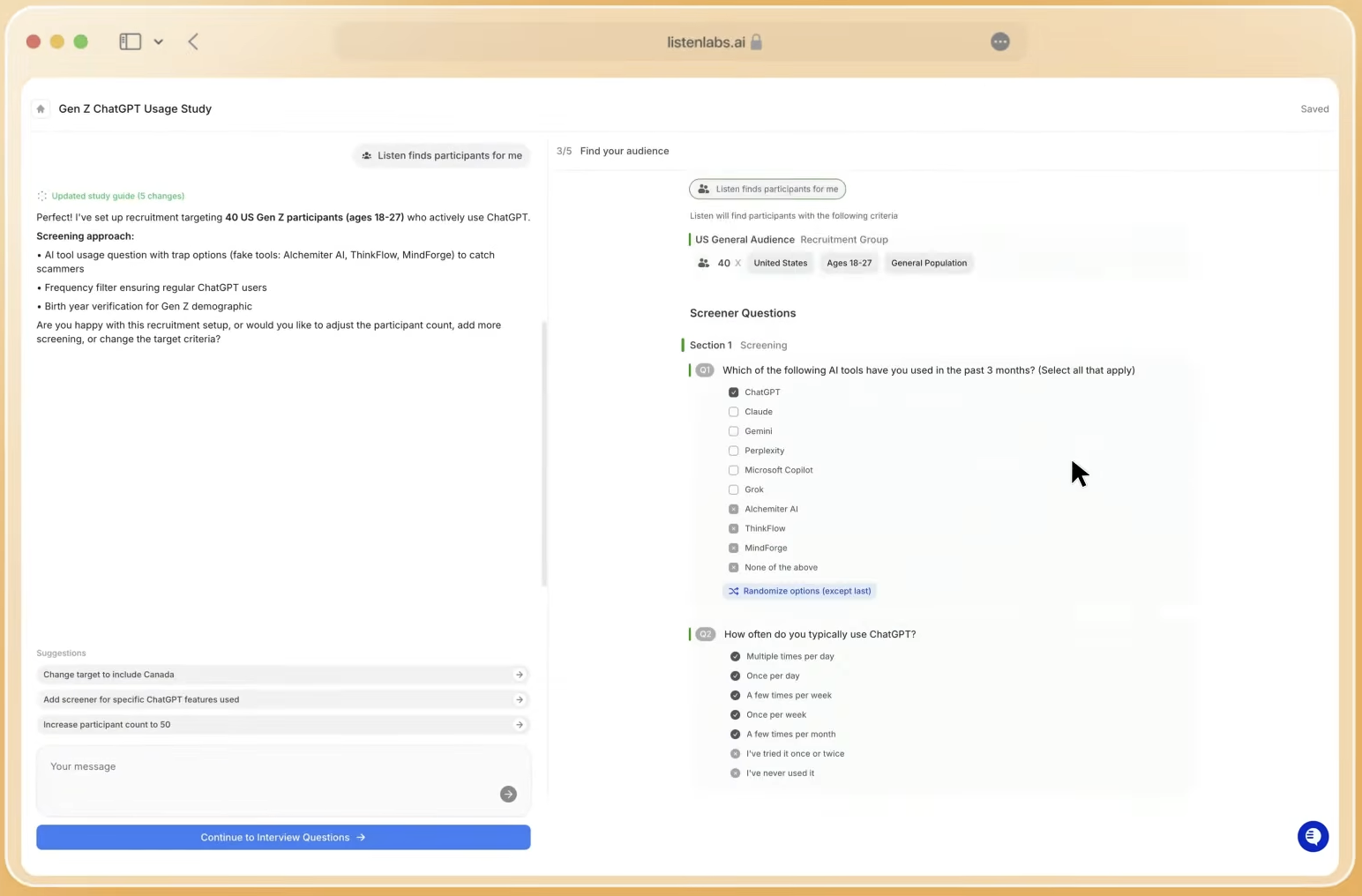
- Study design. AI-assisted co-design drafts structured objectives, tracking questions, and probing context in seconds. Core quantitative questions are locked for trend integrity, and open-ended conversational questions are configured alongside them. This locked design becomes the template for all subsequent waves.
- Participant sourcing. Once the study design is finalized, Listen Labs recruits from a global network of 50M+ verified respondents across 45+ countries and 120+ languages. Quality Guard monitors every interview in real time for fraud, low-effort responses, and repeat respondents, with participants limited to three studies per month to protect data quality.
- AI-moderated video interviews. With the right audience in place, the AI Interviewer conducts personalized conversations with dynamic follow-up questions. It probes deeper on short or interesting answers in the same way a trained human interviewer would. Responses run about three times longer than average because of this intelligent probing.
- Automated theme extraction. After interviews complete, the Research Agent processes all interview data, identifies patterns and themes across responses, quantifies each theme, and surfaces emotion signals derived from tone of voice, word choice, and micro-expressions. This stage turns raw conversations into structured insight.
- Dashboard delivery with drill-down. Finally, every KPI appears next to its associated themes, verbatim quotes, and video clips. Teams can drill from a metric movement to the exact respondent moment that explains it, closing the loop from number to narrative.
Together, these five stages compress what traditionally required two separate research programs, a quantitative tracker and a follow-on qualitative study, into a single continuous instrument.
Why the Number Moved: KPIs with Verbatim Context
Traditional surveys may tell us what people do, but it takes a conversation to understand why. Listen Pulse builds that conversation into the tracking instrument itself. When consideration drops four points, the dashboard does more than flag the decline. It surfaces the themes driving it, ranked by frequency, with verbatim quotes and clips attached to each theme.
One well-known clothing brand, famous for its big logos, was quietly losing customers. Its legacy tracker caught the drop but could not explain it. Pulse revealed that price was not the issue. Style was. A growing group of customers felt the big logos were too loud for their changing lifestyles. That finding arrived in the same wave as the metric, not six weeks later.
In practice, pairing every KPI shift with verbatim context removes the lag between detecting a problem and understanding it well enough to act.
Emotion Signals Reveal Hidden Friction and Delight
What people say and what people feel represent different kinds of data. Listen Labs’ Emotional Intelligence analyzes three layers of signal at once: tone of voice, word choice, and subconscious micro-expressions. Built on Ekman’s universal emotions framework, the same standard used in clinical psychology and UX research, it tracks seven universal emotions: anger, contempt, disgust, enjoyment or happiness, fear, sadness, and surprise.
Every emotion is quantified per question and concept, and every label is traceable to the exact timestamp, verbatim quote, and reasoning behind it. Two brand concepts can receive identical stated ratings while triggering entirely different emotional profiles. Without multimodal signal analysis, that difference stays invisible. Emotional Intelligence works across 50+ languages and connects directly with the Research Agent for natural-language queries, charts, and highlight reels of emotionally significant moments.
The operational impact is clear. Emotion signals turn brand tracking from a metric-reporting exercise into a diagnostic instrument that captures both what respondents say and how they actually feel.
Continuous Analysis Flags Shifts Before KPIs Move
Competitive vulnerability index uses longitudinal share-of-mind data to flag meaningful competitive threats when a competitor’s ownership of a key association increases while the focal brand’s ownership declines, providing a leading indicator four quarters before surface metrics such as awareness or consideration reflect the shift. Listen Pulse applies the same principle by analyzing tens of thousands of responses continuously and surfacing emerging themes in customer conversations before they appear as a decline in tracked metrics.
Association language shifts are detected through longitudinal comparison of verbatim clusters from depth interviews, identifying when the underlying meaning consumers attach to a stable attribute evolves across waves even if quantitative scores remain unchanged. Pulse captures this through its open-ended conversational layer, which lets respondents raise what actually matters instead of constraining them to pre-set answer options.
The strategic implication is straightforward. Continuous theme monitoring gives brand teams a leading indicator, not just a lagging one, and creates time to act before a cultural or competitive shift shows up as a KPI decline.
Traceability: Every Metric Tied to a Real Respondent Moment
Every number in Listen Pulse connects to the interview, verbatim quote, and audio or video clip behind it. When teams drill into any metric, the platform surfaces the original respondent explanation, including their words, the clip, and the timestamp. The platform presents the source, not only a summary.
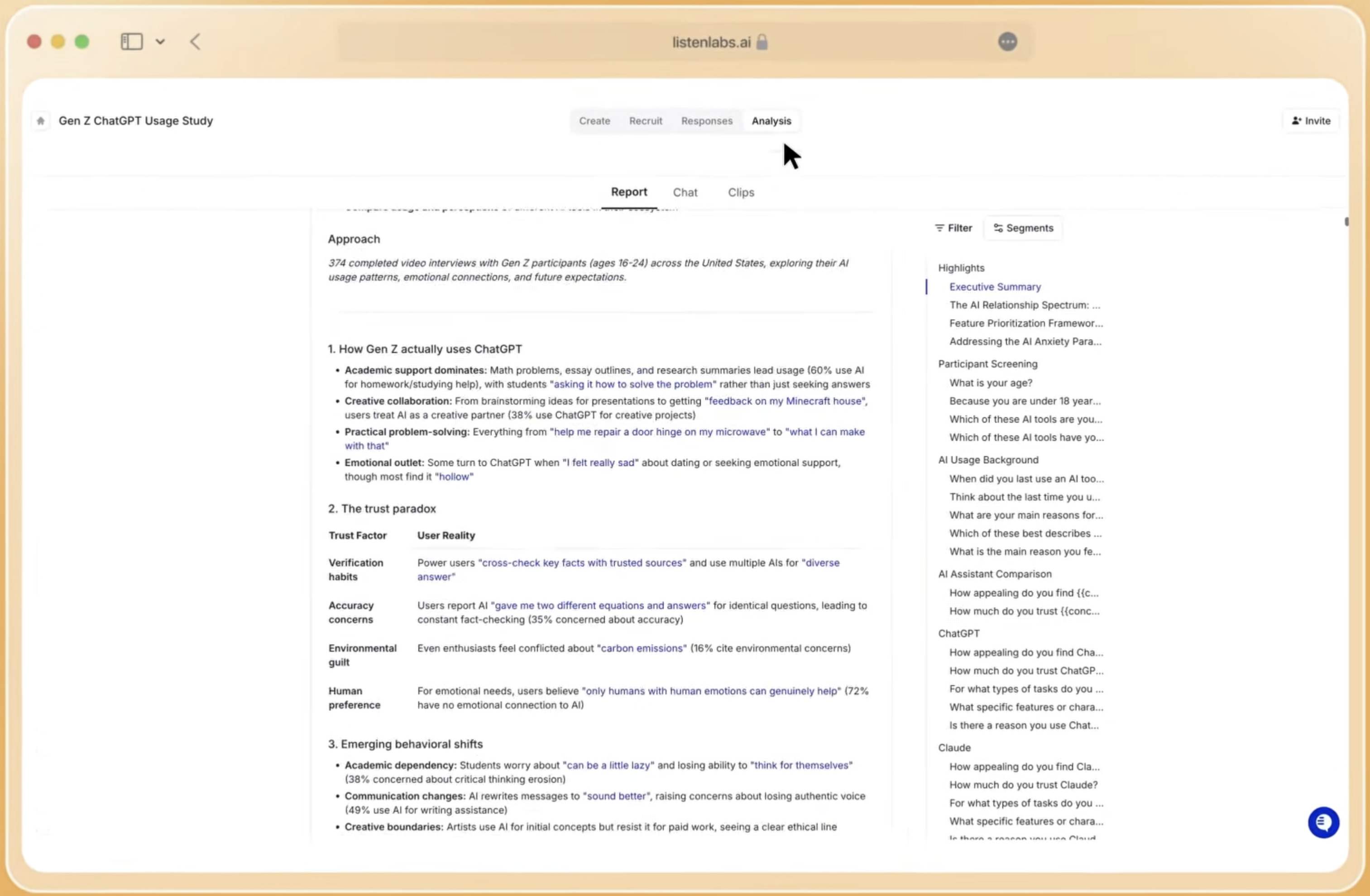
AI-native brand trackers output the same quantitative KPIs as legacy surveys plus the top themes shifting wave-over-wave, verbatim quote evidence for every metric movement, and segment-level breakdowns of why metrics like NPS changed. Full traceability also satisfies governance requirements. When a brand team presents a finding to leadership, the supporting evidence sits one click away instead of hiding in a separate qualitative report.
What this enables is a shift from basic reporting to an evidence base that supports confident, defensible decisions.
Legacy Survey Trackers vs Conversational AI Trackers
Data collection method. Legacy trackers field closed-ended surveys to representative samples on a quarterly or monthly cadence. Their closed-ended methodology only captures what consumers select from predefined options. Conversational AI trackers combine those same structured questions with adaptive open-ended interviews in the same wave, so the quantitative and qualitative data share a sample and a timestamp.
Diagnostic depth. Many traditional trackers capture limited depth on the reasons behind brand equity shifts, which restricts their ability to provide causal explanations for perception changes. Conversational trackers surface themes, emotion signals, and verbatim quotes alongside every KPI, so the diagnostic layer lives inside the same instrument.
Speed to insight. Traditional brand trackers can take weeks or months after fieldwork to produce reports. A modern conversational tracker delivers KPIs plus top themes, verbatim quotes, and segment-level diagnostics in near real time. Listen Labs compresses the full research cycle to less than 24 hours.
Traceability. Legacy trackers report aggregate scores with no path back to individual respondents. Every metric in Listen Pulse links to the interview, quote, and clip that produced it, which lets teams verify findings and build institutional knowledge across waves.
Industry Validation: Moving Toward Continuous Intelligence
Modern CPG brand tracking platforms replace slow quarterly reports with an always-on continuous data collection approach and customizable research waves aligned to campaigns. This shift reflects a broader organizational demand for faster insight cycles that keep pace with rapid product development and competitive pressure.
AI interview platforms now form an emerging category in brand health tracking that addresses the core limitation of survey-based trackers, which is the ability to show that a metric shifted but not why it shifted. Enterprises including Nestlé, Mondelez, and Mars have already moved toward always-on research infrastructure that delivers continuous consumer intelligence rather than periodic snapshots.
The strategic implication is that continuous intelligence programs now represent the direction of the category, and the gap between early adopters and laggards continues to widen.
Risks and Evaluation Criteria for Conversational Trackers
Three risk areas require explicit evaluation when selecting a conversational brand tracker, and together they define the minimum bar for enterprise use.
Data privacy certifications. Any platform handling consumer video interviews and emotion signal data must hold enterprise-grade certifications. Listen Labs maintains SOC 2 Type II, ISO 27001, ISO 27701, and ISO 42001 certifications, is GDPR compliant, uses 256-bit encryption, and never trains its AI models on customer data. These safeguards protect the data itself.
Participant frequency limits. Panel conditioning, where respondents change their answers simply from repeated participation in the same longitudinal survey, is a built-in confound in every brand tracker. Listen Labs limits participants to three studies per month to eliminate professional survey-takers and reduce conditioning effects. This policy protects data quality in addition to privacy.
Governance of AI-generated themes. Every theme surfaced by the Research Agent must be traceable to source interviews and verbatim quotes. Platforms that generate themes without source attribution create a governance risk because findings cannot be verified, challenged, or extended.
In practice, certifications, frequency limits, and theme traceability function as non-negotiable evaluation criteria rather than nice-to-have differentiators.
Questions to Ask When Comparing Next-Generation Platforms
- Does the platform keep core questions constant across waves to protect trend integrity while allowing timely add-on questions?
- Does every KPI movement link directly to verbatim quotes, clips, and timestamps, or only to aggregate summaries?
- Does the platform analyze emotion signals such as tone, word choice, and micro-expressions alongside stated responses?
- Can the tracker deploy alongside an existing Qualtrics or Decipher program, or does it require replacing current infrastructure?
- What data privacy certifications does the platform hold, and does it train AI models on customer data?
- How does the platform prevent panel conditioning and professional survey-takers from distorting longitudinal data?
- Can emerging themes be detected before they register as KPI movements, or does the platform only report on metrics that have already shifted?
The operational test is simple. A platform that cannot answer all seven questions with specificity is not yet ready for enterprise brand tracking at the diagnostic level the category now expects.
Conclusion: Closing the Diagnostic Gap in Brand Tracking
The “why” is what differentiates customer research that is acceptable from customer research that is outstanding. Traditional brand tracking software was built to answer what moved. Listen Pulse is built to answer what moved and why in the same wave, using the locked-core-questions approach described earlier, adaptive open-ended interviews for diagnostic depth, emotion signals for the layer transcripts miss, and full traceability from every metric to the real respondent moment behind it.
The result is a brand tracking program that does more than report on the past. It surfaces what is forming now, explains why numbers are moving, and gives teams the evidence they need to act before a shift becomes a crisis.
Schedule a demo to see Listen Pulse in action and learn how leading enterprises are closing the diagnostic gap between their KPIs and the consumer conversations driving them.
Frequently Asked Questions
What is the difference between a traditional brand tracker and a conversational brand tracker?
A traditional brand tracker fields closed-ended surveys to a representative sample at regular intervals, producing quantitative metrics such as awareness, consideration, NPS, and purchase intent. It is designed to detect whether a metric moved, not to explain why. A conversational brand tracker keeps those same quantitative questions constant across waves to preserve trend integrity while adding AI-moderated open-ended interviews to every wave. Metrics and qualitative explanations arrive together in a single delivery. Listen Pulse follows this model and charts emerging themes next to the KPIs teams already report, with every number traceable to a verbatim quote, clip, and timestamp from a real respondent.
How does Listen Pulse preserve trend integrity while adding open-ended questions?
Trend integrity in brand tracking depends on fielding the same instrument, to a comparable population, on a consistent cadence. Listen Pulse preserves this by locking core quantitative questions across every wave, so awareness scales, NPS, consideration, and other tracked KPIs remain unchanged. Timely add-on questions covering new campaigns, competitors, or news events are layered on top without altering the core instrument, so historical comparability stays intact. The open-ended conversational layer runs alongside the quantitative questions in the same wave rather than replacing them, which keeps the trend line clean while the diagnostic layer grows richer with each wave.
What emotion signals does Listen Labs analyze, and how are they used in brand tracking?
Listen Labs’ Emotional Intelligence analyzes tone of voice, word choice, and subconscious micro-expressions at the same time. As described in the Emotion Signals section, Listen Labs uses Ekman’s framework to track seven universal emotions. Every emotion is quantified per question and concept, and every label is traceable to the exact timestamp, verbatim quote, and reasoning behind it. In brand tracking, this means two brand concepts that receive identical stated ratings can be compared on their emotional profiles, revealing, for example, that one triggers genuine delight while the other produces confusion or flat affect. Emotional Intelligence works across 50+ languages and integrates with the Research Agent for natural-language queries and highlight reels of emotionally significant moments.
Can Listen Pulse integrate with our existing brand tracking infrastructure?
Yes. Listen Pulse integrates directly with Qualtrics and Decipher, so teams keep the KPIs they already report and the dashboards their stakeholders recognize while adding the conversational and diagnostic layer on top. Pulse can also deploy as the primary tracking system for teams that are replacing a legacy tracker entirely. In either configuration, the core quantitative questions remain constant across waves, and the open-ended conversational interviews run alongside them in the same wave, so the metric and the reason behind it arrive together rather than through separate programs.
How does Listen Labs ensure participant quality in a continuous tracking program?
Listen Labs applies three layers of quality control. First, it works exclusively with high-quality, non-commodity panel sources, which avoids professional survey-takers. Second, Quality Guard uses real-time AI monitoring across video, voice, content, and device signals to detect fraud, low-effort responses, AI-generated scripts, and mismatched profiles during every interview. Third, participants are limited to three studies per month, which reduces panel fatigue and the conditioning effects that distort longitudinal data in traditional trackers. A dedicated recruitment operations team adds a human review layer for hard-to-reach segments, and Listen Labs’ reputation scoring system compounds across every interview, so audience quality strengthens as more studies run on the platform.