
Written by: Anish Rao, Head of Growth, Listen Labs
Key Takeaways for Enterprise CMOs
- Enterprise AI brand monitoring now requires tracking how LLMs represent brands across generative engines, separate from traditional SEO.
- Visibility tools alone miss the customer sentiment and emotional context behind AI-generated brand mentions.
- Listen Labs combines cross-model visibility tracking with qual-at-scale interviews to explain why customers respond to AI descriptions.
- Integration with analytics platforms and Research Library turns AI signals into actionable insights within 24 hours instead of weeks.
- Book a demo with Listen Labs to connect AI visibility data directly to customer understanding and revenue impact.
Cross-Model Visibility Tracking Across LLMs
A brand that ranks on Google may be invisible inside AI-generated answers. Brandlight research shows the overlap between top Google links and AI-cited sources dropped from 70% to below 20% by 2026, so traditional SEO rank tracking and AI citation tracking now function as separate disciplines.
Enterprise-grade visibility platforms often provide coverage across major LLM engines such as ChatGPT, Perplexity, AI Overviews, Gemini, Copilot, Claude, and Grok. These platforms, including tools such as Profound and Sight AI, excel at tracking citation share and sending real-time alerts when your brand appears or disappears from AI-generated answers. They stop at the data layer and report what changed, not why customers respond the way they do when they encounter those AI-generated descriptions.
Listen Labs closes that gap. When cross-model sampling surfaces a visibility shift, the platform’s 50M+ verified respondent network can field 100+ AI-moderated interviews within hours. These interviews surface the customer sentiment and emotional context behind the data. Research Library then synthesizes findings across every prior study, so teams avoid starting from zero each time a new visibility signal appears.
Hallucination Detection and Customer Impact
Hallucinations cost businesses $67.4 billion worldwide as early as 2024. A Gartner-related statement by Andrew Frank notes that ChatGPT and Google’s AI Overviews produce false brand information in roughly 2% of cases. Even a 2% error rate creates significant exposure when those answers reach millions of users.
The downstream effect compounds the damage. A negative AI-generated response can generate a spike in online traffic that causes automated bidding systems to bid on related ad space, creating a cycle where a brand funds its own reputational damage.
API-only monitoring tools detect the hallucination text. They cannot tell a brand team whether customers have already internalized the false claim, how strongly it registers emotionally, or which segments are most exposed. Adobe’s AI Inflection Point report emphasizes that real-time monitoring tools are significantly more effective when combined with human judgment for evaluating biased or tone-deaf AI-generated content. Most monitoring platforms still stop at the alert.
Listen Labs’ Emotional Intelligence layer analyzes tone of voice, word choice, and subconscious micro-expressions across interview responses, built on Ekman’s universal emotions framework. When a hallucination is detected, a follow-up interview study can be fielded within the same business day. The study quantifies exactly how the false claim has shaped customer perception and produces the verbatim evidence needed to brief legal, communications, and product teams at the same time.
Competitive Benchmarking with Listen Pulse
Realistic AI share-of-voice targets by category position range from 40–70% for category leaders down to 2–10% for new entrants. Per-model share of voice diverges significantly due to differences in training data cut-offs, retrieval behavior, citation policies, and source preferences across ChatGPT, Perplexity, and Gemini. Tools such as Semrush AIO surface these share-of-voice gaps at the citation level. They leave open the strategic question of why a competitor gains share of voice and what customers actually think when they encounter that competitor’s AI-generated description.
Listen Labs’ Listen Pulse conversational tracker runs the same study with the same screeners wave after wave. It charts emerging themes directly alongside the share-of-voice KPIs teams already report. For enterprises such as Microsoft and P&G, both active Listen Labs customers, a single instrument delivers the competitive metric and the diagnostic explanation in the same wave, without commissioning a separate qualitative study weeks later.
Workflow Integration with Analytics and Research Systems
Enterprise marketing teams need AI visibility data to flow into the analytics environments where decisions are made. Adobe Brand Visibility integrates with GA4 to measure how AI-driven discovery on platforms such as ChatGPT, Gemini, Copilot, Claude, and Perplexity translates into website engagement and business outcomes, and Adobe Brand Visibility natively integrates with Adobe Analytics and Customer Journey Analytics to connect AI search signals to revenue, conversions, and engagement metrics. These integrations address the attribution layer.
Siloed platforms stop at attribution. Listen Labs adds a second integration layer through Research Library, which makes every customer interview, screener, discussion guide, and finding queryable in natural language across the organization’s entire research history. When a GA4 dashboard flags an anomaly in AI-referred traffic, a brand team can query Research Library to determine whether a related customer sentiment shift was already documented in a prior study before commissioning new research.
Listen Pulse also integrates directly with Qualtrics and Decipher, so teams keep the KPI infrastructure they already report while adding the qualitative narrative behind each metric movement.
ROI Measurement from AI Visibility and Research Speed
Missing AI citations on category queries can result in substantial revenue loss for B2B SaaS companies. AI-referred visitors often convert at higher rates than other channels, making citation gaps a direct revenue exposure, not a vanity metric.
The challenge is closing those gaps before the revenue loss compounds. Listen Labs compresses the research cycle that connects visibility data to business action from weeks to under 24 hours. Since launch, the platform has conducted over 1 million AI-moderated customer interviews and grown annualized revenue 15× to eight figures in nine months. That trajectory reflects enterprise demand for a platform that delivers both the visibility signal and the customer understanding needed to act on it.
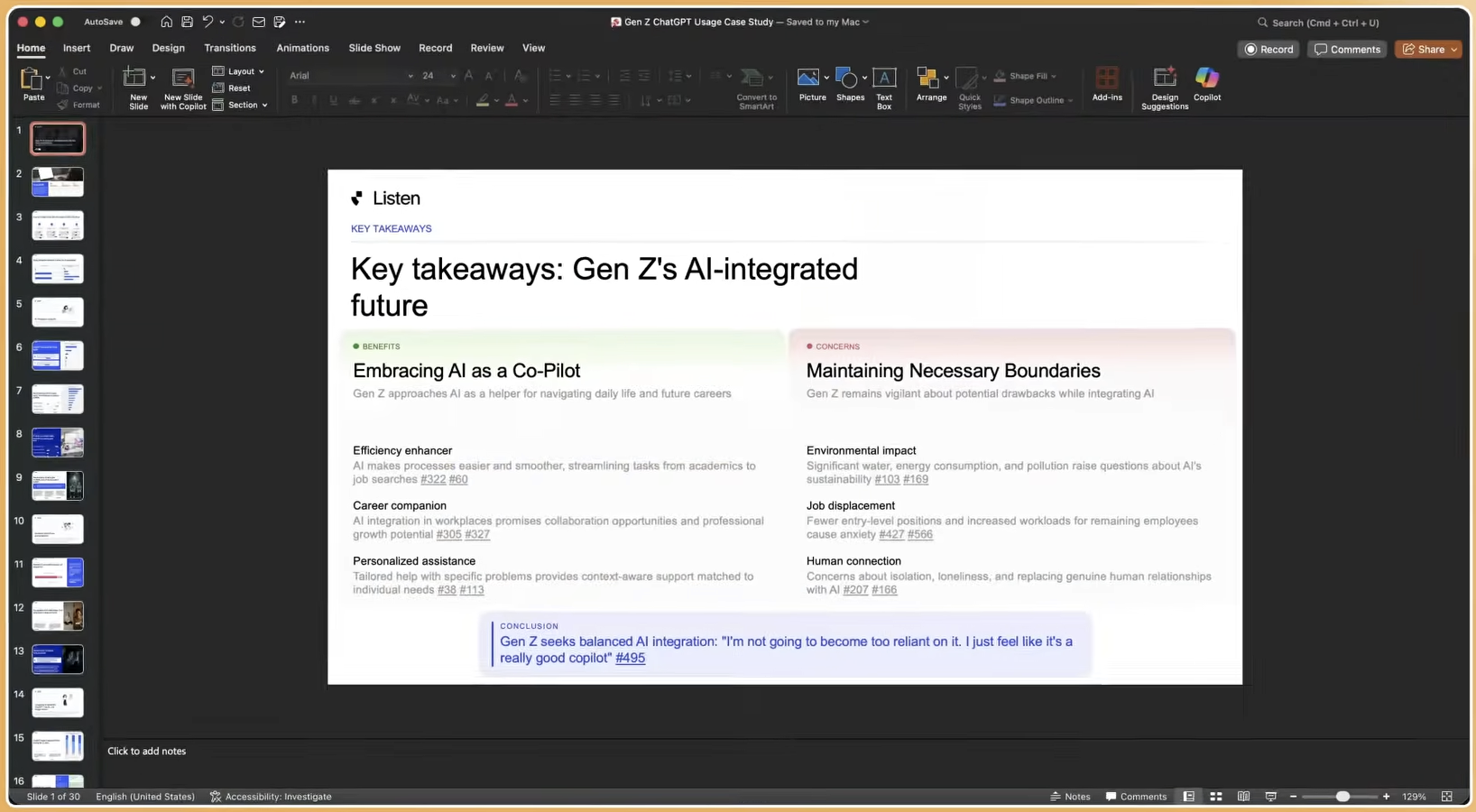
Sweetgreen replaced months-long research cycles with days, scaling research across 300+ US locations at one-third the cost. Microsoft collected global customer stories for its 50th anniversary within a single day.
From Visibility to Insight: Turning AI Mentions into Customer Understanding
Visibility-only tools report what LLMs say about a brand. Listen Labs reports why customers feel that way and what to do about it. The platform turns a raw AI visibility signal into actionable customer insight through a clear operational sequence that typically completes within 24 hours.

- Cross-model sampling identifies a citation share shift or hallucination event across tracked LLM engines.
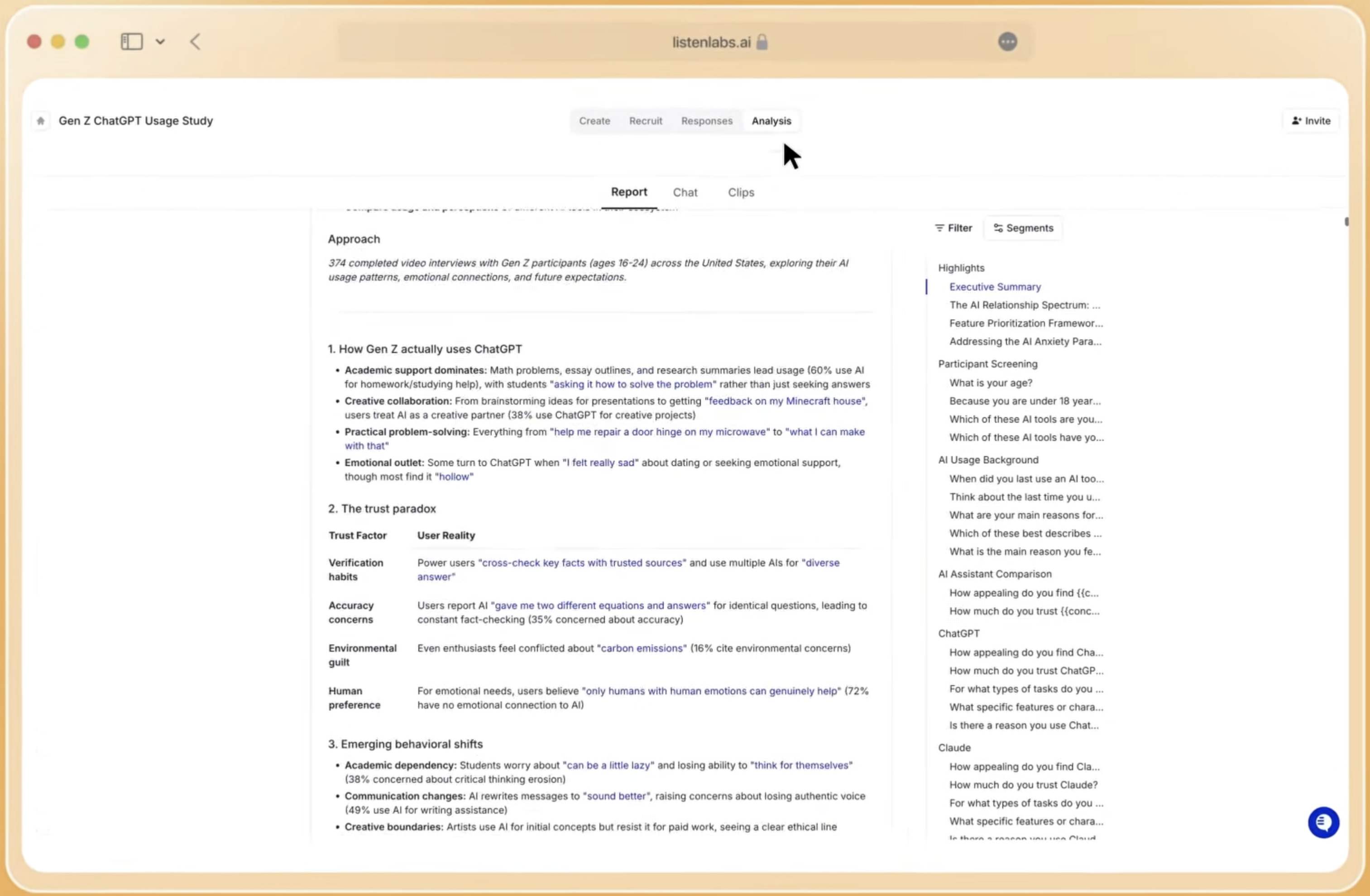
- A targeted interview study is designed using AI-assisted study co-design and fielded to the relevant segment within the 50M+ respondent network, often returning first results in under 24 hours.
- Emotional Intelligence analysis quantifies how customers feel about the AI-generated description at the timestamp level, separating stated sentiment from subconscious emotional response.
- Research Agent generates a consultant-quality slide deck, memo, and video highlight reel from the interview data in under a minute.
- Research Library indexes the study alongside all prior research, so the next visibility shift can be cross-referenced against existing institutional knowledge before new fieldwork is commissioned.
P&G used this cycle to surface where product claims felt exaggerated or unclear before they reached the market. The team received 250+ interviews with quantified themes and verbatim proof in hours. The same infrastructure that powers that qual-at-scale capability is what Listen Labs applies to AI brand monitoring, creating a single platform that converts raw AI mentions into the depth of customer understanding that insights leaders already expect from their research programs.
Implementation Roadmap for a 30-Day Pilot
A 30-day pilot with Listen Labs follows a structured sequence designed to produce impact on the next-quarter brief cycle. Each phase builds on the previous one, moving from setup to live research to synthesis, so teams finish with findings ready to guide the next-quarter strategy.
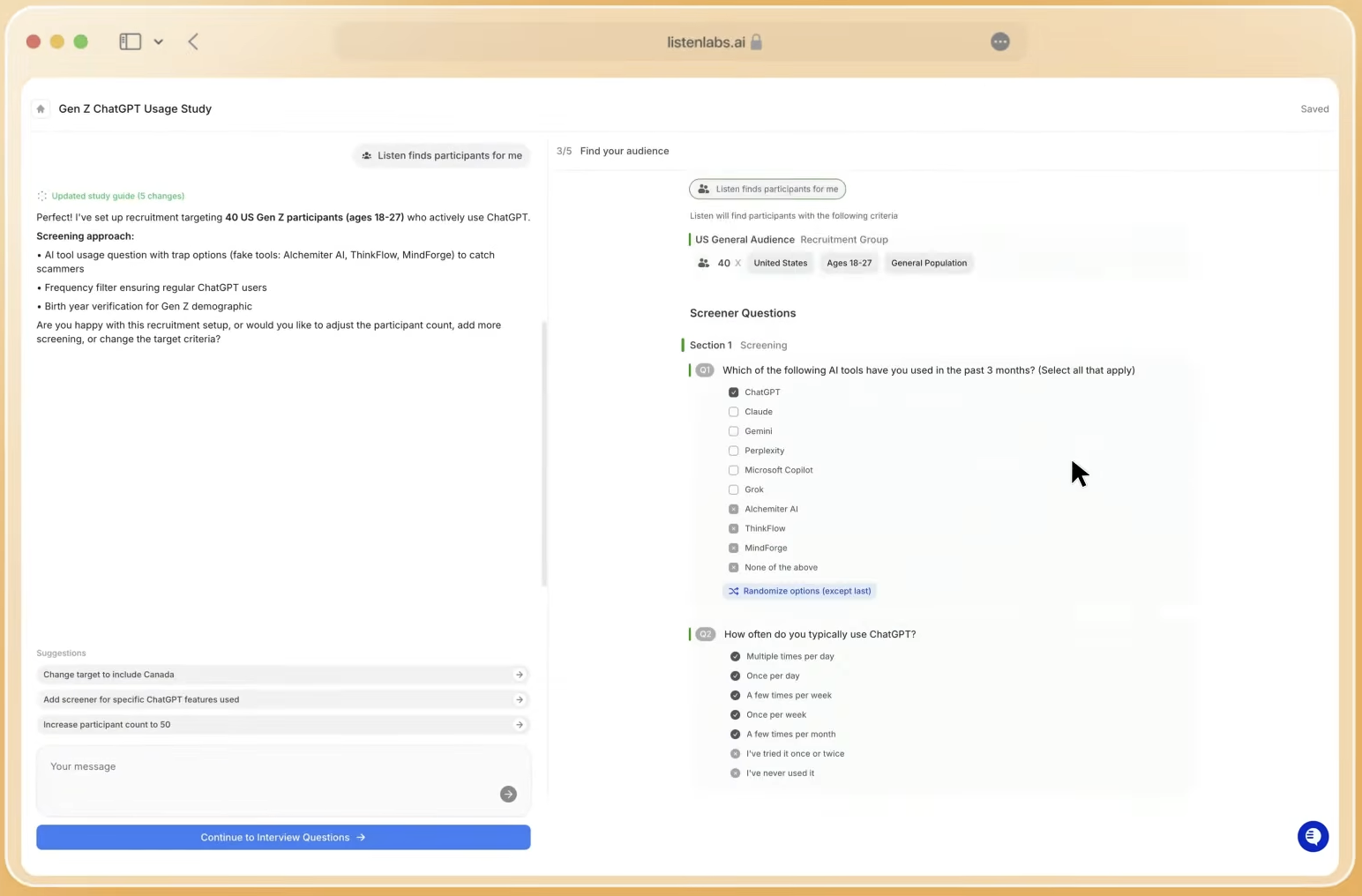
- Days 1–7: Connect existing brand trackers and define the cross-model prompt set covering buyer-intent queries across tracked LLM engines.
- Days 8–14: Run a 100-interview diagnostic study targeting the segments most exposed to AI-generated brand descriptions, with Emotional Intelligence analysis enabled.
- Days 15–21: Integrate findings into Research Library and establish the baseline share-of-voice and sentiment benchmarks against named competitors.
- Days 22–30: Deliver a Research Agent generated synthesis report with prioritized recommendations, ready for the next-quarter insights brief.
Enterprises covering 45+ countries and 120+ languages can run this pilot in a single market or simultaneously across regions. Automatic translation and transcription are included across all supported languages.
Start your 30-day pilot and deliver findings ready for your next-quarter brief.
Frequently Asked Questions
How does Listen Labs pricing compare to visibility-only tools?
Listen Labs uses a subscription model that covers the entire research lifecycle: study design, participant recruitment from its 50M+ verified respondent network, AI-moderated interviews, Emotional Intelligence analysis, Research Agent deliverables, and Research Library access. Visibility-only tools charge separately for citation tracking and carry no research execution capability, so enterprises typically pay for a monitoring platform plus a separate research vendor plus an analysis tool. Listen Labs replaces all three at approximately one-third the cost of the traditional multi-vendor research approach. Credit cost per participant varies based on audience difficulty, with general population studies requiring fewer credits than niche or hard-to-reach segments. Enterprises with more than 100 employees go through a demo and pilot process to scope the right configuration.
What data-privacy certifications does Listen Labs hold?
Listen Labs maintains SOC 2 Type II, ISO 27001, ISO 27701, and ISO 42001 certifications and is GDPR compliant. All data is protected with 256-bit encryption. Enterprise SSO is supported. Listen Labs never trains its AI models on customer data, a hard policy that applies across every study, every respondent, and every market. These certifications cover the platform’s global operations across 45+ countries.
How does Listen Labs integrate with GA4 and Adobe Analytics?
Listen Labs’ Research Library and Listen Pulse tracker are designed to sit alongside existing analytics infrastructure rather than replace it. For teams already using Qualtrics or Decipher for tracking, Listen Pulse sits alongside those platforms, so teams keep existing KPI dashboards and add the customer interview layer that explains the trends. For teams using GA4 or Adobe Analytics to track AI-referred traffic, Listen Labs provides the customer interview layer that explains the behavioral patterns those analytics platforms surface, connecting the what of traffic and conversion data to the why of customer sentiment and emotional response. The Research Library makes every prior study queryable in natural language, so insights teams can cross-reference analytics anomalies against existing research before commissioning new fieldwork.
Can Listen Labs replace separate AI monitoring and research vendors?
Yes. Listen Labs is the only end-to-end platform that covers cross-model AI visibility tracking, hallucination detection follow-up, competitive benchmarking via Listen Pulse, qual-at-scale customer interviews, Emotional Intelligence analysis, and Research Library synthesis in a single subscription. Enterprises currently running a dedicated AI visibility tool alongside a separate qualitative research vendor and a separate analysis or repository tool can consolidate all three functions into Listen Labs. The platform has already demonstrated this consolidation at scale for enterprises including Microsoft, P&G, Sweetgreen, and Nestlé, delivering the same speed and cost improvements documented in the ROI Measurement section above.