
Written by: Anish Rao, Head of Growth, Listen Labs
Key Takeaways
- Visibility-only AI tools report citation frequency and share of voice but cannot explain why metrics shift, so teams see lagging indicators instead of clear diagnostics.
- Conversational trackers like Listen Pulse pair quantitative KPIs with open-ended AI-moderated interviews, so metric movement and consumer narrative arrive in the same wave.
- Emotional Intelligence analysis captures tone, micro-expressions, and verbatim quotes, surfacing emerging themes before they appear in traditional sentiment dashboards or visibility scores.
- Enterprise teams can integrate Listen Pulse with existing Qualtrics or Decipher trackers, preserving historical trend lines while adding qualitative depth without rebuilding reporting infrastructure.
- Listen Labs combines 24-hour turnaround, 50M+ verified respondents across 45+ countries, and enterprise-grade security certifications, so teams can turn brand-awareness monitoring into real-time insight. See Listen Pulse in a live walkthrough.
Eight Criteria That Define Strong AI Brand-Awareness Platforms
Teams make better platform choices when they use a clear evaluation framework instead of a feature checklist. These eight criteria fall into three tiers that reflect how enterprise and mid-market procurement teams prioritize decisions.
The first tier focuses on diagnostic power. Can the platform explain why metrics move, not just report that they did? The second tier covers operational feasibility, including speed, sample quality, and cost. The third tier addresses enterprise readiness, such as security, compliance, and global reach. Each criterion below maps to one of these tiers.
- Speed to insight. Forty-five percent of marketing leaders cannot accurately measure their brand visibility within AI-generated answers, and traditional research cycles that take 4–6 weeks compound that gap. Platforms should compress fielding and analysis to hours, not weeks.
- Ability to explain metric movement. Visibility dashboards surface lagging indicators. The more diagnostic question is whether the platform can attach a causal narrative, including verbatim quotes, emerging themes, and emotional signals, to every KPI shift in the same wave.
- Sample quality and fraud protection. Commodity panels carry professional survey-takers and incentive-driven responses. Evaluate whether the platform uses behavioral matching, real-time fraud detection, and participant frequency limits.
- Global and multilingual reach. DataReportal puts active generative AI users above 2 billion in 2026, so cross-market tracking is now a baseline requirement for enterprise teams.
- Emotional and behavioral signal capture. Sentiment scores derived from text polarity miss sarcasm, cultural nuance, and the gap between what participants say and what they feel. Platforms that analyze tone of voice, micro-expressions, and on-screen behavior help close that gap.
- Traceability to verbatim quotes or clips. Aggregate outputs with no visible evidence chain leave stakeholders unable to interrogate findings or defend brand strategy recommendations to senior leaders.
- Total cost of ownership. Consider panel fees, moderator costs, separate analysis tools, and the headcount required to synthesize findings across vendors, not just license price.
- Enterprise security and compliance. Security and compliance sit near the top of evaluation criteria for enterprise IT and marketing leaders, ahead of API integrations and multi-brand management. SOC 2 Type II, ISO 27001, GDPR compliance, and SSO are non-negotiable for many Fortune 500 procurement teams.
Request a live evaluation to see how Listen Pulse maps to these criteria in your tracking environment.
How Visibility-Only AI Tools Track Brand Awareness
Visibility-only platforms such as Profound, Otterly AI, Brand24, and Semrush’s AI Visibility Index track how often brands appear in AI-generated answers. They submit prompt libraries to large language models like ChatGPT, Gemini, Claude, and Perplexity, then report which brands appear, how often, and in what context. Semrush’s 2026 AI Visibility Index analyzed 126 million U.S. AI search prompts from January through April 2026 and found sharp visibility concentration by industry.
The top three brands accounted for 82.9% of visibility in News and Media and 76.9% in Consumer Electronics, compared to 41.4% in Finance. These platforms excel at study setup speed because they query models instead of recruiting human participants. Moderation happens at the prompt level, and dashboards update on a scheduled cadence.
Data quality controls focus on prompt consistency and session isolation to avoid personalization effects. Testing by Unusual found that swapping single words in a prompt for synonyms moved a brand’s measured share of voice by up to 17 percentage points on the same model in the same week, which means mention rates often reflect the prompt set rather than stable signals of consumer perception.
Despite that variability, visibility platforms still address a real workflow need. The analysis layer centers on dashboards that show citation frequency, share of voice, sentiment scores derived from the surrounding text of AI-generated answers, and source attribution for cited publications. Research shows that 36% of generative AI users have already replaced traditional search engines with AI assistants, so these dashboards matter for understanding brand presence in the discovery layer.
The limitation is clear. These tools measure what AI models say about a brand, not what actual consumers think, feel, or intend to do.
Where Visibility Tools End and Conversational Trackers Begin
Visibility-only platforms and conversational trackers solve related but different problems. The sharpest contrasts appear in four areas that align with the earlier criteria: qualitative depth, quantitative KPI tracking, cross-wave knowledge management, and the gap between lagging indicators and real-time diagnostics.
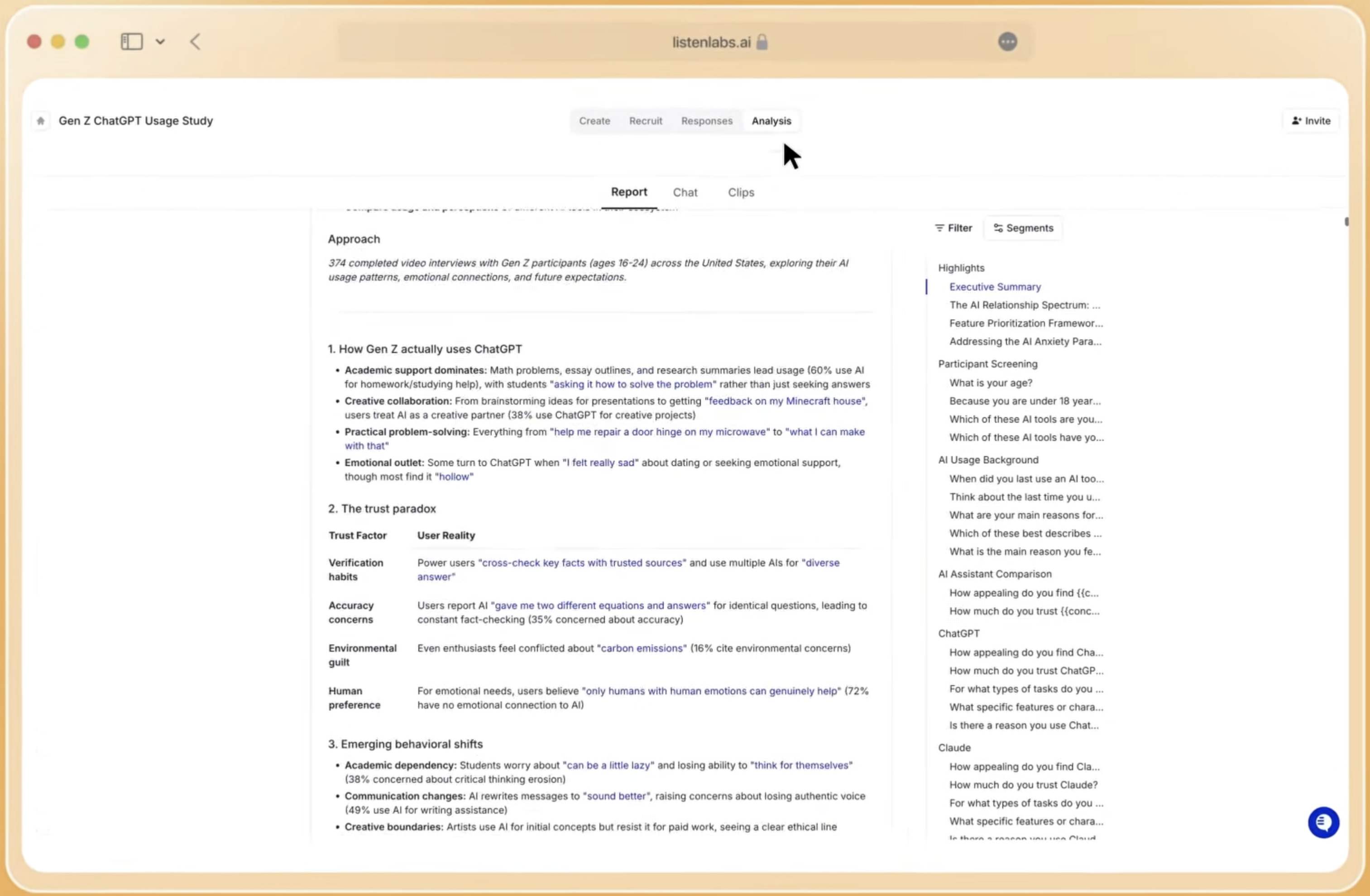
On qualitative depth, visibility tools report narrative themes extracted from AI-generated text. That view helps teams understand how models frame a brand, but it does not replace direct consumer testimony. Traditional surveys may tell us what people do, but it takes a conversation to understand why. Conversational trackers like Listen Pulse conduct open-ended AI-moderated interviews alongside every wave of structured KPI questions, so qualitative evidence and quantitative metrics arrive together instead of weeks apart.
On quantitative KPI tracking, visibility platforms report AI citation frequency and share of voice on a scheduled cadence. Listen Pulse keeps core questions constant wave over wave to protect trend-line integrity. Awareness scales, NPS, MaxDiff, and closed-ended questions run in the same instrument as open-ended conversation. The platform also integrates with Qualtrics and Decipher, so teams keep the KPIs they already report while adding the narrative behind them.
On cross-wave knowledge management, visibility dashboards store historical prompt results but do not connect metric shifts to consumer explanations across time. Listen Labs’ Research Library searches every study ever run simultaneously and returns synthesized answers with full source attribution, so insights compound instead of expiring with each project wave.
On the lagging-versus-real-time distinction, Erlin data from a 2026 study of 500+ brands shows negative sentiment takes 2–3 months to move from community discussions into AI-generated outputs. By the time a visibility dashboard registers a decline, the underlying consumer shift has been building for months. Listen Pulse surfaces emerging themes in customer conversations before they show up as a KPI decline, so teams gain a diagnostic tool instead of a post-mortem report.
When Surface Sentiment Falls Short: The Case for Emotional Intelligence
AI-powered sentiment analysis identifies underlying intent by recognizing sarcasm, cultural nuance, and linguistic subtleties that traditional tone-based methods miss, which improves on simple keyword-polarity scoring. Even so, contextual sentiment analysis applied to AI-generated text or social posts still measures what a model or poster said, not what a consumer felt during a direct interaction with a brand.
The why is what differentiates customer research that is alright from customer research that is outstanding. Listen Labs’ Emotional Intelligence addresses this gap by analyzing three layers of signal at once: tone of voice, word choice, and subconscious micro-expressions, built on Ekman’s universal emotions framework. Every emotion is quantified per question and concept, and every label is traceable to the exact timestamp, verbatim quote, and the reasoning behind it.
This structure means a brand team can see that confusion spiked during a concept test, then pinpoint the exact moment that triggered it and what the participant said immediately after. One clothing brand known for its large logos discovered through Listen Pulse that a growing segment of customers felt the logo aesthetic was too loud for their changing lifestyles. That finding never surfaced in its traditional tracker because the tracker reported a consideration decline without attaching any consumer explanation.
The emotional signal appeared several waves before the KPI movement, giving the team time to adjust creative and product direction. Schedule a platform demo to see how Emotional Intelligence and Listen Pulse surface signals that sentiment dashboards miss.
Operational Fit for Enterprise and Mid-Market Insights Teams
Operational fit often determines whether a promising platform actually gets adopted. Integration with existing infrastructure is a practical prerequisite for enterprise teams. Listen Pulse connects with Qualtrics and Decipher, so teams can add a conversational layer to their current tracking program without rebuilding the reporting stack.
Core KPIs remain comparable across historical waves while open-ended questions and timely add-ons covering new campaigns, competitors, or news events run in the same instrument. Trend lines stay intact while the context around them deepens. Change management then becomes the next concern.
Change management is a secondary but real consideration. Insights teams that have reported wave-over-wave quantitative metrics for years face internal pressure to maintain comparability because stakeholders rely on historical benchmarks. If a new platform breaks the trend line, leaders lose the ability to compare this quarter’s awareness score to last year’s baseline.
Listen Pulse is designed to deploy alongside an existing tracker or as the primary tracking system. Teams can run a parallel period to validate continuity before full migration, which addresses comparability concerns and builds confidence in the new approach.
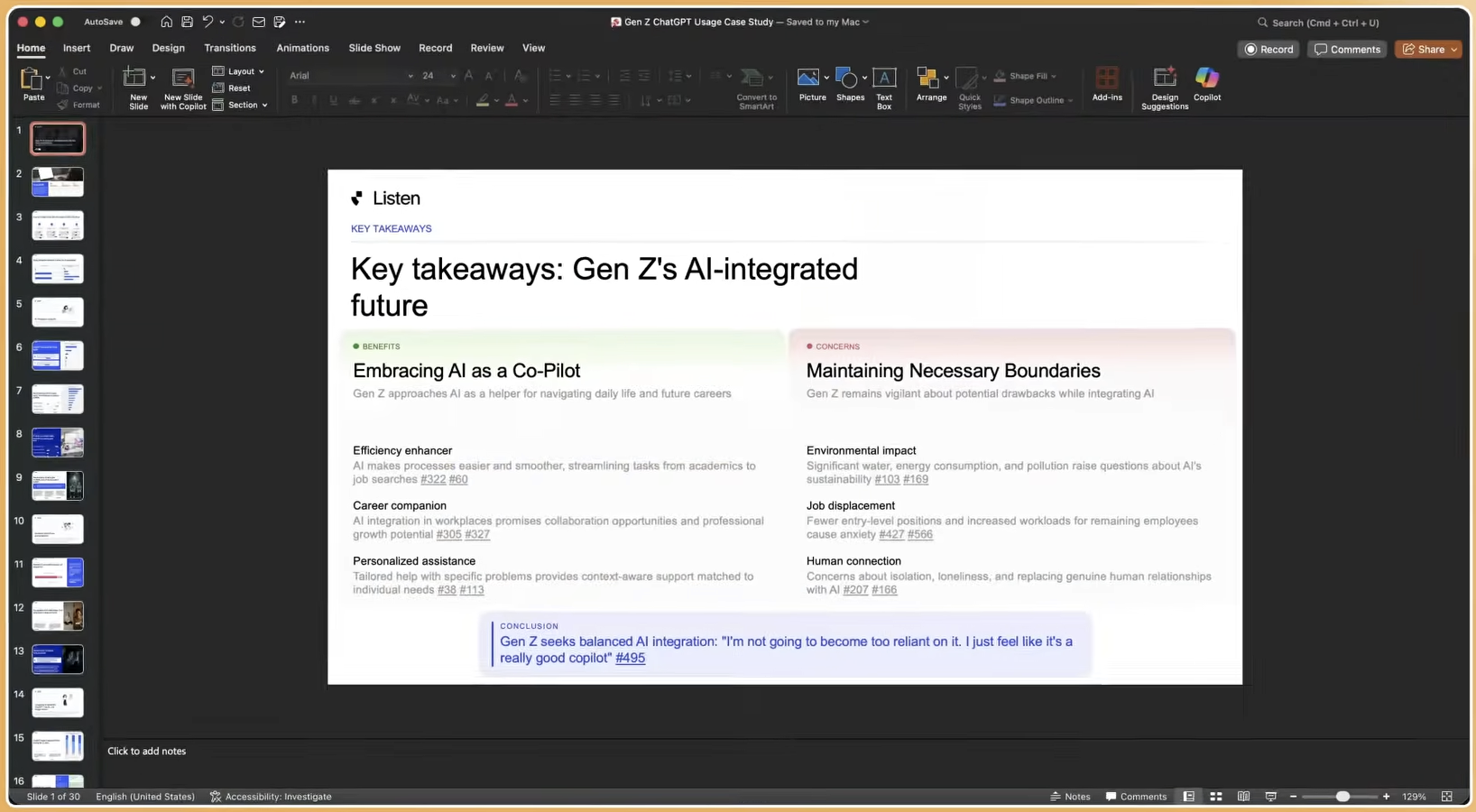
The compounding value of a conversational tracker increases over time. Research Agent handles the full analysis workflow from raw data to final output, and Research Library searches every study simultaneously. Each wave adds to an institutional knowledge base instead of producing a standalone report that gets filed and forgotten. For enterprise teams managing research backlogs across multiple brands and markets, this cross-wave synthesis creates a structural advantage over point-in-time visibility snapshots.
Risks and Limitations of Pure Monitoring Approaches
Behavioral signals captured through social listening and media monitoring tools provide timely visibility into observable actions or expressions, but lack the diagnostic depth to distinguish internal brand issues from external market effects like pricing changes, distribution shifts, competitor investment, or broader economic conditions. Pure monitoring identifies that something changed, not what caused it or what to do about it.
Social listening tools only capture public posts from a small, skewed slice of internet users, often the loudest 1%, while excluding the silent majority of category buyers who drive revenue and do not post about brands online. Unaided awareness, consideration, and preference cannot be measured by scraping public posts. They require direct questions to a representative sample.
The say-do gap compounds this problem. Participants in unmoderated research often report preferences that diverge from their observed behavior, and pure monitoring tools have no mechanism to catch the contradiction. Listen Labs’ Visual Insights closes this gap by having the AI interviewer observe on-screen behavior and probe contradictions in real time.
When a participant states one preference and immediately does the opposite, the moderator asks about it instead of logging the stated preference as ground truth. Hidden recruitment complexity then appears as a further risk for teams that try to add qualitative context by commissioning separate studies.
A separate qualitative wave takes weeks to field, arrives after the business has already reacted to the lagging indicator, and produces findings that cannot be directly compared to the quantitative wave because the samples and timing differ. Conversational tracking within a single platform avoids that split and keeps diagnostics aligned with the metrics they explain.
Decision Framework: Matching Team Profiles to the Right Approach
The right approach depends on what question the team needs to answer and how quickly they need to answer it. Team profile, budget, and primary channel shape that decision more than any single feature.
Enterprise insights teams at Fortune 500 companies in tech, CPG, retail, and food and beverage typically need both a defensible trend line and a real-time diagnostic. Listen Pulse serves as the primary tracking system or runs alongside an existing tracker, adding open-ended conversation to every wave and integrating with Qualtrics and Decipher. The Research Library compounds value across waves, and the 50M+ verified respondent network across 45+ countries supports global multi-market programs. Listen Labs has conducted over 1 million AI-powered customer interviews for companies including Microsoft, P&G, and Sweetgreen, and raised a $69 million Series B in January 2026 at a valuation above $500 million.
Brand managers at mid-to-large companies who need faster feedback loops without adding headcount benefit from Listen Pulse’s self-contained wave structure. Study design, recruitment, AI-moderated interviews, and automated analysis all live in a single platform. The Research Agent generates slide decks, memos, and highlight reels in under a minute, which removes the analyst bottleneck between fielding and stakeholder delivery.
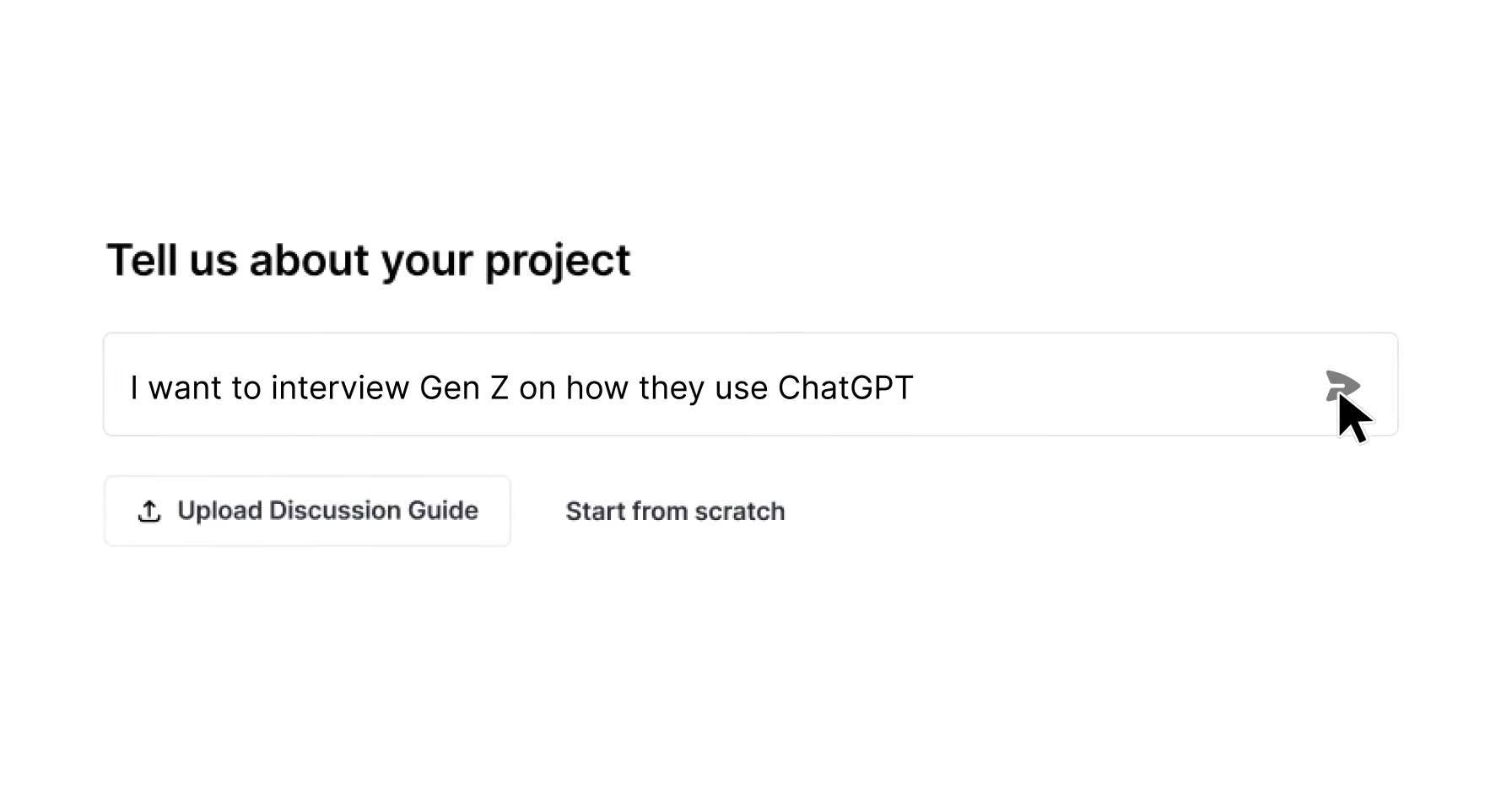
Agencies and consultancies running bespoke brand research for client engagements need speed, global reach, and access to niche audiences. Listen Labs’ dedicated recruitment operations team sources audiences below 1% incidence rate, including enterprise decision-makers, healthcare workers, and engineers, and delivers results in less than 24 hours instead of the 4–6 weeks a traditional research cycle requires. Platforms like Listen Labs layer on auto-recruiting, transcription, sentiment tagging, and insight summarization so teams jump from question to findings in hours, not weeks.
Teams whose primary need is AI-search visibility monitoring focus on tracking citation frequency, share of voice across ChatGPT and Gemini, and source attribution. Dedicated visibility platforms serve that specific signal well. The remaining gap is clear: just 8% of marketing leaders can track AI-driven discovery’s influence on revenue and conversions end-to-end, and visibility tools do not supply the consumer-side explanation for why visibility is moving. A conversational tracker fills that diagnostic gap.
Frequently Asked Questions
How quickly does a Listen Pulse conversational tracking wave turn around?
Listen Labs compresses the full research cycle, including study design, recruitment, AI-moderated interviews, analysis, and deliverables, to less than 24 hours. For ongoing Pulse waves, the core instrument is already configured, so fielding and analysis run faster than a first-time study. The Research Agent generates slide decks, memos, charts, and highlight reels in under a minute once interviews are complete.
How does Listen Labs control participant quality in global panels?
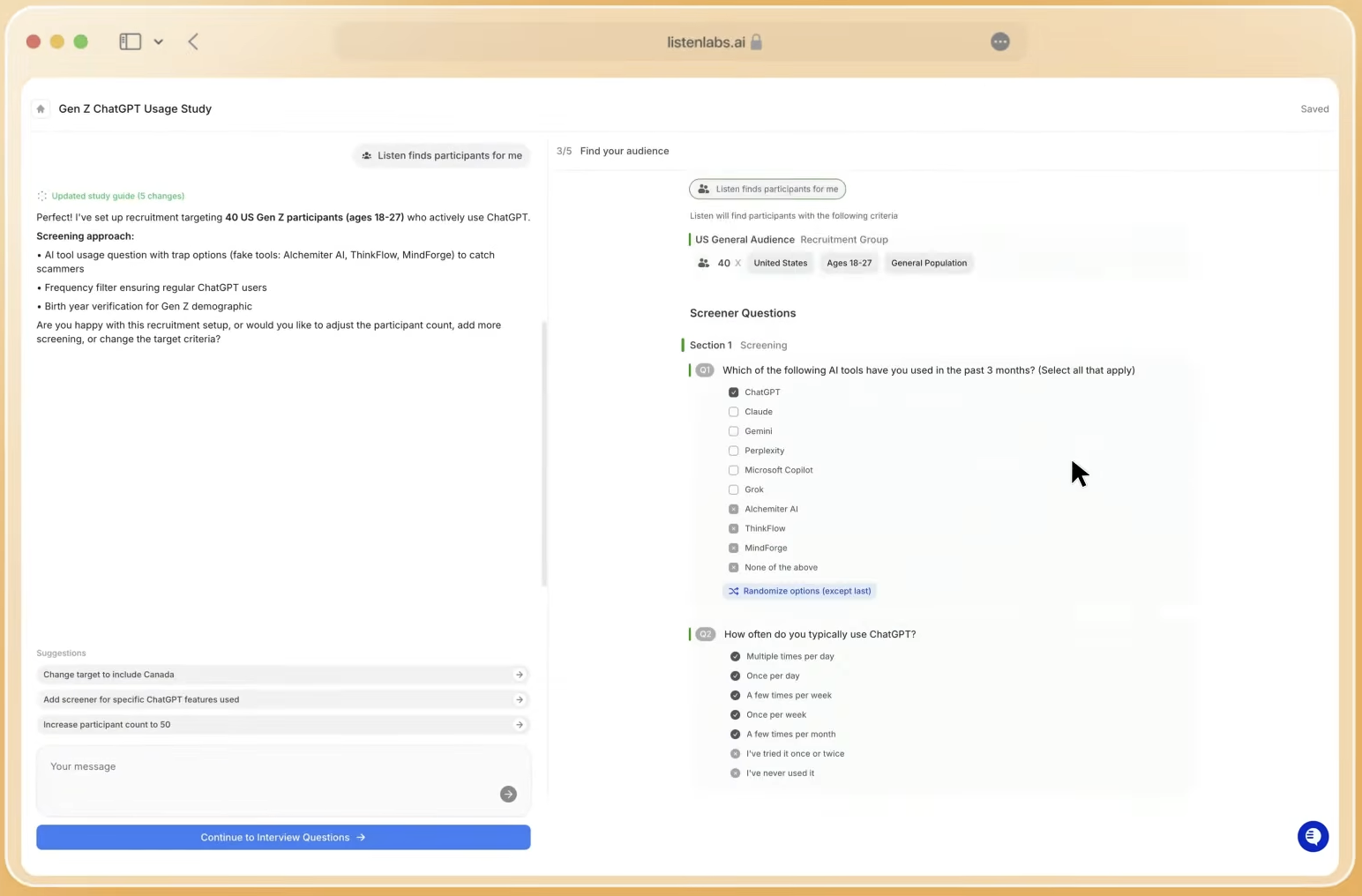
Quality Guard operates across three layers. First, Listen Labs works exclusively with high-quality, non-commodity panel sources, avoiding professional survey-takers. Second, Quality Guard uses real-time AI monitoring across video, voice, content, and device signals to detect fraud, low-effort responses, AI-generated scripts, and mismatched profiles. Third, participants are limited to three studies per month to reduce panel fatigue and incentive-driven behavior. A dedicated recruitment operations team adds a human review layer for hard-to-reach segments, including audiences below 1% incidence rate.
Does Listen Labs support multilingual tracking programs?
The platform supports 120+ languages for conducting interviews, with automatic translation and transcription across all supported languages. Emotional Intelligence analysis is available across 50+ languages. Listen Labs covers 45+ countries across the Americas, Europe, APAC, and MEA, so it fits global brand tracking programs that require consistent methodology across markets.
What security certifications does Listen Labs hold?
Listen Labs holds SOC 2 Type II, ISO 27001, ISO 27701, and ISO 42001 certifications and is GDPR compliant. The platform uses 256-bit encryption and enterprise SSO. Critically, Listen Labs never trains its AI models on customer data, which matters for enterprise procurement teams in regulated industries.
How complex is it to add a conversational layer to an existing brand tracker?
Listen Pulse integrates directly with Qualtrics and Decipher, so teams keep the KPIs they already report while adding open-ended conversation to each wave. Core questions stay constant to protect the historical trend line, and timely add-on questions cover new campaigns, competitors, or news events without breaking comparability. Pulse can deploy alongside an existing tracker during a parallel validation period before any full migration, which addresses the change management concern that arises when teams have years of wave-over-wave quantitative benchmarks to protect.
Conclusion: Turning Brand Metrics into Real-Time Explanations
AI tools for monitoring brand awareness in 2026 range from visibility dashboards that track citation frequency across LLMs to conversational trackers that pair those metrics with direct consumer testimony. Visibility-only platforms serve a real purpose. AI discovery in 2026 is shaped by owned content, third-party sources, community discussion, publishers, retailers, and reference platforms, and tracking that footprint matters.
These tools, however, share a structural ceiling because they report that a number moved without supplying the consumer-side explanation for why. Listen Pulse keeps core questions constant for trend integrity, adds open-ended AI-moderated interviews to every wave, surfaces emerging themes before they hit KPIs, and delivers every metric with traceable quotes, clips, and emotional context.
The platform integrates with existing tracking infrastructure, deploys in less than 24 hours, and draws on a verified global panel of 50M+ respondents across 45+ countries and 120+ languages, without adding headcount to the insights team. With AI-moderated interviews, talking to consumers at scale is no longer the hard part. The challenge is understanding what they mean, and that is what Listen Pulse is built to solve.
Book a demo to see how Listen Pulse delivers the real-time “why” behind every brand awareness metric your team already tracks.