
Written by: Anish Rao, Head of Growth, Listen Labs
Key Takeaways
- Brand health tracking measures how consumer perception shifts over time using metrics like awareness, sentiment, NPS, and share of voice before revenue changes appear.
- Most AI tools report what happened but do not explain why metrics moved, which limits their value for strategic decisions.
- AI search visibility in LLMs like ChatGPT and Perplexity now acts as a critical leading indicator, with many CMOs starting vendor research inside an LLM.
- Effective brand health programs combine social listening for monitoring, AI visibility tools for LLM presence, and full research platforms for qualitative explanations behind metric changes.
- Listen Labs closes the diagnostic gap with AI-moderated interviews that link every metric movement to real consumer conversations, so you can see Pulse in action in a live walkthrough.
The Challenge Facing Brand and Insights Leaders Today
Brand managers and consumer insights leaders face a familiar problem: too many tools, unclear priorities, and trackers that show a number moved without explaining why. This guide examines AI tools for brand health tracking across three categories: social listening platforms, AI search visibility tools, and full research platforms. Each category maps to a simple question: does this tool tell me what happened or why it happened?
The most useful AI tools for brand health tracking diagnose the reasons behind metric movements, not just surface the metrics. That diagnostic layer is where most tools fall short, and it is the gap this guide addresses.
Explore how Listen Labs works as a full research platform and see how it closes that diagnostic gap.
What Brand Health Tracking Measures and Why It Matters
Brand health tracking measures how consumer perception of a brand changes over time. Core metrics include brand awareness (unaided and aided), consideration, preference, share of voice, sentiment, net promoter score (NPS), purchase intent, trust, and loyalty. Together, these signals show whether a brand is gaining or losing ground in the minds of buyers before that movement appears in revenue.
That sequencing matters. Revenue is a lagging indicator. Brand is the leading one. A decline in consideration or trust typically precedes a revenue drop by weeks or months. Teams gain a window to act only when they measure the right signals continuously.
The shift from lagging KPIs such as revenue and market share to leading indicators like branded search volume, AI visibility, and sentiment velocity defines the current evolution in brand health measurement. Teams that track only quarterly survey waves are measuring a market that has already moved on. To keep pace, brand leaders need tools that monitor continuously and explain the shifts, which is why the AI tool landscape has split into three distinct categories.
The Best AI Tools for Brand Health Tracking: A Category Overview
AI tools for brand health tracking fall into three categories. Social listening platforms monitor public conversation in real time. AI search visibility tools track how brands appear in AI-generated answers. Full research platforms conduct AI-moderated interviews to surface the qualitative reasons behind metric movements. Each category answers a different question.

The best brand health tracker depends on the question a team needs to answer. Social listening tools like Brandwatch and Meltwater track public conversation volume and sentiment across millions of sources. AI visibility tools like Profound and Otterly.AI track how brands appear in AI-generated answers from ChatGPT, Perplexity, and Gemini. Full research platforms like Listen Labs diagnose the reasons behind metric movements through AI-moderated consumer interviews at scale.
Teams that need to understand why brand health metrics changed benefit from conversational trackers such as Listen Labs’ Pulse. Pulse combines quantitative KPIs with qualitative explanation in the same wave. For example, Alchemic’s Deeper Brand Tracks also adds an AI-moderated qualitative layer to every wave of a quant brand tracker. Every metric movement traces back to a real interview, a verbatim quote, and a video clip.
How to Track Brand Health with AI: A Step-by-Step Framework
- Define your brand health goals and KPIs. Identify which metrics matter most for your business stage, such as awareness, consideration, NPS, share of voice, or AI search visibility.
- Choose the right mix of tools. Combine a social listening platform for real-time monitoring, an AI visibility tool for LLM presence, and a research platform for diagnostic depth.
- Set up continuous monitoring. Quarterly waves miss early signals. Always-on tracking catches sentiment shifts and emerging themes before they reach your KPIs.
- Analyze the “why” behind metric changes using qualitative depth. Traditional surveys may tell us what people do, but it takes a conversation to understand why. AI-moderated interviews surface the equity drivers that numbers alone cannot reveal.
- Act on insights and track impact. Connect brand health movements to campaign decisions, product changes, and messaging pivots. Then measure whether the intervention worked in the next wave.
AI Search Visibility: The New Frontier in Brand Health
AI search visibility measures how a brand appears in AI-generated answers from ChatGPT, Perplexity, Google AI Overviews, and similar platforms. It now functions as a leading indicator of brand health, yet most brand teams still do not measure it.
22% of CMOs now begin vendor research inside an LLM, compared with 16% who start with traditional search engines, according to a July 2026 study of 100 CMOs conducted by Profound and Listen Labs. 51% of B2B software buyers begin their research with an AI chatbot more often than with Google, up from 29% in April 2025, according to G2’s March 2026 survey of 1,076 buyers.
A brand that remains invisible in AI-generated answers stays invisible to a growing segment of buyers before those buyers ever visit a website or speak to a sales team. Core AI visibility metrics include share of voice across LLMs, citation frequency, average citation position, sentiment in AI-generated descriptions, and prompt coverage across high-intent category queries.
Dedicated AI visibility tools in this category include:
- Profound, which offers Answer Engine Insights, Agent Analytics, and prompt monitoring across Perplexity, Gemini, and ChatGPT
- Peec AI, which provides citation tracking and sentiment analysis across multiple LLMs
- Otterly.AI, which tracks brand mentions across seven AI engines (ChatGPT, Perplexity, Google AI Overviews, Google AI Mode, Gemini, Copilot, and Claude) with share of voice reporting
- AIclicks, which reports visibility scores across ChatGPT, Perplexity, and Gemini
- Determ, which measures brand presence in LLM answers with competitor benchmarking
Free vs. Paid Tools: What You Get at Each Tier
Free options for brand health monitoring exist but carry significant limitations. Google Alerts covers news and web pages but not social platforms. Mention’s free tier is severely limited (1 alert, 250 mentions per month) and excludes historical data, advanced analytics, and AI capabilities, while Brand24 offers no free plan, only a 14-day trial based on its Pro plan, and its paid tiers gate advanced analytics and AI features.
Entry-level social listening tools start around $29–$149 per month, mid-market platforms run $199–$499 per month, and enterprise suites typically land at $800–$3,000+ per month on annual contracts. Paid tools at each tier add deeper historical data, AI-powered sentiment analysis, anomaly detection, and dedicated support.
The jump from mid-tier to enterprise is steep. Enterprise platforms are quote-only, involve sales-led onboarding, custom dashboards, and dedicated account support, with contracts typically reaching five figures annually. AI visibility tools follow a similar pricing ladder. Dedicated platforms start around $49 per month for single-brand tracking, rise to $499–$999 per month for enterprise multi-prompt panels, and can reach $2,000–$15,000+ per month for the largest suites, although some entry-level plans start as low as $20–$29 per month.
How to Choose the Right Tool for Your Company Size
Tool selection should be driven by three variables: budget, team research expertise, and primary need across monitoring, visibility, or diagnostic depth.
- Startups: Budget-friendly tools like Brand24 and Mention offer real-time mention tracking and sentiment analysis. Their entry-level pricing varies: Mention starts at $49 per month (Solo), while Brand24’s Individual plan starts at $79–$249 per month depending on billing. Basic sentiment analysis is included on Brand24’s entry tier, but only on Mention’s higher tiers (Pro and above).
- Mid-market: For mid-market budgets, pair a social listening tool like Sprout Social or Hootsuite Listening with a dedicated AI visibility tool like Otterly.AI. Talkwalker and Brandwatch are typically enterprise-grade, so they may be more than most mid-market teams need.
- Enterprise: Enterprise teams benefit from full research platforms like Listen Labs for diagnostic consumer insights, combined with AI visibility tools like Profound. This combination provides a comprehensive picture of what the numbers are, why they moved, and how the brand appears in AI-generated answers across major LLMs. Profound’s coverage of LLMs depends on the plan, with the Enterprise plan supporting all 10 major answer engines.
Turning Data into Insight: Diagnosing the “Why” Behind Your Metrics
Most AI tools for brand health tracking report what happened, while very few explain why. With AI-moderated interviews, talking to consumers at scale is no longer the hard part. The challenge is understanding what they mean.
One well-known clothing brand, famous for its big logos, was quietly losing customers. Its existing tracker caught the drop in brand preference but could not explain it. Listen Labs’ Pulse conversational tracker found the reason. A growing segment of customers felt the brand’s signature logos were too loud for their changing lifestyles. That insight, centered on style relevance rather than price sensitivity, required a conversation instead of a survey.
Listen Labs’ Emotional Intelligence adds another diagnostic layer by analyzing tone of voice, word choice, and subconscious micro expressions to surface emotions that transcripts alone miss. Teams use it for brand research, creative testing, concept comparison, and usability testing, capturing what people feel, not just what they say.
The Research Agent then automates the analysis workflow. It generates consultant-quality slide decks, memos, highlight reels, and statistical charts from interview data, with every insight linked directly to the underlying response, verbatim quote, and video clip.
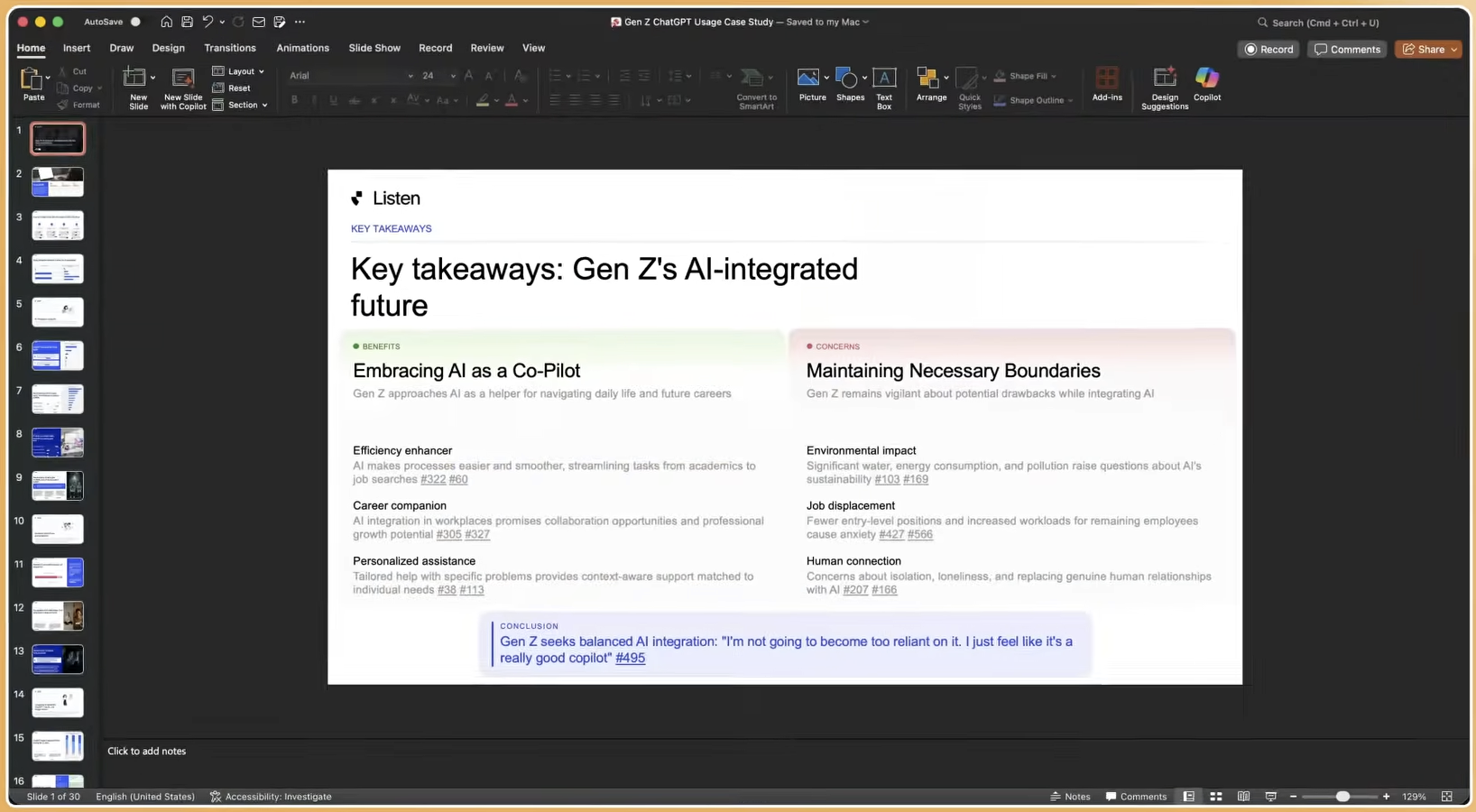
Teams that want to understand why their brand health metrics moved can schedule a Pulse session with Listen Labs and see the full workflow in action.
Frequently Asked Questions
What is the best brand health tracker?
The best tracker depends on what a team needs to know. As covered in the category overview above, the choice hinges on whether the priority is monitoring public conversation, tracking AI visibility, or gaining diagnostic depth. Social listening tools focus on conversation and sentiment, AI visibility tools focus on LLM presence, and full research platforms like Listen Labs explain the reasons behind metric changes.
Teams that care most about the reasons behind brand health changes often choose conversational trackers such as Listen Labs’ Pulse. Pulse combines quantitative KPIs with qualitative explanation in the same wave. For example, Alchemic’s Deeper Brand Tracks also adds an AI-moderated qualitative layer to every wave. Core questions stay constant to protect the trend line, while open-ended conversation in every wave surfaces the themes driving metric movement before they appear as a KPI decline.
How is AI search visibility different from traditional SEO?
Traditional SEO tracks a brand’s ranking position in Google search results pages. AI search visibility tracks how a brand appears in AI-generated answers from ChatGPT, Perplexity, Google AI Overviews, and similar platforms, including whether the brand is mentioned, how prominently, and whether the description is accurate and favorable.
The distinction matters because, as noted earlier, a significant share of CMOs and B2B buyers now start their research in an LLM rather than a search engine. A brand can rank on page one of Google and still be absent from AI-generated answers, which makes the brand invisible to buyers at the moment they form their shortlist.
Can social listening tools explain why brand health metrics change?
Social listening tools track mention volume, sentiment, and share of voice across public online sources, but they capture only the vocal minority who post publicly. The silent majority of buyers, who make purchase decisions without posting on social media, remain invisible to social listening. A social listening tool can report that 10,000 people posted about a rebrand, yet it cannot reveal whether the millions who did not post now think better or worse of the brand, or why.
Explaining why a metric changed requires qualitative depth. AI-moderated interviews surface the equity drivers, associations, and emotional signals behind the numbers. That diagnostic layer sits outside the design of social listening tools.
What is the difference between brand monitoring and brand tracking?
Brand monitoring detects live mentions across social media, news, forums, and review sites in real time. It answers the question of what people are saying about the brand right now. Brand tracking measures longitudinal changes in awareness, consideration, preference, trust, and loyalty over time through repeated studies with consistent methodology. It answers the question of whether the brand is getting stronger or weaker, and with the right tool, why.
Brand monitoring is continuous, real-time, and reactive, while brand tracking is periodic, survey-based, and longitudinal for strategic measurement. The most effective brand health programs use both and add a diagnostic research layer to explain the movements that tracking detects.
Conclusion: Turning Brand Metrics into Clear Direction
Most AI tools for brand health tracking report that a number moved, while the diagnostic question of why it moved remains unanswered for many teams. The shift from lagging indicators like revenue and market share to leading indicators like AI search visibility, sentiment velocity, and branded search volume demands a tool stack that covers monitoring, visibility, and diagnostic depth.
Listen Labs is an end-to-end platform that helps close this diagnostic gap. Pulse combines quantitative KPI tracking with open-ended AI-moderated conversation in every wave, so metric movements arrive with their explanation attached. Emotional Intelligence captures what consumers feel, not just what they say. The Research Agent delivers consultant-quality analysis in hours, not weeks. With a global panel of 50M+ verified respondents across 45+ countries, Listen Labs reaches the audiences that matter, including those who never post publicly.
Teams ready to move from raw metrics to clear meaning can request a tailored Listen Labs demo and see how Pulse, Emotional Intelligence, and Research Agent work together.