
Written by: Anish Rao, Head of Growth, Listen Labs
Key Takeaways
- Brand tracking automation spans four distinct layers: survey tracking, social listening, search demand, and AI analysis. Each layer solves a different problem and works alongside the others.
- Survey-based trackers detect KPI movement over time, while social listening and search tools capture the vocal or behavioral slice of the market.
- AI analysis accelerates pattern recognition when it works from traceable, human-verified data that supports real strategic decisions.
- Effective automation keeps core questions constant, adds flexible diagnostic modules, and connects to existing systems so the trend line stays intact while teams still get the “why.”
- Listen Labs combines quantitative brand tracking with conversational AI in a single wave so teams see both the metric and the explanation together. See how conversational tracking works.
Four Layers Of Brand Tracking Automation
Brand tracking research automation tools fall into four layers, and each layer solves a different problem:
- Brand-health survey tracking measures what is changing in consumer perception across the purchase funnel, wave over wave.
- Social and media listening monitors public conversation across earned media, social, and online sources in real time.
- Search demand tracks branded and category search volume as a behavioral proxy for interest and intent.
- AI analysis and reporting synthesizes data from any of the above layers into themes, deliverables, and alerts.
Most teams either blend these layers together or treat one as a replacement for another. Each layer has a distinct job. Social listening captures public conversation but misses the silent majority who never post. Survey tracking measures perception change but cannot explain why a metric moved. AI reporting layers depend entirely on the quality of the data they synthesize. The operating model that follows maps each layer to the job it actually does and states clearly where each one stops. We start with the layer that anchors every defensible tracking program: the survey tracker.
Layer 1: Brand-Health Survey Tracking — The Trend Line
This layer measures what is changing in consumer perception over time. It forms the foundation of any defensible brand tracking program because it surveys a defined, representative sample at consistent intervals. The result is a set of numbers that generalize to buyers, including the silent majority who never post online.
The leading tools in this layer have clear “best-for” roles:
- YouGov BrandIndex suits teams that need daily, always-on survey-based brand health across 16 core funnel metrics such as awareness, consideration, buzz, and recommendation, backed by a panel of over 30 million registered members.
- Qualtrics brand tracking fits structured survey programs inside existing enterprise infrastructure, where automation around fielding, reporting, and analysis workflows matters most.
- Attest works well for fast, self-serve survey waves and recurring tracker deployment across 59 global markets.
- Tracksuit focuses on affordable always-on brand-health dashboards, with pricing that starts well below traditional agency trackers.
- Quantilope specializes in automating primary survey research workflows and advanced methods such as conjoint and MaxDiff, with access to more than 300 million consumers.
The honest boundary of this entire layer is simple: a brand tracker detects movement; it does not explain it. Closed-ended questionnaires are limited to the answers the researcher anticipated. When awareness drops three points, the tracker reports the drop and stops there. It carries no built-in diagnostic for why. For alternatives to the largest legacy providers in this space, see our coverage of qual-at-scale approaches that extend beyond closed-ended survey design.
Layer 2: Social And Media Listening — The Public Conversation
This layer monitors what people say about a brand across public web sources such as social media, news, blogs, forums, and review sites in real time. It serves teams that need issue detection, share-of-voice monitoring, and earned media measurement.
- Brandwatch focuses on enterprise-scale social listening, contextual sentiment, and topic clustering across a very broad set of sources, and it earned Social Listening Solution of the Year at the 2026 MarTech Breakthrough Awards.
- Meltwater emphasizes media intelligence, coverage, and alerting across earned, social, and AI-generated content, ingesting more than a billion documents daily across many languages.
The honest boundary is representativeness. A listening tool can report that 10,000 people posted about your rebrand, yet still miss what the 100 million people who did not post now think of you. Social listening measures the talkative slice of the internet and provides a real-time signal. It does not replace a representative survey tracker and instead belongs alongside it.
Layer 3: Search Demand — The Intent Signal
This layer tracks branded and category search volume over time as a behavioral proxy for consumer interest. It answers whether people are looking, not what they believe or why they chose.
- Google Trends works well for free, directional views of category and brand interest over time, with no cost barrier to entry.
- Semrush and Ahrefs support branded search volume, share of search, and competitive demand tracking with historical depth and segmentation.
The honest boundary is timing and context. Search demand behaves as a lagging behavioral proxy. A spike in branded search can signal a successful campaign, a crisis, or a competitor’s stumble. The signal confirms that people are looking but does not reveal what they believe or whether they converted. Referral traffic only captures the last step of AI search interactions and misses every AI mention where the user absorbed the recommendation without clicking through. That blind spot grows as discovery shifts into AI-generated answers.
Layer 4: AI Analysis And Reporting — The Synthesis Layer
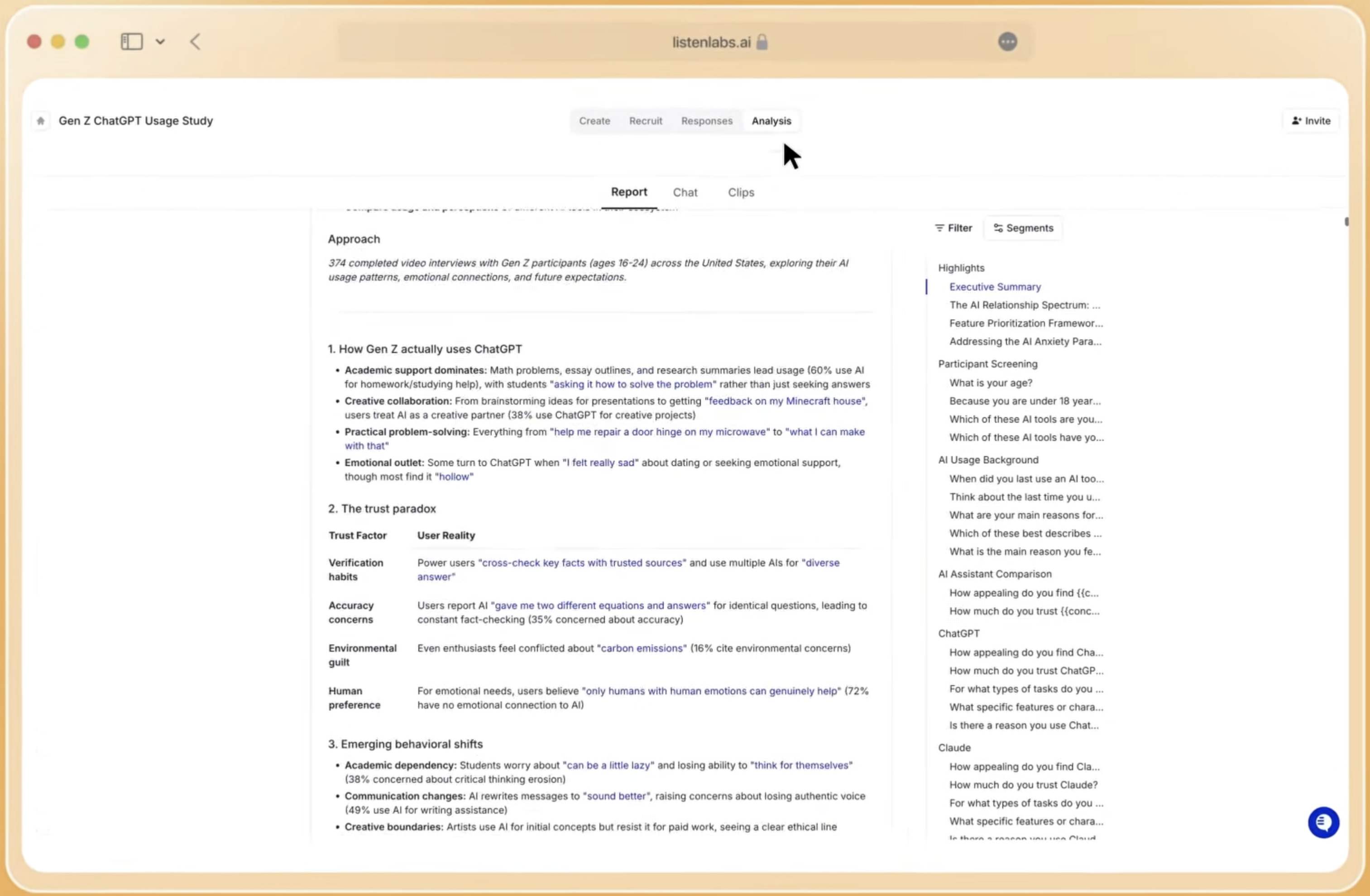
This layer applies AI to synthesize data from the layers above by summarizing open-ended responses, coding themes, drafting readouts, and generating deliverables. It compresses the distance between raw data and a stakeholder-ready answer.
Skepticism about whether AI analysis is trustworthy makes sense and deserves a direct response. AI accelerates pattern recognition but does not replace the judgment needed to decide whether a pattern is strategically significant, what is causing it, and what a brand should do differently. Traceability provides the core test for any AI analysis layer. Every insight should link back to the underlying response data. An AI summary that cannot be drilled into remains a claim, not an insight.
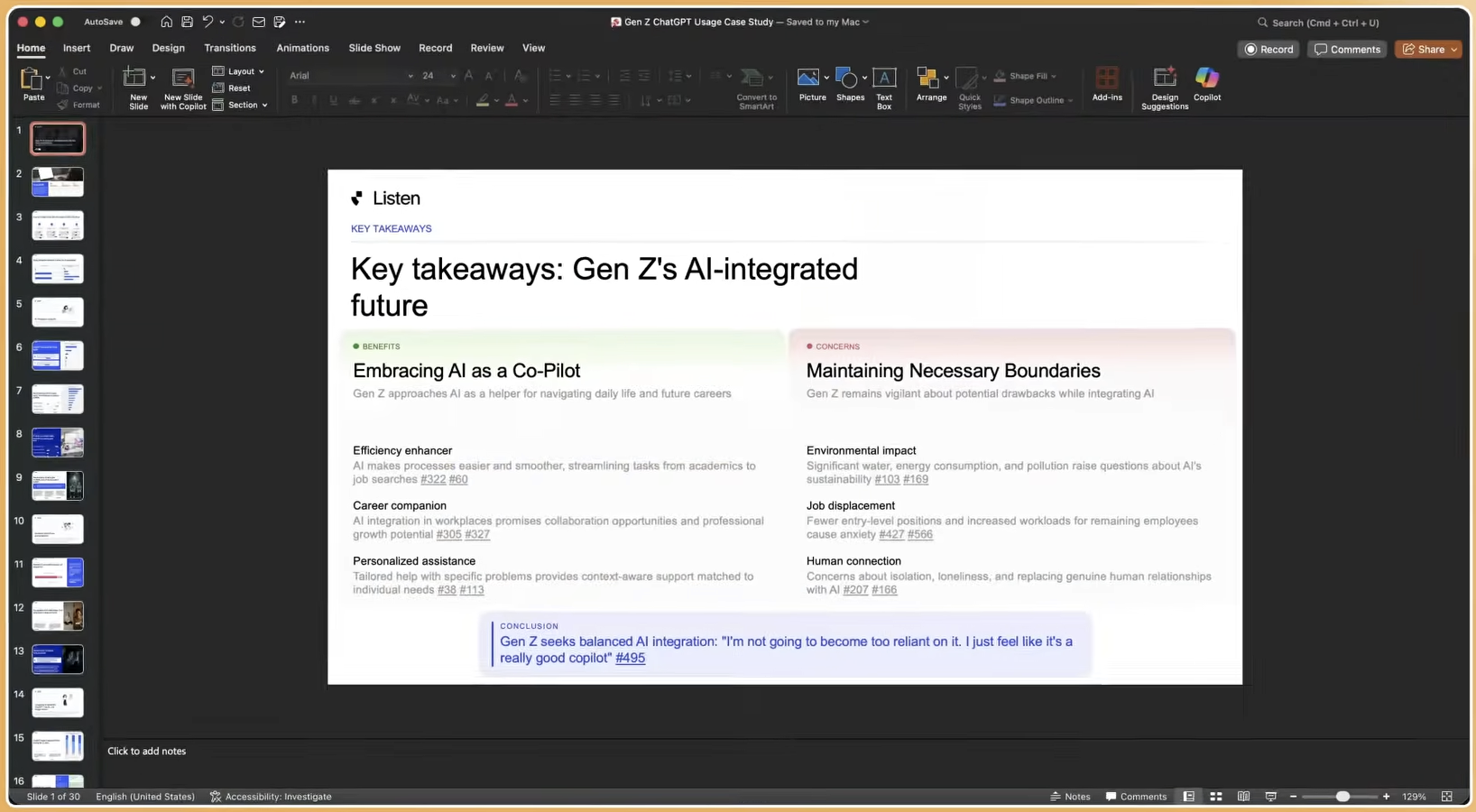
Listen Labs’ Research Agent handles the analysis workflow from interview data to final output, and Research Library answers link back to the original study, discussion guide, screener, and individual respondent. It generates slide decks, memos, highlight reels, and statistical charts. Every output is traceable to the interview, verbatim quote, and clip behind it.
With the four layers mapped, the next question becomes practical: which parts of this work can automation handle, and which still require a human?
What Brand Tracking Automation Can And Cannot Automate
The automatable tasks and the tasks that stay human form two different lists, and mixing them up often breaks automation plans.
Automation genuinely replaces:
- Participant recruitment and panel management
- Interview moderation at scale, including multilingual waves
- Open-end coding and theme identification across thousands of responses
- Wave-over-wave charting, significance testing, and dashboard refresh
- Alerting when a metric crosses a pre-set threshold
- Deliverable generation such as slide decks, memos, and highlight reels
Human judgment stays in the loop for:
- Study design, including which questions to ask, in what order, and with which screeners
- Interpreting whether a pattern is strategically significant or methodological noise
- Deciding how to respond to a decline, such as repositioning, media reallocation, or a product change
- Determining whether a wave-over-wave move is real or an artifact of sample drift, field timing, or question wording
The most effective tracking programs are shifting from periodic scorecards to responsive learning systems designed to explain change and measure it at the same time, and the strongest AI-enabled programs use technology deliberately rather than simply using the most technology. The automatable items all resolve to time and cost trade-offs, which makes them strong candidates for automation. The human items, by contrast, resolve to judgment calls, and no amount of automation can make those for you.
The Number Moved — Now What?
Every tracker on this SERP reports that a metric moved, yet none of them on their own explains why. A shift that begins in week two of a quarter may not surface until the week-six tracking report. By then, the response window has closed. The underlying shift has been building for months. Explaining it usually means commissioning a separate qualitative study that reports weeks after the number moved while budget shrinks and the executive expects an answer now.
This lag creates the diagnostic gap, and Listen Pulse exists to close that gap.
Listen Pulse is a conversational tracker within the brand-health survey layer. It runs the same study with the same screeners wave after wave, keeping core questions constant to protect the trend line. Then it adds open-ended conversation to every wave. It understands the open-ended answers, sorts them into themes, quantifies them, and charts each theme right next to the KPIs teams already report. It analyzes tens of thousands of responses around the clock and surfaces the trends forming now, why the numbers are moving, and what is coming next.
One well-known clothing brand, famous for its big logos, was quietly losing customers. Its old tracker caught the drop but could not explain it. Pulse revealed that price was not the issue. Style was. A growing group of customers felt the big logos were too loud for their changing lifestyles. That finding arrived in the same wave as the KPI movement. Every number traces back to a real moment with a real person, including their words, the quote, and the clip.
Explore how Pulse closes the diagnostic gap.
How To Automate Brand Tracking Without Losing The Why
Closing the diagnostic gap without breaking the trend line comes down to three design principles.
- Keep core questions constant wave over wave. Trend integrity is the entire value of a tracker over time, and every change to the core effectively resets it. Question wording, scale format, and question order must stay identical across waves. Changes to the core break the trend line. They make it impossible to distinguish genuine market movement from measurement artifact.
- Add timely questions in a flexible module. New campaigns, competitor launches, and news events warrant additional questions. Those questions belong in a rotating module that sits alongside the stable core, not inside it. The best way to protect trend integrity is to design the tracker with two layers from the start: a stable trend spine of core KPIs plus a flexible why layer that can rotate based on market conditions.
- Integrate with existing infrastructure rather than replacing it. Pulse connects with Qualtrics and Decipher, so teams keep the KPIs they already report while adding the narrative behind them. That integration means it can deploy alongside an existing tracker or replace it as the primary system without forcing a rebaseline.
The infrastructure behind Pulse is built for enterprise scale and compliance. Listen Labs’ global panel includes more than 50 million verified respondents across over 45 countries and more than 120 languages, which Listen Pulse draws on. Listen Labs holds SOC 2 Type II, ISO 27001, ISO 27701, and ISO 42001 certifications and follows a policy of never training its AI models on customer data.
Where DIY Brand Tracking Automation Breaks
Many teams in practitioner forums attempt to build their own automated brand trackers with a spreadsheet, a general-purpose LLM, and a commodity panel. That approach can work as a starting point. It tends to break in three predictable places.
Panel quality. Commodity panels introduce professional survey-takers and fraudulent respondents that undermine the entire research investment. Panel fraud is the quiet epidemic of the online research industry, including bots, speeders, straight-liners, and increasingly LLM-generated responses. Any tracker worth paying for needs active fraud detection, not just a CAPTCHA.
Analysis consistency. Manual prompt spot-checking looks efficient but rarely scales. Manual prompt spot-checking pours analyst hours into work a tool can do for a few dollars and still misses brand visibility moves that happen between checks. Home-built dashboards strain after a couple of studies, and the human drift that causes inconsistency in traditional research accumulates quietly across waves.
Trend integrity. A DIY tracker that changes question wording between waves, even slightly, produces data that cannot sit on a single trend line. Every reworded question becomes a data point that no longer fits the existing trend. The first wave sets the baseline. Its job is to be methodologically clean enough that wave two means something.
How To Choose: Mapping Team Type To Layer
The right layer depends on the job the team actually has and the decisions it needs to support.
Enterprise insights team running an existing tracker. The survey tracking layer already exists. The trade-off sits between commissioning a separate qualitative study every time a KPI moves, which reports weeks after the fact, and adding a conversational layer like Pulse that delivers the diagnostic in the same wave. The integration question focuses on whether the new layer connects to Qualtrics or Decipher without breaking the existing trend line.
Lean brand team without a dedicated research function. The priority is a tool that handles fielding, analysis, and reporting without requiring a research team to operate it. Tracksuit and Attest serve this segment well for the survey layer. The trade-off is depth. Always-on dashboards report what is changing but provide no built-in mechanism for explaining why.
Agency or consultancy running trackers for clients. The constraint is turnaround time and margin. AI brand interviews reduce time from field start to insight to 24–72 hours, compared with 8–16 weeks for a classic panel tracker. The trade-off is longitudinal comparability. Switching methodologies mid-trend-line requires rebaselining, and regulated categories may require audit-grade panel methodology for claims substantiation.
Every recommendation here resolves to a trade-off. No single layer does all four jobs. The operating model functions as a stack, not a single tool.
Book a demo to see the diagnostic in action.
Frequently Asked Questions
What Are Some Tools That Can Track Brand Mentions?
Brand mention tracking sits in the social and media listening layer. Brandwatch and Meltwater both cover this space. Brandwatch and Meltwater cover the social and media listening layer, and you can see Layer 2 above for their specific strengths and scale. These tools measure the talkative slice of the internet, while a survey-based brand tracker provides the representative signal from the broader market.
What Are Some Tools Used In Marketing Research?
The tools used in consumer insights and brand research map to the four automation layers described in this article:
- Survey tracking layer: YouGov BrandIndex, Qualtrics, Attest, Tracksuit, Quantilope
- Social and media listening layer: Brandwatch, Meltwater
- Search demand layer: Google Trends, Semrush, Ahrefs
- AI analysis and reporting layer: Listen Labs’ Research Agent
For teams that need the diagnostic alongside the metric, Listen Pulse combines quantitative brand tracking with open-ended conversational research in a single instrument.
What Is The Diagnostic Gap In Brand Tracking, And How Does Conversational AI Close It?
The diagnostic gap is the distance between a tracker reporting that a metric moved and a team understanding why, introduced earlier in “The Number Moved — Now What?” Conversational AI closes this gap by adding open-ended, adaptive interviews to the same wave as the quantitative KPIs. The AI moderator probes responses like a trained human interviewer, sorts the answers into quantified themes, and charts those themes next to the tracked metrics. The diagnostic arrives with the score instead of weeks later.
How Do You Protect Trend-Line Integrity When Automating A Brand Tracker?
Trend-line integrity depends on the three disciplines covered in the “How To Automate Brand Tracking Without Losing The Why” section: constant core questions, a flexible module for new questions, and consistent sample composition. The key addition here is emphasis on sample monitoring, because changes in panel composition can create artificial shifts that look like real market movements.
What Stays Human In An Automated Brand Tracking Program?
Automation replaces the operational and analytical mechanics of tracking, including recruitment, moderation, open-end coding, wave-over-wave charting, alerting, and deliverable generation. The judgment calls that stay human include study design, interpretation of whether a pattern is strategically significant or a methodological artifact, and the decision about what to do in response to a finding. AI accelerates the path from data to pattern. The path from pattern to decision remains human.