Written by: Anish Rao, Head of Growth, Listen Labs
Key Takeaways
- Outset AI is an enterprise-grade AI-moderated research platform that runs adaptive qualitative interviews at scale for brand perception, positioning, and creative testing.
- Independent studies show AI moderation can produce consistent probing but may miss some cultural nuance and depth on sensitive topics compared with skilled human moderators.
- Outset meets enterprise security standards with SOC 2 Type II, ISO 42001, GDPR, and HIPAA compliance and strong fraud detection.
- One-off AI interview studies and traditional wave-based trackers both leave a gap, because they cannot explain why a tracked metric moved within the same research cycle.
- Listen Labs closes that gap with continuous brand understanding that pairs quantitative tracking with open-ended conversation and emotional intelligence in every wave.
What Outset AI Actually Does for Brand Research
AI-Moderated Interviews: Sessions run via video, audio, or text, with the AI moderator asking contextual follow-ups, clarifying vague answers, and adapting tone in real time. The workflow follows four steps: build the discussion guide with questions, probing logic, and skip patterns; recruit and screen participants; run the AI-moderated interview; and synthesize findings and share results. The depth of that interview depends on the probing logic. Outset's “Abyss mode” allows up to ten layered follow-ups per question, so the moderator can pursue the reasoning behind an initial answer rather than moving on too quickly.
Brand Perception and Positioning: Outset supports four named brand study types. Brand Perception & Associations explores spontaneous words, images, and feelings people connect to a brand. Positioning & Claim Validation pressure-tests positioning lines for clarity, credibility, and uniqueness. Brand Trust & Credibility Diagnostics unpack what builds confidence versus doubt. Competitive Brand Landscape maps how people mentally group competitors and where a brand is distinct versus interchangeable.
Visual Intelligence: Outset's Visual Intelligence Suite comprises three capabilities. Digital Intelligence monitors participant screens during usability studies. Emotional Intelligence reads facial expressions and tone changes in real time. Physical Intelligence analyzes real-world interactions during unboxings, shopalongs, and similar research. The moderator probes based on what it observes, not only on what participants say.
Verbatim Capture: Outputs include transcripts, thematic summaries, highlight reels, and traceable data points delivered as stakeholder-ready reports, decks, and shareable clips that connect insights back to raw moments and quotes. Exact consumer language then feeds directly into messaging, creative testing, and positioning work.
The Rigor Question: How AI Moderation Supports Defensible Brand Insight
Many qualitative researchers argue that AI cannot match the contextual judgment of an experienced human moderator. They point to skills such as reading hesitation, adjusting for cultural register, and pursuing an unexpected thread before the participant moves on.
Adaptive follow-up in practice looks more concrete. The AI moderator detects hedging language such as “maybe” or “I'm not really sure,” identifies short or vague answers, and probes in context-aware ways rather than advancing the script. Outset's moderator uses sentiment, enthusiasm levels, and linguistic cues to keep participants engaged while extracting richer data.
The independent evidence on where this approach falls short is specific. A head-to-head study by ADM Insights and Strategy researchers, published in Quirk's, found that AI-moderated interviews followed a more standardized sequence with limited flexibility, and often interpreted pauses as completion, advancing to subsequent questions before participants had fully expressed their ideas. The same study found that AI-moderator responses typically echoed participant statements or provided formulaic acknowledgments, which left contributions more surface-level.
Fieldwork's 2026 analysis identifies genuinely exploratory research, high-stakes sensitivity such as trauma or grief, and relational or longitudinal work as the three areas where AI moderation is genuinely weaker than human moderation. The comparison is better framed as two approaches with different failure modes. Fieldwork's analysis notes that human moderation carries its own documented limitations: interviewer effect, inconsistent probing as fatigue sets in across a long study, and recall bias in moderator notes. AI moderation applies the same probing standard to participant one and participant forty. The question is which failure mode is more acceptable for a given research objective.
Is Outset AI Safe and Compliant?
Outset holds SOC 2 Type II, ISO 42001, GDPR, and HIPAA compliance designations. The platform runs on Microsoft Azure with strict access controls. No PII is required to run a study, and automatic PII detection and deletion occurs before any reports can be generated or shared.
Enterprise governance features include data-segregated workspaces, study approval flows based on employee role or study cost, org-wide study templates, and the ability to train the AI moderator with company-specific context. Those controls matter because data quality is a governance issue too. Outset's fraud detection achieves 99%+ accuracy in tagging low-quality responses by monitoring response length and coherence, engagement patterns, and behavioral signals such as copy-paste answers or bot-like patterns.
Buyers should confirm the current status of any specific certification directly with Outset's security team before procurement, because compliance postures can change between publication dates and contract signing.
How Much Does Outset AI Cost?
No tiers, dollar amounts, per-seat pricing, per-interview pricing, free tier, or trial are published. Buyers should expect a discovery call, a scoped proposal, and an enterprise contract sized to their research team and study volume. Optional add-on managed services are available for study creation, panel recruiting, or end-to-end research execution.
This pricing model is standard across enterprise AI research platforms. Audience difficulty, study volume, support level, and the number of panel integrations required all affect the final scope. Teams evaluating Outset should enter the discovery call with a clear picture of their annual study volume, target geographies, and whether they need managed services, because those three variables will drive most of the proposal.
Outset AI vs. Traditional Brand Trackers and Other AI Research Platforms
Traditional brand trackers such as Kantar and YouGov BrandIndex are wave-based and quantitative. Quarterly wave-based tracking captures brand health only at discrete points and cannot correlate changes directly with marketing activity, competitive events, or market shifts. These trackers report that awareness or consideration moved, yet they carry no diagnostic for why. By the time a KPI declines, the underlying shift has typically been building for months. Explaining it then requires commissioning a separate qualitative study, which arrives weeks after the decision window has closed.
Against other AI research platforms, Outset AI's documented strengths include scale, speed, visual intelligence, enterprise security, moderation in 40+ languages, and access to over 1 billion participants via panel integrations. Outset integrates natively with Prolific and User Interviews, and partners with Respondent, and its enterprise governance layer is well documented.
The category as a whole still has to prove itself on several fronts. Probing depth on culturally sensitive topics, emotional nuance with underrepresented populations, and the metric-explanation gap remain open questions for brand teams. “Traditional surveys may tell us what people do, but it takes a conversation to understand why.” One-off AI interview studies, however well designed, still produce episodic findings. The metric and its explanation arrive in separate research cycles, if the explanation arrives at all.
The Shift to Continuous Brand Understanding and Where Listen Labs Fits
The structural gap left by both wave-based trackers and one-off AI interview studies is the same: a number moves, and the team does not know why until they commission another study. Listen Labs has conducted over 1 million AI-powered customer interviews for companies including Microsoft, Perplexity, and Sweetgreen, and its platform is built specifically to close this gap through continuous brand understanding rather than episodic studies.
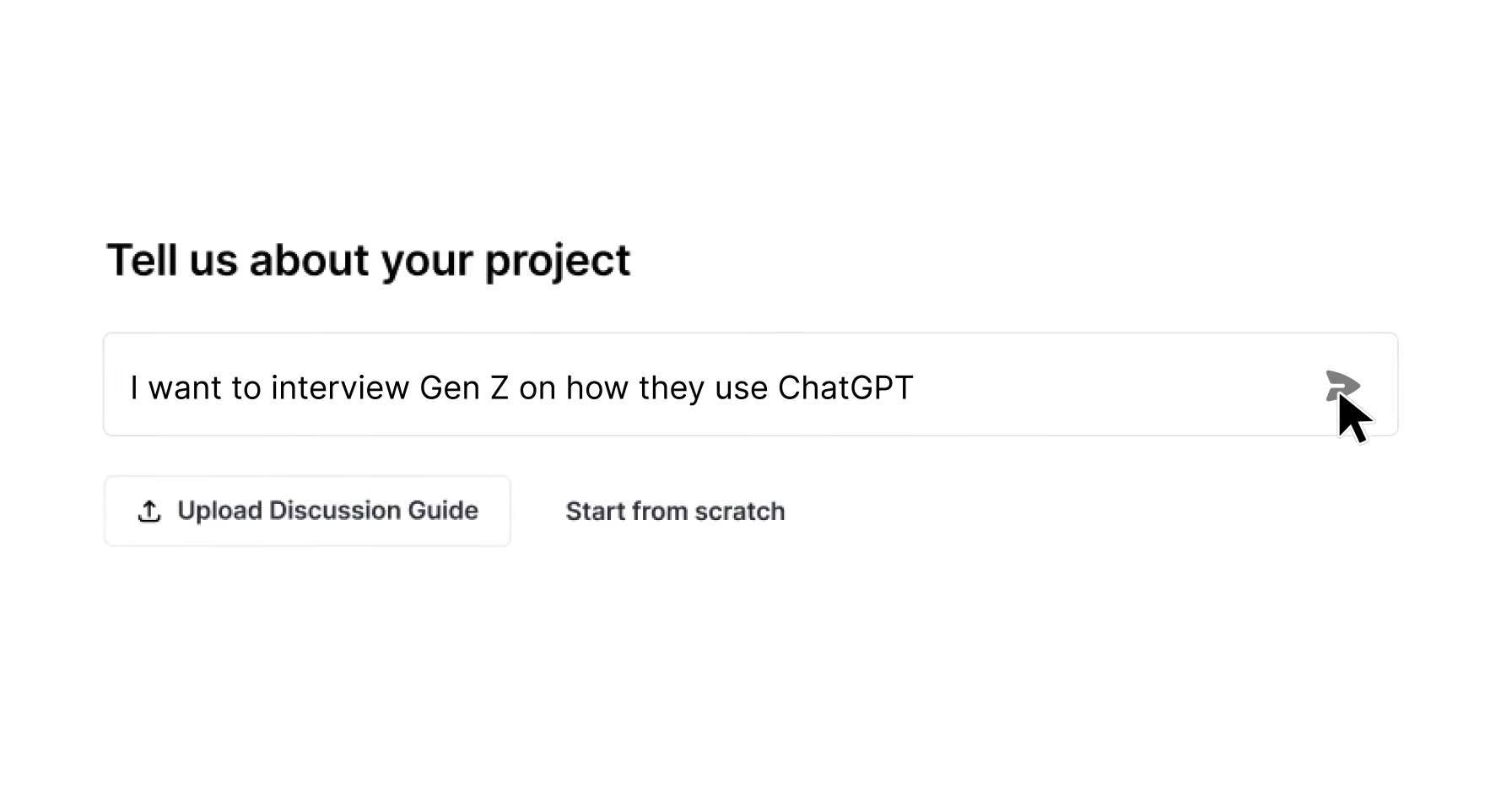
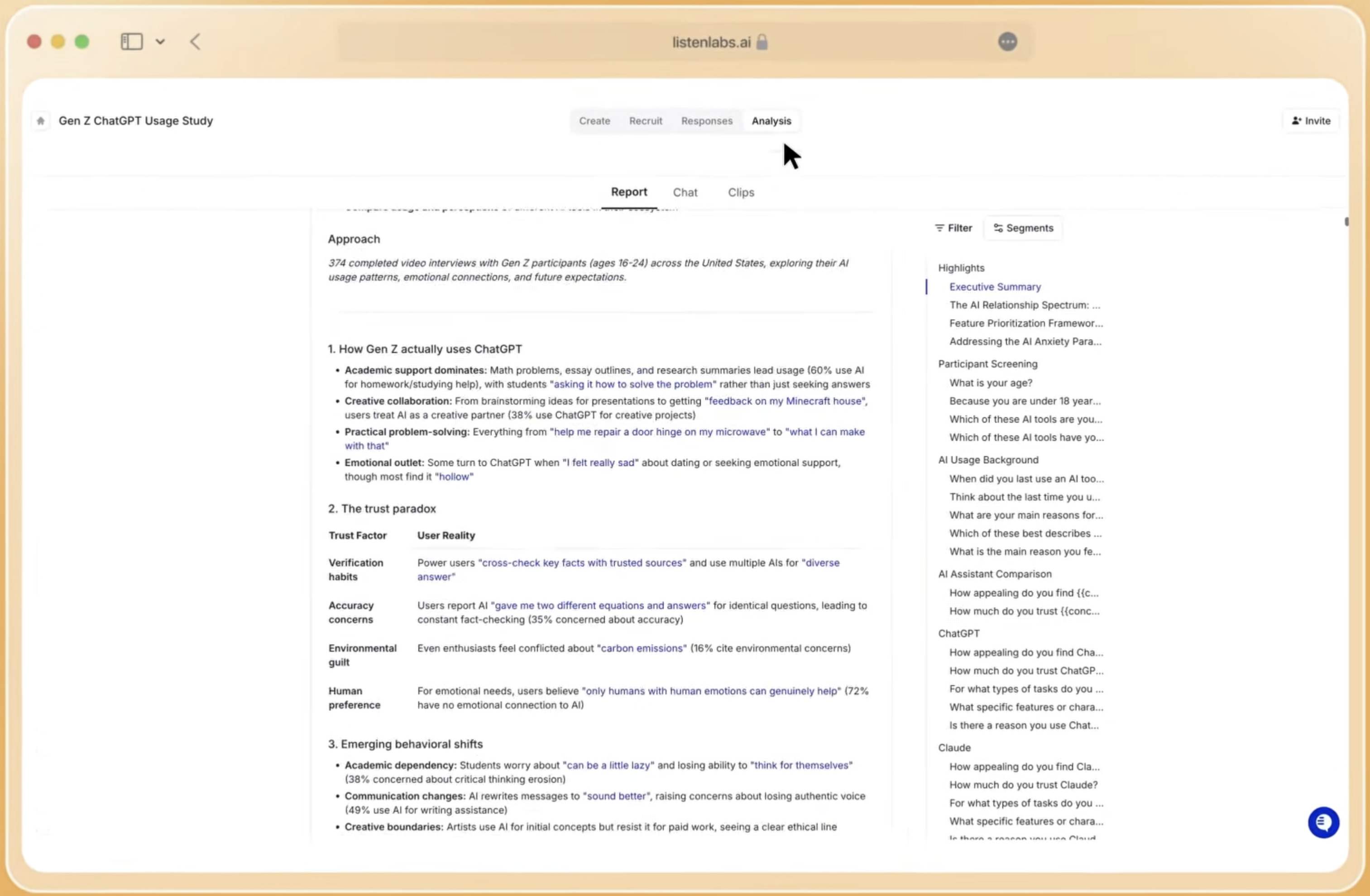
Listen Pulse is a conversational tracker that runs the same study with the same screeners wave after wave. Core questions stay constant to protect the trend line. Open-ended conversation is added to every wave, and emerging themes are charted directly alongside the KPIs teams already report, so the metric change and the reason behind it arrive in the same wave. A well-known clothing brand illustrates how this works in practice. The brand, famous for its big logos, was quietly losing customers, and its old tracker caught the drop but could not explain it. Pulse found the cause was style, not price. A growing group of customers felt the big logos were too loud for their changing lifestyles.
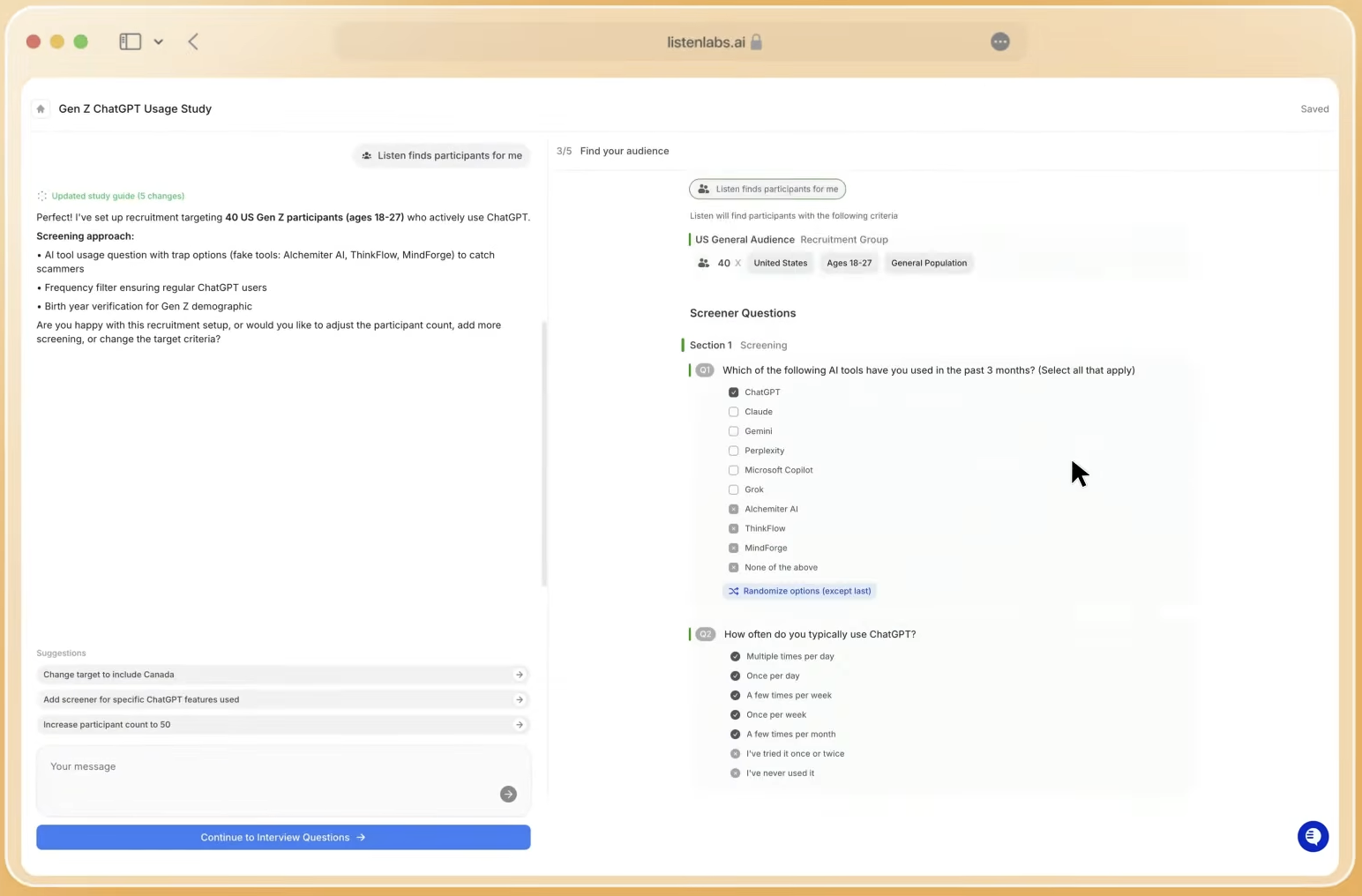
Emotional Intelligence analyzes tone of voice, word choice, and subconscious micro expressions to surface emotions that transcripts alone miss. Built on Ekman's universal emotions framework, every emotion is quantified per question and concept, and every label is traceable to the exact timestamp, verbatim quote, and reasoning behind it. Available across 50+ languages, it is directly integrated with the Research Agent for natural-language queries and highlight reels of emotionally significant moments.
Visual Insights lets the AI Interviewer observe on-screen behavior and probe contradictions between what people say and what they do in real time. This capability closes the say-do gap that neither surveys nor traditional trackers can detect.
Research Library serves as the organization's source of truth. It enables teams to query every study they have ever run in natural language and receive synthesized answers with full source attribution. Individual studies then compound into an interconnected intelligence system rather than expiring as standalone reports.
The platform's credibility rests on scale and speed. It reaches 50M+ verified respondents across 45+ countries and 120+ languages. Research cycles that once took 4–6 weeks now finish in less than 24 hours, supported by auto-recruiting, transcription, sentiment tagging, and insight summarization so teams move from question to findings in hours, not weeks. Enterprise customers include Microsoft, Google, Anthropic, Sony, Sweetgreen, Perplexity, Robinhood, P&G, Skims, Levi's, Boston Consulting Group, and Nestlé.
See continuous brand understanding in action
Company Facts: Outset AI
Outset AI was founded in 2022 and is headquartered in San Francisco, California. Its leadership team includes CEO Aaron Cannon (co-founder) and CTO Michael Hess, and the company participated in Y Combinator's Summer 2023 (S23) cohort. Outset raised a $17M Series A in June 2025, led by 8VC, followed by a $30M Series B led by Radical Ventures, with M12 (Microsoft's venture fund) participating. The company holds SOC 2 Type II, ISO 42001, GDPR, and HIPAA certifications. Named customers include Nestlé, Microsoft, Uber, Google, HubSpot, Glassdoor, Coinbase, Intuit, Indeed, Ipsos, FanDuel, Away, WeightWatchers, and Hipcamp. These details reinforce Outset's positioning as an enterprise-ready platform for large research teams.
Frequently Asked Questions
What Is Outset AI?
Outset AI is an AI-moderated research platform launched in 2022 that runs adaptive qualitative interviews at scale via video, audio, or text, and synthesizes them into themes, quotes, highlight reels, and stakeholder-ready reports. It supports brand research, concept testing, usability testing, diary studies, and creative testing, among other use cases, and moderates in 40+ languages with access to over 1 billion participants through panel integrations.
Is Outset AI Safe?
Outset holds SOC 2 Type II, ISO 42001, GDPR, and HIPAA compliance designations. The platform runs on Microsoft Azure with strict access controls, requires no PII, and automatically detects and deletes PII before any report can be generated or shared. Enterprise governance features include data-segregated workspaces, role-based approval flows, and audit controls. Buyers should confirm the current status of any specific certification directly with Outset before contract signing.
How Much Does Outset AI Cost?
Outset publishes no list price. The /pricing page states that pricing is “not one-size-fits-all” and is scoped to the research team, needs, and support requirements. Buyers should expect a discovery call, a scoped proposal, and an enterprise contract. Optional managed services are available for study creation, panel recruiting, or end-to-end execution. Third-party reviews characterize the platform as a Fortune 500 budget tier. No free tier or trial is offered.
Can AI Moderation Really Probe Like a Human?
AI moderation probes consistently and never tires. It applies the same follow-up standard to participant one and participant forty, which eliminates moderator fatigue and interviewer effect. Independent research published in Quirk's found that AI interviews followed a more standardized sequence with limited flexibility and sometimes interpreted pauses as completion, which left responses more surface-level than those elicited by skilled human moderators. Fieldwork's 2026 analysis identifies genuinely exploratory research, high-stakes sensitivity, and relational or longitudinal work as the areas where AI moderation is genuinely weaker. For structured brand research with defined topics and semi-structured formats, the limitations are less likely to affect the findings materially.
What Are the Best Outset AI Alternatives for Brand Research?
Listen Labs is the strongest option for teams that need continuous brand understanding and the “why” behind KPI movement. Listen Pulse combines quantitative tracking with open-ended conversation in every wave, so the metric change and its explanation arrive together. Emotional Intelligence surfaces subconscious emotional signals that transcripts alone miss. Visual Insights closes the say-do gap by observing on-screen behavior in real time. Research Library lets teams query every study they have ever run in natural language. For teams whose primary need is episodic, one-off qualitative brand studies at scale, Outset AI is a credible option with strong enterprise infrastructure.
Conclusion
Outset AI is a credible, enterprise-grade AI-moderated research platform with real strengths in scale, speed, visual intelligence, and security. For teams running brand perception studies, positioning validation, or competitive landscape research at volume, it is a defensible choice. The honest limitation is structural and shared by the entire category of one-off AI interview tools: they capture what consumers said in a given study window but cannot explain why a tracked metric moved, and they cannot deliver that explanation in the same instrument that measured the movement.
Wave-based trackers share the same gap from a different angle. They report that awareness or consideration shifted, yet they carry no diagnostic. By the time the deck lands, the decision window has often closed.
Continuous brand understanding keeps the metric and its explanation in the same wave, with emotional signals and behavioral observation layered in. That outcome is what Listen Labs is built to deliver. “The why is what differentiates customer research that's alright from customer research that's outstanding.” For insights leaders who need both, the platform to evaluate is Listen Labs.
Talk with Listen Labs about your brand tracking