AI Customer Research Best Practices: Scale Insights 10x
Written by: Anish Rao, Head of Growth, Listen Labs | Last updated: July 29, 2026
Key Takeaways
Enterprise teams shorten qualitative research cycles while maintaining rigor by using structured prompts tied to objectives, human review aligned to business risk, and traceable emotional signals.
AI conversation-based research is now the default for most teams, yet legacy survey tools with bolt-on AI remain the primary frustration for many researchers.
Three tensions shape every implementation: depth versus scale, cost versus governance, and speed versus traceability, all managed through quality-controlled recruitment, structured validation, and timestamp-level emotional intelligence.
High-performing workflows follow five stages: objective-driven study design, verified panel recruitment, AI-moderated adaptive interviews, Ekman-based multimodal emotional analysis, and automated synthesis linked to source data.
Listen Labs delivers this full lifecycle in under 24 hours, covering study design, participant sourcing, AI-moderated interviews, emotional intelligence analysis, and consultant-quality deliverables.
Executive Summary and Six-Dimension Evaluation Framework
Enterprise teams evaluating AI-assisted qualitative research should assess six dimensions.
Research quality, the rigor of study design and validation processes.
Speed, the time from research brief to stakeholder-ready deliverable.
Cost, the total cost of ownership across the research lifecycle.
Scalability, the maximum interview volume at current headcount.
Governance, the strength of human-in-the-loop review and audit capabilities.
Data security, the certifications and data handling practices in place.
A platform that scores well on speed but poorly on governance creates compliance exposure. A platform that excels at scalability but lacks emotional-signal traceability produces incomplete data. Listen Labs is built to satisfy all six dimensions at once, compressing the traditional 4–6 week qualitative cycle to under 24 hours. The workflow below maps directly to these six dimensions. See the full lifecycle in a personalized demo.
Industry and Methodological Landscape for AI Qualitative Research
Strategic Considerations and Trade-offs Across the Six Dimensions
Three tension pairs translate the six dimensions into practical decisions.
Depth versus scale, connecting research quality and scalability.
Cost versus governance, balancing cost and governance.
Speed versus traceability, linking speed and data security through auditability.
The depth-versus-scale tension is the most familiar. Traditional qualitative interviews deliver nuance but cap out at small sample sizes. Surveys scale but flatten meaning. AI-moderated interviews can resolve this by running hundreds of adaptive, personalized conversations at once. This only holds when the platform enforces quality at the participant-sourcing layer, not just the analysis layer. Cutting corners on recruitment to gain speed degrades research quality and undermines the scalability argument.
The cost-versus-governance tension is less discussed but equally consequential. McKinsey’s analysis found that nearly 60% of agentic AI operating costs go toward verifying and refining outputs rather than generating them. This cost structure shows that skipping structured human-in-the-loop validation does not remove verification costs. It simply shifts them into rework, compliance remediation, or stakeholder distrust of findings. Governance therefore acts as the mechanism that makes speed sustainable by placing verification where it is most efficient.
The speed-versus-traceability tension appears most clearly in emotional-signal analysis. Automated synthesis can compress reporting from days to minutes. If emotional labels are not anchored to timestamps, verbatim quotes, and explicit AI reasoning, reviewers cannot audit or challenge them. Outputs must remain traceable back to raw data so reviewers can audit the chain of evidence. Speed without traceability produces findings that look authoritative yet fail under scrutiny.
Current Best Practices for AI-Assisted Qualitative Research
Study Objective Prompt: “You are a senior consumer insights researcher. My research objective is [specific business question]. The target participant is [profile]. The decision this research will inform is [decision]. Draft a semi-structured discussion guide with 8–10 core questions focused on past behavior, not future intent. Flag any question that risks leading the participant.”
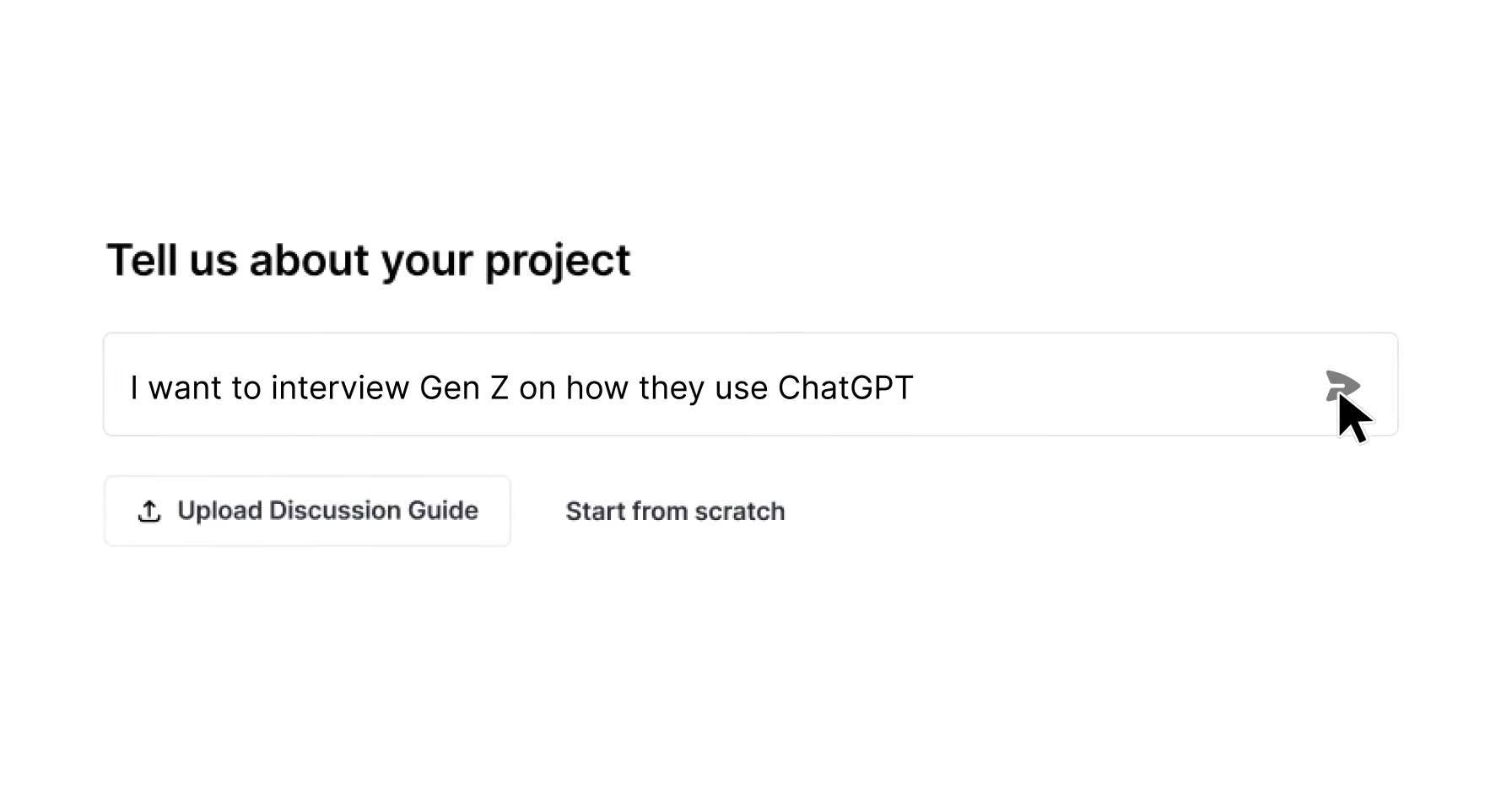
This structured approach to study design is operationalized in Listen Labs’ AI-assisted study co-design. The system accepts natural-language briefs and returns structured objectives, questions, and probing context in seconds. Auto-QA flags guide issues before launch so the brief’s specificity carries through to fieldwork. Teams can download the workflow checklist for a full PAA-mapped study design template that applies these principles.
Our AI helps you go from idea to implemented discussion guide in seconds.
2. Participant Sourcing with Behavioral Verification
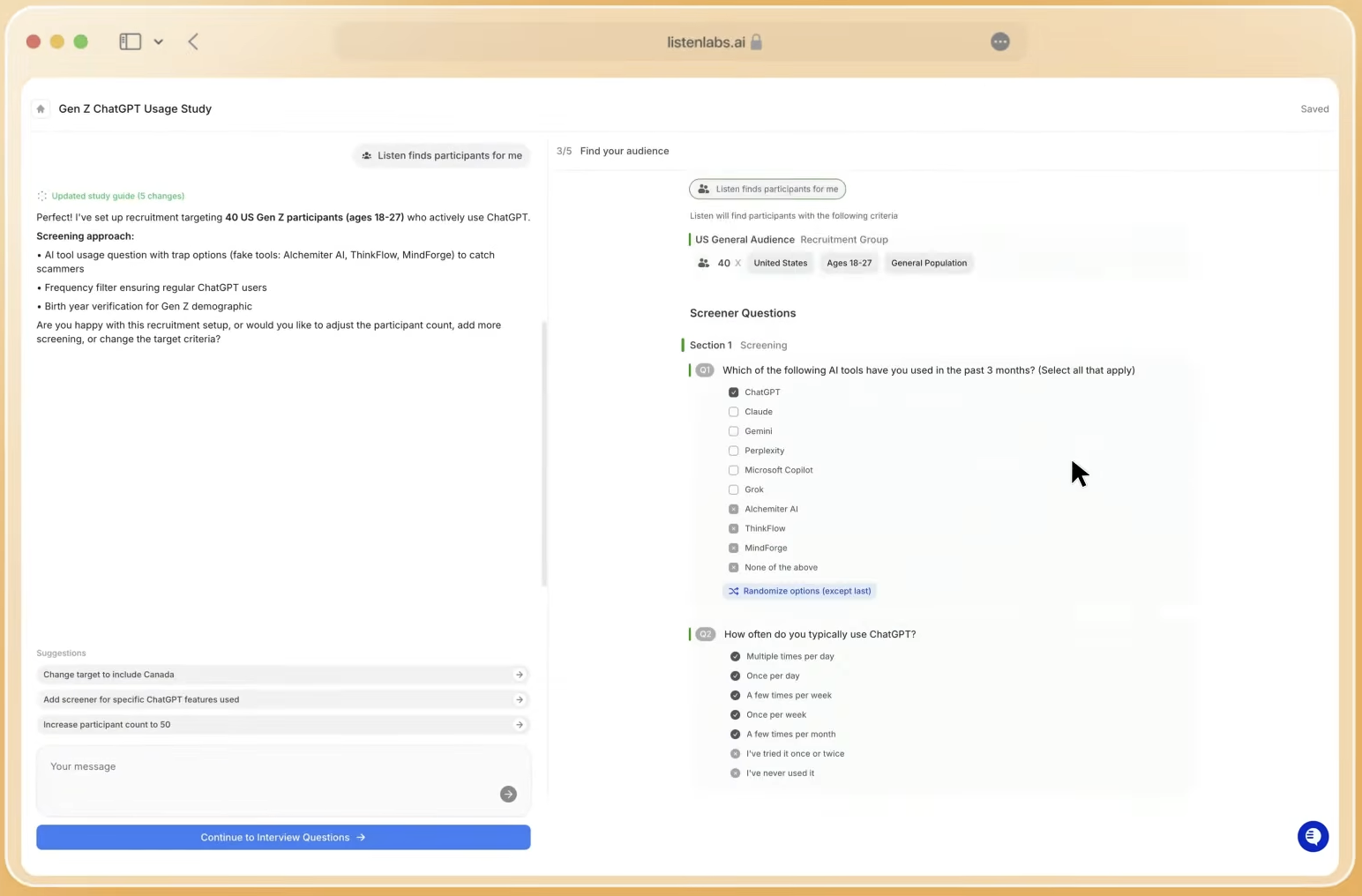
Participant quality is a precondition for analysis quality. Listen Labs’ Listen Atlas panel of 30M verified respondents across 45+ countries uses behavioral and intent matching, not only self-reported demographics, to source participants. Quality Guard monitors every interview in real time for fraud, low-effort responses, and repeat respondents, with a participant frequency cap of three studies per month. A dedicated recruitment operations team manages segments below 1% incidence rate, including enterprise decision-makers, healthcare workers, and engineers. Microsoft used this infrastructure to collect global customer stories for its 50th anniversary celebration within a single day.
Listen Labs finds participants and helps build screener questions
Follow-Up Probe Prompt: “When a participant gives a response shorter than two sentences or uses vague language such as ‘fine,’ ‘okay,’ or ‘it depends,’ ask: ‘Can you walk me through a specific time when that happened?’ Do not accept hypothetical or future-tense answers as substitutes for behavioral examples.”
The feature runs across more than 50 languages and connects directly to the Research Agent for natural-language queries and highlight reels. P&G used this capability to pinpoint where product claims felt exaggerated or unclear before launch, shaping brand strategy across more than 250 interviews in a few hours.
5. Automated Synthesis with Built-In Bias Checks
Teams should treat synthesis as a stage that requires its own quality controls. A bias-check prompt template supports that review.
Bias Check Prompt: “Review the following synthesized themes. For each theme, identify: (a) whether the supporting evidence includes at least three independent participant quotes, (b) whether any counterexample or dissenting view exists in the data and is represented, and (c) whether any qualifier such as ‘sometimes,’ ‘only if,’ or ‘except’ has been omitted from the summary. Flag themes that fail any criterion for human review.”
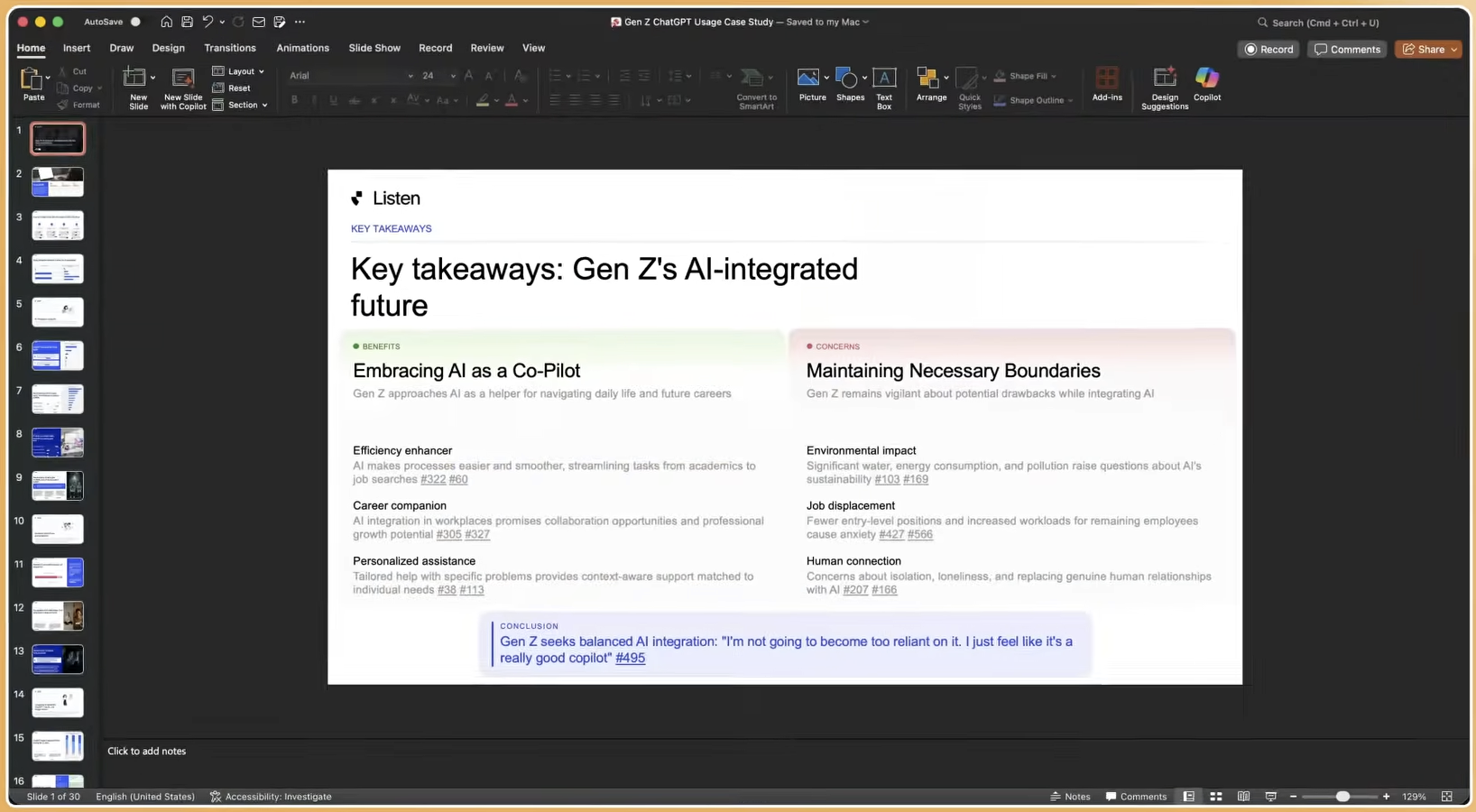
Listen Labs' Research Agent quickly generates consultant-quality PowerPoint slide decks
Readiness and Opportunity Assessment Across the Six Dimensions
Teams assessing their maturity against the six dimensions can use the following checklist.
Research quality: Are discussion guides reviewed against a written research objective before launch, and is there a documented process for verifying AI-generated quotes against source transcripts?
Speed: What is the current median time from research brief to stakeholder-ready deliverable, and is the bottleneck in recruitment, moderation, analysis, or reporting?
Cost: Are multiple vendors handling recruitment, moderation, transcription, and analysis as separate line items, and could a single end-to-end platform consolidate those costs?
Scalability: What is the maximum number of qualitative interviews the team can complete per quarter at current headcount, and is that number constrained by logistics or by methodology?
Governance: Is there a documented human-in-the-loop review step for AI outputs that inform business decisions, and are AI reasoning chains preserved for audit?
Data security: Has the team verified that current AI tooling holds SOC 2 Type II, GDPR, ISO 27001, ISO 27701, and ISO 42001 certifications, and is customer data excluded from model training by contract?
What does “human-in-the-loop validation” mean in practice for AI customer research?
Human-in-the-loop validation means that a trained researcher reviews AI outputs at defined checkpoints before those outputs influence business decisions. In a Listen Labs workflow, this includes reviewing the AI-generated discussion guide before launch, spot-checking AI-moderated interview transcripts against source recordings, auditing synthesized themes for counterexamples and missing qualifiers, and verifying that emotional labels are anchored to specific timestamps and verbatim quotes. The intensity of review scales with the business risk of the decision the research informs. A concept test for a regional campaign requires less scrutiny than findings that will reach a board or regulator.
How does AI-moderated interviewing preserve emotional nuance that transcripts miss?
Transcripts capture only the verbal layer of a participant’s response. Emotional signals such as hesitation, micro-expressions of confusion, or shifts in vocal tone disappear in text. This multimodal gap is where AI-moderated interviewing adds value. By analyzing tone, word choice, and micro expressions together against Ekman’s framework, the system can detect when verbal ratings diverge from emotional signals. A participant might say a concept is “fine” while displaying confusion or hesitation, which alerts the researcher to hidden friction. This capability helps teams understand not just what participants say, but how they feel as they react to concepts.
How does Listen Labs handle participant quality at scale without introducing fraud or panel fatigue?
Listen Labs applies three layers of quality control. First, the Listen Atlas panel of 30M verified respondents uses behavioral and intent matching rather than self-reported demographics, and Listen Labs does not work with commodity quantitative panels. Second, Quality Guard monitors every interview in real time across video, voice, content, and device signals to detect fraud, low-effort responses, AI-generated scripts, and mismatched profiles. Third, participants are capped at three studies per month, which prevents professional survey-takers from dominating samples. A dedicated recruitment operations team adds a human review layer for hard-to-reach segments. This infrastructure enabled Robinhood to surface experience patterns and user-segment insights with speed and sample sizes that traditional recruitment could not match.
What compliance certifications should enterprise teams require from an AI research platform?
Enterprise teams should require SOC 2 Type II, GDPR compliance with a signed Data Processing Agreement, ISO 27001 for information security management, ISO 27701 for privacy information management, and ISO 42001 for AI management systems. They should also verify that the vendor excludes client data from model training by contract, supports data-residency controls for jurisdictions with cross-border transfer restrictions, and maintains immutable audit logs with user attribution. Listen Labs meets all five certification requirements outlined above and encrypts data at 256-bit at rest and in transit. Customer data is never used for AI model training.
How does qual-at-scale differ from running a large quantitative survey?
Quantitative surveys deliver structured data through pre-set questions with no ability to follow up, probe, or adapt to unexpected participant responses. Qual-at-scale uses AI to conduct hundreds or thousands of adaptive, conversational interviews simultaneously, where the AI probes deeper on vague or short answers in the same way a trained human interviewer would. This approach produces the statistical confidence of large samples alongside the rich behavioral and emotional context that surveys cannot capture. Listen Labs combines both modalities, running qualitative adaptive interviews alongside Likert scales, NPS, sliders, and MaxDiff, so teams do not have to choose between depth and scale.
Conclusion and Next Steps for Enterprise Research Teams
The workflow that compresses qualitative consumer research from 4–6 weeks to under 24 hours functions as a disciplined sequence, not a single tool. The sequence includes structured prompting anchored in research objectives, verified participant sourcing through a quality-controlled panel, AI-moderated interviews that capture both verbal and emotional signals, traceable Ekman-based emotional intelligence analysis, and automated synthesis that links every insight to source data. Each stage maps to one or more of the six evaluation dimensions and includes a defined human-in-the-loop checkpoint that matches verification intensity to business risk. Microsoft, Anthropic, P&G, Skims, and Robinhood have run this workflow at enterprise scale, turning multi-week research cycles into results delivered within a day.
Listen Labs executes this full lifecycle end-to-end, combining a 30M verified panel, Quality Guard fraud prevention, Ekman-based Emotional Intelligence across more than 50 languages, Mission Control for cross-study institutional knowledge, and SOC 2 Type II, GDPR, ISO 27001, ISO 27701, and ISO 42001 compliance. Run a pilot study and see consultant-quality deliverables in under 24 hours.