
Written by: Anish Rao, Head of Growth, Listen Labs | Last updated: July 26, 2026
Key Takeaways
- End-to-end AI qualitative research platforms replace separate recruitment, moderation, analysis, and reporting tools, shrinking four-to-six-week cycles to under 24 hours.
- Listen Labs integrates verified participant sourcing through its 30-million-person global panel, AI-moderated interviews with emotional intelligence, and automated deliverables with enterprise-grade compliance.
- Quality controls such as real-time fraud detection, participant frequency caps, and multi-layered verification address fraud and professional survey-taker issues common in commodity panels.
- Emotional Intelligence captures tone, word choice, and micro-expressions across 50+ languages, revealing reactions that transcript-only tools miss.
- Listen Labs replaces fragmented research stacks with a single compliant platform. Book a demo to see how it accelerates your entire qualitative research process.
How to Evaluate AI Qualitative Research Platforms
Enterprise buyers should score vendors against a full set of criteria that determine real-world research value. The eleven dimensions that matter most are:
- Research speed, measured as time from brief to deliverable
- Depth of insight, based on richness of conversational data versus surface-level responses
- Sample quality, with verified participants instead of commodity panel respondents
- Participant sourcing, with integrated recruitment instead of separate vendor dependency
- Methodological flexibility, including IDIs, usability testing, concept testing, diary studies, and mixed methods
- Global reach and language support, including countries covered and native-quality moderation languages
- Analysis effort, comparing automated theme extraction with manual coding burden
- Reporting transparency, including traceability of every insight to a timestamped source
- Governance and security, including certifications and data handling controls
- Scalability, or the ability to run hundreds of simultaneous interviews without quality degradation
- Total operational burden, including number of tools, vendors, and handoffs required
Security and compliance function as binary pass/fail gates in AI tool evaluations, so vendors that cannot confirm SOC 2 Type II, AES-256 encryption at rest, and GDPR compliance are disqualified before the remaining criteria are scored. The following sections show how fragmented stacks and Listen Labs perform against these dimensions across each research stage.
Study Setup and Design: Manual Drafting vs AI Co-Design
Fragmented stacks force researchers to draft discussion guides manually, coordinate screeners across separate tools, and configure logic in survey builders that were not designed for qualitative depth. General-purpose LLMs can speed up drafting, but they lack the proprietary study-design data needed to distinguish question types that produce rich analysis from those that generate noise.
Listen Labs replaces this friction with AI-assisted co-design. Researchers describe their objectives in natural language and the platform drafts structured questions, probing context, and stimuli configurations in seconds. Before launch, Auto-QA flags issues that would compromise data quality, which removes a manual review step that often delays traditional workflows. This speed extends to repeat work because past studies can be cloned and adapted instantly instead of rebuilt from scratch. All of this happens in one interface that supports images, video, PDFs, live URLs, monadic and sequential randomization, branching, skip logic, and version control, so teams do not need a separate survey builder.

Recruitment and Sampling: Commodity Panels vs Listen Atlas
Recruitment often functions as the single largest bottleneck in enterprise research timelines, and it frequently accounts for a substantial portion of total cycle time. Commodity panels introduce professional survey-takers and fraudulent profiles that undermine the entire research investment. Industry benchmarking studies have found that a notable share of survey data is removed during fieldwork due to fraud, duplication, and poor-quality responses.
Listen Labs’ Listen Atlas addresses this risk with a global panel of 30 million verified respondents across 45+ countries. An AI orchestration layer matches and bids across multiple consumer and B2B panel partners based on behavioral and intent data, not just self-reported demographics. Quality Guard monitors every interview in real time across video, voice, content, and device signals. Participants are capped at three studies per month, which removes professional survey-takers from the pool. A dedicated recruitment operations team manages audiences below 1% incidence rate, including enterprise decision-makers, healthcare workers, and engineers.
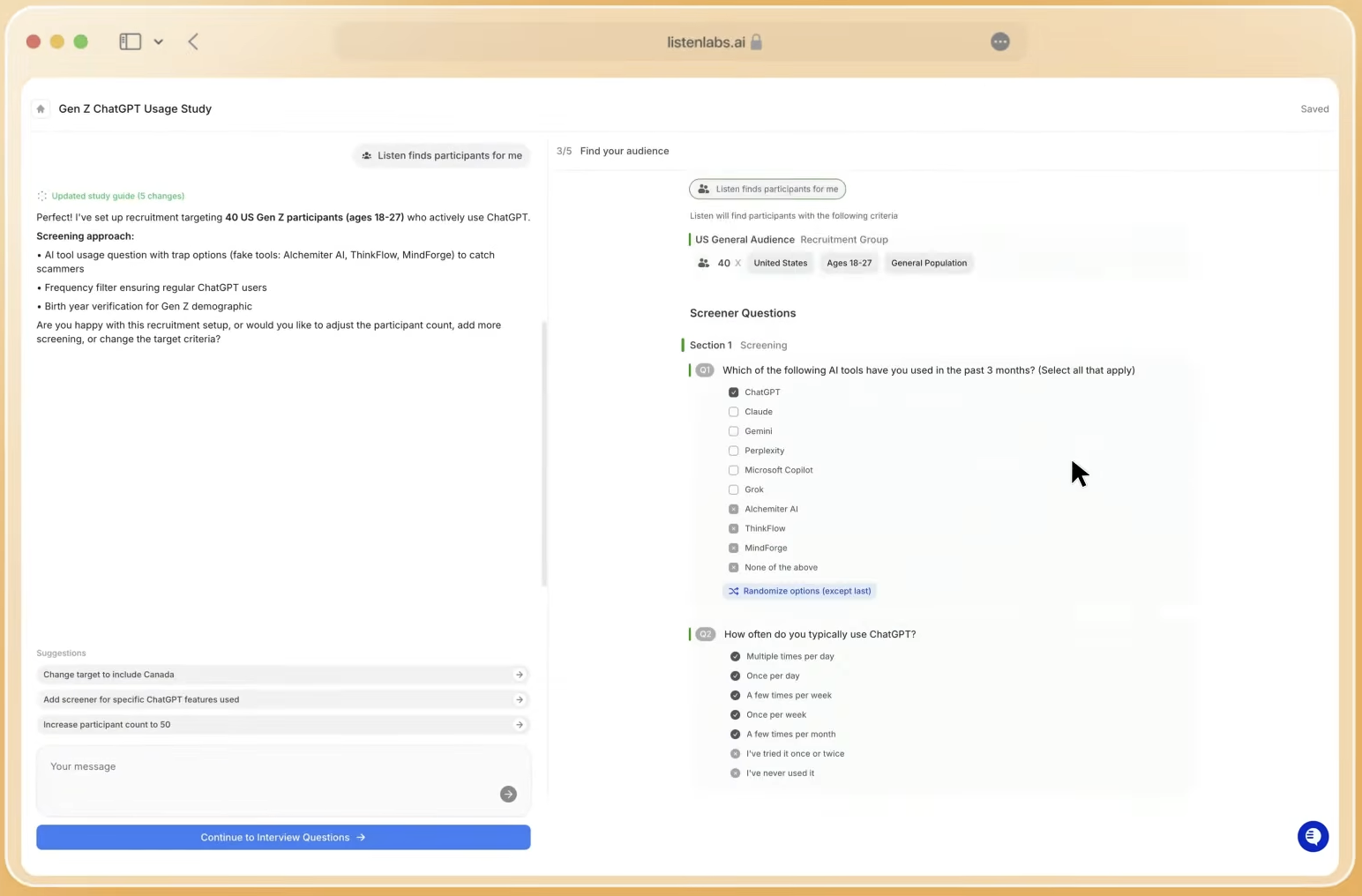
Customers already use this infrastructure at scale. Microsoft collected global customer video stories for its 50th anniversary celebration within a single day. Anthropic surfaced churn drivers from more than 300 user interviews in 48 hours, which was five times faster than previous methods. P&G completed over 250 interviews with quantified themes in hours to shape product and brand strategy before market. Skims identified and qualified thousands of premium consumers overnight to de-risk a global campaign launch.
Moderation Approaches: Human Capacity Limits vs AI Scale
Human-dependent moderation models, including traditional agencies and platforms like UserTesting, are limited to three to five interviews per day per moderator, which creates a hard ceiling on throughput. Traditional focus groups take three to five weeks and cost $4,000 to $12,000 per 90-minute session. Focus group dynamics also introduce groupthink and social desirability bias that distort individual responses.
Listen Labs conducts AI-moderated video interviews at scale, with hundreds of simultaneous, personalized conversations. Each interview includes dynamic follow-up questions that probe deeper on short or interesting answers, similar to a trained human interviewer. AI can schedule and conduct the interview, analyze transcripts for themes, and generate quantitative insights from those interviews. Moderation is available in more than 100 languages with automatic translation and transcription, so teams can run native-quality interviews across 45+ countries at price parity with English-language studies.
Data Quality and Fraud Prevention: Single Layer vs Three Layers
Most AI moderation platforms carry moderate to high fraud risk because they rely on commodity panels without layered verification. A 2025 Qualtrics survey found that 73% of market researchers have already used synthetic responses at least once, and most vendors in the AI-moderated research space do not publicly confirm SOC 2 certification or GDPR compliance.
Listen Labs applies three distinct quality layers. First, Listen Atlas works only with high-quality, non-commodity panel sources, so professional survey-takers do not enter the pool. Second, Quality Guard runs real-time AI monitoring across video, voice, content, and device signals to detect fraud, low-effort responses, AI-generated scripts, and mismatched profiles. Third, a dedicated recruitment operations team adds human review for every study. Reputation scoring compounds across every interview the platform conducts, which creates a quality flywheel that competitors without equivalent study volume cannot match. Every insight produced by the Research Agent is traceable to a timestamped verbatim quote, which satisfies enterprise audit requirements.
Depth and Scale: Rich Qualitative Insight with Quantitative Rigor
Survey platforms like SurveyMonkey and Qualtrics scale to large samples but cannot follow up, probe, or uncover unexpected findings. Analysis-only tools like Dovetail organize research that has already been conducted elsewhere but do not source participants or conduct interviews. Teams often face a forced trade-off between depth and scale.
Recent industry reports show that median qualitative sample sizes for AI-moderated studies have increased substantially since 2022. Listen Labs removes the depth-versus-scale trade-off by combining rich conversational depth with mixed-methods quantitative formats in a single interview session. Dynamic follow-ups, open-ended probing, and screen sharing support usability testing, while Likert scales, NPS, sliders, grids, and MaxDiff capture structured data. Studies show that AI-moderated interviews can produce more words per probe-and-follow-up sequence and higher discussion guide coverage than human-moderated interviews.
Analysis and Deliverables: Manual Coding vs Research Agent
Manual qualitative coding remains the dominant time sink in fragmented stacks. In manual workflows, coding takes one to two weeks for 20+ interviews and synthesis adds another week. Analysis-only tools reduce this burden but require researchers to import data from separate collection tools, which introduces additional handoffs and version-control risks.
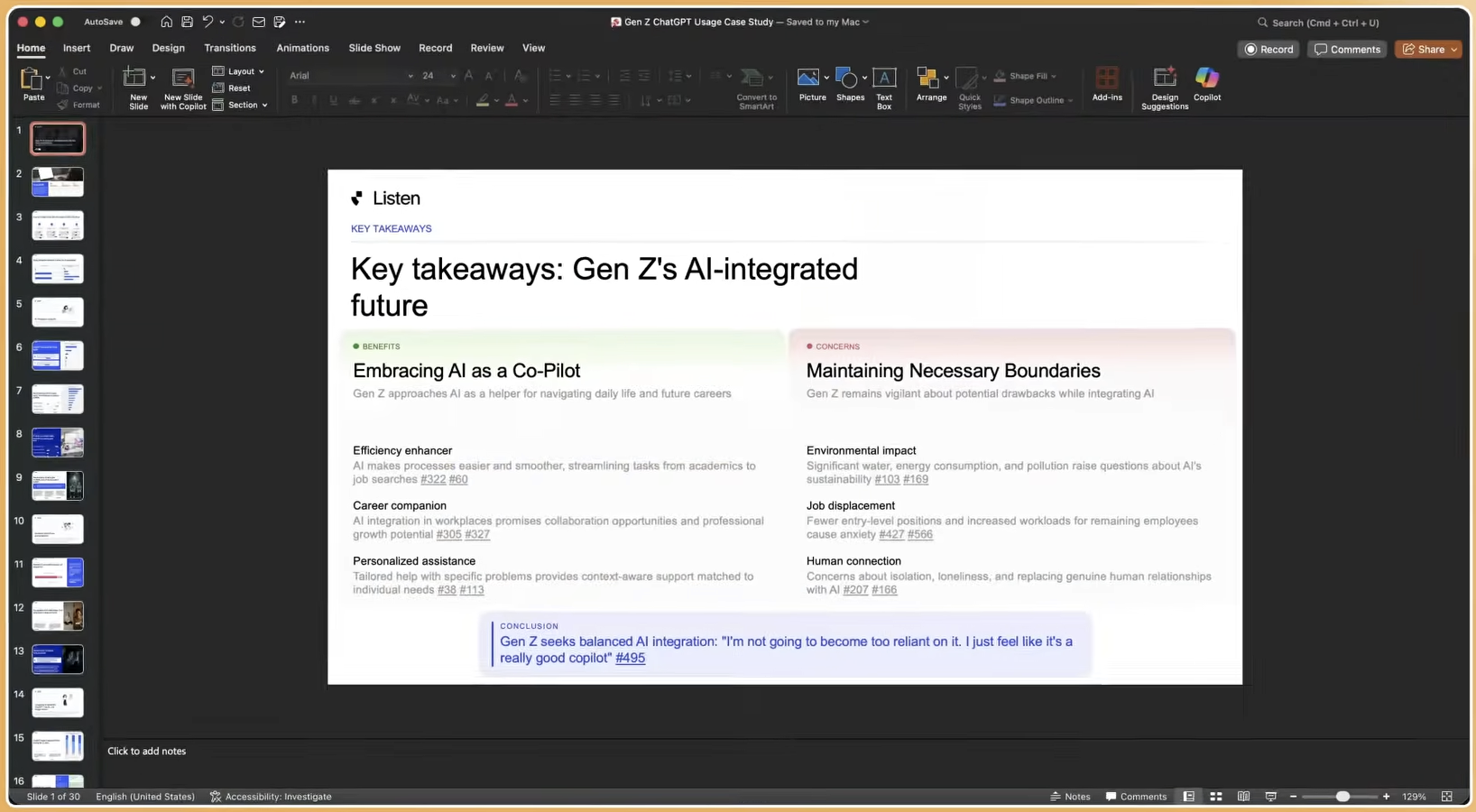
Listen Labs’ Research Agent handles the full analysis workflow from raw data to final output. Automated theme extraction, persona generation, and key findings are produced directly from interview data. Researchers can ask any question in natural language and receive answers, charts, statistical tests, and segmentation breakdowns instantly. Research Agent generates a slide deck in a company’s branded template and a downloadable report, which replaces days of manual report writing. Video highlight reels are generated automatically from interview recordings.
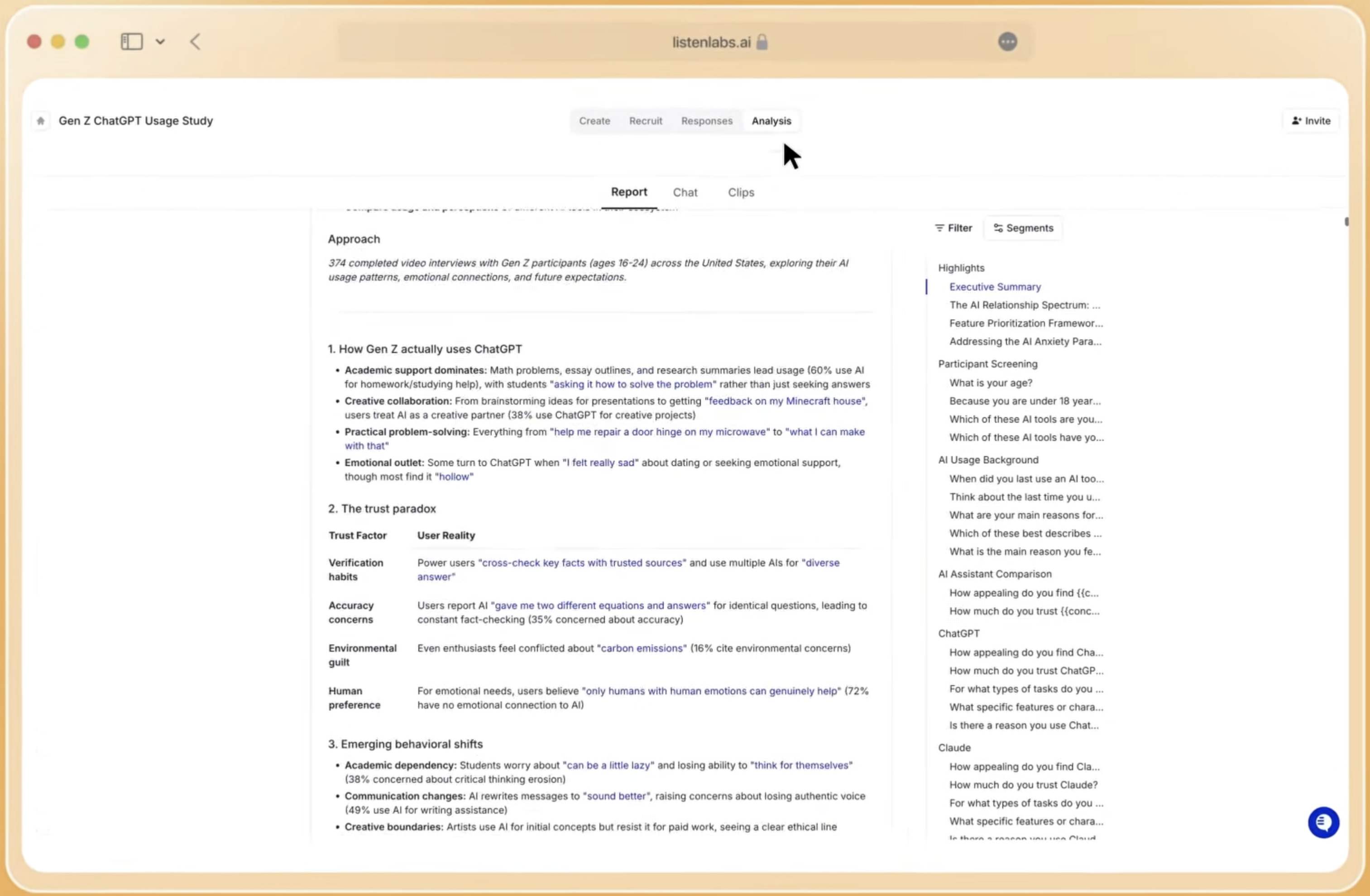
Book a demo to see Research Agent generate consultant-quality deliverables from live interview data.
Emotional Intelligence: Capturing What People Feel, Not Just What They Say
Most competitors in this category, from analysis-only tools to general-purpose LLMs, capture what participants say but not what they feel in the moment. Marco Baldocchi, CEO of Emotivae, notes that emotions remain the most undervalued signal for producing truer data in insights, and that real-time AI can decode emotional states directly from facial micro-expressions using standard cameras.
Listen Labs’ Emotional Intelligence analyzes three simultaneous signal layers: tone of voice, word choice, and subconscious micro-expressions. It is built on Ekman’s universal emotions framework, the same standard used in clinical psychology and UX research, tracking anger, anticipation, disgust, fear, joy, sadness, trust, and surprise. A paper published in npj Artificial Intelligence confirms that foundation models exhibit emergent affective capabilities enabling zero-shot emotion recognition across vision, linguistics, and speech modalities, which provides independent academic grounding for multimodal emotional analysis in AI research systems.
Every emotion is quantified per question and per concept. Every label is traceable to the exact timestamp, verbatim quote, and the AI’s reasoning, so teams see not just that happiness appeared but exactly where and why. This timestamp-level traceability is available across more than 50 languages and connects directly with the Research Agent for natural-language queries, emotional charts, and highlight reels of the most emotionally significant moments.
Teams already use Emotional Intelligence for creative testing, concept comparison, brand research, and usability testing. In creative testing, it pinpoints where participants light up, disengage, or become confused, which transcript-only tools miss. In concept comparison, researchers can ask which stimulus triggered the most confusion and receive a side-by-side emotional breakdown across stimuli, segments, and markets. In usability testing, it surfaces moments of hesitation and frustration that participants do not verbalize.
Knowledge Management: Siloed Reports vs Mission Control
Point solutions tend to produce siloed reports. Findings from a brand study conducted six months ago often remain inaccessible when a product team needs related context today. Organizations repeatedly re-research the same questions because institutional knowledge is scattered across slide decks, shared drives, and individual researchers’ memories.
Listen Labs’ Mission Control serves as the organization’s single source of truth for everything ever learned from customers. Each completed study grows the knowledge base. Cross-study queries return answers in seconds. Trend tracking shows how customer sentiment, needs, and pain points shift over time. Research teams running traditional cycles complete fewer studies per year, while teams running accelerated cycles can complete substantially more, and Mission Control ensures every one of those studies compounds into organizational intelligence instead of disappearing into a folder.
Where Listen Labs Fits Best in Enterprise Teams
Different personas within the enterprise extract distinct value from an end-to-end platform. Consumer insights leaders at Fortune 500 companies use Listen Labs to multiply research output without adding headcount. They run concept tests, brand perception studies, and multi-market segmentation studies in parallel rather than sequentially. UX research leads use AI-moderated interviews with screen sharing to run usability studies with 50 to 100+ participants per sprint instead of the five to ten that human-moderated logistics allow.
Product managers and brand managers without dedicated research teams use natural-language study co-design to launch and analyze studies independently, without methodology expertise. Agencies and consultancies use the platform’s speed and global reach to deliver client research in days rather than weeks. They also access niche audiences, including enterprise decision-makers, healthcare workers, and engineers, that commodity panels cannot reliably source.
Operational and Long-Term Considerations for Adoption
Adopting an end-to-end platform requires alignment across research, legal, IT, and procurement. A large share of AI project failures stem from lack of user adoption rather than technical shortcomings, so change management matters as much as technical evaluation. Listen Labs holds SOC 2 Type II, GDPR, ISO 27001, ISO 27701, and ISO 42001 certifications, and customer data is never used for AI model training. These controls address the compliance requirements that legal and IT teams raise during procurement.
For global research programs, the platform’s 45+ country coverage and 100+ language moderation support enable consistent methodology across markets without per-market vendor relationships. Repeatability comes from study cloning, version control, and Mission Control’s cross-study trend tracking, which supports continuous consumer intelligence programs instead of one-off projects.
Risks, Limitations, and Common Misconceptions
Several misconceptions shape evaluations of AI qualitative research tools. The first misconception claims that speed automatically equals better research. Speed reduces the cost of iteration and eliminates insight staleness, but the underlying methodology, including question design, participant targeting, and analysis rigor, still determines output quality. Girdwood and Manikonda (2026) emphasize that full-lifecycle AI qualitative platforms must demonstrate verifiability and auditability across all five research stages, not only the analysis phase, to avoid undermining rigor.
The second misconception claims that general-purpose LLMs can substitute for purpose-built research platforms. A 2025 PLOS One study testing Microsoft Copilot for thematic analysis highlighted challenges such as differences from human themes and risks of fabrication. Listen Labs is trained on tens of thousands of completed studies, which gives it proprietary signal on which question types produce richer analysis and how to separate signal from noise, data that no general-purpose model possesses.
The third misconception assumes that any panel provider solves recruitment complexity. Hidden fraud, professional survey-takers, and demographic-only matching are endemic to commodity panels. Real-time behavioral verification, frequency limits, and human review layers are not standard. They function as differentiators that directly affect data validity.
Decision Framework: Matching Tools to Research Goals
Teams should match tools to their primary constraint. For teams whose main constraint is analysis speed on data they have already collected, analysis-only tools like Dovetail address a narrow slice of the problem. For teams whose main constraint is participant sourcing for a specific niche, dedicated recruitment platforms like Prolific or User Interviews solve sourcing but leave moderation, analysis, and reporting to other tools. For teams running quantitative surveys at scale, SurveyMonkey and Qualtrics provide breadth but sacrifice the conversational depth needed to understand the “why” behind behavioral data.
Enterprise consumer insights leaders, UX research heads, and product and marketing teams that need to run significantly more studies without added headcount, and that require verified participants, adaptive interview depth, emotional intelligence, automated analysis, and enterprise security in a single workflow, will not find a point solution or combination of point solutions that matches the operational profile of an end-to-end platform. Vendor-led, domain-specific, workflow-integrated solutions tend to succeed at higher rates than generic approaches, and the total operational burden of maintaining four to six separate tools, each with its own contracts, integrations, and quality risks, compounds over time in ways that per-tool pricing comparisons do not capture.
Frequently Asked Questions
How long does end-to-end AI qualitative research take compared with traditional methods?
Traditional in-depth interview studies require four to six weeks end-to-end, with recruitment alone consuming one to two weeks and analysis adding another one to two weeks on top of fieldwork. Listen Labs compresses the entire cycle, including study design, recruitment, AI-moderated interviews, analysis, and deliverable creation, to less than 24 hours. This shift reflects a structural change in how each stage operates rather than a simple reduction in scope. Recruitment runs in parallel with study finalization. Interviews are conducted simultaneously instead of sequentially. Analysis begins as interviews complete instead of waiting for fieldwork to close. As a result, a research team running Listen Labs can complete substantially more studies per year at the same headcount that previously supported fewer.
How does Listen Labs source and verify participants versus other platforms?
Listen Labs operates Listen Atlas, the 30 million-person global panel described earlier, with coverage across 45+ countries. An AI orchestration layer matches and bids across multiple consumer and B2B panel partners, including specialized networks like NewtonX, based on behavioral and intent data rather than self-reported demographics alone. Quality Guard applies real-time monitoring across video, voice, content, and device signals during every interview to detect fraud, low-effort responses, AI-generated scripts, and mismatched profiles. Participants are limited to three studies per month, which removes professional survey-takers. A dedicated recruitment operations team handles hard-to-reach segments, including enterprise decision-makers, healthcare workers, engineers, and audiences below 1% incidence rate, that commodity panels cannot reliably source. Organizations can also bring their own participants from their user base at reduced cost.
What security and compliance certifications matter for enterprise qualitative research?
Enterprise procurement teams should treat SOC 2 Type II, GDPR, and ISO 27001 as minimum requirements for any platform that handles participant data, interview recordings, and proprietary research outputs. Listen Labs holds all three, plus ISO 27701 for privacy information management and ISO 42001 for AI management systems. ISO 42001 is particularly relevant as regulators increase scrutiny of AI systems that process personal data. The platform uses 256-bit encryption, and customer data is never used for AI model training. Enterprise SSO is supported for identity management. Most vendors in the AI-moderated research space do not publicly confirm this full certification stack, which makes it a meaningful differentiator during procurement review.
Can AI-moderated interviews match human depth while scaling to hundreds of participants?
AI-moderated interviews on Listen Labs maintain conversational depth through dynamic follow-up questions that probe deeper on short or interesting answers, the same adaptive behavior that distinguishes a skilled human interviewer from a rigid discussion guide. The platform supports rich response capture, including video, audio, text, and screen recordings. Mixed-methods formats such as Likert scales, NPS, sliders, and MaxDiff can be embedded within the same interview session. Emotional Intelligence adds a layer of analysis that human moderation at scale cannot replicate, including timestamp-level detection of tone, word choice, and micro-expressions across every participant simultaneously. In practice, teams can run more than 200 interviews in 24 hours with consistent methodology, statistical segmentation capability, and emotional signal capture, a combination that human moderation cannot achieve at any price point.
Which AI qualitative research tools best support multilingual studies across 45+ countries?
Listen Labs supports AI-moderated interviews in more than 100 languages with automatic translation and transcription, covering 45+ countries across the Americas, Europe, APAC, and MEA. Emotional Intelligence is available across more than 50 languages, which enables consistent emotional signal capture in multilingual studies. Listen Atlas provides verified participant access in all covered markets, and the AI orchestration layer sources locally appropriate panels instead of relying on a single global commodity source. A single study brief can field simultaneously in English, Spanish, Mandarin, German, and Japanese, with each interview conducted in the participant’s native language, translated automatically, and analyzed within the same Research Agent workflow, without per-market vendor relationships or translation delays.
Conclusion: Replacing the Broken Research Stack with Listen Labs
The fragmented research stack, with separate tools for recruitment, scheduling, moderation, transcription, analysis, and reporting, does not represent a cost-optimization problem. It creates a structural constraint that limits how much consumer intelligence an enterprise can generate per quarter, regardless of team size or budget. Point solutions address individual stages without removing the handoffs, quality risks, and compounding delays between them.
Listen Labs is the only end-to-end AI qualitative research platform that sources verified participants from a 30 million-person global panel, conducts adaptive AI-moderated interviews with Ekman-based emotional intelligence, and delivers consultant-quality outputs, including slide decks, memos, highlight reels, and statistical charts, in under 24 hours, with SOC 2, GDPR, ISO 27001, ISO 27701, and ISO 42001 compliance built in. Microsoft, Anthropic, P&G, Skims, and Robinhood have already replaced their fragmented stacks with this approach. The remaining question for enterprise insights leaders in 2026 concerns how many studies their teams leave undone while the backlog grows.