
Written by: Anish Rao, Head of Growth, Listen Labs | Last updated: July 26, 2026
Key Takeaways
- AI predictive analytics uses machine learning and NLP to forecast consumer behavior and surface emerging trends from historical and real-time data.
- Enterprises apply predictive models to demand forecasting, concept testing, churn prediction, and lifetime-value modeling to support proactive decisions.
- AI-moderated interview platforms bridge the gap between statistical forecasts and human understanding by delivering qualitative depth at enterprise scale.
- Key challenges such as data quality, bias, and privacy are addressed through layered fraud detection, fairness validation, and enterprise-grade compliance certifications.
- Listen Labs delivers end-to-end AI-powered research that compresses weeks of work into under 24 hours, so book a demo to see how your team can benefit.
AI Predictive Analytics Market Size 2026
The global predictive analytics market is expanding quickly as enterprises in every major industry invest in AI-driven decision support. Independent research firms publish 2026 estimates that differ in scope and methodology yet still point to sustained double-digit growth.
Growth through 2030 stems from rising investments in AI-powered analytics platforms, expansion of cloud-native data ecosystems, and broader adoption across industry verticals. North America accounts for a 46.8% revenue share of the predictive analytics market (Market.us, 2023). No source projects a 23.4% CAGR for the Asia Pacific predictive analytics market through 2035, while related APAC data analytics segments show CAGRs of 27.65% or higher to 2035.
Predictive Analytics for Market Trends
Enterprise investment in predictive analytics concentrates in three workflows that directly affect revenue: demand forecasting, concept testing, and trend identification. Together they form a continuous loop across the product lifecycle.
Demand forecasting uses historical sales data, external signals such as weather and economic indicators, and machine learning models to anticipate product demand at the regional or channel level. A grocery chain, for example, can forecast higher beverage sales during a holiday weekend and increase shipments to specific locations before demand peaks.
Once demand signals emerge, concept testing applies predictive models to consumer interview data to rank which product or messaging concepts are most likely to succeed before launch. When teams pair this with AI-moderated qualitative interviews, concept testing reveals both stated preferences and the emotional reactions that predict real-world adoption.
Finally, trend identification monitors behavioral, transactional, and voice-of-customer data streams to detect shifts in consumer sentiment before they appear in sales figures. This real-time detection drives the 20–30% efficiency gains now documented across enterprises, as AI-powered NLP, machine learning, and neural networks detect complex patterns and automate data preparation, turning static reporting into dynamic forecasting.
Predictive Analytics in Customer Behavior
Predictive analytics delivers the most commercial value when it explains and anticipates individual customer actions across churn, value, and personalization.
Churn prediction identifies customers showing early signs of disengagement weeks before cancellation occurs. Predictive models in customer experience can identify at-risk customers and enable intervention through targeted offers or experience adjustments. Anthropic applied this approach with Listen Labs, conducting 300+ user interviews in 48 hours to surface churn drivers 5× faster, identify where former Claude users migrate, and deliver a prioritized list of must-fix product gaps.
Lifetime-value modeling segments customers by predicted long-term revenue contribution so teams can focus resources on the highest-value cohorts. Once high-value segments are identified, enterprises apply demand forecasting to anticipate what those customers will buy next and align inventory, production, and supply planning with the cohorts that matter most.
Micro-targeted personalization uses behavioral and intent signals to tailor product recommendations, pricing, and messaging at the individual level. DICK’S Sporting Goods uses Adobe tools to deliver personalized experiences. P&G applied a comparable logic with Listen Labs, using 250+ AI-moderated interviews to pinpoint where product claims feel exaggerated before market launch and adjust brand strategy in hours rather than weeks.
How Predictive AI Powers Modern Customer Research
The P&G and Anthropic examples illustrate a broader shift toward pairing prediction with explanation. Predictive models generate forecasts, and those forecasts become actionable when teams add the qualitative depth that explains the “why” behind the numbers. AI-moderated interview platforms now close this gap between statistical prediction and human understanding.
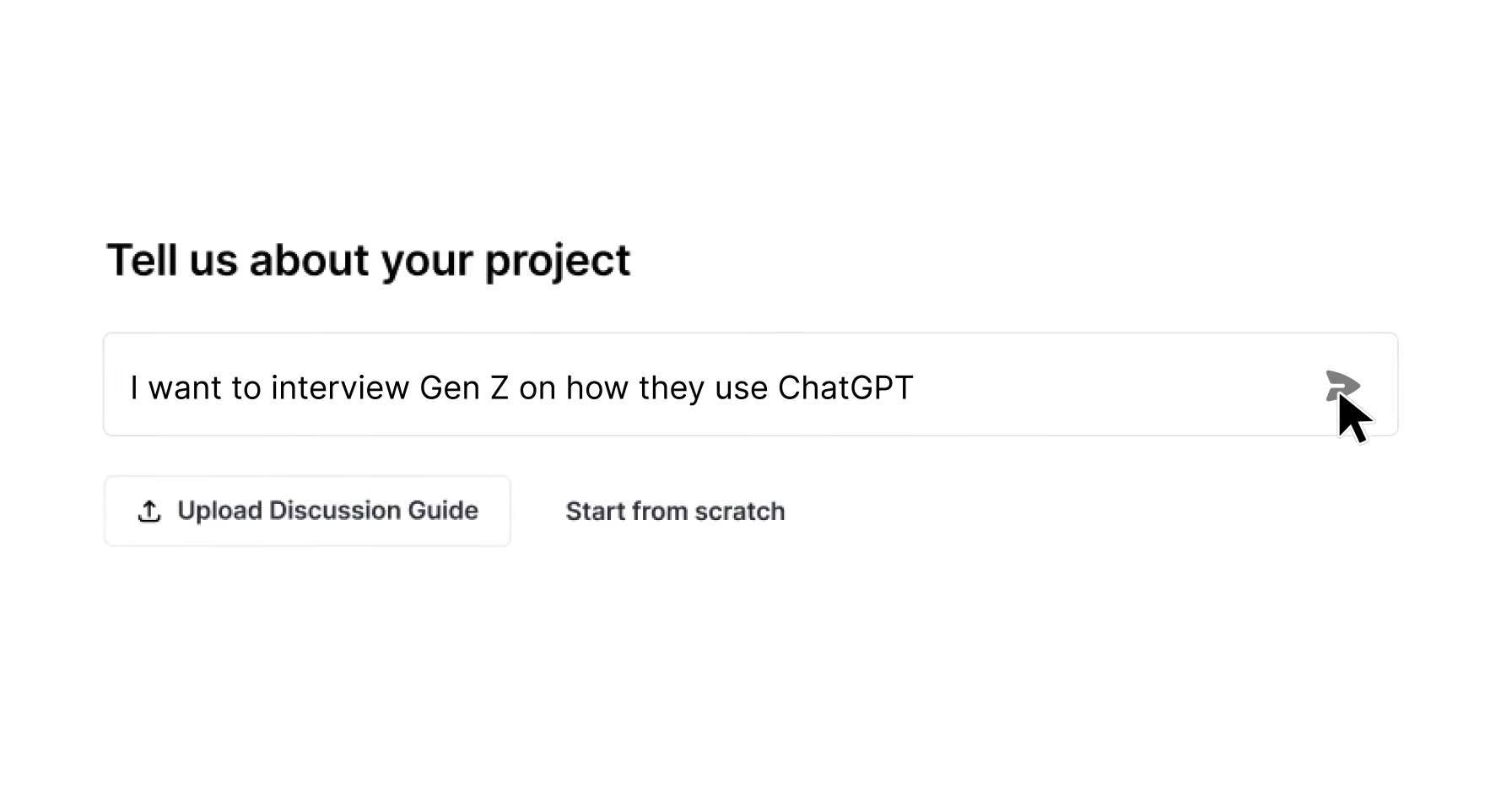
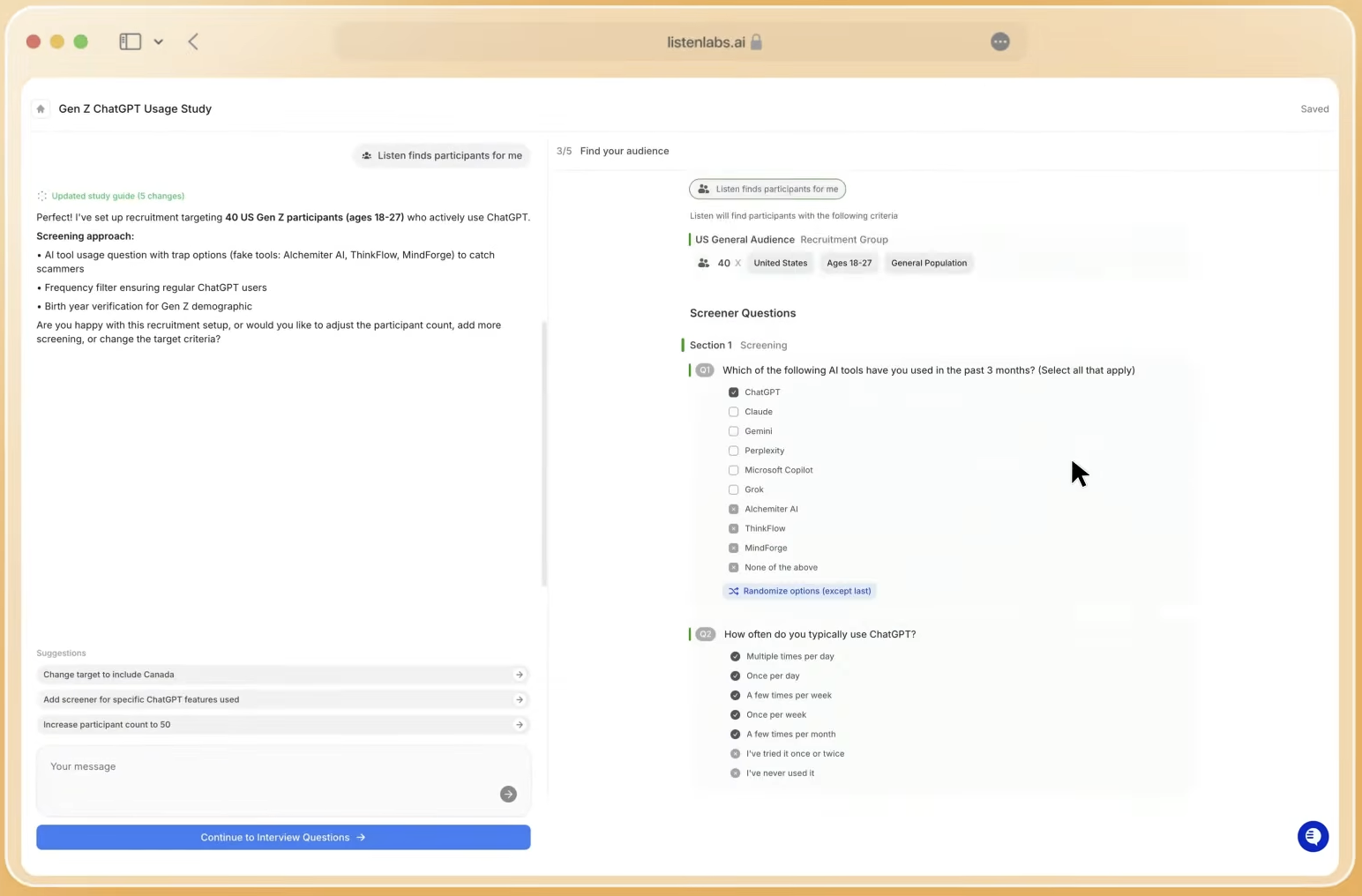
AI can schedule and conduct interviews, analyze transcripts for themes, and generate quantitative insights from qualitative conversations, which collapses the traditional trade-off between depth and scale. Qual-at-scale suits projects that require large sample sizes or broad geographic reach, because AI tools can engage hundreds or thousands of participants remotely and asynchronously.
Listen Labs operationalizes this capability end-to-end. Its Emotional Intelligence feature analyzes three layers of signal, including tone of voice, word choice, and subconscious micro expressions, to surface nuanced emotions that transcripts alone miss. Every emotion is quantified per question and concept, with each label traceable to the exact timestamp, verbatim quote, and AI reasoning behind it. The system relies on Ekman’s universal six emotions framework, the same standard used in clinical psychology and UX research.
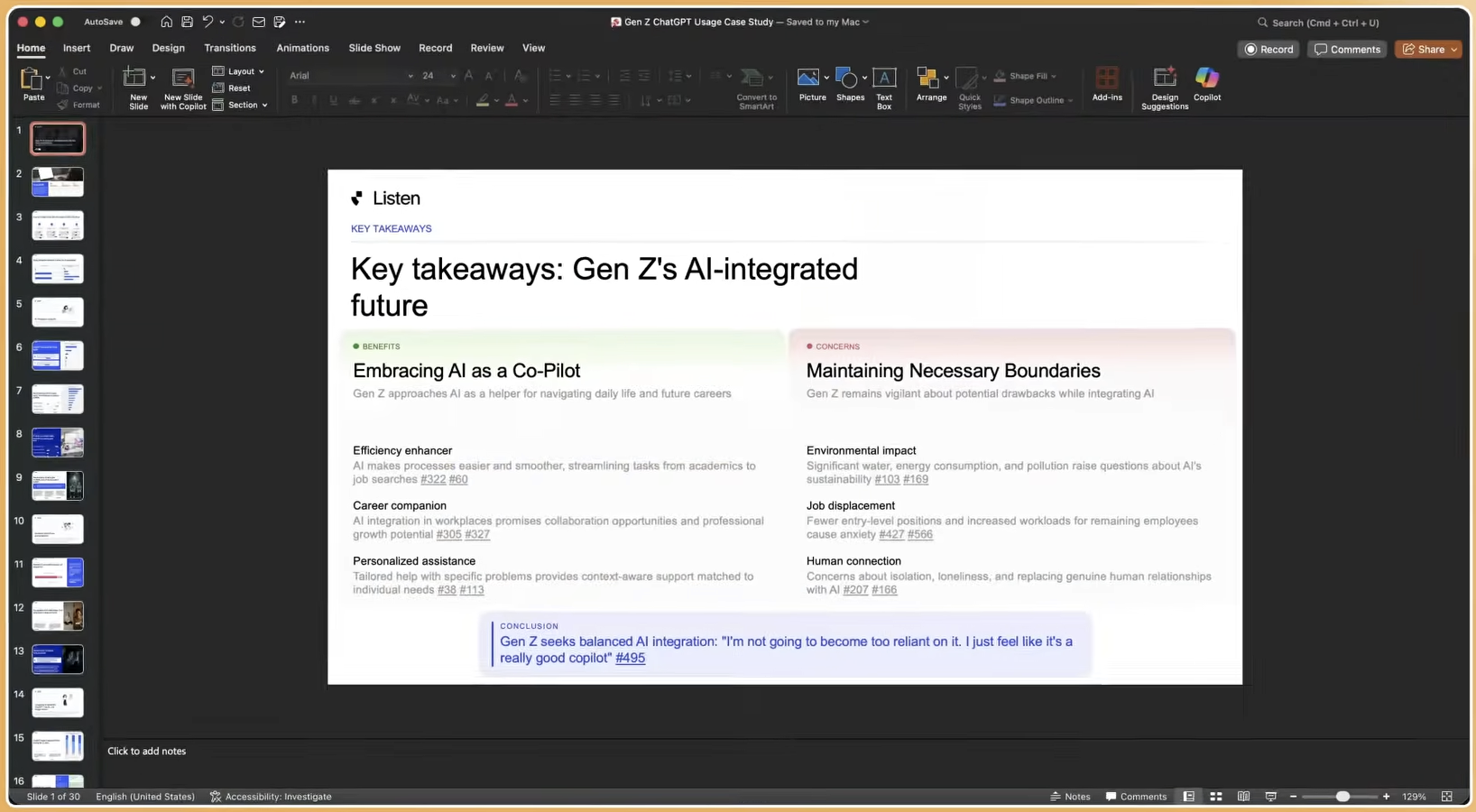
Research Agent then carries the analysis from raw data to final output. One researcher can run a full buying intent analysis across three user segments in under a minute, then refine findings through natural-language prompts. Microsoft used this infrastructure to collect global customer stories for its 50th anniversary celebration within a single day, with its Director of Data Science noting the ability to reach hundreds of users at one third of the cost. Skims validated campaign direction with thousands of high-income buyers overnight, eliminating weeks of recruiting and enabling board-level buy-in before launch.
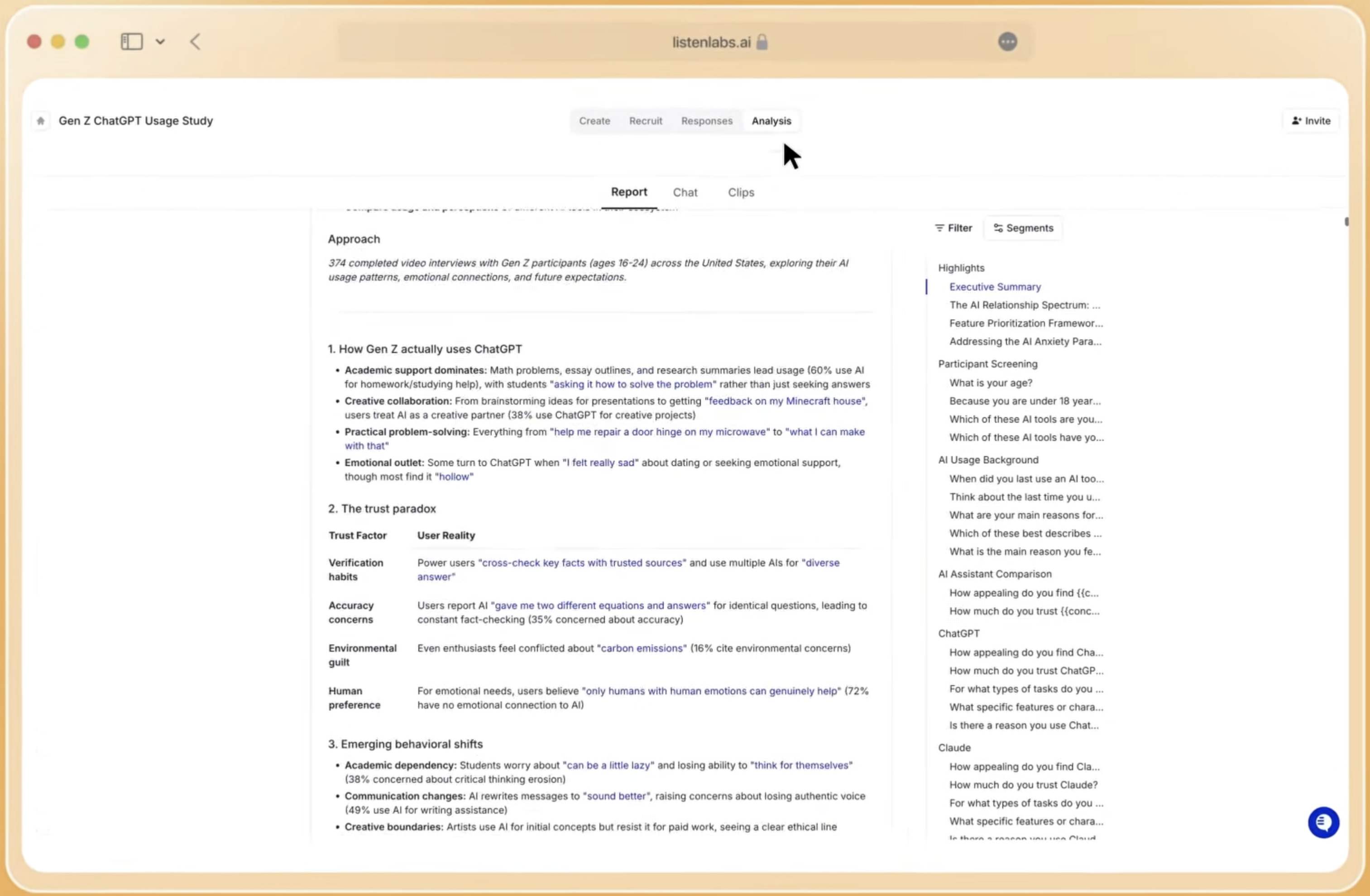
See how enterprise research teams compress 4–6 week cycles into under 24 hours. Book a demo.
Where Synthetic Data and AutoML Fit in Consumer Insights
Synthetic data for market research refers to AI-generated responses that replicate the statistical patterns, relationships, and characteristics found in real-world data, making it useful for early-stage exploration and hypothesis testing.
Researchers associate synthetic data with several distinct applications, including synthetic personas, simulated individual-level survey data, digital twins, and simulated conversations. Synthetic data performs strongest in early-stage and exploratory research such as idea screening, concept testing, pre-testing survey design, and protecting intellectual property when testing new products.
Its limitations are equally well-documented. Synthetic data is not suited for high-stakes final decisions such as go/no-go launches, detailed behavioral recall questions, deeply nuanced cultural or emotional research, or highly regulated industries requiring human-sourced data. Synthetic participants must not replace beneficiary voices because they cannot replicate lived experience.
AutoML tools reduce the technical barrier to building predictive models so research teams without data science expertise can run segmentation, churn scoring, and intent modeling directly within their analytics environments. Predictive analytics trends in 2026 include no-code and low-code predictive tools and tighter integration with operational systems like CRM and ERP.
AI Consumer Research Tools by Role in the Workflow
The competitive landscape for AI-assisted consumer research spans several distinct categories, each addressing a different segment of the research lifecycle. Understanding where each category stops explains why many enterprises still stitch together three or four tools to complete a single study.
- Quantitative survey platforms (SurveyMonkey, Qualtrics) scale efficiently but capture only surface-level data through pre-set questions with no adaptive follow-up.
- Panel and recruitment platforms (Prolific, User Interviews, Respondent) solve participant sourcing but do not conduct moderation, analysis, or delivery.
- Repository and analysis tools (Dovetail) organize past research but do not conduct new studies.
- Human-moderated platforms (UserTesting) depend on human moderators, which limits throughput and scalability.
- End-to-end AI interview platforms cover the full lifecycle, including study design, recruitment, AI-moderated interviews, analysis, and deliverables, in a single workflow.
Listen Labs has conducted over 1 million AI-powered customer interviews for companies including Microsoft, Perplexity, and Sweetgreen, and raised $69 million in a Series B funding round led by Ribbit Capital, with participation from Sequoia Capital, Conviction, and Pear VC, at a valuation over $500 million as of January 2026. Its 30M-respondent panel, Quality Guard fraud detection, and integrated Research Agent place it in the end-to-end category with one of the deepest data moats in the segment.
Key Challenges and Enterprise Solutions
Practitioner surveys have identified four operational barriers when deploying AI in market research: data quality, bias in AI outputs, privacy and compliance obligations, and integration with existing workflows.
Data quality is the foundational challenge. Poor data quality is the most commonly reported impediment to successful analytics work, affecting more than 56% of organizations. The most direct mitigation is layered fraud detection that flags low-quality or fraudulent responses before they enter the dataset. Listen Labs addresses this through Quality Guard, which applies real-time AI monitoring across video, voice, content, and device signals, combined with participant frequency limits of three studies per month.
Bias enters predictive models through unrepresentative training data. Predictive models can unintentionally encode biases from training data, affecting outputs for different demographic groups, so developers must validate fairness using tools such as SHAP or Aequitas. Listen Labs’ AI analysis engine processes all interview data consistently, identifying patterns across hundreds of responses without human confirmation bias.
Privacy and compliance obligations apply to every stage of data handling. AI processing of survey data is subject to the same privacy and compliance obligations as any other data handling, including whether respondent data is routed through external AI systems in compliance with regulations in applicable research jurisdictions. Listen Labs holds SOC 2 Type II, GDPR, ISO 27001, ISO 27701, and ISO 42001 certifications, and customer data is never used for AI model training.
Integration with existing enterprise workflows is a practical barrier. Integration is easiest when AI capability is built into the platforms researchers already use via API connections, allowing exact descriptions of how tools connect to programming platforms, what data is transmitted, and where it is stored. Listen Labs supports enterprise SSO and integrates directly into existing research and data stacks.
Frequently Asked Questions
What is AI predictive analytics in the context of consumer research?
AI predictive analytics in consumer research refers to the use of machine learning and statistical models to forecast customer behavior, segment audiences, and identify emerging trends from behavioral, transactional, and qualitative interview data. In practice, this includes churn prediction, purchase intent scoring, concept ranking, and emotion detection across large samples of AI-moderated customer interviews. The goal is to move research teams from reactive reporting to proactive decision-making.
How does Listen Labs use predictive analytics in its research platform?
Listen Labs integrates predictive and AI-driven capabilities across the full research lifecycle. Its Listen Atlas recruitment layer uses AI orchestration to match participants based on behavioral and intent data rather than self-reported demographics. During interviews, the AI moderator adapts questions in real time based on participant responses. Post-interview, the Emotional Intelligence feature quantifies emotional signals per question, and the Research Agent generates segmentation, statistical comparisons, and deliverables from natural-language queries, all within a single platform.
What are the limitations of synthetic data for consumer insights?
Synthetic data is well-suited to early-stage tasks such as survey pre-testing, idea screening, and scenario modeling, but it cannot replicate lived human experience. It is not appropriate for high-stakes go/no-go decisions, regulatory submissions, nuanced emotional or cultural research, or any context where findings are expected to represent real people’s stated views. Synthetic outputs function as hypotheses to validate with real participants, not as standalone research findings. For enterprise consumer research, human-sourced interview data remains the authoritative source of truth.
How do enterprise research teams address data quality and fraud in AI-powered studies?
Effective fraud mitigation requires layered controls applied before, during, and after data collection. Listen Labs applies three layers: exclusive use of high-quality, non-commodity panel sources; Quality Guard real-time monitoring across video, voice, content, and device signals to detect fraudulent responses and AI-generated scripts; and a dedicated recruitment operations team that adds human review for hard-to-reach segments. Participant frequency limits of three studies per month eliminate professional survey-takers. These controls operate continuously, not as a post-collection audit.
Can non-researchers use AI predictive analytics tools for customer insight work?
Yes, with the right platform design. Listen Labs allows product managers, brand managers, and marketing leaders to describe research goals in natural language and have the platform handle study design, recruitment, moderation, and analysis automatically. The Research Agent generates consultant-quality slide decks, memos, and highlight reels without requiring the user to have research methodology expertise. This extends the reach of consumer insight work beyond dedicated research teams while maintaining methodological rigor through the platform’s built-in quality controls and AI-assisted study co-design.
Conclusion
The AI predictive analytics market research landscape in 2026 is defined by rapid market expansion, maturing tooling across demand forecasting and customer behavior modeling, and a growing recognition that statistical prediction alone cannot deliver the emotional depth enterprise teams need to act with confidence. The gap between predictive models and actionable consumer insight narrows when organizations can conduct hundreds of adaptive, emotion-aware customer interviews in hours rather than weeks.
Listen Labs is the end-to-end platform built for that workflow, combining a 30M-respondent global panel, AI-moderated qualitative interviews, Emotional Intelligence analysis, and the Research Agent into a single system that delivers the consultant-quality results described earlier, typically within the same business day. Enterprises including Microsoft, P&G, Skims, and Anthropic have used it to compress research cycles by 5× and surface insights that traditional methods would have taken months to produce.
Explore Listen Labs’ 24-hour research workflow for your team. Book a demo.