
Written by: Anish Rao, Head of Growth, Listen Labs | Last updated: August 7, 2026
Key Takeaways
- AI-moderated interviews use large language models and multimodal analysis to run hundreds of adaptive qualitative conversations at once.
- Listen Labs runs a four-step workflow of study design, participant matching, AI-moderated interviews, and automated analysis that cuts research cycles from 4–6 weeks to under 48 hours.
- Layered quality controls, including real-time Quality Guard monitoring and behavioral matching, reduce fraud and keep participant standards high across global studies.
- Emotional Intelligence reads tone, word choice, and micro-expressions using Ekman’s framework, adding emotional depth beyond verbal responses alone across 50+ languages.
- Enterprise teams at Microsoft, Anthropic, and P&G have accelerated insights with Listen Labs—see how the platform can transform your next study.
The Four-Step Workflow That Compresses Research Timelines
Listen Labs executes AI-moderated research interviews through four sequential stages that remove the handoffs and delays common in traditional qualitative programs. Together, these stages compress work that usually takes 4–6 weeks into a sub-48-hour cycle while preserving methodological rigor.
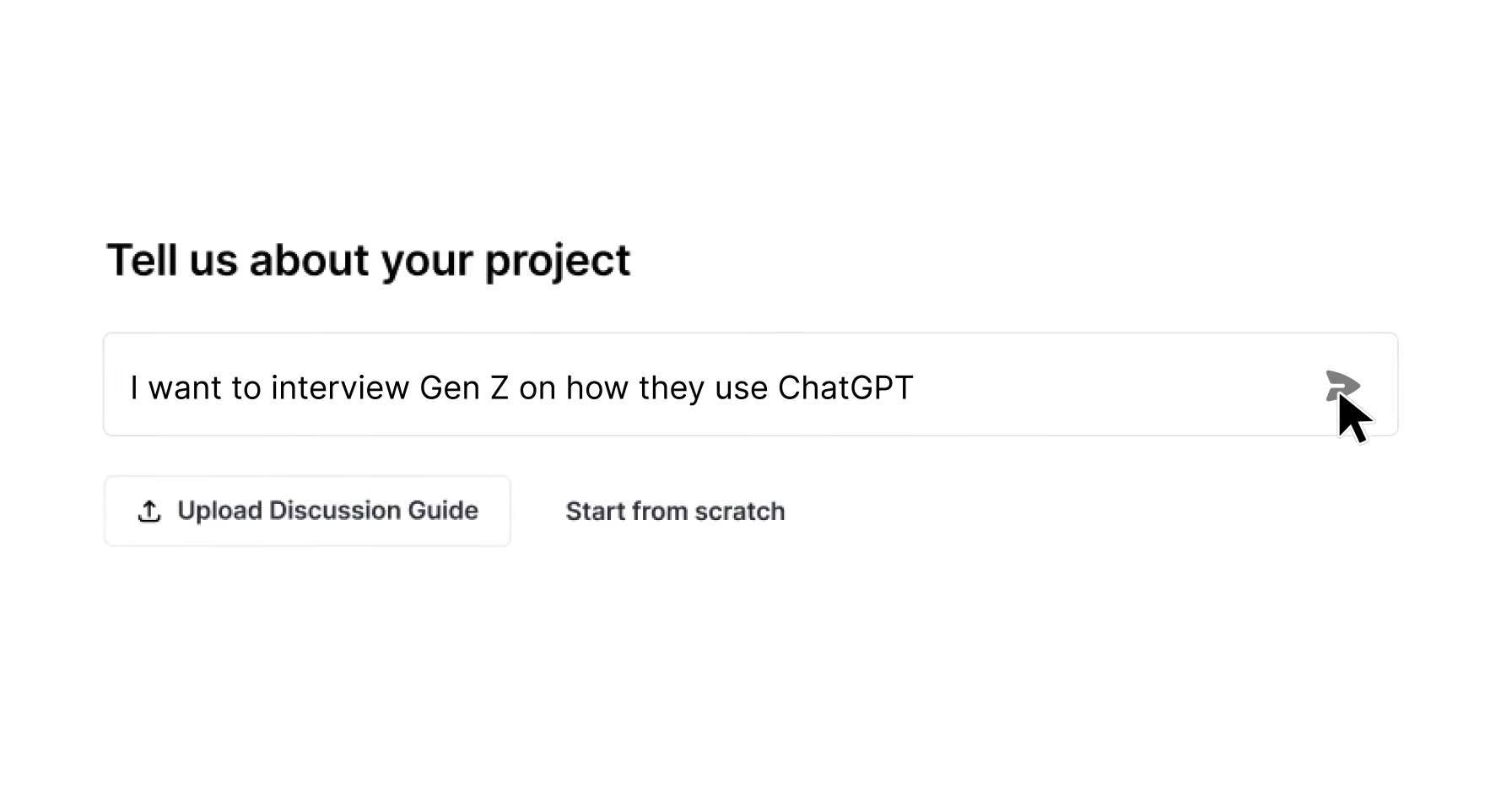
- AI-assisted study design. Researchers describe their objectives in natural language. The platform drafts structured discussion guides, probing context, and stimuli logic, including branching, skip logic, and randomization. It then runs an auto-QA pass that flags issues before launch.
- Participant matching via a 30M+ verified network. AI orchestration matches and recruits participants across behavioral and intent data, not just self-reported demographics, across 45+ countries. A dedicated recruitment ops team handles segments below 1% incidence rate.
- AI-moderated interviews with dynamic follow-ups. The AI conducts video interviews in 100+ languages and probes short or vague answers the way a trained moderator would. If a participant says a product “felt kind of off,” the AI asks what specifically felt that way and continues laddering until it captures a substantive answer. AI moderators apply real-time quality control through adaptive follow-up using researcher-defined probe rules instead of static branching logic. The AI also pursues interesting answers, probing for underlying motivations rather than simple elaboration.
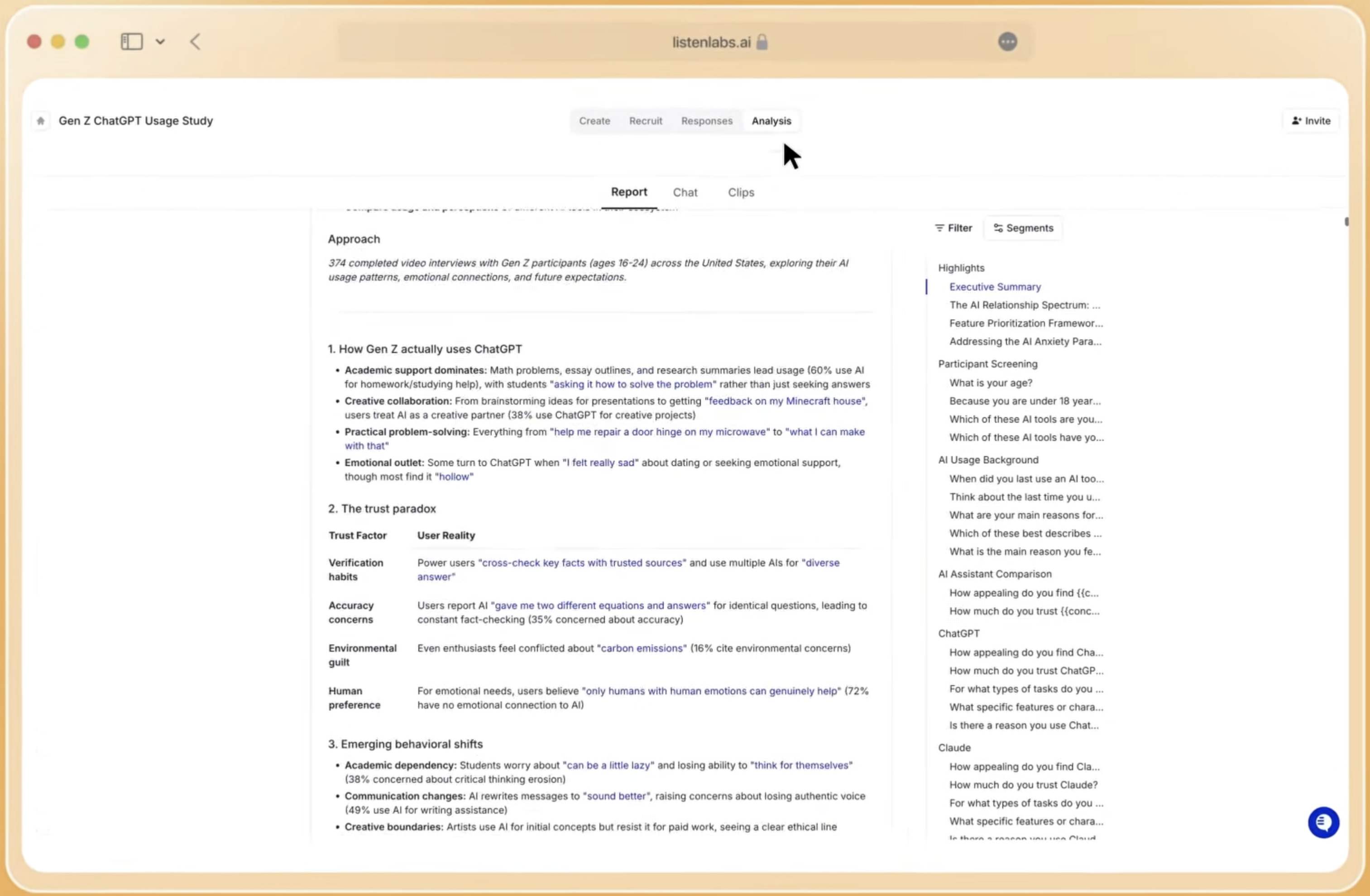
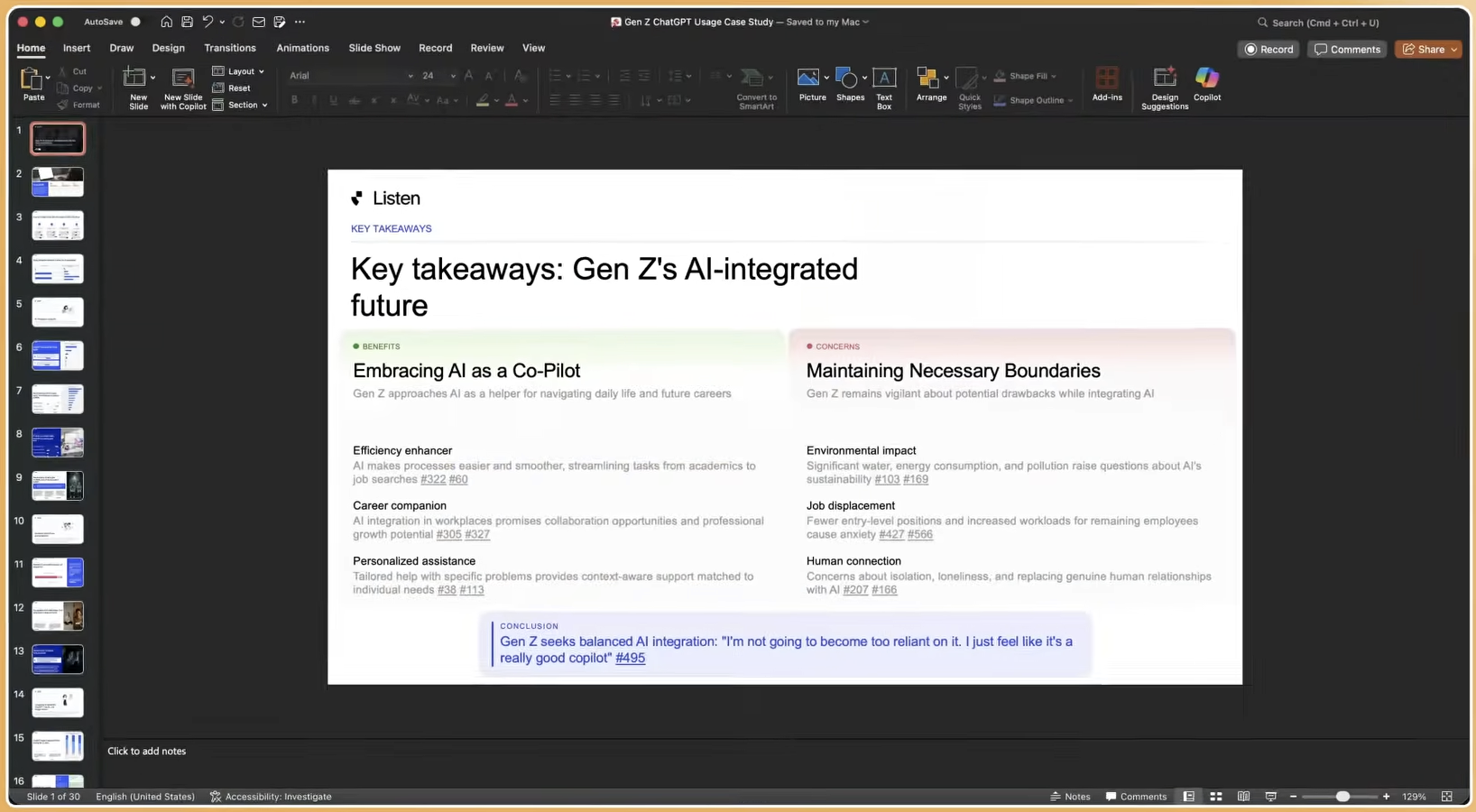
- Automated analysis and deliverables. The Research Agent handles the full analysis workflow from raw data to final output. It generates slide decks, memos, video highlight reels, statistical charts, and segmentation breakdowns, all in under 24 hours.
Enterprise teams at Microsoft, Anthropic, and P&G have used Listen Labs to achieve the sub-48-hour cycle described above.
See the four-step workflow in action on your next consumer insights study.
Real-Time Quality Guard Layers and Fraud Prevention
The four-step workflow delivers speed and scale only when participant quality stays high across hundreds of simultaneous interviews. Participant quality is a structural risk in any scaled qualitative program, so Listen Labs uses multiple controls that work together instead of a single verification gate.
Every participant is limited to three studies per month, which removes the professional survey-taker dynamic that degrades commodity panels. This frequency cap forms the first filter. Real-time monitoring then adds a second layer: Quality Guard tracks each interview session across video, voice, content, and device signals, flagging fraudulent responses, AI-generated scripts, low-effort answers, and profile mismatches before they enter the dataset. Beyond fraud detection, behavioral matching verifies participant fit by checking intent and past actions instead of relying only on self-reported demographics. For the hard-to-reach segments mentioned earlier, a dedicated recruitment ops team adds a final human review layer.
This layered approach produces a compounding advantage. Reputation scores build across every interview conducted on the platform, so panel quality improves as study volume grows. Commodity panel providers cannot replicate this flywheel.
Capturing Emotional Signals with Ekman's Framework
Beyond ensuring participant quality, Listen Labs captures a dimension of insight that traditional interviews often miss: the emotional signals beneath verbal responses. Listen Labs' Emotional Intelligence analyzes three simultaneous signal layers: tone of voice, word choice, and subconscious micro-expressions. What participants say and what they feel often diverge. Two concepts may both receive positive verbal ratings while triggering very different emotional responses.
The system is built on Ekman's universal emotions framework, the standard used in clinical psychology and UX research, tracking anger, anticipation, disgust, fear, joy, sadness, trust, and surprise. Every emotion label links to the exact timestamp, verbatim quote, and AI reasoning behind it. A researcher can ask which concept triggered the most confusion, receive a side-by-side emotional breakdown across stimuli and segments, and pull a highlight reel of the moments that drove that signal, all through natural-language queries.
Emotional Intelligence is available across 50+ languages and connects directly to the Research Agent for chart generation, report creation, and cross-study trend analysis.
Human Versus AI Trade-Offs in Depth, Speed, and Rigor
Independent research has shown AI voice interviews scoring highly against text-chat expert benchmarks and comparably against face-to-face ones, with trained human sociologists scoring similarly on the same 1–5 scale. AI-moderated interviews also produced higher word counts than open-text survey responses.
Human moderators can conduct only 4–6 depth interviews per day before fatigue degrades quality, while AI moderators run hundreds of interviews simultaneously with full adaptive probing and no fatigue effects. AI-moderated interviews deliver equal or superior results to human moderation for 85–90% of qualitative research objectives, including customer discovery, concept testing, churn analysis, journey mapping, and brand perception research.
Human moderators retain an advantage in a defined set of contexts: trauma-adjacent topics involving grief or addiction, C-suite interviews where participants expect senior human rapport, and deeply ethnographic studies requiring cultural membership. For the remaining 85–90% of enterprise consumer insights use cases, AI moderation delivers comparable depth at much greater speed and consistency.
Anthropic used Listen Labs to complete 300+ user interviews in 48 hours, surfacing churn drivers 5x faster than previous methods. P&G completed 250+ interviews with quantified themes and verbatim proof in hours, directly shaping product and brand strategy before market launch.
Enterprise Security and Compliance Standards
Listen Labs holds SOC 2 Type II, ISO 27001, ISO 27701, ISO 42001, and GDPR certifications. All data is encrypted at 256-bit, and customer data is never used for AI model training. Enterprise SSO is supported. These certifications cover the full research lifecycle, from participant data collected during recruitment through interview recordings, transcripts, and generated deliverables. Teams gain a single compliance perimeter instead of running separate vendor assessments for each stage of the research process.
Addressing Bias in AI-Moderated Interviews
AI moderation changes the shape of bias rather than removing it entirely. Human moderators introduce unconscious biases through question framing, selective follow-up, nonverbal cues, and confirmation bias that varies by session. AI-moderated interviews can introduce different biases than human ones, but protocol design and model testing make these biases more controllable than the variable effects of human interviewer mood, fatigue, or rapport.
AI moderation removes interviewer expectation bias, social desirability pressure, moderator fatigue, and leading questions, which produces consistent probing quality across hundreds of interviews and measurably less variance between sessions than human moderation. Listen Labs' discussion guide auto-QA flags leading or ambiguous questions before launch. The Research Agent's analysis engine then processes all interview data without the confirmation bias that affects human analysts reviewing transcripts they helped collect.
Handling Cultural Nuance Across Global Studies
Listen Labs supports 100+ languages for interview moderation with automatic translation and transcription. The platform covers 45+ countries across the Americas, Europe, APAC, and MEA, and the Listen Atlas network localizes participant recruitment to each market.
AI moderation supports 50+ languages with culturally adapted conversational styles, which provides adequate cultural competence for most commercial cross-cultural research. Emotional Intelligence extends the language coverage described above to emotional signal capture, so tone and micro-expression analysis are not limited to English-language studies. For studies that require deep cultural embeddedness, such as academic ethnography involving community-specific metaphors or generational references, a hybrid model that pairs AI breadth interviews with targeted human deep dives is the more appropriate design.
Overcoming Shallow Responses Through Adaptive Probing
Shallow responses threaten the value of any scaled interview program. AI can schedule and conduct the interview, analyze transcripts for themes, and generate quantitative insights from qualitative interviews only when the underlying responses have enough depth to support analysis.
Listen Labs addresses this risk through multi-level follow-up mechanics. The AI identifies short or vague answers in real time and applies researcher-defined probe rules to request elaboration, specificity, or examples before it moves to the next question. AI-moderated interviews reach 5 to 7 levels of probing depth using structured frameworks like laddering and Jobs-to-be-Done. Consistency checks verify that each response meets a relevance and completeness threshold before the conversation advances. Human moderators apply this type of control inconsistently across a long field period.
Thirty-two percent of participants explicitly state they feel less judged with AI moderation, which reduces the social desirability pressure that produces shallow or socially acceptable answers instead of honest ones.
Limitations of AI-Moderated Research Interviews
AI-moderated interviews are not appropriate for every research context. The limitations mentioned earlier, including trauma-adjacent topics, C-suite interviews, and deep cultural embeddedness, apply regardless of platform, along with two additional constraints:
- Completely unstructured exploratory research. Studies that require abandoning the discussion guide entirely based on unexpected participant disclosures work better with skilled human moderators who can improvise without protocol constraints.
- Physiological signal capture. Physiological signals such as EEG, ECG, and EMG offer a more objective window into internal affective states than facial expressions or speech. Video-based AI moderation cannot capture these signals.
Next Steps for Consumer Insights Teams
Teams evaluating AI moderation for enterprise use can structure an internal assessment around a simple sequence of checks. Start with current performance, then evaluate fit, quality controls, compliance, and finally run a live comparison.
- Audit current research cycle time from brief to final deliverable and identify where delays accumulate.
- Identify the three to five study types that represent the highest volume of internal requests and assess whether they fall within the 85–90% of objectives suited to AI moderation.
- Review existing participant sourcing for fraud controls, frequency limits, and behavioral verification.
- Confirm that any platform under evaluation holds SOC 2, ISO 27001, and GDPR certifications and does not use customer data for model training.
- Run a pilot study on a current backlog item and compare turnaround time, response depth, and deliverable quality against the most recent equivalent human-moderated study.
Walk through a pilot study design with the Listen Labs research team and receive a same-day proposal for your highest-priority backlog item.
Frequently Asked Questions
Is the AI interviewer capable of matching the quality of a trained human researcher?
For most enterprise consumer insights use cases, including concept testing, brand perception, churn analysis, customer discovery, and journey mapping, AI moderation delivers methodological rigor comparable to a skilled human moderator with greater consistency across sessions. Listen Labs' in-house research team, with 50+ years of combined expertise, continuously reviews and refines the methodology. The platform applies identical probing depth to every participant, which removes the moderator drift and fatigue that degrade quality in large human-moderated studies. Human moderators still hold an advantage in trauma-adjacent research, senior executive interviews, and deeply ethnographic studies, which represent a minority of enterprise research programs.
How does Listen Labs prevent fraudulent or low-quality participants from entering a study?
Three simultaneous control layers operate on every study. First, Listen Labs works exclusively with high-quality, non-commodity panel sources and limits each participant to three studies per month, which removes professional survey-takers. Second, Quality Guard monitors every interview session in real time across video, voice, content, and device signals and flags fraudulent responses, AI-generated scripts, and profile mismatches before they enter the dataset. Third, a dedicated recruitment ops team adds human review for hard-to-reach segments. Behavioral matching verifies participant fit against intent and past actions rather than self-reported demographics alone.
What deliverables does Listen Labs produce, and how quickly?
The Research Agent generates a full set of stakeholder-ready outputs within 24 hours of study completion. Outputs include automated key findings and thematic analysis, consultant-quality PowerPoint slide decks, memo-style reports, video highlight reels, statistical charts, segmentation breakdowns, and custom reports answerable through natural-language queries. Every insight links directly to the underlying response data, so teams can verify findings without returning to raw transcripts. Microsoft collected global customer video stories for its 50th anniversary celebration within a single day using this workflow.
Can Listen Labs support multi-market studies with participants across different languages and cultures?
Listen Labs supports 100+ languages for interview moderation with automatic translation and transcription and recruits participants across 45+ countries through the Listen Atlas network. Emotional Intelligence extends emotional signal capture to 50+ languages, so tone and micro-expression analysis is available in non-English studies. For studies that require deep cultural embeddedness beyond commercial cross-cultural research norms, a hybrid design that pairs AI breadth interviews with targeted human deep dives is recommended. The dedicated recruitment ops team handles localized sourcing for hard-to-reach segments in each market.