Written by: Anish Rao, Head of Growth, Listen Labs
Key Takeaways
- AI brand tracking pricing ranges from $9/month for basic visibility tools to $10,000+/month for enterprise platforms. Conversational trackers like Listen Pulse use subscription pricing tied to participant volume.
- Two main categories exist. AI visibility monitoring tracks brand mentions in LLM outputs. Conversational brand tracking delivers continuous consumer research that combines quantitative KPIs with qualitative insight.
- Six primary cost drivers shape pricing: prompt volume, platforms tracked, update frequency, user seats, analytics depth, and customization needs. Qualitative analysis depth creates the largest value gap between tools.
- Effective selection depends on defining must-have features, checking data accuracy methods, evaluating insight depth, reviewing scalability, and running pilots with real queries.
- Listen Labs’ Listen Pulse delivers both metrics and the “why” behind brand perception changes through AI-moderated interviews. See how it transforms your brand tracking by booking a demo.
How AI Brand Tracking Works And Why It Matters
AI brand tracking replaces periodic, wave-based brand surveys from providers such as Kantar or YouGov BrandIndex with continuous, always-on intelligence. Brands receive ongoing signals about how consumer perception shifts instead of waiting weeks for a quarterly report.
Two distinct categories sit under “AI brand tracking,” and many buyers conflate them:
- AI Visibility Monitoring tracks how often and how favorably a brand appears in LLM outputs from ChatGPT, Perplexity, Gemini, Claude, and similar engines. Tools in this category answer: “Does AI mention us?”
- AI-Powered Conversational Brand Tracking conducts continuous consumer research through AI-moderated interviews. It combines quantitative KPIs with open-ended qualitative responses at scale. Tools in this category answer: “What do consumers actually think about us, and why?”
These categories serve different purposes and carry different price points. The sections below address both.
AI Brand Tracking Pricing Tiers For Visibility Tools
The following tier structure applies primarily to AI visibility monitoring tools, based on published pricing verified in August 2026. Prices change frequently, so confirm current rates directly with each vendor.
Entry-Level Tools ($9–$49/Month) cover basic mention tracking on a limited number of platforms for solo founders and small businesses. AEO Vision’s Lite plan starts at $9/month for 30 prompts on ChatGPT with updates every three days. Otterly.AI’s Lite plan is $29/month for 15 prompts. Sight AI’s Starter plan is $49/month for 1,500 AI credits, 1 site, and 10 tracked prompts.
Mid-Range Tools ($79–$250/Month) add sentiment analysis, more platforms, and higher prompt volumes. Trackerly’s Growth plan starts at $97/month, tracking seven AI engines on a credit model. Semrush AI Visibility is a $99/month add-on that requires a base Semrush subscription. Sight AI’s Pro plan starts at $129/month for 5,000+ credits and 50 tracked prompts.
High-End Tools ($300–$745/Month) deliver advanced analytics, custom reporting, and broader engine coverage. Profound’s Growth plan is $399/month (billed annually), covering three answer engines and 9,000 responses monthly. Sight AI’s Advanced plan starts at $499/month for 25,000+ credits and 250 tracked prompts.
Enterprise Custom ($1,000–$10,000+/Month) unlocks full-featured platforms with dedicated support, custom integrations, and high-volume tracking. Profound’s Enterprise tier is custom-quoted, while Evertune starts at $3,000/month with mandatory annual contracts.
AI-powered conversational brand trackers like Listen Labs’ Listen Pulse use a different model. They rely on subscriptions with credits tied to participant volume, because they deliver continuous consumer research with qualitative depth alongside quantitative KPIs.
What Factors Affect AI Brand Tracking Pricing?
Six primary cost drivers determine where a tool falls on the pricing spectrum:
- Volume of Prompts or Queries reflects the number of brand mentions or AI searches processed monthly. Prompt volume and platform breadth are the primary pricing levers across tools such as AEO Vision, Peec, and Scrunch.
- Number of Platforms Tracked covers ChatGPT, Perplexity, Gemini, Claude, Google AI Mode, social media, news, and review sites. Some engines like Gemini and Google AI Mode are paid add-ons rather than included in base plans.
- Frequency of Data Updates ranges from real-time to daily or weekly refresh cycles. AI answer engines are volatile. In a July 2026 measurement, the top-recommended brand changed between identical runs 44% of the time on Gemini, 43% on Perplexity, 35% on ChatGPT, and 28% on Claude. This makes refresh frequency a meaningful accuracy variable.
- Number of User Seats varies widely. Peec AI offers unlimited seats on every plan, while Semrush charges per user and Profound’s $99 Starter covers a single seat.
- Depth of Analytics spans basic sentiment through advanced emotion AI, predictive insights, and qualitative analysis. This dimension often receives little attention in comparison guides, yet it creates the largest value gap between tools.
- Customization and Integrations include API access, custom dashboards, CRM integration, and white-label reporting. Historical data access beyond 30 or 90 days, paywalled integrations, and export limits are common hidden costs that inflate total cost of ownership.
For conversational brand trackers, the primary cost driver shifts to the number of consumer interviews or responses analyzed per wave. This differs from prompt-based pricing and matters when comparing tools across categories.
How To Compare AI Brand Tracking Tools On Price And Accuracy
Price alone rarely produces the right choice, so a five-step framework works better:
- Define Must-Have Features First by listing platforms, refresh frequency, reporting format, and integration requirements before reviewing price.
- Assess Data Accuracy Methodology by confirming that the most accurate tools query LLM APIs directly across multiple sessions to account for model temperature and randomized outputs. Single-query tools produce volatile, unreliable baselines.
- Evaluate Insight Depth by checking whether the tool explains why a metric moved or only that it moved. A dashboard showing a 5-point awareness drop helps only when it reveals what drove the change.
- Check Scalability And Hidden Costs by reviewing whether hybrid pricing models combining a platform fee with usage-based overages stay affordable as tracking needs grow. Ask vendors for cost projections at 2x and 3x expected usage.
- Run A Pilot With Real Queries by testing your actual brand and competitor queries, validating sentiment accuracy, and confirming that outputs are usable without heavy manual reformatting.
Ask each vendor directly whether the platform will explain the drivers behind a 5-point metric drop or only report that the change occurred.
Top AI Brand Tracking Tools Compared
Trackerly starts at $97/month on its Growth plan, tracking seven AI engines on a credit model with an API for data export. It offers only a trial, with no permanent free tier. Trackerly works best for teams focused purely on AI visibility monitoring that need daily multi-language tracking.
Sight AI runs from $49/month at Starter to $2,699/month at the top Advanced credit tier, combining visibility tracking with content generation via more than 13 specialized agents. Its credit-based pricing is shared across articles, visibility checks, and outreach drafts, which makes costs less predictable than flat-tier pricing. Sight AI suits marketing teams that want tracking plus content action in one platform.
If you need deeper analytics and broader engine coverage, Profound uses annual-only pricing from $99/month (ChatGPT only, 1 seat) to $399/month for the Growth plan covering three engines. Enterprise pricing is custom-quoted. Profound fits enterprises that need deep AI visibility analytics with wide engine coverage.
Semrush AI Visibility is a $99/month add-on that requires a base Semrush subscription. It covers roughly four engines (ChatGPT, Google AI, Gemini, Perplexity) with weekly data refreshes, though some sources describe coverage as limited to 3–4 LLMs. Semrush AI Visibility works best for teams already invested in the Semrush ecosystem that want to add AI visibility without switching platforms.
Otterly.AI offers Lite at $29/month, Standard at $189/month, and Premium at $489/month. It is a recognized affordable option and a G2 High Performer but lacks native Claude, Grok, and Meta AI coverage. Otterly.AI fits budget-conscious SMBs tracking a focused set of prompts.
Listen Labs (Listen Pulse) operates on a subscription model with credits based on participant volume. Pulse functions as a conversational tracker that runs the same study across waves and analyzes tens of thousands of open-ended responses. It combines quantitative KPIs with qualitative “why,” and every metric traces back to a real consumer quote or video clip. Consider a well-known clothing brand famous for its big logos that was quietly losing customers. Its old tracker caught the drop but could not explain it. Pulse found the cause was style, not price, because a growing group of customers felt the big logos were too loud for their changing lifestyles. Pulse works best for brands that need to understand what is happening with their brand metrics and the reasons behind those movements.
Ready to see Pulse in action? Schedule a Live Demo and find out what your brand metrics are not telling you.
How To Budget For AI Brand Tracking
Effective budgeting starts with objectives and the decisions you need to support. The following principles apply regardless of company size:
- Start With The Decisions The Tracking Will Inform so you avoid paying for a tool that cannot answer your real business questions, regardless of price.
- Calculate The Cost Of Inaction by estimating the impact of a brand perception shift that goes undetected for two quarters before appearing as a KPI decline.
- Compare Against Traditional Research Costs using benchmarks such as a single wave of traditional brand tracking typically costs $50,000–$250,000 and takes 8–16 weeks from field start to insight (including field time of 3–6 weeks plus 2–4 weeks for analysis). AI-powered tracking delivers continuous insight at a fraction of that cost.
- Factor In Total Cost Of Ownership by including setup fees, overage charges, per-site fees, training costs, and contract lock-ins. In 2026, AI vendors increasingly use hybrid models that layer base seat fees, expiring credit bundles, and metered overage charges, which makes sticker prices misleading.
- Ask For Cost Projections At Scale by requesting vendor estimates at 2x and 3x your expected usage before signing any contract.
When comparing options, note that Listen Labs’ subscription model with credits tied to participant volume offers enterprises more predictable budgeting than per-query pricing from visibility tools, where costs scale unpredictably with monitoring scope.
Common Mistakes To Avoid When Choosing AI Brand Tracking
- Choosing Based Solely On Price can lead to gaps in platform coverage, inaccurate data from single-query methods, or dashboards that lack the analytical depth to support real decisions.
- Confusing AI Visibility Monitoring With Brand Tracking creates mismatched expectations. Tracking LLM mentions differs from understanding consumer brand perception, and both categories provide value in separate ways.
- Overlooking The Need For Qualitative Insight creates risk because a metric drop without an explanation leads to wrong decisions, since numbers without context are a liability rather than an asset.
- Ignoring Data Accuracy Methodology undermines trust. Tools that run single queries get volatile results. As discussed earlier, AI answers are volatile between identical runs, so repeated sampling is the minimum standard for reliable tracking.
- Skipping A Pilot removes your chance to validate performance. Always test with real brand and competitor queries before committing to an annual contract.
Why Listen Labs Stands Out For AI Brand Tracking
Listen Labs goes beyond simple visibility monitoring by conducting conversational interviews at scale and handling the entire research lifecycle from study design through recruitment, moderation, analysis, and delivery.

Listen Pulse builds on this approach by keeping core questions constant across waves to preserve a clean trend line. It adds timely questions about new campaigns and competitors without breaking historical comparability, and it surfaces trends and the “why” behind metric changes.
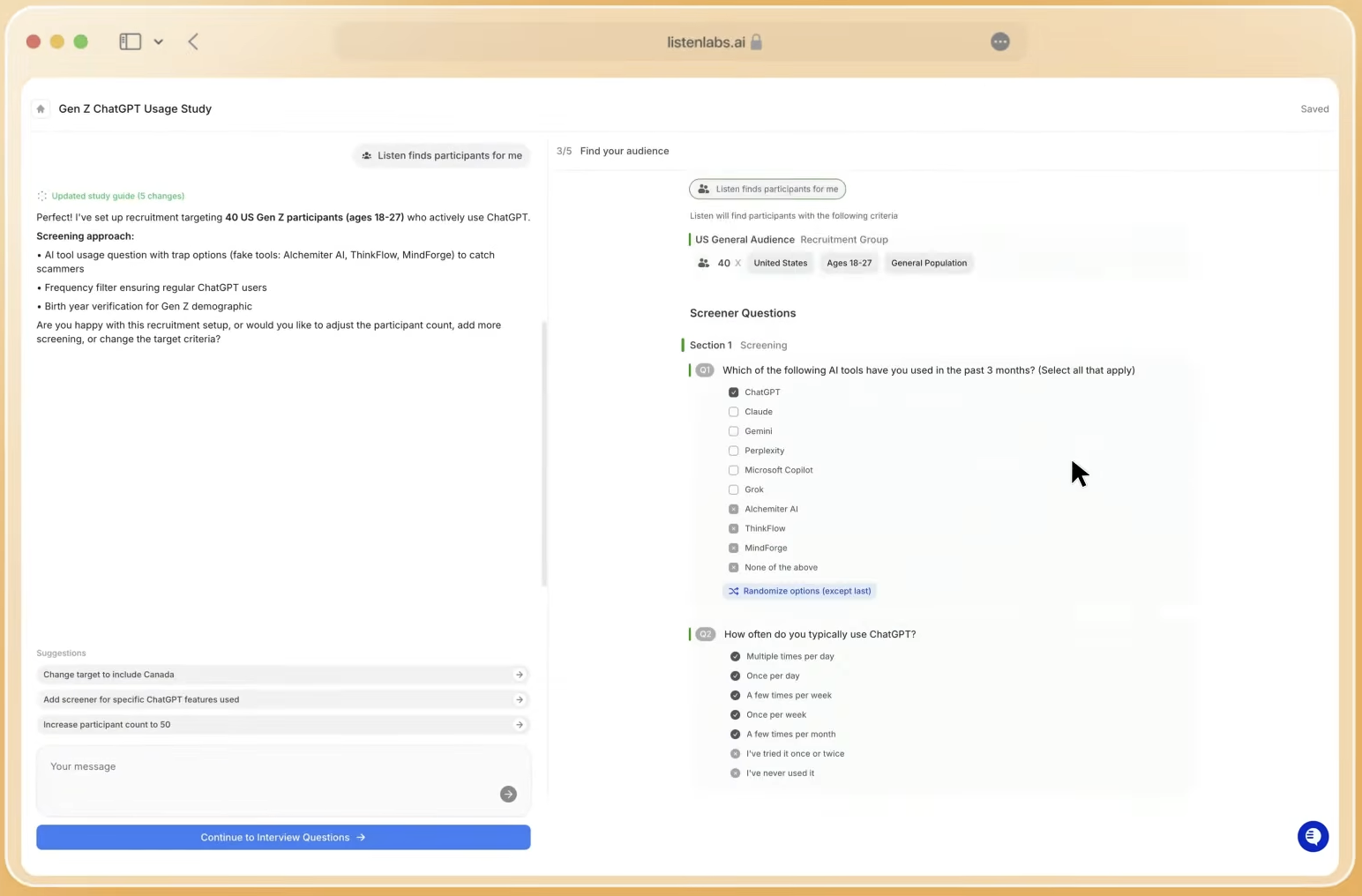
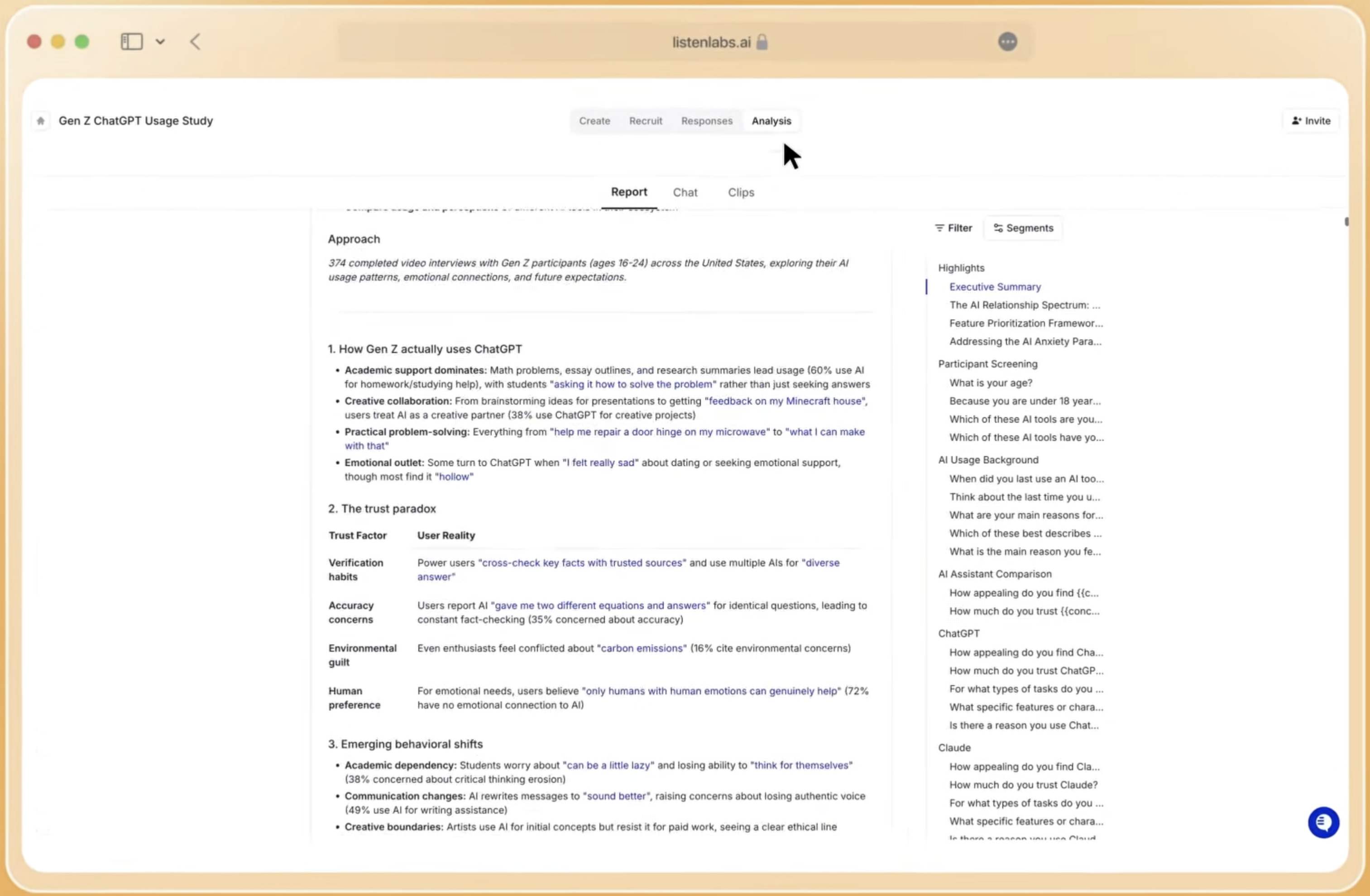
Traditional trackers such as Kantar or YouGov BrandIndex report that a number moved, but they carry no diagnostic for why. Pulse, by contrast, delivers the metric change and the reason behind it in the same wave. It can do this because every number traces back to the interview, verbatim quote, and audio or video clip behind it. Pulse also identifies emerging themes in consumer conversations before they show up as KPI declines, which gives brands an early warning system that lagging indicators cannot provide.
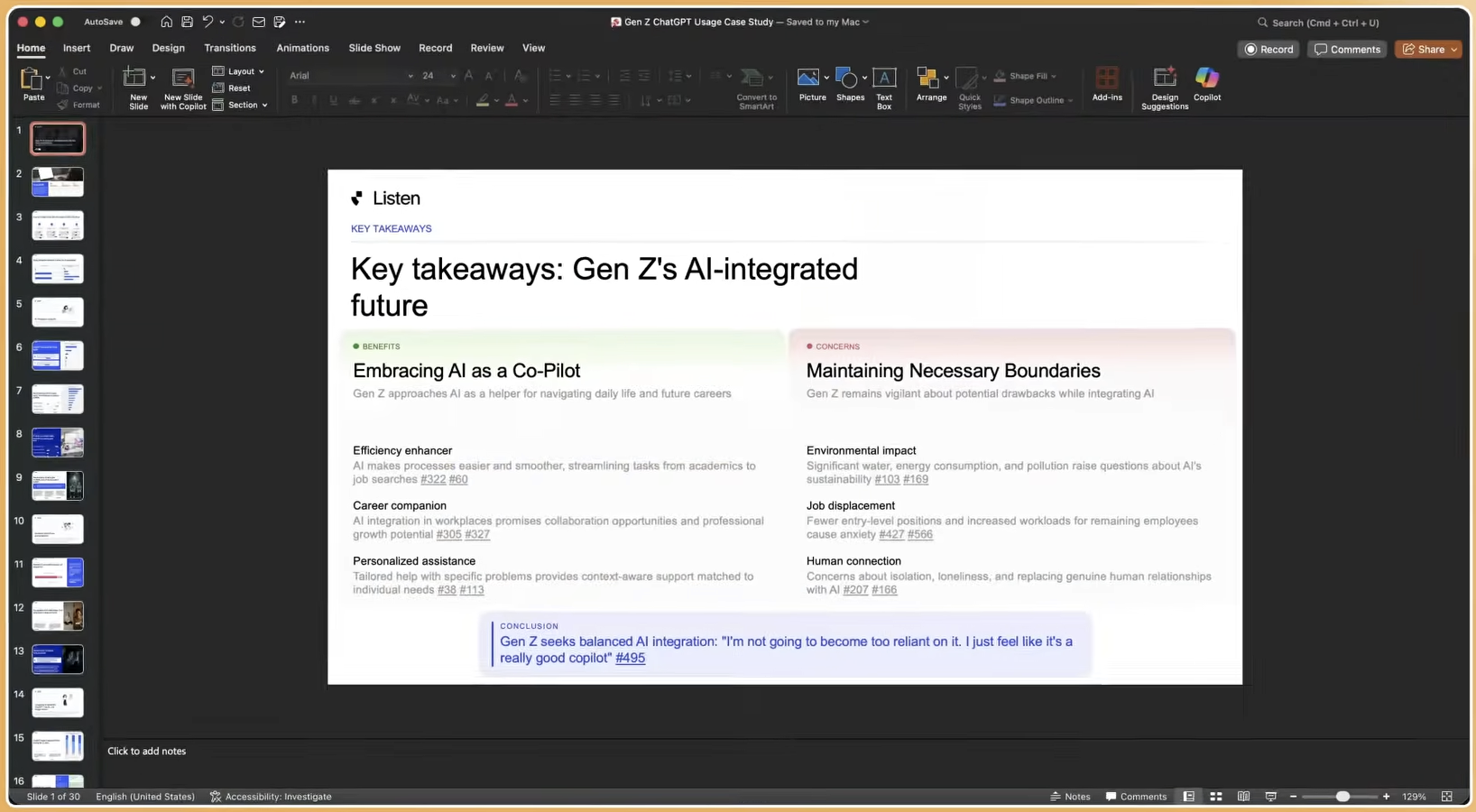
The platform integrates with Qualtrics and Decipher, so teams keep the KPIs they already report while adding the narrative behind them. It deploys alongside an existing tracker or as the primary tracking system.
Listen Labs has conducted over 1 million AI-moderated customer interviews and serves roughly 15% of the Fortune 100, including Microsoft, Google, Sweetgreen, and P&G. The company raised a $69 million Series B led by Ribbit Capital in January 2026 at a valuation above $500 million, following 15x annualized revenue growth to eight figures in nine months.
Pricing uses a subscription model with credits based on participant volume. Enterprises go through a demo and pilot process to receive current pricing tailored to their research objectives and audience requirements.
If your brand metrics moved last quarter and you still do not know why, your tracker is failing your team. Book A Demo With Listen Labs and see how Pulse delivers the insight your old tracker cannot.
Frequently Asked Questions
How Much Does AI Brand Tracking Cost Per Month?
AI brand tracking costs range from $9/month for entry-level visibility monitoring tools to $10,000+/month for enterprise platforms. Entry-level tools ($9–$49/month) cover basic mention tracking on one to two platforms. Mid-range tools ($79–$250/month) add sentiment analysis and broader engine coverage. High-end tools ($300–$745/month) deliver advanced analytics and custom reporting. Enterprise platforms ($1,000–$10,000+/month) include dedicated support, custom integrations, and high-volume tracking. AI-powered conversational brand trackers like Listen Labs’ Listen Pulse use subscription pricing with credits based on participant volume, so contact Listen Labs directly for current pricing.
What Is The Difference Between AI Visibility Monitoring And AI Brand Tracking?
AI visibility monitoring tracks how often and how favorably a brand appears in LLM outputs from tools such as ChatGPT, Perplexity, and Gemini. It answers the question: “Does AI mention us?” AI-powered conversational brand tracking conducts continuous consumer research through AI-moderated interviews and combines quantitative KPIs with open-ended qualitative responses. It answers: “What do consumers actually think about us, and why?” Both categories are valuable, yet they serve different purposes and are priced differently. Many buyers purchase a visibility monitoring tool expecting brand health intelligence and receive only citation data instead.
What Factors Affect AI Brand Tracking Pricing?
Six key factors drive AI brand tracking costs: (1) volume of prompts or queries processed monthly, (2) number of platforms tracked, since some engines are paid add-ons rather than included in base plans, (3) frequency of data updates, because real-time monitoring costs more than weekly refreshes, (4) number of user seats, which varies widely across vendors, (5) depth of analytics, from basic sentiment scoring to qualitative analysis and emotion AI, and (6) customization and integration needs, including API access, historical data retention, and white-label reporting. For conversational brand trackers, the primary cost driver is the number of consumer interviews or responses analyzed per wave rather than prompts queried.
What Hidden Costs Should I Watch For In AI Brand Tracking Tools?
Common hidden costs include setup fees, overage charges when usage exceeds the bundled allowance, per-site or per-brand fees that compound quickly for agencies managing multiple clients, charges for historical data access beyond 30 or 90 days, paywalled API access, export limits, and separate charges for advanced analytics or priority support. Annual billing typically saves 15–20% but requires upfront commitment. Hybrid pricing models that combine a base subscription with metered overages are increasingly common in 2026 and can make total cost of ownership difficult to predict without asking vendors for cost projections at 2x and 3x expected usage.
Is AI Brand Tracking Worth The Investment?
AI brand tracking is worth the investment when the tool matches the right objective. As noted earlier, traditional tracking is expensive and slow, costing $50,000–$250,000 per wave and taking 8–16 weeks, so AI-powered alternatives offer a compelling value. AI visibility monitoring tools pay off for brands that need to understand and improve their presence in LLM outputs. Conversational brand trackers like Listen Pulse pay off for brands that need to understand consumer perception shifts before they appear as KPI declines and that need the qualitative explanation behind every metric movement. The cost of inaction, such as missing a brand perception shift for two quarters, typically exceeds the annual cost of any tracking platform.