
Written by: Anish Rao, Head of Growth, Listen Labs
Key Takeaways
- AI customer feedback analysis sorts and scores open-ended responses at scale but does not explain why customers feel a certain way or what they will do next.
- Three structural gaps – say-do disconnect, missing emotional signals, and the why gap – limit how far passive feedback dashboards can drive decisions on their own.
- Brands can use AI feedback analysis to surface themes and prioritize issues, then run AI-moderated conversational research to uncover motivations and close the say-do gap.
- Listen Labs combines AI-moderated interviews, emotional-intelligence capture, and automated deliverables to turn insights into decisions at a speed passive dashboards cannot match.
- Ready to move from sorting feedback to truly understanding it? See how Listen Labs closes the why gap.
The Feedback Stack That Produces Numbers Without Reasons
Brand and insights leaders face more customer feedback than any team can manually process. Every channel, including surveys, reviews, support tickets, social comments, and open-ends, generates constant signal. AI customer feedback analysis tools make it faster to sort and score that signal. They still leave teams with the hard part of turning those scores into decisions.
The core tension is this: sorting produces a score, not an explanation. A dashboard that shows sentiment dropped three points or that “shipping” is trending negative has done real work. But it leaves you without the reason, the affected customers, or the next step before the next quarter’s numbers arrive.
This guide serves brand and insights leaders evaluating AI customer feedback analysis. It explains how the technology works, names its structural blind spots, and provides a decision framework for when to analyze existing feedback versus when to run new AI-moderated conversational research.
How AI Customer Feedback Analysis Works
AI customer feedback analysis relies on three core mechanisms.
Sentiment tracking measures whether a customer feels positive, negative, or neutral about your brand or a specific interaction. Modern transformer and LLM-based systems exceed 96% accuracy on clean, single-topic benchmark text but fall to roughly 79% on messy, real-world customer feedback containing sarcasm, mixed topics, and ambiguous phrasing. Rule-based lexicon systems, still common in high-volume triage applications, fall to roughly 44% accuracy on messy real-world data, a range some studies describe as barely better than chance once sarcasm is heavily present.
Topic clustering or theme detection identifies repeating words or complaints such as “shipping delay,” “broken zipper,” or “onboarding confusion,” then groups them into themes. This is where AI feedback analysis delivers its clearest operational value. It surfaces what customers are talking about at a scale no human team can match.
Multi-source data merging pulls feedback from social media, emails, chat logs, and review platforms into a unified dashboard. Teams gain a consolidated view of customer sentiment across channels.
These three mechanisms still miss the conversational follow-up layer. They do not perform the adaptive probing that surfaces why a theme is emerging, the emotional signal that separates genuine enthusiasm from polite tolerance, or the behavioral context that reveals whether what customers say matches what they actually do.
What AI Customer Feedback Analysis Misses
The limitations of passive feedback analysis are structural. Three gaps consistently undermine the decisions brands try to make from feedback dashboards alone.
The Say-Do Gap
Customers regularly say one thing and do another because stated intent and real behavior are generated by different cognitive processes. A widely cited Harvard Business Review study found that 65% of consumers said they wanted to buy from purpose-driven brands that support sustainability, yet only about 26% actually followed through with a purchase, a 39-point gap between stated intention and actual behavior.
AI that only reads text cannot catch this gap. It scores what customers wrote, not what they did. NielsenIQ’s 2026 research found that the disconnect between what consumers say they value and what they actually buy has cost the industry more than 13 billion unit sales over the past five years. Passive feedback analysis has no mechanism to surface this divergence.
Emotional Signal
Tone of voice, hesitation, and micro expressions never appear in transcripts. Two customers can both leave positive ratings while having fundamentally different emotional reactions to the same product or campaign.
Imagine testing two new ads. Both get positive ratings. For one, pupils widen, eyebrows lift, and smiles appear in seconds. The other elicits flat, even confused expressions. Transcripts alone miss this entirely. The difference between genuine delight and polite tolerance drives brand decisions, and passive analysis cannot see it.
The Why Gap
Theme detection shows that a theme is emerging. It does not explain why it is emerging or what to do about it. A brand tracker can show that a number moved but not why. Traditional surveys may tell us what people do, but it takes a conversation to understand why.
Consider a clothing brand famous for its big logos that was quietly losing customers. Its tracker caught the drop but could not explain it. Conversational research found the issue was style, not price. A growing group of customers felt the big logos were too loud for their changing lifestyles. That insight requires a conversation, not a sentiment score.
AI Feedback Analysis vs. AI-Moderated Conversational Research
Passive feedback analysis and AI-moderated conversational research answer different questions. Passive analysis sorts and scores what customers already said. AI-moderated conversational research asks why, in conversation, at scale, with adaptive follow-up questions, emotional signal capture, and the ability to surface motivations that a multiple-choice question cannot reach.
The two methods work best together. Analysis tells you what to investigate. Conversational research tells you why it matters and what to do about it.
With AI-moderated interviews, talking to customers at scale is no longer the hard part. The challenge is understanding what they mean, and that requires a platform built for the full research lifecycle, not just the sorting step.
Listen Labs is the end-to-end AI research platform that covers that full lifecycle. It handles AI-assisted study design, global participant recruitment through a network of 50M+ verified respondents across 45+ countries, and AI-moderated interviews with adaptive follow-up. Its Emotional Intelligence analysis captures tone of voice, word choice, and subconscious micro expressions. Its automated deliverables arrive in less than 24 hours.
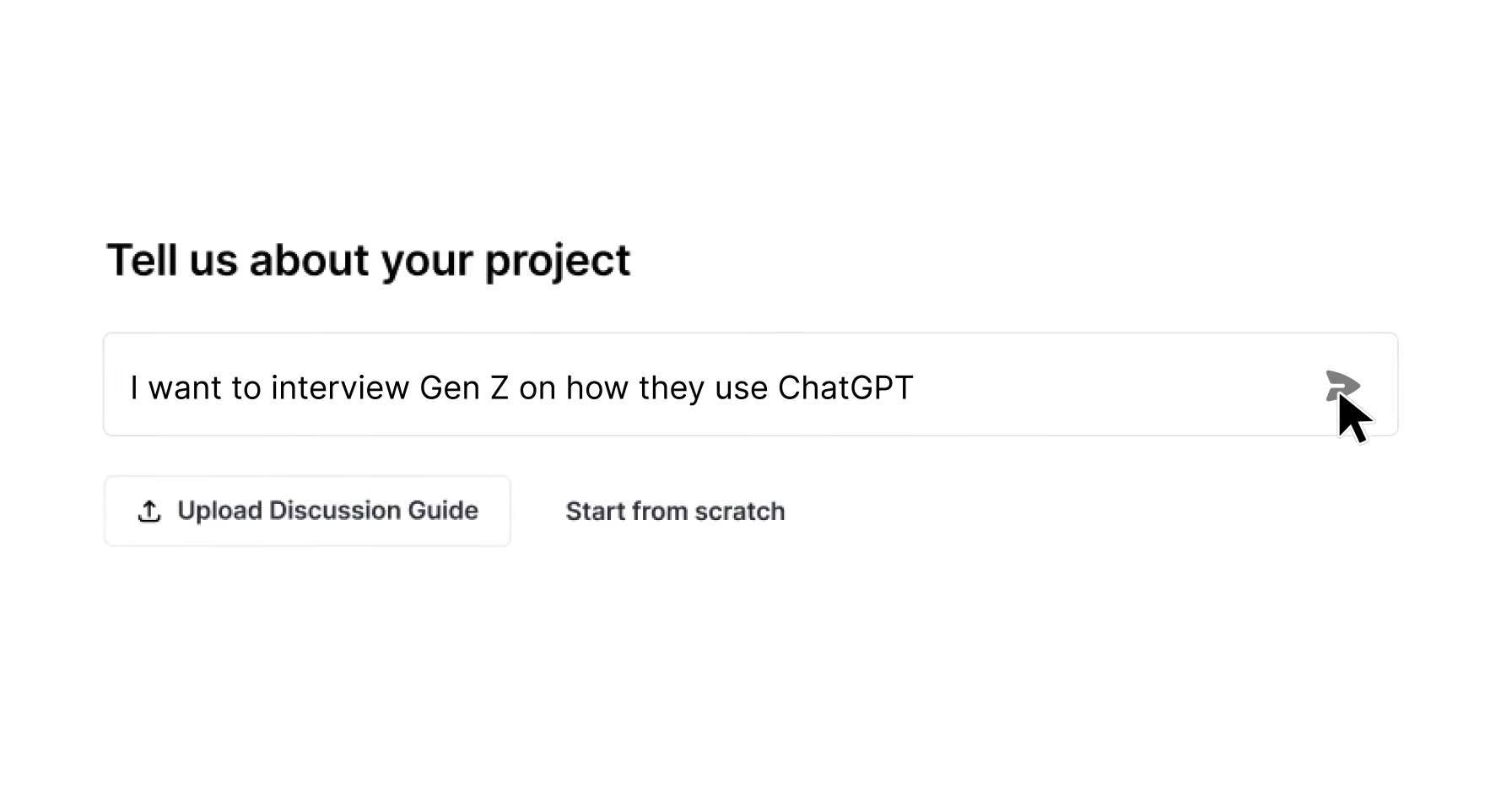
Those capabilities are not marketing claims. They are the operational details that make the full lifecycle possible:
- 50M+ verified respondents across 45+ countries and 120+ languages
- Quality Guard fraud prevention with real-time monitoring and participant frequency limits (no more than 3 studies per month per participant)
- Research Agent for one-click deliverables including slide decks, memos, and highlight reels
- Research cycle reduced from 4–6 weeks to less than 24 hours
- One-third the cost of traditional research
- $100M total funding including a $69M Series B led by Ribbit Capital in January 2026
- 1M+ interviews conducted
How to Turn AI Customer Feedback Analysis into Brand Decisions
The decision between analyzing existing feedback and running new conversational research depends on the question you need to answer.
Start with analysis when the question is what is happening at scale. Analyze existing feedback when:
- You have a large volume of open-ends, reviews, or support tickets to process
- You need to identify themes or track sentiment over time
- You need to prioritize issues across teams before deciding where to investigate further
Move to conversational research when the question is why it is happening. Run new AI-moderated interviews when:
- You need to understand why a theme is emerging, not just that it exists
- You need to test a concept, message, or creative before committing budget
- You need to validate a hypothesis across segments or markets
- You need to close a say-do gap between stated preference and observed behavior
- A KPI has moved and your tracker cannot explain the cause
The output of analysis should feed the design of conversational research. The output of conversational research should feed brand, product, and messaging decisions. The strongest research programs run a loop in which passive feedback flags the question, active feedback answers it, and the answer informs what you build.
See how the full research lifecycle works in practice and book a demo.
Evidence and Validation: Enterprise Outcomes
The decision framework above only matters if the conversational layer actually delivers. These named enterprise deployments show what happens when teams pair passive analysis with AI-moderated interviews.
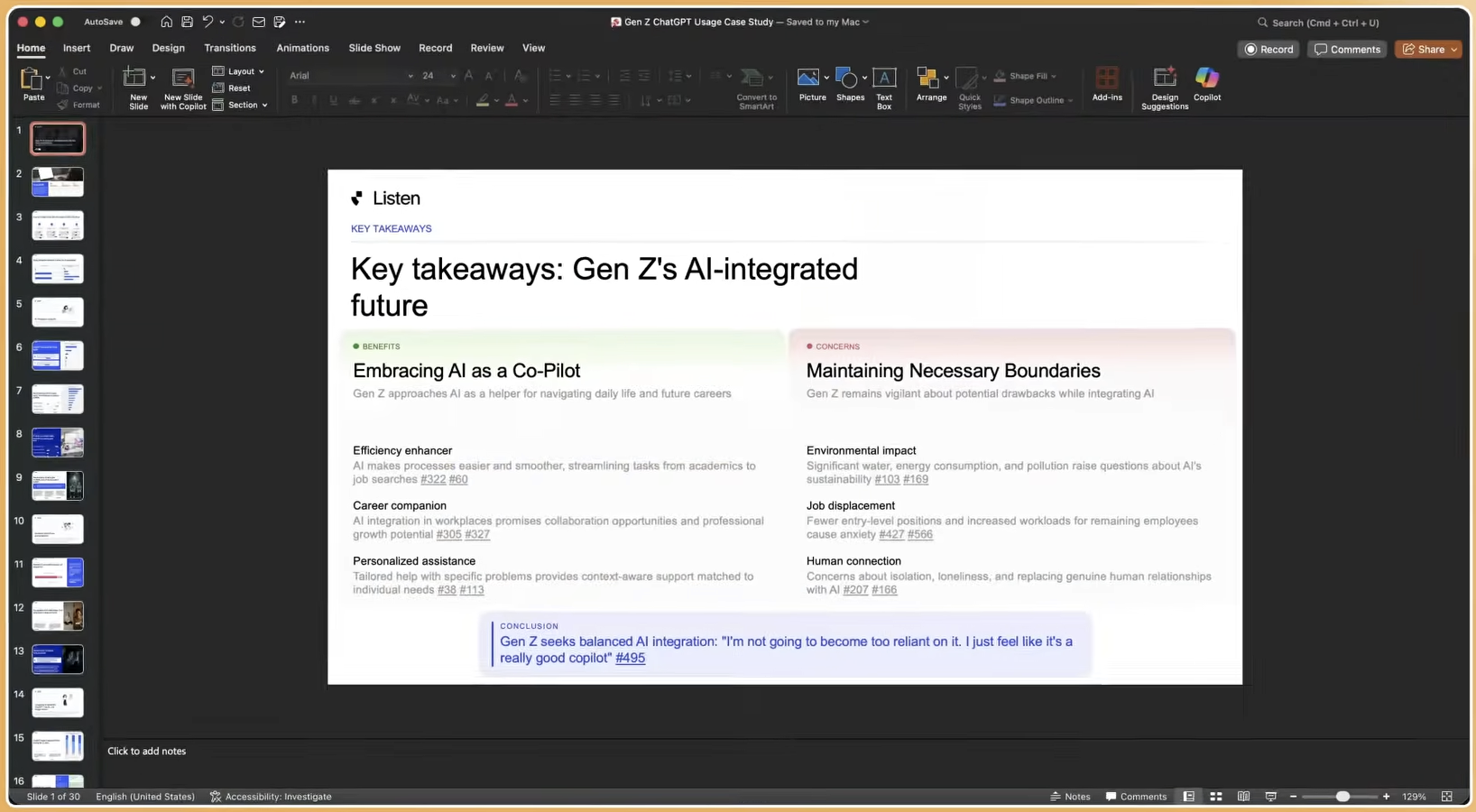
Microsoft cut research wait time from weeks to hours. The team used Listen Labs to collect global customer stories for Microsoft’s 50th anniversary celebration within a day. The Director of Data Science at Microsoft stated: “We wanted users to share how Copilot is empowering them to bring their best self forward, and we were able to collect those user video stories within a day. Our leadership team was very thrilled at both the speed and the scale that Listen Labs enabled. I can reach out to hundreds of users at one third of the cost.”
Anthropic now runs 100 studies in the time it previously took to run five or six. Research reduced churn by enabling the team to ship a key Claude Code feature after surfacing that the crux was context switching, people not wanting to go back and forth between their code editor and the terminal. Jane Justice Leibrock, Head of User Experience Research at Anthropic, described the platform as “kind of like a self-healing study. It finds the new things it needs to understand, and then helps you measure those better going forward.”
Procter & Gamble delivered 250+ interviews with quantified themes and verbatim proof, directly shaping product and brand strategy in hours, not weeks. The research showed that comfort, safety, and reliability matter far more than novelty. Teams avoided investing in features consumers dismiss.
Skims validated with thousands of high-income buyers overnight to de-risk a global campaign launch, eliminating weeks of recruiting and panel sourcing. The SVP of Data, Insights, and Loyalty at Skims stated: “I always struggled with understanding the why and Listen Labs nails this for me.”
AI Feedback Analysis Accuracy and Trust
Evaluation-stage buyers need clear answers on accuracy, data quality, and trust. The following sections cover the three areas that matter most.
Participant Quality and Fraud Prevention
Accuracy in AI feedback analysis depends on both the analysis layer and the quality of the data going in. AI can only generate reliable insights when the data it analyzes is accurate, relevant, and complete, while inconsistent, duplicate, or insufficient feedback leads to inaccurate conclusions and overlooked customer issues.
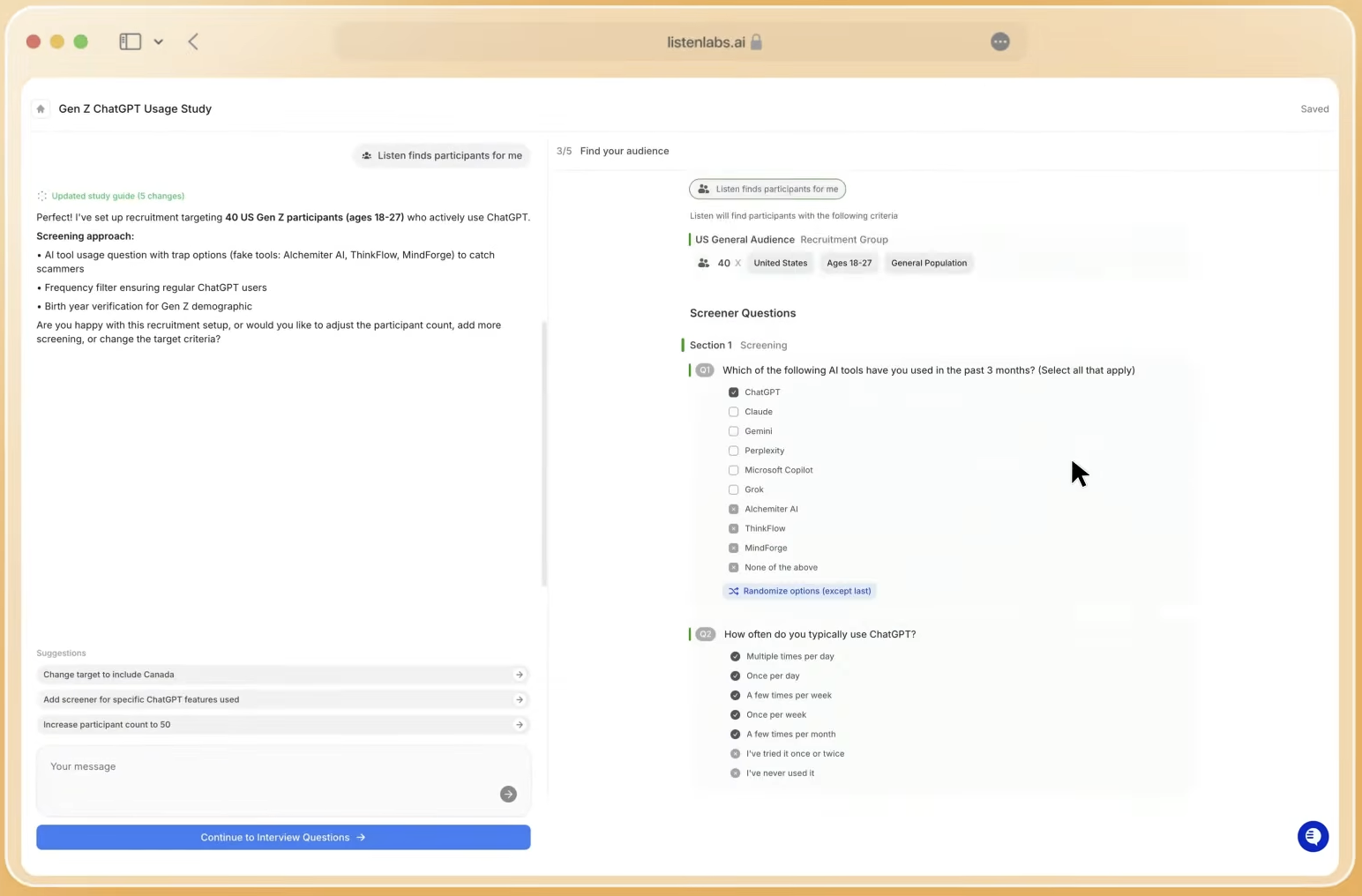
Listen Labs addresses this through Quality Guard, an AI orchestration layer that monitors every interview in real time for fraud, low-effort responses, and repeat respondents. Participants are limited to three studies per month. A dedicated recruitment operations team adds a human review layer. Listen Labs does not use commodity quantitative panels.
Data Security and Privacy
Listen Labs holds SOC 2 Type II, ISO 27001, ISO 27701, and ISO 42001 certifications, is GDPR-compliant, and uses 256-bit encryption. Listen Labs never trains its AI models on customer data.
Traceability
Listen Labs features such as Emotional Intelligence, Research Library, Listen Pulse, Visual Insights, and MaxDiff provide traceability, linking insights back to the exact timestamp, verbatim quote, and respondent. Without traceability, stakeholders cannot verify findings and therefore do not act on them. The Research Agent and Emotional Intelligence features are both built on this principle. Every emotion label, every theme, every claim is auditable to its source.
For evaluation-stage buyers who want short answers, the following questions come up most often.
Frequently Asked Questions
What Is AI Customer Feedback Analysis?
AI customer feedback analysis uses artificial intelligence to process and structure open-ended customer feedback from sources including surveys, reviews, support tickets, and social comments. The core mechanisms are sentiment tracking, topic clustering, and multi-source data merging. The technology identifies what customers said and how they felt at the time of writing. It does not capture why they said it, what they will do next, or the emotional signals that transcripts cannot record.
How Is AI Feedback Analysis Different from AI-Moderated Conversational Research?
AI feedback analysis is passive and processes feedback customers have already produced. AI-moderated conversational research is active and recruits participants, conducts adaptive interviews with real-time follow-up questions, and captures motivations, emotional signals, and behavioral context that passive analysis cannot reach. The two methods answer different questions and are most powerful when used together. Analysis identifies what to investigate, and conversational research explains why it matters.
Can AI Feedback Analysis Replace Customer Interviews?
AI feedback analysis and customer interviews serve different functions. Feedback analysis scales across large volumes of existing text and identifies themes and sentiment trends. Customer interviews, whether human-moderated or AI-moderated, surface the motivations, trade-offs, and emotional context behind those themes. Brands that rely exclusively on feedback analysis will consistently know that something is happening without understanding why, which limits their ability to act on the insight.
How Accurate Is AI Feedback Analysis?
Accuracy varies significantly by implementation and input quality. As noted earlier, accuracy drops sharply on messy real-world feedback. LLM-based systems fall from over 96% on clean text to roughly 79%, and rule-based systems to about 44%. Sarcasm is a persistent failure mode, with machine learning models for sarcasm detection typically achieving only 60–70% accuracy, and LLMs underperforming fine-tuned smaller models on sarcasm detection tasks. Participant quality also matters, because low-quality or fraudulent input degrades even the best analysis layer.
What Is the Say-Do Gap and Why Does It Matter for Brands?
The say-do gap is the distance between what customers say they will do and what they actually do when a real decision arrives. It is driven by social desirability bias, optimistic forecasting, and habit. Surveys also capture deliberate System 2 reasoning, while real purchase decisions are often driven by faster, more automatic System 1 thinking. For brands, the say-do gap means that high purchase intent scores in concept tests do not reliably predict sales, and that sustainability or purpose-driven claims can score well in research while failing to drive behavior change. Closing the gap requires pairing stated responses with behavioral observation and conversational follow-up.
How Do Brands Act on AI Feedback Insights?
The most effective pattern is to use AI feedback analysis to identify themes and prioritize where to investigate, then run AI-moderated conversational research to understand why those themes are emerging and what to do about them. The output of conversational research, including verbatim quotes, emotional signals, behavioral context, and traceable findings, gives brand, product, and messaging teams the evidence they need to make and defend decisions. Without the conversational layer, insights tend to stay in dashboards rather than driving action.
Is Customer Data Used to Train AI Models?
Listen Labs never trains its AI models on customer data. The platform holds SOC 2 Type II, ISO 27001, ISO 27701, and ISO 42001 certifications and is GDPR-compliant. All processing occurs in controlled environments with 256-bit encryption and enterprise SSO. Organizations evaluating any AI feedback or research platform should verify this policy explicitly, as practices vary across vendors.
The Brands That Win Will Connect What Customers Say to Why They Say It
AI customer feedback analysis is a starting point. Sorting and scoring feedback gives you the what; understanding requires the why. The technology has made it faster to identify what customers said. It still leaves a gap between what customers say and what they do, between a sentiment score and a strategic decision, and between a theme on a dashboard and a brief that changes a product.
The decision framework is straightforward. Analyze existing feedback to find themes and prioritize where to look. Run AI-moderated conversational research to understand why those themes are emerging and what to do about them. Use the output of conversational research to feed brand, product, and messaging decisions, not to populate another dashboard.
The brands that win will be the ones that connect what customers say to why they say it and what they actually do. That connection requires both layers working together.
Ready to connect what customers say to why they say it? Book a demo.