
Written by: Anish Rao, Head of Growth, Listen Labs
Key Takeaways
- Traditional consumer research takes 4–6 weeks and can cost hundreds of thousands of dollars, so teams often trade depth for scale.
- AI consumer insights platforms deliver hundreds of interviews and automated analysis in hours at a fraction of traditional costs.
- Four distinct categories of tools – social listening, AI-moderated research, brand tracking, and purchase intelligence – solve different brand problems and need separate evaluation.
- Leading platforms now close the say-do gap with behavioral observation and track how AI perceives brands alongside traditional KPIs.
- Listen Labs delivers consultant-quality AI-moderated research in less than 24 hours, so you can see findings while decisions are still live.
The Research Bottleneck Is a Business Problem
Traditional consumer research takes 4–6 weeks from study design to final report. Large studies can cost hundreds of thousands of dollars. Teams must choose between qualitative depth and quantitative scale, and by the time insights arrive, the business has often moved on.
AI for consumer brand insights changes that equation. Results arrive in hours, not weeks. Hundreds of interviews run simultaneously. Analysis is automated. 53% of researchers now use AI regularly, and teams that do not adopt AI are up to four times more likely to see their organizational influence decline.
This guide organizes the AI consumer insights space into four categories, lays out a practical evaluation framework, and explains two emerging trends – the say-do gap and AI-as-shopper – that generic tool roundups rarely address.
AI Consumer Insights Capabilities That Matter
Modern AI consumer insights platforms handle both qualitative and quantitative data and remove the old depth-versus-scale trade-off. With qual-at-scale, the old trade-off between depth and scale is no longer a barrier. AI can schedule and conduct interviews, analyze transcripts for themes, and generate quantitative insights from those conversations at the same time.
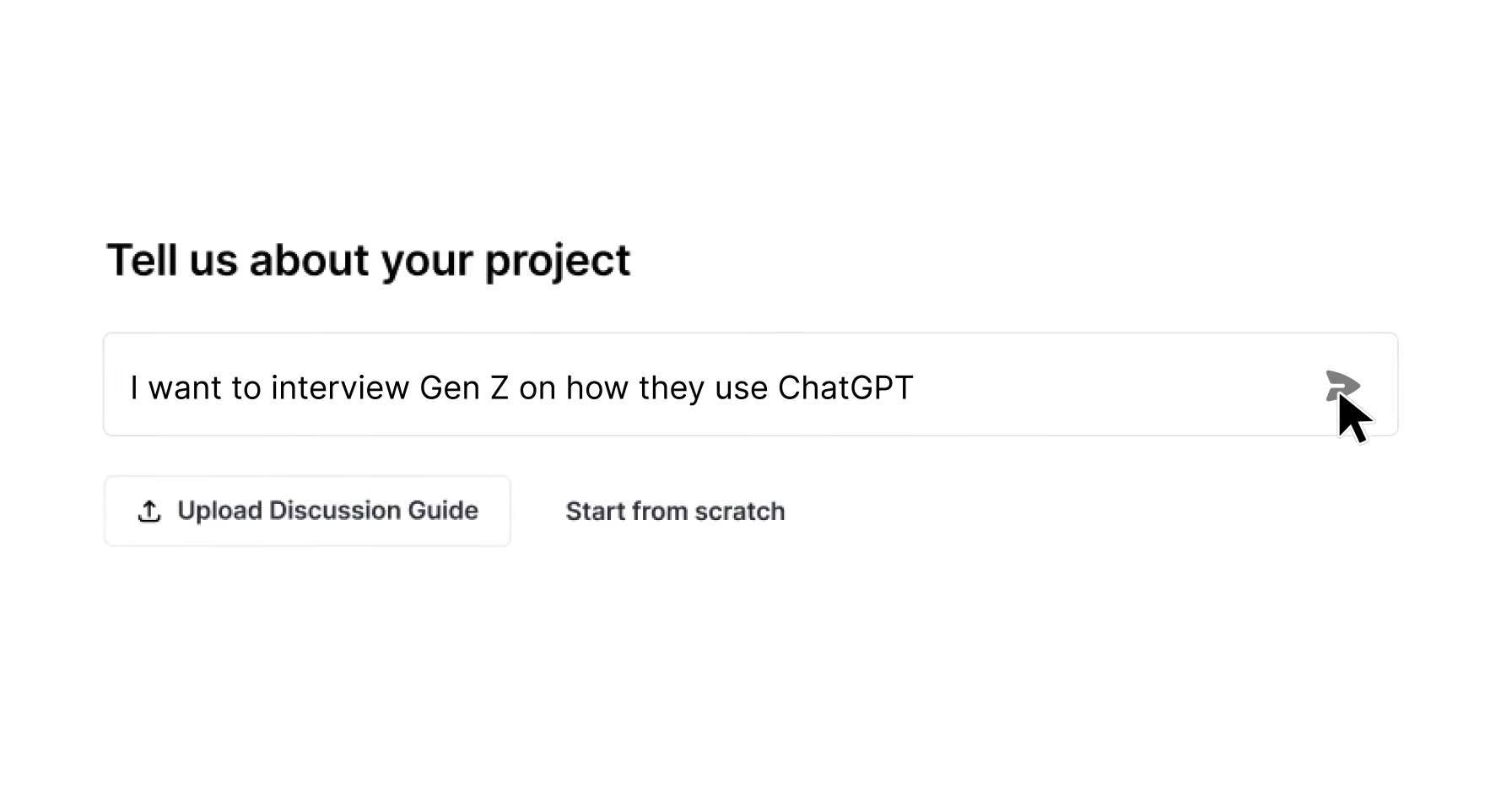
Leading AI consumer insights tools typically offer these capabilities:
- Real-time analysis of unstructured data such as social posts, reviews, and interview transcripts
- Natural language processing for large-scale open-ended response analysis
- Emotion detection based on tone, word choice, and micro-expressions
- Behavioral observation that captures what consumers actually do and reveals gaps between stated intent and real action
- Automated reporting and deliverable generation
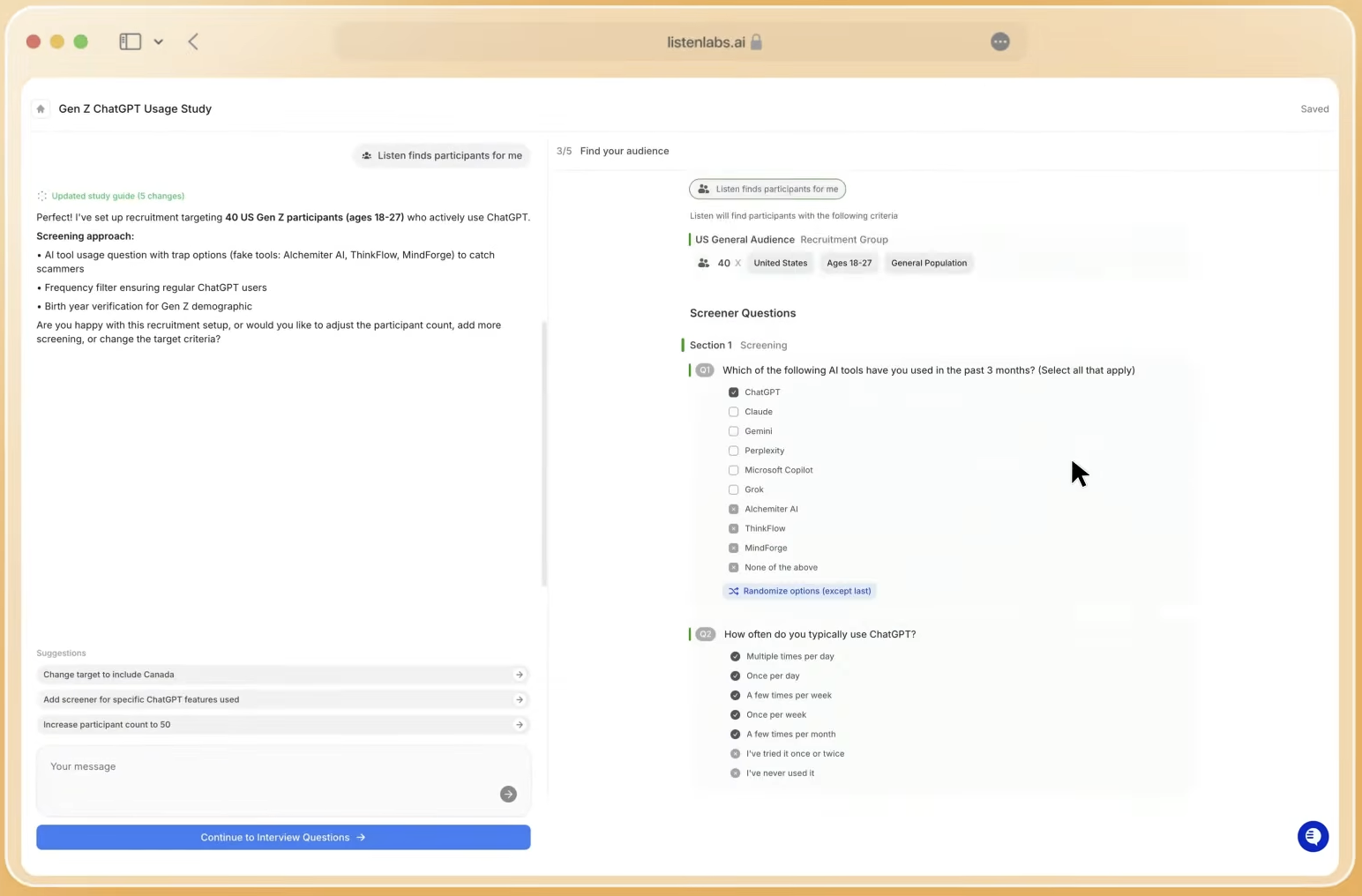
AI-moderated interviews can run hundreds of conversations simultaneously, each with adaptive follow-up questions. This approach delivers the statistical confidence of large samples with the richness of one-on-one interviews. A 200-interview AI-moderated study costs around $4,000 all-in, including recruitment, incentives, transcription, and automated analysis, and delivers completed, synthesized interviews in 48–72 hours. By contrast, a traditional 20-interview qualitative study costs $15,000–$30,000 and takes 4–8 weeks. A traditional 200-interview study would cost far more, around $200,000, and is generally considered infeasible.
Four Categories of AI for Consumer Brand Insights
The AI consumer insights space breaks into four distinct categories, each solving a different problem. Matching your need to the right category is the first step in shortlisting tools.
1. Social Listening for Public Conversation
Social listening platforms monitor social media, forums, and the open web for brand mentions, sentiment, and emerging themes. Primary use cases include brand perception tracking, crisis detection, and competitive intelligence. Leading platforms include Brandwatch and Sprout Social.
The core limitation is that social listening is passive. It captures what people say publicly but cannot probe motivations, run primary research, or explain why a metric moved.
2. AI-Moderated Research for Qual-at-Scale
AI-moderated research platforms conduct personalized, adaptive conversations with participants at scale and analyze responses automatically. Use cases include concept testing, brand perception studies, customer journey mapping, and usability testing. Platforms in this category include Listen Labs, Voxpopme, and Remesh.
Listen Labs leads this category with differentiators that matter for enterprise-grade research. Emotional Intelligence analyzes three signals – tone of voice, word choice, and subconscious micro-expressions – to surface emotions that transcripts alone miss. Every emotion is quantified per question and concept, with each label traceable to the exact timestamp, verbatim quote, and AI reasoning behind it, built on Ekman's universal emotions framework used in clinical psychology and UX research.
Visual Insights closes the say-do gap by letting the AI Interviewer observe on-screen behavior during interviews. It catches when participants act differently from what they said and probes in real time. The platform’s 50M+ verified panel, Quality Guard fraud detection, and sub-24-hour turnaround make it a strong choice for AI-moderated qualitative research at enterprise scale.
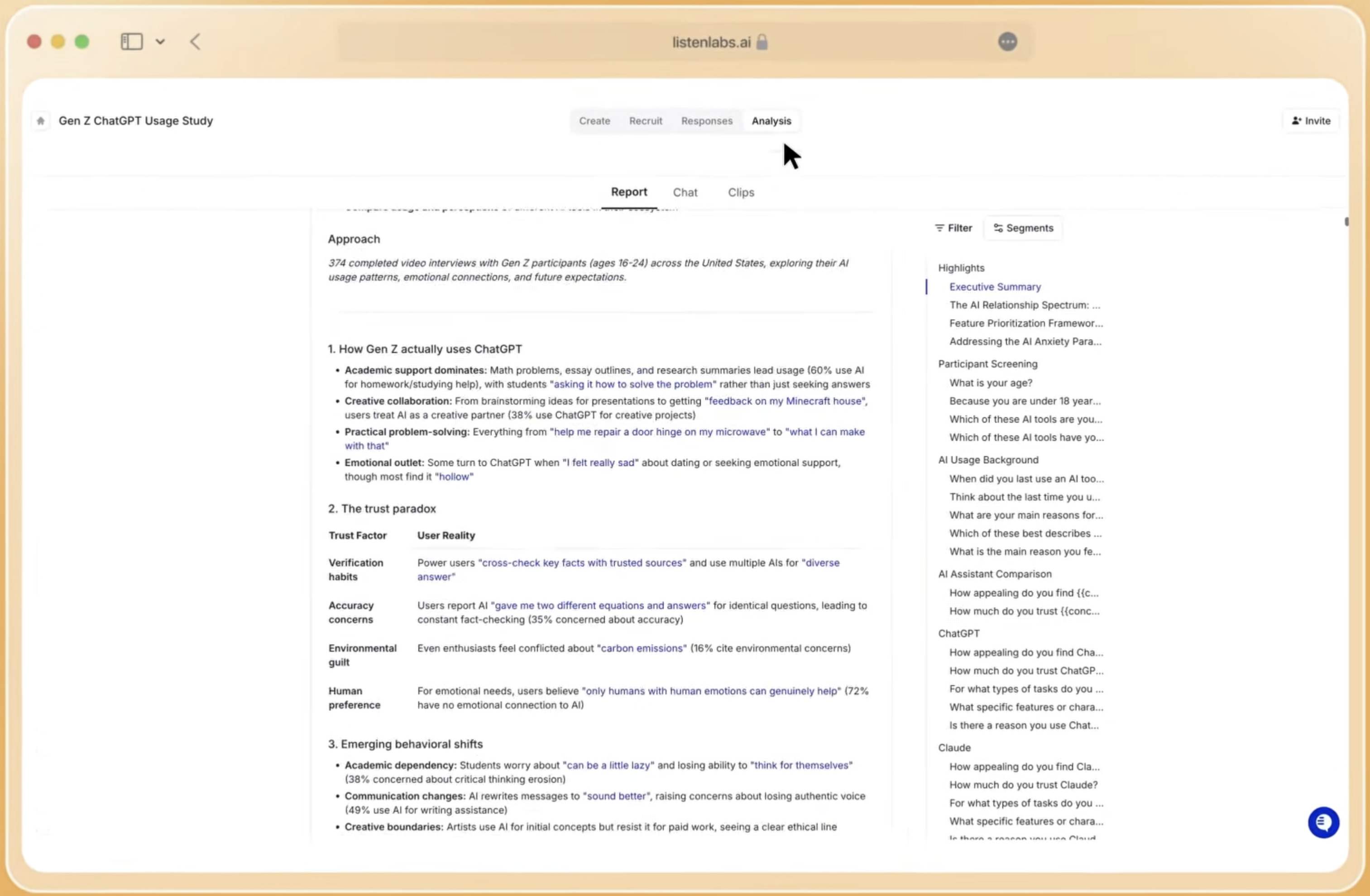
Schedule a live walkthrough to see how Listen Labs delivers consultant-quality research in less than a day.
3. Brand Tracking With Built-In “Why”
Brand tracking platforms measure brand health metrics such as awareness, consideration, and NPS over time to detect shifts. Use cases include ongoing brand health monitoring, campaign effectiveness measurement, and competitive benchmarking. YouGov BrandIndex is a widely used example in this category.
Listen Pulse differentiates by combining quantitative KPIs with qualitative “why.” Every metric movement comes with the explanation behind it, charted next to the KPIs teams already report. Traditional trackers flag the drop. Pulse explains it before it shows up as a lagging indicator.
4. Purchase Intelligence for Demand and AI Perception
Purchase intelligence platforms analyze purchase data, market trends, and consumer behavior to predict future demand. Use cases include demand forecasting, assortment planning, and pricing strategy. NIQ is the leading platform in this category.
42% of consumers used at least one AI tool to shop within the past month. Purchase intelligence now must track how AI perceives your brand alongside how consumers perceive it.
How to Choose AI for Consumer Brand Insights
With four categories and dozens of AI consumer insights tools, evaluation can feel overwhelming. This framework helps you shortlist vendors based on your specific business needs.
- Speed: Measure time from study design to final deliverables. Aim for less than 24 hours, not multiple weeks.
- Depth: Confirm that the tool probes beyond first answers and captures emotion and behavior, not only transcripts.
- Panel quality: Check how participants are sourced and verified, what fraud detection exists, and whether professional survey-takers are filtered out.
- Cost: Traditional one-on-one moderated interviews typically cost $150–$300 per session for moderator-only fees, and fully loaded sessions often range from $150 to $600, with some sources citing $300–$500 for traditional moderated video. AI-moderated studies deliver similar or better insight quality at a fraction of that cost at scale.
- Integration: Confirm that the platform fits your existing stack, supports raw data export, and connects with tools like Qualtrics or Decipher.
- Data security: Look for SOC 2 Type II, GDPR, and ISO certifications, and verify whether your data is used to train the vendor's models.
General-purpose LLMs like ChatGPT and Claude can help draft study guides or summarize transcripts. They lack proprietary research data, end-to-end capabilities such as recruitment and moderation, and enterprise-grade quality controls. Adoption of AI embedded directly inside research software is rising year over year, while reliance on general-purpose AI tools is falling. This shift reflects a move toward purpose-built platforms for defensible research.
A practical shortlisting checklist:
- Define the business decision the research will inform
- Identify which category or categories address the need
- Shortlist 2–3 vendors per category
- Run a pilot study with identical briefs
- Evaluate on speed, depth, panel quality, and traceability
Two Trends That Will Define Consumer Insights in 2026
Closing the Say-Do Gap
The say-do gap is the difference between what consumers say they will do and what they actually do. A widely cited Harvard Business Review study found that 65% of consumers said they wanted to buy from purpose-driven brands supporting sustainability, yet only about 26% actually followed through with a purchase.
The business consequences are significant. McKinsey reports that more than 50% of product and service launches fail to meet their business targets. Many of these failures trace back to decisions based on stated intent that teams never checked against real behavior. Purchase intent scores often need to be discounted substantially, sometimes by 50% or more, to approximate actual conversion, with top-box “definitely would buy” responses typically discounted by about 20–25% and lower intent levels discounted more heavily.
Gen Z often claims to prefer human customer service agents, then clicks the AI agent in three seconds. Traditional research misses this contradiction entirely. Listen Labs’ Visual Insights captures it in real time. The AI Interviewer observes on-screen behavior, detects the contradiction between stated preference and observed action, and probes based on what it saw rather than following a fixed script. 32% of participants explicitly state they feel less judged with AI moderation, which produces more honest responses on sensitive topics where social desirability bias is strongest.
The Rise of AI-as-Shopper
AI systems now influence purchasing decisions, from product recommendations to fully autonomous agents placing orders. 31% of consumers now use AI at some point in their purchase journey, roughly triple the rate of 18 months ago, and 70% of AI loyalists ultimately buy the products that AI recommends.
The shift is already visible in discovery behavior. 35% of US consumers now start product discovery with an AI tool, compared to only 13.6% who start with a search engine. A product now has three audiences: the shopper, the search algorithm, and the machine reasoning over structured data to decide what is worth suggesting.
Brands now need to understand how AI perceives them alongside how consumers perceive them. Listen Labs supports both needs. Visual Insights closes the say-do gap at the individual interview level, and Listen Pulse tracks AI perception alongside traditional brand KPIs in continuous waves.
Explore how Listen Labs tracks consumer and AI perception to keep your brand visible in AI-mediated journeys.
Common Pitfalls to Avoid
- Choosing based on features alone: A tool with impressive demos may fail on panel quality or integration. Run a pilot study with your own research brief before committing.
- Ignoring panel quality: Commodity panels are filled with professional survey-takers optimizing for incentives. Verify fraud detection, participant frequency limits, and behavioral matching before signing.
- Underestimating the need for human oversight: AI augments researcher judgment. Ensure the platform provides full traceability so every insight links back to source data.
- Letting insights die in reports: Insights that never reach decision-makers do not drive action. Choose a platform with a research library that compounds knowledge across studies rather than expiring with each project.
Why Listen Labs Fits This New Research Landscape
AI for consumer brand insights in 2026 centers on depth, behavior, and continuous learning at speed. The platforms that win will close the say-do gap and track AI-as-shopper alongside traditional brand KPIs.
Across these requirements, Listen Labs delivers sub-24-hour turnaround, a 50M+ verified panel across 45+ countries and 120+ languages, and full traceability from every insight back to source data. The Research Agent handles the full analysis workflow, from raw data to final output, with every insight linked directly to the underlying response data. Auto-recruiting, transcription, sentiment tagging, and insight summarization help teams move from question to findings in hours.
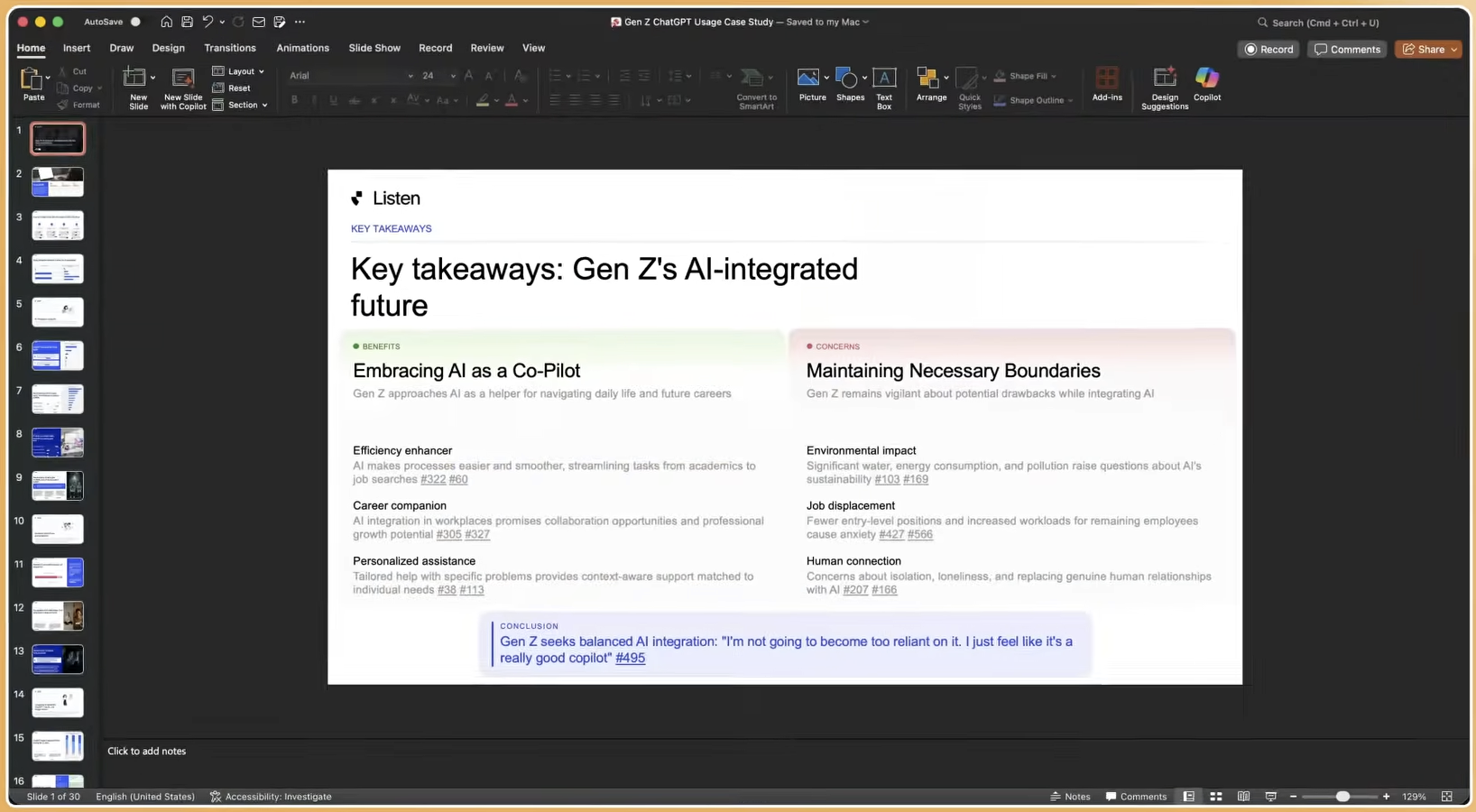
Enterprise-grade quality remains central. Quality Guard fraud detection, SOC 2 Type II, ISO 27001, and GDPR compliance protect data, and Listen Labs does not train its AI models on customer data. The platform is trusted by Microsoft, Google, P&G, Skims, and roughly 15% of the Fortune 100.
See Listen Labs in action with a live demo and evaluate how AI-moderated research can support your next brand decision.
Frequently Asked Questions
What is the difference between AI-moderated research and traditional qualitative research?
Traditional qualitative research relies on human moderators to conduct interviews one at a time, typically yielding 5–15 participants per study over 4–6 weeks. AI-moderated research platforms like Listen Labs conduct hundreds of personalized, adaptive interviews simultaneously, each with dynamic follow-up questions, and deliver automated analysis and deliverables in the sub-24-hour timelines described earlier. The core difference centers on consistency and signal quality. AI moderation applies the same probing logic across every participant, avoiding variability from human moderators who fatigue, drift, or unconsciously favor certain lines of inquiry. AI also captures emotional and behavioral signals such as tone of voice, micro-expressions, and on-screen behavior that human-moderated transcripts miss. The result is research that is faster, more consistent, and richer in signal than traditional qualitative methods at a fraction of the cost.
How does the say-do gap affect consumer brand research, and how can AI close it?
The say-do gap is the systematic difference between what consumers report they will do and what they actually do when a real decision arrives. It stems from social desirability bias, the absence of real-world context in research settings, and the mismatch between the slow, deliberate reasoning that surveys capture and the fast, automatic decision-making that governs most purchases. For brand research, this pattern means purchase intent scores consistently overestimate actual conversion, concept tests that perform well on paper can fail at launch, and sustainability or values-based claims often overstate real market demand.
AI closes the gap through two mechanisms. First, behavioral observation tools such as Listen Labs’ Visual Insights watch what participants actually do on screen during an interview and probe contradictions in real time, instead of relying solely on self-report. Second, emotion analysis through Emotional Intelligence captures tone of voice, word choice, and micro-expressions to surface how participants actually feel about a concept. Together, these capabilities produce a research record that reflects both stated preference and revealed behavior.
What should enterprise teams look for when evaluating AI brand intelligence platforms?
Enterprise evaluation of AI brand intelligence platforms should cover six dimensions. Speed covers how long it takes to move from study brief to final deliverables and whether that timeline is measured in hours or weeks. Depth concerns whether the platform probes beyond first answers and captures emotion and behavior alongside transcripts. Panel quality focuses on how participants are sourced and verified, what fraud detection is in place, and whether professional survey-takers are filtered out through frequency limits and behavioral matching.
Cost should account for total cost per completed interview or study, including platform fees, recruitment, and analysis, compared with the traditional benchmark of $150–$300 per moderated session. Integration covers whether the platform connects with existing tools like Qualtrics or Decipher and whether raw data can be exported in standard formats. Data security requires SOC 2 Type II, GDPR, and ISO certifications, along with clarity on whether the vendor uses customer data to train its AI models. Running a pilot study with an identical brief across two finalists before committing remains the most reliable way to evaluate real-world performance against these criteria.
What is AI-as-shopper, and why does it matter for brand strategy?
AI-as-shopper describes the growing role of AI systems in consumer purchase journeys, from product recommendations and comparison tools to fully autonomous agents that place orders on a consumer's behalf. The commercial scale of this shift is significant. As noted earlier, 42% of consumers used an AI tool to shop in the past month, 35% of US consumers now start product discovery with an AI tool rather than a search engine, and 70% of consumers who rely regularly on AI for purchase decisions buy what AI recommends.
For brand strategy, this shift creates a new audience that traditional consumer research does not address: the machine reasoning over structured product data to decide what to recommend. Brands that focus only on human perception risk becoming invisible in AI-mediated discovery. Brand tracking now must measure how AI perceives and recommends a brand alongside how consumers do, a capability that platforms like Listen Pulse deliver by combining quantitative KPI tracking with open-ended qualitative conversation in continuous waves.
Can AI-moderated research match the quality of human-led interviews?
For most consumer brand research needs, AI-moderated interviews deliver comparable quality to human-led sessions at dramatically greater speed and scale. Studies comparing AI and human moderation show equivalent comfort levels among participants, and 92% report high comfort in both formats. AI moderation is often preferred for sensitive topics like personal finances, political views, and health behaviors, where participants feel less judged and provide more candid responses.
AI moderation also removes a quiet source of bias inherent in human-led research. Human moderators fatigue, drift in their probing, and may unconsciously emphasize findings that confirm pre-existing hypotheses. Human moderation still holds an advantage in highly complex or emotionally nuanced discussions that require deep empathy or expert domain judgment. The practical recommendation for enterprise teams is to use AI-moderated research as the primary instrument for scale and speed and reserve human moderation for the small subset of topics where that depth is genuinely irreplaceable. This hybrid approach delivers breadth and depth without paying traditional panel prices for the entire study.