
Written by: Anish Rao, Head of Growth, Listen Labs | Last updated: August 6, 2026
Key Takeaways
- AI-moderated interviews deliver insight quality comparable to human-led research, with far greater speed and scale for most enterprise studies.
- AI moderation outperforms human moderation on speed, consistency, scalability, fraud prevention, and cost for about 80% of standard consumer insights and UX studies.
- Human moderators still work best for high-context scenarios that need live relationship-building, physical presence, or executive-level co-creation.
- Listen Labs compresses the full research lifecycle from study brief to final deliverables to under 24 hours while maintaining SOC 2 Type II, GDPR, ISO 27001, ISO 27701, and ISO 42001 compliance.
- Teams evaluating AI moderation should assess fit for their research program in a live demo tailored to their current backlog.
What AI-Moderated Interviews Mean in Practice
AI-moderated interviews are asynchronous or synchronous video conversations run by an AI interviewer that asks structured and adaptive follow-up questions, records responses, and routes data to automated analysis. Human-led qualitative research relies on a trained moderator to schedule, conduct, and manually analyze individual or group sessions. Both methods collect qualitative depth, yet they differ sharply in speed, consistency, scalability, and cost structure.
Where AI Can and Cannot Replace Human Researchers
For most enterprise research studies, AI moderation delivers comparable insight quality at much greater speed and scale. Listen Labs has run over 1 million AI-powered customer interviews for companies including Microsoft, Perplexity, and Sweetgreen. A Director of Data Science at Microsoft reported collecting global customer video stories within a single day at one third of the cost of traditional methods. Anthropic’s Director of Product Strategy noted that Listen Labs surfaced churn drivers 5x faster than prior approaches, completing 300+ user interviews in 48 hours.
AI moderation does not replace research expertise. Study design judgment, stakeholder communication, and strategic interpretation still require experienced researchers. AI replaces the operational burden instead. Scheduling, moderation logistics, transcription, manual coding, and report formatting move from manual work to automated workflows. Existing research teams increase their output without adding proportional headcount.
Human moderators remain preferable for studies that depend on live relationship-building with highly sensitive populations, ethnographic observation in physical environments, or executive-level co-creation sessions where moderator seniority signals organizational commitment.
How AI and Human Moderators Compare
Research objective, timeline, sample size, and budget determine which approach fits best. Across the criteria that matter most to enterprise consumer insights programs, such as speed, consistency, scalability, fraud prevention, emotional depth, and cost, AI moderation outperforms human moderation for roughly 80% of standard studies. Human moderation still leads in a narrow set of high-context, relationship-dependent scenarios.
A study comparing AI and human moderation across 50 participants found that 92% reported top comfort levels in both formats. Participant comfort, often cited as a risk of AI moderation, is statistically equivalent. 58% of participants preferred AI moderation for discussing political and religious views, and 32% explicitly stated they feel less judged with AI moderation, which is a meaningful advantage for sensitive consumer topics.
See how Listen Labs compares to your current workflow in a live demo.
How to Evaluate AI vs Human Moderation
Teams need consistent criteria to compare AI and human moderation. The dimensions below matter most for enterprise consumer insights and UX research teams.
- Speed: Time from study brief to final deliverable. Human-moderated qualitative research typically takes 4–6 weeks. Listen Labs compresses the full cycle to under 24 hours.
- Depth: Ability to probe unexpected responses, capture emotional nuance, and surface non-obvious insights. AI adaptive follow-ups and Emotional Intelligence analysis of tone, word choice, and micro expressions match or exceed human moderation for most study types.
- Sample quality: Fraud prevention, respondent authenticity, and demographic precision. Listen Labs’ Quality Guard applies real-time monitoring across video, voice, content, and device signals, with participant frequency capped at three studies per month.
- Recruitment: Access to verified, targeted respondents. Listen Labs’ 30M verified respondent network spans 45+ countries, with a dedicated recruitment ops team for audiences below 1% incidence rate.
- Scalability: Ability to run hundreds of simultaneous interviews. AI moderation runs interviews in parallel, while human moderation remains sequential and resource-constrained.
- Global reach and language support: Listen Labs supports 100+ languages for interview moderation with automatic translation and transcription.
- Analysis workflow: Researchers spend the bulk of their time finding patterns, quantifying insights, testing significance, and formatting results for stakeholders. The Research Agent automates this entire workflow.
- Governance and security: Listen Labs holds SOC 2 Type II, GDPR, ISO 27001, ISO 27701, and ISO 42001 certifications. Customer data is never used for AI model training.
- Operational burden: Human moderation requires scheduling, no-show management, transcription vendors, and manual analysis. AI moderation removes each of these steps.
Side-by-Side: How Workflows Differ
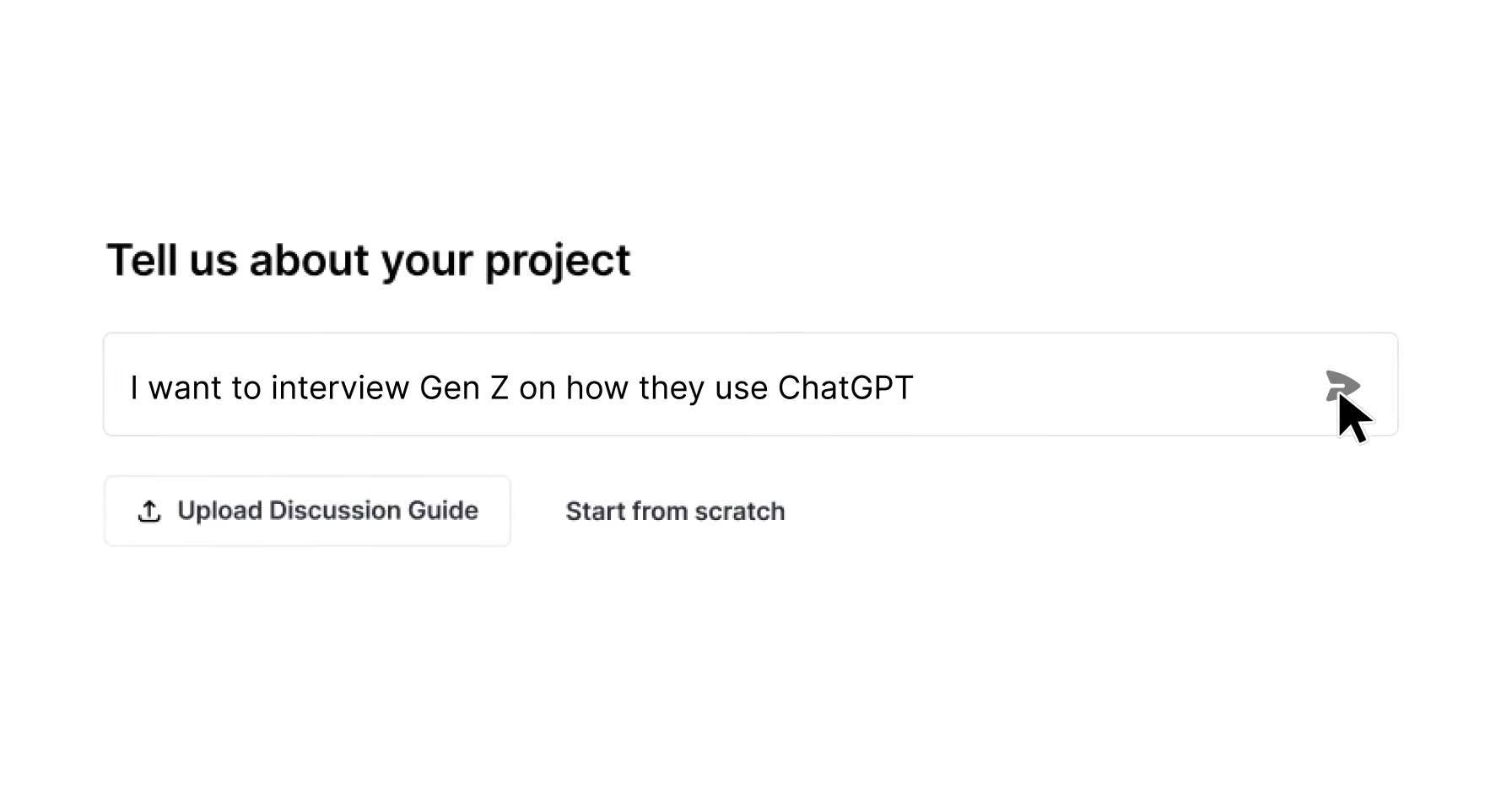
Study setup. Human-led research requires a moderator to review the brief, draft a discussion guide, and pilot-test questions. This process typically spans several days. Listen Labs’ AI-assisted co-design drafts structured objectives and questions from a natural-language brief in seconds, with auto-QA flagging issues before launch.
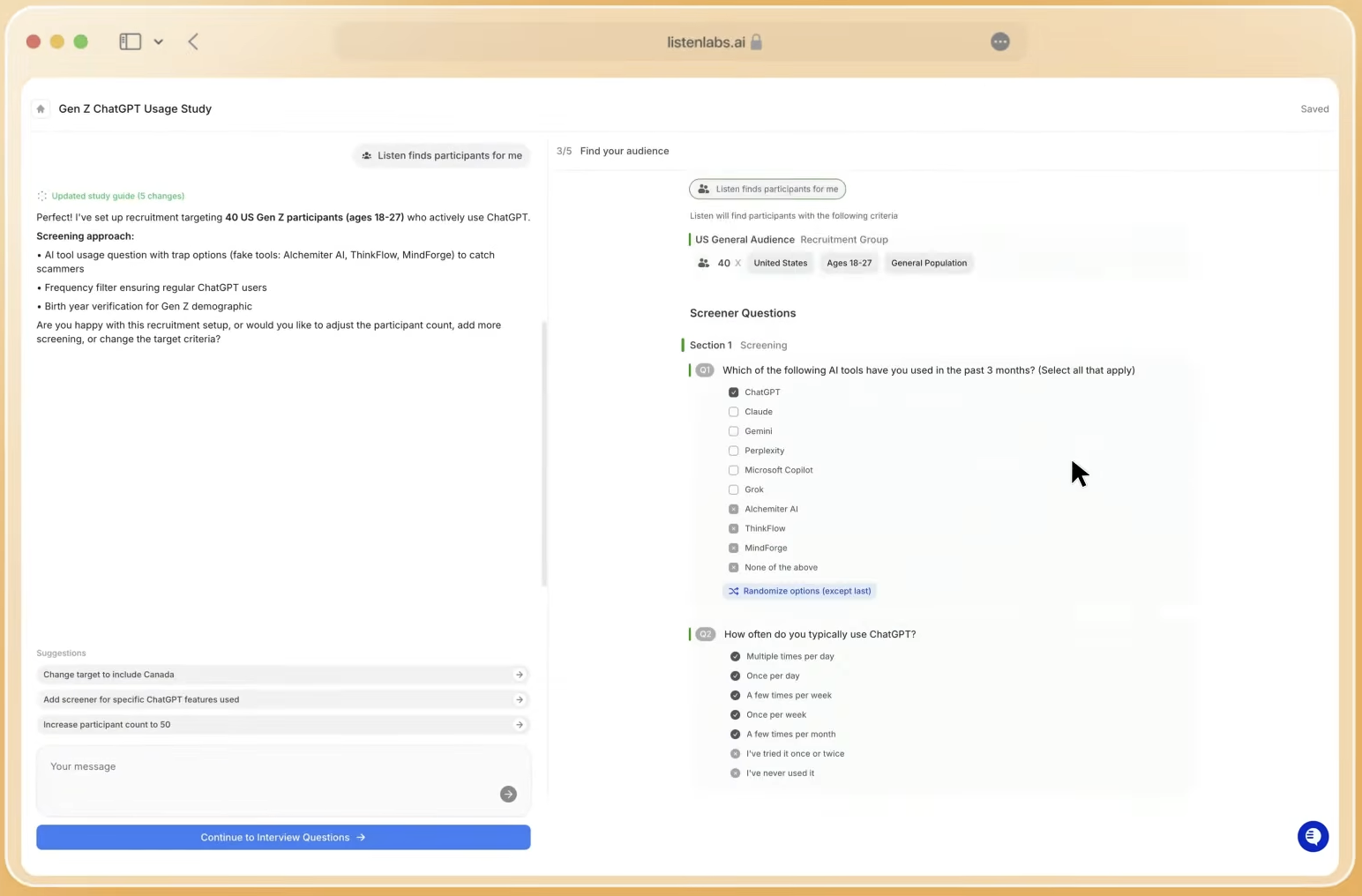
Recruitment and sampling. Traditional research relies on third-party panel providers with variable quality controls and limited geographic reach. Traditional focus groups take 3–5 weeks and cost $4,000–$12,000 per 90-minute session. Listen Labs’ Listen Atlas orchestrates recruitment across its 30M verified respondent network and multiple panel partners at once, with behavioral matching on intent and past actions rather than self-reported demographics alone.
Moderation approach. Human moderators bring interpersonal skill but introduce variability. Tone, fatigue, and unconscious bias differ across sessions and moderators. AI moderation applies identical probing logic to every participant, with smart follow-ups triggered by short or unexpected answers. As Listen Labs CEO Alfred Wahlforss stated: “This AI interviewer means that you can have hundreds of one-on-one interviews run at scale.”
Data quality controls. Human research relies on moderator judgment and post-hoc screening. Quality Guard monitors every interview in real time for fraud, low-effort responses, AI-generated scripts, and mismatched profiles, and its performance improves with every study conducted on the platform.
Qualitative depth. Emotional Intelligence quantifies every emotion per question and concept, with every label traceable to the exact timestamp, verbatim quote, and AI reasoning behind it. Skims used this capability to validate campaign direction with thousands of high-income buyers overnight, securing board-level buy-in with qualitative clarity that transcripts alone could not provide.
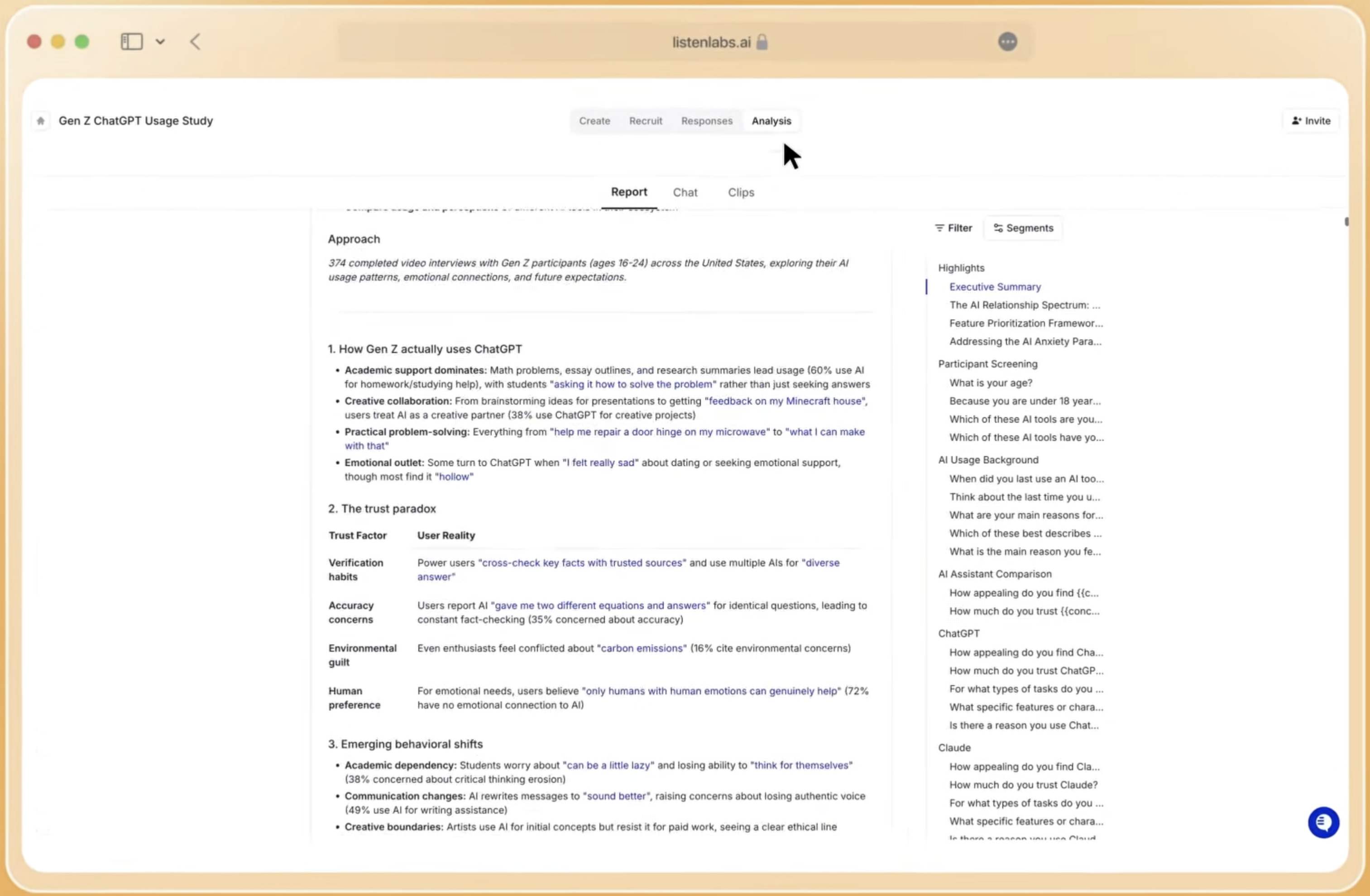
Analysis workflow. One researcher ran a full buying intent analysis across three user segments in under a minute using the Research Agent. Human analysis of equivalent data would require days of manual coding and synthesis.
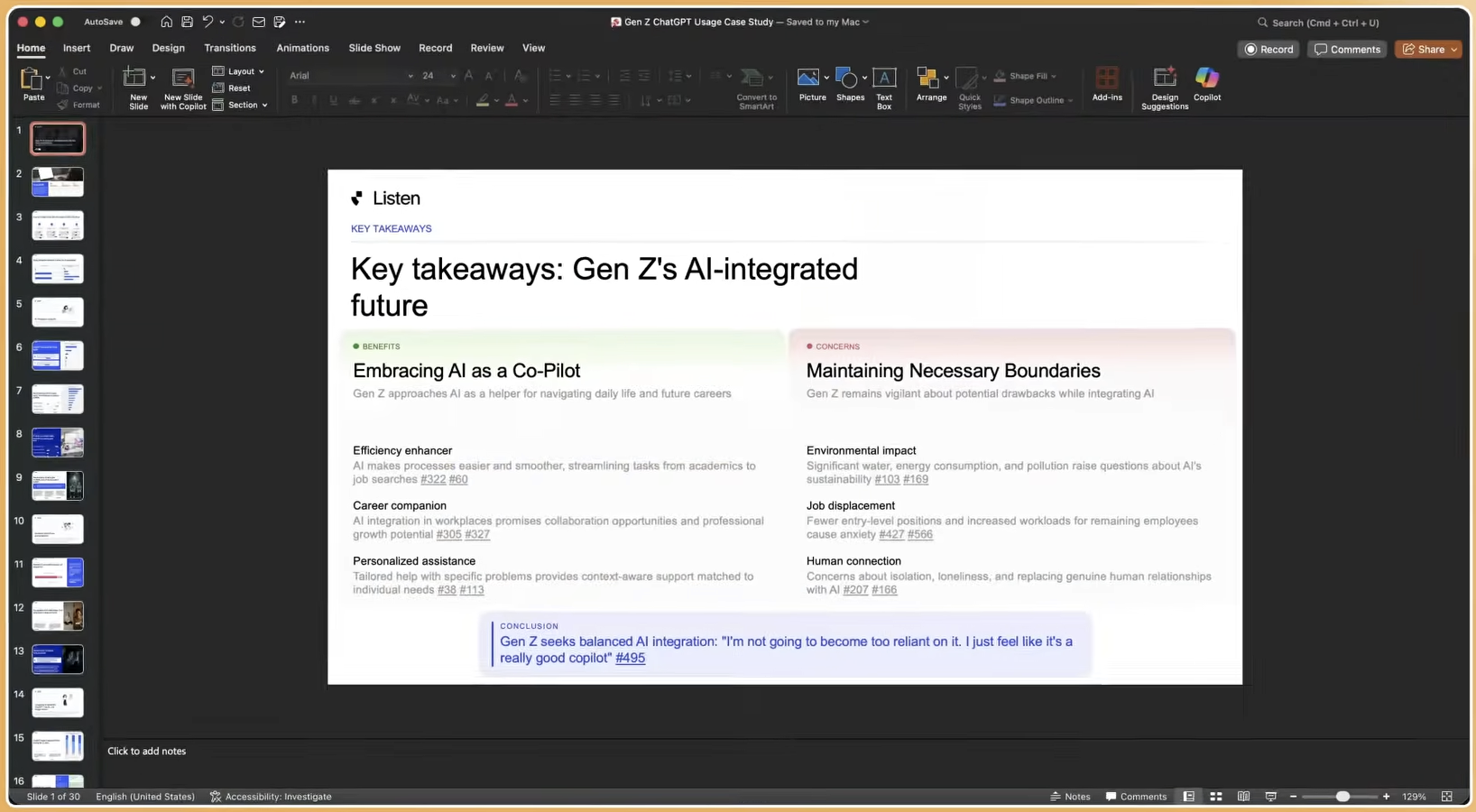
Deliverable creation. The Research Agent generates consultant-quality slide decks, memos, highlight reels, statistical charts, and segmentation breakdowns in under a minute. Human report writing for a comparable study typically requires several additional days after fieldwork closes.
Cross-study knowledge management. Mission Control stores every insight from every study as a queryable knowledge base, which enables cross-study trend tracking and institutional memory. Human-moderated research typically produces siloed reports that are rarely systematically queried.
Which Teams See the Biggest Gains
These operational advantages show up differently by team structure and research volume. The four team archetypes below see the fastest impact from AI moderation.
Enterprise consumer insights teams with growing backlogs and limited headcount benefit most from AI moderation. P&G used Listen Labs to conduct 250+ interviews with quantified themes and verbatim proof in hours, directly shaping product and brand strategy before market launch.
UX research leads at mid-to-large tech companies can replace the scheduling and logistics overhead of 5–10 user sessions with 50–100+ parallel AI-moderated interviews, including screen sharing and mobile screen recording for usability studies.
Product and marketing teams without dedicated researchers can describe research goals in natural language and receive a complete study design, recruited sample, moderated interviews, and analysis without research methodology expertise.
Agencies and consultancies operating on client timelines measured in days rather than weeks can use Listen Labs to reach niche audiences, including enterprise decision-makers, healthcare workers, and consumers below 1% incidence rate, and deliver findings within 24 hours.
Explore which study types fit your team’s backlog in a personalized demo.
Operational and Long-Term Factors to Plan For
Adopting AI moderation at enterprise scale requires stakeholder alignment on what “quality” means in context. Teams accustomed to human-moderated research may initially question whether AI follow-ups probe deeply enough. Reviewing sample transcripts and emotional analysis outputs during a pilot study usually resolves this concern.
Compliance and participant trust are manageable through Listen Labs’ certification stack, which includes SOC 2 Type II, GDPR, ISO 27001, ISO 27701, and ISO 42001, and through clear participant communication that AI moderation is in use. Once these foundations are in place, teams can focus on long-term strategic value. Robinhood’s experience illustrates this value. AI-moderated interviews revealed that users who view prediction markets as entertainment rather than income drive 2.4x higher weekly re-engagement, a behavioral segmentation insight that informed product integration flows and boosted uptake 30–40%.
Global programs benefit from AI moderation’s 100+ language support and 45+ country reach, which removes the logistical complexity of coordinating human moderators across markets and time zones.
Risks, Limits, and Misconceptions to Watch
The most common misconception is that AI moderation produces shallow data. Platforms like Listen Labs layer on auto-recruiting, transcription, sentiment tagging, and insight summarization so teams move from question to findings in hours, not weeks, while still preserving adaptive probing that produces depth. A related misconception claims that AI cannot handle sensitive topics, yet the participant comfort data cited earlier directly contradicts this.
A real limitation is that AI moderation does not suit in-person ethnographic observation, physical product handling studies, or sessions where the moderator’s physical presence is methodologically required. These use cases represent a small fraction of enterprise research volume.
Hidden recruitment complexity creates risk when teams assume any AI interview platform provides equivalent panel quality. Commodity panels carry fraud risk and professional survey-taker contamination. Quality Guard’s real-time monitoring and Listen Labs’ non-commodity panel sourcing policy address this directly, and teams evaluating other platforms should scrutinize fraud controls carefully.
Overestimating automation also creates risk. AI moderation automates logistics and analysis, yet it does not replace the strategic judgment required to translate findings into business decisions. Research teams remain essential for that interpretive layer.
A Simple Framework for Choosing AI or Human Moderation
Teams can match moderation approach to research goals using four variables.
- Timeline: When results are needed within 24–72 hours, AI moderation is the only viable option at meaningful sample sizes.
- Sample size: Studies requiring 30+ interviews benefit from AI moderation’s parallel execution. Studies requiring 5–10 deeply contextual sessions with specific named individuals may warrant human moderation.
- Topic sensitivity: AI moderation’s reduced-judgment environment helps with politically sensitive, health-related, or socially stigmatized topics.
- Internal capability: Teams without dedicated moderators can run rigorous studies independently using Listen Labs’ AI-assisted study design and automated analysis. Teams with experienced moderators can shift that expertise toward strategic synthesis rather than logistics.
For about 80% of enterprise consumer insights and UX research studies, AI moderation with Listen Labs delivers faster, more consistent, and equally nuanced results compared with human-led alternatives. Human moderation remains the right choice for the narrow category of studies where physical presence, named participant relationships, or live co-creation dynamics are methodologically essential.
Assess fit for your research program by seeing the platform in action.
Frequently Asked Questions
Can AI moderation capture the same emotional nuance as a trained human interviewer?
Yes, and in some respects it captures more. Listen Labs’ Emotional Intelligence feature analyzes three simultaneous signal layers, including tone of voice, word choice, and subconscious micro expressions, to surface emotions that transcripts alone miss. Built on Ekman’s universal emotions framework, every emotional label is quantified per question and traceable to the exact timestamp and verbatim quote. Human moderators observe emotional signals in real time but rarely document them systematically or at scale. AI moderation captures and quantifies these signals across every participant in every session, which produces a consistent emotional dataset that human moderation cannot match at volume.
How does Listen Labs prevent fraudulent or low-quality responses at scale?
Three layers of protection operate at the same time. First, Listen Labs sources participants exclusively from high-quality, non-commodity panels, which removes professional survey-takers from the outset. Second, Quality Guard monitors every interview in real time across video, voice, content, and device signals, flagging and removing fraudulent responses, AI-generated scripts, and mismatched profiles before they enter the dataset. Third, a dedicated recruitment operations team adds a human review layer for hard-to-reach segments, and all participants are capped at three studies per month to prevent panel fatigue and repeat-respondent bias. This multi-layer system compounds in effectiveness as the platform scales, because every study strengthens the reputation scoring model that underpins Quality Guard.
What is the realistic turnaround time for a full study, from brief to deliverables?
Listen Labs compresses the full research lifecycle, including study design, recruitment, moderation, analysis, and deliverable generation, to under 24 hours for standard studies. The Microsoft and Anthropic examples cited earlier demonstrate this timeline in practice, with customer video stories delivered in a single day and 300+ interviews completed within 48 hours. Traditional human-moderated qualitative research typically requires 4–6 weeks for the same cycle, and in large enterprise environments with internal prioritization queues, the timeline can extend to six months. The 24-hour benchmark applies to general population studies, while niche or hard-to-reach audiences may require additional recruitment time depending on incidence rate.
Does switching to AI moderation require replacing the existing research team?
No. Listen Labs is designed as a force multiplier for existing research teams, not a replacement. The platform removes the operational tasks that consume most of a researcher’s time, such as scheduling, moderation logistics, transcription, manual coding, and report formatting, and frees researchers to focus on strategic interpretation, stakeholder communication, and study design. Teams that previously ran 10–15 studies per year can run significantly more with the same headcount. The platform’s in-house research team, with 50+ years of combined expertise, also functions as a methodology partner and continuously refines the AI’s question design and analysis frameworks.
Which study types are not well suited for AI moderation?
AI moderation works well for concept testing, usability testing, creative testing, brand perception research, consumer journey mapping, segmentation studies, ad testing, pricing research, and survey open-end analysis, which covers the large majority of enterprise consumer insights and UX research volume. It is less suited for in-person ethnographic observation, physical product handling studies where tactile feedback is the primary data source, and executive co-creation sessions where the moderator’s seniority or organizational relationship is itself a methodological variable. For these narrow use cases, human moderation remains the appropriate choice. For all others, AI moderation with Listen Labs delivers equivalent or superior results at a fraction of the time and cost.