
Written by: Anish Rao, Head of Growth, Listen Labs | Last updated: July 27, 2026
Key Takeaways
- AI-moderated qualitative research platforms deliver interviews at $25–$50 each, far below traditional agency pricing, and return results in under 24 hours instead of weeks.
- Per-interview credit models dominate 2026 pricing, with entry-level tiers starting at $25 per credit and enterprise plans using custom volume-based arrangements.
- Analysis-only tools like NVivo and Dovetail require separate recruitment and moderation vendors, which increases total cost of ownership compared to end-to-end platforms.
- Real enterprise TCO typically runs 2–4× listed prices once integration, training, and management are included, while single-platform solutions like Listen Labs remove many of these hidden multipliers.
- Book a demo to see how Listen Labs’ transparent credit pricing and enterprise TCO model can cut qualitative research spend and speed up time-to-insight.
Per-Interview AI Qualitative Research Pricing in 2026
Per-interview credit models are the dominant pricing structure for AI-moderated consumer insights platforms in 2026. Credits are consumed at different rates depending on interview format.
User Intuition’s Starter tier charges $25 per credit with no monthly commitment, while its Pro tier provides 50 credits per month with additional credits at $20 each. A 5-interview study delivers results within 24 hours, with credit consumption varying by interview format.
Other platforms in the market use different pricing structures. Koji prices AI-moderated text interviews at approximately €1 per interview and voice interviews at €3, with auto-transcription, auto-analysis, and real-time report aggregation included. Koji’s Insights plan starts at €29/month and its Enterprise plan begins at €500/month or €6,000/year for teams that run roughly 100 or more interviews each month.
Traditional qualitative research pricing data is difficult to benchmark publicly. The Insights Association’s 2024 U.S. Insights & Analytics Industry Report covers industry revenue and company rankings but does not publish per-interview costs. The $25–$50 AI-moderated pricing above represents a substantial reduction from traditional agency rates, which industry practitioners report at several hundred dollars per interview.
Niche-audience premiums apply across all platforms when teams target low-incidence segments. B2B decision-makers, healthcare workers, and enterprise technology buyers require additional panel sourcing effort, which translates to higher credit consumption or supplemental recruitment fees. Self-recruit options, where enterprises bring their own customer lists, reduce per-interview costs by removing panel sourcing fees entirely.
Listen Labs operates on a subscription model where enterprises pay for platform access and then spend credits per participant recruited. Credit cost scales with audience difficulty, so general population studies consume fewer credits than niche, hard-to-reach segments. For companies with 100 or more employees, pricing is structured through a demo and pilot process, with volume-based enterprise arrangements available.
NVivo AI and Dovetail Costs vs End-to-End AI Interview Platforms
Analysis-only tools such as NVivo (licensed through Lumivero) and Dovetail run roughly $29–$110/month per seat as of 2026. These tools process qualitative data that researchers have already collected, and they do not recruit participants, conduct interviews, or generate study designs.
The practical consequence for enterprise teams is that an analysis-only licensing cost is additive, not substitutive. A team using NVivo or Dovetail still needs separate vendors for participant recruitment (Prolific, User Interviews, Respondent), interview moderation, transcription, and report writing. Each handoff introduces delay, coordination overhead, and additional cost.
Dovetail offers a free plan and custom enterprise pricing for its AI qualitative analysis and repository platform, with paid plans starting around $29 per user per month billed annually. Other tools are available for AI-assisted qualitative synthesis. None of these tools include recruitment, moderation, or end-to-end delivery.
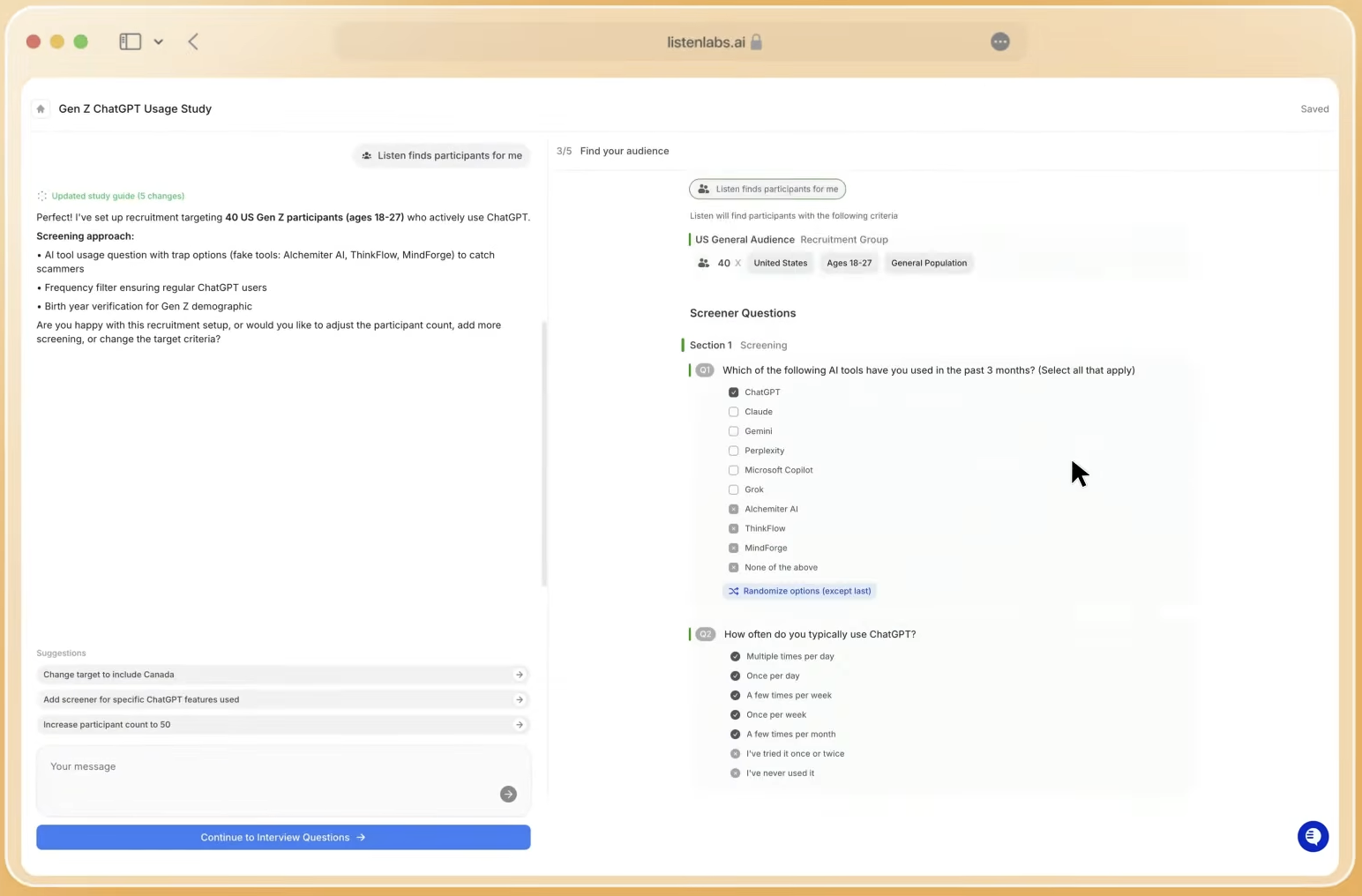
Listen Labs bundles study design, global participant recruitment from a 30M+ verified respondent network, AI-moderated video interviews, automated analysis, and consultant-quality deliverables such as slide decks, memos, and video highlight reels into a single platform. Teams avoid separate recruitment vendors, transcription tools, and standalone analysis licenses that require procurement and integration.
Enterprise AI Qualitative Research Total Cost of Ownership
Listed subscription or per-interview prices represent only a fraction of actual enterprise spend. Tiger Tail’s enterprise AI TCO framework identifies real total cost of ownership as typically 2–4× the listed vendor licensing price once integration, training, data preparation, and ongoing management are included.
- Licensing and API fees: 25–35% of TCO
- Integration and development: 20–30%
- Data preparation: 10–20%
- Training and change management: 10–15%
- Ongoing management and optimization: 10–15%
For fragmented research stacks that rely on separate recruitment, moderation, transcription, analysis, and repository tools, these integration and coordination costs compound across every vendor relationship. For most mid-size companies, realistic year-one budgets for enterprise AI platforms land between $75K and $250K all-in.
Listen Labs’ single-platform architecture removes many of these multiplier costs. There is one contract, one integration point, one security review (SOC 2 Type II, GDPR, ISO 27001, ISO 27701, and ISO 42001 certified), and one vendor relationship to manage. The Research Agent generates deliverables such as slide decks, memos, charts, and highlight reels in under a minute, which removes analyst labor that traditional TCO models treat as a fixed line item.
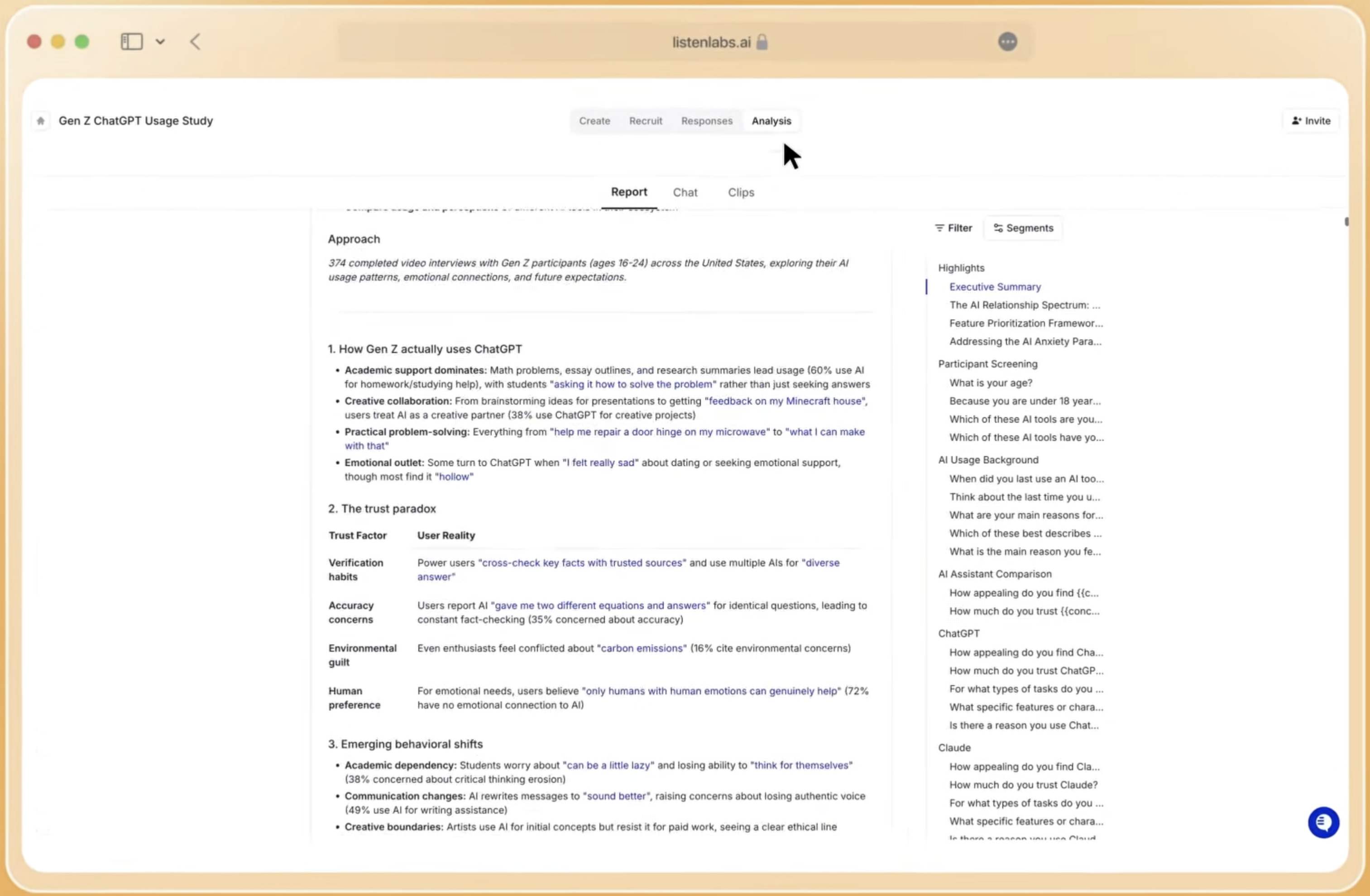
Emotional Intelligence, Listen Labs’ multimodal signal analysis feature built on Ekman’s universal emotions framework, is integrated directly into the Research Agent rather than priced as a separate add-on. Platforms that charge separately for sentiment or emotion analysis add another line to the TCO calculation that Listen Labs avoids.
How Subscription Tiers and Credit Models Work
The 2026 market has converged on three broad tier structures across AI qualitative research platforms.
Entry-level self-serve tiers provide pay-as-you-go credit access with no monthly commitment. User Intuition’s entry-level tier, mentioned earlier at $25 per credit, covers full platform access and panel recruitment with no monthly commitment. Entry-level analysis tools run roughly $29–$110 per seat but do not include recruitment or moderation.
Mid-market professional tiers bundle a monthly credit allocation with a subscription floor. The Pro tier, with its monthly credit allocation described above, adds cross-study pattern detection and unlimited queries against accumulated findings.
Enterprise tiers use custom pricing with volume-based arrangements, dedicated customer success management, API access, SSO, and priority support. Enterprise tools in the AI qualitative research category are typically custom-priced at $20,000–$100,000+ per year. UserTesting’s enterprise tiers range from an estimated $3,000–$5,000 per month at Essentials to $25,000–$100,000+ per month at Ultimate, with opaque pricing that requires direct sales contact.
Listen Labs serves enterprises including Microsoft, Google, Sony, Anthropic, Procter & Gamble, Skims, Levi’s, and Nestlé through its enterprise tier. Companies with 100 or more employees access the platform through a demo and pilot process, with credit consumption scaling by audience difficulty and interview volume.
Niche-Audience Premiums, Self-Recruit Savings, and Hidden Fees
Audience difficulty is the primary variable that moves per-interview costs above published baseline rates on any AI qualitative research platform. General population consumer studies consume the fewest credits. B2B decision-makers, healthcare professionals, engineers, and consumers below 1% incidence rate require additional sourcing effort and carry higher credit costs.
Koji’s detailed cost breakdown for a mid-market B2B SaaS persona shows per-interview totals of €281–€540 using traditional methods, with recruiting alone accounting for €40–€120 per interview. AI-moderated platforms compress this substantially, but niche B2B audiences still carry premiums relative to general consumer panels.
Self-recruit options eliminate panel sourcing fees entirely. Enterprises that bring their own customer lists or CRM segments to Listen Labs pay fewer credits per participant, since Listen Labs’ recruitment infrastructure is not engaged. This approach is the most direct lever for reducing per-interview cost on high-volume programs.
Hidden fees to evaluate during platform procurement can double your effective per-interview cost if teams do not negotiate them upfront. The most common TCO inflators include:
- Credit expiry and rollover rules, where unused credits that expire at month-end inflate effective per-interview cost
- Overage charges when monthly allocations are exceeded
- Separate fees for emotional intelligence, sentiment analysis, or advanced reporting features
- Data egress charges for exporting transcripts, video clips, or raw data
- Implementation and onboarding fees not included in listed subscription prices
- Renewal uplift clauses that index pricing to inflation annually
Listen Labs’ Quality Guard monitors every interview in real time for fraud, low-effort responses, and repeat respondents, and participants are limited to three studies per month. This quality infrastructure is included in the platform rather than priced as a separate quality assurance service, a cost that traditional agency engagements typically embed in their 30–40% overhead markup.
Quality Guardrails and Built-In Emotional Intelligence
Data quality infrastructure now appears as a distinct TCO factor that 2026 enterprise procurement teams evaluate explicitly. Recruitment costs for qualitative studies have decreased with AI-moderated platforms, but lower recruitment costs only help when the resulting data is reliable.
Listen Labs’ Quality Guard applies three layers of protection. First, behavioral matching validates participants on intent and past actions rather than self-reported demographics. Second, real-time AI monitoring analyzes video, voice, content, and device signals to detect fraud and AI-generated responses. Third, a dedicated recruitment operations team adds human review for hard-to-reach segments, and no commodity quantitative panels are used.
Emotional Intelligence, Listen Labs’ multimodal signal analysis feature, analyzes tone of voice, word choice, and subconscious micro-expressions to surface emotions that transcripts alone miss. Built on Ekman’s universal emotions framework, it quantifies emotions including anger, anticipation, disgust, fear, joy, sadness, trust, and surprise per question and concept, with every label traceable to the exact timestamp, verbatim quote, and reasoning. It is available across 50+ languages and integrates directly into the Research Agent for natural-language queries, charts, and highlight reels of emotionally significant moments.
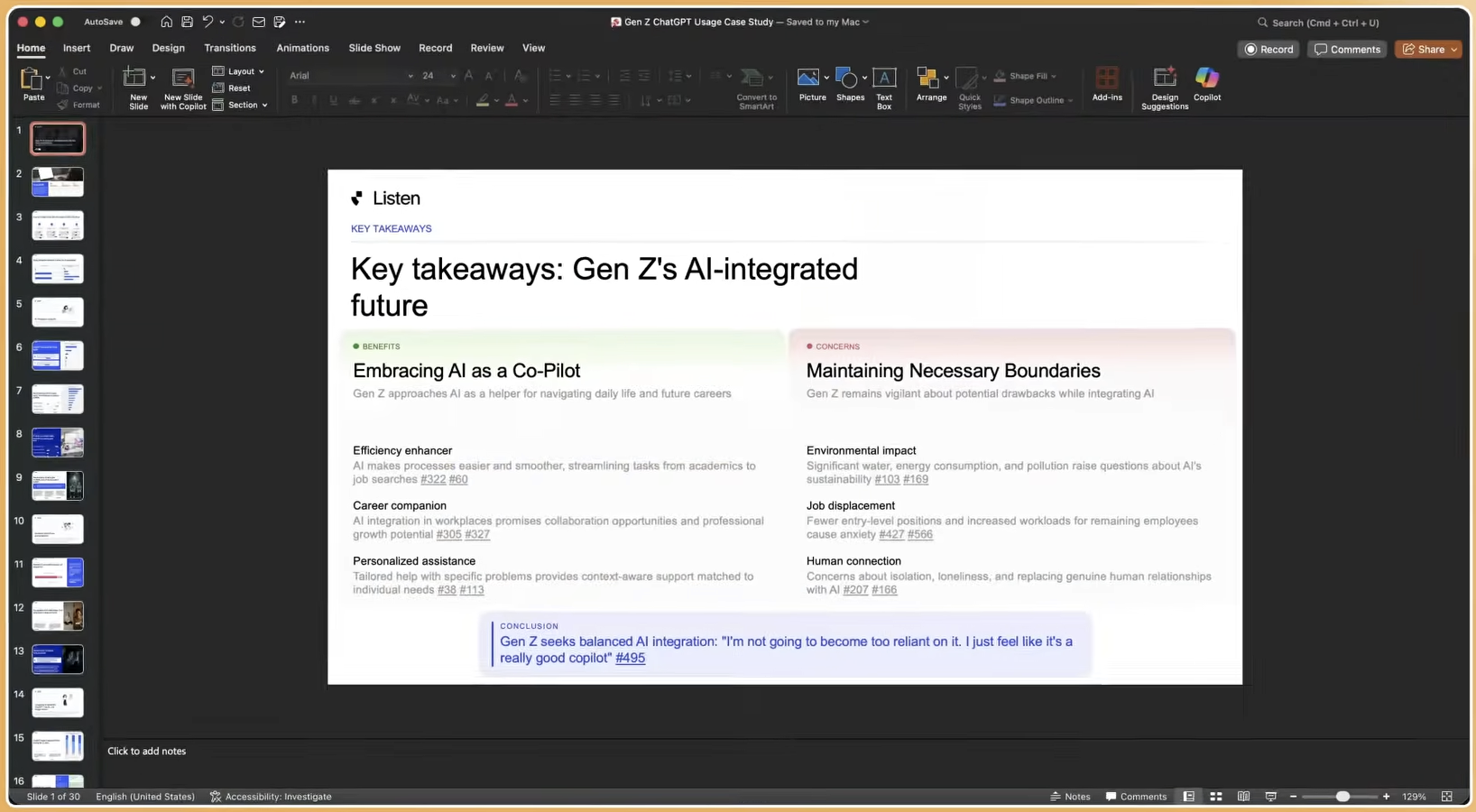
Platforms that offer emotion or sentiment analysis as a separate paid add-on add a line item to enterprise TCO that Listen Labs bundles into the core platform. For creative testing, concept comparison, usability testing, and brand research use cases, this integration removes a procurement and integration step that fragmented stacks require.
Frequently Asked Questions
What is the difference between AI analysis tools and end-to-end AI qualitative research platforms?
AI analysis tools such as NVivo, Dovetail, and Marvin process qualitative data that researchers have already collected through separate recruitment and moderation workflows. They do not source participants, conduct interviews, or generate study designs. End-to-end platforms like Listen Labs handle the entire research lifecycle, including study design, global participant recruitment, AI-moderated interviews, automated analysis, and deliverable generation, within a single platform. For enterprise teams evaluating total cost of ownership, the distinction matters because analysis-only tools require additional vendor contracts, integration work, and coordination overhead that compound the true cost of running a qualitative research program.
How does Listen Labs price its platform for enterprise teams?
As described in the pricing section, Listen Labs uses a subscription-plus-credits model where credit consumption varies by audience difficulty. Niche segments such as enterprise decision-makers, healthcare workers, or consumers below 1% incidence rate require more credits than general population studies. Companies with 100 or more employees access the platform through a demo and pilot process, with volume-based enterprise arrangements available. Self-recruit options, where organizations bring their own customer lists, reduce per-interview costs by eliminating panel sourcing fees. Emotional Intelligence, Quality Guard, and the Research Agent are included in the platform rather than priced as separate add-ons.
Can AI-moderated interviews match the quality of human-moderated qualitative research?
Listen Labs’ AI interviewer conducts personalized, adaptive conversations with dynamic follow-up questions calibrated to each participant’s responses. This mirrors the probing behavior a trained human moderator applies. The platform is built by an in-house research team with more than 50 years of combined expertise, and the methodology framework is continuously refined against tens of thousands of completed studies. For most consumer insights, concept testing, brand research, and usability testing use cases, AI-moderated interviews deliver comparable depth at much greater speed and scale. Enterprises including Microsoft, Procter & Gamble, Anthropic, and Skims use Listen Labs for studies where research quality directly informs product, brand, and go-to-market decisions.
What hidden costs should enterprise teams account for when evaluating AI qualitative research platforms?
Beyond listed subscription or per-interview prices, enterprise teams should evaluate credit expiry and rollover policies, overage charges, separate fees for emotional intelligence or advanced reporting features, data egress charges for exporting transcripts and video, implementation and onboarding fees, renewal uplift clauses, and the internal labor cost of integrating a platform into existing enterprise systems. As noted in the TCO analysis above, true enterprise costs typically run 2–4× listed prices when all integration, training, and operational factors are included. Platforms that bundle recruitment, moderation, analysis, and deliverable generation into a single contract reduce the number of TCO multipliers that fragmented stacks accumulate.
How does self-recruitment reduce per-interview costs on AI qualitative research platforms?
When enterprises bring their own participant lists from CRM databases, loyalty programs, or existing customer communities, AI qualitative research platforms do not engage their panel sourcing infrastructure for those participants. On Listen Labs, self-recruited participants consume fewer credits per interview than panel-sourced participants, since recruitment operations costs are not incurred. For organizations running high-volume continuous research programs against known customer segments, self-recruitment is the most direct lever for reducing per-interview cost while maintaining the full benefit of AI-moderated interviews, automated analysis, and Research Agent deliverables.
Conclusion
The 2026 AI qualitative research pricing landscape gives enterprise consumer insights and UX research teams a clear economic case for platform adoption. Traditional agency qualitative research costs significantly more per interview and takes several weeks. AI-moderated platforms deliver equivalent depth at $25–$50 per interview in under 24 hours, which enables many more interviews on the same budget.
Analysis-only tools address one step in the research lifecycle and require separate recruitment, moderation, and reporting vendors that compound total cost of ownership. End-to-end platforms that bundle every step into a single contract, a single integration, and a single security review remove the hidden multipliers that make fragmented stacks expensive to operate at enterprise scale.
Listen Labs replaces the entire traditional research stack, including recruitment vendors, moderators, transcription services, analysis tools, and report writers, with one platform trusted by Microsoft, Google, Sony, Anthropic, Procter & Gamble, Skims, Levi’s, and Nestlé. Studies that previously took weeks now deliver consultant-quality results in less than 24 hours at a fraction of the cost.