
Written by: Anish Rao, Head of Growth, Listen Labs | Last updated: August 8, 2026
Key Takeaways for AI Brand Visibility
- AI brand visibility now depends on citation rates inside AI-generated answers, not only rankings or social mentions.
- Legacy social listening tools cannot measure prompt-level citations across ChatGPT, Perplexity, Gemini, and Google AI Overviews.
- Effective AI brand tracking requires prompt-level accuracy, model-specific data, enterprise security, global language coverage, SEO-stack integration, and fast turnaround.
- Listen Labs combines prompt-level citation tracking with AI-moderated consumer interviews to explain why AI models represent a brand in specific ways.
- See Listen Labs in action by booking a demo.
The Problem: AI Search Has Outgrown Legacy Brand Tracking
Brand visibility now lives across fragmented AI surfaces. Adobe’s April 2026 analysis shows that visibility depends less on page position and more on whether a brand is cited within AI-generated responses across Google AI Overviews, ChatGPT, Perplexity, and Gemini. Traditional SEO metrics such as rankings, organic sessions, and backlink counts no longer capture this surface.
A study found that 89% of brands never appear in AI-generated answers to category research questions, yet only 14% of marketers track AI search citations, which creates a major measurement gap. This gap matters because SparkToro’s study reported that 68.01% of U.S. Google searches ended with zero clicks in the first four months of 2026, so buyers often form opinions without visiting any site. Social listening tools index human-generated content on Twitter, Reddit, and Instagram, and they do not query AI models directly, so they cannot detect when ChatGPT recommends a competitor instead of your brand.
Any platform that claims to track AI brand visibility must measure four core dimensions that together reveal whether your brand is gaining or losing ground inside AI-generated answers. The four metrics that define a rigorous AI brand tracking program in 2026 are:
- Citation rate: the percentage of panel prompts that mention the brand across a given AI model
- Average rank: mean position when AI answers present ordered lists, with a typical enterprise objective of top three
- Share of voice: the brand’s mention share relative to competitors across the full prompt panel
- Authority sources: which domains are cited when the brand’s category is mentioned, providing a map for content and PR priorities
Studies report that AI referral visitors convert 20–400% better than organic search traffic, with the largest multi-industry analysis finding a 26% lift, which signals real commercial impact that social listening tools structurally miss because they observe conversations about AI rather than AI-generated output itself.
Evaluation Criteria for Modern AI Brand Tracking Platforms
Enterprise buyers need a clear evaluation framework before selecting any AI visibility vendor. The following six criteria separate capable platforms from inadequate ones in 2026 because they address the technical, operational, and strategic gaps that legacy tools cannot close.
- Prompt-level citation accuracy: Citations in LLMs are unstable because models sample answers from a probability distribution, so cited sources vary between runs of the same prompt. Reliable platforms measure citation rate across dozens of related prompts within a topic, not single prompts. They also track citations and brand mentions as separate signals, since a page can be cited while a competitor is named in the answer.
- Model-specific tracking: Citation behavior differs substantially across models, with Perplexity displaying numbered inline sources on nearly every answer, ChatGPT citing only when performing an online search, and Claude surfacing few linked sources. A blended score hides platform-specific differences that require distinct improvement strategies.
- Enterprise security and SSO: Surveys of enterprise IT and marketing leaders show that security, compliance, API access, custom integrations, and identity management drive adoption. SAML 2.0 or OpenID Connect SSO, SOC 2 Type II certification, role-based access control, and audit logging now function as baseline requirements.
- Global language coverage: AI models operate across languages and geographies at the same time. Platforms limited to English-only prompt panels produce incomplete share-of-voice data for brands with international exposure.
- SEO-stack integration: Platforms including Profound and Ahrefs Brand Radar enable weekly citation-share monitoring across multiple engines. Enterprise buyers need API access compatible with BI tools such as Tableau, Looker, and Power BI, plus integration with existing SEO and analytics stacks.
- Speed from query to insight: Citation status for pages in AI Overviews can change within months, which requires at least weekly monitoring. Platforms that deliver insights in sub-24-hour windows allow teams to act before competitive positions erode.
How AI-Native Visibility Platforms Differ from Social Listening Suites
Data sources: Legacy social listening tools monitor public content from social networks, news outlets, forums, and review sites. In 2026, the categories of traditional social listening and AI visibility tracking remain mostly separate, with different data sources, measurement cadence, and tools. Legacy platforms such as Meltwater and Brandwatch have added AI citation modules, yet these modules still lag dedicated AI visibility platforms in prompt-level analysis capabilities. AI-native platforms query live model interfaces directly, and LLM citation data should be captured from live web interfaces rather than APIs, because API responses lack the system prompts and product tuning that shape real user answers.
Prompt-level analysis: A rigorous 2026 LLM citation benchmark requires 500–2,000 prompts per week across a five-dimension prompt matrix that covers brand, category, use-case, comparison, and long-tail queries, with results published only after they meet a 95% confidence interval threshold. Legacy suites were not architected for this type of structured, repeatable prompt-panel execution. A 2026 Trakkr study found that eight major LLMs showed an average agreement rate of 43.3% on brand recommendations, which makes prompt-level precision essential for actionable data.
Moderation and quality controls: Practitioner consensus holds that data from LLM tracking tools is directional rather than precise because personalization, prompt rewriting, and non-deterministic answers cause results to vary across sessions. AI-native platforms address this through geographic control via defined geo-IP proxies, personalization isolation through incognito or fresh sessions, model-version pinning, and redundancy sampling of each prompt several times per window. Legacy tools lack these controls.
Quantitative support and analysis workflow: A 2026 benchmark of US Asset Management firms demonstrated the value of tracking citation rates, average ranks, and share of voice. This level of structured quantitative output with competitive benchmarking does not exist in legacy social listening suites, which report mention volume and sentiment scores rather than citation rates and ranked positions inside AI-generated answers.
Citation data alone cannot explain why a brand appears or disappears from AI recommendations, because it only reveals that the change happened. Listen Labs addresses this gap by connecting citation tracking to the full research lifecycle that shapes AI brand visibility. Understanding why AI models represent a brand a certain way requires deep consumer insight, not just citation counts.
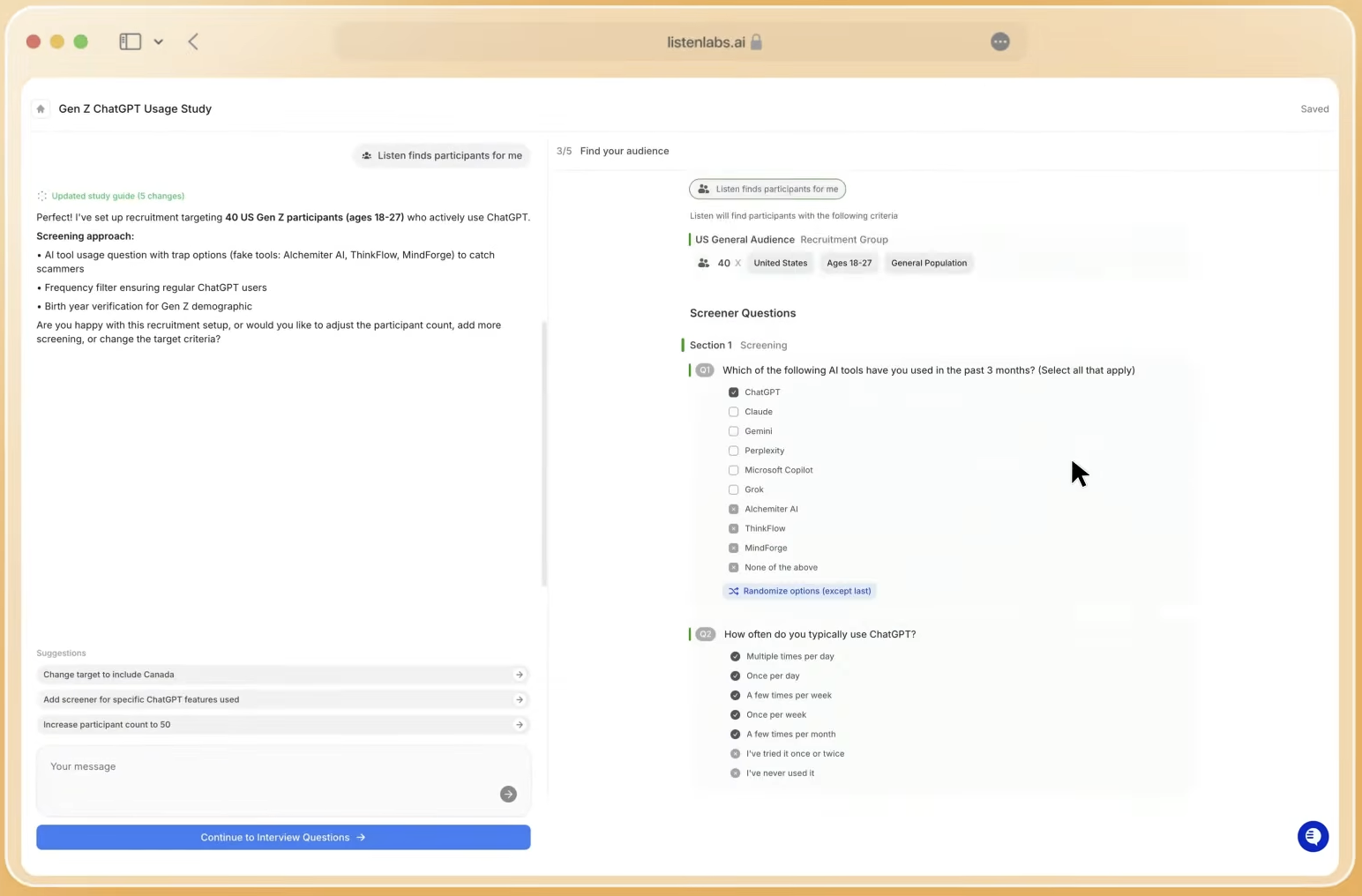
Listen Labs conducts thousands of AI-moderated qualitative interviews simultaneously through a global network of verified respondents across 45+ countries and 100+ languages, and delivers consultant-quality reports with same-day turnaround. Its Emotional Intelligence layer analyzes tone of voice, word choice, and micro-expressions to surface what consumers actually feel about a brand. These insights inform the content and positioning strategy that ultimately shapes AI citations.
Where Listen Labs Fits: Team-Specific Use Cases
Enterprise consumer insights teams at Fortune 500 companies in tech, CPG, retail, and financial services face growing research backlogs and cannot run enough studies per quarter to keep pace with brand and product decisions. Listen Labs compresses the research cycle from 4–6 weeks to a same-day turnaround, which enables teams to run brand perception studies, creative testing, and concept validation at a scale that previously required major headcount increases. Microsoft used Listen Labs to collect global customer stories within a single day for its 50th anniversary campaign.
UX research leads at mid-to-large tech companies need faster feedback loops to inform sprint cycles. Listen Labs supports screen sharing, usability testing, and AI-moderated interviews with 50–100+ participants instead of the 5–10 typical of manually scheduled sessions, which removes scheduling overhead and no-show risk.
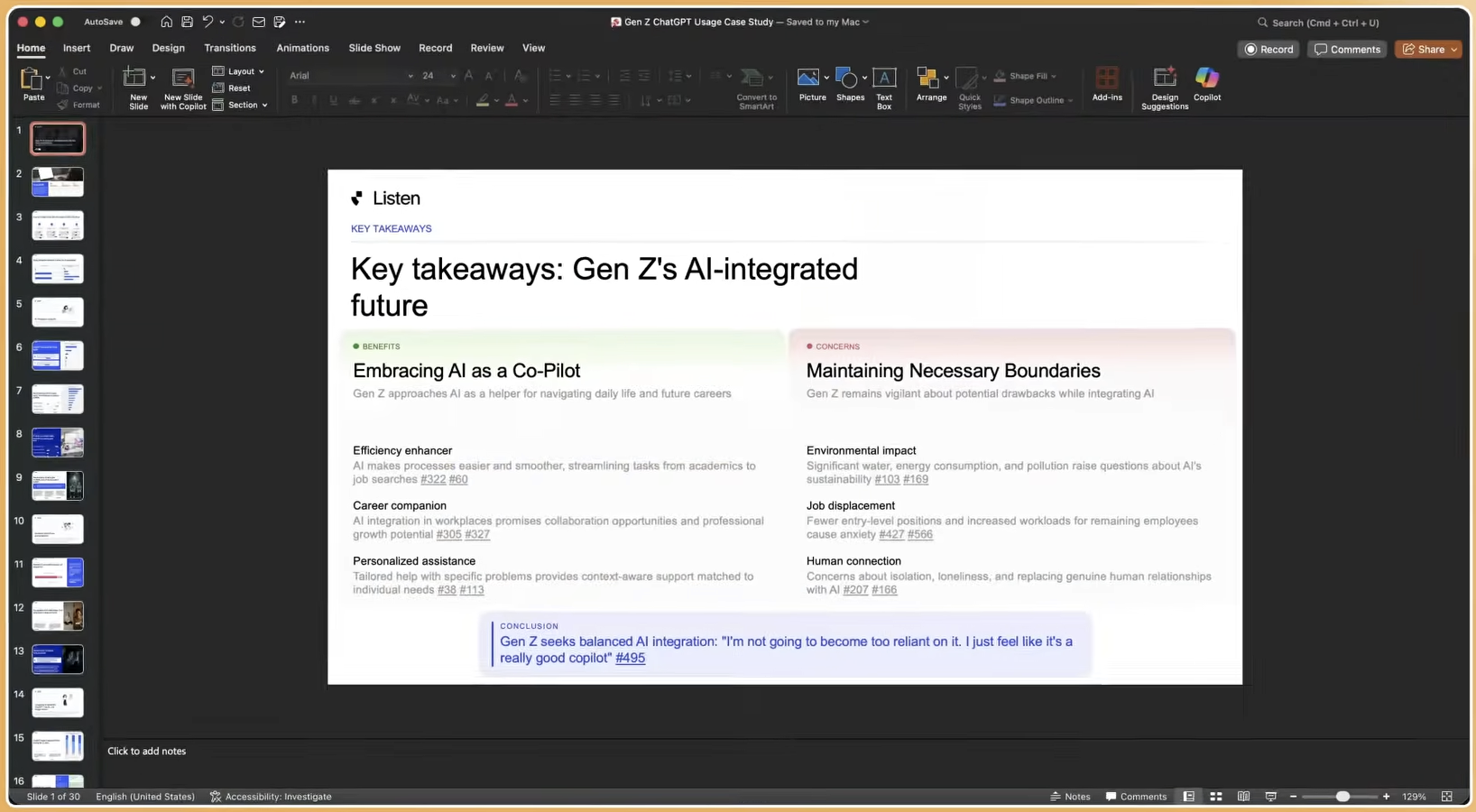
Product managers and marketing leaders without dedicated research teams can describe research goals in natural language and have Listen Labs handle study design, recruitment, moderation, and analysis automatically. The Research Agent then generates slide decks, memos, and highlight reels in under a minute.
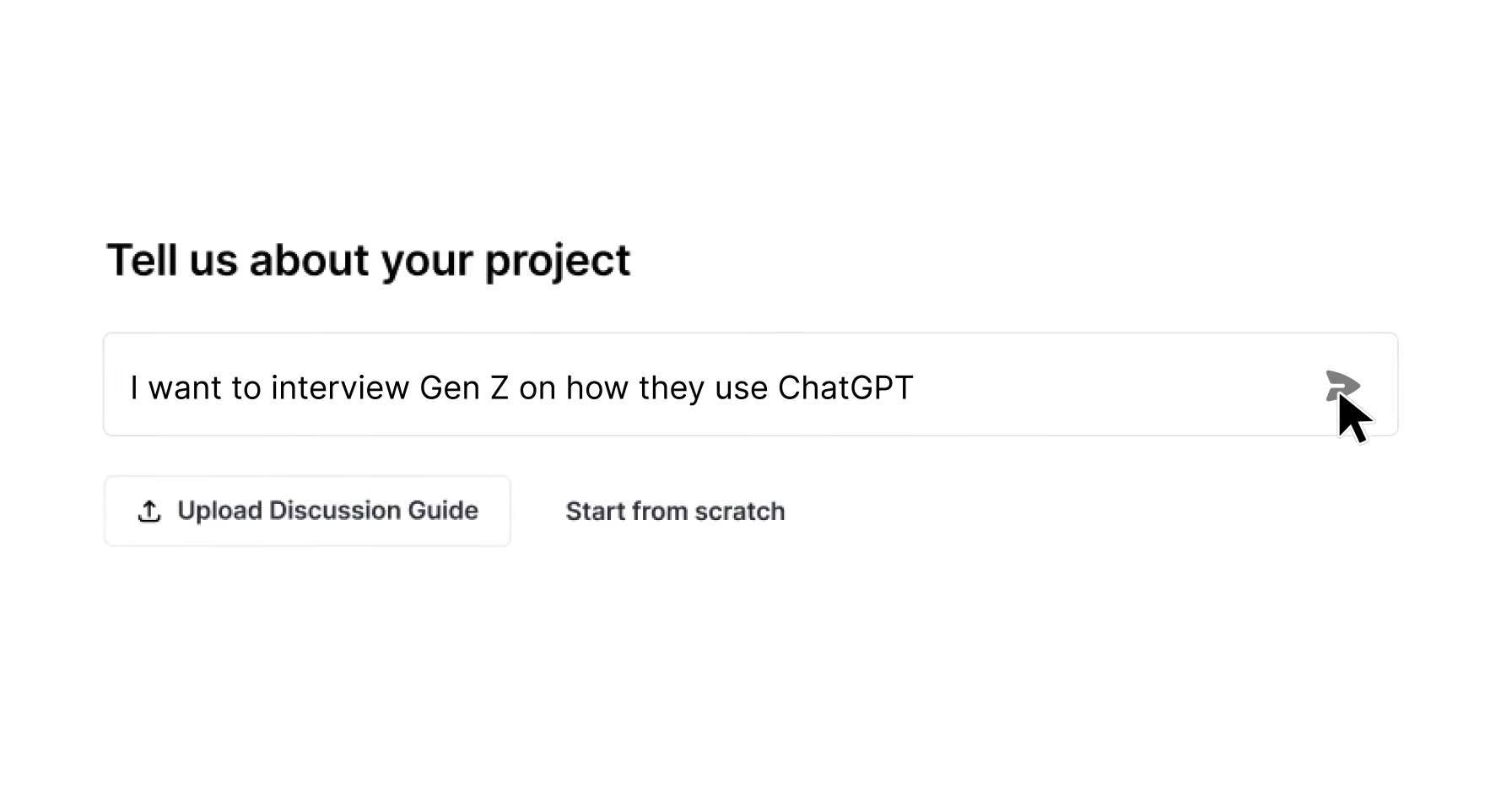
Agencies and consultancies conducting brand research or investment due diligence on compressed client timelines benefit from Listen Labs’ ability to reach niche audiences, including enterprise decision-makers, healthcare workers, and consumers below 1% incidence rate, across 45+ countries within hours.
Operational and Long-Term Requirements for AI Visibility Programs
Sixty-five percent of marketers named AI-driven search changes as their top challenge in 2026, and over half reported struggling to prove ROI from AI visibility. Operational success requires connecting citation metrics to business outcomes, not just reporting citation rates in isolation. A citation is not a recommendation, so enterprise teams must track citation rate, recommendation rate, freshness-adjusted currency, and zero-click exposure as four separate metrics rather than one blended AI visibility score.
Compliance requirements remain non-negotiable for regulated industries. Listen Labs holds SOC 2 Type II, GDPR, ISO 27001, ISO 27701, and ISO 42001 certifications, supports enterprise SSO, and maintains a zero-training-data policy, which means customer data is never used for AI model training. Enterprise procurement teams evaluate SAML 2.0 or OpenID Connect SSO as a baseline requirement, alongside data residency options, GDPR documentation, and documented incident response procedures.
Repeatability across global programs depends on language coverage and participant quality. Listen Labs supports 100+ languages for interview moderation with automatic translation and transcription, and its Quality Guard system monitors every interview in real time for fraud, low-effort responses, and repeat respondents. Participants are limited to three studies per month, which removes professional survey-takers that undermine data quality in commodity panels.
The risks of underinvesting in AI brand tracking already appear in search data. Ahrefs’ March 2026 analysis of 863,000 keywords found that only 38% of pages cited in Google AI Overviews also rank in the top 10 for the same query, down from 76% in July 2025. Brands that rely solely on organic rank tracking now operate with an incomplete picture of their actual AI visibility.
Decision Framework: Choosing Tools for AI Visibility and Consumer Insight
Teams whose primary need involves monitoring social conversation volume and sentiment on human-generated platforms can rely on legacy social listening suites for that surface. Teams that need to understand what AI models say about their brand when buyers ask research questions require a dedicated AI visibility platform with prompt-level citation tracking across ChatGPT, Perplexity, Gemini, and Google AI Overviews.
Teams that need to understand why AI models represent their brand a certain way, and want to influence that representation through better content, positioning, and consumer understanding, require an end-to-end consumer insights platform. Listen Labs serves this need by combining a large verified respondent network, AI-moderated interviews, an Emotional Intelligence layer built on Ekman’s universal emotions framework, a Research Agent for natural-language analysis, and Mission Control as a cross-study knowledge repository. Enterprises including Microsoft, Google, Sony, Anthropic, Procter & Gamble, Skims, Levi’s, and Nestlé use Listen Labs for this purpose.
Budget-constrained teams should compare total research process cost rather than platform fees alone. Listen Labs replaces multiple vendors for recruitment, scheduling, moderation, transcription, analysis, and report writing with a single platform at roughly one third of the cost of traditional research approaches.
Frequently Asked Questions
How long does it take to get results from Listen Labs?
Listen Labs compresses the entire research cycle to under 24 hours by automating every step that usually requires manual coordination. AI assists with study design, which then triggers automated recruitment from a global network of verified respondents. Once recruitment finishes, participants complete video interviews with dynamic follow-up questions, and the platform analyzes all responses in real time to generate deliverables such as slide decks, memos, and highlight reels within a single business day. Traditional qualitative research often takes 4–6 weeks for the same output.
How does Listen Labs ensure participant quality and prevent fraud?
Three layers of protection operate together. First, Listen Labs works exclusively with high-quality, non-commodity panel sources, so professional survey-takers do not enter studies. Second, Quality Guard uses real-time AI monitoring across video, voice, content, and device signals to detect fraud, low-effort responses, AI-generated scripts, and mismatched profiles. Third, a dedicated recruitment operations team adds a human review layer, and participants are limited to three studies per month to prevent panel fatigue and eliminate repeat respondents.
Can Listen Labs support multilingual and multi-market research programs?
Yes. Listen Labs supports 100+ languages for interview moderation with automatic translation and transcription across all supported languages. The platform covers 45+ countries across the Americas, Europe, APAC, and MEA. The Emotional Intelligence layer operates across 50+ languages, which enables consistent emotional signal capture across global programs without separate regional vendors.
What security and compliance certifications does Listen Labs hold?
Listen Labs maintains the full suite of enterprise security certifications detailed in the Operational and Long-Term Requirements section above, including SOC 2 Type II and ISO 27001. The platform uses 256-bit encryption, supports enterprise SSO, enforces role-based access controls, and maintains a zero-training-data policy so customer data never trains AI models.
What deliverables does Listen Labs produce, and how quickly?
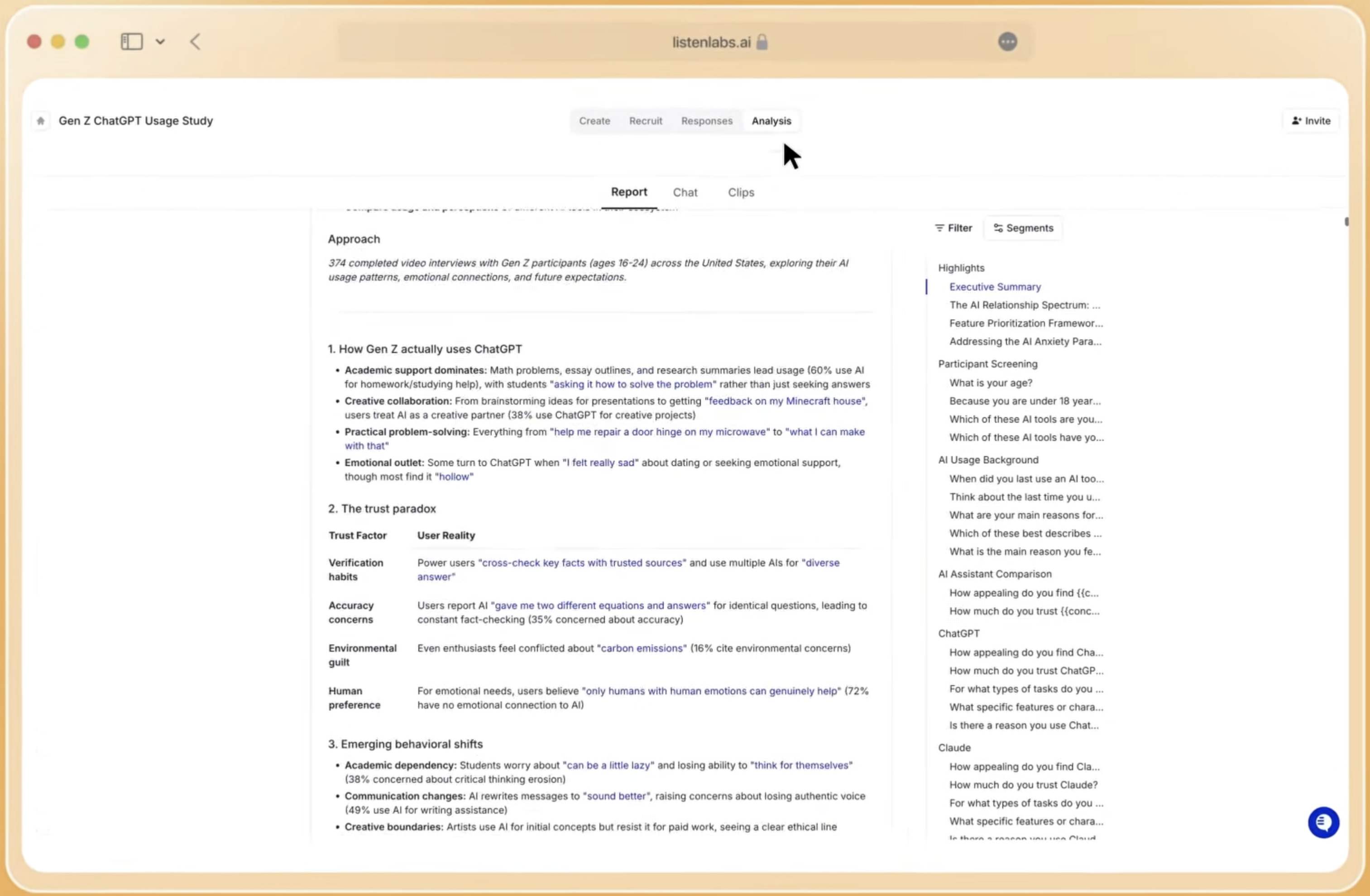
The Research Agent generates deliverables in under a minute from completed interview data. Outputs include automated key findings and theme analysis, consultant-quality PowerPoint slide decks, memo-style reports, video highlight reels, statistical charts and comparisons, segmentation breakdowns by demographics or custom cohorts, and answers to any natural-language question posed against the dataset. Mission Control stores all past research for cross-study queries, which lets teams retrieve institutional knowledge in seconds without digging through archived reports.
Conclusion: Connecting AI Brand Tracking to Consumer Insight with Listen Labs
Traditional metrics like keyword rankings and organic traffic no longer fully reflect search visibility in 2026 because AI search systems evaluate extractability, entity clarity, and topical depth. Brands that will hold share of voice inside ChatGPT, Perplexity, Gemini, and Google AI Overviews will understand their customers deeply enough to produce content that AI models treat as authoritative, specific, and citable.
Listen Labs connects prompt-level consumer insight to the research infrastructure required to act on it by combining a global verified respondent network, 100+ language support, Emotional Intelligence, a Research Agent, and Mission Control in a single enterprise-grade solution with robust security and compliance certifications. The platform moves brand research from study brief to actionable insight in under 24 hours, at roughly one third of the cost of traditional approaches, and at a depth and scale that legacy tools cannot match.