Written by: Anish Rao, Head of Growth, Listen Labs
Key Takeaways
- Brand tracking platforms fall into three categories: survey-based trackers, social listening tools, and AI search visibility trackers. Each answers a different question.
- Survey-based trackers deliver statistically robust trend lines for brand equity, yet they act as lagging indicators and do not explain why metrics move.
- Social listening platforms excel at real-time reputation and crisis monitoring but only capture the vocal minority who post publicly.
- AI search visibility trackers measure brand presence inside generative answers, a growing need as B2B buyers shift their research to AI tools.
- Listen Labs closes the diagnostic gap with Listen Pulse by pairing KPI tracking and open-ended conversation in every wave. See Listen Pulse in action.
Brand Tracking, Brand Monitoring, and AI Visibility
Brand tracking refers to continuous, wave-based measurement of consumer perceptions such as awareness, consideration, purchase intent, and related equity metrics, typically through surveys of a representative sample. The output is a trend line that moves with consumer sentiment over time.
Brand monitoring and social listening describe real-time scanning of public digital content such as social posts, news articles, forums, and reviews for mentions of a brand. The output is volume and sentiment of conversation, which differs from a statistically weighted measure of consumer perception.
AI visibility tracking is a newer discipline that measures how a brand appears inside AI-generated answers from systems like ChatGPT, Google AI Overviews, Perplexity, Gemini, Copilot, and Claude. These tools track mentions, citations, share of voice, and sentiment within those responses.
Note: “Brand monitoring” also appears in cybersecurity contexts, where it refers to detecting fraudulent use of a brand’s identity online. That discipline is unrelated to the consumer insights category this article addresses.
The Three Categories of Brand Tracking Platforms
Survey-Based Brand Health Trackers
Survey-based trackers measure what consumers say they think, feel, and intend, drawn from a representative panel rather than from people who chose to post publicly. Because the sample is controlled and the questions are consistent wave over wave, these platforms produce the trend lines that brand and finance teams use to justify marketing investment.
YouGov BrandIndex tracks 16 brand-health and funnel metrics, including awareness, consideration, purchase intent, buzz, quality, value, and reputation. It draws on YouGov’s global panel of over 30 million respondents with consistent brand tracking data across 55 markets. Data is collected daily and weighted to population targets. Its strength is statistical robustness and historical depth. Its limitation is that it reports what moved without explaining why.
Kantar BrandZ covers 21,000+ brands across 540+ categories in 55+ markets. It uses its Meaningfully Different Framework, measuring brands on Meaningful, Different, and Salient dimensions, to predict brand value, market share, and pricing power. It is enterprise-priced and typically deployed at scale across multiple markets.
Qualtrics runs continuous brand health tracking with built-in driver analysis that identifies which brand associations most influence outcomes like purchase intent and loyalty. Its advantage is that brand tracking data sits alongside CX, segmentation, and message-testing data without requiring movement between systems.
Latana uses machine-learning MRP (multilevel regression with post-stratification) modeling to generate audience-specific brand metrics from smaller sample sizes. This approach enables reliable measurement of niche segments that standard trackers struggle to reach at reasonable cost.
The shared limitation across all survey-based trackers is clear. They are lagging indicators with no mechanism to explain themselves. They can show that awareness or consideration moved. They do not explain why in human terms.
Social Listening and Media Intelligence Platforms
Social listening platforms scan public digital content in real time and measure the volume and sentiment of what people are saying rather than what a representative sample reports thinking. They are the right tool for crisis monitoring, earned media measurement, and competitive narrative tracking. They are not designed to measure the silent majority who do not post.
Brandwatch sources mentions from 13 public source categories, including X (Twitter), Facebook, Instagram, LinkedIn, TikTok, Reddit, forums, YouTube, news, blogs, and review sites. It draws on over 100 million online sources and ingests the full X firehose and approximately 8 million Bluesky mentions per day. Its breadth makes it a strong choice for large-scale conversation analysis, yet it only captures people who post publicly.
Meltwater positions its media monitoring primarily for PR and communications teams, tracking earned media across traditional, digital, social, and broadcast sources while also offering social listening, influencer insights, and AI visibility within a unified platform. Talkwalker now ships only inside Hootsuite Enterprise, which makes it inaccessible as a standalone product. For teams that need basic monitoring without enterprise contract complexity, Brand24 offers budget-friendly real-time mention tracking with published self-serve pricing.
AI Search Visibility Trackers
AI search visibility tools send automated prompts to AI engines on a schedule, record which brands are mentioned and which sources are cited, and convert the results into share-of-voice, sentiment, and citation metrics across platforms including ChatGPT, Google AI Overviews, Perplexity, Gemini, Copilot, and Claude.
RadarKit tracks prompt-level sentiment and multi-assistant visibility. Semrush’s AI Visibility Toolkit bridges traditional SEO with AI visibility tracking and is available as a standalone product at $99/month or bundled into Semrush One starting at $199/month. The category is growing rapidly but carries a clear limitation. AI answers are non-deterministic, so precision is not available and any vendor promising it is overselling.
How to Choose: A Decision Framework by Goal
With the three categories mapped, the harder question is where to start. The right starting point is the business question, not the vendor shortlist.
- Brand equity over time across markets → survey-based brand health tracker. You need a representative sample, consistent question wording, and a trend line that finance will accept.
- Real-time reputation and crisis monitoring → social listening and media intelligence platform. You need volume, velocity, and sentiment from public conversation as it happens.
- PR and earned media measurement → social listening with news and broadcast coverage. You need to track what outlets are saying rather than what consumers are thinking.
- AI search presence → AI search visibility tracker. You need to know whether your brand appears in the AI-generated answers your buyers read before they ever reach your website.
These categories are not mutually exclusive. Most enterprises running serious brand programs operate more than one simultaneously. A survey tracker covers equity, a social listening tool covers reputation, and an AI visibility tool increasingly covers generative search as it becomes a primary research channel for buyers.
Ready to see how a conversational tracker fits alongside your existing stack? Watch a conversational wave run with Listen Labs and see Listen Pulse in action.
Do Brand Trackers Explain Why Metrics Change?
This question sits at the center of the category and carries the greatest operational impact for an insights leader after a wave lands.
Traditional trackers are wave-based and quant-only. They report that awareness or consideration moved and carry no diagnostic for why. By the time a KPI declines, the underlying shift has been building for months. Explaining it usually requires commissioning a separate qualitative study, which means the answer arrives a quarter late. As one practitioner put it, “By the time your Q3 wave shows a dip, the thing that caused it happened in July, and you’re only now starting to investigate in October.”
This pattern creates a diagnostic gap that no survey tracker, social listening platform, or AI visibility tool closes by design. Survey trackers ask closed questions and report net scores, so they never surface the reasoning behind an answer. Social listening captures only what people who post publicly are saying, which means the silent majority is invisible. AI visibility tools measure brand presence in generated answers; they do not capture the consumer reasoning behind brand perception shifts.
Listen Pulse, Listen Labs’ conversational tracker, is built specifically to close this gap. It runs the same study with the same screeners wave after wave, keeping core questions constant to protect the trend line. Every wave adds open-ended conversation alongside the structured KPIs. The platform sorts those open-ended answers into themes, quantifies them, and charts each theme directly next to the metrics teams already report. It analyzes tens of thousands of responses continuously and surfaces the trends forming now, why the numbers are moving, and what is coming next. Every number traces back to the interview, verbatim quote, and audio or video clip behind it.
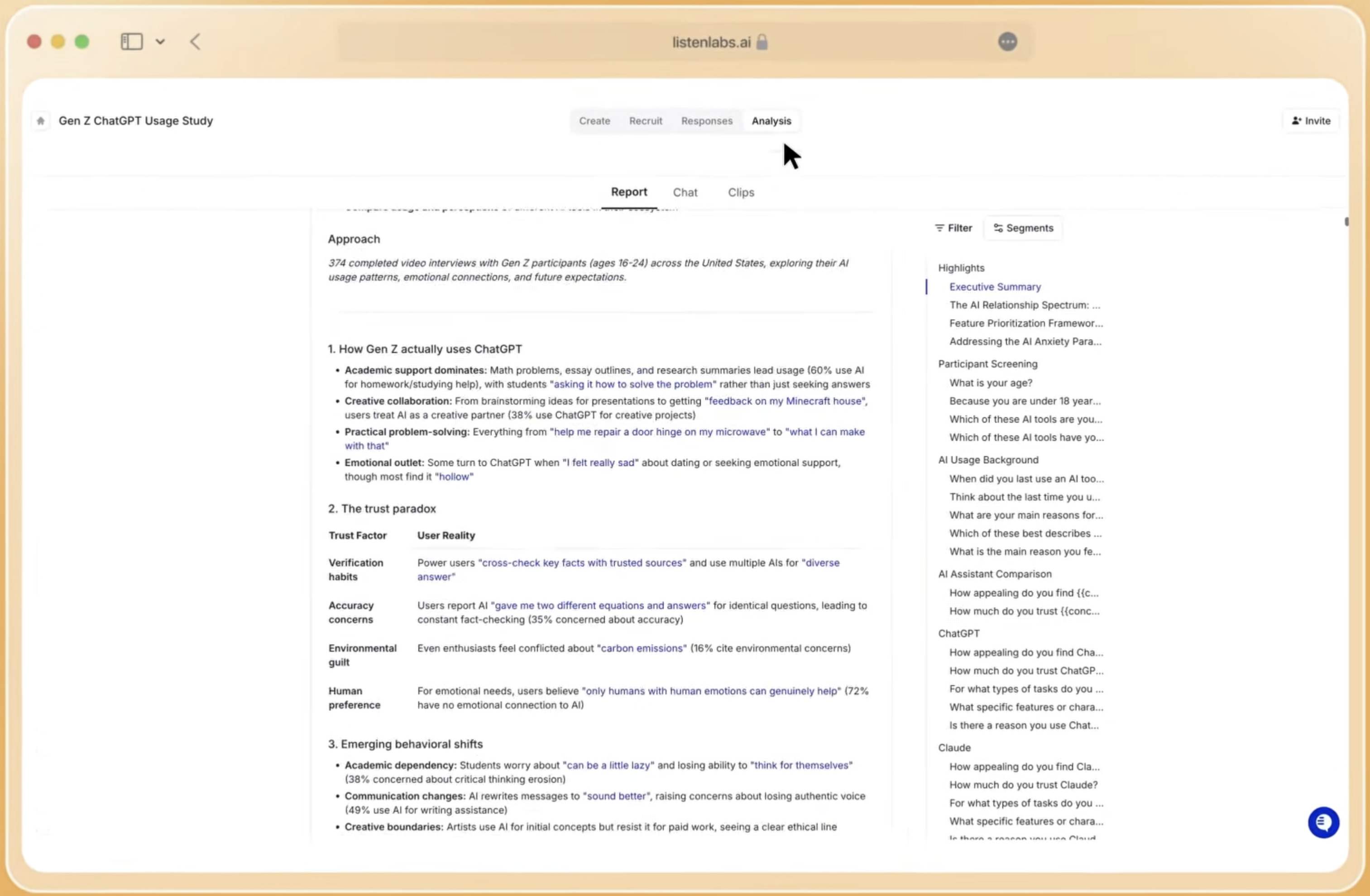
The operational difference is concrete. One well-known clothing brand, famous for its big logos, was quietly losing customers. Its existing tracker caught the drop but could not explain it. Pulse found the cause was style rather than price. A growing group of customers felt the big logos were too loud for their changing lifestyles. That finding arrived in the same wave as the KPI movement, instead of a quarter later after a separate qualitative commission.
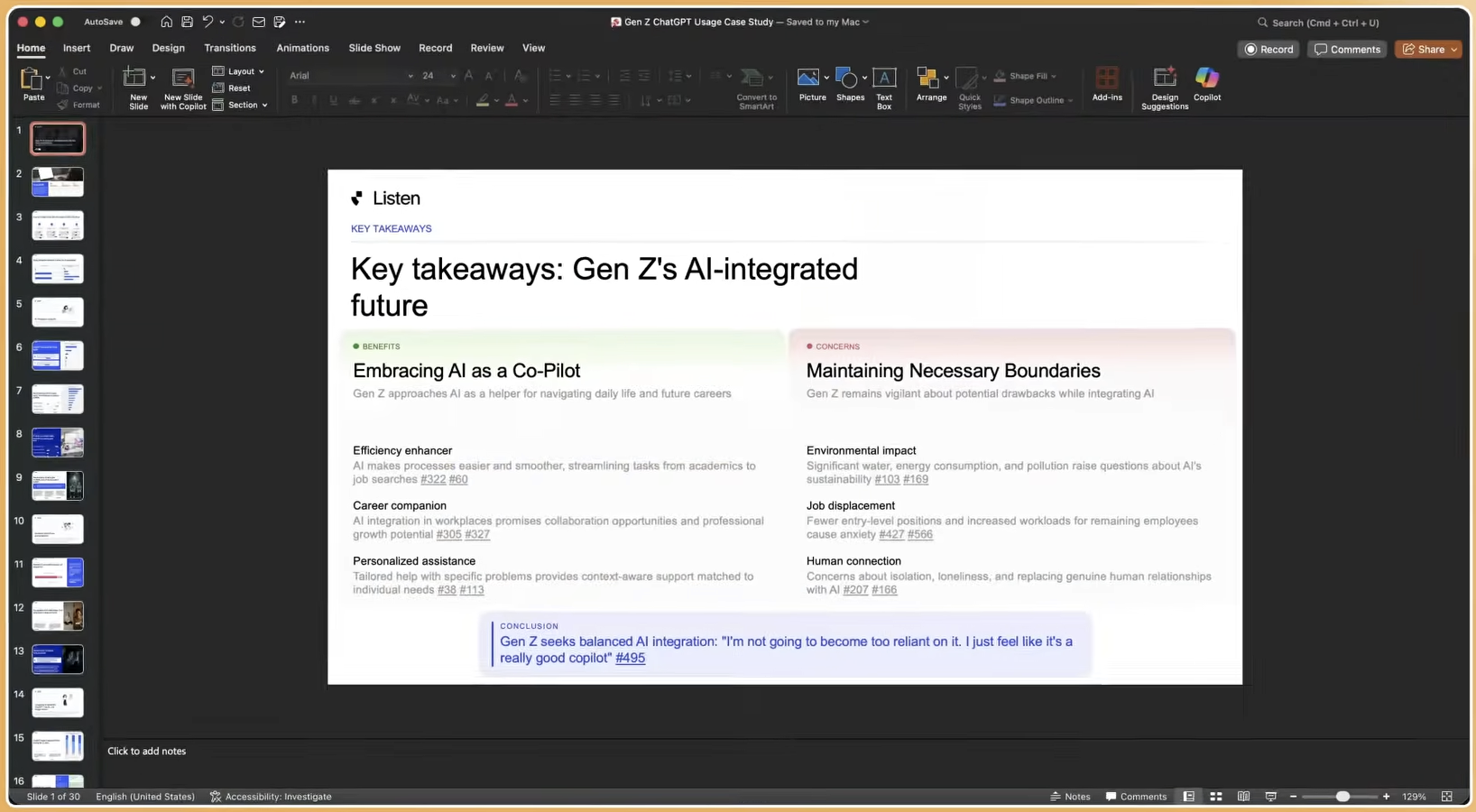
Listen Pulse deploys alongside an existing tracker or as the primary tracking system. It integrates with Qualtrics and Decipher, so teams keep the KPIs they already report while adding the narrative behind them. It sits apart from platform-versus-platform comparisons. The question it answers is “why did the number move,” and it answers that question in the same instrument that produced the number.
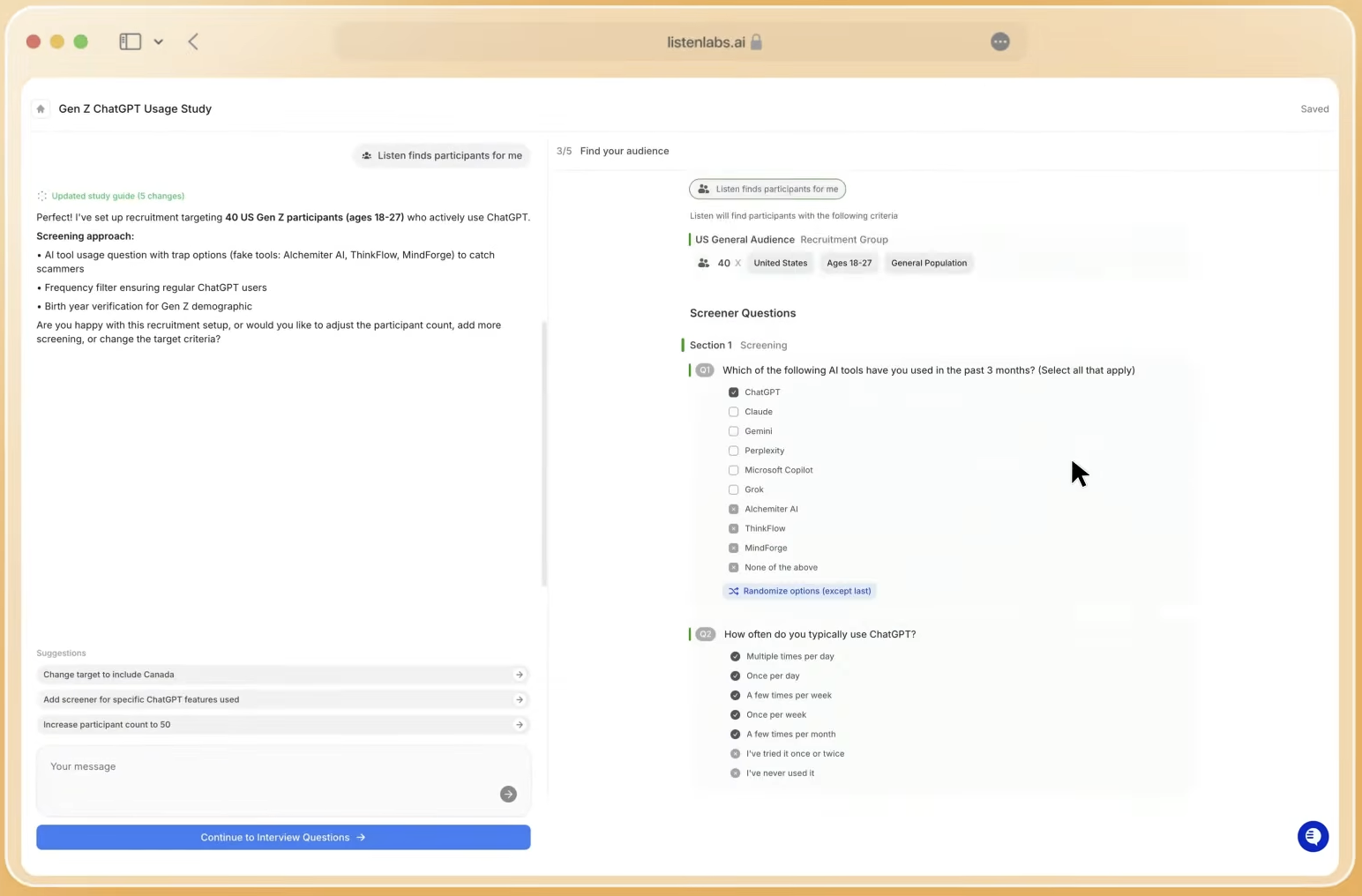
Get a walkthrough of the diagnostic gap and see how Listen Pulse pairs KPI tracking with open-ended conversation in a single wave.
What Brand Tracking Platforms Really Cost
The diagnostic gap has a price tag as well. Because no single category closes it, most enterprises pay for more than one platform, which makes total operational burden, not sticker price, the meaningful comparison point.
Survey-based brand health trackers price primarily on the survey program itself: number of brands tracked, markets covered, metrics included, and whether the engagement is DIY, SaaS, or full-service agency. Legacy agency trackers from Kantar, Ipsos, and Nielsen typically run $100,000–$500,000+ annually for custom studies. Always-on SaaS trackers like Tracksuit and Latana run $10,000–$60,000 per market per year. Enterprise research platforms like Qualtrics carry $60,000–$450,000+ in annual license fees, with panel access often billed separately. The hidden cost that rarely appears in vendor comparisons is the internal researcher headcount required to run the tracker properly, typically one to two FTEs at $120,000–$180,000 per person per year.
Social listening platforms price on mention volume, history depth, source coverage, and seats rather than on the number of users alone. Enterprise contracts for platforms like Brandwatch and Meltwater are quoted annually and rarely published. A critical operational cost that self-serve reviews consistently omit is mention quota behavior. Most enterprise listening contracts do not roll over unused mention quota, so a viral incident can exhaust months of quota in days, exactly when the tool is most needed.
AI search visibility tools price by prompt or keyword volume, with published self-serve tiers starting as low as $29/month for entry-level tools and enterprise platforms priced on custom contracts. The category is new enough that pricing models are still stabilizing.
Total operational burden is the honest comparison point. A $50,000 survey tracker that requires two internal FTEs to operate costs far more than its contract value. A social listening platform sized against a quiet month can generate unexpected overage charges during the crisis it was purchased to monitor.
Free and Paid Brand Tracking Options
Free tiers in this category generally cover monitoring or limited-volume tracking and rarely support the diagnostic depth, sample control, or trend-line integrity of paid platforms.
YouGov BrandIndex Lite is a free, browser-based dashboard that provides a snapshot of brand performance in BrandIndex’s Buzz category, with the ability to benchmark against competitors and filter by market, industry, and audience demographics. It is powered by YouGov’s panel of over 30 million registered members and offers a legitimate starting point for teams that want directional data before committing to a full subscription.
Google Alerts remains the only free option for basic keyword monitoring without sentiment analysis or social platform tracking. It captures new web content mentioning a keyword but provides no volume trend, no sentiment scoring, and no social data.
For teams evaluating whether a paid tracker is justified, the more useful question focuses on actionability. A Buzz snapshot tells you directional sentiment. It does not tell you whether awareness is building, whether consideration is converting, or why either metric moved.
Frequently Asked Questions
This FAQ addresses the operational details teams raise most often when comparing brand tracking approaches.
What Is the Turnaround Time for a Brand Tracking Wave?
Turnaround time varies significantly by category and vendor. Traditional agency-run survey trackers typically deliver results with a 4–6 week turnaround per wave, running 4–6 waves per year, and in enterprise settings internal prioritization can extend this further. Always-on SaaS trackers like YouGov BrandIndex provide daily data updates. Listen Pulse, as an AI-moderated conversational tracker, analyzes tens of thousands of responses continuously and surfaces emerging themes in real time, so the metric and its explanation arrive in the same wave rather than after a separate qualitative commission.
How Are Participants Sourced, and How Do You Ensure Sample Quality?
Survey-based trackers draw from proprietary or third-party panels weighted to match population demographics. YouGov BrandIndex draws from a panel of over 30 million registered members globally. Listen Labs sources participants from its network of 50 million+ verified respondents across 45+ countries and 120+ languages, with Quality Guard, an AI orchestration layer, monitoring every interview in real time for fraud, low-effort responses, and repeat respondents. Participants are limited to three studies per month to eliminate professional survey-takers. Social listening platforms do not source participants at all; they scan public content from people who chose to post.
Can Trackers Handle Multilingual and Multi-Market Tracking?
Leading survey-based trackers are built for multi-market deployment. YouGov BrandIndex covers 55+ markets, and Kantar BrandZ covers 55+ markets across 540+ categories. Listen Labs supports 120+ languages for conducting interviews, with automatic translation and transcription, and covers 45+ countries across the Americas, Europe, APAC, and MEA. AI visibility trackers vary in their language and market coverage; most cover major markets, but geographic depth differs by vendor.
How Is Security and Privacy Handled?
Enterprise-grade security is table stakes for any platform handling consumer research data at scale. Listen Labs maintains SOC 2 Type II, ISO 27001, ISO 27701, and ISO 42001 certifications, is GDPR compliant, uses 256-bit encryption, and supports enterprise SSO. Listen Labs never trains its AI models on customer data. Buyers evaluating any platform should confirm data retention policies, whether respondent data is used for model training, and whether the vendor holds relevant certifications for their operating geography.
Which Category Fits Which Research Context?
Survey-based brand health trackers are the right choice when the goal is measuring brand equity over time with a representative sample, the data that justifies marketing investment to finance. Social listening platforms are the right choice for real-time reputation management, crisis response, and earned media measurement. AI search visibility trackers are the right choice when buyers research in AI assistants and that presence is currently unmeasured. Listen Pulse fits when the goal is understanding not just what a brand metric did but why, pairing the trend line with the consumer reasoning behind it in a single instrument.
Conclusion: Choose Your Approach, Then Close the Gap
The real comparison in brand tracking focuses on measurement approach rather than platform names. Survey-based trackers measure what representative consumers say they think and feel. Social listening platforms measure what people who post publicly are saying. AI visibility trackers measure how a brand appears in AI-generated answers. Each answers a different question, and none of them by design explains why a tracked metric moved.
That diagnostic gap is the most operationally consequential problem in brand measurement, and Listen Pulse is built to close it. Pulse delivers the number and its cause in the same instrument, on the same cadence, without a separate qualitative commission.
Ready to know why your brand metrics moved? Start closing the why gap with Listen Pulse.