Written by: Anish Rao, Head of Growth, Listen Labs
Key Takeaways
- AI-powered brand perception studies compress weeks of traditional research into hours by pairing AI-moderated interviews with automated analysis and human validation checkpoints.
- The six-step workflow covers study design, participant recruitment, AI interviews, automated theme analysis, human validation, and instant report generation for stakeholder-ready deliverables.
- Speed comes from parallelization and automation, while rigor depends on human checkpoints for sample verification, theme validation, emotional review, and cross-study comparison.
- Synthetic audiences support early hypothesis testing but do not replace real consumer validation for final brand strategy and leadership decisions.
- Listen Labs delivers consultant-quality brand perception insights in under 24 hours with built-in validation; see how the platform works.
Prerequisites And Context For AI Brand Perception Studies
This guide is for brand managers, consumer insights leaders, marketing strategists, and UX research leads at mid-to-large companies. These teams face pressure to deliver brand insights faster and often feel skeptical of AI-generated data. They need a methodology that is fast, scalable, and defensible, with evidence that AI actually makes research easier.
Several terms appear throughout this guide:
- Brand perception study: Research that captures how consumers describe, remember, and feel about a brand, revealing the story behind tracker scores.
- AI-moderated interview: A one-on-one video conversation conducted by an AI interviewer that adapts in real time and probes deeper on interesting or short answers the way a trained human interviewer would.
- Synthetic audience: AI-generated virtual participants created by training large language models on real-world data to simulate how real humans would respond. Synthetic respondents match real respondents at 85–95% accuracy for quantitative trends, but accuracy drops to 60–80% for qualitative depth, emotional nuance, and lived experience.
- Validation checkpoint: A human-in-the-loop step that confirms AI-generated findings are grounded in real consumer behavior before teams present them to stakeholders.
- Share of model: The proportion of AI-generated responses in a category that mention or recommend a brand, an emerging brand health metric as consumers increasingly begin research inside large language models.
The market context is shifting fast. Organizations are moving from one-off research projects to continuous customer intelligence programs. The rise of qual-at-scale, the ability to conduct hundreds or thousands of qualitative interviews simultaneously, is collapsing the traditional trade-off between depth and scale. AI can schedule and conduct interviews, analyze transcripts for themes, and generate quantitative insights from those interviews, all within a single workflow.
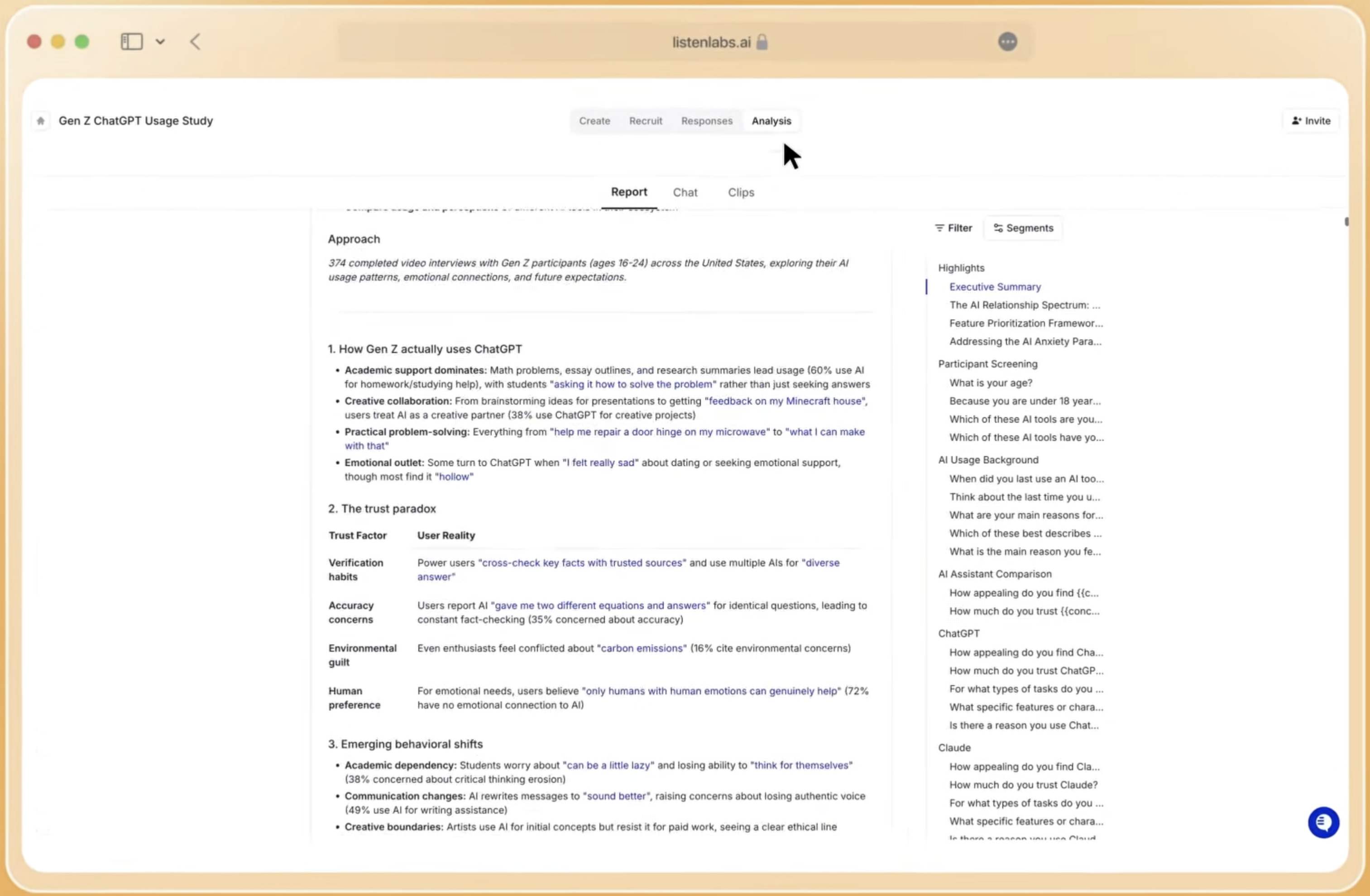
This workflow is built around Listen Labs, an end-to-end AI research platform that sources participants from a large verified respondent network, conducts AI-moderated interviews, analyzes findings, and delivers results in under 24 hours. See the platform in action.
Six-Step Workflow For Faster AI Brand Perception Studies
The following six-step workflow covers the full brand perception study lifecycle, from study design to stakeholder-ready deliverables.
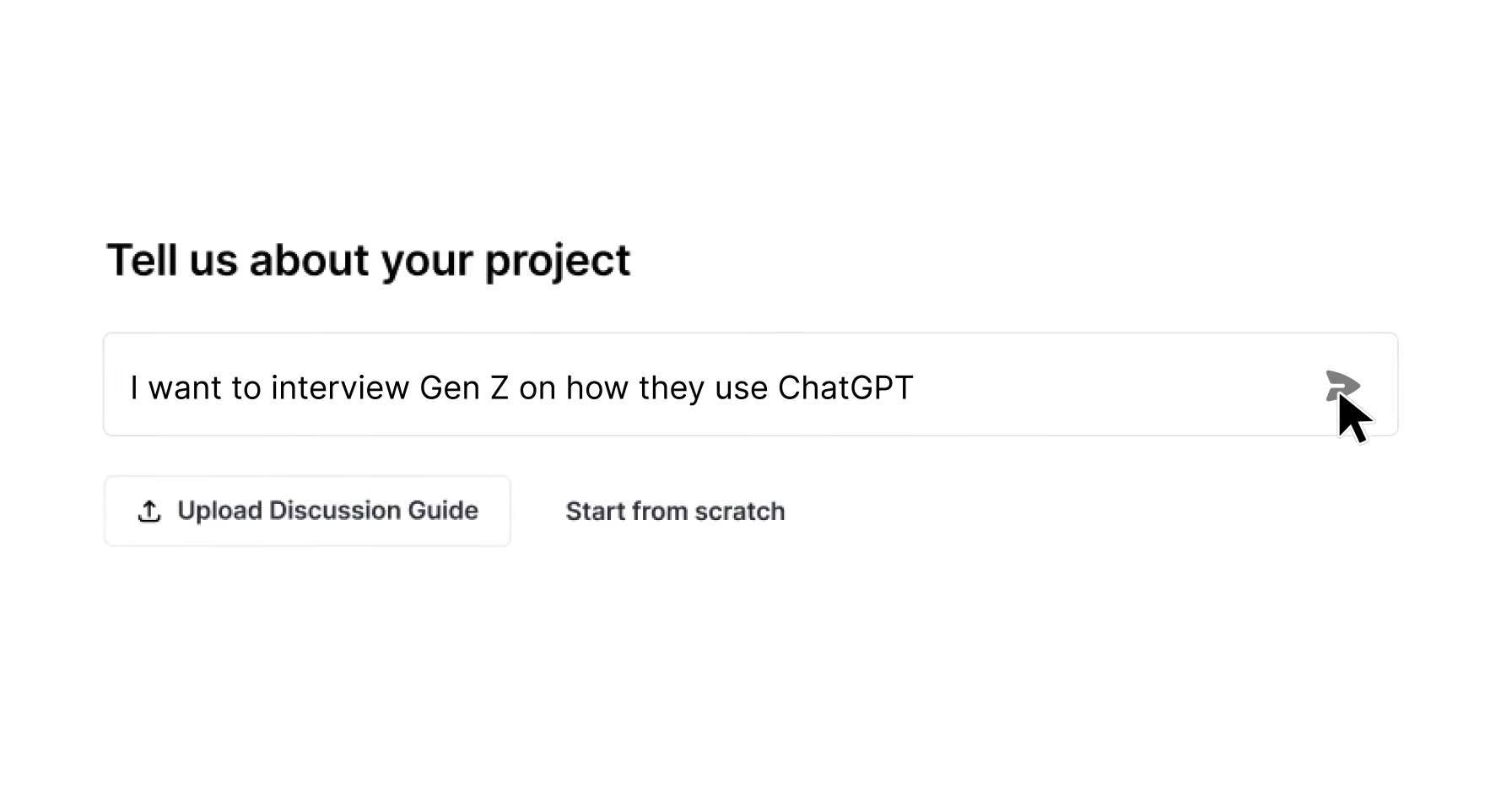
- Define The Brand Perception Questions And Hypotheses. Translate brand goals into structured research objectives. Specify which associations you want to measure and which segments matter most. Clarify the hypotheses you want to test. AI-assisted study co-design can draft structured objectives, questions, and probing context in seconds from a plain-language description of research goals. Typical time: hours.
- Recruit The Right Participants. Effective brand perception research requires recruiting category buyers, category rejecters, competitor loyalists, and lapsed users, rather than only a brand’s existing customer base. Screening criteria, quotas, and incidence rates must be defined before recruitment begins. Listen Labs addresses this with two layers of matching. Quality Guard screens participants on behavioral and intent data rather than self-reported demographics, and Listen Atlas bids on the best participants across panel partners and Listen Labs’ proprietary database. To keep those participants genuine, Listen Labs caps participation at three studies per month and maintains a dedicated recruitment ops team for hard-to-reach segments such as enterprise decision-makers, healthcare workers, and consumers below 1% incidence rate. Typical time: hours to 1–2 days.
- Run AI-Moderated Brand Perception Interviews. AI-led video interviews conduct personalized conversations with dynamic follow-up questions. They capture video, audio, and text simultaneously. Intelligent probing generates responses 3x longer than average, and Listen Labs conducts hundreds of AI-moderated qualitative interviews simultaneously while supporting 120+ languages for interview moderation. 92% of participants report top comfort levels in AI-moderated sessions, comparable to human-moderated sessions. Typical time: hours.
- Analyze Themes, Sentiment, And Emotion. Automated qualitative coding identifies patterns and themes across hundreds of responses without human bias. Listen Labs’ Emotional Intelligence analyzes tone of voice, word choice, and subconscious micro expressions, built on Ekman’s universal emotions framework, to quantify emotion per question and concept. Every label is traceable to the exact timestamp and verbatim quote. Emotional Intelligence is available across 50+ languages. Typical time: minutes to hours.
- Validate AI-Generated Findings Against Real Consumers. This step turns a fast study into a defensible one. The validation checklist appears in detail in the section below. Typical time: hours to 1 day.
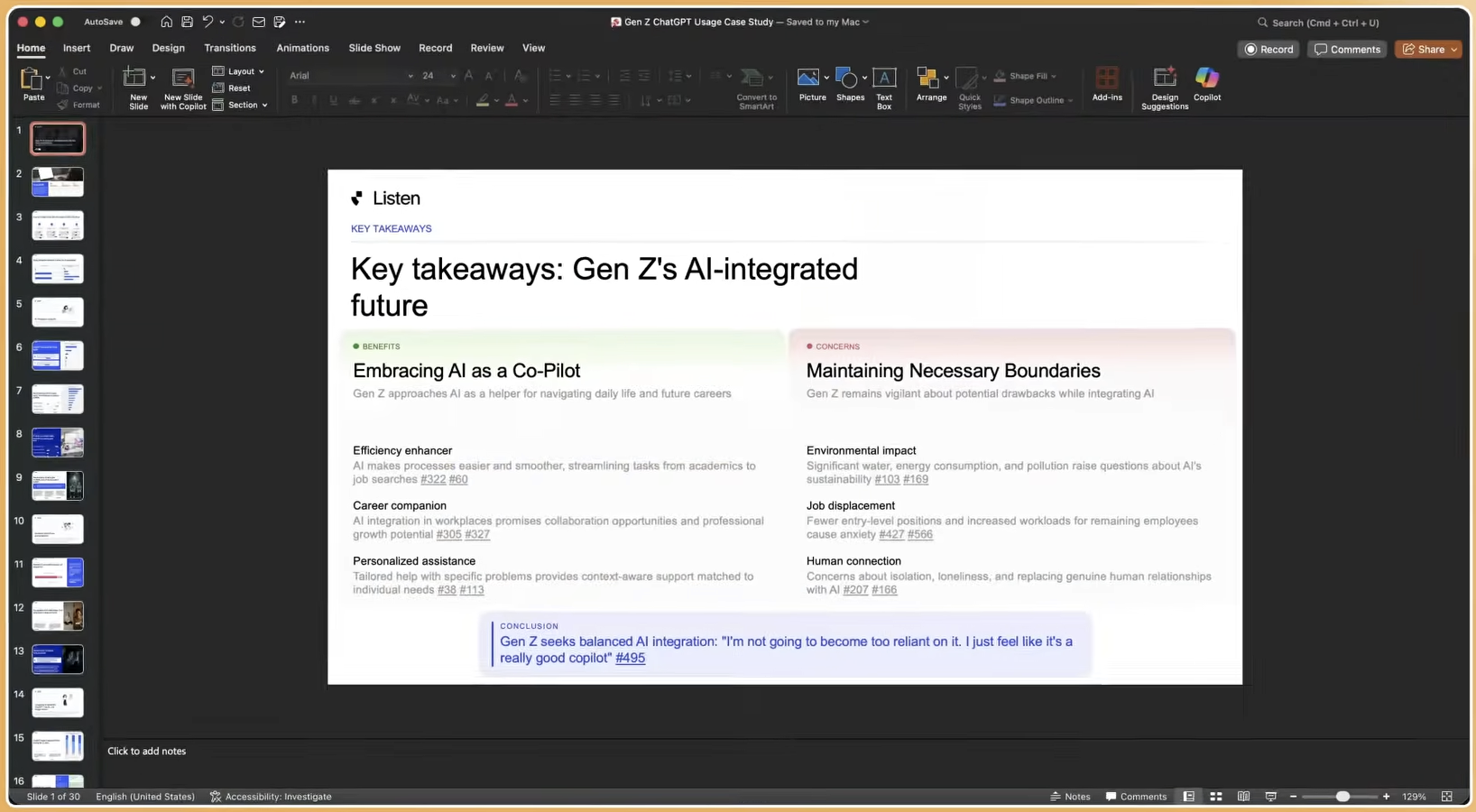
- Report And Activate. The Research Agent handles the full analysis workflow from raw data to final output. It generates slide decks, memos, highlight reels, and charts in under a minute. Research Library lets teams query past studies for cross-study synthesis, so every new study builds on institutional knowledge rather than starting from zero. Typical time: minutes.
Walk through this workflow with a researcher and see how it applies to your next brand perception study.
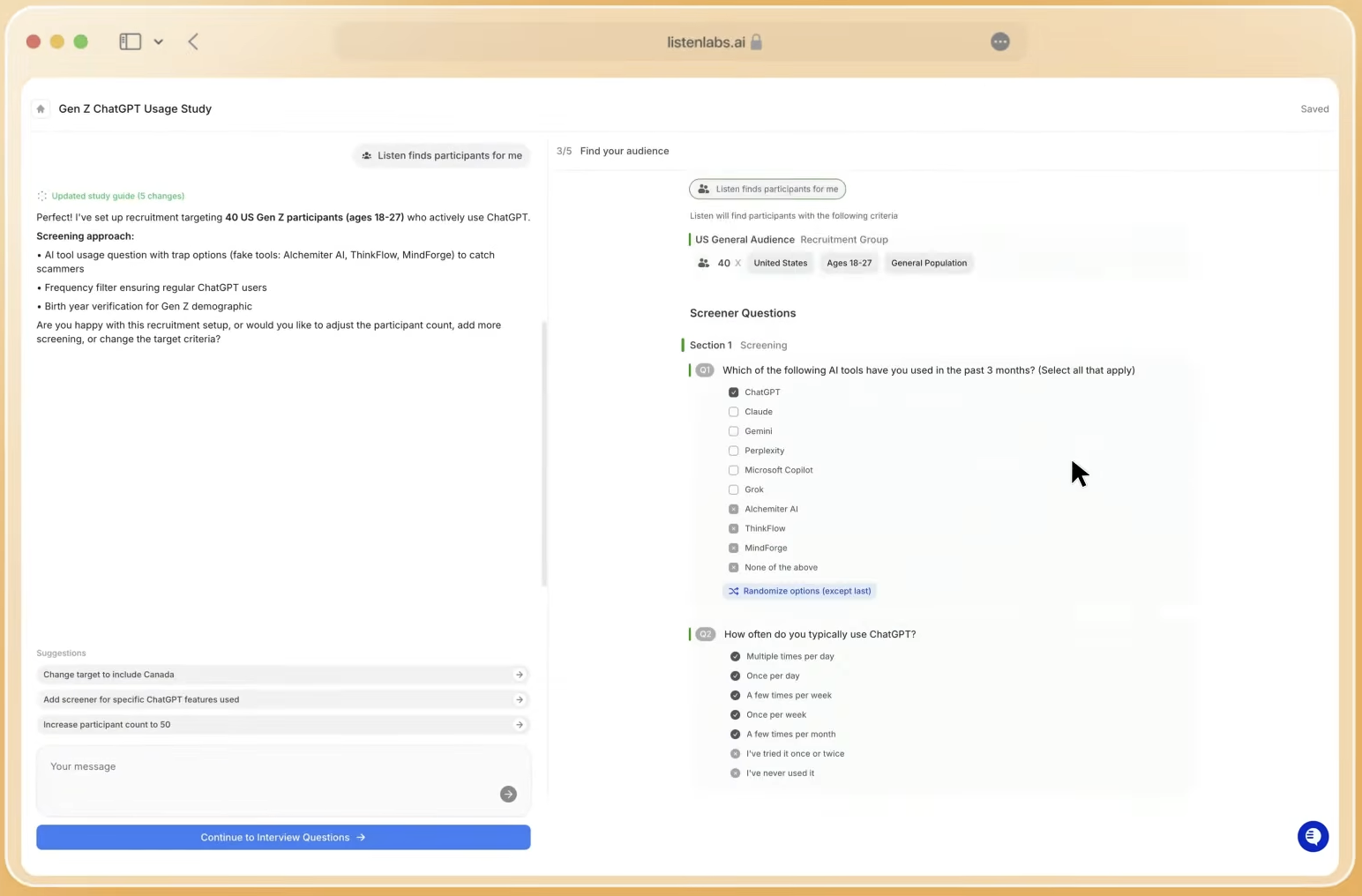
Before committing to this workflow, it helps to know which steps actually compress and which still require calendar time.
A Realistic Time Map For AI Brand Perception Studies
Speed in AI-accelerated brand research comes from parallelization and automation. Rigor comes from human checkpoints that teams should preserve. Knowing which parts of the workflow compress and which do not helps set accurate stakeholder expectations.
Compresses to hours:
- Study design and discussion guide drafting
- Recruitment for general population audiences
- AI-moderated interviews at scale, running in parallel
- Automated qualitative coding and theme identification
- Emotional analysis across all interview recordings
- First-draft deliverables: slide decks, memos, highlight reels
Still takes days:
- Recruiting niche audiences such as enterprise decision-makers or consumers below 1% incidence rate
- Human validation of AI-coded themes against raw transcripts and recordings
- Multi-market localization review for culturally sensitive research
- Stakeholder alignment on interpretation and strategic implications
A brand perception study that includes human validation and stakeholder alignment typically takes 2–3 days end-to-end for the concept and message testing cycle. A full continuous AI brand interview program can take 5–10 business days from kickoff to first wave of data, compared to 6–12 weeks for a full-service research agency. The compression is real. When validation is built into the workflow from the start, speed and rigor reinforce each other.
AI-Moderated Interviews And The Limits Of Surveys
Surveys scale but cannot follow up or probe. A 1–5 scale for “innovative” shows that the average moved but never that customers stopped saying “cutting-edge” and started saying “expensive.” Open-ended responses captured via conversational AI run 12–20x longer per respondent than equivalent open-ended survey items, averaging 180–400 words across 3–7 conversational turns versus 8–15 words in a classic panel survey.
AI-moderated interviews probe brand associations, category cues, and emotional responses in real time. When a participant gives a vague or short answer, the AI follows up. When an unexpected finding surfaces, the AI pursues it. Platforms like Listen Labs layer on auto-recruiting, transcription, sentiment tagging, and insight summarization so teams move from questions to findings in hours.
Human review remains important in specific contexts. Researchers still interpret ambiguous brand language, navigate cultural nuance in sensitive markets, and make strategic positioning calls that require judgment. A 2026 head-to-head study comparing AI-moderated and human-moderated interviews found that AI moderation is advantageous when scale and speed are required, while skilled human moderation still adds value for deeply culturally specific research. The practical implication: use AI moderation for the bulk of interviews and reserve human review for interpretation and validation.
Synthetic Audiences And AI Personas In Brand Research
Synthetic audiences, AI-generated virtual participants trained on real-world data, have a defined role in brand research workflows. That role sits upstream of final decisions rather than replacing them.
Synthetic respondents are most accurate on predictable patterns and least accurate when research requires understanding new contexts, unfamiliar products, or unique personal stories. They work well for early-stage hypothesis generation, pre-testing discussion guides, and concept screening before teams commit to a full fielded study.
Limits matter just as much. Critics have called synthetic respondents “homeopathy for market research” in high-stakes contexts, and real human validation is required for go/no-go decisions, pricing decisions, and brand strategy. Synthetic respondents also exhibit sycophancy, where LLMs tend to produce responses that align with what the prompt seems to want, which makes positive synthetic reactions carry very little information. The signal lives in specific, repeated objections.
For final brand decisions, teams should treat synthetic outputs as hypotheses to validate with real participants. The verified respondent network behind Listen Labs provides the real-consumer validation layer that synthetic-only tools lack. Listen Labs has run over 1 million AI-powered customer interviews for companies including Microsoft, Perplexity, and Sweetgreen, building a data moat on real consumer conversations rather than simulated ones.
The Validation Framework For Defensible AI Brand Studies
The validation framework separates a fast study from a credible one. Every step below should be documented so stakeholders can see the rigor behind the findings.
- Confirm The Sample Is Real And Verified. Start by confirming the sample is real and verified rather than synthetic-only. If participants were generated by an AI model instead of recruited from a verified panel with behavioral matching and real-time fraud monitoring, every downstream finding is compromised.
- Spot-Check AI-Coded Themes Against Raw Transcripts And Clips. Pull a random sample of responses for each major theme and confirm the AI’s coding matches what participants actually said. Every insight in Listen Labs links directly to the underlying response data, which keeps this step fast and auditable.
- Review Emotionally Significant Moments With A Human Researcher. Emotional Intelligence flags moments of confusion, hesitation, delight, and surprise. A human researcher should review the highest-signal clips to confirm that interpretations are accurate and contextually grounded.
- Test Whether Findings Hold Across Segments, Markets, And Languages. A theme that appears in one segment but not others becomes a segmentation insight rather than a universal finding. Break down results by the key demographic and behavioral cuts before drawing conclusions.
- Compare Against Existing Tracker Data Or Prior Studies. AI-generated findings should be triangulated against historical brand health metrics, prior qualitative studies, or behavioral data. Research Library enables cross-study queries so teams can check whether a new finding is consistent with or contradicts what they learned previously.
- Document The Validation Steps For Stakeholders. When a CMO or board member asks “is this rigorous enough?”, the answer comes from the documented validation process rather than a general assurance that AI is accurate. Show the sample verification, the spot-check results, the emotional review, and the cross-study comparison.
This framework addresses the core concern of skeptical researchers that speed might erode rigor. When validation sits inside the workflow from the start, speed and rigor move together. See how validation works inside the platform.
Frequently Asked Questions
These are the questions brand and insights leaders ask most often when evaluating an AI-accelerated brand perception workflow.
How Long Does An AI Brand Perception Study Take?
With an end-to-end platform like Listen Labs, the core study, including design, fielding, and automated analysis, can be completed in under 24 hours. A defensible study that includes human validation of findings and stakeholder alignment on interpretation typically takes 2–3 days. Recruiting niche or hard-to-reach audiences can extend the timeline to 1–2 days for the recruitment phase alone, but the interview and analysis phases still run in hours once participants are confirmed.
Can Synthetic Audiences Replace Real Consumers For Brand Research?
Synthetic audiences cannot replace real consumers for brand research. They are useful for early-stage hypothesis generation, pre-testing discussion guides, and screening large sets of concepts before a full fielded study. As covered above, they lack the lived experience and emotional depth of real consumers and tend to produce overly agreeable responses. For final brand decisions, teams should treat synthetic outputs as hypotheses and validate them with real participants.
How Do You Validate AI-Generated Brand Insights?
Validation involves a human-in-the-loop process applied after automated analysis is complete. The six-step framework above covers the full process:
- Confirming the sample is real and verified
- Spot-checking AI-coded themes against raw transcripts
- Reviewing emotionally significant moments with a human researcher
- Testing whether findings hold across segments and markets
- Comparing against existing tracker data or prior studies
- Documenting every validation step
The documentation makes findings presentable to skeptical stakeholders.
What Is Share Of Model And Why Does It Matter For Brand Perception?
Share of model is the proportion of AI-generated responses in a category that mention or recommend a brand. As consumers increasingly begin research inside large language models, with over 900 million people per week asking questions through ChatGPT alone, this metric is becoming a new indicator of brand health and visibility. A brand can have high traditional awareness and low share of model, meaning it is known but not surfaced when consumers ask AI assistants for recommendations. Tracking share of model alongside traditional brand health metrics gives a more complete picture of where a brand stands in the modern consumer decision journey.
How Does AI Brand Tracking Compare To A Traditional Brand Tracker?
Traditional trackers are wave-based and quantitative-only. They report that awareness or consideration moved but carry no diagnostic for why. By the time a KPI declines, the underlying shift has been building for months, and explaining it requires commissioning a separate qualitative study. Listen Pulse, Listen Labs’ conversational tracker, keeps core questions constant to protect the trend line while adding open-ended conversation to every wave, so the metric change and the reason behind it arrive in the same wave. Pulse deploys alongside an existing tracker or as the primary tracking system and integrates with Qualtrics and Decipher so teams keep the KPIs they already report while adding the narrative behind them.
How Do You Ensure Participant Quality And Prevent Fraud?
Quality comes from a multi-layered approach. Listen Labs uses Quality Guard, which matches participants based on behavioral and intent data rather than self-reported demographics and monitors every interview in real time for fraud and low-effort responses. The platform limits participants to three studies per month to eliminate professional survey-takers. A dedicated recruitment ops team adds a human review layer for hard-to-reach segments. Listen Labs does not work with commodity quantitative panels.
Can AI-Moderated Interviews Capture Emotional Responses To Brands?
AI-moderated interviews can capture emotional responses when paired with the right analysis. As described in the workflow above, Emotional Intelligence quantifies emotion per question and concept and traces every label to its source. Teams can query this emotional data in natural language through the Research Agent and build highlight reels of emotionally significant moments.
How Do You Handle Multi-Market And Multilingual Brand Perception Studies?
Listen Labs supports AI-moderated interviews in 120+ languages and Emotional Intelligence analysis in 50+ languages. This enables simultaneous, localized studies across multiple markets with automatic translation and transcription. Multi-market localization review, confirming that brand attribute language carries the correct meaning across cultures, still requires human oversight and remains one of the steps that takes days rather than hours in the realistic time map above.
Is Customer Data Used To Train AI Models?
Customer data is never used to train Listen Labs’ AI models. The platform holds SOC 2 Type II, GDPR, ISO 27001, ISO 27701, and ISO 42001 certifications and uses 256-bit encryption for its enterprise-grade security.
When Should You Repeat, Expand, Or Retire A Brand Perception Study?
Brand perception works best as a continuous signal rather than a calendar event. A competitor’s campaign can reset brand associations in a month, and a 2-point decline in consideration that looks like noise in a single annual wave becomes a declining trend across four consecutive quarters. Listen Pulse is an always-on conversational tracker that runs the same core questions wave after wave to protect the trend line. It adds timely questions to cover new campaigns, competitors, or market events without breaking historical comparability. One well-known clothing brand, famous for its big logos, was quietly losing customers. Its old tracker caught the drop but could not explain it. Pulse found the issue was style rather than price. A growing group of customers felt the big logos were too loud for their changing lifestyles.
Conclusion: Building A Faster, More Defensible Brand Research Workflow
Traditional brand perception studies are too slow for modern business needs. A process that takes 4–6 weeks, or longer in enterprise settings, cannot keep pace with campaign cycles, competitive moves, or the speed at which consumer sentiment shifts. By the time insights arrive, the business has often moved on.
The answer is to build a workflow where AI handles the automatable parts, including study design, parallel interviewing at scale, automated coding, emotional analysis, and first-draft deliverables. Human validation checkpoints then protect the credibility of findings at every stage that matters.
Listen Labs is the end-to-end platform that makes this workflow possible, combining a large verified respondent network with AI-moderated interviews in 120+ languages. Its Emotional Intelligence, built on Ekman’s framework, traces every label to the exact timestamp and verbatim quote, while the Research Agent delivers slide decks, memos, and highlight reels in under a minute. Research Library then turns every study into compounding institutional knowledge.
The result is consultant-quality brand perception insights in under 24 hours, with the validation checkpoints needed to present findings to leadership with confidence. Ready to run your next brand perception study in hours, not weeks? Book a Demo with Listen Labs today.