
Written by: Anish Rao, Head of Growth, Listen Labs
Key Takeaways
- AI brand perception research runs hundreds of adaptive, conversational interviews at once, so you get both depth and scale.
- Conversational AI uncovers the “why” behind brand metrics by probing vague answers, capturing emotional signals, and reducing social-desirability bias.
- Studies that once took 4–6 weeks can now finish in under 24 hours while still delivering rich qualitative data and statistical confidence.
- A six-step process with clear objectives, well-sequenced guides, diverse recruitment, AI moderation, AI-assisted analysis, and traceable deliverables keeps results actionable.
- Listen Labs provides an end-to-end platform for recruitment, moderation, analysis, and instant stakeholder-ready reports; see Listen Labs in action.
How AI Brand Perception Research Actually Works
An AI moderator conducts one-on-one video interviews, asks open-ended questions, and adapts follow-up probes based on each participant’s responses in real time. The conversation follows the guide but stays flexible, so when a participant gives a vague answer the AI digs deeper, and when a participant names a competitor unprompted the AI follows that thread instead of forcing a return to the script.
Three distinct signal layers inform brand perception: “say” (stated associations in the conversation), “do” (observed behavior), and “feel” (emotional response via tone, word choice, and micro-expressions). Verbal feedback alone cannot fully explain brand perception, so capturing all three layers gives a more complete picture.
Listen Labs’ Emotional Intelligence feature analyzes tone of voice, word choice, and subconscious micro-expressions to surface emotions that transcripts miss. Built on Ekman’s universal emotions framework, every emotion is quantified per question and concept, with every label traceable to the exact timestamp, verbatim quote, and AI reasoning behind it. The feature works across 50+ languages and connects directly to the Research Agent for natural-language queries, charts, and highlight reels of emotionally significant moments.
Interviews run in 120+ languages with automatic translation and transcription, which makes simultaneous multi-market studies operationally straightforward. A 2026 systematic review of 69 empirical papers on enterprise conversational agents found that conversational style and design cues shape perceptions of both the agent and the brand, so the medium carries real methodological weight and study design choices matter.
Benefits of AI Brand Perception Research vs Traditional Surveys
Deeper insights. Traditional surveys capture what people do; a conversation reveals why they do it. Because surveys rely on fixed questions, they suffer from agreement bias, social desirability bias, and shallow response quality, so respondents often claim to recognize brands they have never encountered and express purchase intent for products they would never buy. AI-moderated interviews counter this by probing vague or contradictory answers instead of recording them as-is, and intelligent probing generates responses that are roughly three times longer than average.
Speed. Studies that take 4–6 weeks with traditional methods can be completed in less than 24 hours. Microsoft used Listen Labs to collect global customer stories for its 50th anniversary celebration within a single day, replacing a process that previously took 6–8 weeks.
Scale. Qual-at-scale removes the old trade-off between depth and scale by running hundreds or thousands of interviews simultaneously. Sweetgreen scaled research across 300+ US locations at five times the previous volume and at roughly one-third of the cost.
Honesty. About 32% of participants explicitly state they feel less judged with AI moderation, which reduces social desirability bias. Roughly 83% of participants report being as open or more open with an AI moderator than with a human researcher.
Consistency. AI moderators apply the same probing logic and neutral framing across every session, which removes the interviewer variability that accumulates in human-moderated studies.
Engagement. AI brand research interviews average 8–12 minutes and typically achieve higher completion rates than equivalent surveys because a conversation feels more engaging than clicking through matrix questions. B2C survey response rates often sit in the 5–15% range, and conversational formats consistently outperform that baseline.
For a deeper look at how continuous AI-moderated research compounds over time, see Qualitative Brand Tracking with AI: Continuous Insights.
How to Run an AI Brand Perception Study in 6 Steps
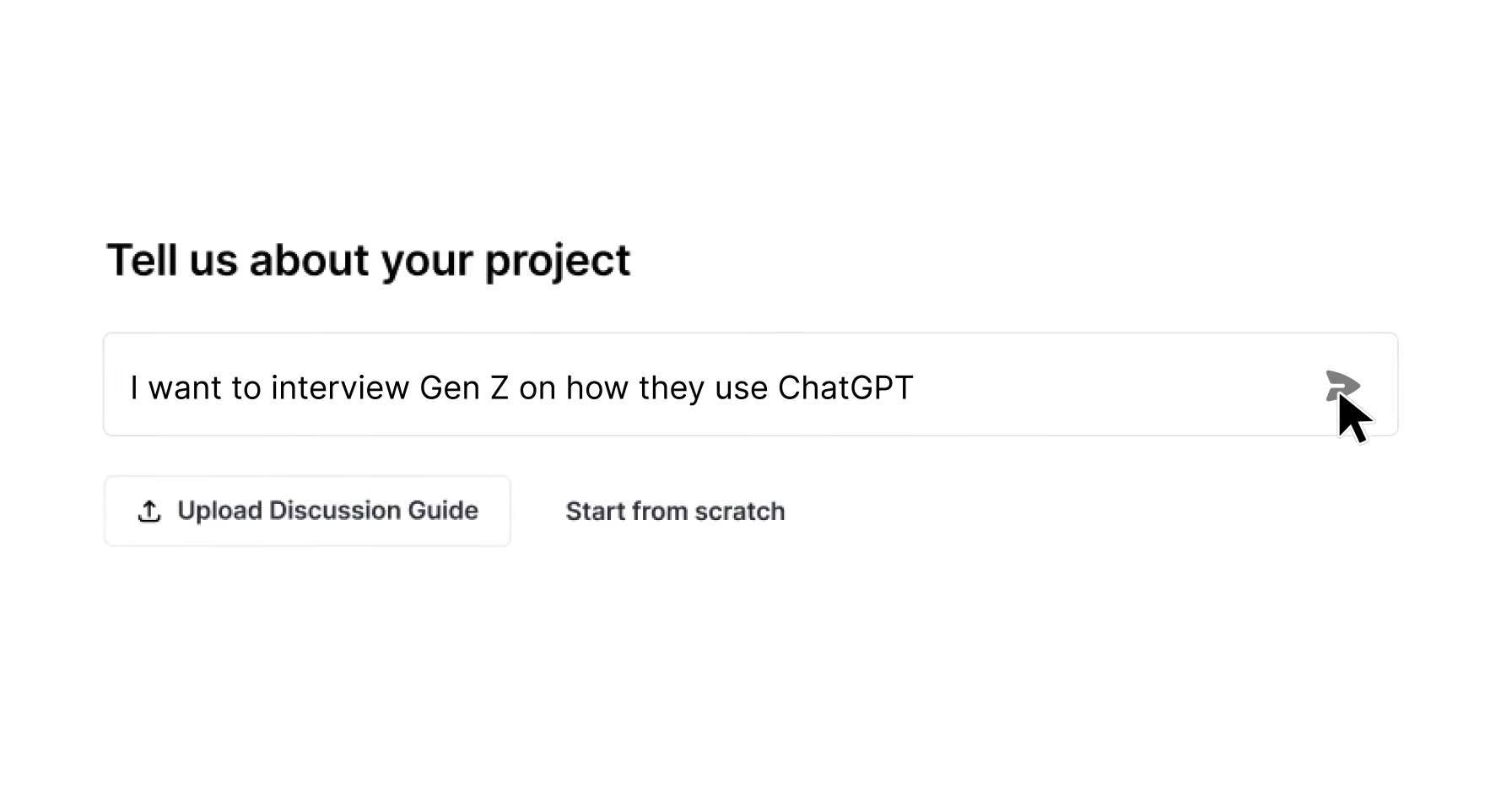
Step 1: Define your research objectives. Start by deciding what you need to learn, such as awareness, consideration, emotional connection, competitive positioning, or purchase drivers. Write each perception dimension as the decision it informs, for example “differentiation → the positioning statement on the homepage.” Map every question to a specific action instead of copying an old tracker’s 20-attribute battery.
Step 2: Design the study guide. Use AI assistance to draft questions, then review them for leading language and double-barreled items. Place unaided recall questions before aided recall questions so you do not contaminate recall by planting the brand name too early. Let consumers name attributes before you introduce the brand’s own attribute battery. Include a mix of open-ended questions, Likert scales, NPS, and MaxDiff so you can prioritize attributes without ties. Localize discussion guides for multi-market studies instead of translating them word-for-word, because attributes carry different meanings across markets.
Step 3: Recruit the right participants. Include category buyers, category rejecters, competitor loyalists, and lapsed users, not only existing customers. Recruiting only loyalists confirms existing beliefs and hides the perception gaps that matter most. Listen Labs’ Quality Guard uses behavioral matching on intent and past actions, real-time monitoring across video, voice, content, and device signals, and participant frequency limits of three studies per month to remove professional survey-takers and fraudulent profiles. The platform’s network of 50M+ verified respondents spans more than 45 countries.
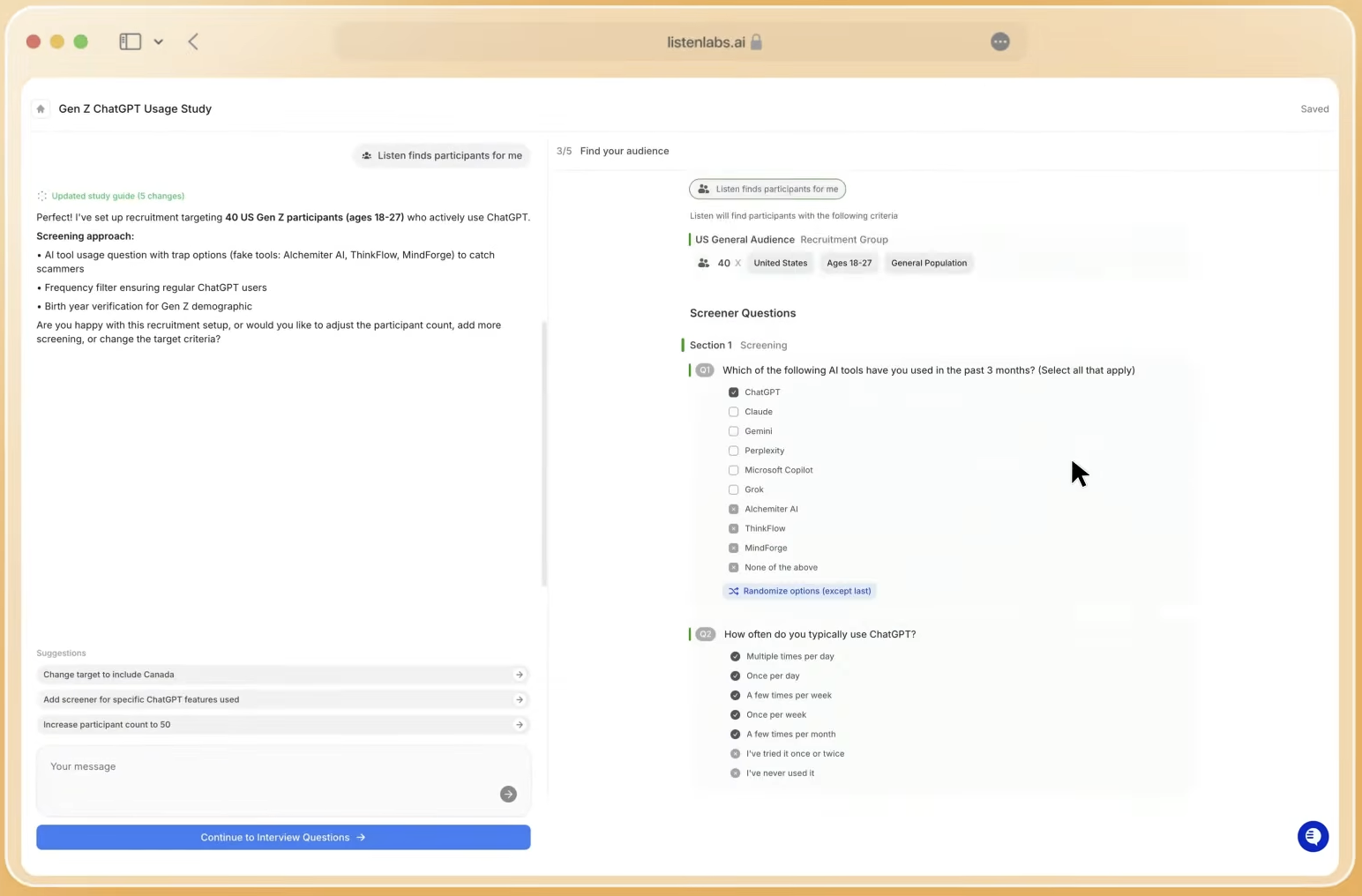
Step 4: Conduct AI-moderated interviews. Most AI-powered brand research studies complete data collection in 3–7 days, which reflects the speed advantage described earlier. Plan for 30–60 interviews per key segment to reach thematic saturation for qualitative depth. Use 200–400 participants for a baseline brand perception study when you need quantitative confidence on language patterns.
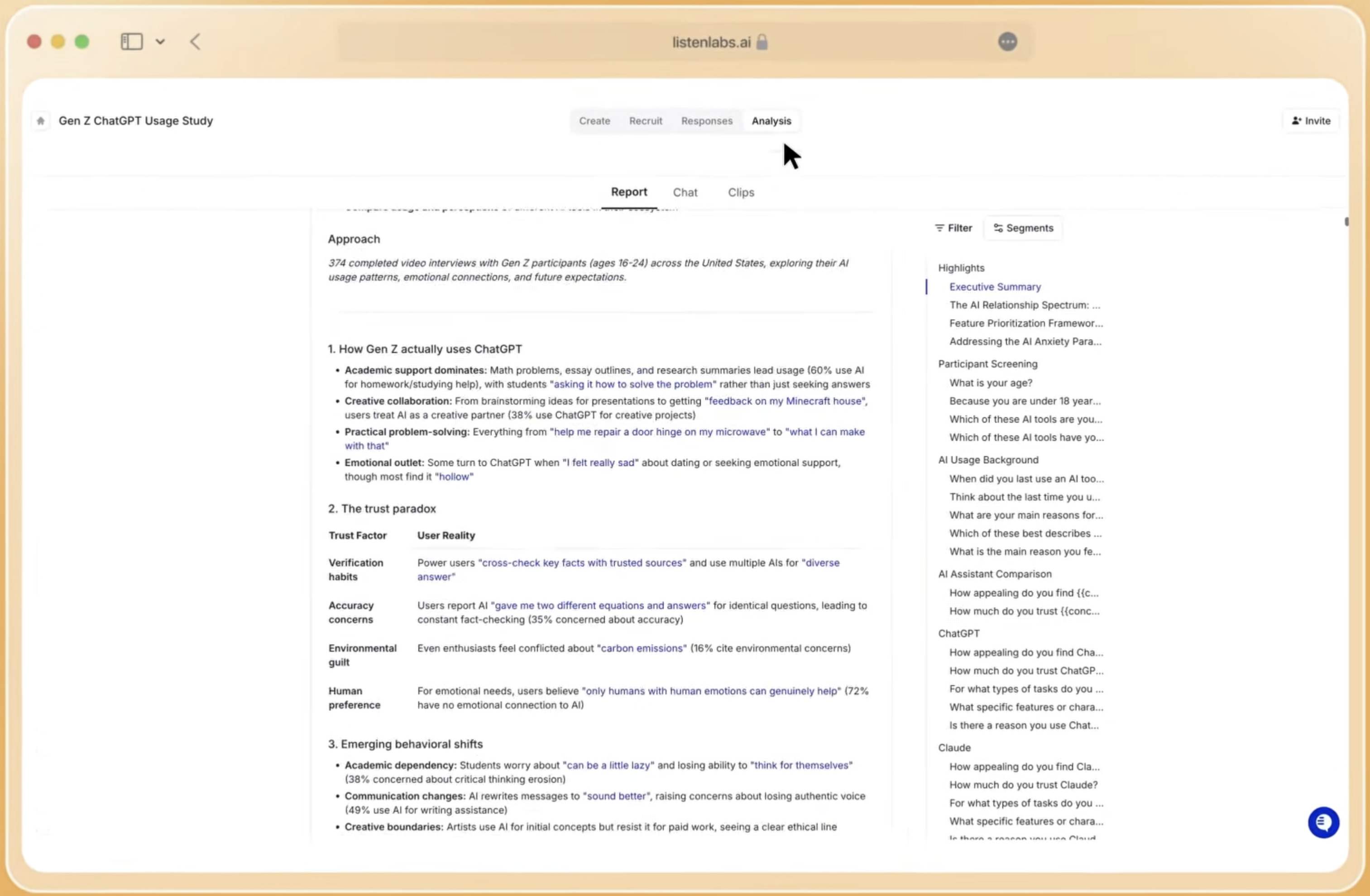
Step 5: Analyze the data. With AI-moderated interviews, talking to consumers at scale becomes straightforward, and the main challenge shifts to understanding what they mean. Validate AI-surfaced themes against session recordings, because transcripts miss tone, hesitation, and sarcasm that the recording captures. Listen Labs’ Research Agent generates automated key findings, themes, and personas, and supports chat-based natural-language queries, segmentation, and statistical comparisons.
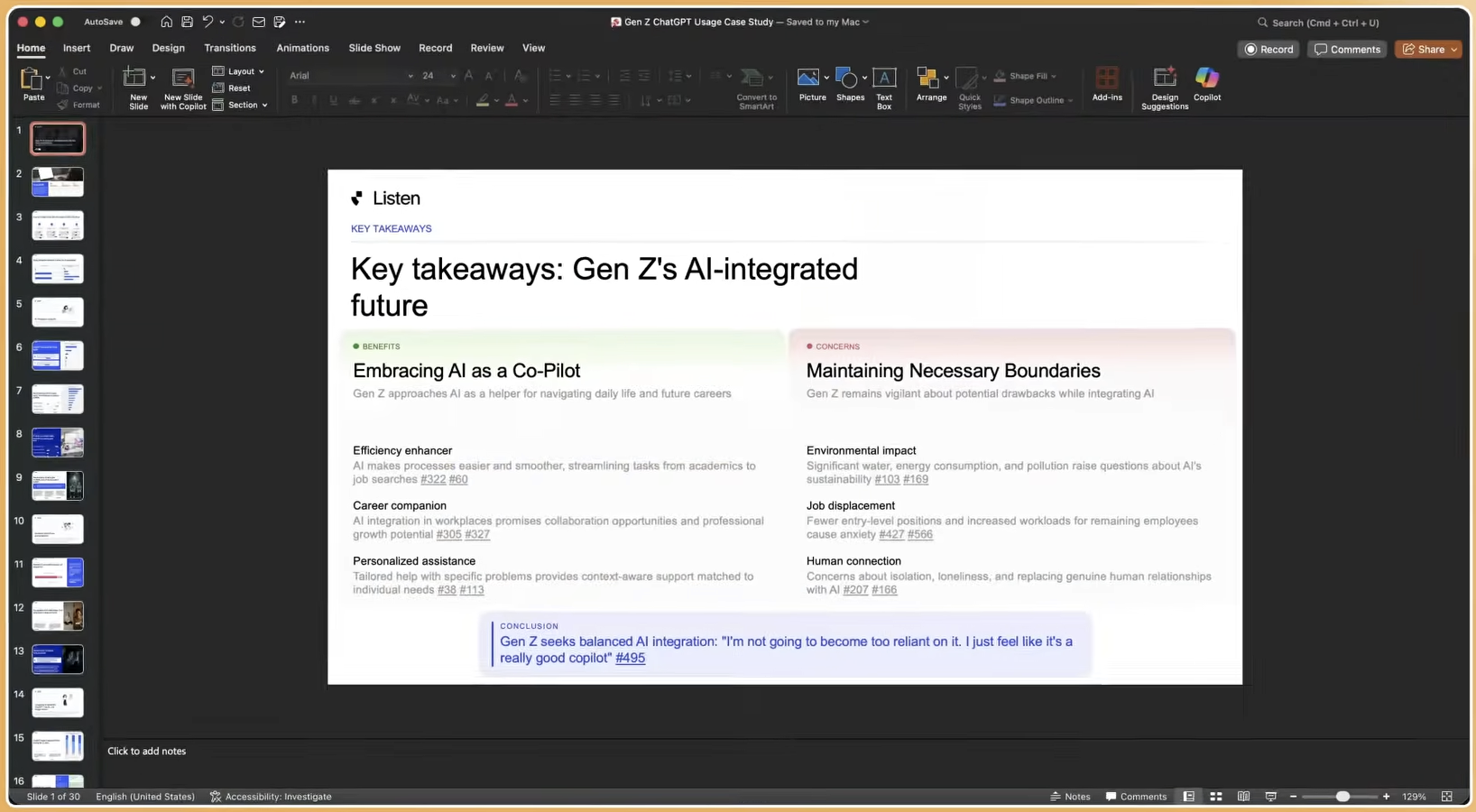
Step 6: Generate deliverables. Build deliverables so every insight traces back to the underlying response data. Listen Labs’ Research Agent generates slide decks, memos, highlight reels, charts, and custom reports in under a minute, with full traceability from finding to verbatim quote to session recording.
How to Choose Between AI, Traditional Surveys, and Human Interviews
Once you understand the process, the next step is deciding whether AI is the right method for your specific study. Surveys are scalable and structurally shallow, because fixed questions with no follow-up capability record agreement bias and social desirability bias as data. They work well for attribute-level quantitative tracking, such as confirming that awareness moved from 34% to 41%, but they do not explain why it moved or what that shift means for positioning.
Human interviews deliver very deep qualitative insight, especially for sensitive topics where trust is essential for honest disclosure. Traditional focus groups take 3–5 weeks and cost $4,000–$12,000 per 90-minute session. A single agency-led qualitative study typically costs $15,000–$40,000. At that cost level, most teams can only run a few studies per year, and sample sizes stay small.
AI conversational research delivers both depth and scale. A 500-person brand perception study produces both statistical reliability and strategic depth. For example, it can show that 73% of participants mentioned price as a consideration, and that those price concerns cluster into three distinct patterns. This approach fits best when you need to diagnose why a tracker’s numbers moved, explore brand associations, elicit attributes before designing a quantitative tracker, or run fast post-campaign reads.
The strongest long-term setup combines all three methods. Keep quantitative metrics for benchmarking and trend continuity, then layer AI interviews on top to explain every meaningful movement. YouGov’s BrandIndex Voices illustrates this hybrid model by combining AI-guided conversational research directly with ongoing brand metrics so metric movement and its explanation arrive together.
Limitations and When AI Brand Perception Research Is Not the Right Fit
Medium effects on brand relationships. A 2026 study by Das and Mondal across three preregistered experiments (n=791) found that AI-mediated brand interactions can reduce brand love compared with direct brand exposure, and the effect grows when the AI agent uses richer anthropomorphic social cues. Brand heritage moderates this effect, so established brands are largely protected while emerging brands are more vulnerable. For studies that require deep emotional exploration or involve vulnerable populations, traditional methods may still work better.
AI bias. Training datasets for LLMs may contain demographic imbalances and regional dominance that skew associations and favor particular viewpoints. Effective mitigation uses diverse panels, human oversight of AI-surfaced themes, and transparent reporting of methodology.
Post-rationalization at scale. Brand associations are formed and retrieved largely below conscious awareness, so consumers often construct plausible stories when asked why they chose a brand. A thousand AI-moderated interviews can generate a thousand rationalizations, and AI moderation scales this effect rather than removing it. Pair conversational interviews with behavioral and emotional signal layers to reduce, though not fully remove, this limitation.
When AI moderation is a poor fit. Longitudinal trend measurement that requires strict statistical representativeness, culturally sensitive research in markets where language coverage has not been verified, and studies that demand deep rapport and highly improvisational probing still align better with traditional methods.
For a full treatment of AI brand perception metrics and audit methodology, see How AI Measures Brand Perception: Metrics & Audit Guide.
Question Design and Follow-Up Techniques That Improve AI Studies
Strong AI brand perception studies rely on thoughtful question design as much as on the moderation platform. The following practices consistently improve data quality:
- Sequence unaided questions before aided ones so you do not contaminate recall by naming the brand too early.
- Let participants name attributes before you present the brand’s own attribute battery, because unprompted language is more diagnostic than reactions to pre-set terms.
- Probe the first brand named unprompted, since the competitor that comes to mind first often reveals more than the brand being studied.
- Write neutral, open-ended questions and avoid leading language like “How much do you love our new packaging?” or double-barreled questions such as “How do you feel about our price and quality?”
- Use MaxDiff for prioritization tasks, because rating scales often produce ties while MaxDiff aggregates responses into a clean ranking.
- Localize discussion guides for multi-market studies instead of translating them directly, since attributes can carry different meanings across markets and direct translation can introduce bias.
Conversational follow-ups such as “Can you tell me more about what sustainability means to you when you think about this brand?” often reveal that customers have never linked the brand and sustainability in their minds. That shift turns an initial survey rating into noise and the conversation into signal.
AI Tools for Brand Perception: Where Listen Labs Fits
The AI brand perception research landscape includes several tool categories, and each one solves a different part of the workflow.
Survey tools like Qualtrics and SurveyMonkey scale quantitative tracking but offer no follow-up or probing capability. They measure what people think, not how or why they think it.
Recruitment platforms like Prolific and User Interviews handle participant sourcing but do not conduct moderation, analysis, or delivery. They serve as inputs to a research process rather than a complete solution.
Analysis tools like Dovetail organize and analyze research conducted elsewhere. They do not recruit participants or moderate sessions, so teams still need separate infrastructure.
AI interview platforms including Perspective AI and Entropik provide AI-moderated interviews but vary widely in panel quality, geographic reach, language coverage, and end-to-end capability.
Listen Labs covers the entire research lifecycle in a single platform: AI-assisted study design, global participant recruitment from a network of 50M+ verified respondents across 45+ countries, AI-moderated interviews in 120+ languages, automated analysis via the Research Agent, and consultant-quality deliverables generated in under a minute. Researchers spend most of their time on analysis, such as finding patterns, quantifying insights, testing significance, and formatting results for stakeholders who each need something different. The Research Agent automates that workflow. Trusted by Microsoft, Google, P&G, Sweetgreen, and roughly 15% of the Fortune 100, Listen Labs serves teams that want recruitment, moderation, analysis, and reporting handled in one place.
For a broader view of how AI fits into brand perception analysis, see AI Brand Perception Analysis: Complete 2026 Guide.
Start With a Pilot Study to Build Confidence
AI brand perception research delivers the most value when the study uses strong methodology, including clear objectives, properly sequenced questions, a participant mix that includes rejecters and competitor loyalists, and human validation of AI-surfaced themes. The depth, speed, and scale are real, and they depend directly on the quality of the design.
A practical starting point is a pilot that defines two or three perception dimensions, runs 30–50 interviews in a single segment, and compares the output against a study your team has run with traditional methods. That comparison highlights both the platform’s strengths and any design adjustments you should make before scaling.
The value of AI brand research compounds over time. Each study adds to an institutional knowledge base that you can query across waves, compare across segments, and use to decide whether a new study is necessary before commissioning it. As you run more studies, the library becomes more powerful.
Watch how Listen Labs helps teams run deeper, faster, and more scalable brand perception studies.
Frequently Asked Questions
How many participants do I need for an AI brand perception study?
The right sample size depends on the study’s purpose. As covered in Step 4, qualitative depth and quantitative confidence require different architectures, and AI-moderated interviews extract more information per participant than surveys do. For ongoing tracking, monthly pulses of 100 to 150 conversations per wave create a continuous insight stream rather than episodic snapshots. The main constraint is the research objective, since qualitative thematic work and population-level projection call for different designs.
Can AI brand perception research replace a traditional brand tracker?
AI brand perception research and traditional quantitative trackers answer different questions and work best together. A quantitative tracker measures whether awareness, consideration, or preference moved and produces the trend line that stakeholders report. AI-moderated interviews explain why those numbers moved by surfacing the language, associations, and emotional drivers behind metric shifts. The practical architecture looks like a stack: the tracker watches the metrics, AI-moderated research diagnoses the movements, and behavioral and emotional signal layers check whether the verbal explanation holds. Listen Labs’ Listen Pulse is designed for this hybrid use case, keeping core tracking questions constant to protect the trend line while adding open-ended conversational waves that explain every meaningful movement. It integrates with Qualtrics and Decipher so teams keep the KPIs they already report while adding the narrative behind them, and for teams without an existing tracker, Pulse can serve as the primary tracking system.
How does Listen Labs ensure participant quality in brand perception studies?
Participant quality rests on three layers. First, Listen Labs works only with high-quality, non-commodity panel sources, so professional survey-takers who optimize for incentives do not enter the pool. Second, Quality Guard applies real-time AI monitoring across video, voice, content, and device signals to detect and remove fraudulent responses, AI-generated scripts, and mismatched profiles, and participants are limited to three studies per month to prevent fatigue and repeat bias. Third, a dedicated recruitment operations team adds human review for hard-to-reach segments such as enterprise decision-makers, healthcare workers, and audiences below 1% incidence rate. For brand perception studies, this matters because the participant mix must include category rejecters and competitor loyalists as well as existing customers. Recruiting only loyalists produces confirmation instead of insight, so Listen Labs’ behavioral matching infrastructure sources and verifies the right mix before any interview begins.
What ethical and compliance obligations apply to AI-moderated brand research?
AI-moderated research must follow established research ethics and data protection rules. The Insights Association’s Code of Standards and Ethics requires that participants know about and consent to AI involvement in data collection, that researchers disclose to clients any AI use that may affect research quality, and that no AI system operate without human judgment in its design, implementation, and validation. AI models also need regular bias audits. Under GDPR, consent must be freely given, specific, informed, and unambiguous, and data processing agreements are required when using third-party AI platforms. For EU respondents, data must be stored within EU-approved infrastructure. Listen Labs holds SOC 2 Type II, ISO 27001, ISO 27701, and ISO 42001 certifications, complies with GDPR, and never trains its AI models on customer data. Every insight generated by the Research Agent traces back to the original study, discussion guide, screener, and individual respondent, which provides the data lineage that compliance teams and stakeholders expect.
How is AI brand perception research different from AI brand monitoring?
AI brand perception research and AI brand monitoring serve different purposes. AI brand perception research is primary research in which an AI moderator conducts one-on-one interviews with real consumers to understand how they describe, associate with, and feel about a brand, producing qualitative and quantitative insight grounded in human responses. AI brand monitoring, sometimes called share-of-model or LLM monitoring, measures how often and how favorably a large language model like ChatGPT or Gemini mentions a brand when asked a category question. It involves no consumers and instead measures the model’s training data and retrieval behavior. Both practices add value, and they are not substitutes. A brand can show strong AI search visibility and weak consumer emotional connection, or the reverse. AI brand perception research shows what real consumers think and feel, while AI brand monitoring shows how AI systems represent your brand in generated responses, and a complete brand intelligence program tracks both.