
Written by: Anish Rao, Head of Growth, Listen Labs
Key Takeaways for Travel and Hospitality Teams
- Traditional qualitative research takes 4–6 weeks, while AI-moderated interview platforms like Listen Labs deliver complete studies in under 24 hours.
- CDPs and surveys capture traveler actions, but only adaptive AI conversations reveal the emotional and motivational reasons behind booking, churn, or upgrade decisions.
- Listen Labs’ verified 30M-person global network and real-time Quality Guard deliver higher-quality respondents than commodity panels, with 92% reporting top comfort levels.
- Emotional Intelligence captures tone, micro-expressions, and word choice, providing early churn warnings and precise campaign feedback that transcripts alone miss.
- Listen Labs turns traveler conversations into retention and personalization strategies on a next-day cycle instead of a multi-week research timeline.
Speed: Turning Multi-Week Research into a One-Day Cycle
Traditional qualitative research relies on agency briefing, panel recruitment, moderator scheduling, transcription, and synthesis, which creates a multi-week bottleneck from study design to final deliverable. In enterprise settings, internal prioritization and budget approval can stretch that cycle to six months, by which point the business context has often shifted.
AI-moderated interview platforms remove that bottleneck and compress the full cycle to a single business day. Listen Labs sources participants from its 30M-person verified global network, runs AI-moderated video interviews in parallel across time zones, and delivers automated analysis and stakeholder-ready deliverables, including slide decks, memos, and highlight reels, within the same business day. For an airline managing a post-disruption churn spike or a hotel chain testing a loyalty campaign before launch, that speed difference directly affects revenue and guest satisfaction.
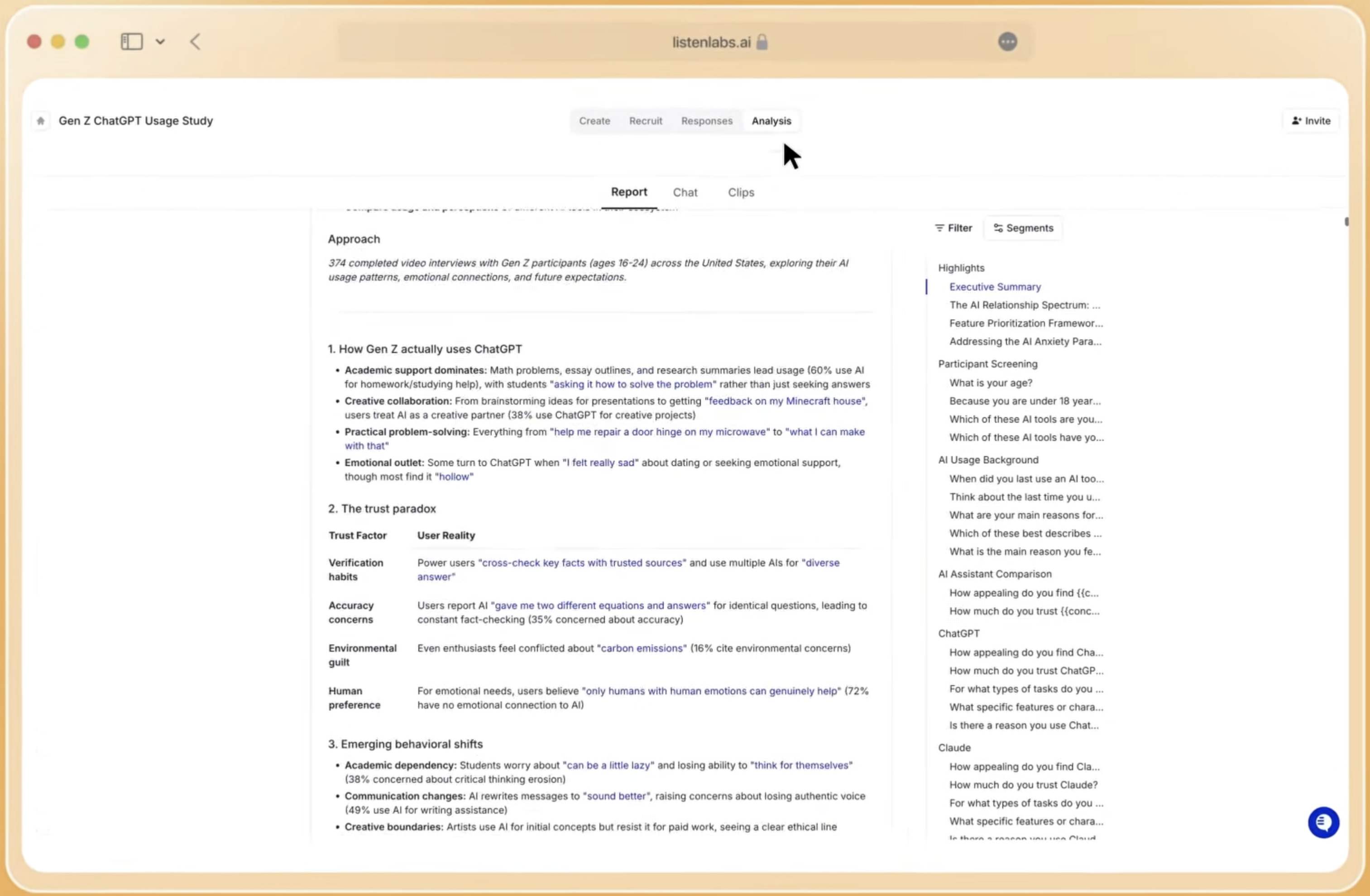
A study from the University of Mannheim found that AI-moderated interviews generated more words, more unique words, and more distinct themes than static online surveys with the same number of follow-up questions. These findings show that faster cycles can still deliver richer qualitative depth.
Depth: Why Adaptive Conversations Beat Static Surveys
CDPs and survey tools capture what travelers do, while conversational research explains why they do it. Fixed-question surveys cannot follow up when a respondent calls a booking flow “confusing”; they record the label without the story behind it. AI-moderated interviews average 3.2× more probe-driven follow-ups than scripted human-moderated equivalents, which surfaces the specific friction point, the competing option considered, or the emotional trigger behind a decision.
Online travel agencies see roughly 85% booking abandonment, yet behavioral analytics cannot explain whether a drop-off reflects price sensitivity, a non-refundable policy concern, or a competitor offer found on metasearch. Adaptive AI interviews explore each participant’s specific path and recover the reasoning that conversion funnels structurally discard.
AI-moderated interviews also surface more unique themes across a participant set than human-moderated interviews. Consistent probing logic removes interviewer fatigue and reduces social desirability bias. Listen Labs’ AI applies the same adaptive follow-up logic across every conversation, which enables reliable comparative analysis across segments, routes, or markets.
See how adaptive AI interviews uncover retention drivers in under 24 hours, then book a demo to explore Listen Labs’ conversation-to-strategy workflow.
Sample Quality: Verified Travelers Instead of Commodity Panels
NPS surveys in travel often draw response rates of 10–30%, and commodity panels compound that problem with professional survey-takers who optimize for incentives rather than honest reflection. Low-quality respondents distort the data that downstream personalization and retention models depend on.
Listen Labs’ Listen Atlas panel spans 30M verified respondents across 45+ countries. An AI orchestration layer matches participants on behavioral and intent signals, not just self-reported demographics, and Quality Guard monitors every interview in real time for fraud, low-effort responses, and mismatched profiles. Participants are capped at three studies per month, which prevents panel fatigue and repeat respondents. A dedicated recruitment operations team handles hard-to-reach segments such as frequent flyers in specific fare classes, loyalty program lapsers, or OTA bookers below 1% incidence rate.
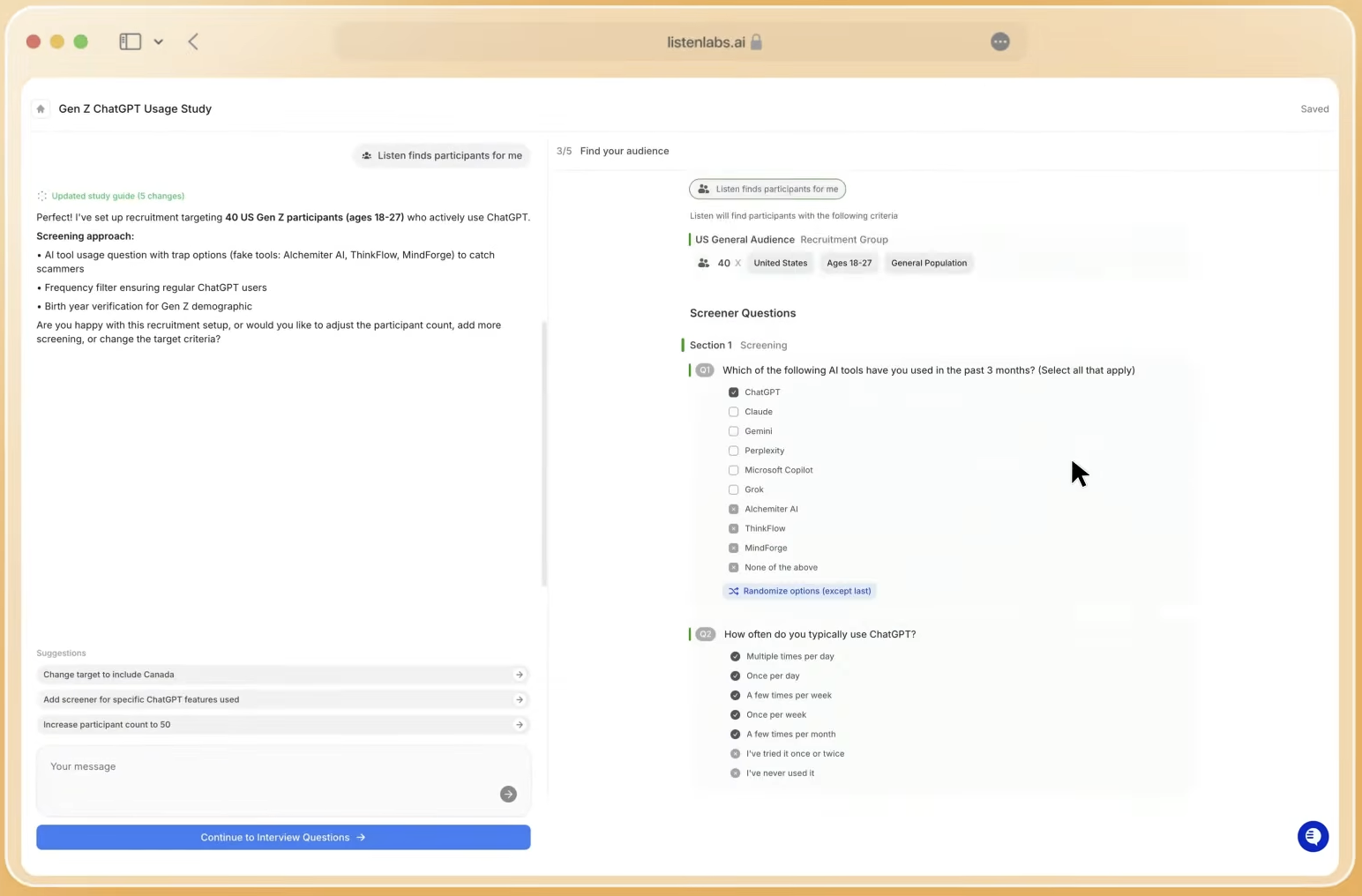
AI moderation creates a measurable comfort advantage. Participants in AI-moderated sessions report significantly higher comfort levels than those in human-moderated equivalents, and 32% explicitly state they feel less judged with AI moderation. This reduced social pressure translates into more honest feedback on price sensitivity, loyalty program dissatisfaction, and competitor switching, which are exactly the topics where human moderation often produces socially desirable rather than truthful responses.
Emotional Intelligence: Capturing Tone, Micro-Expressions, and Signals
Traditional self-report surveys in hospitality and tourism often miss honest emotional reactions because respondents may not remember how they felt or lack the words to express those feelings accurately. Facial expression studies in tourism can reveal differences in emotional responses to various travel imagery, which self-reported preference ratings would never surface, and those signals directly inform creative and merchandising decisions.
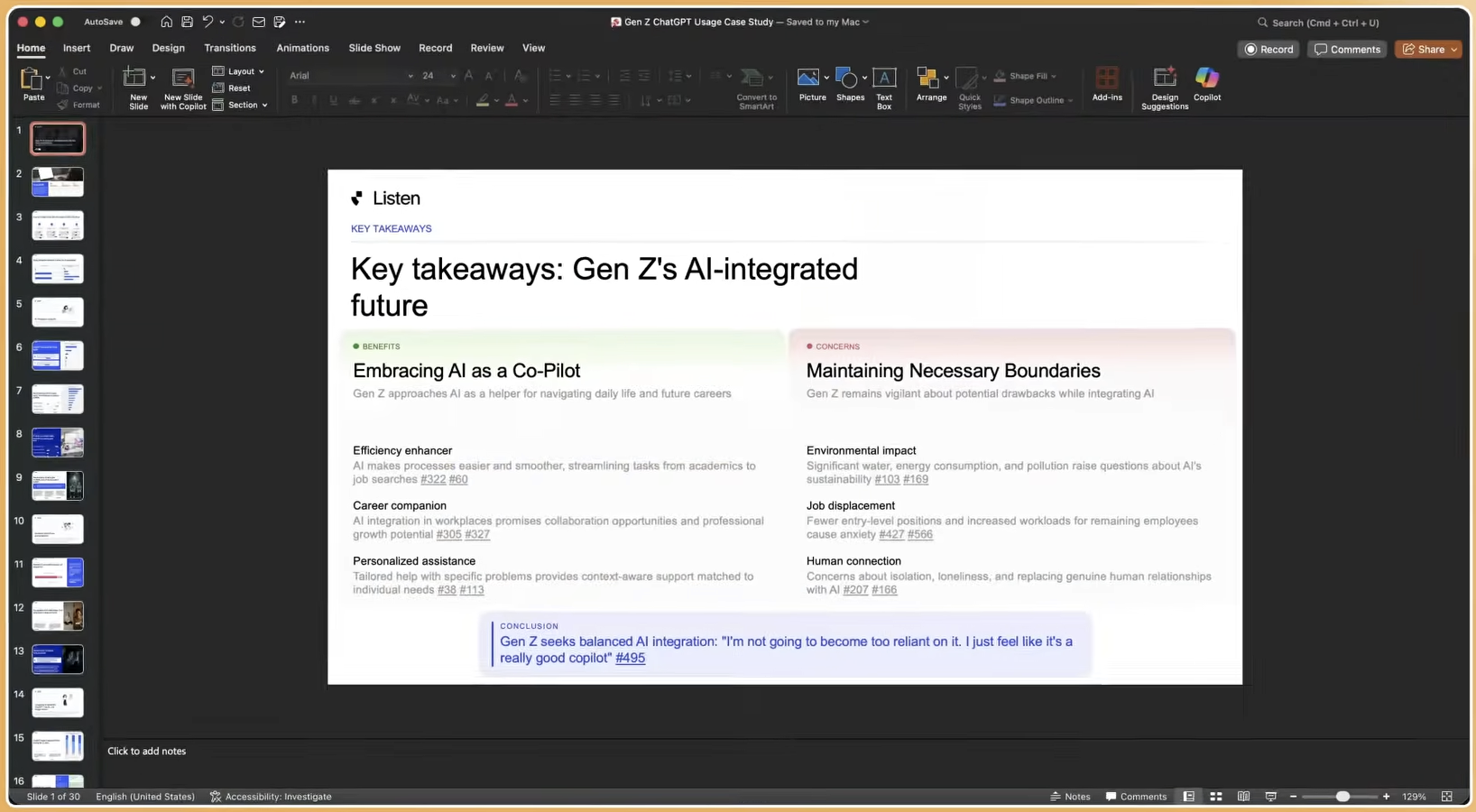
Listen Labs’ Emotional Intelligence analyzes three simultaneous signal layers: tone of voice, word choice, and subconscious micro-expressions. Built on Ekman’s universal emotions framework, the same standard used in clinical psychology and UX research, every emotion is quantified per question and concept, with each label traceable to the exact timestamp, verbatim quote, and AI reasoning behind it. A hotel chain testing two campaign directions can ask which concept triggered the most confusion and receive a side-by-side emotional breakdown across stimuli, segments, and markets, not just a rating average.
Customers rarely complain right before they churn and often go quiet instead, with tonal flattening serving as a key early warning signal 2–4 weeks prior to cancellation. Emotional Intelligence captures that tonal shift at the interview level and gives airlines and hotels a leading indicator that NPS scores and booking-data CDPs cannot produce. Capturing these emotional signals becomes even more powerful when applied consistently across every market where travelers originate.
Global Reach and Language Support for Multimarket Travel Research
Travel brands collect feedback at six distinct journey stages but capture intent and context at almost none of them, and this gap widens across markets where language and cultural context shape traveler motivation differently. A Mastercard 2024 study conducted by Forrester Consulting across 228 airline and hospitality leaders in North America, Europe, Latin America, and Asia-Pacific found that most leaders expect third-party solution providers to help improve personalization and identify new revenue streams. Meeting that expectation requires multilingual, multi-market qualitative reach.
Listen Labs runs AI-moderated interviews in 100+ languages with automatic transcription and translation, covering 45+ countries across the Americas, Europe, APAC, and MEA. Emotional Intelligence is available across 50+ languages, which enables a DMO or OTA to run destination research across source markets simultaneously rather than sequentially. This approach collapses a multi-month, multi-agency research program into a single 24-hour study.
Total Cost of Ownership and Research Team Impact
Organizations report significant cost savings compared with traditional approaches when they conduct qualitative research at scale with AI moderation. AI breaks the linear cost relationship between sample size and expense after initial setup. Human-moderated interviews carry substantial per-interview costs, while AI-moderated equivalents cost a fraction of that and produce transcripts in seconds rather than days.
Listen Labs replaces multiple disconnected vendors, including panel providers, scheduling tools, moderation platforms, transcription services, and analysis software, with a single end-to-end platform. Internal research teams remain central and shift their time from logistics to strategic interpretation. A Director of Data Science at Microsoft noted the ability to reach hundreds of users at one-third of the previous cost.
Retention economics reinforce the urgency of investing in qualitative depth. Bain & Company research by Frederick Reichheld found that increasing customer retention rates by 5% increases profits by 25% to 95%, depending on the industry, and Harvard Business Review research shows it costs 5 to 25 times more to acquire a new guest than to retain an existing one. Travel brands need to understand why guests lapse, not just that they do, before they can close that profitability gap.
Explore how Listen Labs integrates with your research stack, then book a demo to see the platform in action without disrupting your team.
Travel Use Cases: From Airline Churn to DMO Market Insights
For airlines, churn prediction depends on understanding the emotional and practical triggers behind switching, not just the fare differential. A single NPS score collapses different emotional and practical causes into one number, which makes it impossible to distinguish a detractor angry about a delay from one who found a cheaper fare on metasearch. Listen Labs’ AI interviews probe each churn driver individually and deliver a prioritized list of retention levers, the same approach that surfaced churn drivers for Anthropic’s Claude Code product 5× faster than traditional methods across 300+ interviews in 48 hours.
For hotel chains, campaign testing before launch prevents costly misfires. Research shows that hotel loyalty program members spend more annually than non-member guests, which makes campaign accuracy directly tied to revenue. Listen Labs’ Emotional Intelligence layer identifies which creative direction triggers genuine anticipation versus polite indifference, with timestamp-level precision across every respondent segment.
For OTAs, personalization at scale requires understanding the specific blockers behind the high abandonment rates discussed earlier. CDP-driven abandonment recovery campaigns can improve booking conversion rates compared to generic retargeting, but only when personalization relies on accurate motivational data. AI interviews recover the “why now” and “why not” that behavioral click-stream data structurally cannot.
For DMOs, destination research across multiple source markets requires multilingual reach and cultural nuance. Listen Labs conducts simultaneous studies across 100+ languages, which enables a DMO to compare traveler motivations in Germany, Japan, and Brazil within a single 24-hour research cycle instead of commissioning sequential agency studies across three markets.
Addressing Concerns: AI Quality, Fraud, Team Roles, and Security
No 2024 University of Melbourne HCI Lab study on AI-moderated interviews appears in the evidence. Listen Labs layers auto-recruiting, transcription, sentiment tagging, and insight summarization so teams move from question to findings in hours, not weeks, and this stack replaces the need for that specific citation.
On fraud, Listen Labs’ Quality Guard applies real-time monitoring across video, voice, content, and device signals. Participants are limited to three studies per month, and a dedicated recruitment operations team adds a human review layer. The platform does not use commodity panels.
On team replacement, Listen Labs functions as a force multiplier. The platform handles recruitment, moderation, and analysis logistics so internal researchers can focus on strategic interpretation and stakeholder communication. This shift multiplies research output without requiring proportional headcount increases.
On data security, Listen Labs holds SOC 2 Type II, GDPR, ISO 27001, ISO 27701, and ISO 42001 certifications. Customer data is never used for AI model training.
Decision Framework Checklist for Travel Insights Platforms
The criteria below separate platforms that deliver actionable traveler insights from those that simply collect data. Use this checklist to identify whether a platform can support high-stakes retention, campaign, and personalization decisions.
- Speed: Can the platform deliver 300+ completed interviews with analysis in under 24 hours?
- Depth: Does the platform use adaptive follow-up questions that probe beyond stated preferences?
- Sample quality: Are participants verified through behavioral matching, real-time fraud detection, and frequency limits, not commodity panels?
- Emotional intelligence: Does the platform capture tone, micro-expressions, and word choice, not just transcripts?
- Global reach: Does the platform support 100+ languages and 45+ countries in a single study?
- Integration: Can findings be exported into existing CRM, CDP, and BI stacks without custom engineering?
- Compliance: Does the platform hold SOC 2, GDPR, ISO 27001, ISO 27701, and ISO 42001 certifications?
- Team impact: Does the platform multiply existing research team output rather than require replacing it?
- Deliverables: Does the platform generate consultant-quality slide decks, memos, and highlight reels automatically?
Frequently Asked Questions
How quickly can Listen Labs deliver 300+ traveler interviews?
Listen Labs completes the full research cycle, including study design, participant recruitment, AI-moderated interviews, analysis, and deliverables, in under 24 hours. AI interviews run simultaneously across participants rather than sequentially, so 300+ completed conversations with automated theme analysis, charts, and a stakeholder-ready slide deck are available within a single business day. This timing applies to both general traveler populations and harder-to-reach segments such as frequent flyers in specific fare classes or loyalty program lapsers.
Can Listen Labs conduct multilingual traveler research across multiple source markets simultaneously?
Yes. Listen Labs supports AI-moderated interviews in 100+ languages with automatic transcription and translation, covering 45+ countries across the Americas, Europe, APAC, and MEA. Emotional Intelligence is available across 50+ languages. A DMO, airline, or OTA can run a single study that interviews travelers in German, Japanese, Brazilian Portuguese, and Mandarin simultaneously, with all responses unified into a single analysis instead of commissioning sequential studies through separate regional agencies.
What security and compliance certifications does Listen Labs hold?
Listen Labs maintains SOC 2 Type II, GDPR, ISO 27001, ISO 27701, and ISO 42001 certifications, with 256-bit encryption across all data. Customer data is never used for AI model training. The platform supports enterprise SSO and role-based access control. For travel and hospitality organizations operating across multiple jurisdictions, Listen Labs’ multi-jurisdiction consent management and audit logging capabilities align with GDPR and CCPA requirements.
How does Listen Labs integrate with existing CDP and data stacks?
Listen Labs complements existing CDPs and data infrastructure rather than replacing them. CDPs unify behavioral and transactional data such as booking history, loyalty status, and payment patterns, while Listen Labs adds the qualitative layer that explains the motivations and emotions behind those behaviors. Research outputs, including themes, verbatim quotes, emotional signals, and segmentation breakdowns, can be exported into CRM, BI, and data warehouse systems. Organizations can also bring their own participant lists, which enables Listen Labs to interview existing loyalty members or churned customers directly from internal CRM segments.
Is AI interview quality sufficient for high-stakes travel research decisions?
Listen Labs is trusted by enterprises including Microsoft, Google, Procter & Gamble, and Anthropic for decisions ranging from product strategy to global campaign launches. The platform’s in-house research team, with 50+ years of combined expertise, continuously refines the methodology framework. Quality Guard eliminates fraudulent and low-effort responses in real time. For travel-specific applications such as churn driver analysis, campaign concept testing, and loyalty program research, the combination of adaptive AI moderation, verified participants, and Emotional Intelligence delivers the depth and reliability required for board-level decisions.
Conclusion: Adding the Missing Qualitative Layer to Your Stack
CDPs and survey tools solve the data unification problem. They tell airlines which routes generate lapsers, tell hotels which segments book direct, and tell OTAs where abandonment concentrates. These tools cannot explain the emotional logic, the competing consideration, or the specific friction point that drives each outcome. The next competitive advantage will come from who can reason over customer data best, not from who has the most of it.
AI-moderated interview platforms close that gap. For travel and hospitality organizations that need to predict churn before it registers in booking data, test campaigns before they reach market, or personalize at a scale that loyalty tier dashboards cannot support, the qualitative layer functions as missing infrastructure. This layer does not replace existing data stacks; it makes those stacks actionable by explaining the motivations behind the numbers.
Listen Labs delivers 300+ emotionally rich traveler interviews at the speed your business context demands, across 100+ languages, from a 30M-person verified global network, with Emotional Intelligence that captures tone, micro-expressions, and word choice alongside every transcript. The Research Agent converts that data into consultant-quality deliverables in minutes. Mission Control ensures every study compounds into institutional knowledge rather than disappearing into a shared drive.
Add the qualitative layer your insights stack is missing, then book a demo to see Listen Labs in action.