Written by: Anish Rao, Head of Growth, Listen Labs
What You Can Get Done in 7 Days with Free Tools
- Bootstrapped founders can build a credible picture of customer demand in seven days by chaining free secondary sources, pain-language mining, and lightweight surveys into a repeatable workflow.
- Days 1–3 define the problem and gauge demand using Google Trends, Keyword Planner, Similarweb, and government data.
- Days 4–5 pull unfiltered customer language from Reddit and niche forums, then test patterns with a Google Forms or Typeform survey.
- Day 6 uses ChatGPT or Claude to turn raw notes into themes and personas, while Day 7 audits where free tools stop delivering reliable answers.
- When your free-tool findings raise questions that surveys and Reddit threads cannot answer, see a Listen Labs demo to watch AI-moderated qualitative interviews with verified participants deliver answers in under 24 hours.
Day 1: Define the Exact Customer Problem
Clear research starts with a single, sharp problem statement. Before opening a tool, write one statement in this format: [Specific customer segment] struggles to [do X] because [root cause], which costs them [time/money/opportunity]. Then list five to eight research questions the week must answer. Focus on frequency, intensity, current workarounds, and willingness to pay.
Two framing rules prevent the most common mistakes. First, define one reachable market rather than a broad category such as “SMBs” or “Europe.” A strong definition looks like “seed-stage B2B SaaS teams hiring their first two account executives” because it shares timing, pain, buyer, and reachable channels. Second, most founders fail not because they cannot build, but because they build before confirming anyone wants the thing, so the problem statement must challenge assumptions rather than confirm them.
Days 2–3: Use Free Data Sources to Confirm Demand and Competitors
With your problem statement and research questions set, the next step is to see whether real demand exists. Secondary research answers this before you invest time in interviews. Use these sources in sequence:
- Google Trends: Reveals whether search demand for a topic is rising, declining, or seasonal over a five-year timeframe, though it provides only relative interest, not absolute volume.
- Google Keyword Planner: Converts relative trends into estimated monthly search volumes for problem-adjacent keywords, surfacing the language real buyers use.
- Similarweb free tier: Provides estimated monthly visits, traffic sources, top referring sites, and geographic distribution for any competitor website, limited to one month of data and five results per metric, which is sufficient for monthly pulse checks.
- Ubersuggest free tier: Adds keyword difficulty and competitor domain authority for a quick SEO-based competitive map.
- U.S. Census Bureau and BLS: The SBA recommends Census Bureau data and Bureau of Labor Statistics demographics for segmenting populations and validating market size. The Census Bureau’s County Business Patterns provides establishment counts, employment ranges, and payroll data by industry and geography down to the county level across more than 1,000 NAICS codes.
For competitor intelligence, LinkedIn job postings reveal strategy signals. Ten engineering roles in a month indicate active building, while three enterprise sales roles suggest an upmarket move. The Wayback Machine provides free historical versions of competitor websites, so you can review pricing page changes and messaging shifts over the past year.
A competitor map should cover four categories. Include direct competitors, substitutes such as agencies or spreadsheets, manual workarounds, and the “do nothing” option. When no direct competitors appear, the real competition often comes from apathy or existing habits.
Day 4: Pull Real Customer Language from Reddit and Niche Communities
Secondary data confirms that a market exists, while Reddit shows what it feels like to live inside the problem. Reddit is the tiger in the wild rather than at the zoo, so you get instincts, emotion, and raw truth rather than the rehearsed version.
Use these exact search patterns inside relevant subreddits:
frustrated with [category]sorted by Top (All Time)wish there was [solution type][competitor name] alternativeI hate [tool/process]
On Product Hunt, filter by your category and read the comments on top-ranked products. Dissatisfied users describe exactly what the product fails to do. On G2 and Capterra, one- and two-star reviews surface customer pain points and switching motivations that no survey would capture. Copy verbatim phrases into a running document. This language becomes your survey copy, landing page headlines, and interview probes.
Day 5: Use Simple Surveys to Check Patterns, Not Predict Revenue
Surveys on Day 5 confirm patterns identified in Days 2–4 rather than discovering new ones. Good survey questions ask about frequency, such as “How often did this happen in the last 30 days?” Weak questions ask “Would you buy this?” because answers are detached from real budget behavior.
Plan around these free tier limits:
- Google Forms: Unlimited responses on the free plan and direct integration with Google Sheets for real-time analysis.
- Typeform free tier: Limits the number of questions per form and responses per month, but its conversational one-question-at-a-time format often yields higher completion rates.
- SurveyMonkey free tier: Capped at 10 questions and 25 responses per survey.
Distribute surveys through the Reddit communities you mined on Day 4 by DMing users who posted detailed problem descriptions. Share them in relevant Slack and Discord groups and through your personal network. DM outreach to Reddit users who posted detailed problem descriptions in the past three months typically achieves a 20–30% response rate. Always include one open-ended question such as “What would you want me to know that I have not asked?” to capture language that closed questions miss.
Day 6: Turn Raw Notes into Themes with ChatGPT or Claude
Day 6 converts scattered inputs into a coherent picture. Paste your raw notes, survey responses, and Reddit excerpts into ChatGPT or Claude and use structured prompts to extract signal:
- “Identify the top five pain themes across these responses. For each theme, quote three verbatim examples and rate frequency (high/medium/low).”
- “Draft two customer personas based on these patterns. Include job title, primary frustration, current workaround, and willingness-to-pay signal.”
- “List the assumptions my problem statement makes that these responses do not support.”
One critical constraint shapes this step. Free AI tools carry risks of hallucinations and outdated data, which makes independent verification a required step rather than optional. Trace every factual claim the model produces, such as market size figures, competitor details, or statistics, back to a primary source before it enters a pitch deck or product decision.
Day 7: Audit Free-Tool Limits and Decide Whether to Add Interviews
Day 7 acts as an honest audit of everything you found. Map each insight against four failure modes:
- Sample quality: Reddit miners and Google Forms respondents self-select. Sampling bias occurs when the research sample does not accurately represent the target audience due to geographical clustering, demographic exclusions, or convenience sampling. Self-selection means your findings reflect whoever chose to participate, not necessarily your true target market.
- Depth: Surveys can only answer the questions put into them and may mistake measurement for understanding. They miss emotion, context, and emerging tensions that appear only when someone tells a story.
- Speed: Market research takes time to design, collect, and analyze, by which point the market may have shifted. A seven-day free-tool sprint is fast, but recruiting 20–30 qualified interview participants manually can add weeks.
- Scale: Most free tools lack advanced methodologies, statistical analyses, and predictive modeling that businesses need to make strategic decisions.
If any of these failure modes would change a product, pricing, or go-to-market decision, the free workflow has reached its limit. At that point, AI-moderated qualitative interviews with verified participants, adaptive follow-up questions, and analysis at scale become the next step.
Free Tools by Category and How to Use Them
| Category | Tool | Purpose | Free Limit |
|---|---|---|---|
| Secondary Research | Google Trends | Demand signal and seasonality | Unlimited; relative volume only |
| Secondary Research | U.S. Census Bureau / BLS | Understanding segments, demographics, NAICS data | Fully free; manual extraction required |
| Secondary Research | Google Keyword Planner | Search volume and keyword intent | Free with Google Ads account |
| Competitor Intelligence | Similarweb | Competitor traffic estimates and sources | 1 month of data; 5 results per metric |
| Competitor Intelligence | Wayback Machine | Historical competitor website changes | Fully free |
| Competitor Intelligence | G2 / Capterra | Competitor review monitoring and pain mining | Free alerts; limited filter depth |
| Pain-Language Mining | Unfiltered customer complaints and language | Fully free; manual search required | |
| Pain-Language Mining | Product Hunt | Early adopter feedback and unmet needs | Fully free |
| Lightweight Surveys | Google Forms | Pattern-checking surveys with unlimited responses | Unlimited responses; basic analytics |
| Lightweight Surveys | Typeform | Conversational surveys with higher completion rates | Limited questions and responses per month |
| Synthesis | ChatGPT / Claude | Theme extraction, persona drafting, gap analysis | Free tiers; hallucination risk requires verification |
The table above shows what free tools can do, from demand signals to pain-language mining. When you need verified participants and adaptive follow-up at scale, explore how Listen Labs delivers both in under 24 hours.

When Free Tools Stop Working for Customer Insight
The seven-day workflow delivers directional confidence, not decision-grade insight. The four failure modes identified on Day 7 create structural limits that no amount of free-tool effort can overcome.
Sample quality. Online panels often include highly practiced respondents who rush, skim, or give patterned answers. Reddit self-selectors skew toward power users and vocal complainers, not the median buyer, and this sampling bias is why 42% of failed startups cite “no market need” despite having conducted customer research. They asked the wrong people.
Follow-up depth. Surveys cannot probe. When a respondent writes “it is just too complicated,” a survey moves to the next question. A trained interviewer, or an AI moderator built for qualitative research, asks “What specifically made it feel complicated? Walk me through the last time that happened.” That follow-up is where the actionable insight lives. Even when you identify the right questions to ask, free tools create a second bottleneck.
Speed at scale. Recruiting 20–30 qualified participants manually through LinkedIn cold outreach, Reddit DMs, and personal networks can take two to three weeks. A realistic initial research push often requires several weeks and multiple customer conversations, which creates a timeline that free tools alone cannot compress.
Emotional signal. Free tools lack advanced methodologies such as facial emotion analysis and sentiment analysis that reveal the gap between what participants say and what they actually feel. Two survey respondents can both rate a concept “7 out of 10” while one is genuinely enthusiastic and the other is politely indifferent.
Free tools are the starting line, not the finish line. Listen Labs solves all four failure modes: verified participants reduce sample bias, AI moderation enables adaptive follow-up, automated recruitment compresses timelines, and emotional intelligence captures what surveys miss. See how it works.
How Listen Labs Delivers Decision-Grade Insight in Under 24 Hours
Listen Labs is an end-to-end AI research platform that replaces the fragmented free-tool stack with a single workflow covering study design, participant recruitment, interview moderation, analysis, and deliverable generation.
The platform’s Listen Atlas network provides access to 30M verified respondents across 45+ countries and 100+ languages. An AI orchestration layer matches and recruits participants based on behavioral and intent data, not just self-reported demographics. Quality Guard monitors every interview in real time for fraud, low-effort responses, and repeat respondents, with participants limited to three studies per month to eliminate professional survey-takers.
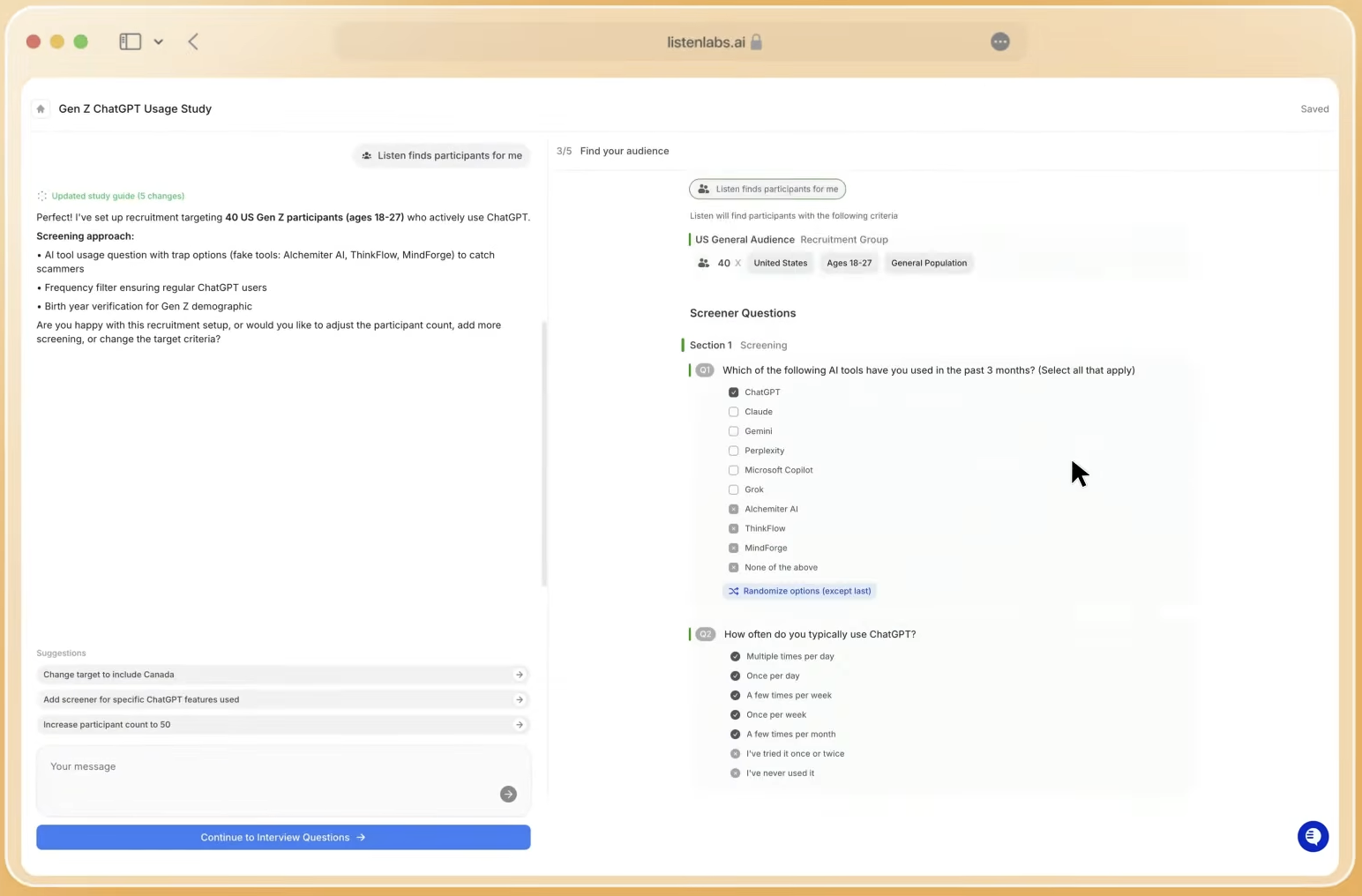
AI-moderated video interviews conduct personalized, adaptive conversations that probe deeper on short or interesting answers exactly as a trained human interviewer would. Mixed methods combine qualitative follow-up questions with quantitative formats such as Likert scales and MaxDiff in a single session. Emotional Intelligence analyzes tone of voice, word choice, and micro expressions to surface emotions that transcripts alone miss, built on Ekman’s universal emotions framework and traceable to exact timestamps and verbatim quotes.
The Research Agent then generates automated key findings, themes, and personas, along with consultant-quality slide decks and memos, video highlight reels, and statistical charts. This happens in under a minute. A process that traditionally takes four to six weeks, and that the seven-day free-tool workflow compresses to one week with significant quality trade-offs, Listen Labs delivers in less than 24 hours.
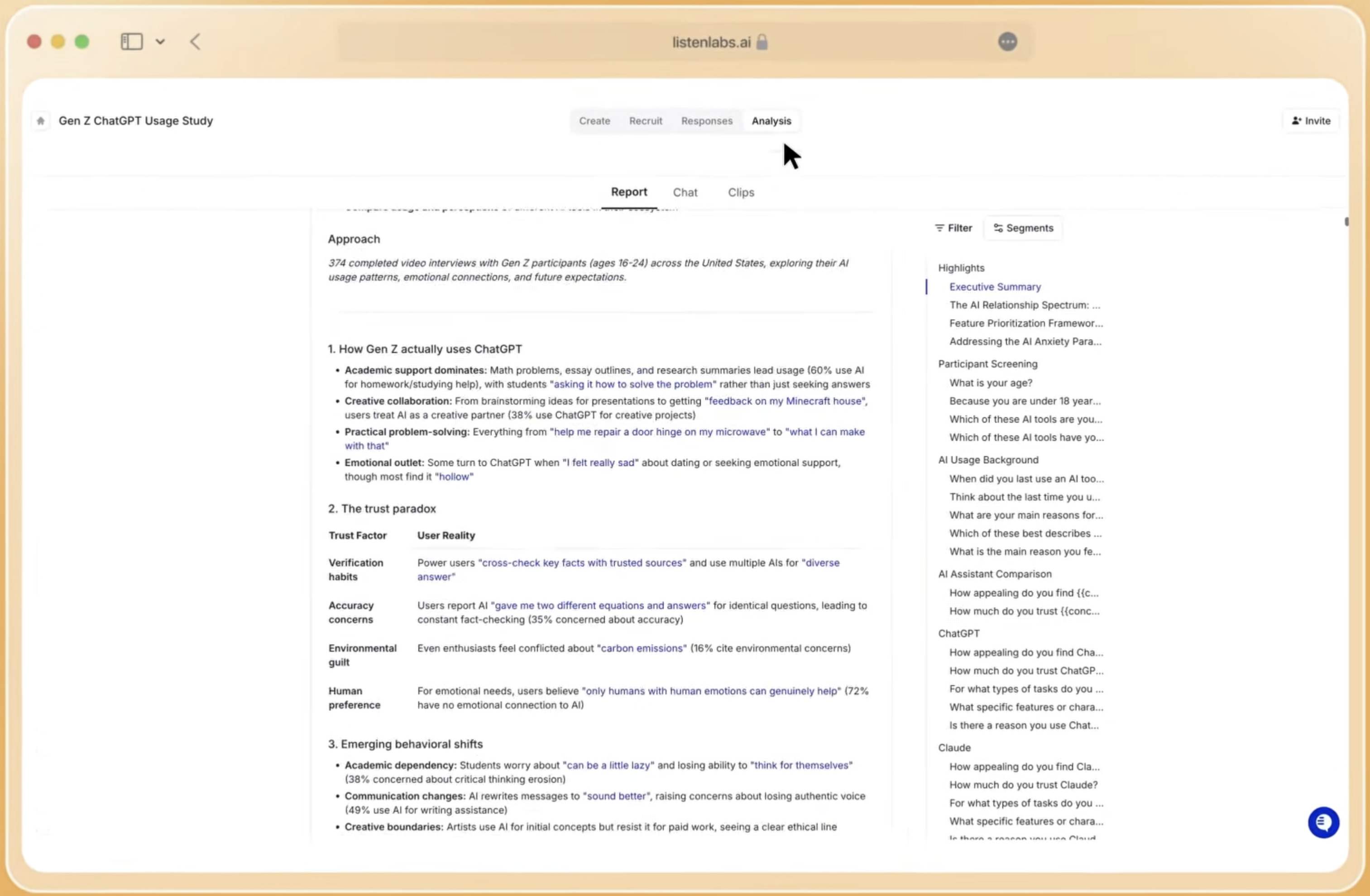
Microsoft used Listen Labs to collect global customer stories for its 50th anniversary celebration within a day. Anthropic surfaced churn drivers across 300+ user interviews in 48 hours, five times faster than previous methods. Procter & Gamble delivered 250+ interviews with quantified themes and verbatim proof that directly shaped product and brand strategy in hours, not weeks.
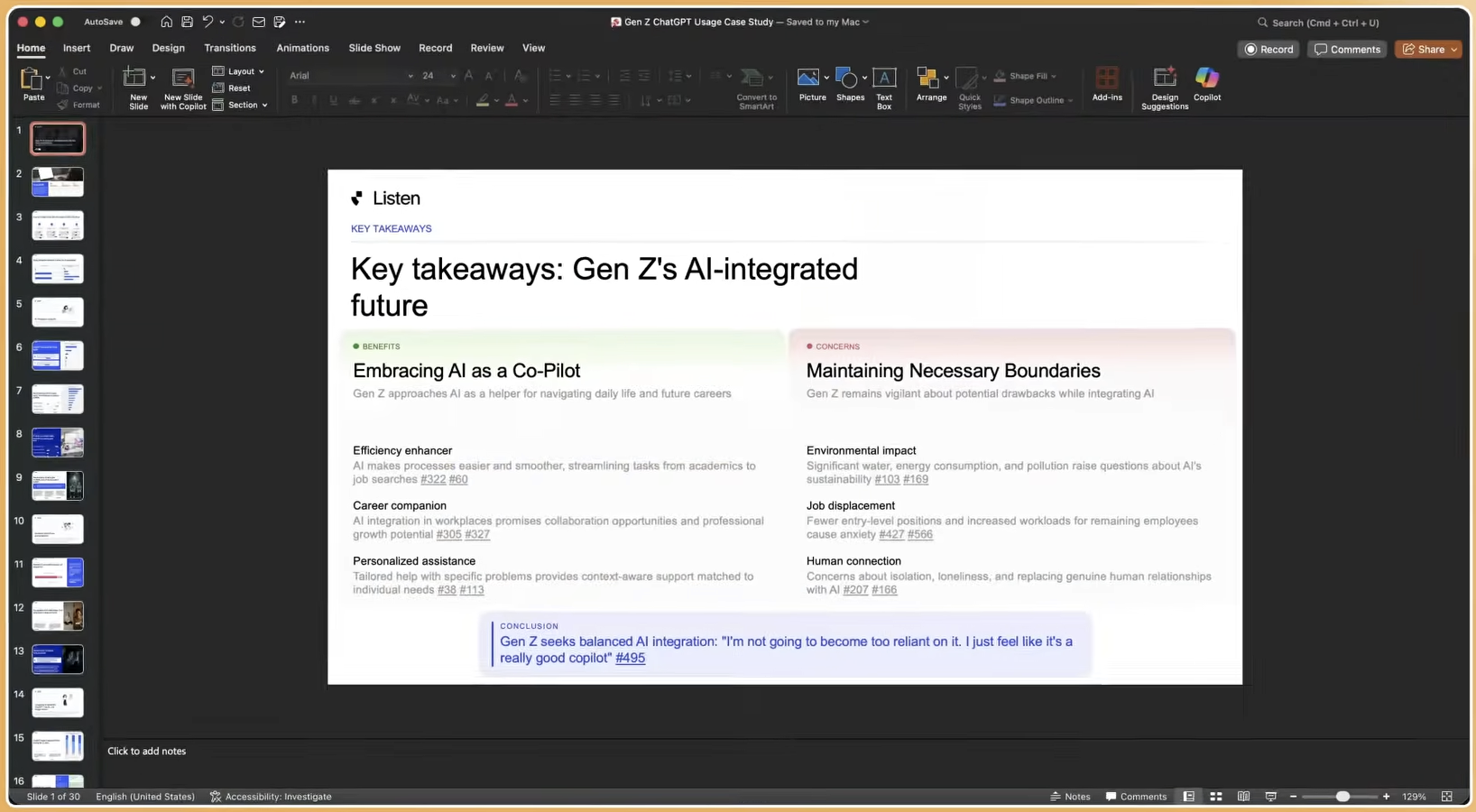
Ready to move beyond the limits of free tools? See how Microsoft, Anthropic, and P&G use Listen Labs to deliver consultant-grade qualitative research in under 24 hours.
Frequently Asked Questions
How long does the 7-day process actually take?
The seven-day framework assumes roughly two to four hours of focused work per day, totaling 14 to 28 hours across the week. Days 2 and 3 are the most time-intensive because pulling, reconciling, and interpreting government data from the Census Bureau and BLS requires manual effort. Day 4 can be shorter if you already know which subreddits and review platforms your target customers use. Day 6 synthesis with ChatGPT or Claude is fast, typically one to two hours, but verifying every AI-generated claim against primary sources adds time that most founders underestimate. Practitioners report that a meaningful initial research push, including multiple customer conversations, typically takes several weeks when done rigorously. The seven-day sprint delivers directional confidence and a validated problem statement, not a complete research program.
What sample quality can I realistically expect from free tools?
Free tools produce convenience samples, not representative ones. Reddit respondents skew toward power users and vocal complainers. Google Forms surveys distributed through personal networks reflect the founder’s existing relationships, not the broader market. Typeform’s free tier has a cap on monthly responses that is too small to identify statistically meaningful patterns. The practical implication is that free-tool findings are best treated as hypothesis generators rather than decision-grade evidence. They tell you what questions to ask in a proper qualitative study, not what the answers are. When a finding would change a product roadmap, a pricing decision, or a go-to-market strategy, the sample quality of free tools is insufficient and verified participant recruitment becomes necessary.
How does Listen Labs protect participant privacy?
Listen Labs maintains enterprise-grade security with 256-bit encryption, and customer data is never used for AI model training. The platform holds SOC 2 Type II, GDPR, ISO 27001, ISO 27701, and ISO 42001 certifications. Participant frequency limits, with no more than three studies per month per person, protect against panel fatigue and ensure responses reflect genuine experience rather than incentive-driven behavior. Quality Guard monitors every interview in real time across video, voice, content, and device signals, adding a layer of protection for both participant integrity and data reliability.
When should I repeat or expand the study?
A research cycle should be repeated when a product, pricing, or messaging decision has been made based on earlier findings and enough time has passed for market conditions to shift. Practically, a monthly cadence of two to three hours scanning target subreddits and review platforms keeps pain-language current. A quarterly cadence of five to ten customer interviews and five churned-user interviews tracks whether the problem intensity and workaround behavior identified in the original sprint still hold. A full competitive landscape review annually catches structural market shifts. Expansion, such as adding new segments, geographies, or use cases, is warranted when the original segment shows strong validation signals and the next growth lever requires understanding a meaningfully different buyer. Listen Labs’ Mission Control stores all past research as a searchable knowledge base, so each new study builds on prior findings rather than starting from scratch.