Written by: Anish Rao, Head of Growth, Listen Labs
Key Takeaways
- Media consumer insights reports aggregate audience behavior and platform data, yet long publication cycles often leave findings outdated.
- Core selection criteria include recency, methodology transparency, geographic coverage, and how easily outputs connect to your decision systems.
- Leading 2026 reports from PwC, Mordor, Grand View, Deloitte, and Statista provide macro benchmarks but stop short of brand-level depth.
- Free reports offer directional context, yet they rarely answer precise questions about specific audience segments or behaviors.
- Listen Labs delivers custom consumer insights in under 24 hours, replacing weeks of report sourcing with targeted interviews.
How to Choose the Right Media Consumer Insights Report
Evaluate every potential report against clear criteria before you purchase or download it.
- Recency: Confirm the data collection cutoff date, not only the publication date. A report released in 2026 may rely on survey fieldwork completed in late 2024.
- Methodology transparency: Reputable vendors disclose sample sizes, geographic coverage, data sources, and weighting procedures. Treat any report that omits these details as a black box and avoid using it for strategic calls.
- Specificity to your audience: Broad market sizing rarely maps cleanly to a specific consumer segment, region, or platform. Check whether the report breaks down findings by the demographics or behaviors that matter for your decision.
- Geographic coverage: A North America-centric report cannot support a truly global media strategy. Confirm that the regions you care about appear with enough granularity to guide action.
- Primary vs. secondary data: Reports built on proprietary primary research carry more weight than those that aggregate third-party statistics. Secondary research sources such as industry reports from Statista and analyst studies from McKinsey or Gartner provide cost-effective market context but may be less specific to a target audience and sometimes outdated or incomplete.
- Integration utility: Outputs must connect into decision-making systems like CRM platforms, marketing dashboards, and campaign management tools to deliver value.
- Vendor track record: Prioritize vendors with documented methodologies, named analysts, and peer-reviewed or audited data sources so you can defend the numbers internally.
If these seven criteria reveal that no syndicated report fits your needs, or your timeline cannot absorb a 4–6 week sourcing cycle, custom consumer research often becomes the more efficient path. See how Listen Labs delivers targeted insights in under 24 hours, without the wait for a syndicated report cycle.
Best Media Consumer Insights Reports 2026
The table below compares the leading global vendors across three decision factors: primary research focus, free preview availability, and geographic reach. Use this comparison to quickly identify which vendors cover your target markets before you invest time in sample requests. All figures come from publicly available vendor documentation as of July 2026.
| Vendor | Primary Focus | Free Tier Available | Geographic Coverage |
|---|---|---|---|
| PwC Global E&M Outlook | Revenue Forecasting, Advertising, OTT | Summary press release only | Global (53 territories) |
| Mordor Intelligence | General Market Research and Custom Services | Sample materials | Global (90+ countries) |
| Grand View Research | Market Research Reports and Consulting in Data Analytics, Pricing/Procurement Intelligence, and ESG Across Industries | Sample PDF brochures | Global (25 countries) |
| Deloitte Digital Media Trends | Consumer Behavior, Fan Economy | Full report (registration required) | United States |
| Statista | Aggregated Statistics, Charts | Limited data points | Global |
PwC’s Global Entertainment & Media Outlook 2026–30 projects the global E&M industry will reach US$4.2 trillion in revenues by 2030, growing at a CAGR of 3.4% from 2026–2030. The full report requires purchase, while PwC publishes a concise press-release summary at no cost. Mordor Intelligence estimates the global media market at USD 2.24 trillion in 2026, growing to USD 2.69 trillion by 2031 at a 3.71% CAGR. Several vendors provide sample materials that cover methodology and one or two data tables, which helps you assess structure and fit before you commit budget.
For teams with limited research budgets or those seeking directional context rather than deep segmentation, fully free reports may be sufficient.
Free Media Consumer Insights Reports
Deloitte’s 2026 Digital Media Trends survey of 3,575 US consumers is the most substantive free option in the media category. It sits behind a registration gate and covers SVOD adoption, fan behavior, and AI content attitudes with primary survey data. Statista provides free access to individual data points and chart previews, while full datasets and cross-tabulations require a paid subscription. Government sources such as the Australian Communications and Media Authority’s 2025 annual consumer survey are fully free and methodologically rigorous, though geographically narrow.
The structural limitation of all free reports is their design for the broadest possible audience. A VP of Consumer Insights at a CPG company who needs to understand how a specific shopper segment engages with ad-supported streaming will find that free reports answer adjacent questions, not the precise one on the brief. That gap is where custom consumer research often becomes the more efficient investment. The following sections examine category-specific reports in more detail, starting with streaming, the fastest-growing segment in the media landscape.
Streaming Consumer Insights Reports
OTT advertising is projected to grow at a 9.4% CAGR and represent 22.6% of OTT revenues by 2030, per PwC’s Global Entertainment & Media Outlook 2026–30. Within that broader growth, OTT advertising significantly outpaces the overall market’s 3.4% CAGR, which makes PwC’s Outlook the industry standard for OTT revenue forecasting across 53 territories.
Media market reports show that ad-supported streaming tiers have driven revenue growth for major platforms like Netflix and helped Disney reach streaming profitability, with engagement levels among ad-tier users often matching or exceeding premium tiers. Mordor’s reports center on segment CAGRs and competitive landscapes, which suits teams building business cases and competitive narratives for streaming investment.
Grand View Research treats OTT within its broader digital advertising and publishing coverage. Its June 2026 digital publishing report helps teams understand the content economics that shape streaming platform decisions, though it lacks the OTT-specific revenue modeling depth that PwC provides.
None of these reports can explain why a specific audience segment churns from a streaming service, which content formats drive re-engagement, or how a new ad-supported tier feels to price-sensitive subscribers. Syndicated reports aggregate past behavior across broad populations and cannot surface motivations, emotional reactions, or decision-making logic for a defined segment. Those questions require direct consumer interviews.
Digital Advertising Consumer Insights Reports
Grand View Research estimates the global digital advertising market at USD 488.4 million in 2024, projected to reach USD 1,164.25 million by 2030 at a 15.4% CAGR from 2025 to 2030. Its report segments by device, format, and vertical, which supports format-level budget allocation decisions.
Mordor Intelligence projects the global online advertising market to grow from USD 323.74 billion in 2026 to USD 525.39 billion by 2031 at a 10.17% CAGR. Mordor’s online advertising report is particularly strong on programmatic and mobile breakdowns.
eMarketer (now Insider Intelligence) and Kantar remain staples for media agencies that need annual ad spend forecasts, though their full datasets sit behind enterprise subscription paywalls. Global digital ad spend reached $740 billion in 2026, commanding 73% of total global media spend, according to aggregated data from eMarketer, Statista, and IAB. Aggregated sources like this work for directional figures in board presentations. When teams make channel investment decisions, the underlying primary data from eMarketer or Kantar usually justifies the subscription cost.
After reviewing these vendor options, many teams still need a way to judge whether a specific purchased report is strong enough to guide strategy.
How to Evaluate Report Quality After Purchase
Once you have purchased or downloaded a report, apply a second layer of quality checks before using it in strategic decisions. These checks build on the earlier selection criteria and focus on the actual content.
- Recency in practice: Confirm that the key charts and tables rely on data less than 12 months old for fast-moving categories like streaming and digital advertising. Treat older data as historical context rather than a basis for forward-looking bets.
- Methodology transparency in detail: Review the appendix to see whether the report discloses sampling frames, response rates, and weighting logic. If these elements are missing, treat any precise-seeming segment claims with caution.
- Sample size and representativeness: Check whether each segment shown in charts has enough respondents to support the claimed level of granularity. A global conclusion drawn from a small, single-country subsample should not drive global strategy.
- Geographic and segment alignment: Map the report’s regions and segments to your own audience definitions. If key growth regions or priority segments appear only in rollups, treat the report as context and plan follow-on research for your specific needs.
Even the highest-quality syndicated report still shares a fundamental limitation: it answers the questions its authors anticipated, not the specific questions your brand needs to resolve.
Generate Custom Media Audience Insights Instead
That structural constraint is where custom consumer research often becomes the more efficient path. Syndicated reports answer the questions their authors anticipated and cannot address the nuances of your brand, your audience segment, or your strategic moment. Listen Labs exists to close that gap.
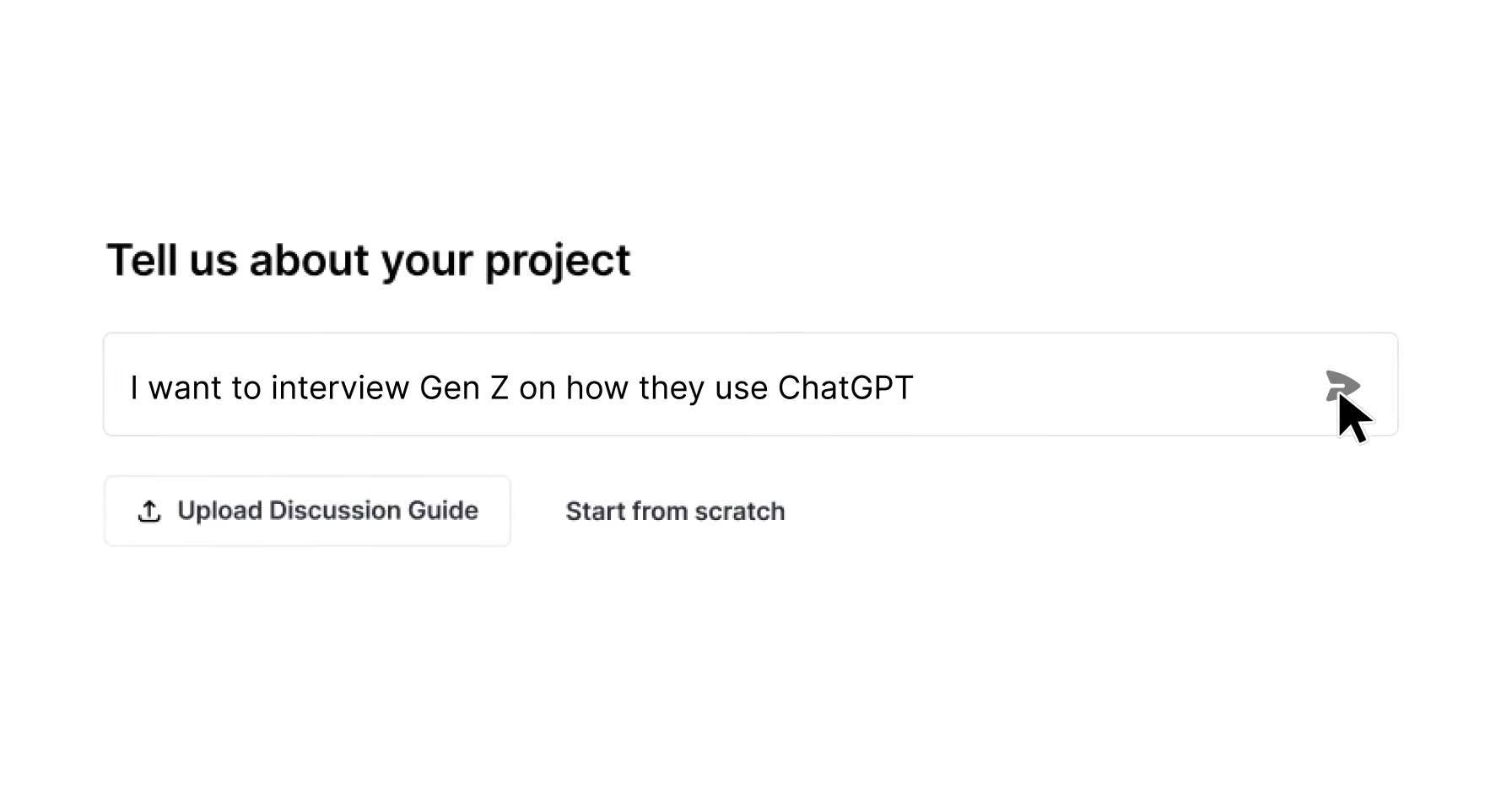
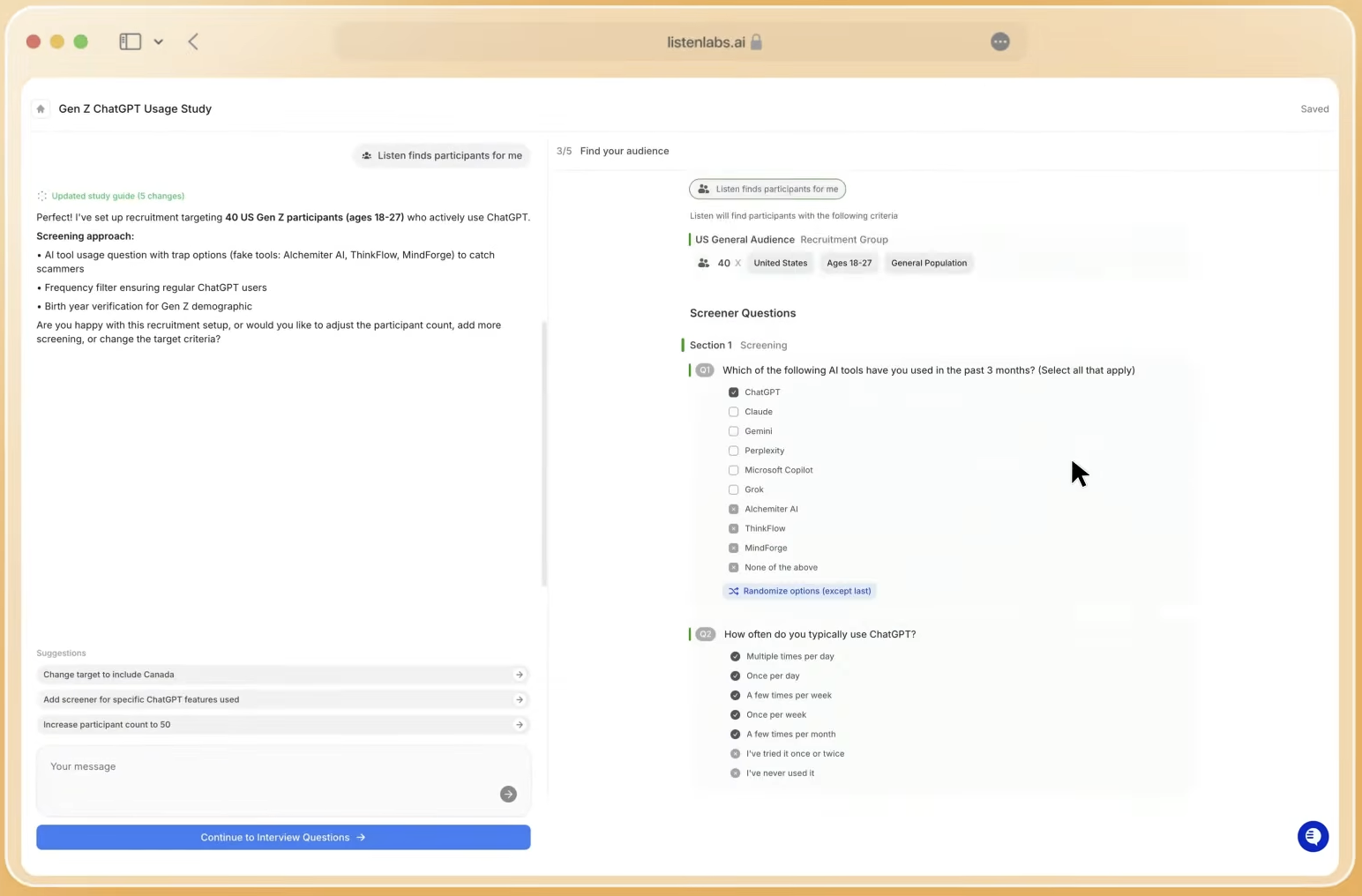
Listen Labs is an end-to-end AI research platform that sources participants from a network of 30M verified respondents across 45+ countries, conducts AI-moderated in-depth interviews in 100+ languages, and delivers consultant-quality findings in under 24 hours. Deliverables include slide decks, video highlight reels, and theme analysis. The platform removes the 4–6 week cycle of traditional qualitative research while preserving depth. Each interview adapts in real time, as the AI probes short answers and follows unexpected threads the way a trained human moderator would, surfacing emotional nuance and behavioral context that syndicated reports cannot capture.
Enterprises including Microsoft, Procter & Gamble, Google, and Anthropic use Listen Labs to run consumer research at a scale and speed that syndicated reports cannot match. Microsoft collected global customer video stories for its 50th anniversary celebration within a single day, demonstrating speed at global scale. Anthropic used the platform to surface churn drivers from 300+ user interviews in 48 hours, informing retention strategy. P&G ran 250+ interviews with quantified themes that shaped product strategy in hours rather than the weeks a traditional qualitative study would require.
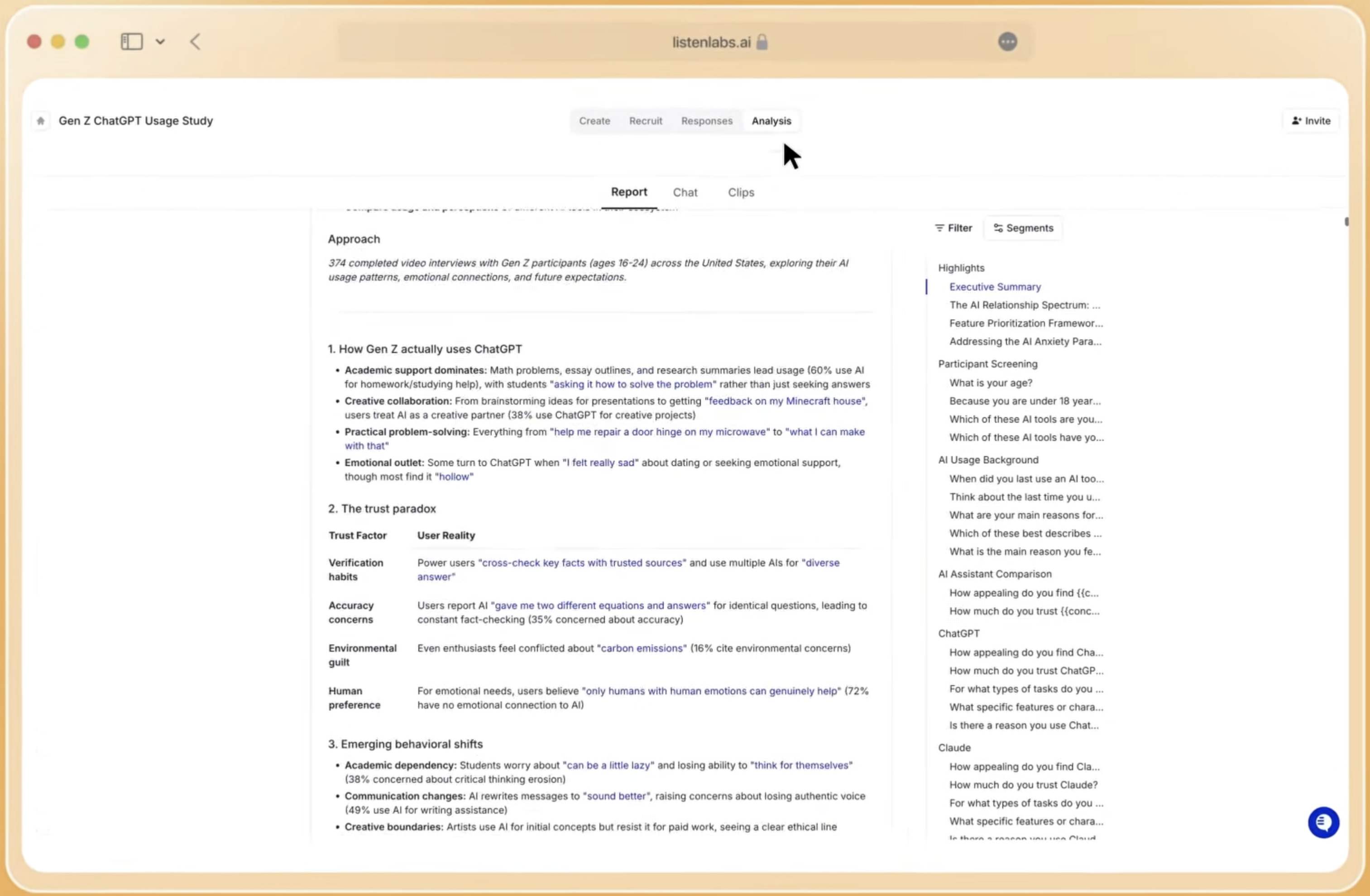
For Consumer Insights leaders whose teams already manage research backlogs, Listen Labs functions as a force multiplier. The same team can run significantly more studies per quarter without proportional increases in headcount or budget.
Frequently Asked Questions
What is a media consumer insights report sample PDF, and how do I get one?
A sample PDF is a partial preview of a paid syndicated report that usually includes the table of contents, a methodology summary, and one or two data tables. Vendors such as Mordor Intelligence and Grand View Research provide sample PDFs on their product pages at no cost after a short registration process. These samples help you evaluate a report’s structure, segmentation depth, and geographic scope before purchasing the full document. They rarely contain enough data to support a strategic decision on their own, so many insights teams use them as a starting point and then commission primary research to fill audience-specific gaps.
How current are the data in leading media consumer insights reports?
Publication date and data recency differ, and both matter. A report published in mid-2026 may have closed its primary data collection in late 2024 or early 2025. PwC’s Global Entertainment & Media Outlook 2026–30 is among the most current, with 2025 actuals and 2026 projections in its latest release. The Deloitte survey mentioned earlier was fielded in early 2026, which makes it one of the fresher primary datasets available at no cost. For fast-moving categories like connected TV advertising or retail media, even a six-month data lag can distort decisions. Teams that need current data on a specific audience segment gain more value by running a targeted consumer interview study than by waiting for the next syndicated report cycle.
What are the best free media consumer insights reports available in 2026?
See the “Free Media Consumer Insights Reports” section above for a detailed comparison of the strongest no-cost options, including Deloitte’s Digital Media Trends, ACMA’s viewing and listening report, and PwC’s press release summary. The key tradeoff across all free reports is breadth versus depth. They provide broad, directional context but rarely answer segment-specific or brand-specific questions.
When does it make more sense to run custom consumer interviews than to buy a syndicated report?
Syndicated reports work well for directional questions that focus on broad patterns, such as confirming that streaming is growing or that digital advertising is shifting toward connected TV. Directional questions seek high-level trends rather than detailed explanations. Custom consumer interviews fit specific questions that require depth, such as why a particular audience segment churns, how a new product claim lands with a defined demographic, or which creative direction triggers the strongest emotional response. If the decision depends on motivations, language, and emotional reactions within a clearly defined group, no syndicated report will provide that level of insight. Listen Labs conducts hundreds of AI-moderated qualitative interviews simultaneously, delivering the statistical confidence of large samples alongside the depth of one-on-one conversations in under 24 hours and at roughly a third of the cost of traditional qualitative research.
How does Listen Labs handle participant quality compared to standard research panels?
Standard commodity panels carry well-documented risks such as professional survey-takers, fraudulent profiles, and incentive-driven responses that distort findings. Listen Labs addresses this through three layers. First, it works exclusively with high-quality, non-commodity panel sources and its own proprietary database of 30M verified respondents. Second, Quality Guard applies real-time AI monitoring across video, voice, content, and device signals to detect fraud and low-effort responses during every interview. Third, participants are capped at three studies per month, which removes the professional respondent problem. A dedicated recruitment operations team adds a human review layer for hard-to-reach segments, including enterprise decision-makers, healthcare workers, and audiences below 1% incidence rate. The platform is SOC 2 Type II, GDPR, ISO 27001, ISO 27701, and ISO 42001 certified.
Conclusion
Media consumer insights reports from PwC, Mordor Intelligence, Grand View Research, and Deloitte provide essential macro context on industry revenue, advertising growth, and consumption trends. They form a necessary starting point for any insights leader building a strategic brief. As outlined earlier, even the highest-quality syndicated report shares a fundamental constraint: it serves the broadest possible audience rather than your specific strategic needs.
For Consumer Insights leaders managing growing research backlogs and shrinking timelines, a blended approach works best. Use syndicated reports for directional benchmarking and Listen Labs for the targeted consumer understanding that actually moves decisions. Thirty million verified participants, coverage in 100+ languages, and results in under 24 hours replace the weeks-long cycle of sourcing, fielding, and analyzing traditional qualitative research.