
Written by: Anish Rao, Head of Growth, Listen Labs
Key Takeaways for Enterprise Research Leaders
- Enterprise consumer insights platforms fall into five categories, each evaluated across thirteen criteria including speed, depth, quality, and governance.
- Traditional agencies and panel surveys take weeks to deliver results, while AI-moderated platforms return synthesized findings in 24–72 hours.
- End-to-end AI interview platforms combine adaptive moderation, proprietary verified panels, native multilingual support, and automated deliverables without sacrificing quality.
- Global reach and data quality stay high only when platforms conduct interviews in native languages with real-time multimodal fraud detection instead of commodity panels or post-hoc translation.
- See how Microsoft, P&G, and Sweetgreen compress research cycles from weeks to hours with Listen Labs.
Thirteen Criteria That Shape Platform Decisions
The thirteen evaluation criteria below define the decision surface for enterprise consumer insights leaders. Each criterion maps directly to a pain point that VP- and Director-level research teams face when justifying platform spend to stakeholders.
- Research speed: Traditional agency-led qualitative studies take four to eight weeks from brief to report, while AI-moderated platforms return synthesized findings in 24–72 hours.
- Depth of insight: A 2024 Glaut study found AI-moderated interviews produced 129% more words per response than traditional surveys, with 66% of transcripts rated higher quality by independent reviewers.
- Sample quality: NORC at the University of Chicago’s April 2026 research brief found fraud rates across the market research industry at 15% to 30%, reaching as high as 45% on some survey platforms.
- Participant sourcing: Platforms range from proprietary verified panels to open commodity exchanges, and verification rigor creates meaningful data quality gaps.
- Methodological flexibility: The ability to combine qualitative depth with quantitative validation in a single study workflow separates end-to-end platforms from point solutions.
- Global reach: Multi-market qualitative programs that once required three to four months of sequential fieldwork can now run in parallel across 50+ languages and markets in days using AI-moderated interviews.
- Language support: Native-language moderation, not post-hoc translation, determines whether emotional nuance survives across markets.
- Analysis effort: Manual coding and thematic analysis represent the largest time sink in traditional workflows, and automated analysis engines remove this bottleneck.
- Reporting transparency: Vendors should disclose exact question wording and metric formulas so that insights teams can explain to executives exactly where a number came from.
- Governance: Data provenance, consent documentation, and PII handling policies determine whether a platform clears enterprise procurement review.
- Security: SOC 2 Type II attestation, encryption in transit and at rest, SAML 2.0 single sign-on, and a public trust center are required enterprise operations features.
- Scalability: The ability to run hundreds of studies simultaneously without proportional cost increases defines whether a platform can serve as continuous research infrastructure.
- Total operational burden: AI total cost of ownership includes licences, infrastructure, integration, evaluation, governance, and exit costs, not just the headline per-seat price.
The following sections evaluate five platform categories against these thirteen criteria and show how each category performs across the decision surface enterprise teams face.
Global Panels and Surveys for Structured Quantitative Data
Global panel and survey platforms, including Qualtrics, SurveyMonkey, Cint, Dynata, and Prolific, focus on structured quantitative data collection at scale. Study setup is self-serve and fast, and a survey can launch within hours of questionnaire finalization. Recruitment draws from aggregated panel exchanges, and Cint maintains the largest aggregated consumer panel across 130+ countries.
Moderation is absent by design, so fixed questions accept whatever response a participant provides with no adaptive follow-up. Data quality depends entirely on panel controls, and professionally managed panels maintain fraud rates below 2%, while consumer panels without active controls commonly run 17 to 46%. Qualitative depth stays structurally limited because open-ended fields usually produce single-word or single-sentence responses with no mechanism to probe further. Quantitative support is the category’s core strength, with statistical defensibility at large sample sizes.
Analysis workflow requires manual coding of open-ends or a separate text analytics tool, and deliverable creation falls to the research team. Cross-study knowledge management is not native to most platforms.
Risks and limitations: Pew Research Center’s long-running tracking of its own telephone surveys found response rates dropped from 36% in 1997 to single digits within about two decades, a trend attributed to survey fatigue. Surveys work well for tracking fixed metrics like NPS trends or satisfaction indices at scale, but they cannot surface the reasoning behind numbers or the emotional logic of decisions.
Social Listening Platforms for Public Conversation Signals
Social listening platforms such as Brandwatch, Sprinklr, and Talkwalker aggregate publicly available text from social networks, forums, review sites, and news sources. Study setup involves configuring keyword queries and Boolean logic rather than designing a discussion guide. Recruitment does not apply because the platform harvests existing public conversation, and moderation does not exist in this category.
Data quality is bounded by what participants choose to post publicly, which introduces self-selection bias and platform-specific demographic skew. Qualitative depth is limited to the length and candor of organic posts, and emotional nuance is inferred from text sentiment models rather than observed directly. Quantitative support covers volume, share of voice, and trend lines across time.
Analysis workflow is largely automated for sentiment and topic clustering, but analysts must interpret results to connect social signals to business decisions. Deliverable creation is manual, and cross-study knowledge management is not a native capability.
Risks and limitations: Social listening captures what people say in public, not what they think in private. Populations active on monitored platforms are not representative of most consumer segments. The category excels at trend detection and brand monitoring but cannot explain why a sentiment shift occurred or which specific product or messaging change would reverse it.
Behavioral Analytics Platforms for Product Usage Data
Behavioral analytics platforms, including Mixpanel, Amplitude, and Heap, instrument digital products to capture what users actually do, such as clicks, session paths, funnel drop-off, and feature adoption. Study setup is a tagging and instrumentation exercise rather than a research design task. Recruitment does not apply because data comes from the existing user base, and moderation does not exist.
Data quality is high for the behaviors being tracked but limited to instrumented surfaces. Qualitative depth is zero because behavioral data records actions without capturing motivation. Quantitative support is the category’s primary value, providing large-sample behavioral patterns with statistical confidence. Analysis workflow is self-serve through dashboards and funnel reports, and deliverable creation is manual. Cross-study knowledge management is not native.
Risks and limitations: A 2026 Harvard Business Review analysis of AI-powered interviewers notes that these systems can uncover not just what customers think but why they think it, capturing emotional nuance and candid responses that are harder to reach through fixed questioning, which behavioral analytics cannot provide. The say-do gap is visible in behavioral data but remains unexplained without qualitative context.
AI-Native Research Platforms for Assisted Surveys and Analysis
AI-native research platforms, including tools that layer AI onto survey engines or offer AI-assisted analysis of uploaded transcripts, form a broad and heterogeneous category. Study setup ranges from self-serve questionnaire builders with AI question suggestions to platforms that accept natural-language research briefs. Recruitment is typically handled through third-party panel integrations rather than proprietary infrastructure. Moderation ranges from chatbot-style fixed-question delivery to genuinely adaptive AI conversation.
Data quality depends on the underlying panel source and fraud controls applied. Video-based participation with multimodal AI analysis is the highest-signal authenticity check available because it captures tone, hesitation, facial micro-expressions, and contextual detail that are hardest for fraudsters to simulate consistently at scale. Qualitative depth varies significantly, and platforms with genuine adaptive probing produce materially richer responses than those delivering predetermined questions with an AI label. Quantitative support appears on most platforms through embedded rating scales and NPS items.
Analysis workflow is partially automated, with theme extraction and sentiment scoring available on most platforms. Deliverable creation ranges from raw transcript exports to AI-generated summaries, and cross-study knowledge management is rare in this category.
Risks and limitations: Synthetic and LLM-driven platforms prioritize speed and iteration, which makes them attractive when rapid feedback cycles matter, but a peer-reviewed study by researchers at the Nuremberg Institute for Market Decisions found synthetic data matched real participants’ brand choices only 79% of the time and showed significantly less variation than real responses. Platforms without proprietary recruitment infrastructure depend on commodity panels and inherit their fraud exposure.
End-to-End AI Interview Platforms for Qual-at-Scale
End-to-end AI interview platforms cover the complete research lifecycle within a single system, including study design, participant recruitment, AI-moderated interviews, automated analysis, and deliverable generation. Listen Labs leads this category and has conducted over 1 million AI-powered customer interviews for companies including Microsoft, Perplexity, and Sweetgreen.
Study setup on Listen Labs begins with a natural-language brief, and the AI co-designs structured objectives, questions, and probing context in seconds. This speed removes the traditional bottleneck of discussion guide development. Once the guide is drafted, advanced stimuli support for images, video, audio, PDFs, prototypes, and live URLs enables concept testing, creative testing, and usability research within the same platform, so teams avoid juggling separate tools. Before launch, Auto-QA flags issues in the discussion guide and catches problems that would otherwise surface only after fieldwork begins.

Recruitment draws from Listen Atlas, a global panel of 50M+ verified respondents across 45+ countries and 120+ languages. An AI orchestration layer matches and bids across multiple panel partners, including NewtonX for B2B audiences. A dedicated recruitment operations team handles segments below 1% incidence rate, such as enterprise decision-makers, healthcare workers, and engineers, which commodity panels cannot reliably reach. Organizations can also self-recruit from their own user base.
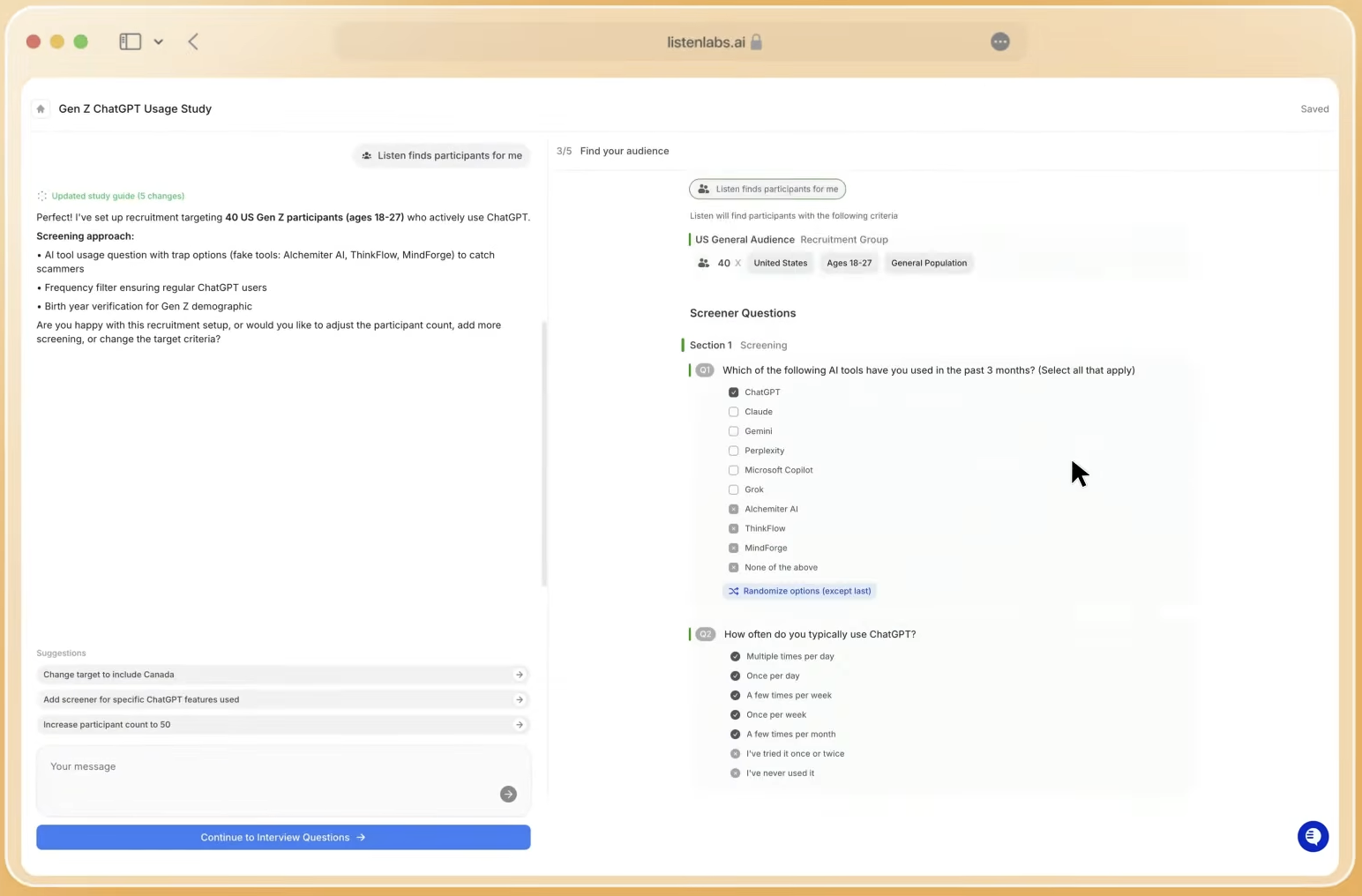
Quality Guard operates as a multi-layer fraud prevention system that addresses fraud at three distinct points. Before recruitment, behavioral matching uses intent and past actions rather than self-reported demographics to filter out participants whose behavior suggests professional survey-taking. During the interview, real-time monitoring covers video, voice, content, and device signals simultaneously and catches fraud attempts that pre-screening alone would miss. After each study, participant frequency is capped at three studies per month, which removes professional survey-takers who slip through the first two layers. Platforms like Listen Labs layer on auto-recruiting, transcription, sentiment tagging, and insight summarization so teams jump from question to findings in hours, not weeks.
AI-moderated interviews on Listen Labs conduct personalized, adaptive conversations with dynamic follow-up questions. The AI probes short or vague answers the same way a trained human interviewer would and produces responses three times longer than average. Mixed methods, including Likert scales, NPS, sliders, and MaxDiff, run alongside qualitative questions in the same session. Emotional Intelligence analyzes tone of voice, word choice, and subconscious micro-expressions across 50+ languages, built on Ekman’s universal emotions framework, with every emotion label traceable to a specific timestamp and verbatim quote.
Visual Insights closes the say-do gap by allowing the AI interviewer to observe on-screen behavior in real time, detect contradictions between stated preference and observed action, and probe the contradiction mid-interview instead of following the script past it. Research Library stores every study ever run and returns synthesized cross-study answers in natural language, with full source attribution to the original discussion guide, screener, and individual respondent. Listen Pulse delivers always-on conversational tracking that combines quantitative KPI waves with open-ended conversation and integrates with Qualtrics and Decipher.
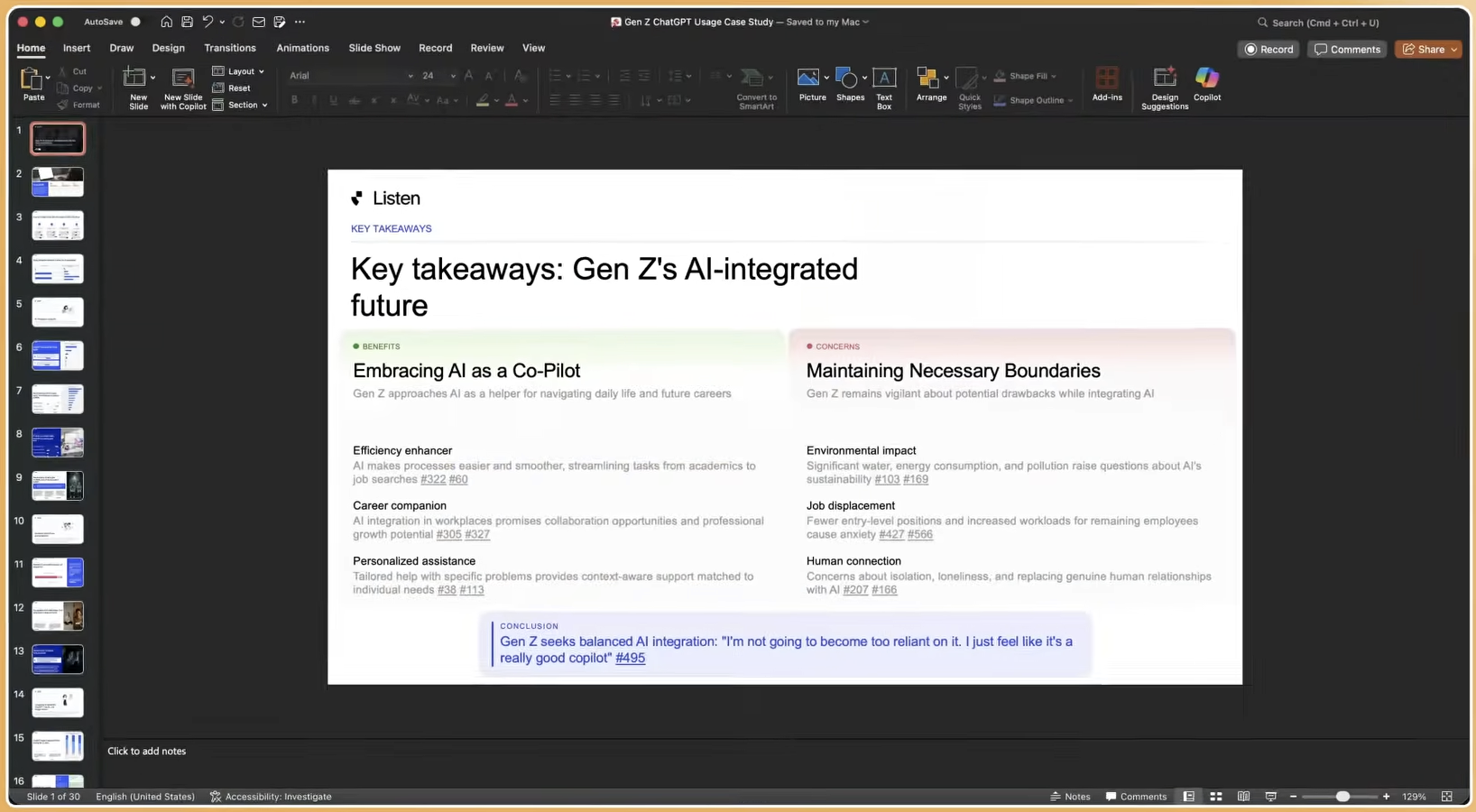
The Research Agent generates consultant-quality slide decks, memos, video highlight reels, statistical charts, and segmentation breakdowns in under a minute. With qual-at-scale, the old trade-off between depth and scale no longer blocks ambitious research programs.
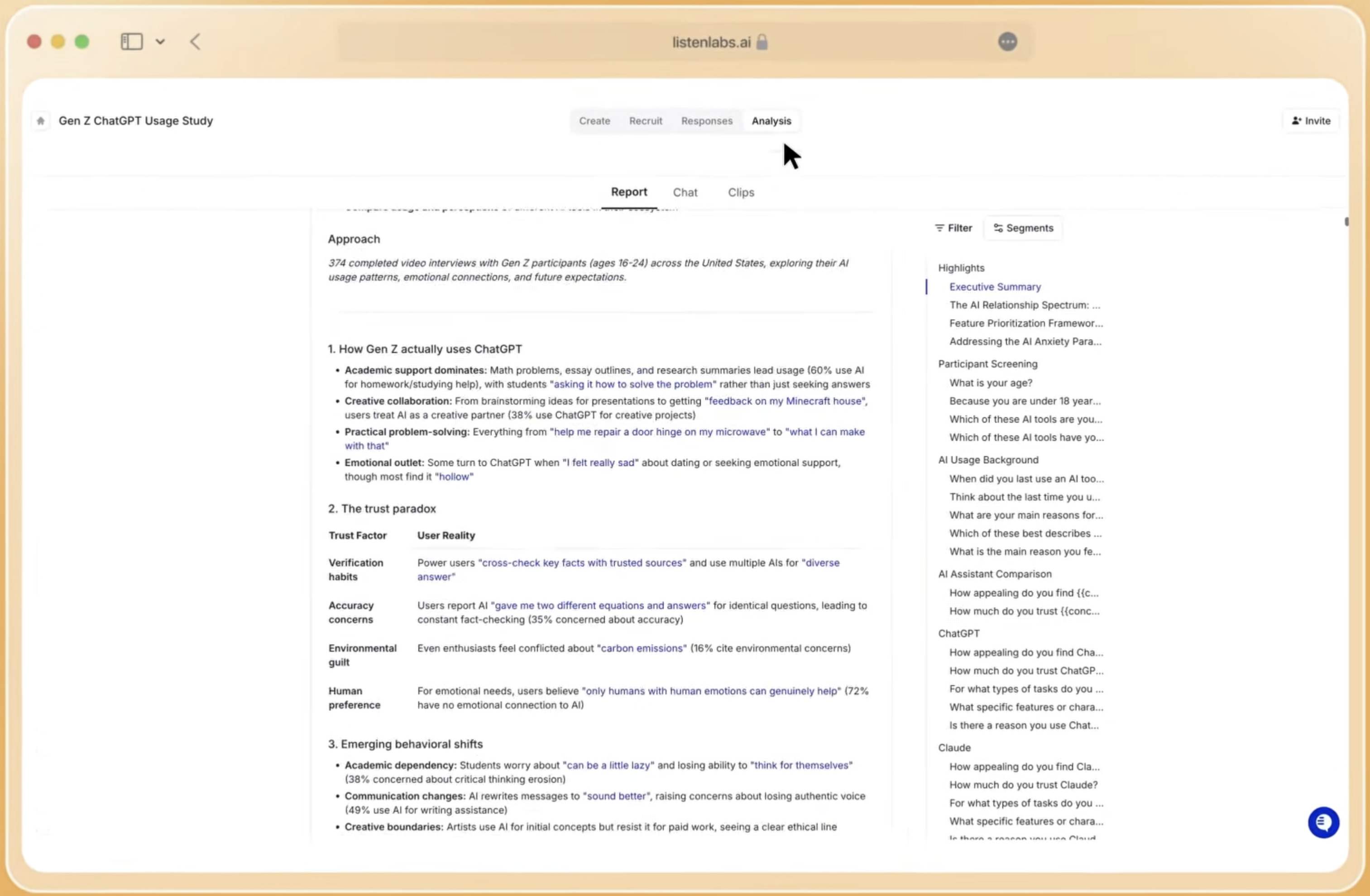
Enterprise case study results:
- Microsoft: Cut research wait time from weeks to hours and collected global customer stories for Microsoft’s 50th anniversary celebration within a day. “I can reach out to hundreds of users at one third of the cost.” — Director of Data Science at Microsoft
- Anthropic: Researchers now run 100 studies in the time it previously took to run five or six. Research reduced churn by enabling the team to ship a key Claude Code feature that cut drop-off after surfacing that context switching between the code editor and terminal was the core friction. “It is kind of like a self-healing study.” — Jane Justice Leibrock, Head of User Experience Research, Anthropic
- P&G: Delivered 250+ interviews with quantified themes and verbatim proof, surfacing where product claims feel exaggerated before market launch and directly shaping product and brand strategy in hours, not weeks.
- Sweetgreen: Replaced months-long research cycles with days and scaled research across 300+ US locations at five times the scale and one-third the cost. “By having the speed to insight, insights can lead to actions.” — Brian Davia, Head of Consumer and Business Insights, Sweetgreen
Security and compliance include SOC 2 Type II, ISO 27001, ISO 27701, ISO 42001, GDPR, 256-bit encryption, and enterprise SSO. Listen never trains its AI models on customer data.
See how to run research at scale without expanding headcount like Microsoft, P&G, and Sweetgreen do.
Global Reach and Quality Preservation Across Platforms
Across the thirteen evaluation criteria, the five categories diverge sharply on global reach and quality preservation.
Global panel and survey platforms offer the broadest raw geographic coverage, and Pollfish reaches 250M+ users via mobile app distribution across 160+ countries. Coverage breadth does not equal quality depth, however. Commodity panels in non-English-speaking markets carry elevated fraud risk, and fixed-question surveys cannot adapt to linguistic or cultural nuance mid-interview. Language support exists for survey translation, but the moderation layer that surfaces emotional reasoning does not.
Social listening platforms cover markets where social media penetration is high, yet coverage gaps in regulated or low-connectivity markets remain significant. The data captured reflects what users post publicly in each market, not what they think privately, and sentiment models trained primarily on English-language data lose accuracy across other languages.
Behavioral analytics platforms are market-agnostic for instrumented digital surfaces but provide no qualitative signal in any market. Global reach becomes irrelevant when the data type is click-stream rather than consumer reasoning.
AI-native research platforms vary widely. Those dependent on third-party panel exchanges inherit the geographic and quality limitations of those exchanges. Platforms without native multilingual moderation rely on post-hoc translation, which loses tonal and emotional nuance. Traditional qualitative studies are limited to 1–3 languages and small samples, a constraint that AI-native platforms with genuine multilingual moderation can remove.
End-to-end AI interview platforms with proprietary recruitment infrastructure and native multilingual moderation are the only category that preserves qualitative depth across markets simultaneously. Listen Labs conducts interviews in 120+ languages across 45+ countries. Emotional Intelligence analysis operates across 50+ languages, so emotional signal is captured in the participant’s native language rather than inferred from a translated transcript. Studies spanning ten countries return synthesized findings in under 24 hours instead of the months that sequential fieldwork would require.
Across the remaining criteria, end-to-end AI interview platforms deliver the strongest combined performance. AI-moderated interviews with adaptive probing produce materially richer responses than any fixed-question format. Proprietary verified panels with real-time multimodal fraud detection outperform commodity exchanges on sample quality. Automated theme extraction and one-click deliverables remove the manual coding bottleneck. Full traceability to individual respondents, timestamps, and verbatim quotes satisfies executive scrutiny. Enterprise certifications clear governance and security reviews. The ability to run hundreds of parallel interviews without proportional cost increases defines continuous research infrastructure, and replacing five separate vendors for recruitment, scheduling, moderation, transcription, and analysis with a single platform reduces coordination overhead and avoids inter-vendor quality loss.
Best-Fit Use Cases by Enterprise Persona
Different personas within the same enterprise have different primary needs from a consumer insights platform.
VP or Director of Consumer Insights at a Fortune 500: The primary need is multiplying research output without proportional headcount or budget increases. The research backlog grows faster than the team can deliver, each study takes 4–6 weeks, and internal stakeholders feel frustrated. An end-to-end AI interview platform that compresses the cycle to under 24 hours and delivers consultant-grade output directly addresses this bottleneck. Listen Labs is purpose-built for this persona.
UX Research Lead: The primary need is faster feedback loops that keep pace with sprint cycles. Screen-sharing and usability testing capabilities, combined with the ability to test with 50–100+ users instead of 5–10, make end-to-end AI interview platforms with Visual Insights the strongest fit. AI-native platforms without proprietary recruitment are a secondary option for teams with existing participant pools.
Product Manager or Marketing Leader without a dedicated research team: The primary need is self-serve simplicity, which means describing research goals in natural language and receiving study design, recruitment, moderation, and analysis automatically. End-to-end AI interview platforms with natural-language study co-design serve this persona without requiring research methodology expertise.
Consultancy, agency, or investor: The primary need is speed to insight measured in days, global reach, and the ability to recruit niche audiences for client engagements or due diligence. End-to-end AI interview platforms with dedicated recruitment operations for hard-to-reach segments, such as enterprise decision-makers, healthcare workers, and sub-1% incidence audiences, are the strongest fit.
Operational and Long-Term Platform Considerations
Stakeholder alignment is the first operational consideration. Research teams that adopt a new platform must show product, brand, and marketing stakeholders that output quality is maintained or improved. Traceability, with every insight linked to a specific respondent, timestamp, and verbatim quote, builds stakeholder trust in AI-generated findings.
Change management is the second consideration. Larger organizations integrate AI-native tools to augment existing research workflows, accelerate projects in new markets and languages, and increase overall research velocity without expanding team size. Platforms that position themselves as force multipliers rather than replacements for existing research teams reduce internal resistance during adoption.
Compliance requirements vary by industry and geography. Enterprise procurement requires documented data provenance, informed consent records, PII handling policies, data residency options, and third-party sub-processor disclosure. Enterprise procurement teams should weight data governance at 20% and security and compliance at 15% of their platform evaluation rubric.
Repeatability across global programs is the long-term differentiator. Platforms that accumulate institutional knowledge across studies, enable cross-study queries and trend tracking, and support onboarding of new team members against the full research corpus compound in value over time. Platforms that treat each study as a self-contained event do not. AI can schedule and conduct the interview for you, analyze the transcripts for themes, and even generate quantitative insights from those interviews, but only platforms with cross-study knowledge management convert individual studies into organizational intelligence.
Risks, Limitations, and Common Misconceptions by Category
Each category carries specific risks that enterprise teams should evaluate objectively.
Global panels and surveys risk producing shallow open-ended data and are vulnerable to professional survey-takers on commodity exchanges. The misconception that large sample size equals high data quality is common, and the Greenbook 2025 GRIT Report shows that data quality correlates more strongly with decision usefulness than panel size.
Social listening platforms risk demographic non-representativeness and platform-specific bias. The misconception that high post volume equals broad consumer sentiment ignores the self-selection of users who post publicly.
Behavioral analytics platforms risk the say-do gap, because behavioral data records what users do but cannot explain why. The misconception that observed behavior is more reliable than stated preference ignores that behavior without context produces incomplete decisions.
AI-native research platforms risk quality variance across the category. The Directions Group found that fluent, natural-sounding AI text creates an illusion of validity, leading researchers to false confidence even when underlying synthetic data is distorted. Platforms without proprietary recruitment inherit commodity panel fraud rates. The misconception that any AI label on a research tool implies adaptive, human-quality moderation remains widespread.
End-to-end AI interview platforms are not preferable for every research context. Human-moderated interviews remain preferable for emotionally sensitive topics, therapy-like conversations, research involving trauma, or studies where body language and subtle emotional cues are central. The misconception that AI moderation replaces human researchers entirely misrepresents the force-multiplier model, where AI handles logistics and scale while human researchers focus on strategic interpretation.
Decision Framework for Matching Platforms to Goals
The following checklist helps enterprise teams match platform categories to their specific research goals without prescribing a single answer.
- Define your primary output type. If the primary output is a tracked metric such as NPS, awareness, or consideration, global panel and survey platforms or conversational trackers are the starting point. If the primary output is the reasoning behind a metric movement, AI-moderated interviews are required.
- Assess your turnaround requirement. If decisions must be made within 48 hours, only AI-moderated platforms with integrated recruitment can meet the timeline. If 4–6 weeks is acceptable, traditional agencies remain an option.
- Evaluate your sample quality requirements. If the study will inform a major product, pricing, or brand decision, verify that the platform applies real-time multimodal fraud detection, not just post-hoc data cleaning, and caps participant study frequency.
- Determine your global reach needs. If the study spans more than three markets, confirm that the platform conducts moderation in native languages rather than translating a single discussion guide.
- Assess your analysis bandwidth. If the research team is already at capacity, platforms that require manual coding and report writing add operational burden rather than reducing it. Automated theme extraction and one-click deliverables become a requirement, not a nice-to-have.
- Evaluate governance and security requirements. Confirm SOC 2 Type II, GDPR compliance, data residency options, and a clear policy on whether customer data is used to train AI models before procurement approval.
- Calculate total cost of ownership across three years. TCO comparisons commonly omit prerequisite licences for AI add-ons, which can double or triple the real per-seat cost. Include implementation, training, integration, and exit costs alongside the headline subscription price.
- Assess institutional knowledge accumulation. If the organization runs more than ten studies per year, platforms that enable cross-study querying and trend tracking compound in value. Platforms that treat each study as self-contained do not.
Walk through this decision framework with a Listen Labs research specialist to see how the platform maps to your specific research program.
Frequently Asked Questions
How long does it actually take to get results from an AI interview platform versus a traditional agency?
Traditional agency-led qualitative research breaks into sequential phases, including recruitment, fieldwork, analysis, and deliverable creation, that together require 4–8 weeks for a full-service project. Listen Labs compresses the entire cycle to under 24 hours. AI assists with study design in minutes, recruitment draws from a 50M+ verified panel and runs in parallel with study setup, and interviews are conducted simultaneously rather than sequentially. The Research Agent then generates slide decks, memos, and highlight reels automatically once fieldwork closes. Enterprise teams at Microsoft and Sweetgreen have used this cycle to collect and synthesize hundreds of interviews within a single business day.
How does Listen Labs source participants, and what prevents fraud?
Listen Labs sources participants through Listen Atlas, its proprietary verified panel, which provides access to hard-to-reach segments and supports recruitment in over 120 languages. The AI orchestration layer matches and bids across multiple high-quality panel partners, including NewtonX for B2B audiences, and a dedicated recruitment operations team handles hard-to-reach segments below 1% incidence rate. Fraud prevention operates across three layers, as Quality Guard applies real-time monitoring across video, voice, content, and device signals simultaneously, participants are capped at three studies per month to eliminate professional survey-takers, and Listen Labs does not work with commodity panel sources. Organizations can also self-recruit from their own user base at reduced cost.
Can Listen Labs support research across multiple languages and markets simultaneously?
Listen Labs supports 120+ languages for interview moderation and 50+ languages for Emotional Intelligence analysis. Moderation occurs in the participant’s native language, not translated from a single English discussion guide, which preserves tonal and emotional nuance across markets. Multi-market studies run in parallel rather than sequentially, so a study spanning ten countries returns synthesized findings in under 24 hours instead of the three to four months that sequential fieldwork would require. Emotional Intelligence analysis operates natively across 50+ languages, and emotional signal is captured in the original language rather than inferred from a translated transcript.
What deliverables does Listen Labs produce, and how traceable are the findings?
The Research Agent generates consultant-quality PowerPoint slide decks, memo-style reports, video highlight reels, statistical charts, segmentation breakdowns, and custom reports based on any natural-language question, all in under a minute. Every finding is traceable to the original study, discussion guide, screener, and individual respondent. Emotional Intelligence labels link to the exact timestamp, verbatim quote, and reasoning behind each classification. Research Library extends this traceability across every study ever run on the platform, enabling cross-study synthesis and trend tracking in natural language. This level of traceability allows research leaders to answer executive scrutiny with specific evidence rather than summarized conclusions.
Is Listen Labs a replacement for the internal research team?
Listen Labs functions as a force multiplier for existing research teams, not a replacement. The platform handles the logistics and scale that currently consume most of a research team’s time, including recruitment, scheduling, moderation, transcription, and initial analysis, which frees researchers to focus on strategic interpretation, stakeholder communication, and study design. Anthropic’s Head of User Experience Research described a 20x increase in study throughput for her team. P&G’s analytics and insight team used the platform to deliver 250+ interviews with quantified themes in hours rather than weeks. The in-house research team at Listen Labs, with 50+ years of combined expertise, continuously refines the methodology framework so the platform reflects current research best practices rather than generic AI outputs.