
Written by: Anish Rao, Head of Growth, Listen Labs
Key Takeaways
- AI Brand Perception Score is a 0–100 composite metric that tracks how consistently and favorably LLMs describe, recommend, and cite a brand across standardized prompts.
- A 30-prompt audit template covering brand recognition, category context, branded evaluation, and decision-stage intent provides the foundation for reliable measurement across ChatGPT, Claude, Gemini, and Perplexity.
- Scoring accuracy, sentiment, and citation share produces the composite score, while a perception-gap matrix compares LLM outputs to real customer language to reveal overstatements, understatements, or misattributions.
- Targeted AI-moderated interviews with verified respondents surface corrective signals that feed back into the perception-gap matrix and drive content and positioning remediation.
- Listen Labs compresses the full research cycle, including LLM audits, AI-moderated interviews, and monthly tracking, into a continuous program. Get started with your brand’s prompts to see how it works for your team.
Step 1: Build a 30-Prompt Audit Template Differentiated by Industry
A defensible audit starts with a fixed prompt set that mirrors actual buyer language, not marketing copy. Effective audit prompts should be specific about context, use buyer language rather than marketing language, vary phrasing of the same question, and include negative-framing prompts such as “What are the main criticisms of [Your Brand]?”
Structure the 30 prompts across four categories:
- Brand recognition, such as “What is [Brand]?” and “Who are [Brand]’s main customers?”
- Category and competitive context, using unbranded queries such as “What are the best [category] solutions for [target customer type]?” run without naming the brand.
- Branded evaluation, such as “Is [Brand] reliable?”, “Is [Brand] worth the price?”, and “What are the disadvantages of [Brand]?”
- Decision-stage intent, such as “Which [category] platform should a [persona] use for [use case]?”
Run each prompt across at least four models, including ChatGPT, Claude, Gemini, and Perplexity, and execute at least seven runs per prompt per day to account for nondeterminism, because LLM outputs vary even when inputs stay constant. This variability makes granular logging essential. Record the exact query text, platform, date, and full response for every run so you can trace any pattern back to its source. Aggregated outputs should never replace logs, extracts, sources, and citations, because every conclusion must be traceable to its evidence.
Step 2: Score Accuracy, Sentiment, and Citation Share
Raw responses become useful once you score them on three dimensions that roll up into the composite AI Brand Perception Score.
Accuracy. Classify each material claim as factual hallucination, unsupported claim, outdated information, entity conflation, classification error, omission, distortion, recommendation mismatch, or positioning misalignment. Hallucinations represent only one subset of the broader accuracy problem.
Sentiment. Apply a five-level rubric. Use Recommended (explicit endorsement), Positive framing (favorable attributes without explicit recommendation), Neutral listing (mentioned without evaluation), Hedged (qualified suitability with caveats), and Negative (active warnings or discouragement). Calculate Net Sentiment Score as (Recommended + Positive − Hedged − Negative) ÷ total brand mentions × 100. Scores above +40 indicate strongly favorable AI reputation, while scores below −15 signal active negative narratives that require immediate remediation.
Citation share. Citation rate is the share of responses linking to the brand’s domain or related page, and share of voice is the brand’s mentions divided by all brand mentions across the same prompt set. Weight citation share carefully. Dr. Li’s 2025 meta-analysis found users click citations embedded in AI-generated summaries at rates approximately 15 times lower than traditional search result links, so the framing inside the answer often drives commercial impact even when a link appears.
These three dimensions combine into a single composite metric that balances visibility, favorability, and attribution. The formula weights inclusion and sentiment equally as the primary drivers of commercial impact, with citation share as a supporting signal. Combine the three dimensions into a composite 0–100 score using the formula (inclusion rate × 0.4) + (normalized sentiment score × 0.4) + (citation rate × 0.2), recalculated monthly against the same frozen prompt set.
Step 3: Run a Perception-Gap Matrix That Compares LLM Outputs to Actual Customer Language
An AI Brand Perception Score measures what LLMs say. It does not measure whether those outputs reflect what real customers actually think and say. The perception-gap matrix bridges that divide.
The matrix plots two axes: LLM-generated brand attributes on one axis and customer-reported brand attributes on the other. Gaps between the two surfaces reveal one of three conditions, and each type calls for a different remediation strategy.
- LLM overstatement, where the model describes an attribute more favorably than customers report experiencing it.
- LLM understatement, where customers consistently cite a strength that LLMs omit or underweight.
- LLM misattribution, where the model associates the brand with attributes customers do not recognize.
Identifying these gaps is only the first step. Closing them requires populating the customer side of the matrix with primary data that reflects what real buyers actually say. Decision-grade brand perception research requires verbatim quotes, minority views, and behavioral signals from real customer interviews rather than synthetic LLM responses, because LLMs smooth away dissenting opinions that predict churn or adoption failure. A preregistered benchmark found that demographic-only personas achieved 74% of human test-retest consistency, while interview-grounded conditioning achieved 83% (or 86% when combined with surveys). Primary interview data is the critical lever.
Ready to see how Listen Labs maps LLM outputs against real customer language at scale? See the perception-gap matrix with your data and walk through the findings for your brand.
Step 4: Launch Targeted AI-Moderated Interviews to Surface Corrective Signals
The perception-gap matrix identifies where LLM outputs diverge from customer reality. AI-moderated interviews with real participants then surface the corrective signals needed to close those gaps.
Target interview recruitment to the segments most commercially relevant to each gap. For an understatement gap, where customers cite a strength LLMs ignore, recruit current customers who have directly experienced that attribute and collect verbatim language describing it. For a misattribution gap, recruit category buyers who have not yet purchased and probe their unaided associations before exposing them to the brand.
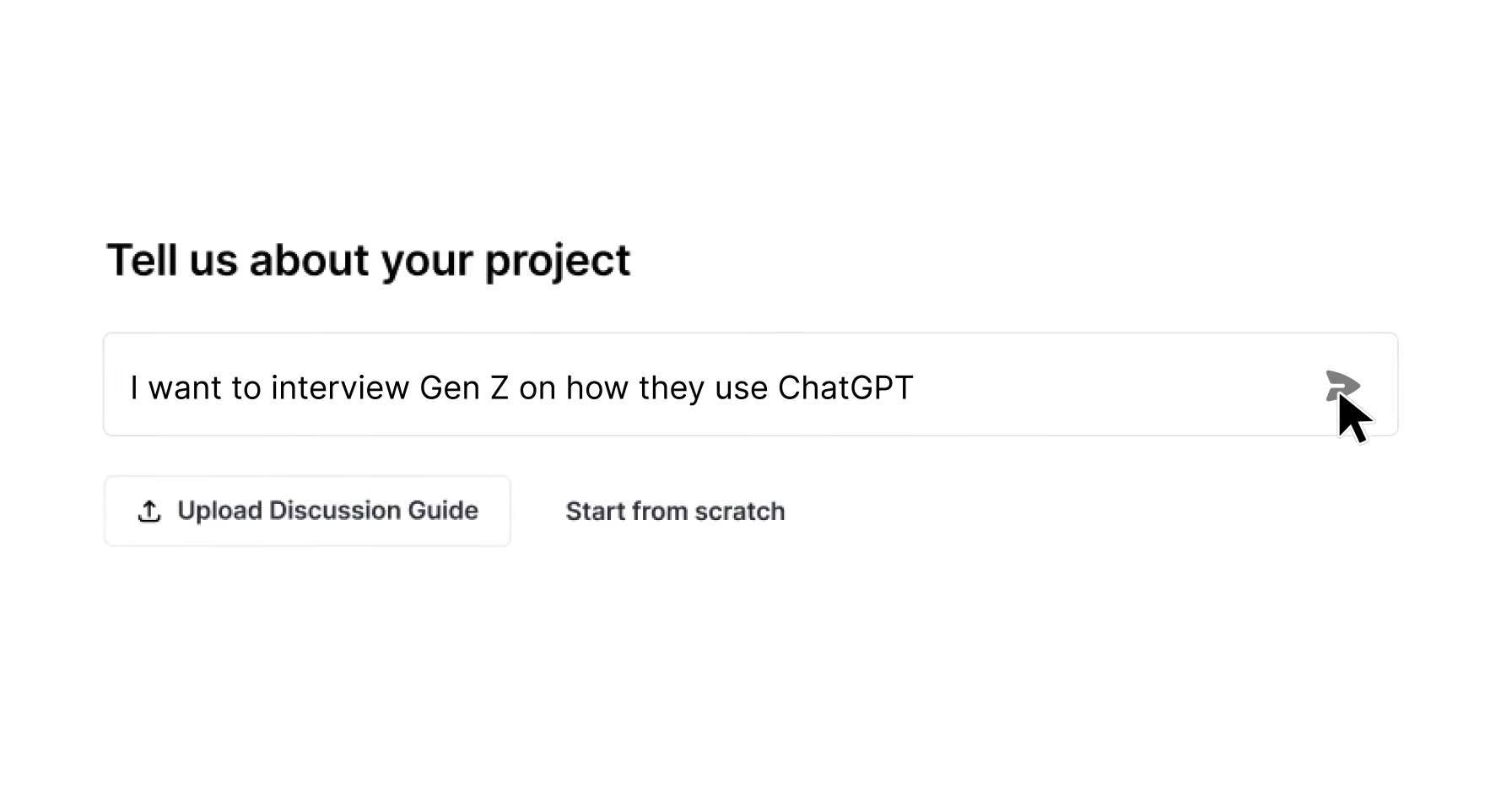
Listen Labs conducts AI-moderated video interviews at scale across its network of 50M+ verified respondents in 45+ countries, with intelligent probing that generates responses three times longer than average. The platform’s Emotional Intelligence layer analyzes tone of voice, word choice, and micro-expressions to surface emotional signals that transcripts alone miss. These signals are critical for understanding whether a brand attribute truly resonates or merely registers.
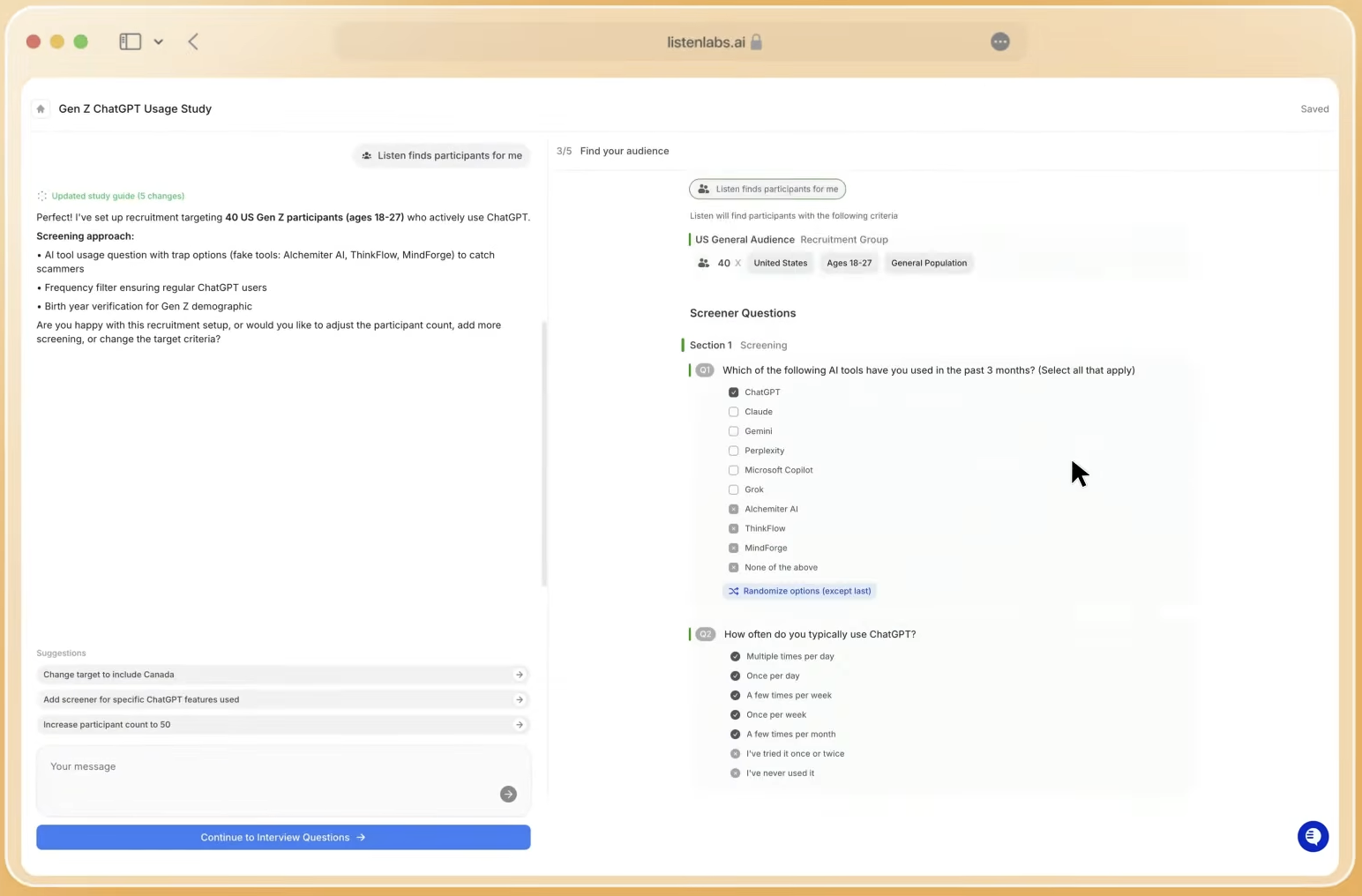
AI-moderated brand research with real consumers and AI brand visibility tracking of LLM outputs answer different questions and are not substitutes, because a brand can rank well in ChatGPT responses while losing salience with actual category buyers. Both inputs are required to close perception gaps in a durable way.
The interview outputs feed directly back into the perception-gap matrix. Customer verbatims replace inferred attributes, and the corrected matrix becomes the brief for content and positioning remediation. LLMs simply mirror the data available to them, so if high-quality signals are not supplied, someone else’s signals will fill the gap.
Step 5: Feed Findings into a Continuous Conversational Tracker for Monthly Cadence Reporting
A one-time audit produces a snapshot. Closing perception gaps durably requires a monthly cadence that tracks both LLM outputs and customer language in parallel.
Structure the monthly tracker around three fixed layers.
- LLM re-audit, where you re-run the frozen 30-prompt set across the same four models and recalculate the composite AI Brand Perception Score. Re-run within one week of major model releases to maintain month-over-month comparability.
- Conversational tracking wave, where you run a new wave of AI-moderated interviews with the same screeners and core questions used in the baseline study, adding timely questions covering new campaigns or competitive moves without breaking historical comparability.
- Gap delta reporting, where you compare this month’s perception-gap matrix to last month’s and flag which gaps narrowed, widened, or shifted category.
Executing this three-layer structure manually each month is operationally intensive. Listen Pulse, Listen Labs’ always-on conversational tracker, operationalizes this cadence by automating all three layers. It analyzes tens of thousands of responses continuously, charts emerging themes next to quantitative KPIs, and surfaces the reasons behind metric movements in the same wave, not in a separate follow-on study. Every number traces back to a verbatim quote and the video clip behind it.
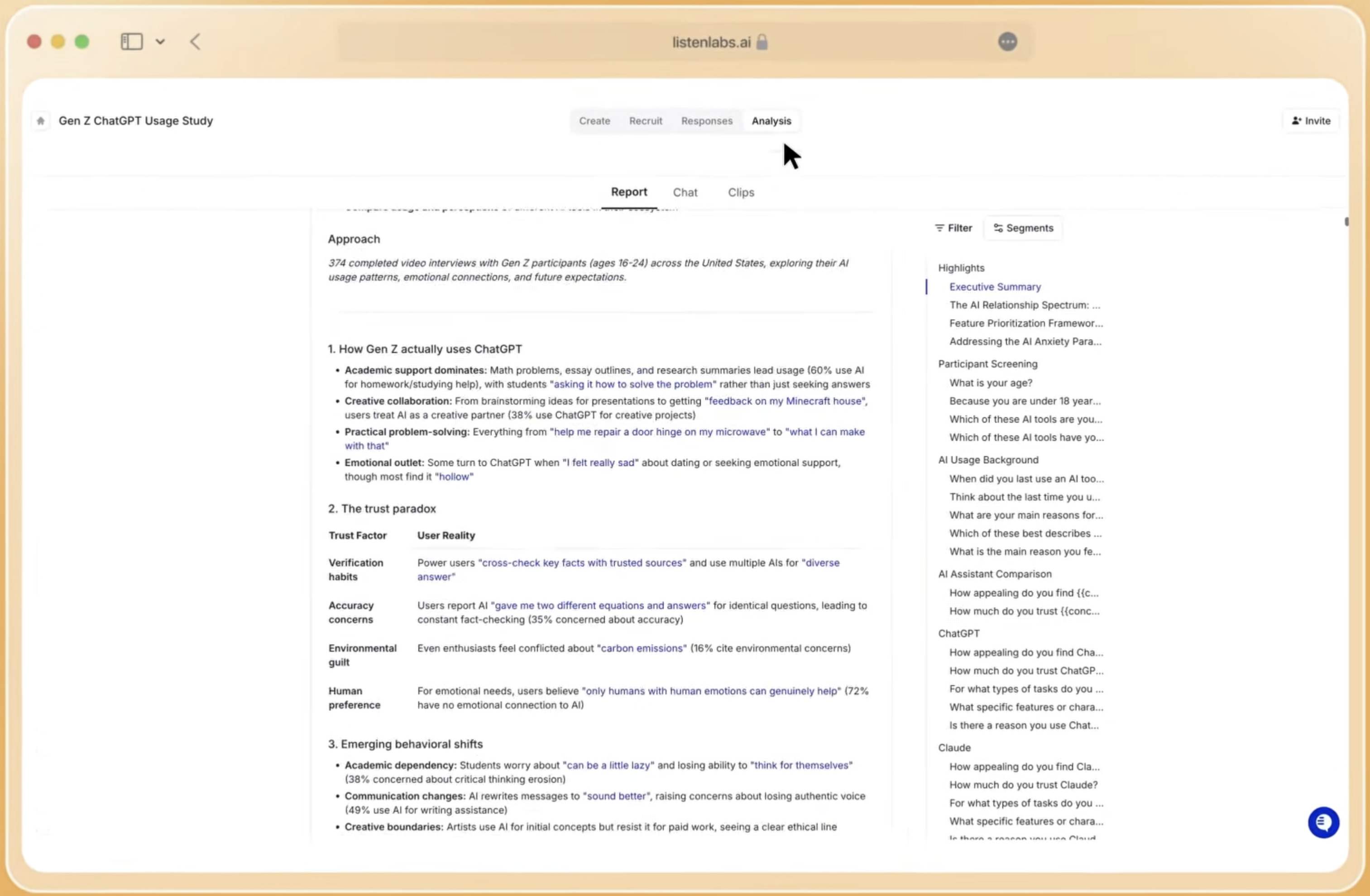
Eighty-five percent of consumers who interact with GenAI tools rank them among their top five most influential touchpoints in the purchase decision process. A monthly tracker that captures both LLM outputs and customer language helps brand teams detect narrative drift before it reaches downstream consideration metrics.
Measurement Success: Tracking Month-over-Month Improvement
Month-over-month improvement in AI Brand Perception Score is the primary signal that remediation is working, but a rising score alone does not prove commercial impact. Three secondary signals confirm that LLM gains are translating to real-world outcomes by tracking the downstream behaviors that score improvements should trigger.
- Consideration lift, where an LLM recommendation has been shown to lift same-name Google searches by 4.3 percentage points and site visits by 2.4 percentage points among previously unengaged users.
- Revenue per AI-referred visit, where Adobe Analytics data showed US shoppers referred from LLMs generated 53% more revenue per visit than shoppers from non-AI sources in May 2026.
- Customer language convergence, where the gap between LLM-generated brand attributes and customer-reported attributes narrows as corrective content reaches model training and retrieval pipelines.
When AI tools share incorrect product information, 58% of consumers say their trust in the brand decreases and 16% abandon the purchase. Closing perception gaps functions as a revenue protection program, not just a brand hygiene exercise.
Listen Labs compresses the full research cycle, from study design through AI-moderated interviews, automated analysis, and deliverable generation, to less than 24 hours. Enterprises including Microsoft, P&G, and Nestlé use the platform to run continuous consumer insights programs that would have taken months under traditional research infrastructure.
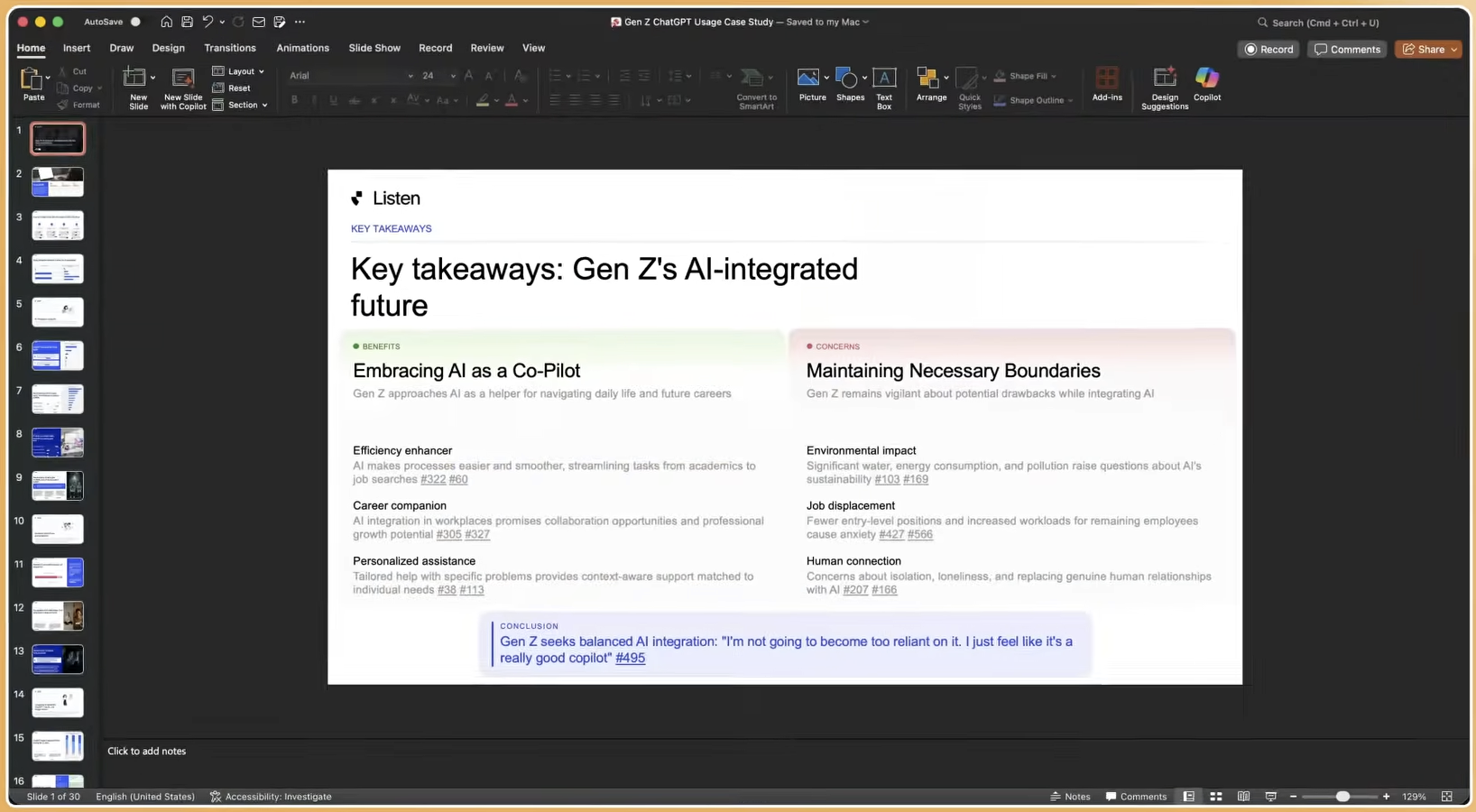
See the five-step playbook in action with your brand’s prompts and customer segments. Get started with your brand’s prompts and turn LLM visibility into measurable commercial impact.
Frequently Asked Questions
What is an AI Brand Perception Score and how is it different from traditional brand tracking?
An AI Brand Perception Score is a composite 0–100 metric that quantifies how consistently and favorably large language models describe, recommend, and cite a brand across a standardized set of prompts. It combines inclusion rate, sentiment classification, citation share, and factual accuracy against ground-truth positioning, recalculated monthly against a frozen prompt set. Traditional brand trackers measure awareness, consideration, and preference among human survey respondents. AI Brand Perception Score measures the same constructs as they are represented inside LLM outputs, a channel that now influences purchase decisions for a large and growing share of buyers. The two measurements are complementary, not interchangeable. A brand can score well on a traditional tracker while being misrepresented or absent in LLM responses, and the reverse can also occur.
How many prompts does an LLM audit require, and which models should be included?
A robust audit uses a minimum of 30 prompts structured across four categories: brand recognition, unbranded category and competitive context, branded evaluation, and decision-stage intent queries. Each prompt should be run across at least four models, including ChatGPT, Claude, Gemini, and Perplexity, with at least seven runs per prompt per day to account for the nondeterminism inherent in LLM outputs. Sentiment is significantly noisier than mention status across resampling, prompt paraphrases, models, and languages, which makes repeated sampling essential for reliable measurement. The full 30-prompt audit should be run at least monthly for stable categories, while fast-moving categories benefit from weekly re-runs of the competitive context subset.
Why is primary customer interview data necessary to close AI perception gaps?
LLM outputs reflect the data available in model training and retrieval pipelines. They do not reflect what real customers actually experience or say about a brand. Synthetic or inferred customer language cannot substitute for primary interview data because reactions to a specific brand name are shaped by lived experiences such as support interactions, competitor usage, and sales conversations that no training corpus captures. A preregistered benchmark found that demographic-only personas achieved 74% of human test-retest consistency, while interview-grounded conditioning achieved 83% (or 86% when combined with surveys). AI-moderated interviews with real participants surface the verbatim vocabulary customers use to describe a brand, which then populates the customer side of the perception-gap matrix and provides the corrective signals needed to update content and positioning.
How long does it take to see measurable improvement in AI Brand Perception Score after remediation?
Improvement timelines depend on the type of gap being closed and the remediation lever used. Citation-based gaps, where the brand is absent from LLM responses because authoritative third-party sources do not reference it, can show movement within four to eight weeks as new content is indexed and retrieved. Sentiment gaps driven by outdated or inaccurate claims in model training data take longer, often three to six months, because they depend on model update cycles rather than retrieval. Factual accuracy corrections submitted directly to model providers can accelerate resolution for specific hallucinations. A 30/60/90-day rollout, addressing obvious issues in the first 30 days, expanding to aspect-level scoring and automated alerts by day 60, and adding human validation plus KPI correlation by day 90, provides a practical remediation cadence for most enterprise brand teams.
How does Listen Labs integrate with LLM audit workflows?
Listen Labs is an end-to-end AI research platform that handles the full research lifecycle from study design and participant recruitment through AI-moderated interviews, automated analysis, and deliverable generation. The platform’s Listen Pulse conversational tracker runs continuous waves of AI-moderated interviews with the same screeners and core questions wave after wave, charting emerging themes next to quantitative KPIs so that every metric movement arrives with its explanation in the same wave. While the LLM prompt audit itself is conducted across external model platforms, Listen Labs provides the primary customer language data, collected through AI-moderated interviews with verified participants from its 50M+ respondent network across 45+ countries, that populates the customer side of the perception-gap matrix and drives corrective action. The Research Library then stores every study and every wave, enabling cross-wave queries that track how customer language evolves relative to LLM outputs over time.
Advanced Considerations for Multi-Market AI Perception Programs
Enterprises operating across multiple markets face compounding complexity because LLM outputs vary by language, model version, and regional retrieval environment. A brand’s AI Brand Perception Score in English on ChatGPT can differ materially from its score in German on Gemini or Japanese on Perplexity. An always-on program addresses this by running localized prompt sets in each priority market, recruiting AI-moderated interview participants from those markets through Listen Labs’ network spanning 45+ countries and 120+ languages, and maintaining separate perception-gap matrices by market.
Cross-market synthesis, which identifies which gaps are global versus regional, then informs whether remediation requires a universal content update or a market-specific intervention. For global brand teams, Listen Labs’ Research Library enables natural-language queries across all market studies simultaneously. This capability surfaces how customer language and LLM representation diverge or converge across geographies without requiring manual cross-study analysis. Explore a multi-market program to see how a global AI perception initiative would be structured for your brand.