
Written by: Anish Rao, Head of Growth, Listen Labs
Key Takeaways
Before diving into the details, keep these core points in mind about Kantar alternatives and conversational tracking.
- Kantar’s main weaknesses are slow turnaround, high enterprise pricing, and limited explanation for why metrics shift.
- Enterprise alternatives like Ipsos, NielsenIQ, and YouGov provide global scale but remain quant-heavy and cannot diagnose why brand metrics move.
- Agile challengers such as Tracksuit and Latana offer faster, lower-cost tracking but still deliver only quantitative data without qualitative context.
- Listen Pulse combines quant KPIs with conversational insights in the same wave, delivering both the metric and its explanation.
- Teams seeking deeper brand insights should see how conversational tracking closes the “why” gap.
Kantar’s Strengths and Where It Falls Short
Kantar is a strong platform with serious pedigree. Kantar’s BrandZ database covers 21,000+ brands across 540+ categories, with quantitative panels spanning 50+ markets. Its Meaningful-Different-Salient framework is academically validated through 20+ years of research, and its reports carry weight in boardrooms. Kantar is ranked #1 in WifiTalents’ 2026 list of top brand research services with an overall score of 8.9/10.
That strength comes with three structural weaknesses that push teams to look for alternatives.
Slow turnaround. A quarterly brand health wave takes 4–8 weeks from fieldwork to final report. By the time insights arrive, the market has already moved.
Enterprise pricing. Custom Kantar brand health programs typically run $50,000–$200,000+ per year, which puts them out of reach for many mid-market and challenger brands.
The “why” gap. Kantar’s survey-based methodology measures what consumers select from predefined options but cannot capture why they feel the way they do, what language they naturally use, or what specific experiences shaped their perceptions. As a result, it tells you a number moved, but it does not explain the reason behind the change. Traditional surveys may tell us what people do, but it takes a conversation to understand why.
This is the core pain point. Teams shopping for alternatives are looking for a tracker that delivers the diagnostic, not just the scoreboard.
Enterprise-Grade Replacements: Ipsos, NielsenIQ, and YouGov
Teams that need global scale, boardroom credibility, and cross-market comparability often turn to Ipsos, NielsenIQ, or YouGov. These platforms mirror Kantar’s enterprise positioning yet share the same limitation: quant-heavy methodology with no built-in explanation for why metrics shift.
Ipsos offers comprehensive global scale with contextual brand tracking tied directly to purchase situations and market dynamics. It runs as a full-service consulting engagement, with pricing driven by study complexity, sample size, and analytical depth. Ipsos works best for multinational brands that need standardized tracking across 20+ markets. The company structures its work around a mix of recurring tracking studies and one-off customized projects, which supports a balanced revenue profile with recurring contracts adding visibility.
NielsenIQ is the default measurement source across consumer goods. NielsenIQ operates in over 90 countries with 122 trillion data records, and its brand tracking connects to retail sales data, which makes it uniquely positioned for CPG brands that need to link brand health to actual purchase behavior. Pricing is quote-based and negotiated through sales, with annual or multi-year contracts that typically run two to five years.
YouGov BrandIndex tracks daily public perception of thousands of brands, making it the closest thing to a shared benchmark in the category. YouGov operates a panel of 30 million members and offers both self-serve and full-service options. Like Kantar, it is primarily quantitative, so it shows what is changing without explaining why.
Like YouGov, Ipsos and NielsenIQ rely on enterprise-grade, quant-heavy, wave-based tracking. This same limitation applies to all three enterprise alternatives: they are enterprise-grade, quant-heavy, and wave-based. They solve the scale problem but not the “why” problem. If you need a solution that addresses this gap, a conversational tracker like Listen Pulse offers a different approach. To see what that looks like in practice, you can experience a conversational tracker in action.
Agile Challengers for Faster, Cheaper Tracking
For mid-market and challenger brands that need speed and accessible pricing, a new generation of agile trackers has emerged. These agile challengers include Tracksuit, Latana, and Savanta. They are faster and cheaper than Kantar, yet they still operate within the quantitative paradigm.
Tracksuit, founded 2021, focuses on accessible pricing for challenger and growing brands, with subscription pricing starting around $30,000/year. Its deliberate simplicity is a strength for teams that need a clean dashboard. That same simplicity limits utility for enterprise-scale programs that need cross-market comparison or sophisticated segmentation.
Latana uses mobile-optimized surveys and machine learning-powered analytics to improve sample quality and reduce bias. Latana claims to be 3x cheaper than comparable solutions, with pricing starting at approximately $20,000/year. Its mobile-first methodology inherently limits the depth of each data point. Mobile survey responses are shorter and less nuanced than conversational data.
Savanta provides BrandVue, a continuous brand and reputation tracking platform. It serves enterprise clients with complex, multi-market tracking needs but operates on a traditional agency model with custom pricing. Its case studies include global brand health monitoring for major financial institutions, demonstrating capability at enterprise scale. However, like the others, Savanta delivers quant-only data without qualitative context.
These platforms solve the speed and cost problems but still deliver quant-only data. They tell you a number moved faster and cheaper than Kantar, yet the reason behind the change remains unclear.
The Conversational Alternative: Listen Pulse
Every competitor above leaves the same gap open: none of them explain why your metrics move. They catch the drop, but they cannot diagnose it. The “why” is what differentiates customer research that’s alright from customer research that’s outstanding.
Listen Pulse is a conversational tracker that closes this gap. It runs the same study with the same screeners wave after wave. It then understands the open-ended answers, sorts them into themes, quantifies them, and charts each theme right next to the KPIs you already report. Every metric movement comes with its explanation in the same wave.
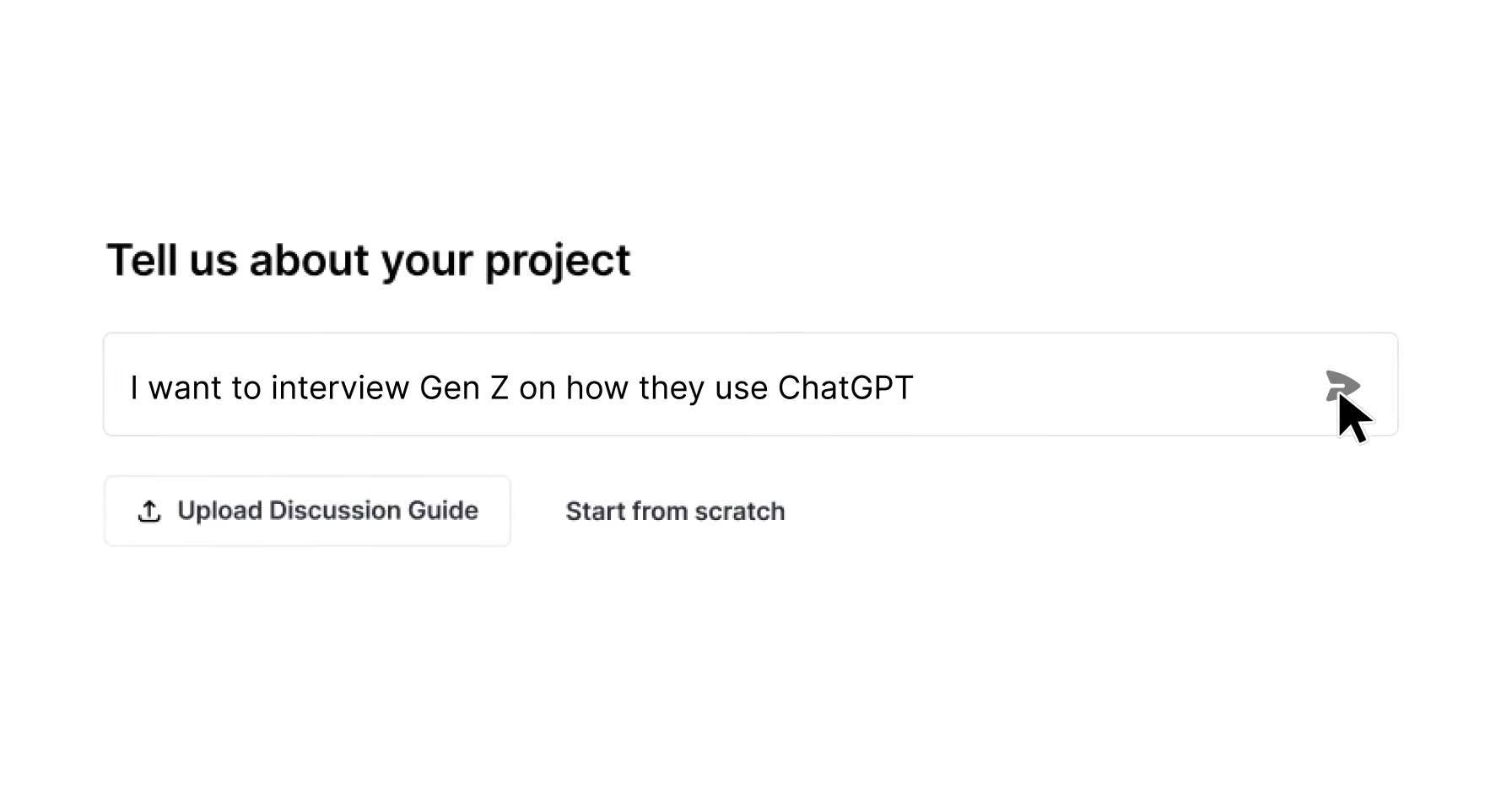
Here is how Listen Pulse works in practice:
- Quant KPIs plus qualitative “why” in one instrument: Repeated waves combine structured tracking questions with open-ended conversation, so every number traces back to a real moment with a real person, including their words, the quote, and the clip.
- Trend integrity preserved: Core questions stay constant wave over wave, while timely add-on questions cover new campaigns, competitors, or news events without breaking historical comparability.
- Integration with existing infrastructure: Pulse connects with Qualtrics and Decipher, so teams keep the KPIs they already report while adding the narrative behind them. It can deploy alongside an existing tracker or as the primary tracking system.
One well-known clothing brand, famous for its big logos, was quietly losing customers. Although its old tracker caught the drop, it could not explain it. Pulse found that the issue was style, not price. A growing group of customers felt the big logos were too loud. Their lifestyles were changing, and the logos no longer fit. That is the difference between a number and an answer: one tells you what happened, the other tells you why.
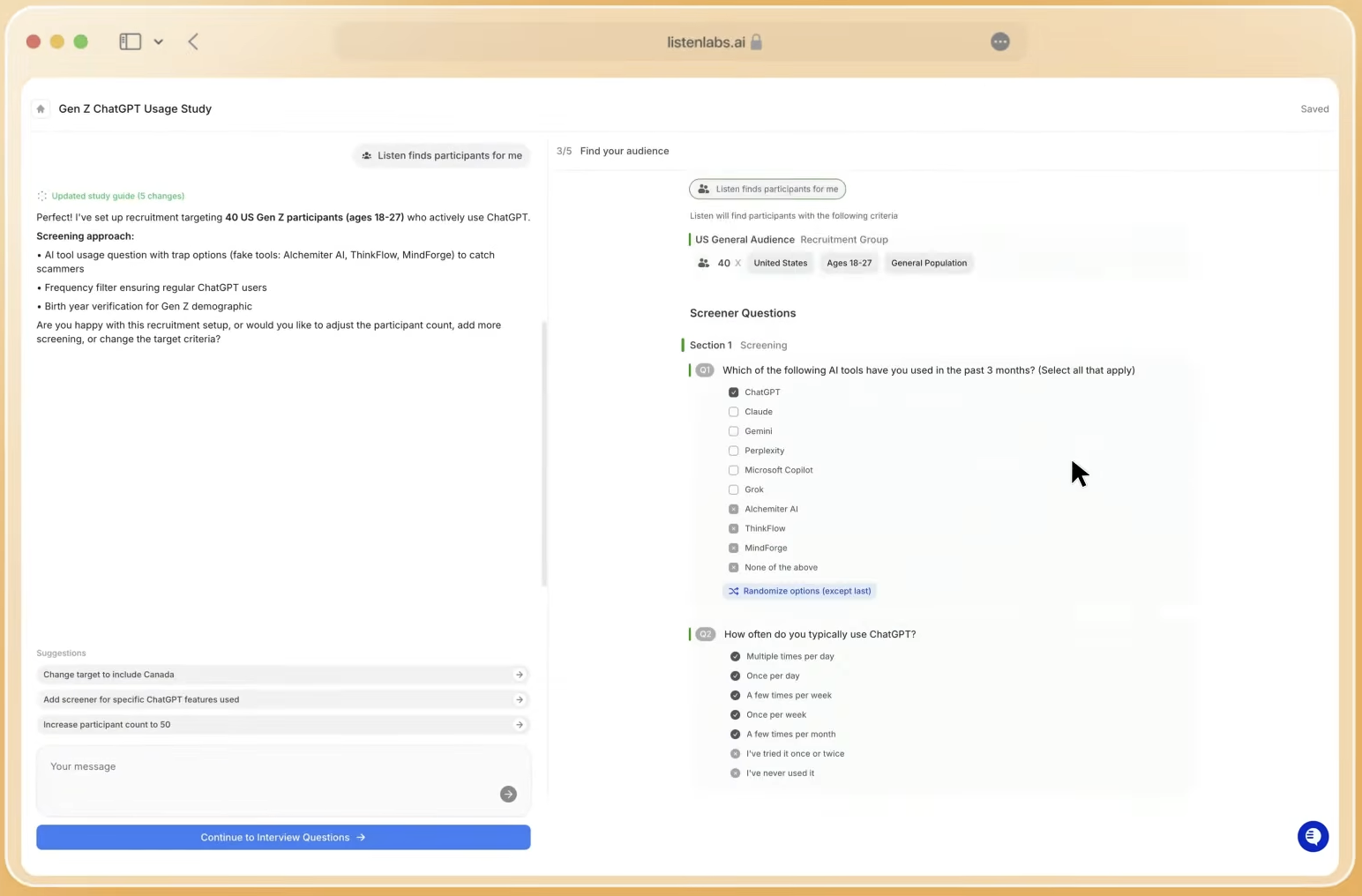
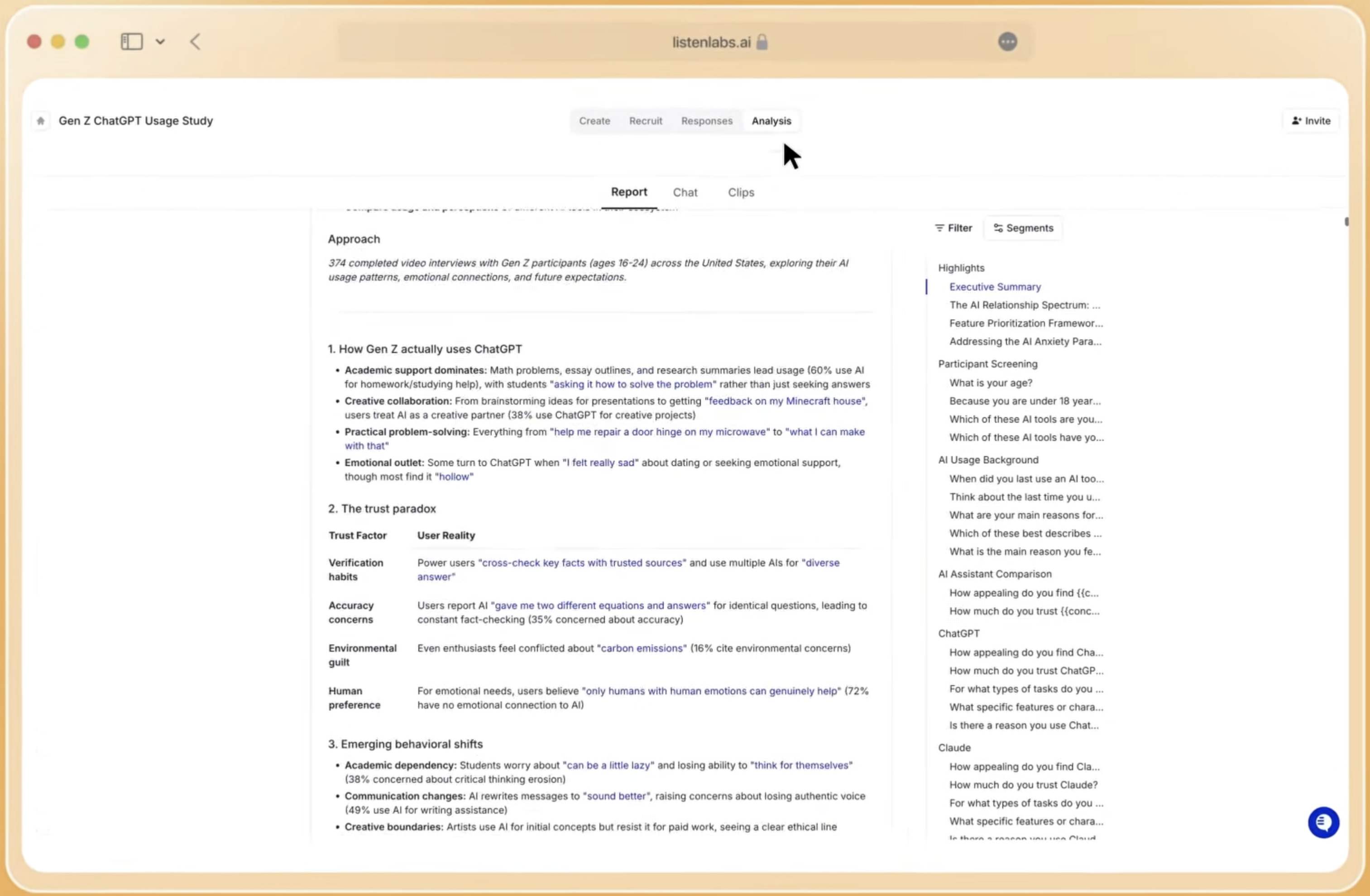
Platforms like Listen Labs layer on auto-recruiting, transcription, sentiment tagging, and insight summarization so teams jump from question to findings in hours, not weeks. Listen Labs has run over 1 million AI-powered customer interviews for companies including Microsoft, Perplexity, and Sweetgreen, and raised $69 million in a Series B funding round led by Ribbit Capital at a valuation above $500 million in January 2026.
To see how Listen Pulse adds the “why” to your brand tracking program, schedule a personalized demo.
How to Choose: A Practical Decision Framework
Given the trade-offs between enterprise scale, agile speed, and conversational depth, choosing the right Kantar alternative comes down to three criteria: budget, speed, and need for qualitative “why.”
- Budget: If you have a $100K+ annual research budget and need boardroom-grade brand valuation, enterprise alternatives like Ipsos or NielsenIQ are viable. If you are mid-market, agile challengers like Tracksuit or Latana offer accessible subscription pricing. If you need qualitative depth without enterprise overhead, conversational trackers like Listen Pulse deliver the “why” at a fraction of traditional qualitative costs.
- Speed: Wave-based trackers such as Kantar, Ipsos, and NielsenIQ deliver results in weeks. Agile challengers like Tracksuit and Latana deliver in days. Listen Pulse analyzes tens of thousands of responses 24/7 and surfaces trends as they form, not after the wave closes.
- Need for qualitative “why”: This is the decisive criterion. If you only need to know that awareness moved, any quant tracker works. However, if you need to know why it moved, including what language customers use, what experiences shaped their perception, and what is coming next, only a conversational tracker closes that gap.
Frequently Asked Questions
Is Kantar reputable?
Yes. As mentioned earlier, Kantar holds the top spot in WifiTalents’ 2026 ranking, and its BrandZ framework is academically validated through 20+ years of peer-reviewed research linking brand equity to financial performance. The question is fit. Kantar is built for enterprise-scale, quant-only tracking. Teams that need fast, affordable, qualitative depth will find it structurally limited regardless of Kantar’s methodological rigor.
Who owns Kantar?
Kantar is majority-owned by Bain Capital Private Equity, which acquired a controlling stake in 2019 when WPP sold a 60% interest in the company. Kantar is no longer under WPP ownership and operates as an independent research and data company, with Bain Capital holding a 60% majority stake and WPP retaining a 40% minority interest.
Does Kantar explain why brand metrics move?
No. As noted earlier, Kantar’s survey-based approach cannot capture the underlying reasons behind metric shifts. Explaining a metric shift typically requires commissioning a separate qualitative study, which adds weeks and cost to the process. Conversational trackers like Listen Pulse are built to close this structural gap by delivering the metric and its explanation in the same wave.
What should I look for when evaluating a Kantar alternative?
Three questions cut through most feature comparisons. First, what do you still have to do after the data lands? Many platforms deliver a number but leave the diagnostic work, such as understanding why the number moved, to a separate study or internal analysis. Second, what still exists in six months? Research that does not compound into institutional memory expires with each project. Third, does the platform tell you what it does not know? The strongest platforms surface emerging themes before they appear as KPI declines, not after. A platform that only confirms what you already suspected is delivering the gap faster instead of closing it.
Can Listen Pulse run alongside my existing Kantar tracker?
Yes. Listen Pulse is designed to deploy alongside an existing tracker or as the primary tracking system. It integrates with Qualtrics and Decipher, so teams keep the KPIs they already report to stakeholders while adding the open-ended conversational layer that explains why those KPIs move. Core questions stay constant to protect trend continuity, and timely add-on questions can address new campaigns or competitive events without breaking historical comparability. Teams typically use Listen Pulse to add the qualitative diagnostic layer that their existing quant tracker cannot provide.
Conclusion: Turning Metrics into Answers
Traditional brand trackers like Kantar, Ipsos, and YouGov tell you a number moved. Agile challengers like Tracksuit and Latana tell you the same story faster and cheaper. None of them explain why.
The “why” is what separates a lagging indicator from an actionable insight. By the time a KPI declines, the underlying shift has been building for months. Without a conversational layer, the only way to diagnose it is to commission a separate qualitative study, which adds weeks and cost to a process that is already slow.
Listen Pulse closes this gap by combining quant KPIs with open-ended conversation in the same wave, so every metric movement arrives with its explanation. Core questions stay constant to protect your trend line. Every number traces back to a real moment with a real person, including their words, the quote, and the clip. Qual-at-scale tools can engage hundreds or thousands of participants remotely and asynchronously, which makes the depth-versus-scale trade-off obsolete.
To start adding the “why” to your brand tracking, get a firsthand look at Listen Pulse.