
Written by: Anish Rao, Head of Growth, Listen Labs
Key Takeaways
- AI brand monitoring tracks how AI engines describe, judge, position, and surface your brand across brand, reputation, competition, and visibility layers using five core metrics: visibility, share of voice, sentiment, accuracy, and citation rate.
- Buyers now research inside ChatGPT, Gemini, Perplexity, and Claude before reaching your website, so traditional social listening alone cannot capture AI-driven brand perception.
- A 90-day operating playbook covers defining monitoring layers, building a buyer-intent prompt taxonomy, running baselines across engines, tracing AI claims to sources, and validating findings with primary customer research.
- Success depends on daily alerts, weekly reviews, and monthly strategy sessions with clear role ownership so monitoring produces decisions and actions instead of static reports.
- Listen Labs closes the loop from AI answer to research-backed action. Start Your AI Brand Monitoring Program.
Prerequisites And Context
This guide serves consumer insights leaders, brand and marketing leads, SEO and content leads, and product managers at mid-to-large companies who own brand perception outcomes.
Key terms used throughout:
- AI Brand Monitoring: Systematic tracking of how AI engines describe and surface your brand.
- AI Brand Visibility Tracking: Measuring how often and how prominently your brand appears in AI-generated answers.
- AI Share Of Voice: Your brand’s proportion of AI mentions relative to competitors within the same prompt clusters.
- Citation Rate: How often AI platforms link back to your content as a source.
- Prompt Taxonomy: A versioned, organized set of buyer-intent prompts used to query AI engines systematically.
- Say-Do Gap: The difference between what customers say they believe and what their actual behavior reveals.
Traditional brand tracking monitors social mentions, press coverage, and survey-based awareness. AI brand monitoring operates on a different layer entirely. AI assistants stated something factually inaccurate or outdated about a brand in 19% of answers across a study of 240 brands. Those inaccuracies leave no trace in brand analytics because they are delivered privately to one customer at a time.
How To Build An AI Brand Monitoring Strategy: 7 Steps
The seven steps below turn the monitoring layers and prompt taxonomy into an operating program. Steps 1–2 define what you track, steps 3–5 capture and diagnose what the engines return, and steps 6–7 validate and operationalize the findings.
- Define Your Monitoring Layers — Establish brand, reputation, competition, and AI visibility as distinct tracking dimensions.
- Build Your Buyer-Intent Prompt Taxonomy — Create a versioned set of prompts organized by funnel stage and reputation and competitive categories.
- Choose Engines And Run A Baseline — Capture presence, position, sentiment, accuracy, and citations across ChatGPT, Gemini, Perplexity, and Claude.
- Instrument The Metrics That Matter — Track the five core metrics together. A high visibility score with low accuracy means you are being described incorrectly at scale, so the metrics only become actionable when read as a set.
- Trace AI Claims To Their Influencing Sources — Identify whether each claim originates from owned pages, third-party reviews, forums, press, competitor content, or structured data gaps.
- Validate AI Perception Against Primary Customer Research — Confirm or refute AI narratives through customer interviews before acting.
- Run The Operating Cadence — Establish daily alerts, weekly reviews, and monthly strategy sessions with clear role ownership.
Monitoring Layers And Prompt Taxonomy
The four monitoring layers define what you are actually measuring:
- Brand Layer: How AI engines describe your brand, including category, positioning, and core attributes.
- Reputation Layer: How AI engines judge your brand, including sentiment, caveats, and recurring criticisms.
- Competition Layer: How AI engines position you against named competitors, including who gets recommended first and why.
- AI Visibility Layer: Whether and where you appear at all across engines and prompt types.
The prompt taxonomy is the artifact most teams skip and the one that makes everything else defensible. A minimum viable taxonomy covers a focused set of prompts organized by funnel stage. Version it from day one so trend lines stay comparable as products, competitors, and categories change.
Example prompts by funnel stage:
- Awareness: “What are the best tools for consumer insights research?” / “How do companies understand what customers think about their brand?” / “What is qualitative research used for in marketing?”
- Consideration: “What’s the difference between AI-moderated interviews and traditional focus groups?” / “How do brands track customer sentiment at scale?” / “What platforms do Fortune 500 companies use for customer research?”
- Decision: “Best AI research platform for enterprise brand teams” / “How does [your brand] compare to [competitor] for consumer insights?” / “Which customer research tools integrate with Qualtrics?”
- Post-Purchase: “How do companies validate brand perception after a campaign?” / “What tools help track whether brand messaging is landing with customers?”
- Reputation: “Is [your brand] trustworthy?” / “What do customers say about [your brand]?” / “Has [your brand] had any controversies?”
- Competitive: “What are the alternatives to [your brand]?” / “Why would someone choose [competitor] over [your brand]?” / “Which AI research platform is best for CPG brands?”
Refresh the prompt set quarterly. Add prompts when you launch new products or enter new categories. Remove prompts that no longer reflect real buyer language. Changing the prompt pool changes the denominator and can manufacture an apparent improvement, so the pool must be versioned and the baseline restated whenever it changes.
Engines, Baseline, And AI Brand Monitoring Metrics That Matter
Run your baseline across ChatGPT, Gemini, Perplexity, and Claude. Each engine has a different retrieval architecture. When asked the same questions, ChatGPT and Claude overlap on only 12.5% of their returned claims. Only 11% of domains cited by ChatGPT are also cited by Perplexity for the same query.
For each prompt, record whether your brand appears, where it appears in the response, how it is described, what sentiment surrounds it, whether the facts are accurate, and which sources are cited or implied. Run each prompt two to three times in signed-out sessions so account history does not shape the answer.
The five metrics that matter, and what movement in each signals:
- Visibility: How often your brand appears across the full prompt set. Low visibility means the model does not associate your brand with the category. The fix focuses on entity-level work such as structured data, Wikipedia presence, and third-party corroboration.
- Share Of Voice: Your brand’s mentions as a proportion of all brand mentions across the same prompt set. A brand can dominate traditional share of voice and be invisible in AI responses. Declining share of voice against a stable prompt set means a competitor’s content ecosystem is strengthening faster than yours.
- Sentiment: Whether AI descriptions are positive, neutral, mixed, or negative. 34% of AI brand mentions carry neutral or negative framing even for brands with strong reputations on their own channels. Mixed sentiment often traces to a single high-authority third-party source repeating an old criticism.
- Accuracy: Whether specific facts such as pricing, product capabilities, positioning, and leadership are correct. 72% of brands have at least one factual error in AI-generated responses. Accuracy errors sit at the top of the corrective action list because they directly affect purchase decisions.
- Citation Rate: How often AI engines link to your domain as a source. 84% of AI responses do not cite a brand’s own domain at all. A rising citation rate is the leading indicator that your content is being treated as authoritative.
No single metric tells the full story. A high visibility score with low accuracy means you are being described incorrectly at scale. Strong citation rate with negative sentiment means your own pages are being used to surface criticisms.
How To Find The Sources Influencing AI Answers About Your Brand
The AI Claim To Source To Action diagnostic is the workflow that separates monitoring programs that produce reports from programs that produce outcomes. 85.7% of LLM brand citations point to sites the brand does not own. The source of a wrong or negative AI narrative is therefore almost always somewhere you did not expect to look.
Run this workflow for every inaccurate, outdated, or negative AI claim you identify:
- Capture The Exact Prompt And Answer. Record the engine, date, prompt wording, full response, and any cited URLs. Capture the inaccurate statement verbatim.
- Identify The Cited Or Implied Sources. Note every URL the engine cites. For engines that do not surface citations, run the same prompt in Perplexity, which averages cited sources per response, to triangulate likely inputs.
- Classify The Source Type. Determine whether the claim comes from an owned page, a third-party review, a forum thread, press coverage, a competitor comparison article, or a structured data gap.
- Prescribe The Corrective Action By Source Type. The corrective action depends on where the claim originates. Owned pages require updates and schema markup. Third-party reviews require platform outreach and factual corrections. Forum threads require accurate participation under a real identity. Press coverage requires corrections or new coverage that updates the story. Competitor content requires authoritative comparison content. Structured data gaps require Organization schema and profile updates.
Prioritize claims to fix based on business impact: pricing errors and category misclassification first, outdated product descriptions second, sentiment caveats third. For companies with inaccurate earned media coverage, errors typically come from just four websites unique to each brand. The fix usually targets a small set of influential sources rather than a broad content overhaul.
Validate AI Perception Against Primary Customer Research
A dashboard that shows negative AI descriptions cannot tell you whether those descriptions are true. Before committing resources to correcting an AI narrative, you need to know whether the narrative reflects what customers actually think, highlights a legitimate weakness, or distorts reality.
The validation workflow runs in parallel with source tracing:
- Extract the specific claims AI engines repeat about your brand, both positive and negative.
- Test those exact claims in customer interviews. Ask customers to describe your brand in their own words, then probe whether the AI’s framing matches their experience.
- Capture emotional signal alongside stated opinion. A customer who says your brand is “fine” with hesitation is giving you different data than one who says the same word with clear enthusiasm.
- Compare AI narrative against interview findings. Where they diverge, you have either an AI accuracy problem to correct or a brand experience problem to fix.
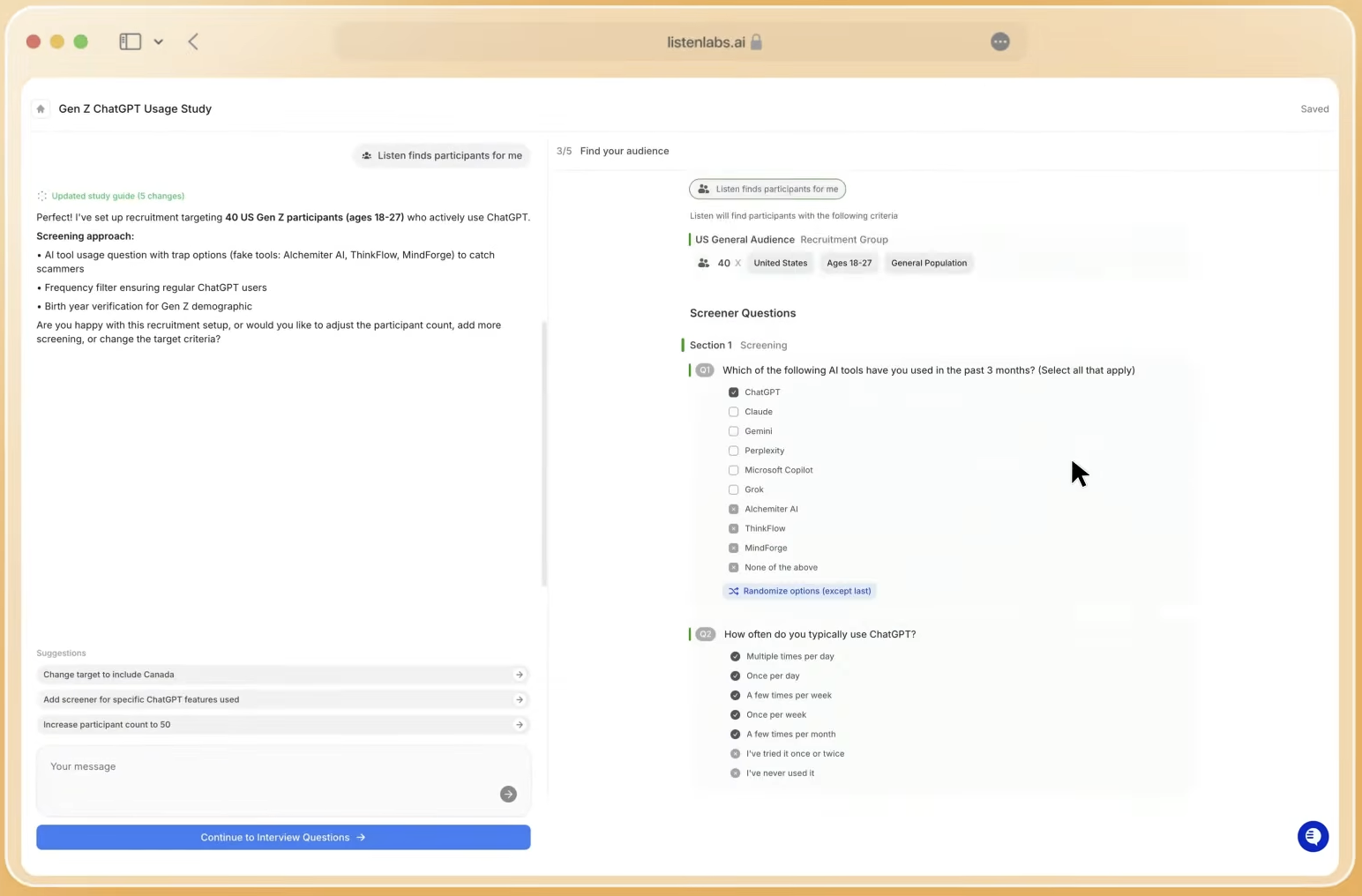
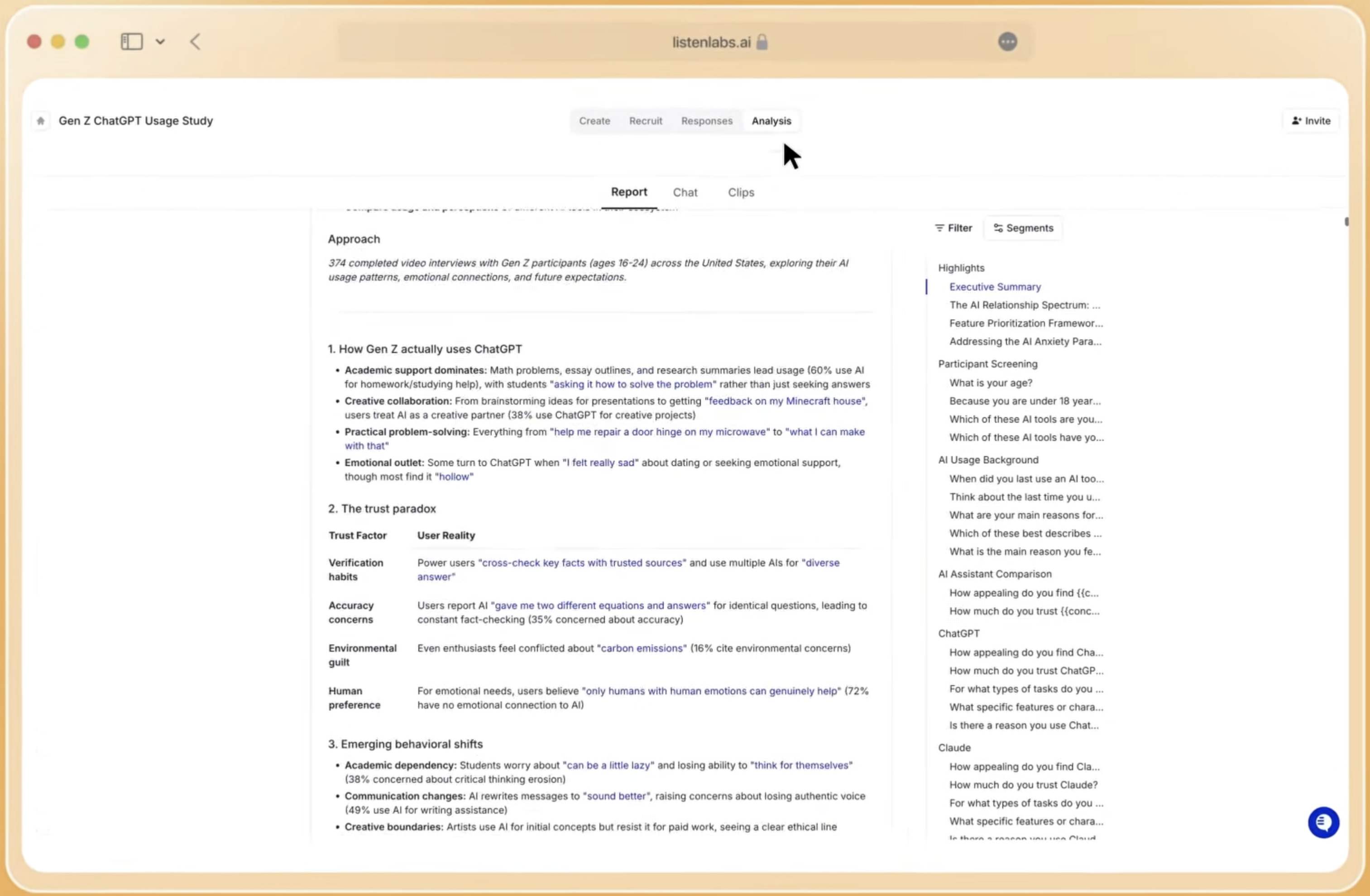
Listen Labs is the end-to-end AI research platform built for this validation layer. It sources the right participants from its 50M+ network, conducts and analyzes thousands of in-depth customer interviews in hours rather than weeks, and delivers consultant-quality reports, slide decks, and video highlight reels. The specific capabilities that map directly to AI brand monitoring validation include:
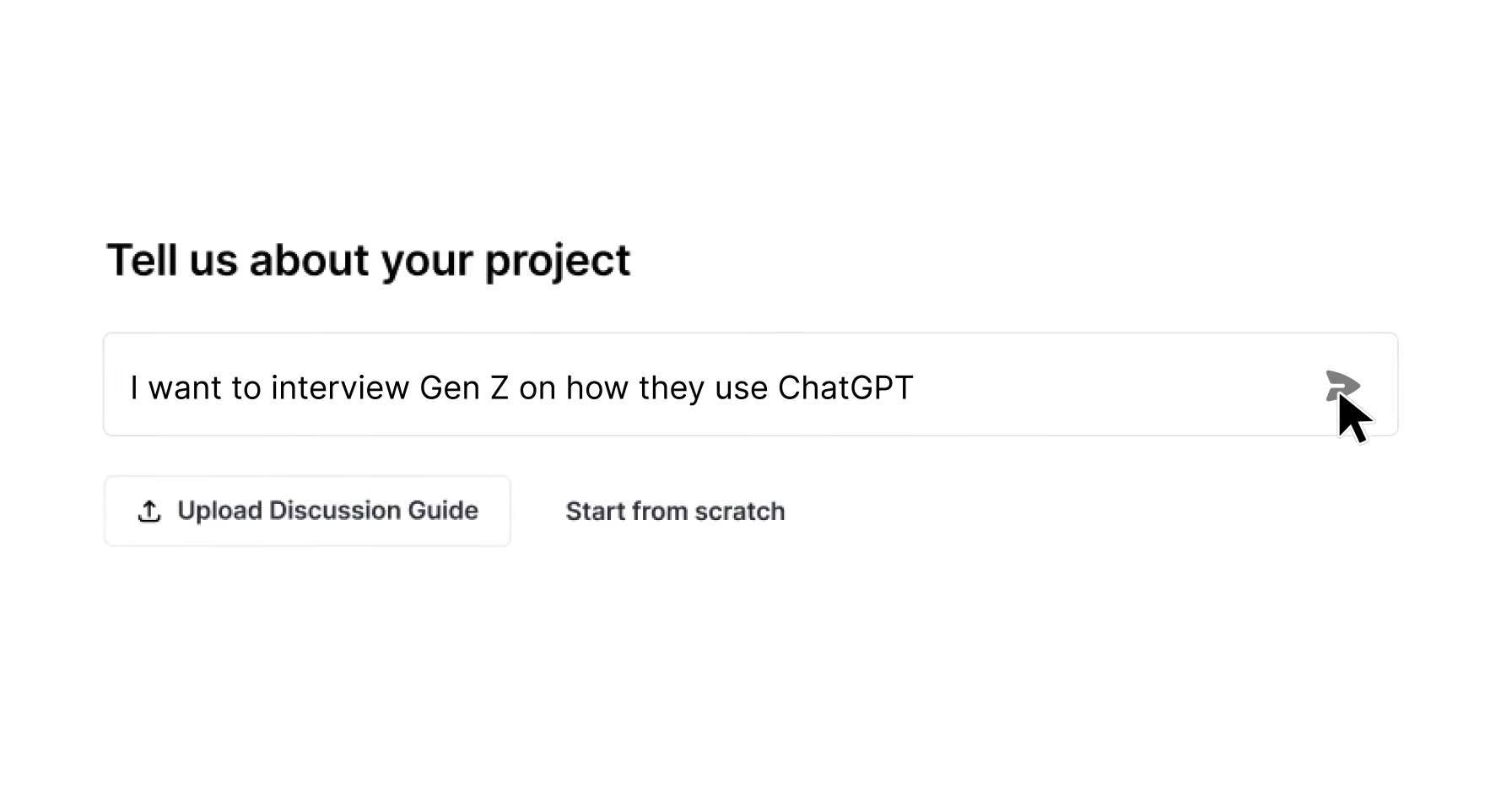
- AI-Moderated Interviews With Dynamic Follow-Ups that probe the exact claims AI engines repeat, the way a trained human interviewer would. Every insight is linked directly to the underlying response data, so validation findings are traceable rather than anecdotal.
- Emotional Intelligence built on Ekman’s universal emotions framework, which analyzes tone of voice, word choice, and subconscious micro expressions to surface emotions that transcripts alone miss. This capability catches the say-do gap that can make AI narratives misleading.
- Visual Insights for observing on-screen behavior in real time. When a participant says they trust your brand but their behavior tells a different story, the AI interviewer catches it and probes the contradiction mid-session.
- Research Library for querying every past study in natural language so validation findings compound rather than expiring with each project.
- Listen Pulse for always-on conversational tracking that charts emerging themes next to the KPIs teams already report. This view surfaces shifts in customer perception before they appear as a decline in tracked metrics.
Listen Labs is trusted by Microsoft, Anthropic, P&G, Skims, Sweetgreen, Robinhood, and Simple Modern, and raised a $69M Series B led by Ribbit Capital in January 2026. Qual-at-scale is ideal when research requires large sample sizes or broad geographic reach because AI tools can engage hundreds or thousands of participants remotely and asynchronously. AI brand monitoring validation often needs this reach to confirm whether an AI narrative holds across segments and markets.
How To Set Up AI Brand Monitoring Alerts: Operating Cadence And Role Ownership
Monitoring without a cadence produces reports nobody acts on. A cadence works only when every layer of the program has a rhythm for when it runs, a decision it is meant to produce, and a named owner accountable for that decision. The sections below define all three for each layer.
Daily Alerts (Owner: SEO Lead Or Brand Lead)
- Monitor for significant shifts in AI answers on your highest-priority prompts.
- Flag any new inaccuracies or negative framings for the weekly review queue.
- Track citation changes on owned pages.
Weekly Review Checklist (Owner: Insights Lead, With SEO And Brand Leads)
- Review flagged inaccuracies from the daily alert queue.
- Run the source-tracing diagnostic on any new negative or inaccurate claims.
- Assign corrective actions with owners and deadlines.
- Check whether previously identified corrections have propagated into AI answers.
- Note any competitor share of voice shifts.
Monthly Strategy Session (Owner: Insights Lead, With Comms And Brand Leads)
- Review the full prompt set across all four engines.
- Update the five core metrics.
- Assess whether validation interviews are needed based on persistent AI narratives.
- Refresh the prompt taxonomy for any product, competitor, or category changes.
- Report movement to stakeholders using process-based success signals rather than invented scores.
A downloadable prompt-list template should accompany this cadence, versioned with a date and a change log so trend lines remain comparable across reporting periods. Platforms like Listen Labs layer on auto-recruiting, transcription, sentiment tagging, and insight summarization so teams jump from question to findings in hours, not weeks. This speed means validation interviews can be completed within the monthly cadence rather than requiring a separate multi-week research cycle.
90-Day Rollout
Days 1–30: Baseline
- Deliverable: Baseline captured across ChatGPT, Gemini, Perplexity, and Claude for the full prompt taxonomy.
- Success signal: Prompt taxonomy versioned, documented, and reviewed by all role owners. Five core metrics recorded for each engine.
Days 31–60: Diagnose
- Deliverable: Source-tracing workflow run at least once on the highest-priority inaccurate or negative claims identified in the baseline.
- Success signal: Named corrective actions assigned to owners with deadlines. At least one source-level fix published.
Days 61–90: Optimize
- Deliverable: Validation interviews completed on the AI narratives that most affect purchase decisions.
- Success signal: Cadence operating with clear role ownership. Stakeholders using monitoring outputs in decisions. At least one AI narrative confirmed or refuted with primary customer research evidence.
Common Challenges And Troubleshooting
- Prompt Sets That Go Stale. Early warning: the same prompts keep returning the same answers even as your product evolves. Cause: the taxonomy was not versioned or refreshed. Fix: assign a quarterly prompt review to the SEO lead with a standing calendar reminder.
- Monitoring That Produces Reports Nobody Acts On. Early warning: weekly reviews happen but corrective actions are never assigned. Cause: no role ownership for source tracing or correction. Fix: assign the source-tracing diagnostic to a named owner before the first weekly review.
- AI Narratives That Turn Out To Be Accurate And Uncomfortable. Early warning: validation interviews confirm the AI’s negative framing. Cause: a real brand experience gap. Fix: route the finding to the product, onboarding, or communications owner rather than treating it as an AI accuracy problem.
- Source Tracing That Dead-Ends In Third-Party Sites You Do Not Control. Early warning: the inaccurate claim traces to a high-authority publication that will not issue a correction. Cause: the brand lacks sufficient independent corroboration to override the source. Fix: earn new coverage from sources with equal or greater authority that contradicts the outdated narrative. Brands appearing in ten or more third-party sources discussing their category see measurably higher citation probability.
- Stakeholder Skepticism About Whether AI Answers Matter. Early warning: leadership asks for proof that AI monitoring affects revenue. Cause: the program is reporting visibility metrics without connecting them to buyer behavior. Fix: run validation interviews that surface how buyers are actually using AI in their research process, and present the findings alongside the monitoring data.
Measuring Success
The indicators that the strategy is working are process-based. They focus on whether the program is operating as designed rather than on numeric targets invented for a slide deck:
- The prompt taxonomy is versioned and reviewed on schedule.
- Source tracing produces named corrective actions rather than just flagged observations.
- Validation interviews confirm or refute AI claims with evidence from real customers.
- Stakeholders use monitoring outputs in decisions about content, messaging, and product.
- The cadence runs without requiring a project manager to chase owners.
Distinguish short-term noise from a durable trend by requiring a minimum observation window before drawing conclusions. 40–60% of cited sources change month-to-month, so a 12-week minimum observation window is required before drawing any trend conclusion. A single week of improved sentiment is an observation. Three consecutive months of improved sentiment across the same prompt set is a trend worth reporting.
Advanced Considerations For Scaling Your Program
Once the baseline cadence is operating and the source-tracing workflow has run at least once, the program is ready to expand. Expansion focuses on closing gaps the baseline cannot cover, such as markets where AI narratives differ, signals that transcripts miss, and shifts that happen between monthly reviews.
- Always-On Conversational Tracking. Listen Pulse runs the same study with the same screeners wave after wave, charts emerging themes next to the KPIs teams already report, and surfaces the shifts forming before they appear as a decline in tracked metrics. Readiness criterion: the monthly cadence is operating with clear role ownership.
- Qual-At-Scale Validation Across Markets. When AI narratives vary by market, validation interviews need to run in each priority market. In 23% of cases the same brand is described positively on one AI engine and with caveats on another. Listen Labs covers 45+ countries and 120+ languages. Readiness criterion: at least one validation study completed in the primary market.
- Multi-Market And Multilingual Monitoring. Expand the prompt taxonomy into additional languages and run baselines in each priority market. Readiness criterion: the English-language program is stable and producing corrective actions.
- Integrating Behavioral And Emotional Signal. Visual Insights and Emotional Intelligence add the layer that transcripts miss, catching the say-do gap in real time and quantifying friction across sessions. Readiness criterion: validation interviews are running on a regular cadence and the team is ready to act on emotional signal as well as stated opinion.
Pilot each expansion in a small phase before scaling. A multi-market rollout that starts with two markets and a 20-prompt taxonomy produces more defensible findings than a 10-market rollout with a 200-prompt taxonomy that nobody has time to analyze.
Frequently Asked Questions
The questions below address the decisions teams most often get wrong when they move from planning to operating an AI brand monitoring program.
How Many Prompts Should You Track In AI Brand Monitoring?
A minimum viable prompt set for a single market uses a focused range of prompts organized by funnel stage and reputation and competitive categories. Serious competitive analysis benefits from a larger set. The prompt set should reflect real buyer language drawn from sales call transcripts, support tickets, review sites, and forum discussions. Version the set from day one and restate the baseline whenever you add or remove prompts, because changing the denominator changes the metric.
Which AI Engines Should You Prioritize?
Start with ChatGPT, Gemini, Perplexity, and Claude. These four engines cover the majority of buyer research behavior across both B2B and B2C contexts. Each has a different retrieval architecture, which means your brand may be described accurately on one and inaccurately on another for the same prompt. Perplexity is retrieval-first and surfaces citations explicitly, making it the most useful engine for source tracing. As of August 2026, OpenAI’s ChatGPT is the larger AI platform by users, having crossed 1 billion weekly active users in July 2026, ahead of Google’s Gemini at 1 billion monthly active users. Gemini has the broadest knowledge graph through Google’s search index. Claude’s share of B2B usage is growing. According to Ramp’s September 2026 AI Index, 43.8% of businesses in Ramp’s dataset transacted with Anthropic in August 2026, up 0.34 percentage points month over month, versus 39.8% for OpenAI. This measures share of Ramp’s own customer base, not US-wide market or revenue share. Track all four from day one rather than optimizing for one engine and expanding later.
How Often Should You Re-Run Baselines?
Run a full baseline monthly across the complete prompt set. Run spot-checks on priority prompts weekly. Re-run a full baseline after any major AI model release because each update can reshuffle citation patterns independently of your content. Re-run after significant product launches, rebrands, or earned media campaigns to create before-and-after comparisons. AI answers are non-deterministic and citation sources change frequently, so a single snapshot is an observation rather than a baseline.
How Do You Trace An AI Claim To Its Source?
Use the four-step diagnostic described in How To Find The Sources Influencing AI Answers About Your Brand. The key addition for teams starting out is to run the same prompt in Perplexity when an engine does not surface citations, since Perplexity’s retrieval-first architecture makes it the most reliable triangulation tool.
How Do You Validate AI Perception With Primary Customer Research?
Extract the specific claims AI engines repeat about your brand, including favorable framings and caveats. Test those exact claims in customer interviews by asking customers to describe your brand in their own words, then probing whether the AI’s framing matches their experience. Avoid leading with the AI’s language. Capture emotional signal alongside stated opinion because what customers say and what they feel are different data points. Compare the interview findings against the AI narrative. Where they align, the AI reflects real perception. Where they diverge, you have either an accuracy problem to correct or a brand experience problem to fix. Listen Labs conducts and analyzes thousands of in-depth customer interviews in hours, with Emotional Intelligence built on Ekman’s universal emotions framework to surface the signal that transcripts alone miss.
Who Should Own The AI Brand Monitoring Program?
The insights lead owns the overall program and the monthly strategy session. The SEO lead owns daily alerts and the prompt taxonomy. The brand lead owns sentiment tracking and corrective messaging. The comms lead owns earned media corrections and third-party source outreach. The source-tracing workflow crosses owned content, third-party coverage, and customer research, so no single role can run the program alone. Assign owners before the first weekly review so the program produces observations that someone acts on.
How Does AI Brand Monitoring Differ From Traditional Brand Tracking And Social Listening?
Traditional brand tracking measures awareness, consideration, and sentiment through surveys run on a wave-based schedule. Social listening monitors mentions across social platforms and news. Neither approach captures what AI engines are saying about your brand to buyers who are actively researching a purchase. AI brand monitoring operates on a different layer. It tracks how AI engines describe, judge, and position your brand in response to buyer-intent prompts, traces those descriptions to their influencing sources, and validates them against primary customer research. AI brand monitoring closes the loop from buyer prompt to AI answer to influencing source to corrective action, which traditional tracking and social listening cannot complete.