
Written by: Anish Rao, Head of Growth, Listen Labs | Last updated: June 17, 2026
Key Takeaways for Enterprise Research Leaders
- Traditional qualitative research cycles of 4–6 weeks create structural delays, so insights often arrive after decisions are already made.
- Enterprise teams need to evaluate AI interview platforms across speed, insight depth, participant quality, emotional signal capture, and total cost of ownership.
- AI platforms like Listen Labs compress research timelines from weeks to under 24 hours while keeping methodological rigor through verified participant networks and real-time fraud protection.
- Emotional intelligence capabilities that analyze tone, micro-expressions, and word choice deliver deeper insights than transcripts alone and improve decision reliability.
- Listen Labs delivers enterprise-grade AI research with verified participants, emotional intelligence, and automated analysis—schedule a tailored platform walkthrough to see how it scales qualitative interviews for your team.
How AI Interview Platforms Protect Panel Quality and Block Fraud
Participant quality directly determines whether research findings can be trusted. Commodity quantitative panels carry well-documented risks such as professional survey-takers focused on incentives, synthetic responses generated by LLMs, and repeat respondents who skew data. These problems compound at scale, so larger samples can mean more fraud contaminating the dataset.
Recruitment-only platforms like Prolific, User Interviews, and Respondent solve sourcing but hand off moderation and analysis to other tools, which creates fragmentation and quality gaps at every handoff. Analysis-only tools like Dovetail do not conduct recruitment at all, so they inherit whatever panel issues occurred upstream.
Listen Labs addresses panel quality through three distinct layers. Listen Labs sources participants from a verified 30M+ global respondent network spanning 45+ countries and explicitly avoids commodity panels prone to professional survey-takers and synthetic responses. The second layer is Quality Guard, which performs continuous real-time behavioral monitoring during AI-moderated video interviews to identify and filter respondent fraud, low-effort answers, and profile mismatches before data enters analysis. The third layer is a hard cap of three studies per participant per month, which reduces panel fatigue and repeat-respondent bias. A dedicated recruitment operations team adds human review for hard-to-reach segments such as enterprise decision-makers, healthcare workers, and audiences below 1% incidence rate.
Listen Atlas, the AI orchestration layer, matches participants on behavioral and intent data rather than self-reported demographics alone, which matters when research outcomes depend on reaching genuinely qualified respondents.
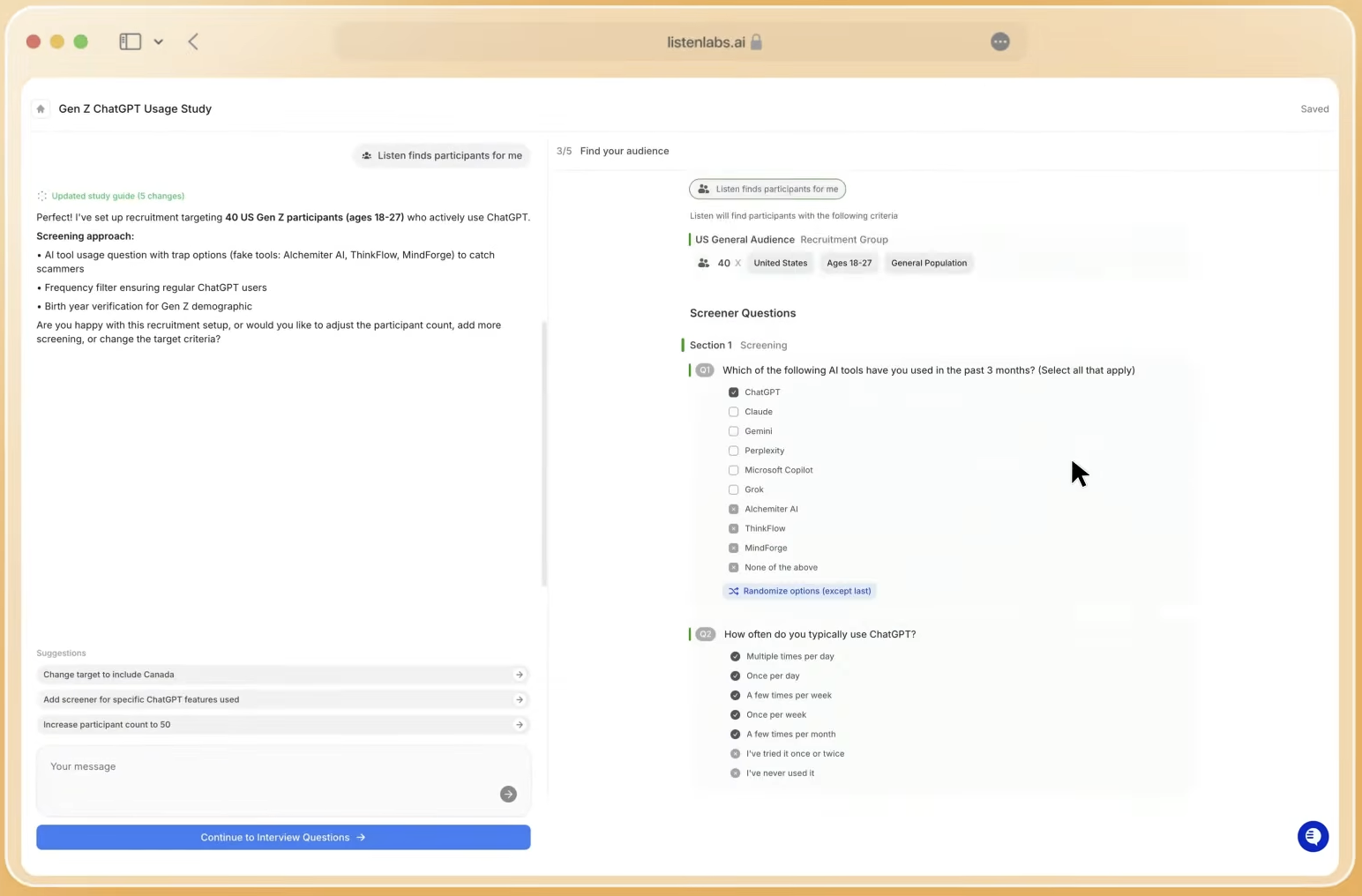
See Quality Guard and Listen Atlas in action to evaluate participant verification against your next study’s requirements.
Real Cost Differences Between Traditional Research and AI Platforms
Total cost of ownership in qualitative research extends far beyond the agency invoice. It includes internal headcount time for study design, recruitment coordination, moderation, transcription, analysis, and report writing, plus the opportunity cost of a 4–6 week delay on a business decision.
Traditional focus groups run $4,000–$12,000 per 90-minute session and take 3–5 weeks to complete. Multiplied across a research program with multiple studies per quarter, the annual spend becomes prohibitive for most teams, even well-funded ones.
End-to-end AI platforms change this economics entirely. A Director of Data Science at Microsoft summarized the shift clearly: “I can reach out to hundreds of users at one third of the cost.” Anthropic’s team used Listen Labs to complete 300+ user interviews in 48 hours, surfacing churn drivers 5x faster than prior methods. Skims validated campaign direction with thousands of high-income buyers overnight, removing weeks of recruiting and panel sourcing.
The hidden cost most teams underestimate is analysis time. Human analysis of qualitative data is slow, subjective, and prone to confirmation bias. Research Agent handles the full analysis workflow from raw data to final output, with one researcher completing a full buying intent analysis across three user segments in under a minute. That compression in analyst time directly reduces headcount cost per study.
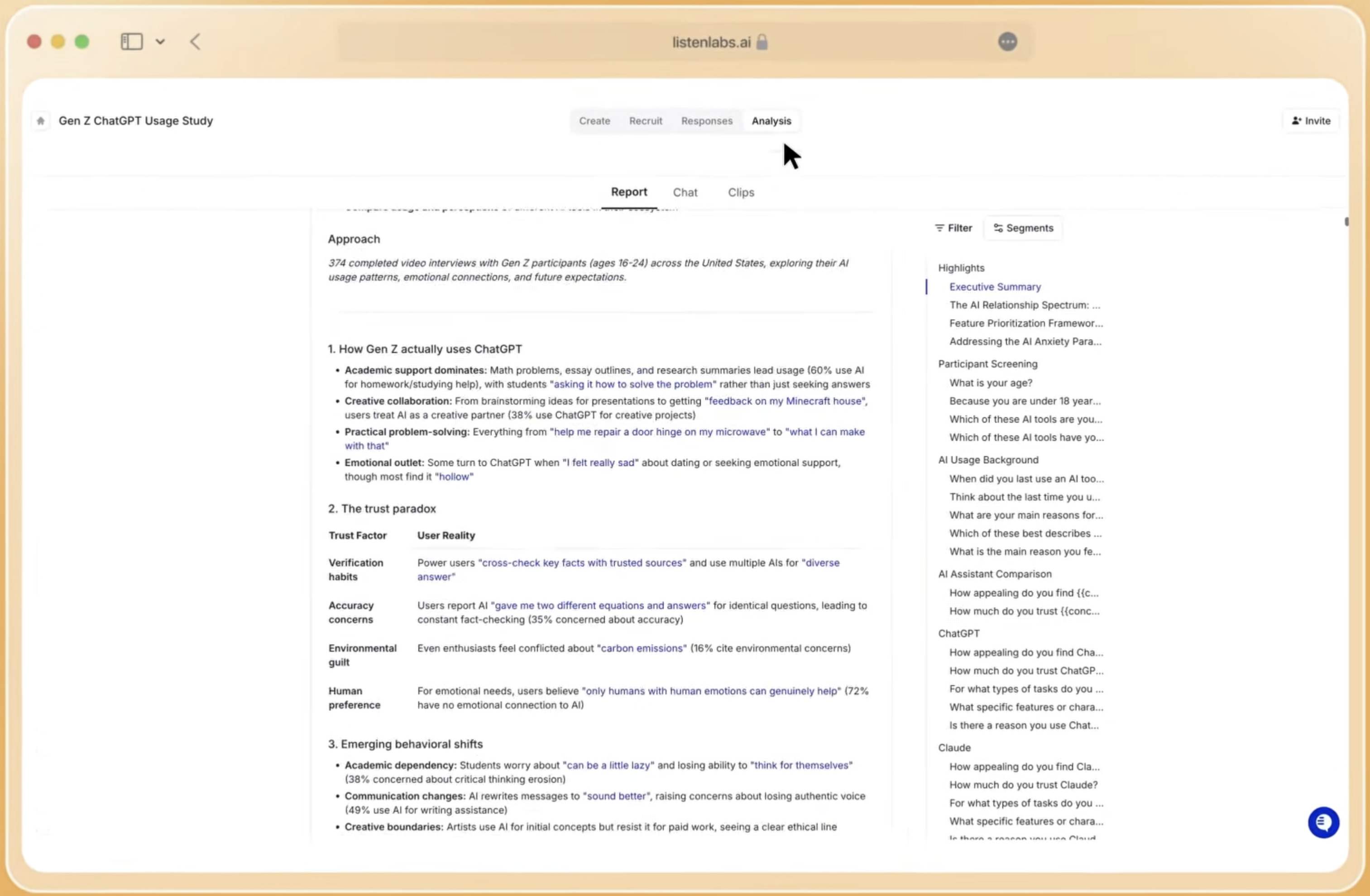
For enterprises running dozens of studies per year, shifting from agency-led research to an AI platform like Listen Labs delivers a structural cost reduction, not just a speed improvement.
How Emotional Intelligence Makes AI Research Insights More Reliable
Most research tools capture what participants say through transcripts, survey responses, and self-reported ratings. These formats reflect conscious, deliberate communication. They miss the emotional responses that participants cannot articulate or choose not to express, such as hesitation before answering, microexpressions of confusion, or vocal tone that contradicts a positive rating.
Listen Labs’ Emotional Intelligence analyzes three signals simultaneously: tone of voice, word choice, and subconscious micro expressions, surfacing nuanced emotions that transcripts alone miss. The framework is built on Ekman’s universal emotions model, the same standard used in clinical psychology and UX research, tracking anger, anticipation, disgust, fear, joy, sadness, trust, and surprise.
Traceability creates the practical advantage. Every emotion is quantified per question and concept, with each label traceable to the exact timestamp, verbatim quote, and AI reasoning behind it. Teams can see not just that happiness was detected, but why it appeared and at which precise moment in the interview. This level of auditability matters for enterprise teams presenting findings to leadership or using research to justify significant investment decisions.
Teams already apply Emotional Intelligence across creative testing, concept comparison, brand research, and usability testing, especially where the gap between stated preference and genuine emotional response carries real risk. Two ad concepts may both receive positive ratings, yet emotional signal capture reveals which one triggers genuine delight versus polite approval.
Emotional Intelligence is available across 50+ languages and integrates directly with Research Agent. Teams can run natural-language queries against emotional data and automatically generate highlight reels featuring the most emotionally significant moments. Given these capabilities, organizations that depend on creative performance, brand health, or product-market fit gain the most from platforms that combine emotional signal capture with automated analysis.
Where AI Customer Research Tools Deliver the Most Value
Enterprise consumer insights leaders managing teams of 5–30 researchers and growing internal backlogs benefit most from end-to-end AI platforms. The core value is multiplying research output without proportional headcount or budget increases. Listen Labs compresses a 4–6 week cycle to under 24 hours, which lets teams fulfill more internal requests per quarter and reduce the backlog that frustrates product and brand stakeholders.
UX research leads at mid-to-large tech companies gain the ability to run 50–100+ participant studies instead of the 5–10 typical of manually scheduled sessions. Screen sharing, mobile screen recording, and usability testing capabilities make Listen Labs well suited to sprint-cycle feedback loops where speed to first insight determines whether research influences a product decision at all.
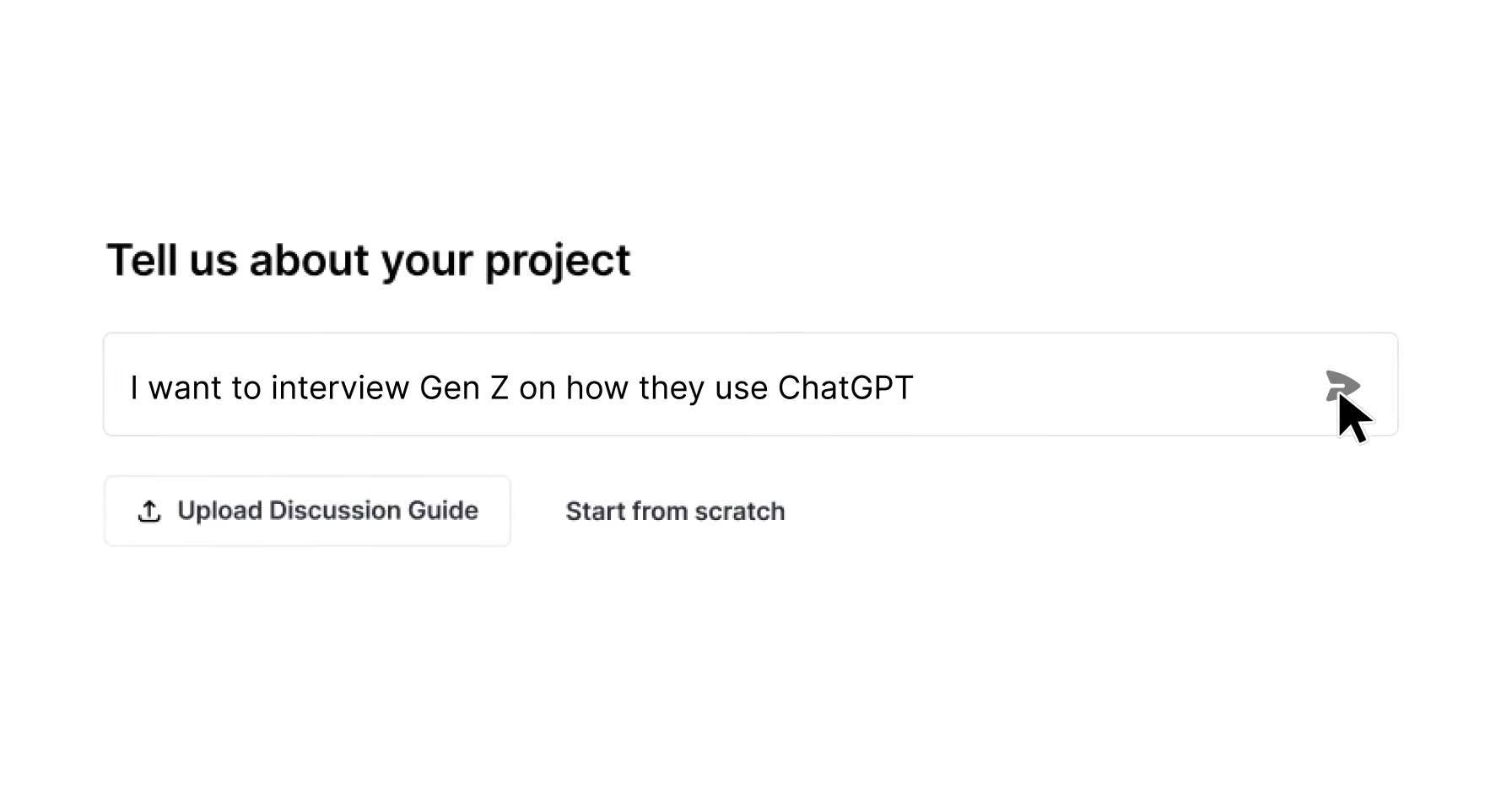
Product managers and marketing leaders without dedicated research teams can describe goals in natural language and let the platform handle study design, recruitment, moderation, and analysis automatically. AI can schedule and conduct the interview, analyze transcripts for themes, and generate quantitative insights from qualitative interviews. This removes the methodology expertise barrier that previously made self-serve research impractical.
Consultancies and agencies running client engagements or investment due diligence on compressed timelines benefit from Listen Labs’ global reach across 45+ countries and the ability to recruit niche audiences such as enterprise decision-makers, engineers, and healthcare workers that commodity panels cannot reliably source.
Operational Risks and Requirements for AI Research Adoption
Enterprise adoption of AI research platforms introduces change management requirements that teams should address before deployment. Research teams accustomed to agency relationships or manual workflows need clear protocols for study design review, quality validation, and stakeholder communication around AI-generated deliverables.
Compliance is a non-negotiable requirement in 2026, particularly because only 21% of leaders have mature AI governance frameworks in place. This governance gap makes third-party certification essential, so enterprise teams evaluating AI market research platforms should confirm SOC 2 Type II, GDPR, and HIPAA compliance at minimum. The urgency increases with the EU AI Act’s transparency provisions taking effect in August 2026, which impose penalties up to €15 million or 3% of global annual turnover for non-compliant high-risk AI systems. Listen Labs holds SOC 2 Type II, GDPR, ISO 27001, ISO 27701, and ISO 42001 certifications, with 256-bit encryption and a policy of never using customer data for AI model training.
Global research programs require platforms with genuine multilingual capability, not translation bolted onto an English-first architecture. Listen Labs supports 100+ languages for interview moderation with automatic translation and transcription, and covers 45+ countries across the Americas, Europe, APAC, and MEA.
The risk of shallow data rises with platforms that use non-adaptive questioning. Static interview scripts miss the follow-up probes that surface unexpected findings. Listen Labs’ AI moderation applies dynamic follow-up questions based on participant responses, mirroring the adaptive logic a trained human interviewer uses, rather than executing a fixed sequence regardless of what the participant says.
General-purpose LLMs do not replace purpose-built research platforms. They lack the proprietary dataset of tens of thousands of completed studies that informs Listen Labs’ question quality, methodology selection, and signal-from-noise separation.
Decision Framework for Selecting an AI Customer Research Platform
A practical evaluation checklist for enterprise buyers should follow a clear progression. Start with architectural completeness. Does the platform handle the full research lifecycle, including design, recruitment, moderation, analysis, and delivery, or does it require stitching together multiple vendors?
Next, assess data integrity, because fragmentation creates quality gaps. Does the platform maintain a verified participant network with real-time fraud controls, or does it rely on commodity panels? After that, evaluate analytical depth. Does it capture emotional and non-verbal signals beyond transcripts, and can teams trace those signals back to specific moments in the interview?
Finally, confirm operational fit. Does the platform support the languages and geographies your research program requires? Does it hold the security certifications your legal and IT teams require? Does it have documented enterprise deployments at Fortune 500 scale that resemble your own use cases?
Listen Labs is the only platform that combines all of these elements in a single stack: over 1 million AI-powered customer interviews completed for enterprises including Microsoft, Perplexity, and Sweetgreen, a large verified participant network with Quality Guard fraud protection, multimodal Emotional Intelligence built on Ekman’s framework, Research Agent automation that generates branded slide decks and stakeholder-ready deliverables, and an in-house research team with 50+ years of combined expertise. Platforms like Listen Labs layer auto-recruiting, transcription, sentiment tagging, and insight summarization so teams move from question to findings in hours, not weeks.
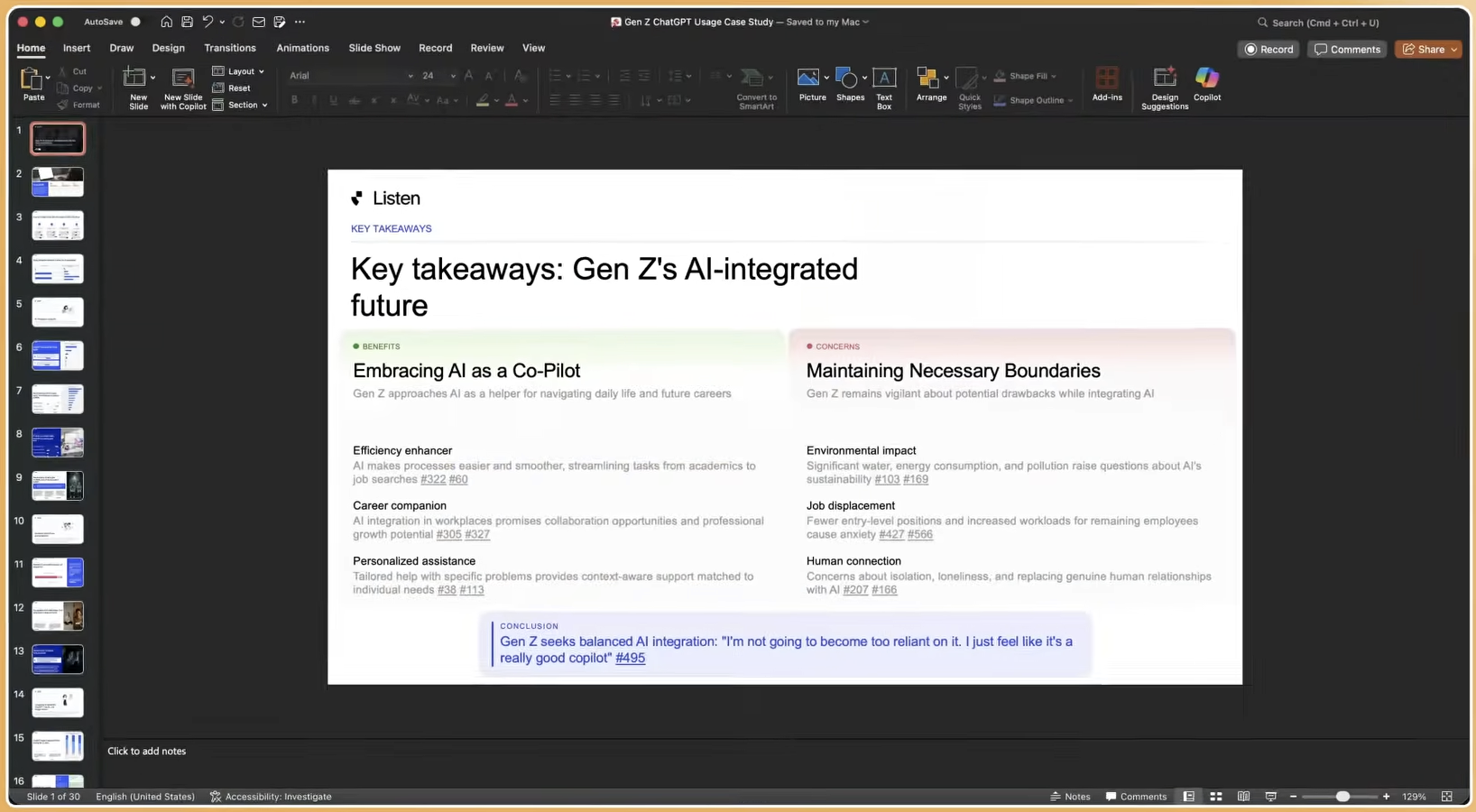
Request an evaluation session to map Listen Labs’ capabilities to your organization’s research standards and governance requirements.
Frequently Asked Questions
How quickly can AI interview platforms deliver results compared with traditional methods?
Traditional qualitative research often takes 4–6 weeks from study design to final report, and in large enterprises with internal prioritization queues, the timeline can extend to six months. End-to-end AI platforms like Listen Labs compress the entire cycle, including study design, recruitment, moderation, analysis, and deliverable generation, to under 24 hours. This shift represents a structural change in how research integrates with business decision-making, so teams can run studies in response to live business questions rather than planning research months in advance.
Where do leading platforms source participants and how do they control quality?
Participant sourcing approaches vary significantly across platforms. Recruitment-only tools like Prolific and User Interviews provide access to panels but do not moderate interviews or control quality during data collection. Commodity quantitative panels carry risks of professional survey-takers, synthetic responses, and repeat respondents. Listen Labs operates a proprietary network of 30 million verified respondents across 45+ countries, with AI orchestration through Listen Atlas matching participants on behavioral and intent signals rather than self-reported demographics. Quality Guard monitors every interview in real time across video, voice, content, and device signals. Participants are capped at three studies per month, and a dedicated recruitment operations team handles niche audiences below 1% incidence rate, including enterprise decision-makers, healthcare workers, and specialized consumer segments.
Which AI research tools support multilingual studies at enterprise scale?
Multilingual capability varies widely. Some platforms offer translation as a post-processing step, which introduces latency and potential accuracy loss. Listen Labs supports 100+ languages for live interview moderation with automatic translation and transcription built into the platform, not added on. Emotional Intelligence is available across 50+ languages. The participant network covers 45+ countries across the Americas, Europe, APAC, and MEA, which enables genuinely global research programs rather than US-centric studies with translated versions.
What security and compliance certifications should enterprises require in 2026?
The minimum baseline for enterprise AI research platforms in 2026 includes SOC 2 Type II, GDPR compliance, and ISO 27001. With the EU AI Act’s high-risk system provisions taking effect in August 2026, platforms processing personal data in research contexts should also hold ISO 27701 (privacy information management) and ISO 42001 (AI management systems) certifications. Enterprises should verify that customer data is not used for AI model training, that encryption meets 256-bit standards, and that the platform supports enterprise SSO. As noted in the operational considerations section, Listen Labs meets these requirements and maintains a policy of never using customer data for model training.
Conclusion: How to Choose an Enterprise-Grade AI Research Partner
The core trade-offs in customer research, such as speed versus depth, scale versus quality, and cost versus rigor, come from fragmented, manual infrastructure rather than from research itself. AI-moderated interview platforms remove many of these constraints. The remaining decision for enterprise buyers is which platform removes the most trade-offs without introducing new risks around participant quality, emotional signal capture, compliance, or analytical depth.
Listen Labs is the only platform that removes these trade-offs across the full research lifecycle, from verified participant sourcing through emotional signal capture to automated analysis, while operating within an enterprise security framework that meets 2026 compliance requirements. Enterprises including Microsoft, Google, Sony, P&G, Anthropic, and Nestlé have already made this shift.
Explore a sub-24-hour pilot study to see how Listen Labs delivers consultant-quality research at enterprise scale.