
Written by: Anish Rao, Head of Growth, Listen Labs | Last updated: July 19, 2026
Enterprise teams comparing AI-moderated interview platforms in 2026 face a high-stakes choice. The right platform must balance participant quality, emotional depth, speed, and enterprise-grade security. This guide compares Outset AI and Listen Labs across the dimensions that matter most for Fortune 500 insights programs and continuous research.
Key Takeaways
- Outset AI offers AI-moderated interviews and automated analysis but relies on third-party panels without native video verification or advanced fraud controls.
- Enterprise teams face limitations with Outset around emotional signal quantification, analysis traceability, and global language coverage beyond 40 languages.
- Listen Labs provides a proprietary 30M-person verified panel, real-time Quality Guard fraud detection, and Ekman-based emotional intelligence across 50+ languages.
- Listen Labs delivers full analysis traceability, consultant-quality deliverables, and Mission Control for cross-study knowledge management under SOC 2 Type II, GDPR, ISO 27001, ISO 27701, and ISO 42001 certifications.
- Enterprise teams using Listen Labs compress 6-week research cycles into under 24 hours with emotionally rich, fraud-controlled interviews at scale.
Outset AI at a Glance
Outset’s core workflow covers study design, AI-moderated interviews across video, voice, or text in more than 40 languages, and basic automated analysis. Its AI moderator can probe up to 10 follow-up questions per topic and uses Visual Intelligence to observe participant screens, prototypes, packaging, or facial reactions.
Outset supports recruitment through integrated third-party panels or customer-provided participant lists. It does not operate a proprietary global recruitment network at enterprise scale, and its emotional intelligence layer, while present through facial reaction observation, does not apply a structured, quantified framework like Ekman’s universal emotions model across every interview. Analysis outputs are automated but lack the cross-study knowledge management and institutional memory features that enterprise teams need for continuous insight programs.
Outset AI Reviews and Real-User Feedback
These structural gaps align with the concerns that practitioners consistently surface when evaluating Outset AI in real-world enterprise contexts. Three themes recur across independent platform reviews and user feedback in 2025 and 2026.
- Panel quality. When teams rely on third-party panels without a proprietary fraud layer, an estimated 30–40% of online survey data is compromised by bots, duplicates, or professional respondents, and AI-moderated platforms that depend on commodity panels inherit that risk.
- Moderation depth. Most AI moderation platforms implement branching logic systems where researchers pre-define question trees, reaching a ceiling of 2–3 levels of probing depth per topic, rather than generating non-deterministic follow-up questions in real time.
- Analysis transparency. Users report that automated summaries can obscure the reasoning behind theme identification, making it difficult to trace a finding back to a specific participant moment, which enterprise stakeholders expect.
Outset AI Limitations in 2026
Four structural limitations define where Outset AI falls short for enterprise-scale consumer insights programs:
- Panel quality and fraud controls. Outset relies on panel pre-screening and AI fraud screening rather than native video verification of participants. Enterprise procurement teams require vetted global panels across 50+ markets with fraud filtering and verification, and pre-screening alone does not meet that bar for high-stakes concept testing or brand research where a single wave of low-quality responses can distort findings.
- Emotional signal capture. Even audio-based AI systems have significant gaps in interpreting emotional subtext such as hesitation in a participant’s voice. Outset’s Visual Intelligence observes facial reactions but does not quantify emotion per question using a validated psychological framework, so emotional data remains observational rather than structured and comparable across studies.
- Analysis transparency and speed. AI-generated analysis outputs must be treated as drafts only, with analysts checking them back against session notes and transcripts to keep findings traceable to evidence. Independent platform evaluations indicate that Outset offers only partial traceability, which increases the internal synthesis burden on research teams.
- Global reach and language support. Outset supports more than 40 languages. Many multinational insights teams now run qualitative studies with native-quality interviews in 95+ languages at price parity with English, and Outset’s 40-language coverage does not reach that threshold.
Outset AI Pricing and Total Cost of Ownership
These capability gaps translate directly into hidden costs that extend beyond platform licensing fees. Outset AI does not publish a detailed public pricing page for enterprise tiers, but the total cost of ownership for any AI-moderated interview platform includes operational expenses that vary based on the limitations described above.
When a platform lacks a proprietary recruitment network, teams must source participants through third-party panel providers, which adds three layers of cost: per-complete fees paid to the panel, internal recruitment operations overhead to coordinate with external vendors, and quality assurance time to verify participant authenticity. While recruitment costs for qualitative studies have decreased substantially between 2022 and 2026 for AI-moderated platforms with integrated recruitment infrastructure, teams using Outset with external panels do not capture that reduction and continue to pay the full stack of third-party sourcing costs. When analysis traceability requires manual verification, analyst time adds a hidden cost that compounds across a high-volume research program.
Outset AI vs Listen Labs: Category-by-Category Comparison
The following six categories highlight where platform differences most affect research quality, speed, and total cost of ownership. Each category reflects a core requirement for enterprise-scale continuous research programs.
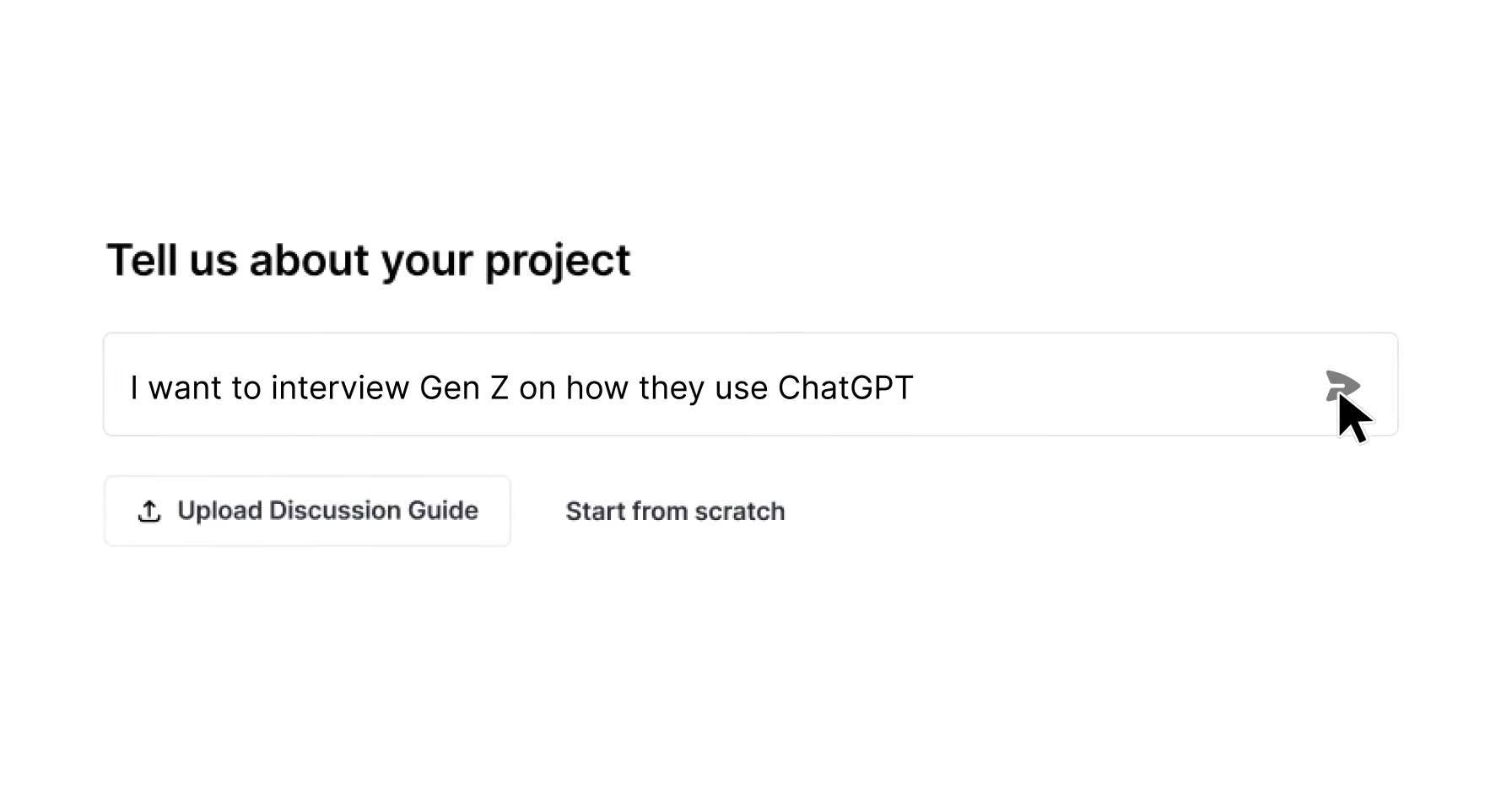
Study setup and design. Both platforms support AI-assisted study design from natural language inputs. Listen Labs adds auto-QA that flags issues in the study guide before launch, version control, and a template library spanning IDIs, ethnography, diary studies, task-based UX testing, and mixed-method designs that combine qualitative questions with Likert scales, NPS, MaxDiff, and sliders in a single study.
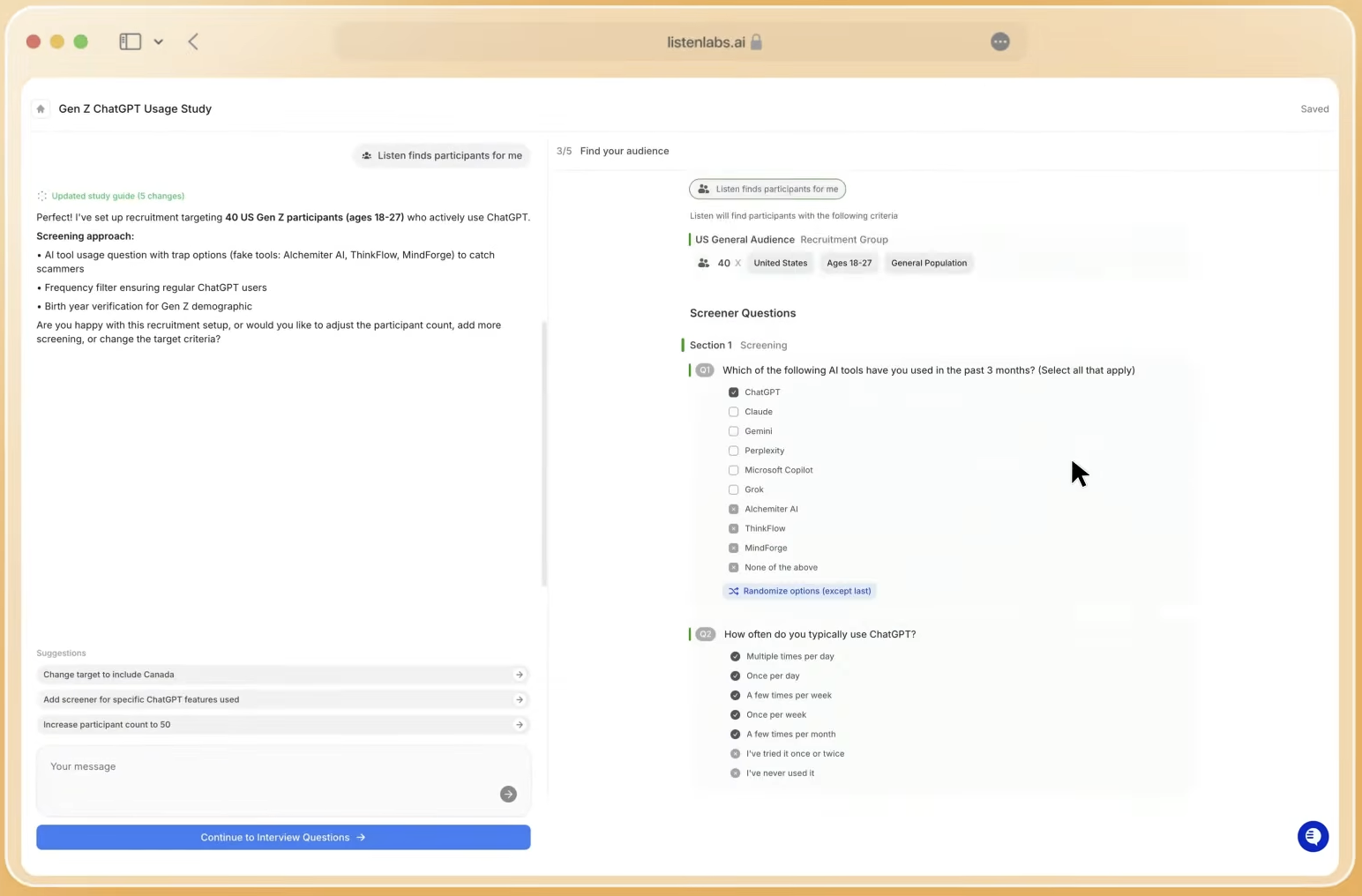
Recruitment and sampling. Listen Labs operates Listen Atlas, a global panel of 30M verified respondents across 45+ countries and 100+ languages, with an AI orchestration layer that automatically matches and bids across multiple consumer and B2B panel partners. A dedicated recruitment operations team handles hard-to-reach segments including enterprise decision-makers, healthcare workers, and audiences below 1% incidence rate. Quality Guard monitors every interview in real time across video, voice, content, and device signals to detect and eliminate fraudulent responses, and participants are capped at three studies per month to eliminate professional survey-takers. Outset supports recruitment through its own panel or customer-provided lists without an equivalent proprietary fraud detection layer or dedicated recruitment operations function.
Moderation approach and emotional intelligence. Listen Labs’ AI moderator conducts adaptive video interviews with dynamic follow-up questions that respond to the actual content of each response. Its Emotional Intelligence layer analyzes three simultaneous signal streams, including tone of voice, word choice, and subconscious micro-expressions, using Ekman’s universal emotions framework, the same standard used in clinical psychology and UX research. Every emotion is quantified per question and concept, and every label is traceable to the exact timestamp, verbatim quote, and reasoning behind it across 50+ languages. Outset’s Visual Intelligence observes facial reactions but does not apply a structured quantified framework or produce per-question emotional scores traceable to source moments.
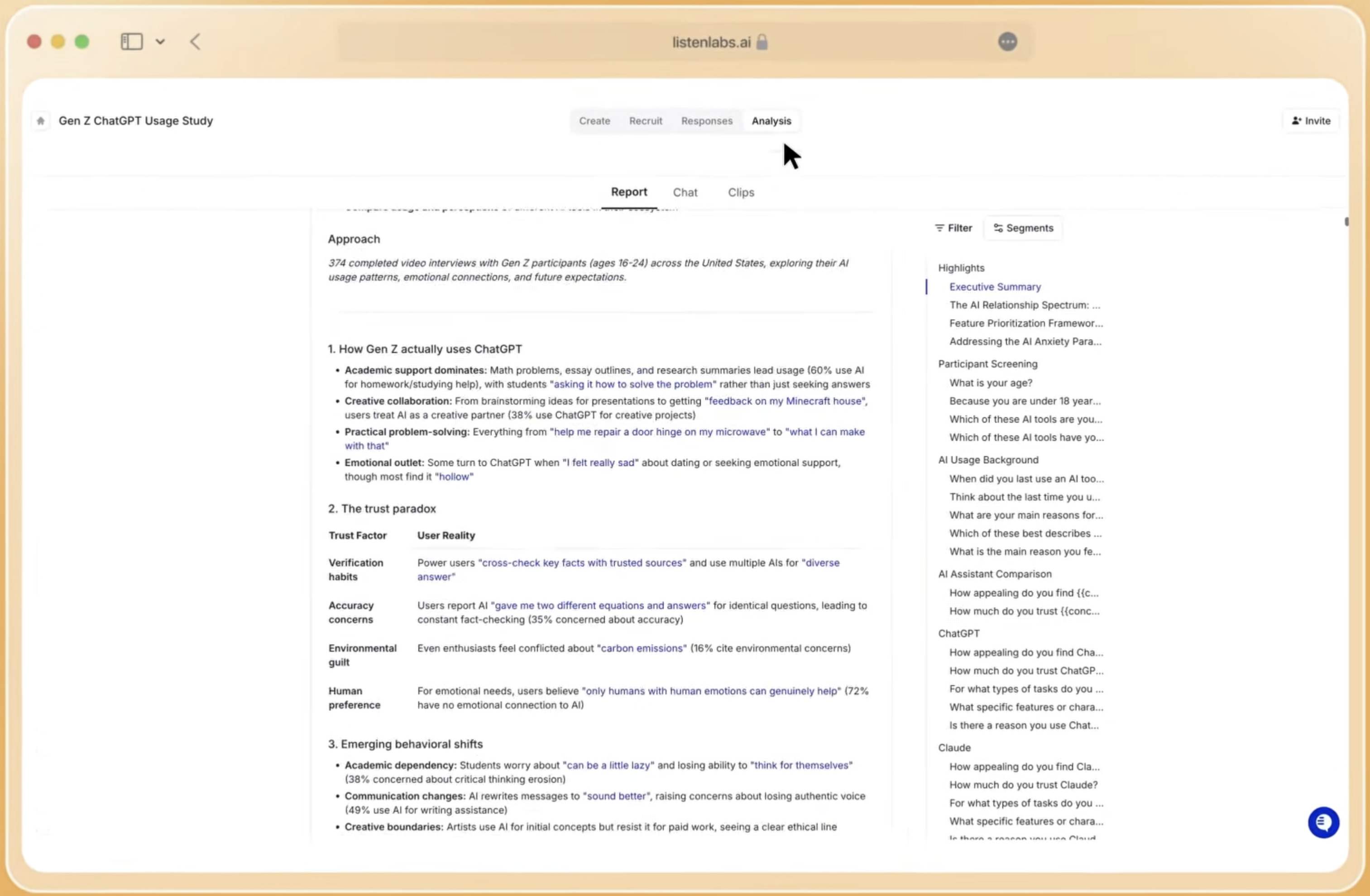
Data quality controls and analysis workflow. Listen Labs’ Research Agent processes interview data to identify patterns, themes, and insights across hundreds of responses, separating signal from noise using proprietary data from tens of thousands of completed studies. Chat-based analysis allows researchers to ask questions in natural language and receive answers, charts, statistical tests, and segmentations. Listen Labs provides full traceability from insights to source responses and uses video-verified participants with real-time Quality Guard fraud monitoring. Outset offers partial traceability without native video verification of participants.
Deliverable creation and cross-study knowledge management. Listen Labs’ Research Agent generates consultant-quality PowerPoint slide decks, memo-style reports, video highlight reels, statistical charts, and custom reports in under a minute. Mission Control serves as the organization’s source of truth for everything learned from customers across all studies, enabling cross-study queries, trend tracking, and institutional knowledge building. Outset does not offer an equivalent cross-study knowledge repository.
Enterprise security and compliance. Listen Labs holds SOC 2 Type II, GDPR, ISO 27001, ISO 27701, and ISO 42001 certifications, supports enterprise SSO, and operates with 256-bit encryption. Customer data is never used for AI model training. Enterprise buyers require explicit written confirmation that respondent data will not be used to train the vendor’s AI models as a non-negotiable data governance condition. Outset holds SOC 2 Type II and GDPR compliance but lacks publicly confirmed EU data hosting and ISO certifications at the same breadth.
Listen Labs Enterprise Proof Points
Microsoft used Listen Labs to collect global customer stories for its 50th anniversary celebration within a single day. The Director of Data Science at Microsoft noted that leadership was thrilled by the speed and scale and highlighted that the team reached hundreds of users at roughly one third of previous costs.
Anthropic’s Claude Code team ran more than 300 user interviews in 48 hours to surface churn drivers, identify where former Claude users migrate, and deliver a prioritized list of 10 must-fix items. The Director of Product Strategy at Anthropic stated that Listen Labs provided a level of clarity and speed on user churn the team had never experienced before.
Procter & Gamble used Listen Labs to evaluate how men respond to new product claims before market launch, delivering more than 250 interviews with quantified themes and verbatim proof in hours. Skims validated campaign direction with thousands of high-income buyers overnight, eliminating weeks of recruiting and securing board-level buy-in. Robinhood’s qualitative interviews revealed that users who view prediction markets as entertainment rather than income drive 2.4x higher weekly re-engagement, with insights delivered 5x faster than traditional methods.
See how Microsoft, P&G, and Anthropic achieve the speed and scale described above using Listen Labs’ end-to-end platform.
Listen Labs Use Cases: When It’s the Right Fit
Listen Labs aligns best with four enterprise research personas, each with distinct requirements that map directly to specific platform capabilities.
- Enterprise consumer insights teams running continuous programs across multiple markets need a platform with a proprietary verified panel, real-time fraud detection, multilingual support across 100+ languages, cross-study knowledge management, and full enterprise security certifications. Listen Labs is purpose-built for this use case.
- UX research leads at mid-to-large tech companies need screen-sharing, usability testing, and the ability to test with 50–100 or more users per study rather than 5–10. Listen Labs supports mobile screen recording on iOS, task-based study designs, and parallel AI-moderated sessions at that scale.
- Non-researcher product managers and brand managers without a dedicated research team need self-serve simplicity where natural language inputs produce a complete study design, recruitment, moderation, and analysis automatically. Listen Labs’ AI-assisted co-design and Research Agent support this persona.
- Agencies and consultancies with client timelines measured in days need global reach, niche audience access, and fast turnaround. Listen Labs’ dedicated recruitment operations team can source audiences below 1% incidence rate across 45+ countries.
Operational Considerations and Change Management
Enterprise adoption of AI-moderated interviews requires planning across compliance, global scaling, and institutional knowledge building. Compliance integration starts with confirming that the vendor’s certifications align with internal security review requirements. SOC 2 Type II is table stakes, while ISO 27001, ISO 27701, and ISO 42001 address information security management, privacy information management, and AI management systems for regulated industries and multinational data governance.
Global scaling depends on native multilingual moderation rather than post-hoc translation. AI systems may approximate surface markers of empathy but currently lack the ability to adaptively recognize emotion and adjust questioning in culturally rooted fashions without language-native moderation. Institutional knowledge building requires a platform that compounds learning across studies rather than treating each project as a standalone deliverable. Mission Control addresses this by enabling cross-study queries and trend tracking over time.
Risks, Limitations, and Common Misconceptions
Four risks apply to AI-moderated interview platforms broadly, including both Outset and Listen Labs:
- Shallow data from rigid methods. Branching-logic AI moderators reach a ceiling of 2–3 levels of probing depth per topic because the question tree was written before the conversation and cannot adapt to each participant’s specific language or unexpected responses. Platforms using genuinely adaptive, non-deterministic probing reach 5–7 levels, and study guide quality still determines output quality regardless of platform.
- Hidden recruitment complexity. AI moderation can amplify sampling bias because the lower marginal cost of interviews tempts teams to talk to whoever clicks the link rather than maintaining rigorous sample-frame discipline. Platforms without proprietary fraud controls and participant frequency limits inherit commodity panel risks.
- Overestimating automation. AI moderation systems do not design studies, determine the right research question or methodology, or account for organizational context and competitive dynamics. Strategic research design remains a human responsibility.
- Faster does not automatically mean better. For the wrong research questions, AI moderation produces faster, cheaper, worse data compared to skilled human moderation. Emotionally sensitive topics, bereavement research, trauma-informed inquiry, and C-suite executive interviews still benefit from human moderators.
Decision Framework: Choosing the Right Platform for Your Research Goals
Use the following seven criteria as a sequential filter to match platform capabilities to your program requirements. If your research program requires capabilities in criteria two through five, those needs will narrow your platform options significantly.
- Sample size per study: Studies requiring 50–2,000 interviews favor AI-moderated platforms. Median qualitative sample sizes for AI-moderated studies have increased substantially since 2022.
- Recruitment source: If your team cannot self-recruit, the platform must provide a verified panel with real-time fraud detection. Evaluate whether the vendor operates a proprietary network or resells commodity panels.
- Emotional signal requirements: If creative testing, concept comparison, or brand research requires emotional data, confirm the platform applies a validated framework such as Ekman with per-question quantification and timestamp-level traceability.
- Compliance requirements: Enterprise security reviews require SOC 2 Type II at minimum. Regulated industries and multinationals should confirm ISO 27001, ISO 27701, ISO 42001, GDPR alignment, and data residency options.
- Cross-study knowledge management: Teams running continuous research programs need a platform that compounds institutional knowledge across studies, not just delivers one-off reports.
- Language and geography: Confirm native moderation language count, not just translation, and panel coverage by country for your target markets.
- Topic sensitivity: For trauma-informed research, bereavement studies, or C-suite executive interviews, human moderation remains the appropriate methodology regardless of platform.
Frequently Asked Questions
How quickly can Listen Labs deliver results compared to Outset AI?
Listen Labs compresses the entire research cycle, including study design, recruitment, AI-moderated interviews, analysis, and deliverables, to less than 24 hours. Traditional qualitative research often takes 4–6 weeks. Outset AI also offers faster turnaround than traditional methods, but without a proprietary 30M-person recruitment network and dedicated recruitment operations team, sourcing participants for niche or hard-to-reach audiences adds time and external vendor coordination that Listen Labs handles internally.
How does Listen Labs source and verify participants?
Listen Labs operates Listen Atlas, a global panel of 30M verified respondents across 45+ countries and 100+ languages. An AI orchestration layer automatically matches and bids on the best participants across multiple consumer and B2B panel partners and Listen Labs’ proprietary database. Quality Guard monitors every interview in real time across video, voice, content, and device signals to detect fraud, low-effort responses, AI-generated scripts, and mismatched profiles. Participants are limited to three studies per month to eliminate professional survey-takers. A dedicated recruitment operations team handles sourcing for audiences below 1% incidence rate, including enterprise decision-makers, engineers, and healthcare workers.
What makes Listen Labs’ emotional intelligence different from basic sentiment analysis?
Listen Labs’ Emotional Intelligence uses the Ekman framework described earlier to track eight emotions, including anger, anticipation, disgust, fear, joy, sadness, trust, and surprise, with three-signal-stream analysis and timestamp-level traceability across 50+ languages. These emotional labels connect directly into the Research Agent for natural-language queries, charts, and highlight reels of emotionally significant moments. Basic sentiment analysis produces positive, negative, or neutral scores without this level of granularity, traceability, or multimodal signal capture.
What security certifications does Listen Labs hold?
Listen Labs holds SOC 2 Type II, GDPR, ISO 27001, ISO 27701, and ISO 42001 certifications. The platform uses 256-bit encryption, supports enterprise SSO, and operates with a strict policy that customer data is never used for AI model training. ISO 27701 covers privacy information management and ISO 42001 covers AI management systems, which address governance requirements for AI-powered research platforms handling sensitive consumer data at enterprise scale.
Can Listen Labs support multilingual research programs across multiple markets simultaneously?
Listen Labs supports more than 100 languages for interview moderation with automatic translation and transcription across all supported languages. Its panel covers 45+ countries across the Americas, Europe, APAC, and MEA. Studies can run simultaneously across multiple markets with native-language AI moderation, enabling global concept testing, brand research, and segmentation studies that would require weeks of coordination through traditional agency models. Emotional Intelligence is available across 50+ languages, so emotional signal capture is not limited to English-language studies.
Explore a walkthrough of Listen Atlas, Emotional Intelligence, and Mission Control in a live session with the Listen Labs team.
Conclusion: The Clear Path Forward for Enterprise Insights Teams
Outset AI functions as a capable first-generation AI interview platform for teams with straightforward recruitment needs, moderate scale requirements, and limited compliance mandates. For enterprise consumer insights leaders, UX research leads, and product teams at Fortune 500 companies, evaluation criteria in 2026 extend beyond basic AI moderation to verified recruitment at scale, real-time fraud detection, quantified emotional intelligence, full analysis traceability, cross-study knowledge management, and a complete enterprise security certification stack.
Listen Labs is the only end-to-end platform that addresses all of those requirements in a single solution, from AI-assisted study design and global recruitment through its 30M-person verified network to adaptive AI-moderated interviews with Ekman-framework emotional intelligence, Research Agent deliverables, and Mission Control institutional knowledge building, all under the certification stack described earlier. The result is the cycle-time compression and quality improvements demonstrated in the proof points above, without sacrificing the depth or stakeholder credibility that enterprise decisions require.
Request a personalized demo to see how Listen Labs removes trade-offs between speed, depth, participant quality, and enterprise compliance in a single platform built for insights teams at scale.