Written by: Anish Rao, Head of Growth, Listen Labs
Key Takeaways
- AI brand monitoring tracks how AI assistants describe, recommend, compare, and cite your brand across ChatGPT, Perplexity, Google AI Overviews, Gemini, and Claude.
- Visibility, position, perception, competitive share, and sources are the five core metrics. Raw mention counts are unreliable because brand mentions disagree across platforms.
- Unbranded category prompts reveal the real visibility gap. Brand homepages appear in only 6% of category prompts that name a sector but no company.
- Citation forensics separates owned from earned sources. Third-party mentions correlate with AI citation at r=0.664, making off-site presence roughly 3× more predictive than backlinks.
- Listen Labs pairs AI brand monitoring with qualitative customer research to explain why metrics move, using AI-moderated interviews and conversational tracking across a 50M+ network.
Talk With Listen Labs About AI Brand Monitoring
What AI Brand Monitoring Actually Measures
AI brand monitoring measures five things: visibility, position, perception, competitive share, and sources. Visibility is whether your brand appears at all in an AI answer. Position is where you appear in a recommendation list. Perception is how the AI describes you. Competitive share is how often you appear relative to named competitors across the same prompts. Sources are which third-party pages the AI cites when it describes you.
Raw mention counts are a weak primary KPI. Brand mentions disagreed 62% of the time across ChatGPT, Claude, and Google AI in a SparkToro and Gumshoe.ai study of 2,961 prompts, and only 17% of queries return the exact same brand set across ChatGPT, Google AI Overviews, and Google AI Mode. A single snapshot misleads teams that want to understand real visibility. Track instead:
- Share of AI answers where your brand appears
- Average position in recommendation lists
- Sentiment and framing of descriptions
- Share of voice versus named competitors
- Which sources AI assistants cite
AI brand monitoring is distinct from traditional brand tracking. Traditional trackers report that awareness or consideration moved. AI brand monitoring shows how AI assistants describe and recommend your brand in the moment a buyer asks, giving you a leading indicator of perception shifts. 57% of AI shoppers bought from a brand they were not considering at the start of their session, which means the AI recommendation layer actively reshapes consideration sets before buyers reach any brand-owned surface.
See How AI Brand Monitoring Connects to Customer Research
How to Build an AI Brand Monitoring Prompt Library
A prompt library is the foundation of your AI brand monitoring program. Start by organizing 50–100 prompts into nine categories: discovery, comparison, recommendation, problem, use-case, trust, pricing, alternatives, and negative. These categories mirror how real buyers ask for help.
- Discovery: “What is the best [category] for [use case]?” / “Which [category] tools should I consider for [need]?”
- Comparison: “[Brand] vs [Competitor] for [need]” / “How does [Brand] compare to [Competitor] on [feature]?”
- Recommendation: “What [category] would you recommend for a [company size] [industry] company?”
- Problem: “How do I solve [specific problem]?” / “What tool helps with [pain point]?”
- Use-case: “Best [category] for [specific use case]” / “What [category] works well for [scenario]?”
- Trust: “Is [Brand] reliable?” / “What do reviews say about [Brand]?”
- Pricing: “How much does [Brand] cost?” / “Is [Brand] worth the price?”
- Alternatives: “What are alternatives to [Brand]?” / “Cheaper options than [Brand]?”
- Negative: “What are the downsides of [Brand]?” / “Why do people leave [Brand]?”
Unbranded prompts matter more than branded ones. Branded prompts tell you what AI says when someone already knows you. Unbranded prompts tell you whether AI recommends you at all. Brand homepages appeared in only 6% of responses to category prompts that named a sector but no company, according to a Citations.press study of 3,850 commercial prompts. That gap shows where you truly stand in category discovery.
Source prompts from real buyer questions so your library reflects what customers actually ask. Use sales call transcripts, support tickets, search queries, and qualitative interview data. Once you have a draft set, log each prompt in a spreadsheet with columns for prompt text, category, AI surface tested, date, brand mentioned (Y/N), position, competitors mentioned, sources cited, and notes. A minimum viable prompt pool requires 100–200 prompts. For enterprise competitive analysis, aim for 250–500.
Build Your Prompt Library With Customer Research Insights
Which AI Surfaces to Monitor and How They Differ
AI brand monitoring works only when you run your prompt library across the major AI surfaces. Monitor ChatGPT, Perplexity, Google AI Overviews and AI Mode, Gemini, and Claude. Each surface behaves differently and pulls from different sources.
ChatGPT defaults to parametric training knowledge for roughly 79% of prompts and triggers a web search only 21% of the time, primarily for queries with commercial or local intent. It builds on the Bing index, so Bing Webmaster Tools access matters. Perplexity performs a live web search for every query and typically cites two to six sources per answer with a 92% citation integration rate. Google AI Overviews influence high-intent Google searchers and are shaped by classic search ranking signals. Around 92% of Google AI Overview citations come from domains already ranking in the organic top 10. Gemini and Claude handle technical, workspace-integrated, and research-heavy queries with distinct citation patterns.
Freshness and access both matter. Google Search Console now reports generative AI performance, and Google’s August 31, 2026 site-owner controls for AI Search features let publishers manage how their content appears in AI Overviews, AI Mode, and generative AI features in Discover. OpenAI’s OAI-SearchBot guidance tells site owners how to ensure their content is accessible to ChatGPT Search. Blocking OAI-SearchBot via robots.txt removes a site from the ChatGPT Search index entirely.
Run a technical accessibility check that covers robots.txt rules, OAI-SearchBot access, and crawlable HTML. If AI assistants cannot access your content, visibility will not improve. Test AI brand visibility weekly for priority prompts, monthly for the full library, and immediately after major launches or PR events. 40–60% of cited sources change month-to-month, which is why a 12-week minimum observation window is required before drawing trend conclusions.
How to Run Citation Forensics
Citation forensics shows which sources actually shape how AI talks about your brand. It is the practice of identifying which sources AI assistants cite when they describe or recommend your brand, and separating owned sources (your site, your docs) from earned sources (Reddit threads, review sites, analyst reports, YouTube transcripts, third-party listicles).
Sector directories accounted for 41% of citations behind AI-generated provider recommendations versus 18% for brand-owned pages, across 3,850 commercial prompts analyzed by Citations.press. Brand-owned pages account for only 5–10% of AI citations across major platforms, with the remaining 90–95% coming from Reddit, Wikipedia, Quora, YouTube, and industry review sites. These numbers show that off-site content usually carries more weight than your own pages.
Use citation forensics to diagnose whether a visibility gap is an authority problem or a content problem:
- Authority play: If AI cites competitors’ pages but not yours, earn third-party mentions, reviews, and analyst coverage. Third-party brand mentions correlate with AI citation at r=0.664, compared with r=0.218 for backlinks. Off-site brand presence is roughly three times more predictive of AI citation than backlinks.
- Content play: If AI cites your pages but frames them poorly, restructure owned pages with extractable definitions, lists, and comparisons. 44.2% of ChatGPT citations come from the first 30% of a page’s text, and AI systems favor self-contained sections in the 120–180 word range.
Also check platform-level citation overlap. Citation overlap between specific major AI platform pairs is often below 15% for example, 11% between ChatGPT and Perplexity and 12% between Google AI Overviews and ChatGPT, though overlap varies by platform pairing. A citation win on one platform rarely transfers automatically to another. Run citation forensics per surface, not as a blended total.
How to Audit Accuracy and Handle AI Hallucinations
Accuracy audits protect buyers from bad information and protect your brand from misplaced blame. Build a must-be-correct fact list that covers founding date, headquarters, pricing, target customer, integrations, limitations, and any regulated claims. The majority of commercially damaging AI brand hallucinations involve five categories: pricing, features and integrations, founding dates, acquisition and ownership, and customer base and use case.
Apply this severity triage framework when a hallucination is detected:
- Critical: Pricing, legal, safety, or competitive claims that could mislead a buyer. Re-test within 48 hours. 58% of shoppers blame the retailer or brand, not the AI tool, when a recommendation contains incorrect product information.
- Moderate: Outdated features or wrong positioning. Re-test within two weeks.
- Low: Tone or framing issues. Re-test at the next monthly review.
When you detect an inaccuracy, first classify its severity. That classification sets how urgently you need to identify the source AI is citing and correct it, either by fixing the source or publishing a corrective owned page. A practical remediation loop is to fix the source content, wait 2–4 weeks for propagation, and then rerun the prompt suite to see whether the hallucination persists. AI engines that retrieve live pages, such as Perplexity, ChatGPT Search, and AI Overviews, can reflect a corrected, recrawled page within days to weeks. Facts baked into static training data may take months.
Audit AI Accuracy With Listen Labs Research Workflows
How to Report AI Brand Monitoring to Executives
Executive reporting should show that AI brand monitoring drives decisions, not just dashboards. Keep the weekly report to one page with three sections: wins, problems, and actions. For the first executive review, lead with a finding that changed a decision rather than walking through the dashboard.
Use a four-week rollout plan that fits into existing headcount by focusing on a lean but complete loop:
- Week 1 — Baseline: Build a focused prompt library across the nine categories. Run a first full test across ChatGPT, Perplexity, Google AI Overviews, Gemini, and Claude. Log results in a standardized spreadsheet.
- Week 2 — Diagnose: Run citation forensics on the highest-impact prompts. Separate owned from earned sources. Flag the clearest authority gaps and content gaps per platform.
- Week 3 — Fix: Publish or correct a short list of priority sources. Earn a targeted set of third-party mentions. Update the most important owned pages with extractable, declarative facts.
- Week 4 — Re-test: Measure movement against the baseline on the same prompt set. Present findings with a single decision-changing insight as the lead.
For AI brand monitoring metrics to report to leadership, track citation rate, share of voice versus named competitors, sentiment score, AI referral traffic, and accuracy rate on must-be-correct facts. Boards asking the right questions track sentiment drift and message pull-through, meaning whether AI is saying what the brand wants it to say and whether that narrative is moving deals forward.
How AI Brand Monitoring Connects to Customer Research
AI brand monitoring highlights where perception shifts, and qualitative research explains why those shifts happen. AI brand monitoring tells you what changed, but not why. A visibility drop, a shift in how AI describes your brand, or a competitor overtaking you in recommendation lists are all symptoms. To explain them, you need qualitative customer research.
When AI starts describing your brand as “expensive” or “for enterprises only,” qualitative interviews with real customers reveal whether that framing reflects lived experience or a stale third-party narrative. The why is what differentiates customer research that is alright from customer research that is outstanding. AI brand monitoring surfaces the signal. Qualitative research delivers the explanation.
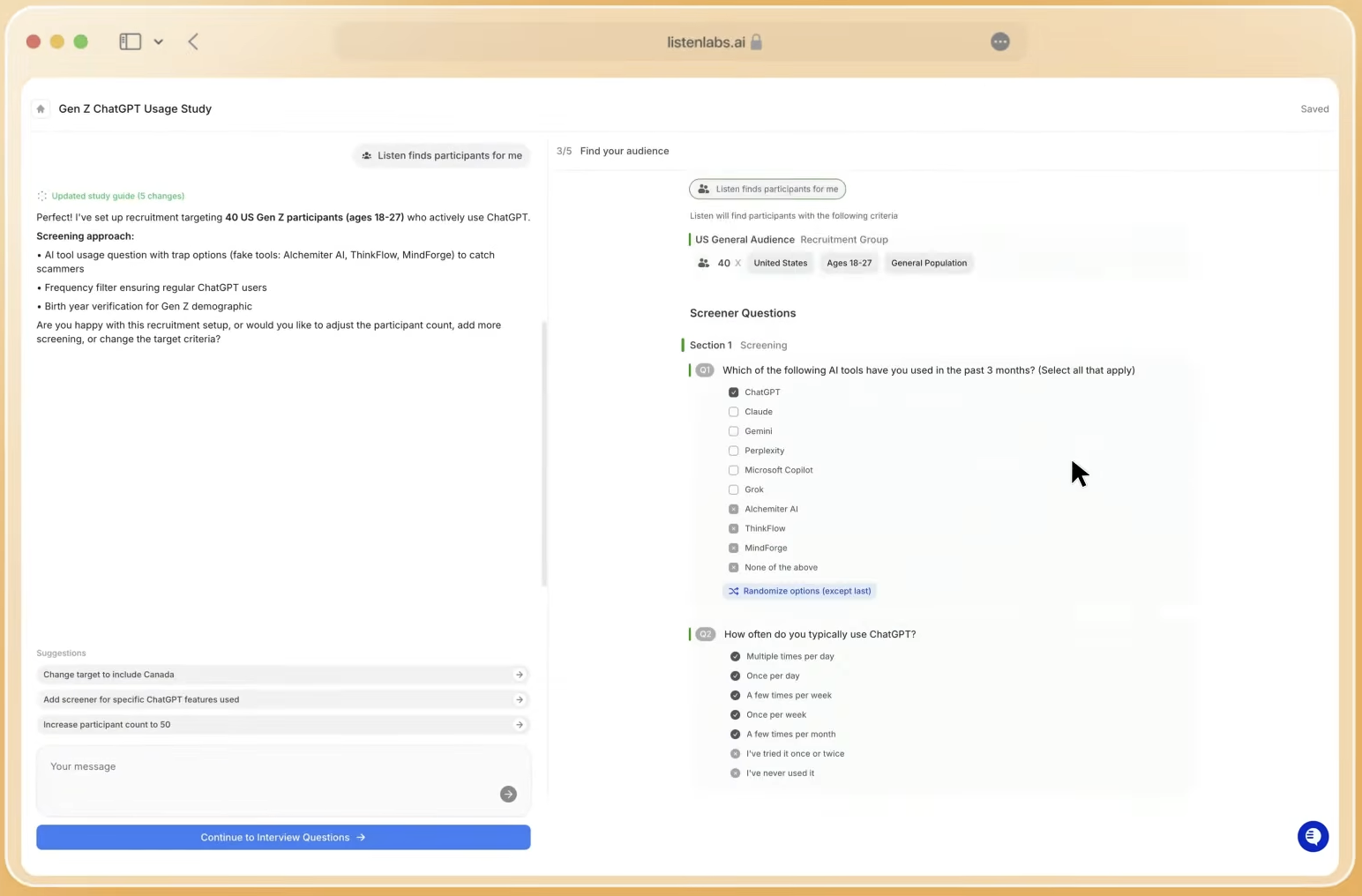
Listen Labs is an end-to-end AI research platform that supports this diagnostic loop. It sources the right participants inside its 50M+ network to conduct, analyze, and summarize thousands of in-depth customer interviews in hours. Specific capabilities that matter for AI brand monitoring programs include:
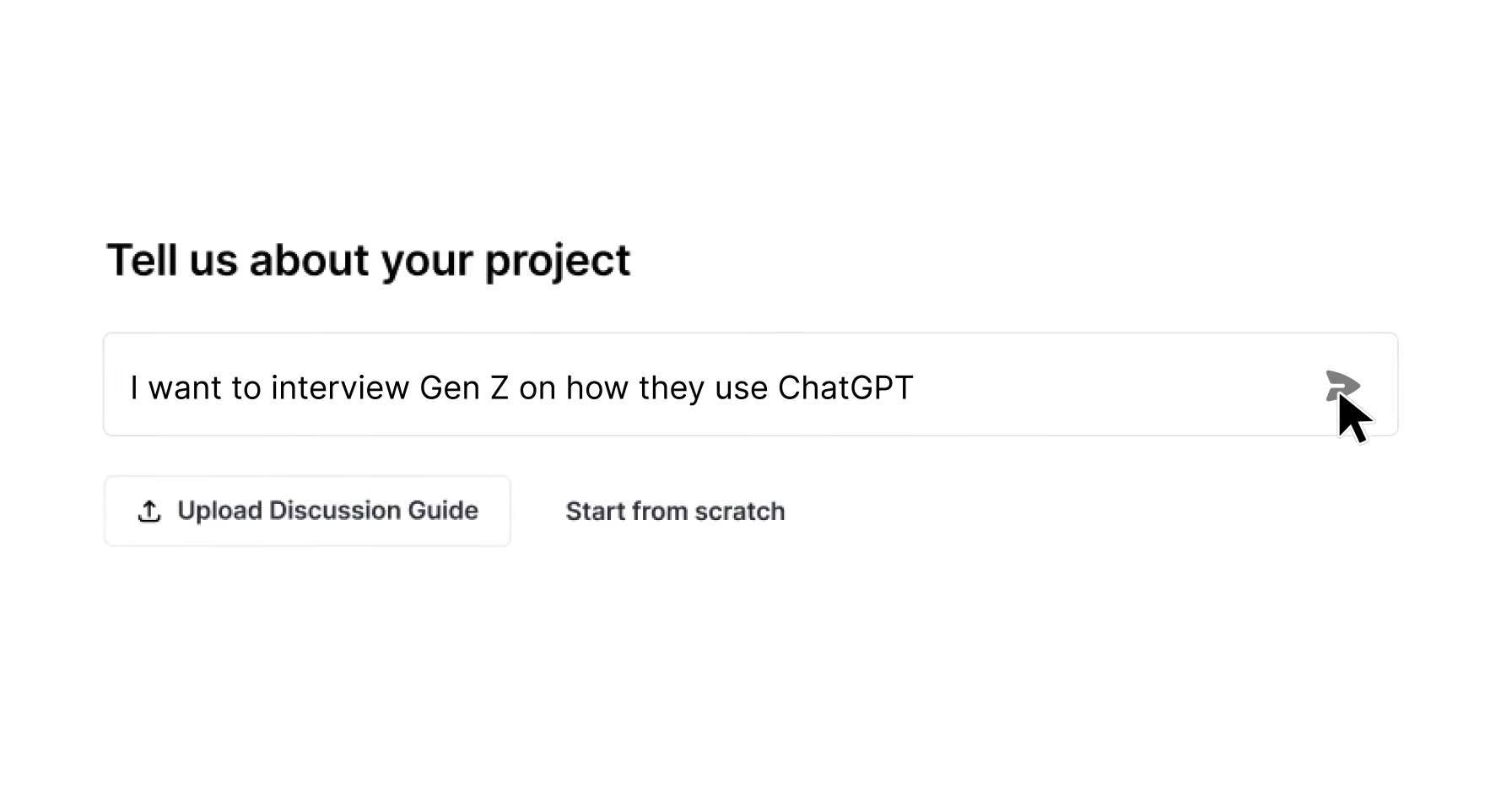
- AI-moderated interviews with dynamic follow-up questions that probe perception shifts in real time
- Global panel of 50M+ verified respondents across 45+ countries and 120+ languages
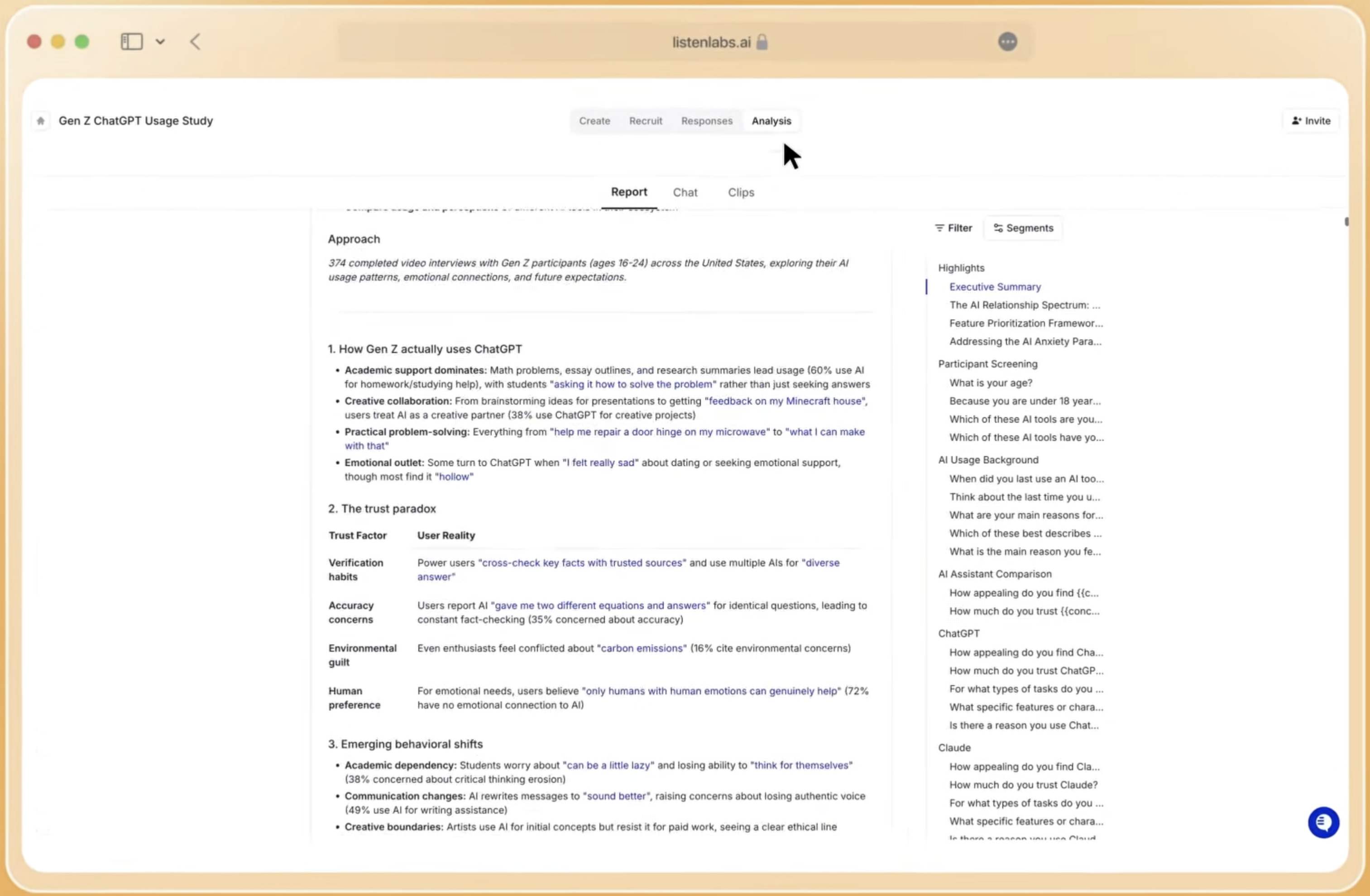
- Emotional Intelligence analysis across 50+ languages, tracking tone of voice, word choice, and subconscious micro expressions to surface emotions that transcripts alone miss, directly applicable to brand research when AI framing shifts
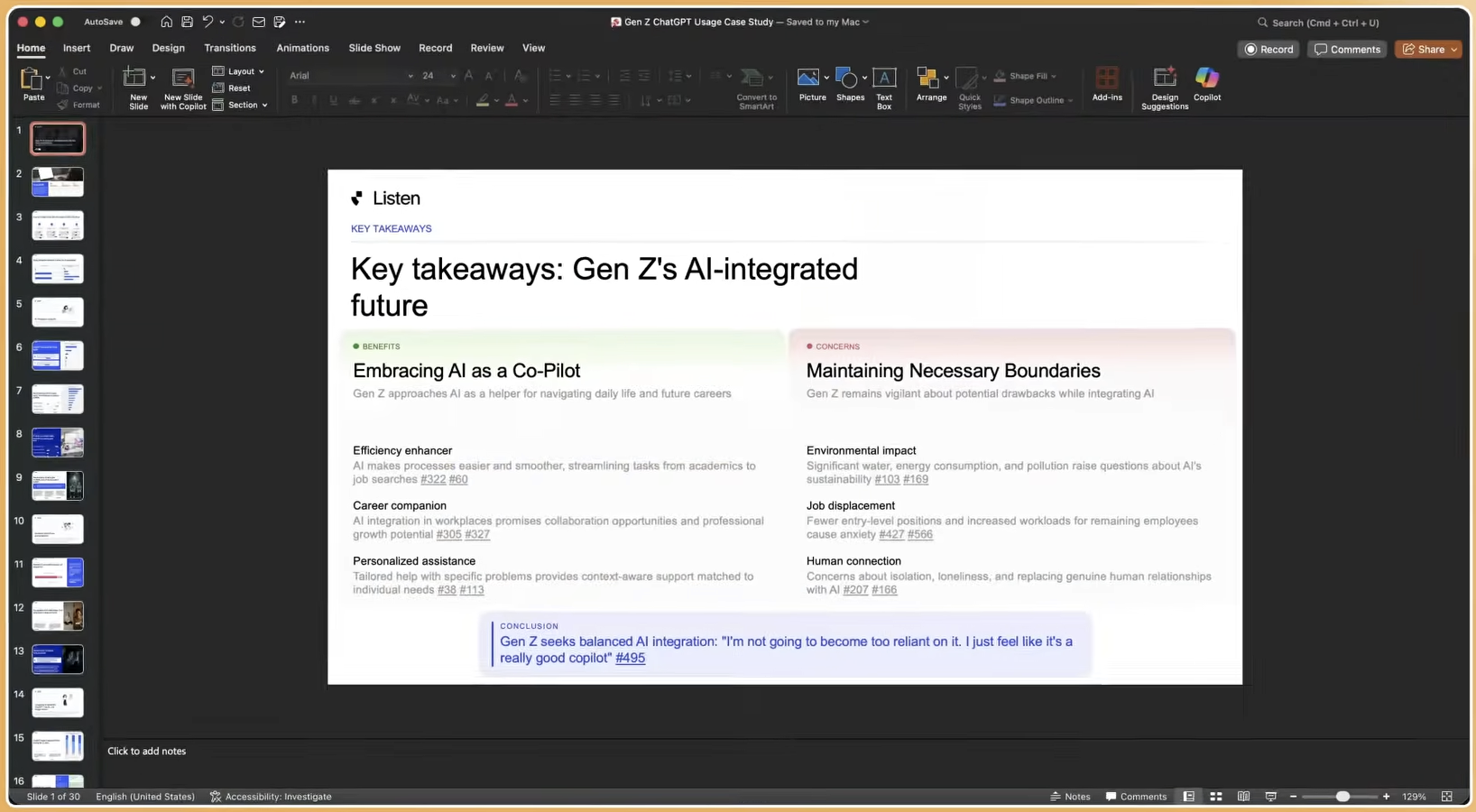
- Research Agent that generates slide decks, memos, and highlight reels in under a minute, with every insight linked directly to the underlying response data
Listen Pulse, the conversational tracker, surfaces emerging themes before they show up in KPIs. AI narratives often shift before traditional brand trackers register a change. Pulse runs the same study wave after wave, understands open-ended answers, sorts them into themes, quantifies them, and charts each theme next to the KPIs teams already report. It integrates with Qualtrics and Decipher and deploys alongside an existing tracker or as the primary tracking system.
Microsoft cut research wait time from weeks to hours and reached hundreds of users at one third of the cost. Anthropic researchers now run 100 studies in the time it previously took to run five or six. Listen Labs serves enterprises including Microsoft, Google, Anthropic, Sony, Sweetgreen, Perplexity, Robinhood, Procter & Gamble, Skims, Levi’s, Boston Consulting Group, and Nestlé, including roughly 15% of the Fortune 100.
Connect AI Brand Monitoring to Customer Research With Listen Labs
AI Brand Monitoring Versus Traditional Brand Tracking
AI brand monitoring and traditional brand tracking answer different questions and work best together. Traditional trackers are wave-based and quant-only. They report that awareness or consideration moved but carry no diagnostic for why. Brand tracking surveys are best run as repeated waves to provide a longitudinal view, but by the time results return the campaign that moved the needle is old news. By the time a KPI declines, the underlying shift has been building for months.
AI brand monitoring captures how AI assistants describe and recommend the brand in the moment a buyer asks, giving teams a leading indicator of narrative change. As AI assistants become a more common starting point for product research, customers’ purchase decisions may increasingly take place before they ever reach a marketplace or brand site.
The two approaches are complementary. Traditional trackers protect the trend line over time. AI brand monitoring catches the narrative shift as it emerges. Qualitative research explains the reasons behind both. Listen Pulse deploys alongside an existing tracker or as the primary tracking system, integrating with Qualtrics and Decipher so teams keep the KPIs they already report while adding the narrative behind them.
See How Listen Pulse Complements Your Brand Tracking
Frequently Asked Questions
What Is AI Brand Monitoring?
AI brand monitoring is the practice of tracking how AI assistants describe, recommend, compare, and cite your brand across ChatGPT, Perplexity, Google AI Overviews, Gemini, and Claude. It measures visibility, position, perception, competitive share, and sources, giving brand leaders a leading indicator of how AI shapes buyer perception in real time.
How Often Should You Test AI Brand Visibility?
Test weekly for priority prompts, monthly for the full library, and immediately after major launches or PR events. AI answers change dynamically with model updates and live web crawling, so a single snapshot does not show the full picture. Use at least a 12-week observation window before drawing trend conclusions because 40–60% of cited sources change month-to-month across major AI platforms.
How Do You Build an AI Brand Monitoring Prompt Library?
Start with 50–100 prompts grouped into discovery, comparison, recommendation, problem, use-case, trust, pricing, alternatives, and negative categories. Source prompts from sales call transcripts, support tickets, search queries, and qualitative interview data. Track prompt text, category, AI surface, date, brand mentioned, position, competitors, sources, and notes in a standardized spreadsheet. Prioritize unbranded category prompts because they reveal whether AI recommends you at all.
How Do You Find Which Sources AI Cites About Your Brand?
Run citation forensics by listing the sources AI assistants cite when they describe or recommend your brand and tagging each as owned or earned. Treat gaps where competitors are cited and you are not as authority opportunities. Treat cases where your pages are cited but framed poorly as content clarity opportunities. Run this analysis separately for each platform because citation overlap between specific major AI platform pairs is often below 15%.
What Do You Do When AI Describes Your Brand Inaccurately?
Respond with a structured workflow. Detect the inaccuracy, classify severity as critical, moderate, or low, identify the source AI is citing, correct the source or publish a corrective owned page, and then re-test on a matching cadence. Critical issues re-test within 48 hours, moderate issues within two weeks, and low-severity issues at the next monthly review. The fix happens in the underlying sources AI retrieves from rather than through a form filed with the model vendor.
Can AI Brand Monitoring Tell You Why Perception Changed?
AI brand monitoring tells you what changed, not why. To explain a visibility drop or a shift in how AI describes your brand, you need qualitative customer research. Listen Labs provides AI-moderated customer interviews and conversational tracking that surface the reasons behind metric movement, including whether a framing shift reflects lived customer experience or a stale third-party narrative that has propagated into AI training data.
How Is AI Brand Monitoring Different From Traditional Brand Tracking?
Traditional trackers are wave-based and quant-only. They report that awareness or consideration moved but do not explain the cause. AI brand monitoring captures how AI assistants describe and recommend the brand in the moment a buyer asks, which provides a leading indicator of narrative change. Traditional trackers protect the trend line, AI brand monitoring catches the narrative shift, and qualitative research explains the why.
Conclusion and Next Steps
AI brand monitoring becomes powerful when you treat it as a full diagnostic loop. The loop is baseline, diagnose, fix, and re-test. The metric tells you what changed. The conversation tells you why.
Build the prompt library this week. Run a baseline across ChatGPT, Perplexity, Google AI Overviews, Gemini, and Claude. Run citation forensics. Pair the findings with qualitative customer research so you can act on what you see.
AI assistants are becoming a primary discovery surface. Brands that pair monitoring with customer research will be the ones that catch narrative shifts before they hit KPIs. Listen Labs is the qualitative research layer that makes AI brand monitoring diagnostic and actionable, with a 50M+ network, AI-moderated interviews, and deliverables in under 24 hours.