
Written by: Anish Rao, Head of Growth, Listen Labs
Key Takeaways
- Scaling brand perception studies with AI works best with a four-layer architecture that combines real respondents, AI-moderated interviews, synthetic exploration, and AI-ecosystem perception.
- Every decision-grade finding must trace back to verified human participants through a calibration layer that validates AI-generated themes against raw verbatims.
- Continuous brand tracking with AI preserves trend-line integrity by keeping core questions stable and adding rotating sections for timely topics.
- AI visibility now functions as a formal brand metric that measures share of recommendation and competitor co-occurrence across ChatGPT, Gemini, Claude, and Perplexity.
- Listen Labs provides the end-to-end platform that makes this four-layer brand perception operating model executable at enterprise scale.
See How Listen Labs Runs AI Brand Research
How AI Scales Brand Perception Research
Continuous brand perception intelligence at enterprise scale relies on a four-layer architecture. The architecture has four layers, each with a defined role and explicit limits, described in detail below.
See The Four-Layer Architecture In Action
The Skill And Knowledge Gap
That architecture sounds straightforward, but most teams cannot execute it today. Brand and insights leaders have heard AI brand perception pitches for years. Vendors promise six-week studies compressed into hours, hundreds of qualitative interviews in parallel, and clear reasoning behind every metric movement.
Most teams lack an operating model that keeps those outputs from collapsing into synthetic-sounding noise that leadership will not trust. Research backlogs grow faster than teams can deliver. Each study still takes four to six weeks, which limits teams to a handful per quarter.
Internal stakeholders in product, brand, and marketing wait months for answers that arrive after decisions are already locked. When AI tools appear without a calibration architecture, findings lose the traceability that makes them defensible in a boardroom.
This article provides a practical operating model for AI brand perception research grounded in accepted research principles. It covers study design, the four-layer architecture, the calibration layer that competitors avoid discussing, continuous brand tracking with AI, and AI-ecosystem perception as a formal brand metric.
Scale AI Brand Perception Research
Who This Guide Is For And Key Terms
This guide serves VP and Director-level Consumer Insights leaders, brand strategists, and research leads at mid-to-large enterprises who are ready to build an operating model for AI research. Several terms appear throughout the guide.
- Calibration layer is a recurring human review process that validates AI-derived themes against raw verbatims and communicates confidence levels to stakeholders.
- Synthetic respondents are AI-generated personas used for hypothesis generation, not evidence. A systematic benchmark by Andrew Gordon and Nora Petrova of Prolific, presented at AAPOR 2026, found fundamental limitations in LLM-based synthetic survey data’s ability to replicate human responses, with consistently high error rates across RMSE and JS Divergence metrics.
- Trend line refers to the longitudinal comparability of a tracker, preserved by keeping core question wording, scales, and panel composition constant wave over wave.
- AI visibility is the formal measurement of what AI assistants say about a brand, including share of recommendation and competitor co-occurrence.
- Panel refers to the verified respondent network from which participants are recruited.
The shift from static quarterly trackers to continuous brand perception intelligence has already started. According to a McKinsey State of Marketing Europe 2026 report, branding ranked as the number-one marketing priority for 2026, yet 82% of companies still conduct brand tracking studies only twice a year, a cadence that makes it nearly impossible to attribute brand changes to specific causes.
Build A Continuous Brand Perception Program
The Four-Layer Architecture
The four-layer architecture forms the spine of a scalable brand perception operating model. Each layer has a defined role, a defined scope, and clear limits on what it can deliver.
Layer 1: Real Respondents. AI-moderated qualitative interviews with verified human participants create the evidence base. Every decision-grade finding that informs a campaign, repositioning, or pricing change must trace back to a real person. Verasight’s Synthetic Sampling Report V (June 2026) explicitly frames AI digital twins as predictions of public opinion rather than measurements, arguing they are only as accurate as the underlying model of the response variable. That framing explains why digital twins cannot carry the evidentiary weight that decision-grade claims require.
Layer 2: AI-Moderated Qualitative Interviews At Scale. With qual-at-scale, the old trade-off between depth and scale no longer applies. Hundreds of parallel adaptive conversations replace the fixed question sets of traditional trackers. This layer delivers depth at scale, while a separate stable core question set preserves the trend line.
Layer 3: Synthetic Exploration. Synthetic respondents work well for early-stage hypothesis generation, such as narrowing twelve concepts to three or thirty message variants to five, before real respondents validate survivors. Strat7’s 2026 study found synthetic surveys had a 47% success rate in accurately tracking changes in numbers between studies, essentially no better than a coin toss, leading researchers to conclude that synthetic augmentation is the wrong tool for tracking. Use synthetic data for screening options, and reserve decision-grade claims for human data.
Layer 4: AI-Ecosystem Perception. What ChatGPT, Gemini, Claude, and Perplexity say about a brand now functions as a measurable perception channel. In May 2026, Google announced that AI Mode had surpassed 1 billion users, with usage doubling every quarter. Brands that ignore this layer miss a growing share of the buyer journey. This layer tracks AI-ecosystem associations and competitor co-occurrence over time while respondent data continues to anchor decision-grade findings.
How To Design An AI-Moderated Brand Perception Interview
Effective AI-moderated brand interviews probe six dimensions: unaided associations, brand personality, differentiation, trust, price-premium, and emotion. The order matters. Unaided associations must come before any brand stimulus appears, or the data becomes contaminated.
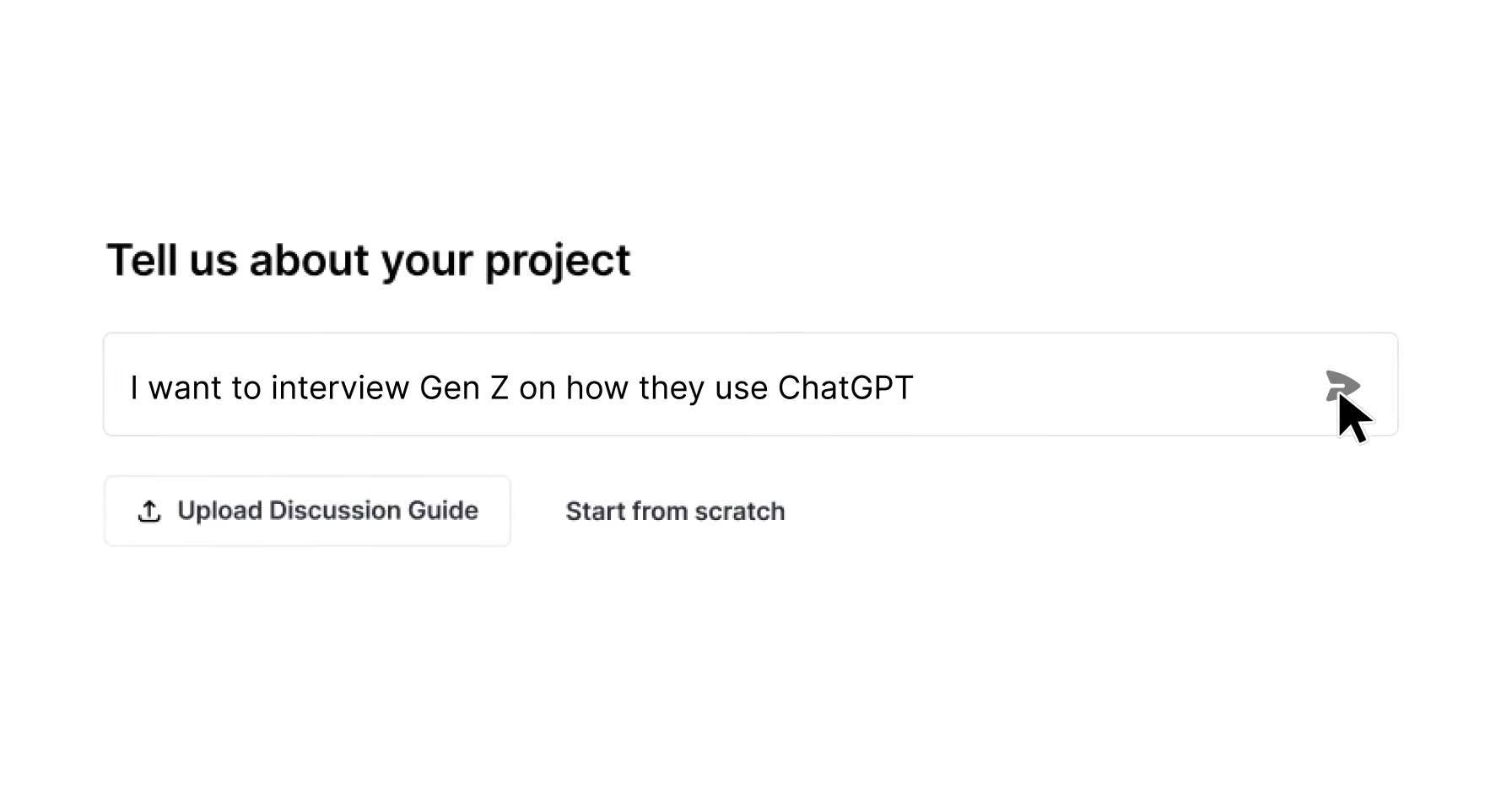
Open-ended probing consistently outperforms 1–5 scales for brand perception work. Scales produce ties and provide no diagnostic for why a number moved. Adaptive follow-ups surface the reasoning behind a perception, including the specific memory, experience, or association that produced the rating. Platforms like Listen Labs layer on auto-recruiting, transcription, sentiment tagging, and insight summarization so teams jump from question to findings in hours, not weeks.
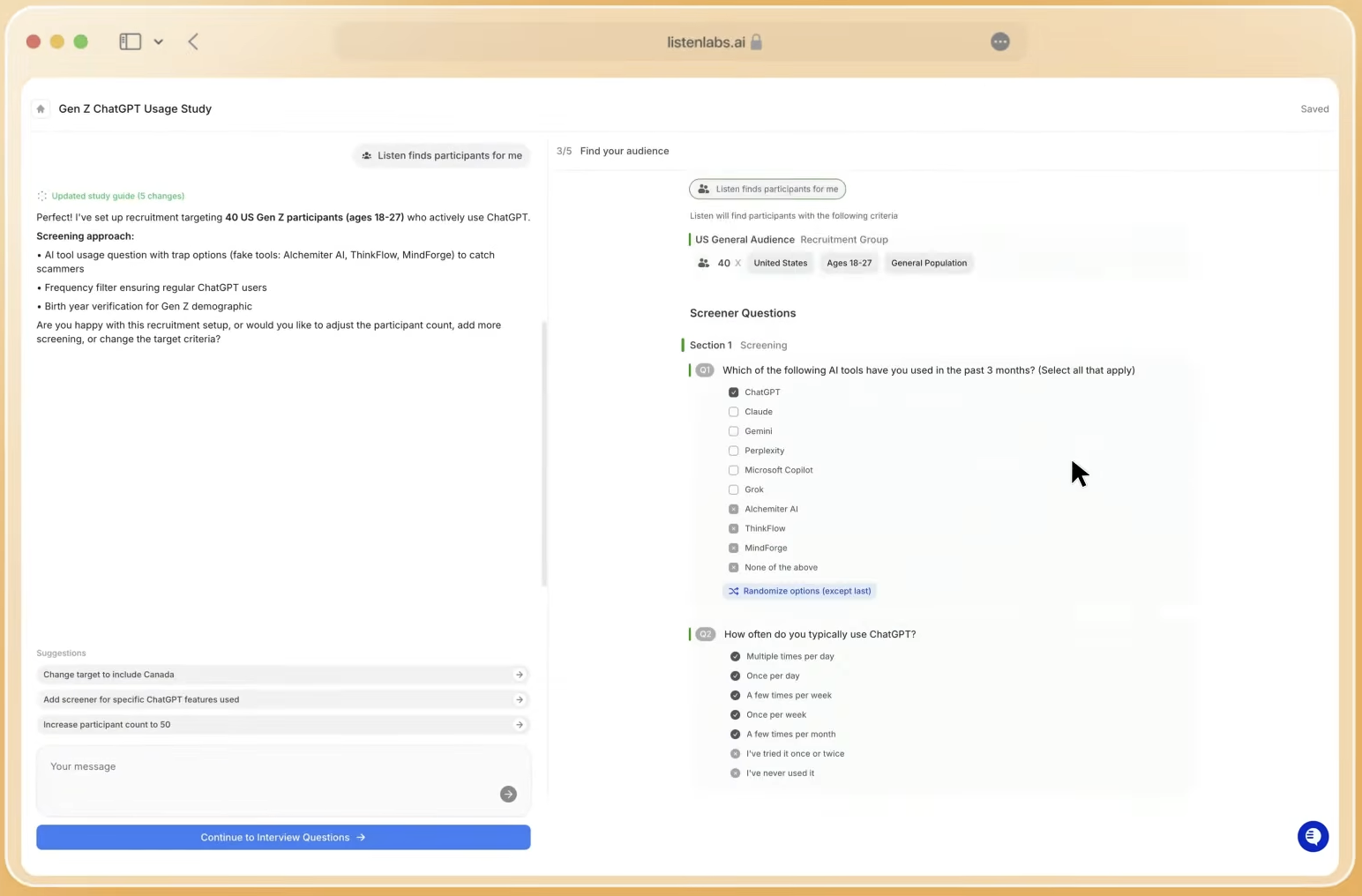
Listen Labs’ AI moderator generates responses three times longer than average through intelligent probing and supports 120+ languages for interview moderation. Emotional Intelligence analyzes tone of voice, word choice, and micro expressions across 50+ languages. It captures what people feel alongside what they say, built on Ekman’s universal emotions framework so every emotional label is traceable to the exact timestamp and verbatim quote behind it.
Switching to Listen Labs AI-moderated interviews let Chubbies capture hundreds of candid, one-to-one conversations overnight, which illustrates the scale advantage of removing the human moderator bottleneck without sacrificing conversational depth.
The Calibration Layer: How To Validate AI-Generated Brand Perception Insights
The calibration layer turns AI-derived themes from assertions into findings. Without it, teams struggle to defend AI outputs. With it, stakeholders can see how each claim connects to human evidence.
A practical calibration architecture has three components: a recurring human panel, traceability to verbatims, and explicit confidence levels. Each appears below.
First, a recurring human panel of 8–12 participants per key segment reviews a sample of AI-generated themes each wave and confirms whether the themes match what they actually said. Entropik’s September 2026 validation guide recommends periodically running parallel human-moderated and AI-moderated rounds on matched cohorts and comparing theme overlap and response depth, establishing a calibration baseline that can be shown to skeptical stakeholders as concrete evidence rather than an assertion defended from memory.
Second, every AI-derived label must be traceable to the exact timestamp, verbatim quote, and reasoning behind it. CleverX’s quality-control guidance warns that AI-generated summaries sometimes misattribute or paraphrase quotes in ways that change meaning, which is why researchers should trace each headline claim back to a specific participant quote before any insight document reaches stakeholders.
Third, confidence levels must be communicated explicitly. The Insights Association’s Code §4.3 requires that no AI system used in research operate exclusively without human judgment embedded in its lifecycle. In practice, humans stay in the loop at study design, screener review, theme validation, and final sign-off before findings reach stakeholders. Research on silicon sampling supports this: grounding synthetic or AI-generated outputs in verified human data, such as interviews or structured surveys, materially improves fidelity compared with demographic-only prompting. Sarstedt et al. (2024) caution that results vary across domains and that silicon samples work best in upstream stages such as qualitative pretesting and pilot studies.
Keeping The Trend Line Clean In Continuous Brand Tracking With AI
Clean continuous brand tracking with AI relies on a two-track instrument design. A stable core question set with identical wording, identical scales, and identical panel quotas runs every wave without modification. Dr. Saeideh Bakhshi, researcher at OpenAI and former methodologist at Meta, states: “The discipline of a tracker is stability. The same instrument, fielded the same way, to a comparable population, with the same mode, at a regular cadence. Every change to any of those is a confound for the trend you’re trying to read.”
Alongside the stable core, a rotating add-on section covers new campaigns, competitor activity, and news events without touching the historical comparability of the core metrics. Brandsand’s July 2026 guide recommends adding a small “flexi-section” of rotating questions to each wave for topical issues while keeping the core questions entirely untouched, giving agility without compromising longitudinal integrity.
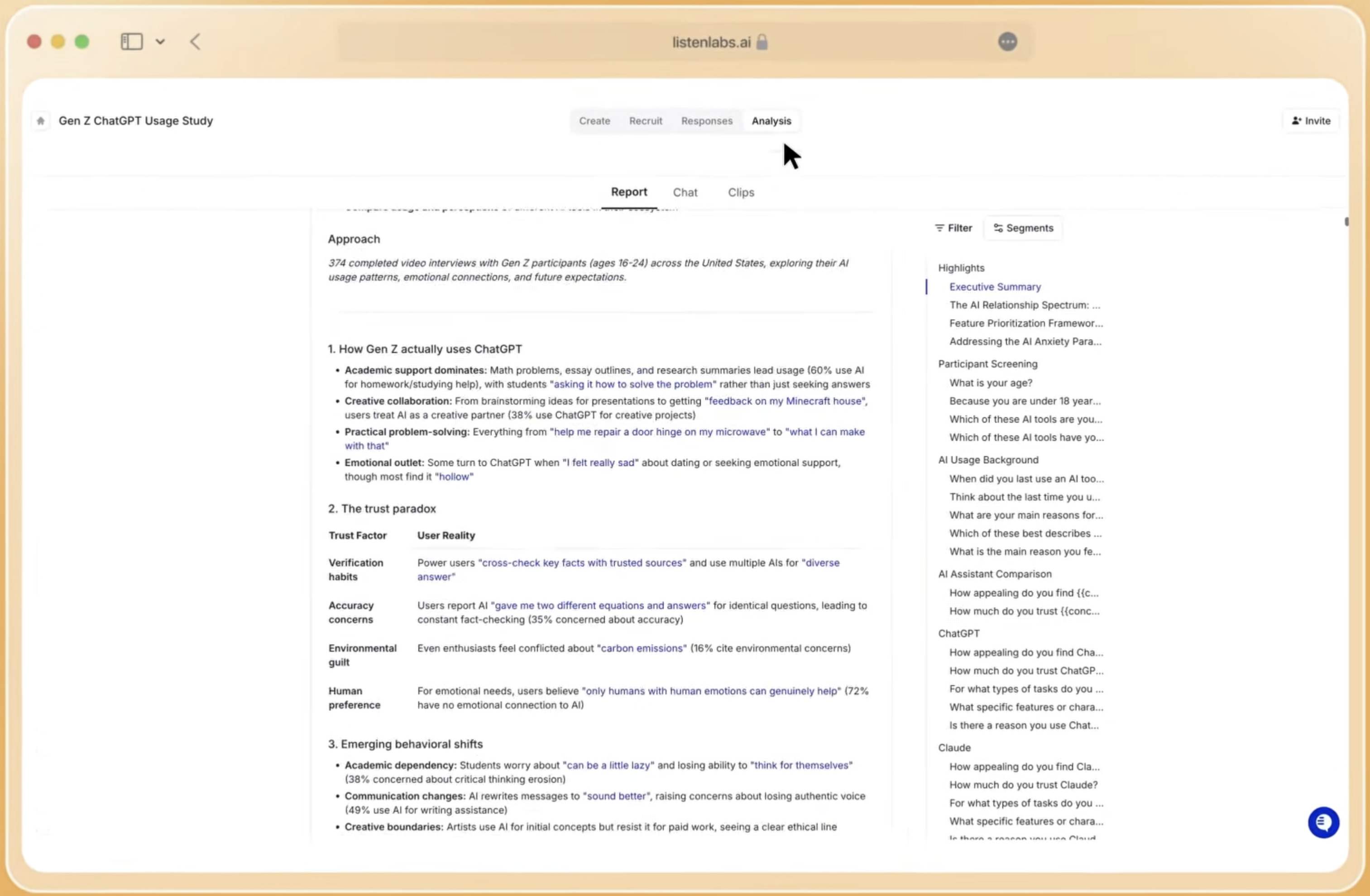
This model differs fundamentally from wave-based trackers that report a number moved but provide no diagnostic for why. Listen Pulse is the conversational tracker that executes this model. It runs the same study with the same screeners wave after wave, understands open-ended answers, sorts them into themes, quantifies them, and charts each theme next to the KPIs teams already report. It integrates with Qualtrics and Decipher, so teams keep the metrics they already report while adding the narrative behind them.
What AI Visibility Is And Why It Matters As A Brand Metric
AI-ecosystem perception functions as the fourth formal data layer in the brand perception operating model. It measures what ChatGPT, Gemini, Claude, and Perplexity say about a brand when buyers ask category questions, and it remains a perception channel most brand trackers still ignore.
The core metrics are share of recommendation, brand associations surfaced in AI-generated answers, and competitor co-occurrence. Share of recommendation captures the percentage of tracked AI answers in which the brand is actively recommended, not merely mentioned. 5WPR’s AI Visibility Index distinguishes Brand Mention Rate, Recommendation Share, Source Citation Rate, Accuracy Rate, Query Coverage Rate, and Cross-Platform Consistency Rate, each answering a different business question.
Measurement requires a fixed prompt panel of buyer-representative questions run across each AI platform on a repeating schedule. Because AI systems are non-deterministic, a single answer tells you nothing; the unit of measurement is the distribution across many repeated runs, reported separately for each platform. Tracking this layer over time reveals whether a brand’s AI-ecosystem associations move in the same direction as its respondent-reported perceptions or diverge.
Measure AI Visibility As A Brand Metric
Transparency And Disclosure
Measuring AI visibility raises a separate question about what teams may do with AI-moderated research and what they must disclose. AI-moderated research requires explicit disclosure at the participant level and at the stakeholder level. The Insights Association’s Code §2.4 requires researchers to notify participants when AI-based avatars or chatbots could be perceived as human, ensuring informed consent in AI-moderated research. Code §4.2 requires that AI-generated data be distinguished from human-derived data, with disclosure of the tool’s purpose, technique, model type, accuracy, and source. EU AI Act Article 50 transparency obligations, effective 2 August 2026, require that providers of AI systems designed to interact directly with people ensure users are informed they are interacting with AI.
Transparency protects both respondent trust and stakeholder confidence in the numbers. Listen Labs never trains its AI models on customer data and holds SOC 2 Type II, ISO 27001, ISO 27701, ISO 42001, and GDPR compliance. That compliance posture makes the disclosure conversation with legal and procurement straightforward.
A Real Enterprise Example Of The Architecture In Practice
To see the four-layer architecture in practice, consider a well-known clothing brand famous for its big logos that was quietly losing customers. Its traditional tracker caught the drop in key brand metrics but could not explain it. The team initially suspected price sensitivity, which seemed reasonable in a tightening consumer environment.
Listen Pulse found the driver was style, not price. A growing group of customers felt the big logos were too loud for their changing lifestyles. The tracker surfaced this perception shift and traced it to a specific driver in the same wave that reported the KPI movement, rather than in a separate qualitative study commissioned weeks later. That diagnostic capability sits at the heart of the four-layer model and lies beyond what wave-based trackers can deliver.
Why Listen Labs
Listen Labs is the end-to-end platform that makes the four-layer brand perception operating model executable. Listen Labs has run over 1 million AI-powered customer interviews for companies including Microsoft, Perplexity, and Sweetgreen. The platform covers 50M+ verified respondents across 45+ countries and 120+ languages, which enables research cycles to compress from four to six weeks to less than 24 hours.
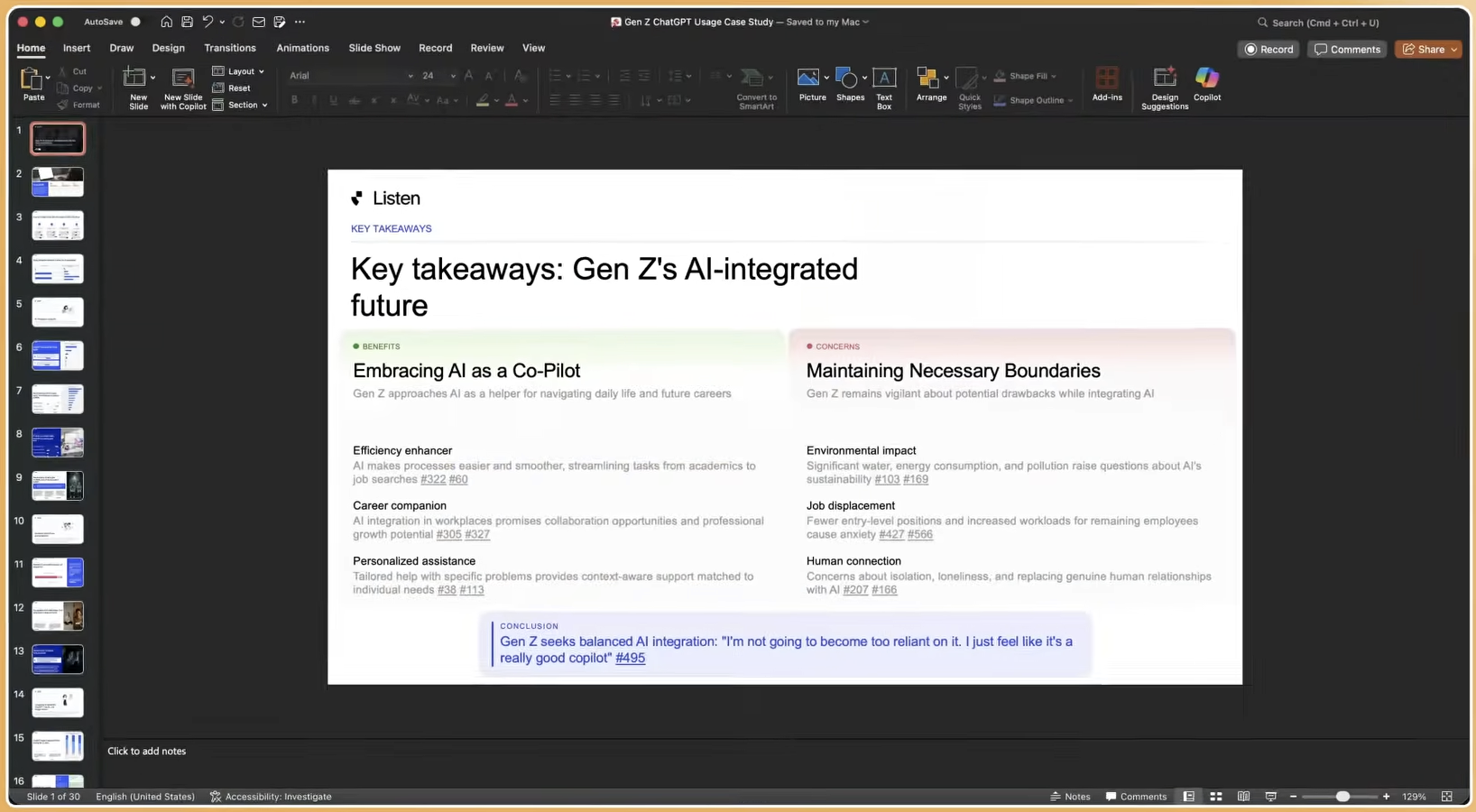
Quality Guard’s real-time fraud detection eliminates the panel quality problems that undermine brand tracker credibility. A three-studies-per-month participant limit prevents panel fatigue from degrading data quality. In January 2026, Listen Labs raised $69 million in a Series B led by Ribbit Capital at a valuation above $500 million.
Talk With Listen Labs About Your Brand Tracker
Common Challenges And Troubleshooting
Several pitfalls appear repeatedly when teams scale brand perception studies with AI. Recognizing them early keeps programs on track.
- Unclear perception dimensions. Studies that do not specify which brand attributes to probe produce unfocused themes that stakeholders cannot act on. Define the six core dimensions of unaided associations, personality, differentiation, trust, price-premium, and emotion before study design begins.
- Poor recruitment fit. A screener that does not match the actual target segment produces data that looks clean but reflects the wrong population. Review screener criteria against the brand’s actual customer definition before fielding.
- Low response quality. Short, generic answers to open-ended questions signal either a screener problem or a question design problem. CleverX’s quality-control guidance specifies that a study where more than 20% of open-ended responses score a 1 (surface, one sentence or fewer) indicates either a participant quality problem or a question design problem.
- Analysis bottlenecks. AI-generated theme clusters that are not validated against raw transcripts before reporting create downstream credibility problems. Build the calibration review into the workflow as a standard step.
- Stakeholder misalignment. Findings that arrive without confidence levels or traceability to verbatims will be challenged. Every reported theme should link to a timestamp and a quote.
- Over-reliance on synthetic respondents. Synthetic data functions as a screening tool rather than an evidence source. A 2026 survey found that 97% of researchers use AI in some workflow, but only 8% trust AI-generated participants for decision-grade calls. Keep synthetic exploration in Layer 3 and real respondents in Layer 1.
Measuring Success
Clear indicators show when a continuous brand perception program is working. Study cycle times consistently fall under 24 hours. Participation and completion rates stay stable across waves. Themes remain consistent wave over wave in ways that reflect genuine market movement rather than methodological noise.
Stakeholders start citing findings in campaign briefs, product decisions, and board presentations. Short-term signals include wave-over-wave theme stability and screener pass rates. Teams should treat early wave-to-wave movement as noise until it persists across multiple waves, because genuine linear trends in noisy data often take time to emerge.
Advanced Considerations And Iteration
Teams that have stabilized the four-layer architecture can extend into always-on research programs, multi-market brand perception studies using the same global respondent pool and language coverage described above, advanced segmentation by behavioral cohort rather than demographics, and emotion analysis at the concept and campaign level using Emotional Intelligence.
Readiness criteria include research operations maturity with a defined owner for each calibration stage, data governance with a documented policy on AI model training and data retention, and cross-functional alignment among brand, insights, and legal on disclosure norms. New capabilities should be piloted in a single market or segment before global rollout, with a bridge wave that overlaps the pilot and the existing tracker to preserve trend-line comparability.
Scale Your Brand Perception Program
Frequently Asked Questions About AI Brand Perception Programs
Can AI Replace Traditional Brand Trackers?
AI-moderated conversational trackers like Listen Pulse can replace wave-based trackers as the primary tracking system or deploy alongside them. The key difference is diagnostic capability. Traditional trackers report that a metric moved. A conversational tracker reports what moved, why it moved, and which respondent segment is driving the shift in the same wave.
The trend line stays intact through consistent core questions, identical scales, and stable panel quotas. Open-ended conversation then adds the context that makes every metric movement interpretable without commissioning a separate qualitative study.
How Do You Validate AI-Generated Brand Insights?
Validation requires four steps. Confirm participant quality and screener compliance. Manually review a sample of transcripts against the AI synthesis. Triangulate emerging themes against at least one other source or method. Obtain explicit human sign-off before findings reach stakeholders.
The depth of validation should scale with decision stakes. A major repositioning warrants a full calibration review, while a routine tracking wave can move faster through the same steps. Validation also relies on traceability to verbatims, as described in the calibration layer.
What Is AI Visibility As A Brand Metric?
AI visibility measures how a brand is represented in AI-generated answers across ChatGPT, Gemini, Claude, and Perplexity. The core metrics are share of recommendation, brand associations surfaced in AI answers, and competitor co-occurrence. Teams track it by running a fixed set of buyer-representative prompts across each platform on a repeating schedule and recording the distribution of results across many runs rather than a single answer.
AI visibility functions as an earned channel that responds to third-party coverage, review platform presence, and content extractability rather than owned-page rankings.
How Do You Keep A Trend Line Clean While Adding Open-Ended AI Conversation?
The answer lies in the same two-track instrument design described in the tracking section. A stable core question set with identical wording, identical scales, and identical panel quotas runs every wave without modification. A rotating add-on section covers timely topics without touching the core.
When a question must change, the old and new versions run in parallel for at least one wave to build a bridge that preserves comparability with the historical time series. Changing question wording, scales, or panel sources mid-program remains the single most common cause of unreliable trend data in brand tracking.
How Do You Handle Niche Or Hard-To-Reach Audiences In Brand Perception Research?
Hard-to-reach audiences such as enterprise decision-makers, healthcare workers, or consumers below 1% incidence rate require a dedicated recruitment operations layer beyond standard panel access. AI orchestration can match and bid across multiple panel partners simultaneously. A human recruitment operations team still needs to source segments that panels cannot fill at volume.
Quality Guard’s behavioral matching on intent and past actions, rather than self-reported demographics, reduces the risk of recruiting participants who pass the screener but do not reflect the actual target segment. Participant frequency limits of no more than three studies per month per participant prevent panel fatigue from degrading data quality in recurring tracking programs.
How Do Legal, Compliance, And Privacy Considerations Affect AI-Moderated Brand Research?
EU AI Act Article 50 transparency obligations, effective 2 August 2026, require that participants be informed they are interacting with an AI system. The Insights Association’s Code §2.4 requires the same disclosure in the participant flow. Consent must cover what will be recorded and how answers will be used.
Data governance requires that AI models not be trained on customer data, a policy Listen Labs maintains as a documented commitment. SOC 2 Type II, ISO 27001, ISO 27701, ISO 42001, and GDPR compliance provide the audit trail that legal and procurement teams require before approving an AI-moderated research program at enterprise scale.
Scale Brand Perception Studies With AI