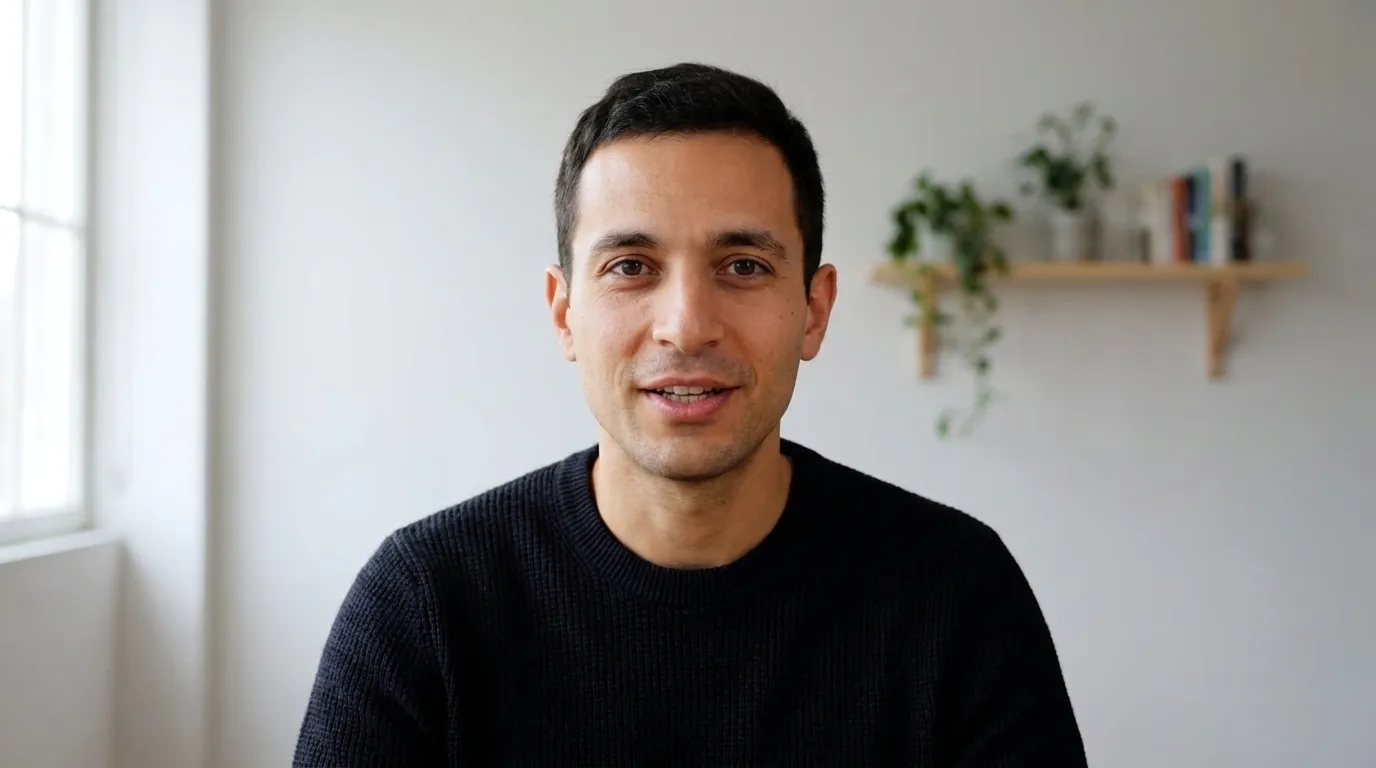
Written by: Anish Rao, Head of Growth, Listen Labs | Last updated: July 19, 2026
Key Takeaways
- AI-powered brand monitoring tracks how LLMs describe brands in generated answers, not just what humans post online.
- Roughly 80% of brands are materially misrepresented by AI models, while 80% of consumers now rely on AI results for at least 40% of their searches.
- Correcting AI misrepresentation depends on verified customer voice at scale, so teams can see where customer beliefs and AI answers diverge.
- Traditional monitoring tools cannot see ephemeral, non-indexed AI outputs or provide the qualitative depth needed to diagnose and fix brand hallucinations.
- Listen Labs supplies verified customer intelligence that lets enterprises find, understand, and correct AI brand misrepresentation at scale. Book a demo to see how.
Where AI Brand Monitoring Starts and Traditional Monitoring Stops
Traditional brand monitoring focuses on human-generated, publicly posted content such as social posts, news articles, forums, and reviews that live at fixed, crawlable URLs. Social listening platforms, media monitoring services, and web mention trackers are built to index and analyze this static layer of the web.
AI-specific monitoring covers a different environment. When someone asks ChatGPT, Gemini, or Perplexity about a product or category, the engine generates a fresh response from training data plus real-time retrieval. These outputs are ephemeral, non-indexed, and invisible to traditional social listening tools that crawl public human-generated content. A brand can be described unfavorably across millions of AI-generated responses without triggering a single alert in a conventional monitoring stack.
The scale of this blind spot becomes clear when examining query volume. Graphite.io’s March 2026 analysis found that AI assistants generate 45 billion sessions per month worldwide, equal to 56% of global search engine volume. Bain & Company reports that 60% of all searches now complete without a click, with zero-click rates rising to 83% for queries that trigger AI Overviews and 93% in Google AI Mode. AI-generated descriptions often become the only touchpoint before a prospect forms an opinion, with no visit to a brand-owned page to correct errors.
Evaluation Criteria for AI Brand Monitoring Platforms
AI-specific brand monitoring platforms must handle probabilistic, non-indexed LLM outputs and deliver enough research depth to correct them. The criteria below work together as a single framework: speed and analysis effort address the probabilistic nature of outputs, depth and sample quality address research rigor, global reach and language support address coverage, and security protects sensitive brand data.
- Speed: How quickly the platform moves from study design to actionable insight.
- Depth: Whether the platform captures motivations, emotions, and context instead of just sentiment flags.
- Sample quality: How rigorously the platform verifies participants and prevents fraud.
- Global reach: Coverage across markets, languages, and audience segments that match the brand footprint.
- Language support: The ability to research and analyze in the languages where AI engines generate brand descriptions.
- Analysis effort: How much synthesis the platform automates for internal teams.
- Security: Enterprise-grade protection, compliance, and guarantees that customer data never trains external models.
How Traditional Monitoring Compares to AI-Specific Needs
On speed, traditional social listening tools excel at near-real-time alerts for human-generated content, such as viral posts or news mentions. That speed does not translate to AI monitoring. LLM responses are non-deterministic and vary by probability, so one-and-done scraping cannot produce accurate brand baselines. Establishing a reliable view of how an AI engine describes a brand requires running each core prompt 60 to 100 times, which social listening architectures were never built to support.
On depth, social listening shows what people say publicly but not why they believe it. Correcting a hallucination, such as a mid-market fintech company seeing Claude list its starting price as $500 per month instead of the actual $299, requires knowing which sources AI engines trust and which customer-facing assets must change. Teams need qualitative depth, not just mention counts.
On sample quality, traditional monitoring indexes everything that is publicly posted, including low-quality forums, incentive-driven reviews, and outdated articles. Half of AI citations come from content less than 13 weeks old, and AI Overview content changes about 70% of the time for the same query, with nearly half of citations replaced when answers update. The sources shaping AI brand descriptions refresh constantly, and their quality directly affects accuracy. Tools that cannot separate high-authority earned media from low-quality community posts cannot direct correction work effectively.
On global reach and language support, only 11% of domains appear in both ChatGPT and Perplexity citations. Each engine draws from distinct source pools. A brand’s German-language presence in Gemini can differ sharply from its English-language presence in ChatGPT. English-centric monitoring tools cannot surface these cross-market gaps or support the multilingual research needed to close them.
On analysis effort and security, traditional platforms provide dashboards of volume and sentiment. They rarely produce structured customer insight such as verbatim quotes, emotional signals, and themes that brand and PR teams can hand to content partners or executives. Enterprise security standards like SOC 2, GDPR, and ISO certifications apply to both categories, yet they matter even more for AI research platforms that handle proprietary perception data.
Key Operational Differences Between Traditional and AI Monitoring
Study setup for traditional monitoring stays passive. Teams define keywords, set alerts, and let the tool crawl existing content. AI-specific monitoring requires active query design because LLM outputs follow probability distributions instead of fixed results. Teams build a prompt library of 50 to more than 200 queries drawn from real buyer language, support tickets, and sales transcripts, then run those prompts repeatedly across engines on a set cadence to reach statistical validity. Each query runs in a fresh session to avoid conversation history contamination, and results are logged with timestamp, platform, model version, and full response text to track drift over time.
Recruitment and moderation barely apply to traditional monitoring, yet they sit at the center of AI-specific brand research. Understanding why customers hold the beliefs that AI engines synthesize requires verified respondents who match real buyer profiles, not generic panelists chasing incentives. In-depth interviews must surface motivations and context, not just top-of-mind opinions.
Data quality in traditional monitoring depends on whatever people choose to post. LLMs synthesize brand views from training data plus live retrieval in RAG-enabled systems, so third-party sources such as analyst reports, review platforms, and editorial coverage often outweigh a brand’s own site. Monitoring tools that cannot trace which third-party sources drive AI descriptions cannot support precise correction strategies.
Qualitative depth is largely missing from traditional outputs. Mention counts and sentiment scores do not explain the gap between customer beliefs and AI answers. With zero-click rates this high, AI-generated descriptions increasingly become the only brand touchpoint in a research session. Closing the gap between AI output and brand truth requires rich customer voice from in-depth interviews.
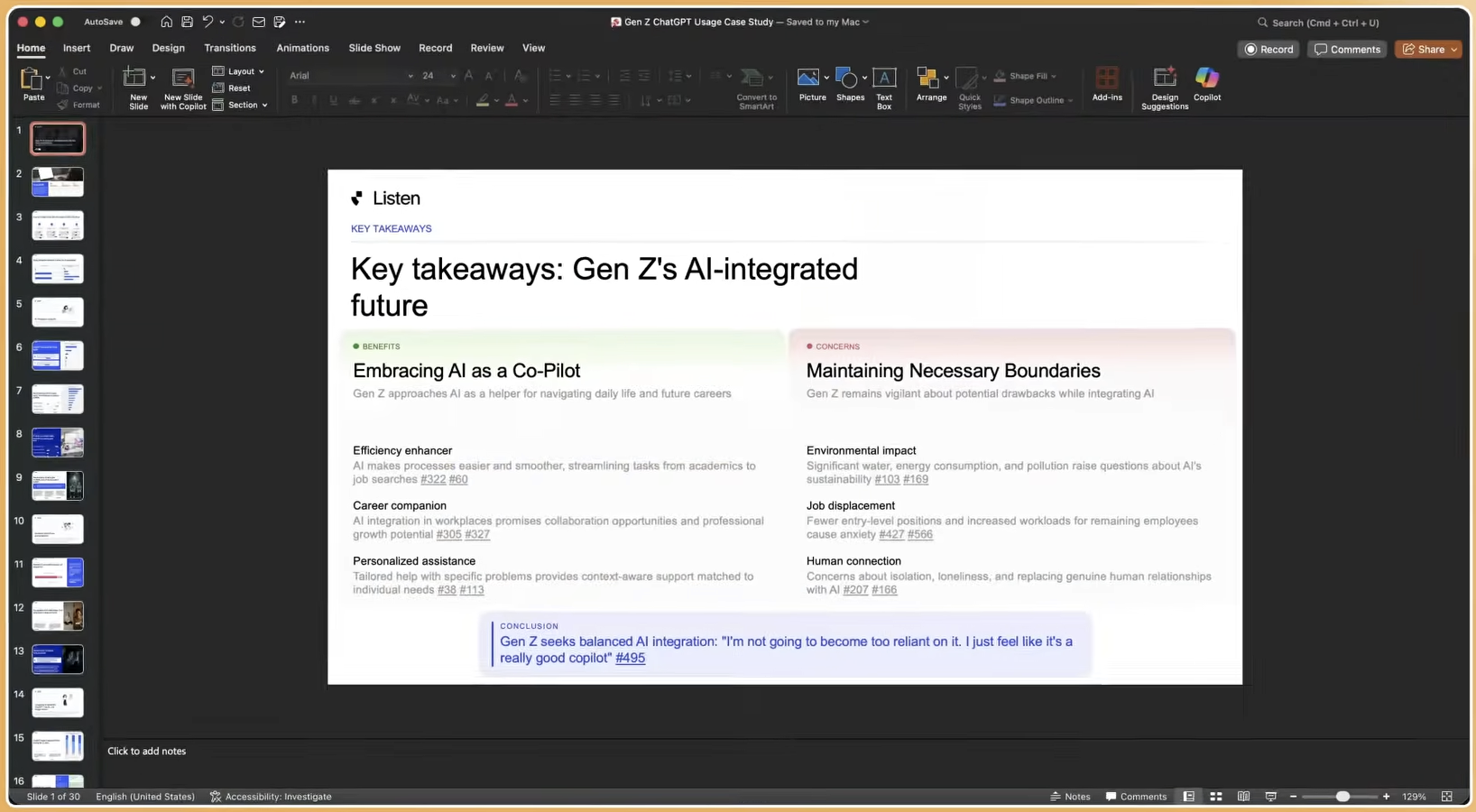
Analysis and deliverables from traditional tools target social and PR teams that track volume and sentiment trends. AI brand correction programs need consultant-grade outputs such as structured reports, prioritized action lists, and cross-study knowledge bases that guide content strategy, partner briefings, and executive decisions about commercial risk.
Which Teams Benefit Most from AI Brand Monitoring
Consumer insights teams at large enterprises face the most complex version of this challenge. Their brands appear in AI-generated answers across many markets and languages, with each engine drawing on different sources and citation logic. A single study cannot provide the always-on visibility required to track how model updates, new third-party content, or competitor moves shift brand representation. These teams need a platform that supports continuous research programs and rolls findings into a searchable institutional knowledge base.
Brand and PR teams at mid-market companies often lack dedicated research infrastructure. They need a platform that handles study design, recruitment, and analysis without requiring deep research expertise, and that delivers results quickly enough to shape content and PR decisions before AI misrepresentation compounds. Access to niche or hard-to-find respondents, whose perceptions AI engines synthesize, is especially important.
Agencies managing multiple clients require cross-client research infrastructure that scales without matching cost growth. They must run parallel studies across categories, markets, and segments, then deliver consultant-quality reports to each client. That capability determines whether AI brand monitoring becomes a profitable agency service line.
Running AI Brand Monitoring as an Ongoing Program
One-off audits create a snapshot but cannot track continuous drift in AI brand representation as models update and new sources appear. The citation volatility described earlier makes one-time checks unreliable. Always-on research programs that compare AI outputs to verified customer voice give teams a durable picture of brand representation across engines.
Workflow integration drives enterprise adoption. Research findings need to flow directly into content strategy, PR briefs, and brand guidelines without manual copy-and-paste work. Platforms that store outputs in a searchable, cross-study knowledge base, where teams can query past findings in natural language, reduce knowledge loss when insights stay trapped in slide decks.
Institutional knowledge compounds over time. Each study that validates or corrects AI brand descriptions adds to a growing dataset of customer voice. That dataset improves future study design, highlights recurring perception gaps, and shows whether correction efforts work. Teams that invest in always-on programs build this advantage, while teams that rely on occasional audits do not.
Risks and Misconceptions About AI-Moderated Research
Participant quality often tops the list of concerns about AI-moderated research. The risk is real in commodity panel environments where professional survey-takers and incentive seekers flood studies. Purpose-built quality infrastructure solves this through behavioral matching on intent, real-time fraud detection across video, voice, content, and device signals, and frequency limits that block repeat respondents.
AI moderation versus human moderation rarely presents a true either-or choice. AI-moderated interviews that probe dynamically on interesting or short answers can match human qualitative depth while scaling far faster. The key question is whether researchers designed the methodology, not whether a human sat in every session.
Data security concerns remain valid for enterprise teams handling proprietary perception data. Certifications such as SOC 2 Type II, GDPR, ISO 27001, ISO 27701, and ISO 42001 should be mandatory, along with clear guarantees that customer data never trains external AI models.
The most persistent misconception frames an AI research platform as a replacement for internal research teams. The more accurate framing treats it as force multiplication. The same team runs more studies, spends time on strategic analysis instead of logistics, and builds institutional knowledge faster than before.
Decision Framework and Checklist
Before selecting a platform for AI brand monitoring and correction, brand and insights leaders can use the following checklist.
- Can the platform run in-depth customer interviews, not just surveys, to surface the qualitative insight needed to correct AI misrepresentation?
- Does the platform rely on a verified respondent pool with documented fraud prevention instead of commodity panels?
- Can the platform reach the specific buyer profiles that shape AI outputs, including niche or hard-to-find segments?
- Does the platform support the languages and markets where AI representation matters most commercially?
- How long does it take from study brief to final deliverable, and can the platform move fast enough to keep up with model updates and competitors?
- Does the platform store outputs in a searchable knowledge base that supports cross-study queries and trend tracking?
- Does the platform hold enterprise security certifications and guarantee that customer data never trains models?
- Can the platform scale from one-off studies to always-on programs without proportional cost increases?
Teams ready to evaluate Listen Labs against these criteria can book a demo and see the full platform in action.
How Listen Labs Delivers End-to-End AI Brand Monitoring
Listen Labs addresses each decision criterion through an end-to-end platform that covers the full research lifecycle. The platform handles study design, recruitment, moderation, analysis, and delivery in one place, so teams avoid stitching together multiple vendors.
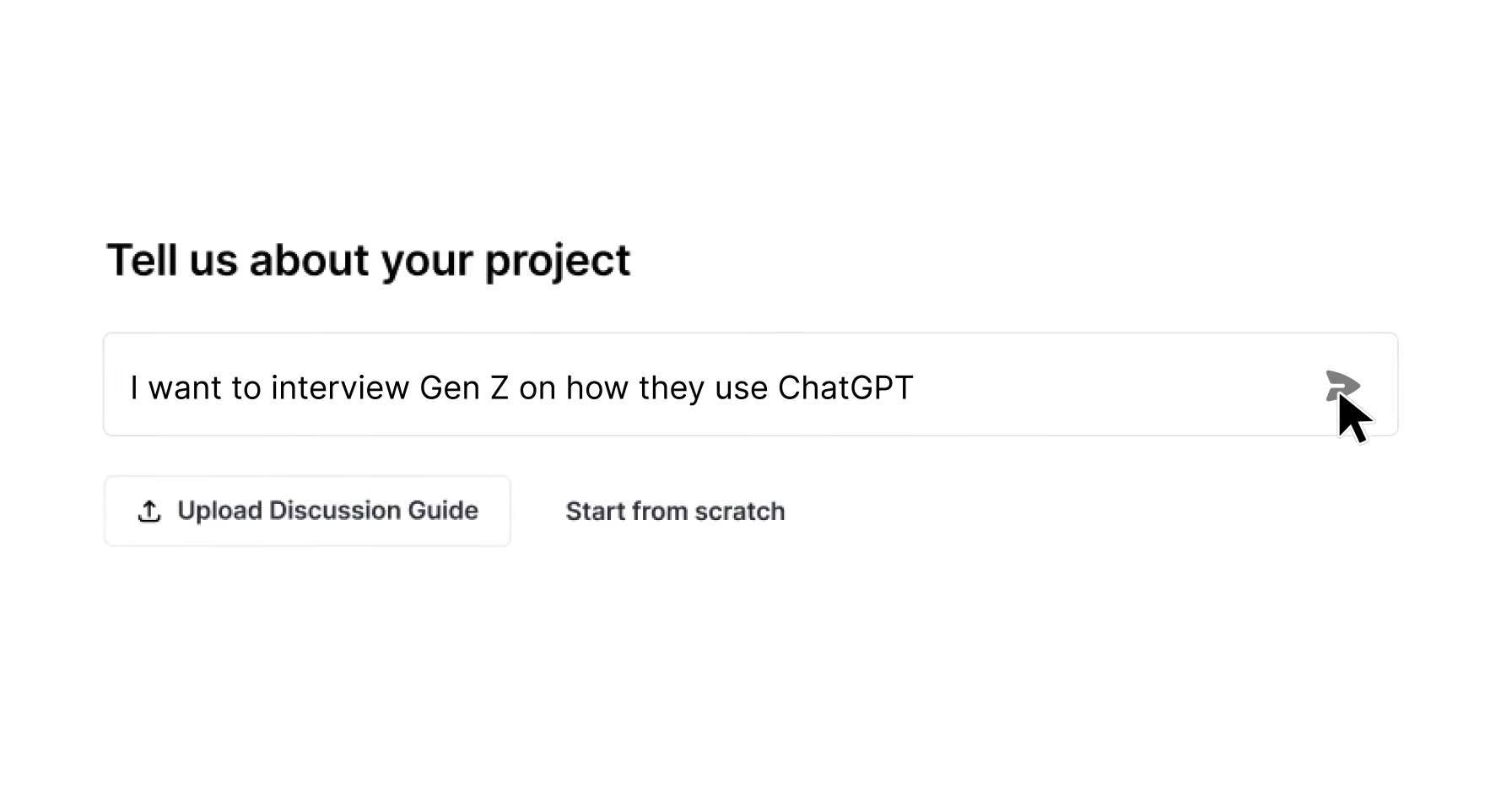
Study design starts with natural-language input. Brand and insights leaders describe objectives in plain language, and the platform generates structured guides, question sets, and probing context in seconds. Support for images, video, PDFs, prototypes, and live URLs enables concept testing and creative evaluation alongside brand perception work.
Participant recruitment draws from Listen Atlas, a global network of more than 30 million verified respondents across over 45 countries and 100 languages. An AI orchestration layer matches and bids across multiple panel partners and Listen Labs’ proprietary database using behavioral and intent data, not just self-reported demographics. A dedicated recruitment operations team sources hard-to-reach segments such as enterprise decision-makers, healthcare workers, and sub–1% incidence consumers, and organizations can self-recruit from their own customers at lower cost.
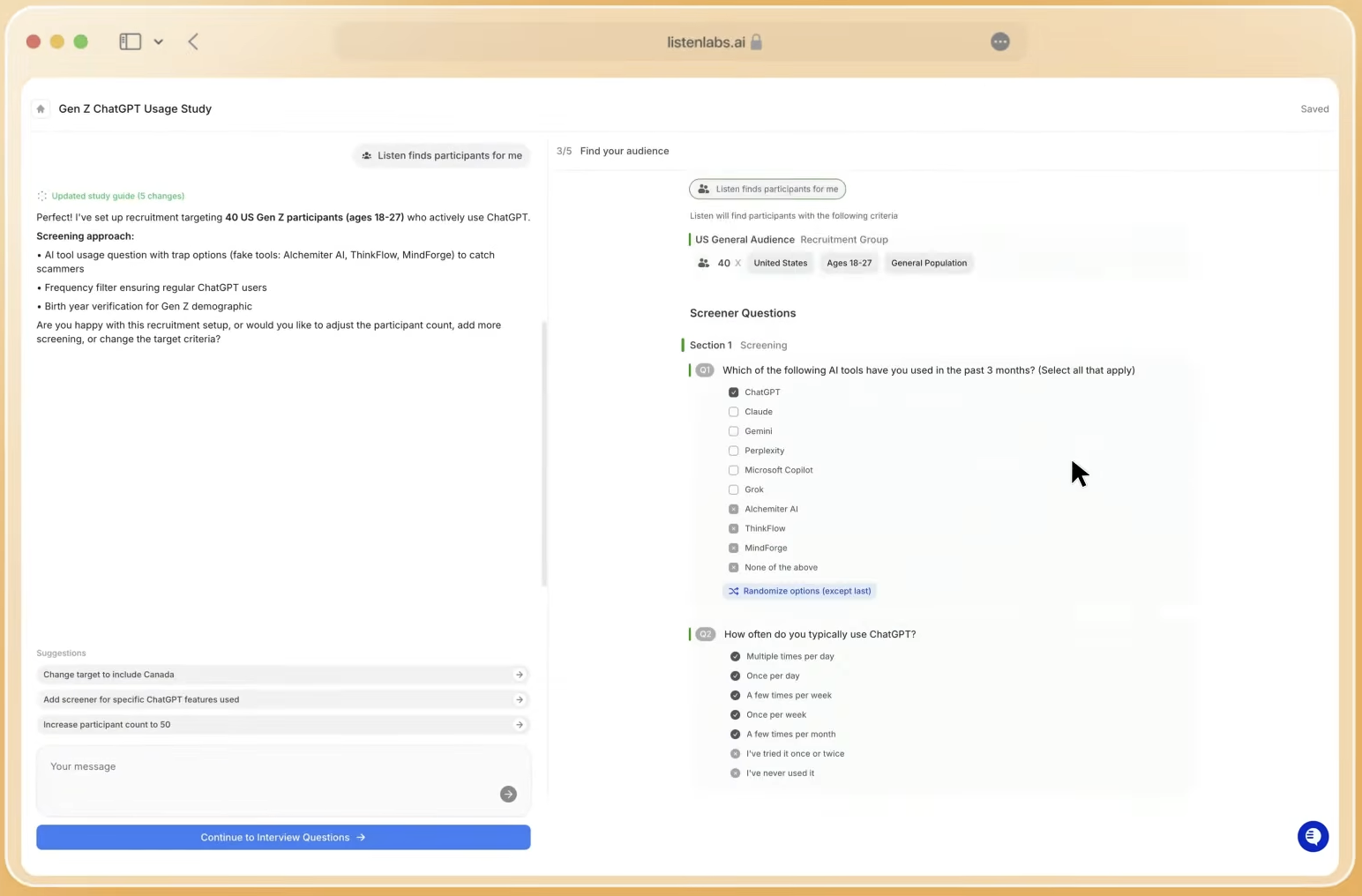
Quality Guard monitors every interview in real time across video, voice, content, and device signals to flag fraud, low-effort responses, AI-generated scripts, and mismatched profiles. Participants can join only three studies per month, which removes professional survey-takers. This system produces verified customer voice that AI engines cannot generate and traditional monitoring cannot capture.
AI-moderated interviews run personalized conversations with dynamic follow-up questions, probing deeper on interesting or brief answers. Emotional Intelligence adds a multimodal layer that analyzes tone of voice, word choice, and micro-expressions to surface emotions that transcripts miss. Built on Ekman’s universal emotions framework, every signal is quantified per question, tied to exact timestamps and verbatim quotes, and available across more than 50 languages.
The Research Agent processes interview data to produce automated key findings, thematic analysis, segment views, slide decks, memos, video highlight reels, and charts in under 24 hours from study launch. Mission Control stores every output in a searchable knowledge base, enabling cross-study queries, trend tracking, and institutional knowledge building as AI engines evolve.
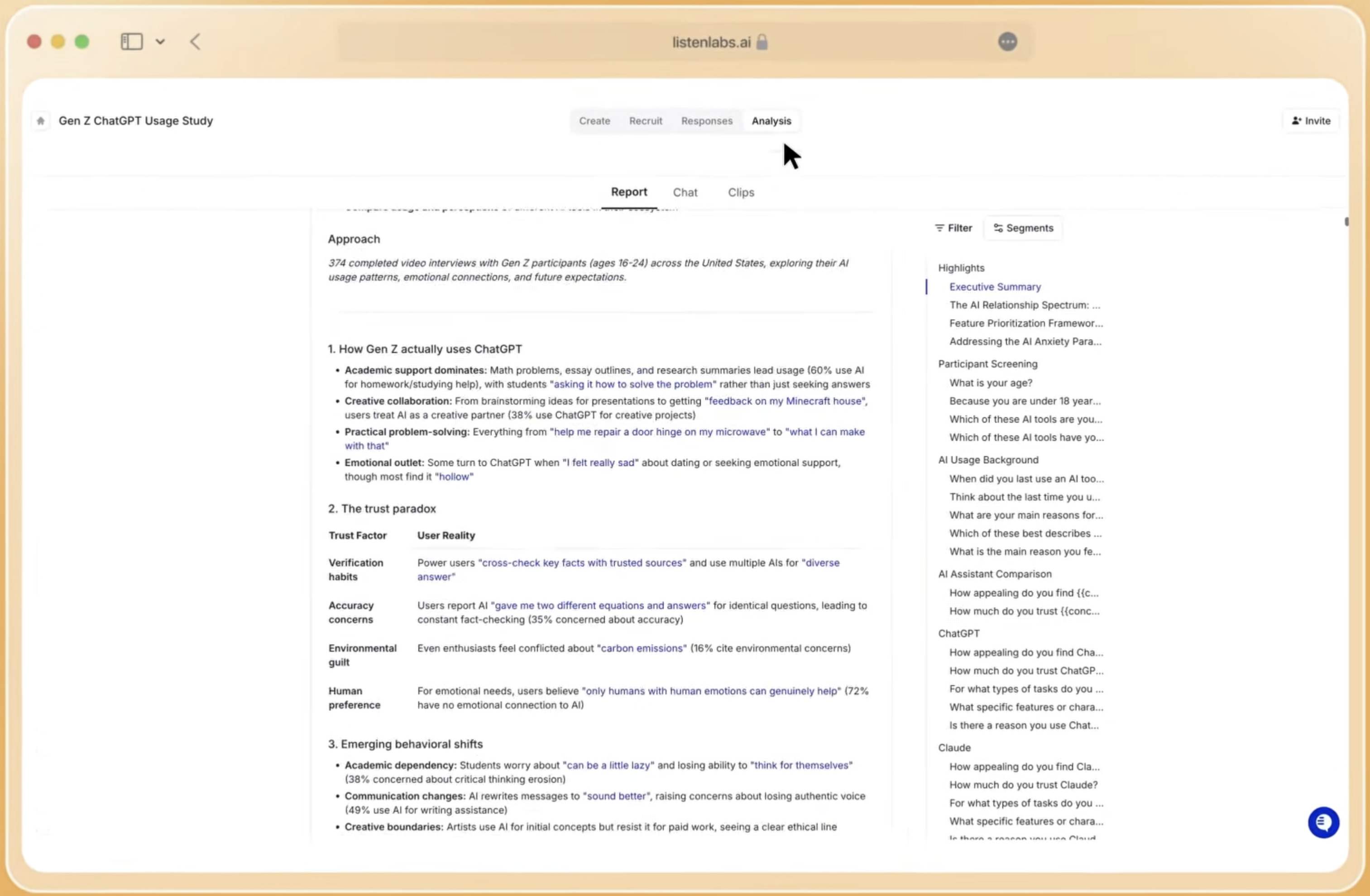
Enterprises including Microsoft, Google, Procter & Gamble, Anthropic, Skims, and Nestlé use Listen Labs to compress research cycles that once took four to six weeks into results delivered in less than a day, often at roughly a third of the cost of traditional qualitative research.
Frequently Asked Questions
How long does an AI brand perception study take with Listen Labs?
Listen Labs compresses the full research cycle from study design through recruitment, AI-moderated interviews, analysis, and final deliverables to less than 24 hours. Traditional qualitative cycles often take four to six weeks, and enterprise processes can stretch timelines to six months. Listen Labs removes that delay by handling every step on a single platform with AI-assisted design, automated recruitment from a 30 million–plus verified network, parallel AI-moderated interviews, and automated reporting.
Does Listen Labs support multilingual and global research?
Listen Labs supports more than 100 languages for interviews, with automatic translation and transcription. The platform covers over 45 countries across the Americas, Europe, APAC, and MEA. Emotional Intelligence, which analyzes tone, word choice, and micro-expressions, works across more than 50 languages. This global infrastructure is essential when a brand’s German-language presence in Gemini differs from its English-language presence in ChatGPT.
Can Listen Labs reach niche or hard-to-find respondents?
Yes. The recruitment operations team partners with niche communities, micro-creators, and specialized networks to reach participants that commodity panels miss. These participants include enterprise decision-makers, engineers, healthcare workers, and consumer segments below 1% incidence. The AI orchestration layer in Listen Atlas matches on behavioral and intent data and bids across multiple panel partners and the proprietary database to find the right people for each study.
How does Listen Labs price its platform, and can organizations use their own participants?
Listen Labs uses a subscription model. Enterprises pay for platform access, which includes a set number of studies and credits, then spend credits per recruited participant. Credit cost varies by audience difficulty, so general population studies cost fewer credits than niche segments. Organizations can self-recruit from their own customers at reduced credit cost, and they can also bring a proprietary panel. Companies with more than 100 employees typically go through a demo and pilot, while smaller organizations can use the self-serve platform.
How is Listen Labs different from survey tools and analysis-only platforms?
Survey tools such as SurveyMonkey and Qualtrics collect structured, quantitative data through fixed questions with no ability to probe. Listen Labs runs conversational interviews where AI adapts in real time, asks follow-up questions, and uncovers unexpected findings, emotional nuance, and context that surveys miss. Analysis-only platforms like Dovetail organize research conducted elsewhere. They do not recruit, interview, or generate new insight. Listen Labs covers the entire lifecycle on one platform, and Mission Control provides repository and cross-study intelligence capabilities as part of that end-to-end solution.
Conclusion: Turning AI Brand Visibility into a Continuous Capability
Traditional brand monitoring cannot see what AI engines say about a brand, cannot detect hallucinations or sentiment drift inside LLM outputs, and cannot supply the verified customer voice needed to correct inaccurate descriptions at scale. Tools built for social listening and web monitoring do not match the probabilistic, non-indexed, continuously refreshed nature of AI-generated brand representations.
AI-powered brand monitoring requires verified respondents, AI-moderated in-depth interviews, multimodal emotional analysis, automated synthesis, and an always-on knowledge base that grows with every study. AI search referrals convert at 4.4 times the rate of traditional organic traffic, so accurate brand representation inside AI engines now sits squarely in the commercial core, not at the monitoring margins.
Listen Labs delivers the research infrastructure that enterprise brand and insights teams need to detect perception gaps, validate AI outputs against real customer voice, and feed accurate data into the sources AI engines trust. Teams can move from questions to answers in under 24 hours, at global scale, with the security certifications enterprise procurement expects.
Book a demo to build your always-on AI brand visibility program with Listen Labs.