
Written by: Anish Rao, Head of Growth, Listen Labs | Last updated: August 8, 2026
Key Takeaways for Enterprise Research Teams
- Fragmented research stacks create compounding delays, quality risks, and hidden costs by splitting recruitment, moderation, transcription, and analysis across separate platforms.
- Integrated AI platforms like Listen Labs compress the full research cycle from study design to deliverables into under 24 hours while maintaining enterprise-grade security and fraud protection.
- AI-moderated interviews deliver deeper conversational insights at scale, with sample sizes of hundreds versus the 5–15 typical of human-moderated sessions, plus multimodal emotional-signal capture that transcripts alone cannot provide.
- Automated analysis and reporting remove the largest time sink in traditional research, generating consultant-quality slide decks, reports, and highlight reels in under a minute.
- Listen Labs consolidates the entire workflow, including recruitment, moderation, analysis, and knowledge management, into one certified platform. Book a demo to see how your team can replace Discuss.io and Respondent.io with a single, 24-hour solution.
Use-Case Decision Framework for Common Research Scenarios
Enterprise teams evaluating research platforms should map their specific scenarios to required capabilities rather than comparing tools feature by feature. The following scenarios show which capabilities matter most for different research objectives.
- Concept testing requires stimulus display (images, video, PDFs), monadic or sequential randomization, adaptive probing, and quantified emotional response. Speed to decision becomes critical when results must arrive before development investment.
- Churn analysis requires lapsed-user recruitment, 5–7 levels of laddering depth, cross-segment comparison, and deliverables that product leadership can share directly. Depth at scale is necessary to achieve statistical confidence alongside qualitative nuance.
- Creative testing requires video or audio stimuli, micro-expression capture, timestamp-level emotional tracing, and highlight reel generation. Emotional signal fidelity matters because ratings alone rarely explain why a creative concept works or fails.
- Global brand tracking requires 45+ country reach, 100+ language moderation, cross-market segmentation, and cross-study trend tracking. Consistency across markets becomes essential when methodology must remain identical in every locale.
Evaluation Criteria for Choosing a Research Platform
Research cycle time. Traditional qualitative research often takes 4–6 weeks from study design to final report, or up to 6 months in enterprise settings, with recruitment, scheduling, sequential fieldwork, and manual analysis each adding time. AI-moderated interview platforms can complete the full cycle from research brief to actionable insights in 24 hours. For enterprise teams managing backlogs of dozens of pending studies, this compression becomes the primary selection criterion.
Participant quality and fraud protection. Respondent fraud is a known challenge in panel-based qualitative research, making it the single largest uncontrolled threat to research validity. When platforms rely on commodity panels without real-time behavioral monitoring, they cannot detect or prevent fraud during the interview itself, which means the research team discovers the problem only after wasting time and budget on invalid data.
Conversational depth at scale. AI-moderated interviews typically achieve laddering depth of 5–7 levels because the AI applies identical neutral probing protocols without fatigue. Human moderators usually achieve more limited probing depth across a full study because cognitive fatigue accumulates over time.
Emotional-signal capture. Transcripts record what participants say, but they do not record hesitation, micro-expressions, or tonal shifts. Platforms that analyze only text miss a material share of the signal available in video interviews, which reduces the accuracy of creative and brand decisions.
Deliverable speed. For teams using AI-native platforms, qualitative synthesis time drops from days or weeks to under a minute. Research Agent generates a complete slide deck, report, and highlight reel directly from raw interview data, so stakeholders see polished outputs almost immediately after fieldwork ends.
Enterprise security. SOC 2 Type II, ISO 27001, ISO 27701, and ISO 42001 certifications form the baseline for Fortune 500 procurement. GDPR compliance is required for any study involving European participants and must cover data storage, processing, and deletion.
Total cost of ownership. A 2026 analysis found that AI-moderated interviews cost roughly $4–$10 per completed conversation, versus $40–$120 per human-moderated equivalent. Multi-tool stacks also carry hidden costs, including researcher time spent on coordination, handoff errors, and duplicate vendor contracts.
Study Design: From Manual Setup to AI Co-Design
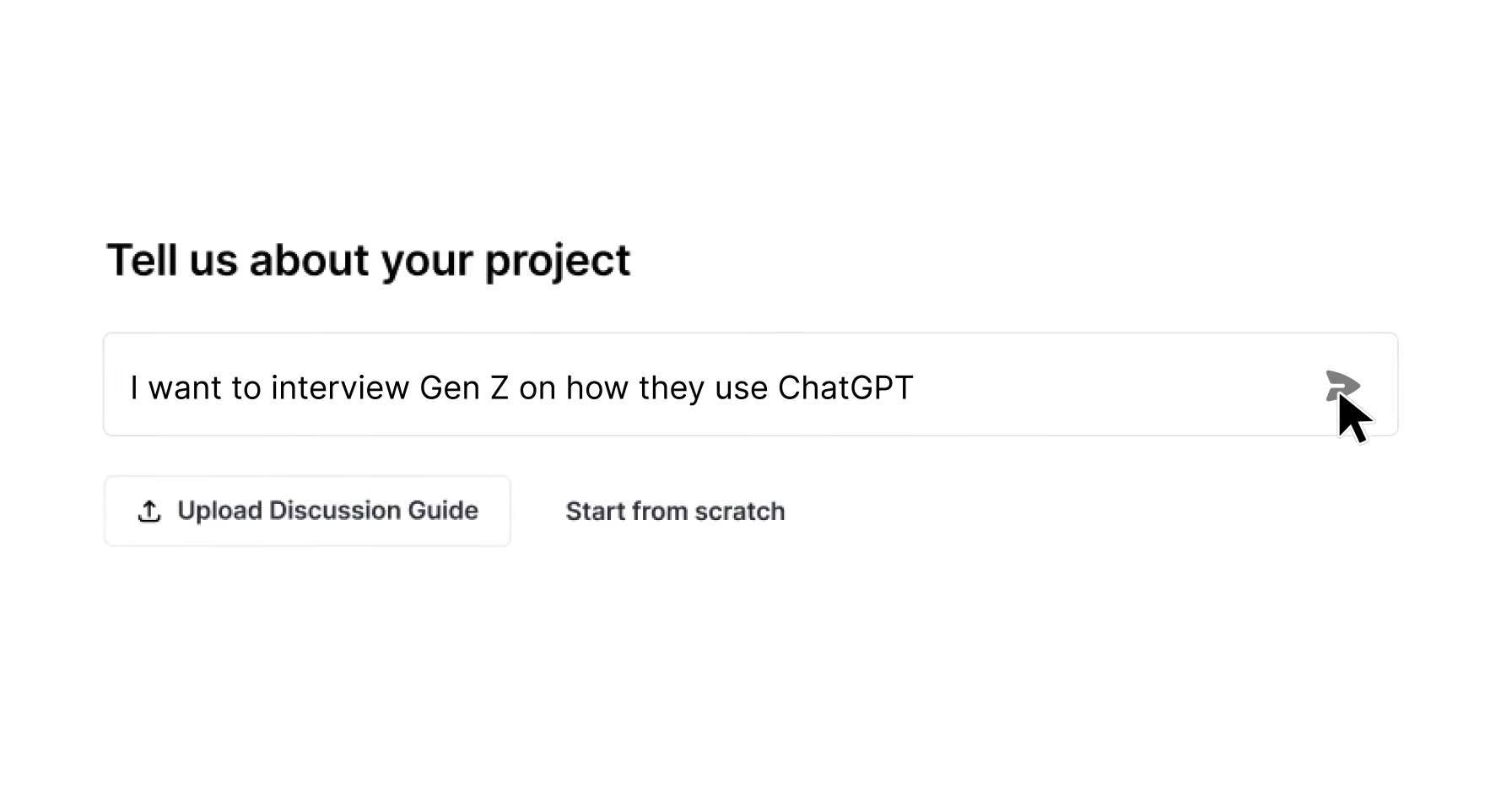
With a fragmented stack, study design begins in a document editor, moves through email threads for review, and then gets manually translated into whichever interview platform the team uses. The process lacks automated quality checks, a shared template library, and version control that persists across studies. Every new project effectively starts from scratch.
An integrated platform replaces this manual process with AI-assisted co-design. A researcher describes objectives in natural language and the platform drafts structured questions, probing context, branching logic, and stimuli configuration in seconds. Auto-QA flags issues before launch. Once the team finalizes a design, past studies can be cloned and adapted, which compresses setup from days to minutes and builds institutional consistency across every study the team runs.
Participant Sourcing: From Isolated Recruiters to Integrated Panels
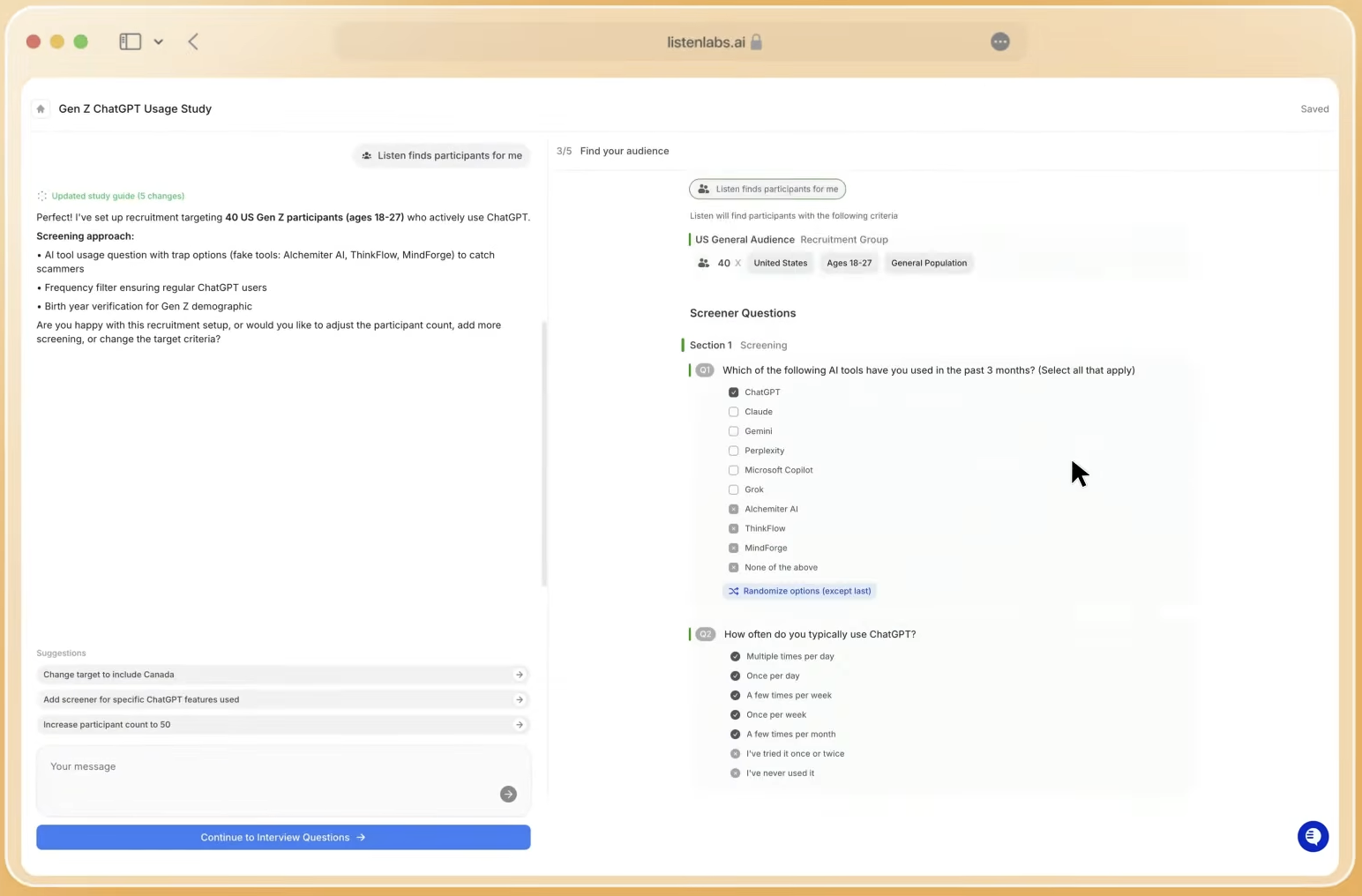
Respondent.io and similar recruitment platforms solve one problem, which is finding participants, but they hand off to a separate system for everything that follows. No-show rates for confirmed participants in traditional moderated research sessions typically range from 10–20%, which forces researchers to overrecruit and extends timelines. Each handoff between recruitment and moderation tools introduces scheduling friction, incentive processing delays, and sample documentation gaps.
Listen Labs’ Listen Atlas panel covers 30M verified respondents across 45+ countries and 100+ languages, with an AI orchestration layer that matches and bids across multiple panel partners and a proprietary database simultaneously. A dedicated recruitment operations team handles hard-to-reach segments such as enterprise decision-makers, healthcare workers, and consumers below 1% incidence rate, without requiring the research team to manage vendor relationships. Organizations can also self-recruit from their own user base at reduced cost, which eliminates external panel fees entirely for studies targeting existing customers.
Interview Moderation: From Limited Human Schedules to Parallel AI
Discuss.io and comparable live-interview platforms are constrained by human moderator availability. Traditional moderated interviews limit one researcher to a small number of sessions per week, which stretches fieldwork for large generative studies before synthesis can even begin. Scheduling across time zones compounds the delay. Sample sizes therefore stay small, typically 5–15 participants, and findings carry limited statistical weight.
AI-moderated interviews run in parallel across any number of participants at the same time. Listen Labs enables sample sizes of hundreds of participants per study, with examples including 250+ and 300+ interviews, while still keeping each conversation personalized and adaptive. The AI probes deeper on short or interesting answers, applies identical methodology to every participant regardless of session order, and removes the interviewer drift that accumulates across a long fieldwork period. Switching to AI-moderated interviews lets teams capture hundreds of candid, one-to-one conversations overnight.
Quality Assurance: From Manual Checks to Real-Time Guardrails
Fragmented stacks place the entire quality assurance burden on the research team. Screening responses must be manually reviewed, fraudulent profiles identified after the fact, and low-effort answers filtered out during analysis. These tasks consume researcher time without creating new insight.
Listen Labs’ Quality Guard monitors every interview in real time across video, voice, content, and device signals. AI-moderated interviews enable simultaneous multi-signal analysis of response latency, linguistic complexity, reasoning depth, emotional markers, and cross-reference consistency across every interview, a capability human moderators cannot replicate due to cognitive bandwidth limits. Participants are capped at three studies per month, which removes professional survey-taker behavior. A dedicated recruitment operations team adds a human review layer for studies requiring niche audiences. The result is a quality flywheel, where every additional study strengthens reputation scoring across the participant network.
Analysis and Reporting: From Manual Coding to Research Agent
Manual synthesis of qualitative data represents the largest single time sink in a traditional research cycle. Video qualitative research generates substantial raw recordings that require significant time for manual qualitative data analysis by an experienced researcher before synthesis can begin. Analysis tools like Dovetail help organize data that has already been collected elsewhere, but they do not remove the manual coding and synthesis work.
Listen Labs’ Research Agent handles the full analysis workflow, from raw data to final output. Automated key findings, themes, and personas are generated directly from interview data. Researchers can ask any question in natural language and receive answers, charts, statistical tests, and segmentation breakdowns. Research Agent generates a slide deck in a company’s branded template and a downloadable report in under a minute. Video highlight reels are generated automatically from interview recordings, giving stakeholders direct access to participant voices without watching hours of footage.
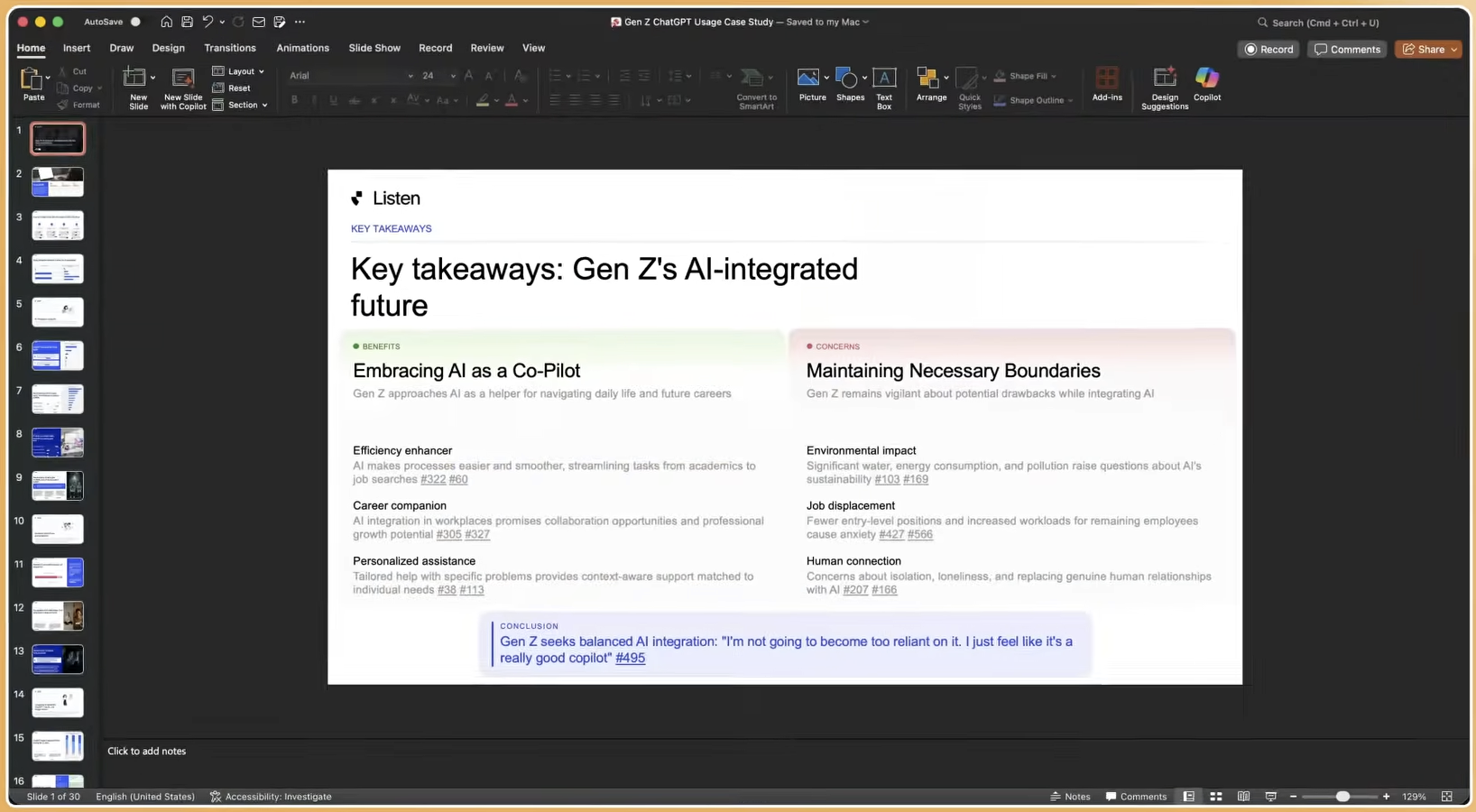
Book a demo to see Research Agent generate a full deliverable from live interview data.
Emotional-Intelligence Analysis Across Languages and Markets
Most qualitative platforms capture what participants say, but they do not capture what participants feel. Two concepts can receive identical verbal ratings while triggering entirely different emotional responses, and only multimodal signal analysis can surface that difference.
Listen Labs’ Emotional Intelligence analyzes three signals: tone of voice, word choice, and subconscious micro-expressions. The system is built on Ekman’s universal emotions framework, the same standard used in clinical psychology and UX research, tracking anger, anticipation, disgust, fear, joy, sadness, trust, and surprise. Every emotion is quantified per question and concept, and every label is traceable to the exact timestamp, verbatim quote, and the reasoning behind the classification. Teams are already using Emotional Intelligence for creative testing, concept comparison, brand research, and usability testing. The feature is available across 50+ languages and integrates directly with the Research Agent for natural-language queries, charts, and highlight reels of emotionally significant moments.
Cross-Study Knowledge Management with Mission Control
In a fragmented stack, completed research lives in scattered slide decks, shared drives, and individual researchers’ memories. Teams routinely re-research questions that were answered in a prior study because no searchable record of past learning exists. End-to-end AI research platforms convert qualitative research into reusable, stakeholder-ready evidence stored in a searchable insight library that compounds across studies.
Listen Labs’ Mission Control serves as the organization’s source of truth for everything ever learned from customers. Each study grows the knowledge base. Cross-study queries return answers in seconds. Trend tracking shows how customer sentiment, needs, and pain points shift over time. The compounding value of Mission Control means that a team’s hundredth study on the platform becomes more valuable than its first, which creates a structural advantage that no disconnected tool stack can match.
Operational Considerations for Consolidating Your Stack
Consolidating from a fragmented stack to an integrated platform requires change management, but the operational lift usually stays lower than most teams expect. Study templates, past participant data, and historical reports can be migrated. The research team’s role shifts from logistics coordination to strategic analysis, a change that most researchers welcome.
Listen Labs is designed as a force multiplier for existing research teams, not a replacement. The platform enables teams to run significantly more studies with the same headcount. Many researchers who have adopted AI tools report faster research turnaround, better team efficiency, and smoother workflows. For enterprise teams operating as internal service providers to product, brand, and marketing stakeholders, this multiplier effect directly reduces the backlog that drives stakeholder frustration.
Self-recruit flexibility means organizations are not locked into external panel costs for every study. Teams studying their own customer base, such as churn analysis, onboarding feedback, or loyalty research, can run those studies at reduced cost while maintaining the same AI moderation, quality assurance, and analysis capabilities.
Decision Framework for Platform Selection
Enterprise teams evaluating alternatives to fragmented research tool stacks should assess their requirements against the following platform attributes.
- Research cycle time under 24 hours: Required for teams running continuous insight programs or supporting sprint-cycle product development. This attribute delivers the 24-hour cycle introduced earlier.
- Verified global panel with fraud protection: Required for any study where participant authenticity affects the validity of findings, especially when leadership will act directly on the results.
- Adaptive AI moderation at scale: Required for studies where sample sizes above 50 are needed for statistical confidence alongside qualitative depth.
- Multimodal emotional-signal capture: Required for creative testing, concept comparison, and brand research where verbal ratings alone cannot explain performance.
- Automated deliverable generation: Required for teams with high stakeholder reporting demands and limited analyst bandwidth.
- Cross-study knowledge management: Required for organizations building continuous intelligence programs rather than running isolated projects.
- Enterprise security certifications: SOC 2 Type II, ISO 27001, ISO 27701, and ISO 42001 are required for Fortune 500 procurement approval.
- Self-recruit option: Required for teams that need to study their own customer base without external panel costs.
Teams that check five or more of these requirements operate at a scale and complexity where a fragmented tool stack creates compounding costs in time, quality risk, and researcher capacity that an integrated platform removes.
Frequently Asked Questions
How long does it actually take to get results from Listen Labs?
The full research cycle, from study design through participant recruitment, AI-moderated interviews, analysis, and deliverable generation, completes in under 24 hours for most studies. Microsoft used Listen Labs to collect global customer video stories for its 50th anniversary celebration within a single day. Anthropic surfaced churn drivers from 300+ user interviews in 48 hours. The 24-hour benchmark applies to standard consumer studies; studies targeting very hard-to-reach audiences may take longer on the recruitment side, but the moderation and analysis stages remain the same.
How does Listen Labs prevent fraudulent or low-quality participants?
Three layers of protection operate simultaneously. First, Listen Labs works exclusively with high-quality, non-commodity panel sources, avoiding professional survey-taker pools. Second, Quality Guard monitors every interview in real time across video, voice, content, and device signals, detecting fraud, low-effort responses, AI-generated scripts, and mismatched profiles before they enter the dataset. Third, participants are capped at three studies per month across the platform, which removes the incentive-optimization behavior that degrades commodity panel quality. A dedicated recruitment operations team adds human review for studies requiring niche or hard-to-reach audiences.
What security certifications does Listen Labs hold?
Listen Labs holds SOC 2 Type II, GDPR, ISO 27001, ISO 27701, and ISO 42001 certifications. Customer data is encrypted at 256-bit and is never used for AI model training. Enterprise SSO is supported. These certifications cover the full scope of enterprise procurement requirements across North America, Europe, and APAC markets.
How does Listen Labs pricing work for enterprise teams?
Listen Labs uses a subscription model. Enterprises pay for platform access, which includes a set number of studies and credits, and then spend credits per participant recruited. Credit cost varies based on audience difficulty, so general population studies cost fewer credits than niche or hard-to-reach segments. Companies with more than 100 employees go through a demo and pilot process before committing to a subscription. Organizations that self-recruit from their own user base pay fewer credits per participant, which reduces total cost for studies targeting existing customers.
Can Listen Labs replace both Respondent.io and Discuss.io in a single contract?
Yes. Listen Labs covers the entire workflow that Respondent.io and Discuss.io handle separately, including participant sourcing, screening, scheduling, interview moderation, transcription, analysis, and deliverable generation, plus capabilities neither platform offers, such as multimodal emotional-signal capture, cross-study knowledge management via Mission Control, and automated report and highlight reel generation. Teams that consolidate onto Listen Labs remove the handoff delays, duplicate vendor costs, and quality risks that come from coordinating two separate platforms.
Conclusion: Moving from a 6-Week Cycle to a 24-Hour Standard
The case for replacing a Respondent-plus-Discuss.io stack with an integrated AI research platform centers on the compounding cost of fragmentation across every stage of the research workflow, including study design, recruitment, moderation, quality assurance, analysis, reporting, and knowledge management. Each stage handled by a separate tool adds delay, introduces handoff risk, and consumes researcher capacity that could be directed at strategic work.
Listen Labs collapses all seven stages into a single enterprise-grade system trusted by Microsoft, Anthropic, Procter & Gamble, and Skims. The platform delivers verified participants from a 30M-person global network, adaptive AI-moderated interviews in 100+ languages, multimodal emotional-signal capture built on Ekman’s framework, and automated consultant-quality deliverables. These capabilities together deliver the 24-hour cycle described earlier, backed by SOC 2, ISO 27001, ISO 27701, and ISO 42001 certifications that cover enterprise security requirements.
For consumer insights and UX research leaders evaluating their options in 2026, the practical decision centers on how long the organization can afford to operate on a 4–6 week research cycle when a 24-hour alternative already exists. Book a demo to see the full Listen Labs workflow, from study brief to stakeholder-ready deliverable, in a live session with the team.