Written by: Anish Rao, Head of Growth, Listen Labs | Last updated: July 22, 2026
Key Takeaways
- Traditional brand tracking studies cost $200K–$1M annually and take 6–12 weeks, so results arrive too late for real-time decisions.
- AI brand tracking combines LLM visibility monitoring across ChatGPT, Gemini, and Claude with emotional perception research that captures tone, micro-expressions, and sentiment in under 24 hours.
- Modern platforms should be evaluated on speed, depth, emotional signal capture, sample quality, scalability, and enterprise security certifications.
- Listen Labs delivers end-to-end brand intelligence, from study design through AI-moderated interviews and multimodal analysis, in under 24 hours with verified participants and fraud prevention.
- Leading enterprises like Microsoft, Anthropic, P&G, and Skims already use Listen Labs to replace slow surveys with continuous intelligence. See how the platform works in a live walkthrough.
Why Traditional Brand Tracking Falls Short
Classic quarterly brand tracker studies cost $50,000–$250,000 per wave, with most large brand teams running four waves per year for an annual spend of $200,000–$1,000,000. Time is the structural problem. Fieldwork, cleaning, and analysis often take 6–12 weeks with classic panel brand trackers. By the time findings arrive, the campaign has launched, the product decision is locked, and the competitive landscape has already shifted.
The depth problem compounds the speed problem. AI-moderated brand interviews can produce detailed open-ended responses with multiple conversational turns. Equivalent one-shot survey questions usually receive much shorter answers. Traditional surveys capture what customers say in a constrained format. They cannot capture hesitation, micro-expressions, or the emotional register behind a response.
Many companies run brand tracking studies infrequently, so they get retrospective snapshots that rarely guide day-to-day decisions. Meanwhile, roughly 30–40% of online survey responses are fraudulent or unusable, which undermines the data quality those expensive trackers depend on.
The emotional signal gap is the most consequential limitation. Most brand tracking tools only capture what participants say. Critical signals such as a frown, a moment of hesitation, or a drop in tone never make it into the data. Two campaigns might both receive positive ratings while triggering entirely different emotional responses in the audience.
The Evaluation Framework for Modern Brand Tracking
Modern brand tracking platforms should solve the speed, depth, and emotional signal gaps rather than repackage them in a new interface. Consumer Insights Leaders evaluating AI brand tracking platforms can use six practical dimensions.
- Speed: Confirm that the platform delivers a synthesis report within 24–72 hours of field launch. The 2026 State of AI in Customer Research report did not report median time-to-insight figures, and other 2026 Perspective AI reports cite compressions such as 21 days to 6 days, so vendor benchmarks matter.
- Depth: Check whether the platform conducts adaptive, conversational interviews with dynamic follow-up questions instead of relying on checkbox responses.
- Emotional signal capture: Look for analysis of tone of voice, word choice, and facial micro-expressions, not just transcripts and self-reported ratings.
- Sample quality: Ask how the platform prevents fraud, professional survey-takers, and low-effort responses, and whether participant frequency is capped.
- Scalability: Confirm that the platform can run hundreds of simultaneous interviews across 45+ countries and 100+ languages without proportional cost increases.
- Enterprise security: Verify SOC 2 Type II, GDPR, ISO 27001, ISO 27701, and ISO 42001 certifications, and confirm that customer data is excluded from AI model training.
See how Listen Labs performs on each of these six dimensions.
How to Track Brand Mentions in ChatGPT and Other LLMs
Before you can understand why customers prefer your brand, you need to know whether AI platforms even mention it. LLM visibility tracking establishes that baseline. LLM visibility tracking is a measurement-of-output problem. Because model responses vary by phrasing, context, and version, the methodology requires repeated sampling and multi-model cross-testing rather than single deterministic queries. Use this structured process for tracking brand mentions in ChatGPT and other LLMs.
- Build a prompt library tied to real user contexts. Base LLM visibility measurement on structured prompts tied to real user contexts, not generic keyword queries that represent an abstract user with no history, constraints, or purchase-stage intent.
- Run multi-model cross-testing. Test prompts across ChatGPT, Gemini, and Claude simultaneously to surface platform-specific framing differences. BrightEdge’s March 2026 study found Google AI Overviews is 44% more likely than ChatGPT to surface negative brand sentiment, and the engines flag different brands as negative 73% of the time on identical queries.
- Measure mention frequency and framing. Record whether the brand appears as a primary recommendation or an alternative. Evaluate the sentiment context around each mention.
- Track AI Share of Voice. Calculate mention frequency against direct competitors across the same prompt set.
- Account for data freshness limitations. Training data delays and knowledge cutoffs mean new brand information may not appear in AI responses until the next model update. Baseline measurements may miss recent campaigns or launches, so treat them as a lagging indicator.
- Repeat sampling under controlled conditions. Because LLM responses are non-deterministic, repeated sampling matters. LLM responses are non-deterministic due to randomness settings and conversation context, so tracking tools must perform repeated sampling to estimate stability rather than treating single outputs as reliable.
Visibility tracking answers whether a brand appears in AI answers. It does not explain why customers feel the way they do or which emotional associations drive brand preference. That requires a second layer of capability.
AI Tools for Brand Equity Tracking Across LLMs and Live Customers
Brand equity tracking improves when LLM visibility data connects with deep qualitative perception research. Traditional surveys may tell us what people do, but it takes a conversation to understand why. The visibility audit from the previous section tells you where your brand appears in AI answers. The next layer explains why customers react the way they do to those mentions and to your real-world campaigns.
- Run LLM visibility audits across ChatGPT, Gemini, Claude, and Perplexity to establish baseline share of voice and sentiment framing.
- Design AI-moderated interview studies that target specific brand perceptions, associations, and emotional drivers that visibility data cannot explain.
- Recruit verified participants from a quality-controlled panel matched to the target consumer profile, not commodity survey-takers.
- Conduct adaptive video interviews with dynamic follow-up questions that probe the emotional and contextual reasons behind brand perceptions.
- Apply multimodal emotional intelligence to surface tone of voice, word choice, and micro-expression signals that transcripts miss.
- Synthesize findings into a unified brand health dashboard that tracks visibility, sentiment, and emotional perception over time.
Key Capabilities Overview
Modern brand tracking solutions differ in how they combine visibility monitoring with emotional perception research. Visibility-only tools focus on LLM mention tracking but lack depth. Survey platforms capture structured ratings but miss emotional nuance. AI interview platforms vary in their ability to deliver multimodal emotional intelligence and enterprise-grade quality controls. Listen Labs integrates LLM visibility monitoring with adaptive AI-moderated interviews, multimodal emotional signal capture, and real-time fraud prevention to deliver continuous brand intelligence at scale.
Multimodal Emotional Intelligence: Capturing What Customers Actually Feel
Traditional brand tracking captures what customers say about your brand. Their feelings often stay hidden in tone, pacing, and expression. Enterprises now move from one-dimensional sentiment tagging to multimodal emotional inference to close that gap. This shift is driving the emotion analytics market from an estimated USD 5.02 billion in 2026 to a projected USD 7.70 billion by 2031.
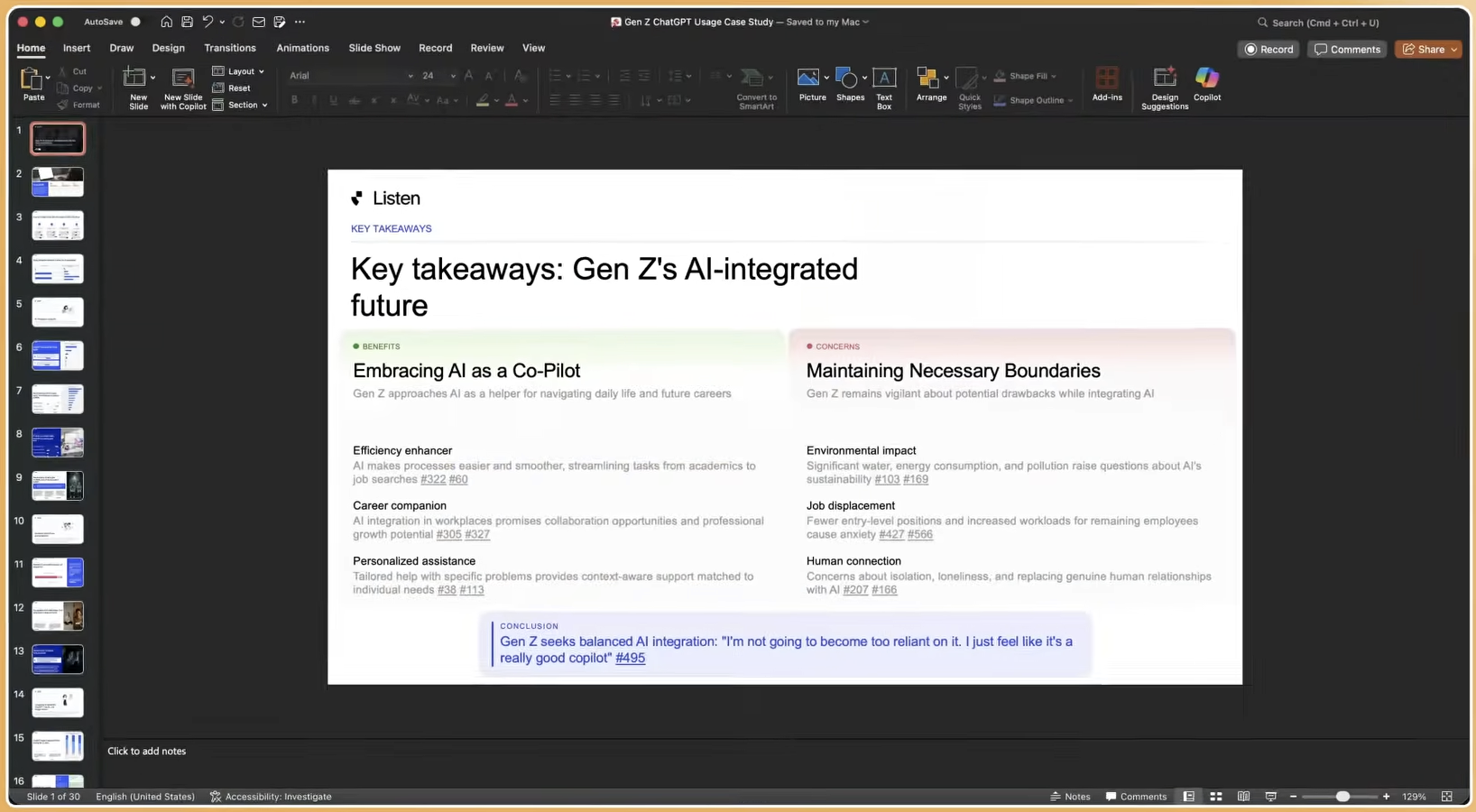
Listen Labs’ Emotional Intelligence analyzes three layers of signal: tone of voice, word choice, and subconscious micro-expressions, surfacing nuanced emotions that transcripts alone miss. The system is built on Ekman’s universal six emotions framework, the same standard used in clinical psychology and UX research: anger, disgust, fear, happiness, sadness, surprise, and neutral.
Every emotion is quantified per question and per concept, and every label is traceable to the exact timestamp, verbatim quote, and the reasoning behind the classification. Brand teams can ask the Research Agent questions like “which concept triggered the most confusion?” and receive a side-by-side emotional breakdown across stimuli, segments, and markets. The capability works across 50+ languages and connects directly to automated highlight reels of the most emotionally significant moments.
Watch Emotional Intelligence in action on a live brand perception study.
Enterprise Case Studies: Speed, Scale, and Emotional Depth
Microsoft: Global storytelling at speed. Microsoft needed global customer stories for its 50th anniversary celebration and faced a traditional research timeline of 6–8 weeks. Using Listen Labs, the team collected user video stories within a single day. The Director of Data Science at Microsoft noted, “Our leadership team was very thrilled at both the speed and the scale that Listen Labs enabled. I can reach out to hundreds of users at one third of the cost.”
Anthropic: Churn analysis with emotional clarity. Anthropic needed to understand why Claude users cancel their subscriptions. Listen Labs delivered 300+ user interviews in 48 hours, surfacing churn drivers 5x faster, identifying where former Claude users migrate, and producing a prioritized list of 10 “must-fix” items. The Director of Product Strategy at Anthropic stated, “Listen Labs lets us understand user churn with a level of clarity and speed we’ve never had before.”
Procter & Gamble: Pre-launch concept testing. P&G used Listen Labs to evaluate how men respond to new product claims before market launch. The platform delivered 250+ interviews with quantified themes and verbatim proof in hours. The study surfaced where claims felt exaggerated or unclear and showed that comfort, safety, and reliability matter far more than novelty to the target consumer.
Skims: Overnight validation with premium buyers. Skims needed to validate campaign direction with thousands of high-income buyers overnight before a global launch. Listen Labs identified and qualified premium consumers overnight, eliminating weeks of recruiting. The SVP of Data, Insights, and Loyalty at Skims noted, “I always struggled with understanding the why and Listen Labs nails this for me.”
Repeatable Implementation Roadmap
Listen Labs compresses the entire brand research lifecycle into a single connected workflow.
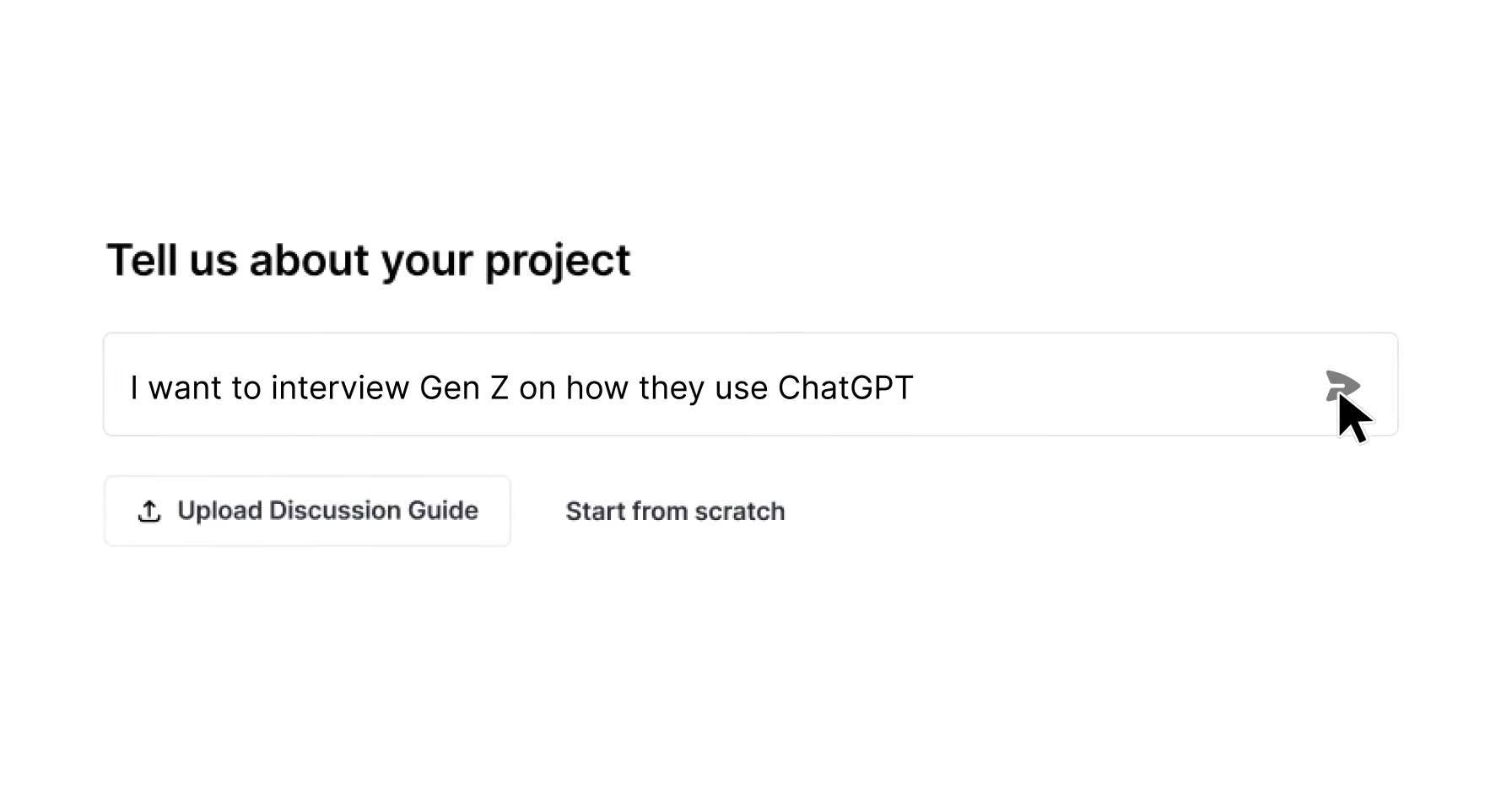
- AI-assisted study design. Describe research goals in natural language. The platform drafts structured objectives, questions, and probing context, then auto-QA flags issues before launch.
- Global participant recruitment. Once the study design is validated, Listen Atlas, the AI orchestration layer, matches and recruits from a network of 30M+ verified respondents across 45+ countries. Quality Guard applies real-time fraud detection across video, voice, content, and device signals. Participants are capped at three studies per month to eliminate professional survey-takers.
- AI-moderated interviews in 100+ languages. The AI conducts personalized video interviews with dynamic follow-up questions, collecting video, audio, text, and screen recordings simultaneously.
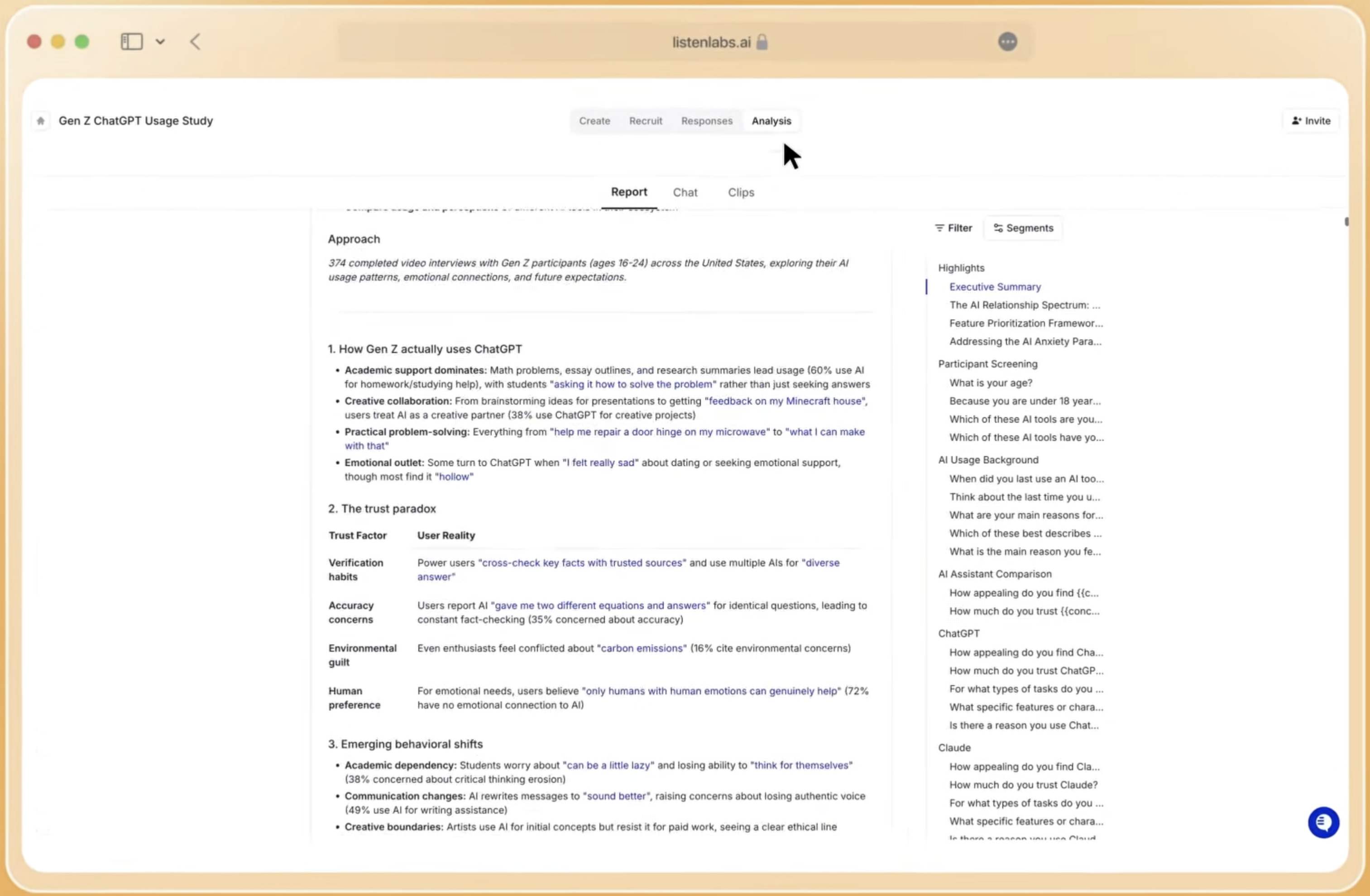
- Automated analysis with Emotional Intelligence. The Research Agent processes all interview data, quantifies emotional signals per question and concept, and generates automated key findings, themes, and personas.
- Deliverables in under 24 hours. Slide decks, memo-style reports, video highlight reels, and statistical charts are generated in under a minute.
- Mission Control tracking. Every study feeds the organization’s source of truth for cross-study queries, trend tracking, and institutional knowledge building over time.
Addressing Common Objections
AI interviewer quality vs. human researchers. Listen Labs maintains the same level of methodological rigor as an excellent in-house research team, built by researchers with 50+ years of combined expertise. Qual-at-scale works best when research requires large sample sizes or broad geographic reach, with AI tools engaging hundreds or thousands of participants remotely and asynchronously. That rigor extends to use cases no human moderator team can match. The platform acts as a force multiplier for existing research teams, allowing them to focus on strategic interpretation while the AI handles execution at scale.
Quality Guard fraud prevention. Three layers of protection operate simultaneously. Listen Labs works exclusively with high-quality, non-commodity panel sources. Quality Guard monitors every interview in real time for fraud, low-effort responses, AI-generated scripts, and mismatched profiles. A dedicated recruitment ops team adds human review for hard-to-reach segments including enterprise decision-makers, healthcare workers, and consumers below 1% incidence rate.
Enterprise security. Listen Labs holds SOC 2 Type II, GDPR, ISO 27001, ISO 27701, and ISO 42001 certifications. All data is encrypted at 256-bit, and customer data is never used for AI model training. Enterprise SSO is supported.
Frequently Asked Questions
What is the difference between AI brand visibility tracking and AI brand sentiment analysis?
AI brand visibility tracking measures whether and how a brand appears in AI-generated answers across platforms like ChatGPT, Gemini, and Claude, tracking mention frequency, framing, and share of voice relative to competitors. AI brand sentiment analysis goes a layer deeper, evaluating the emotional tone and contextual framing of those mentions. Listen Labs adds a third layer with multimodal emotional intelligence that analyzes tone of voice, word choice, and facial micro-expressions during qualitative interviews to capture what customers actually feel about a brand, not just what they say or how AI platforms describe it.
How long does it take to get brand tracking results with Listen Labs?
Listen Labs delivers end-to-end results, from study design through recruitment, AI-moderated interviews, analysis, and final deliverables, in under 24 hours for most studies. Traditional panel brand trackers often require 8–16 weeks, and standard qualitative research cycles typically take 4–6 weeks. Deliverables include slide decks, memo-style reports, video highlight reels, and statistical charts, all generated automatically by the Research Agent.
How does Listen Labs prevent fraudulent or low-quality participants from skewing brand research?
Listen Labs operates a three-layer quality system that compounds over time. First, the platform works exclusively with high-quality, non-commodity panel sources and avoids generic survey panels prone to professional survey-takers. Second, Quality Guard applies real-time AI monitoring across video, voice, content, and device signals during every interview to detect fraud, low-effort responses, AI-generated scripts, and mismatched respondent profiles. Third, participants are limited to three studies per month across the network, and a dedicated recruitment ops team adds human review for specialized or hard-to-reach audiences. This system builds a reputation score across every interview, creating a growing quality advantage over time.
Can non-researchers use Listen Labs for brand tracking without methodology expertise?
Yes. Brand Managers and Marketing Leaders without a research background can describe their goals in natural language and have the platform handle study design, recruitment, moderation, and analysis automatically. AI-assisted study co-design drafts structured objectives and questions from a plain-language brief. Auto-QA flags issues before launch. The Research Agent then generates findings in natural language with one-click deliverables. The platform is designed to be self-serve for non-researchers while maintaining the methodological rigor that enterprise research teams require.
How does Mission Control support continuous brand intelligence over time?
Mission Control serves as the organization’s source of truth for everything learned from customers across all studies. Each brand tracking study feeds the knowledge base, enabling cross-study queries, trend tracking of customer sentiment and brand perception over time, and institutional knowledge building. Teams can retrieve answers from past research in seconds without digging through old reports, and the system surfaces shifts in brand health before they appear in sales data or competitive intelligence.
Conclusion: Turn Brand Tracking into a Competitive Advantage
Traditional brand tracking forces a choice between speed and depth, and between scale and emotional truth. The result is expensive, infrequent snapshots that arrive too late to inform the decisions that matter. AI for brand tracking with Listen Labs removes that trade-off. Instead of waiting weeks for stale snapshots, teams get intelligence that combines visibility monitoring, emotional perception research, and multimodal analysis in a single platform, with results arriving faster than a traditional tracker can even launch fieldwork.
Teams using AI-driven primary customer data report higher confidence in roadmap bets. Enterprises already running continuous brand intelligence programs, including Microsoft, P&G, Skims, and Anthropic, make faster, more confident decisions while competitors wait weeks for outdated data.