
Written by: Anish Rao, Head of Growth, Listen Labs | Last updated: July 26, 2026
Key Takeaways
- Legacy CAQDAS tools like NVivo, ATLAS.ti, and MAXQDA only analyze data after it has been collected, which forces teams to manage separate vendors for recruitment, moderation, and transcription.
- Full-stack AI platforms like Listen Labs handle the entire research lifecycle from study design through AI-moderated interviewing, automated analysis, and deliverable creation in under 24 hours.
- Listen Labs provides integrated recruitment from a 30M verified global panel across 45+ countries and 100+ languages, so teams avoid fragmented vendor stacks and the quality risks that come with them.
- The platform’s Research Agent delivers traceable, bias-aware themes with source-linked outputs and supports mixed-method designs plus emotional intelligence analysis that goes beyond transcript content.
- Listen Labs offers enterprise-grade security certifications and cross-study knowledge management, making it a strong fit for teams that want to compress weeks-long research cycles into a single day. See the full workflow tailored to your team.
Evaluation Framework for AI Qualitative Data Analysis Software
Selecting the right platform means assessing capability across the full research workflow, not just the analysis stage. The following 12 criteria provide a structured basis for comparison:
- Research speed: Time from study brief to final deliverable, including setup, recruitment, data collection, and analysis.
- Depth of insight: Ability to surface latent themes, emotional signals, and unexpected findings beyond surface-level responses.
- Sample quality: Mechanisms for verifying participant authenticity, preventing fraud, and ensuring responses reflect genuine consumer perspectives.
- Participant sourcing: Whether the platform includes integrated recruitment or requires separate vendor relationships for panel access.
- Methodological flexibility: Support for IDIs, usability testing, concept testing, diary studies, mixed-method designs, and custom logic such as branching and quotas.
- Global reach and language support: Number of countries covered, languages supported for moderation and analysis, and localization capabilities.
- Analysis effort and bias controls: Degree of manual coding required, traceability of AI-generated themes to source data, and safeguards against confirmation bias.
- Reporting transparency: Whether outputs link directly to verbatim evidence and whether the reasoning behind each finding is auditable.
- Governance and security: Certifications held, data handling policies, and whether participant data is used to train third-party AI models.
- Scalability: Ability to run hundreds or thousands of interviews simultaneously without proportional increases in cost or headcount.
- Cross-study knowledge management: Whether the platform accumulates institutional knowledge across studies or treats each project in isolation.
- Total operational burden: Number of vendors, tools, and manual handoffs required to complete a full research cycle.
See a live walkthrough of the framework tailored to your team’s research workflow.
Study Setup and Recruitment Comparison
Legacy CAQDAS platforms such as NVivo, ATLAS.ti, and MAXQDA are built to analyze data that arrives from external sources. They center on manual coding, tagging, and retrieval of data that has already been collected and transcribed. This separation means recruitment, scheduling, screening, and data collection must be handled through entirely separate vendor relationships before any analysis can begin. A typical enterprise stack uses a panel provider such as Prolific or User Interviews, a scheduling tool, a video interview platform, and a transcription service, with each step adding a handoff, a cost center, and a point of quality risk.
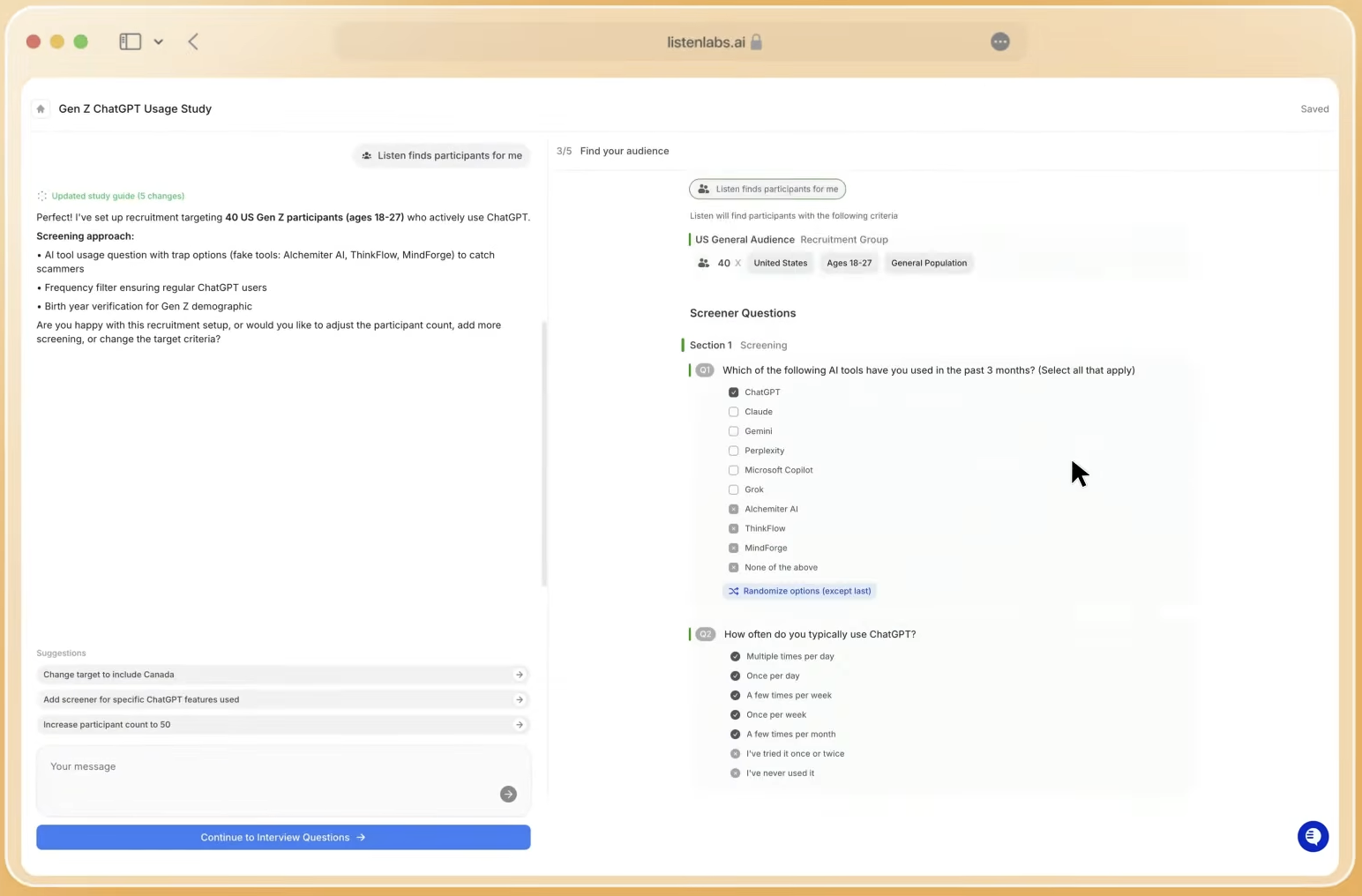
This fragmented workflow creates the exact inefficiencies that full-stack platforms are meant to solve. Listen Labs eliminates this fragmentation by keeping every stage in one place. AI-assisted study co-design lets researchers describe goals in natural language and receive structured objectives, questions, and probing context within seconds. Listen Atlas, the platform’s AI orchestration layer, then matches and recruits from this global network, automatically bidding across multiple panel partners and Listen Labs’ proprietary database. For hard-to-reach segments such as enterprise decision-makers, healthcare workers, or audiences below 1% incidence rate, a dedicated recruitment operations team adds a human sourcing layer. Qual-at-scale uses AI to automate time-consuming aspects of qualitative research like recruiting, interviewing, and analysis, compressing what traditionally required weeks of coordination into the sub-24-hour cycle mentioned above.

Moderation Approach and Data Quality Controls
Legacy CAQDAS tools perform no moderation, so data quality depends entirely on the upstream collection method. A human moderator may conduct rigorous interviews, or a commodity panel may deliver incentive-driven survey responses. A 2025 PLOS One study testing Microsoft Copilot for thematic analysis identified limitations including potential inaccuracies in AI-generated outputs, which shows that analysis quality is bounded by the integrity of the data entering the system.
Listen Labs conducts AI-moderated video interviews that probe dynamically based on each participant’s responses and mirror the adaptive behavior of a trained human interviewer. To ensure the quality of those responses, Quality Guard monitors every session in real time across video, voice, content, and device signals to detect fraud, low-effort responses, AI-generated scripts, and mismatched profiles. The platform further protects data integrity by limiting participants to three studies per month, which removes professional survey-takers who might provide rehearsed rather than authentic responses. Beyond verifying participant authenticity, the Emotional Intelligence layer adds another dimension by analyzing tone of voice, word choice, and subconscious micro-expressions, built on Ekman’s universal emotions framework, to surface emotional signals that transcripts alone miss. Every emotion label is traceable to the exact timestamp, verbatim quote, and reasoning behind it across more than 50 languages.
Qualitative Depth, Quantitative Support, and Analysis Workflow
Manual coding by a trained researcher is time-intensive and scales directly with dataset size. Legacy CAQDAS workflows for studies of 30 interviews often require multiple days for transcription plus additional time for manual coding before insights reach stakeholders. Coding a twenty-interview qualitative study to the depth required by Braun and Clarke’s thematic analysis framework demands significant analyst time, and that effort grows quickly with larger samples.
Manual analysis also introduces bias risk. Henri Schildt, Professor of Strategy at Aalto University, argues that a trustworthy AI-assisted qualitative workflow must enable two-way traceability: moving from any conclusion back to the exact source passages and from any source passage forward to see what was coded and what was ignored across every stage of analysis.
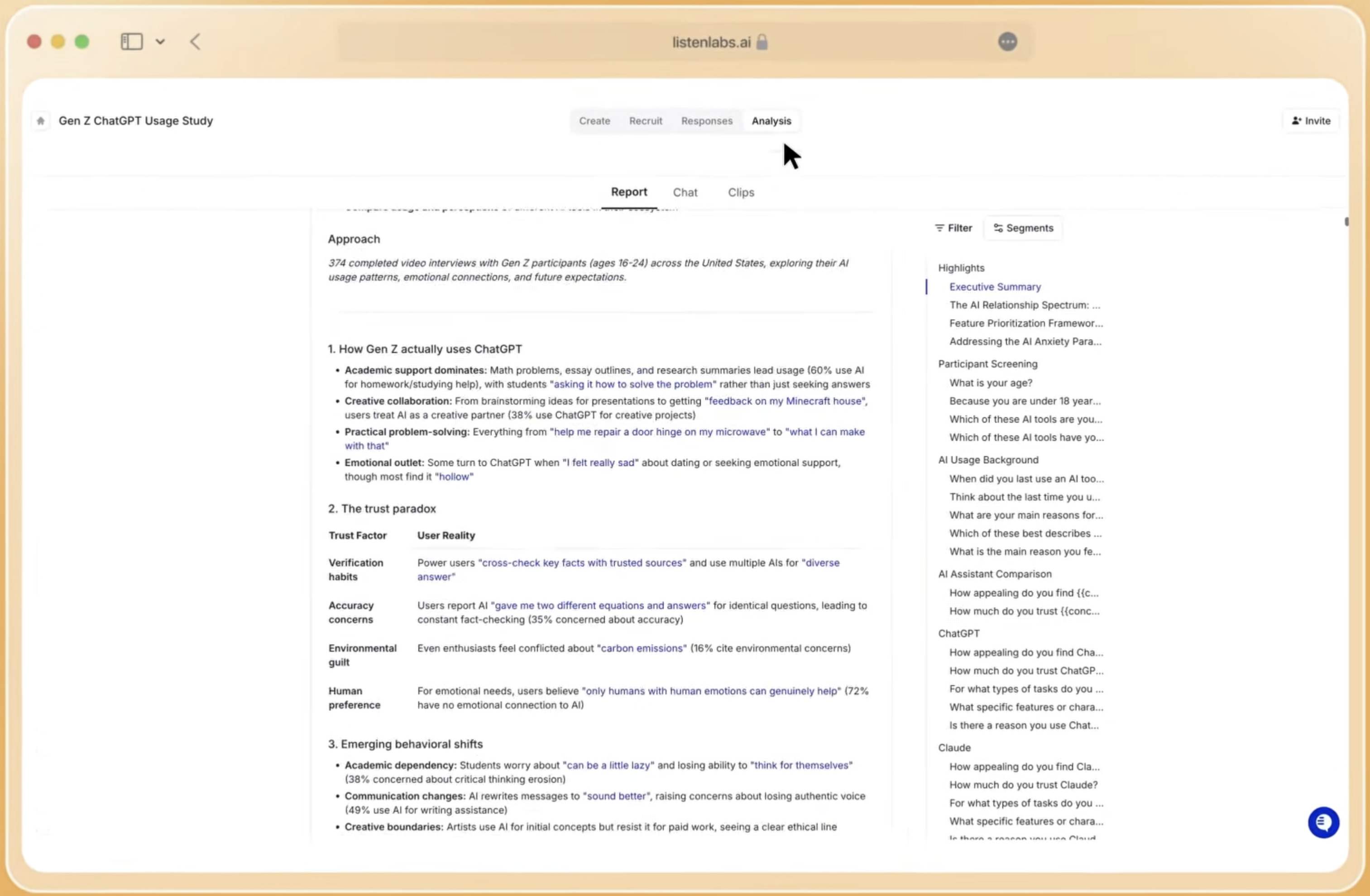
This bidirectional traceability standard is exactly what Listen Labs’ Research Agent is built to deliver. The platform processes all interview data and produces traceable, bias-aware themes without manual coding. Every insight links directly to the underlying response data, which satisfies the traceability standard that methodologists require. One researcher ran a full buying intent analysis across three user segments in under a minute. The Research Agent also supports mixed-method designs, combining qualitative interview depth with quantitative formats such as Likert scales, NPS, MaxDiff, and statistical significance testing, which legacy CAQDAS tools typically require separate software to match.
Deliverables and Cross-Study Knowledge Management
After analysis, legacy CAQDAS workflows still require researchers to write reports, build slide decks, and extract video clips manually. These tasks persist even though AI reduces report writing time by up to 80% (or 40–90% depending on tasks) in qualitative research projects. Even when teams add AI assistance to a legacy stack, the researcher must still orchestrate outputs across disconnected tools.
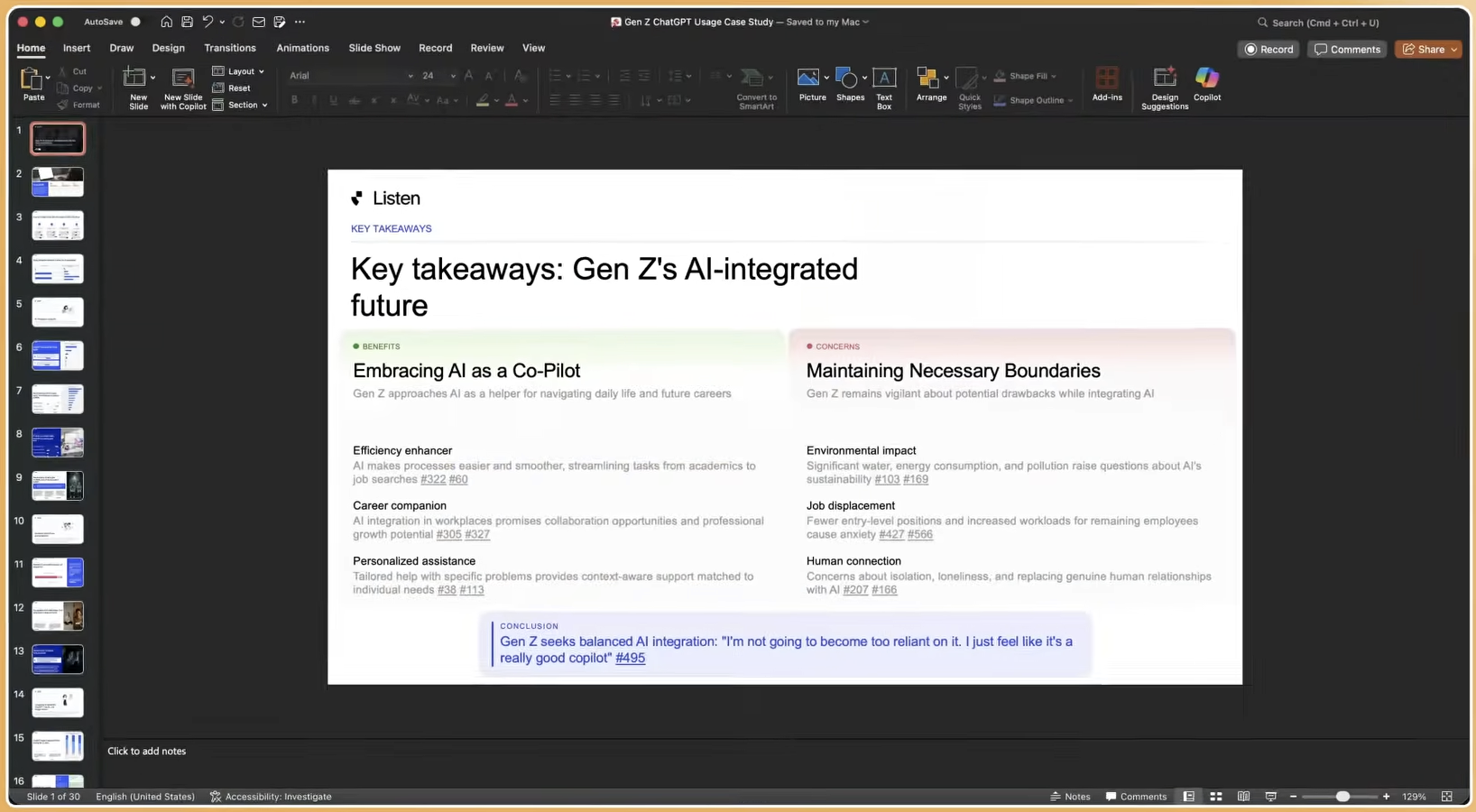
Listen Labs’ Research Agent generates consultant-quality PowerPoint slide decks, memo-style reports, video highlight reels, statistical charts, and segmentation breakdowns in under a minute from a single interface. Mission Control then acts as the organization’s permanent source of truth, enabling cross-study queries, trend tracking, and institutional knowledge retrieval in seconds. Each completed study grows the knowledge base, so teams avoid re-researching questions that prior studies have already answered. This compounding advantage is not available in analysis-only tools because they hold no memory of prior work.
Scenario-Based Guidance by Team Type
Enterprise consumer insights teams with high research backlogs and strong internal stakeholder demand gain the most from Listen Labs’ end-to-end automation. The same team can run significantly more studies per quarter without proportional headcount increases. Microsoft used Listen Labs to collect global customer stories for its 50th anniversary within a single day, and the Director of Data Science highlighted the ability to reach hundreds of users at one third of the previous cost.
UX research leads at mid-to-large product companies gain the capacity to run 50–100+ participant studies in parallel instead of the 5–10 that manually scheduled sessions usually allow. Screen sharing and mobile screen recording support usability testing at scale, while AI moderation handles logistics that previously consumed researcher time.
Product managers and marketing leaders without dedicated research teams can describe goals in natural language and receive a complete study design, recruited participants, moderated interviews, and analyzed deliverables without deep research methodology expertise. AI can schedule and conduct the interview, analyze the transcripts for themes, and even generate quantitative insights from those interviews, which makes self-serve consumer research realistic for non-researchers.
Agencies and consultancies working under client timelines measured in days rather than weeks gain the ability to handle two to three times more concurrent projects with the same headcount. This outcome aligns with research agencies that have adopted AI-assisted analysis handling two to three times more concurrent client projects with the same headcount.
Discuss your team’s workflow requirements in a personalized demo.
Risks and Limitations of Each Option
Legacy CAQDAS tools create several structural risks for enterprise teams. Manual coding is time-intensive and vulnerable to confirmation bias, where analysts unconsciously emphasize findings that confirm pre-existing hypotheses. AI systems may reflect biases from training data, potentially overemphasizing common themes, overlooking minority perspectives, reinforcing existing assumptions, or generating biased interpretations. This risk applies to any AI layer added to a legacy stack without strong traceability controls. Fragmented vendor stacks also introduce recruitment complexity and quality risk that CAQDAS tools cannot mitigate because they only operate after data collection is complete.
Full-stack AI platforms introduce their own considerations. AI-mediated interviews may produce different accounts than human-led ones because participants may disclose differently to a chatbot, feel less judged, or be less accountable, and current evidence on these effects remains limited. Teams should also avoid assuming that faster tools automatically produce better research. Speed only helps when data quality, methodological design, and analytical traceability meet the standards required for the decision at hand. Listen Labs addresses these concerns through Quality Guard, the Emotional Intelligence layer, and the Research Agent’s source-linked outputs, and teams can validate platform outputs against their own methodological standards during an initial pilot.
Data privacy remains a non-negotiable requirement for enterprise deployments. Under GDPR, each distinct processing step in AI-moderated interviews, such as natural language processing, follow-up question generation, transcription, and theme extraction, counts as a separate data processing activity that requires its own lawful basis and must be disclosed to participants. Listen Labs holds SOC 2 Type II, GDPR, ISO 27001, ISO 27701, and ISO 42001 certifications, uses 256-bit encryption, and does not use customer data to train AI models. These controls address the procurement requirements that enterprise legal and security teams apply to any AI research vendor.
Decision Aid: Matching AI Qualitative Data Analysis Software to Your Goals
The following criteria indicate when each architecture is the appropriate choice:
- Choose a legacy CAQDAS platform if your team already has high-quality transcripts from a controlled collection process, requires a specific academic coding methodology such as grounded theory or framework analysis applied manually, and operates in a context where institutional review requires documented human-led analysis at every stage.
- Choose an analysis-only AI tool if you have a large existing corpus of support tickets, open-ended survey responses, or archived transcripts that require thematic tagging without new data collection.
- Choose Listen Labs if your team needs to compress a 4–6 week research cycle into less than 24 hours, requires integrated recruitment from a verified global panel, needs to run hundreds of simultaneous interviews without proportional cost increases, requires emotional signal capture beyond transcript content, or needs cross-study knowledge management as part of a continuous consumer intelligence program.
- Choose Listen Labs if your organization operates across multiple markets and requires extensive language support for moderation and analysis within a single platform.
- Choose Listen Labs if enterprise security certifications, no-training-data guarantees, and SSO are procurement requirements.
Frequently Asked Questions
How long does it actually take to get results with Listen Labs compared to legacy CAQDAS tools?
Listen Labs compresses the full research cycle, including study design, recruitment, AI-moderated interviewing, analysis, and deliverable generation, to less than 24 hours. Legacy CAQDAS workflows require data to be collected, transcribed, and imported before any analysis begins, with transcription alone consuming multiple hours per interview hour and manual coding adding days or weeks depending on sample size. For a 30-interview study, the combined transcription and coding phase in a legacy workflow typically consumes two or more weeks before any insight reaches stakeholders. Listen Labs removes both steps as manual activities.
How does Listen Labs ensure participant quality, and how does that compare to sourcing participants independently for CAQDAS analysis?
Listen Labs applies three layers of quality control. Listen Atlas matches participants using behavioral and intent data rather than self-reported demographics alone. Quality Guard monitors every interview in real time across video, voice, content, and device signals to detect fraud, low-effort responses, and mismatched profiles. Participants are capped at three studies per month to prevent panel fatigue, and a dedicated recruitment operations team handles hard-to-reach segments. When teams source participants independently for CAQDAS analysis through commodity panels or self-managed recruitment, each of these controls must be implemented separately. Many commodity panels also carry known risks of professional survey-takers and incentive-driven responses that degrade data quality before analysis begins.
Can Listen Labs support the same methodological rigor as a human-led qualitative study?
Listen Labs is built by researchers with more than 50 years of combined in-house expertise and is trusted by enterprise research teams at organizations including Microsoft, Google, Procter & Gamble, and Anthropic. The platform supports IDIs, semi-structured interviews, usability testing, concept testing, diary studies, and mixed-method designs with branching, skip logic, quotas, and stimuli presentation. The Research Agent links every theme and finding directly to the verbatim source data, which satisfies the traceability standard that methodologists and enterprise compliance teams require. The Emotional Intelligence layer, built on Ekman’s universal emotions framework, adds a quantified emotional dimension that most human-led studies do not capture systematically. For teams with specific academic or regulatory requirements, Listen Labs supports bringing your own participants and customizing study design to match institutional protocols.
What happens to participant data after a study is complete?
Listen Labs maintains enterprise-grade security with 256-bit encryption and holds SOC 2 Type II, GDPR, ISO 27001, ISO 27701, and ISO 42001 certifications. Customer data is never used to train AI models. The platform supports configurable data retention, right-to-erasure handling, and role-based access control. Enterprise SSO is supported. These controls address the procurement requirements that legal, security, and privacy teams apply when evaluating any AI platform that processes interview recordings, transcripts, and participant personal data at scale.
Is Listen Labs suitable for teams without dedicated research expertise?
Listen Labs works well for teams without dedicated research expertise. Product managers, brand managers, and marketing leaders can describe their goals in natural language and receive a complete study design, recruited participants, AI-moderated interviews, and analyzed deliverables without manual configuration. The platform’s AI-assisted study co-design drafts structured objectives and questions automatically, Auto-QA flags issues before launch, and the Research Agent generates stakeholder-ready outputs including slide decks, memos, and video highlight reels in under a minute. For organizations with established research teams, Listen Labs functions as a force multiplier and enables the same team to run significantly more studies per quarter without proportional headcount increases.
Conclusion: Choosing the Right AI Qualitative Data Analysis Software
The evaluation framework above clarifies the architectural tradeoffs. Legacy CAQDAS platforms and fragmented vendor stacks require researchers to solve recruitment, moderation, transcription, and quality control independently before any analysis begins. This process consumes weeks and introduces compounding quality risk at every handoff. Analysis-only AI tools accelerate the coding stage but leave the upstream collection problem unsolved. Platforms like Listen Labs layer on auto-recruiting, transcription, sentiment tagging, and insight summarization so teams move from question to findings in hours, not weeks.
Listen Labs brings recruitment from a 30M verified global panel, AI-moderated interviewing with real-time Quality Guard fraud prevention, Emotional Intelligence signal capture, Research Agent analysis, and Mission Control cross-study knowledge management into the single-day workflow that distinguishes full-stack platforms from analysis-only tools. It holds the enterprise security certifications that procurement teams require, supports more than 100 languages across 45+ countries, and has delivered results for Microsoft, Google, Procter & Gamble, Anthropic, Skims, Robinhood, and Nestlé. With qual-at-scale, the old trade-off between depth and scale no longer blocks decision-making.
Evaluate the platform for your team and see the full workflow from study brief to stakeholder-ready deliverable while you assess fit against your research objectives, security requirements, and turnaround expectations.