
Written by: Anish Rao, Head of Growth, Listen Labs | Last updated: July 18, 2026
Key Takeaways
- AI qualitative research best practices now enable enterprise teams to reduce research cycles from 4–6 weeks to under 24 hours while preserving methodological integrity through structured, human-led workflows.
- Success requires defining clear objectives, guardrailed study design, verified participant recruitment, adaptive AI-moderated interviews, and traceable audit trails at every stage.
- Human-in-the-loop oversight, first-pass AI coding with human validation, and emotional intelligence analysis add rigor by ensuring accuracy, accountability, and deeper insight beyond transcripts alone.
- Privacy protection, explicit consent, and enterprise-grade certifications (SOC 2, GDPR, ISO standards) must be built into the workflow from the start to meet compliance requirements.
- Listen Labs is the end-to-end platform that operationalizes this full workflow, so you can see how it scales rigorous AI qualitative research for your team in a live demo.
Step 1: Define Clear Research Objectives Before Any AI Use
Every rigorous AI-assisted study starts with explicit, written research objectives created before any AI tool is activated. Impact MR’s practical rule for 2026 is to use AI to increase coverage and consistency while using humans to protect meaning, nuance, and accountability, and that human accountability begins at the objective-setting stage. Here is how to turn that principle into concrete steps before you open a single AI window.
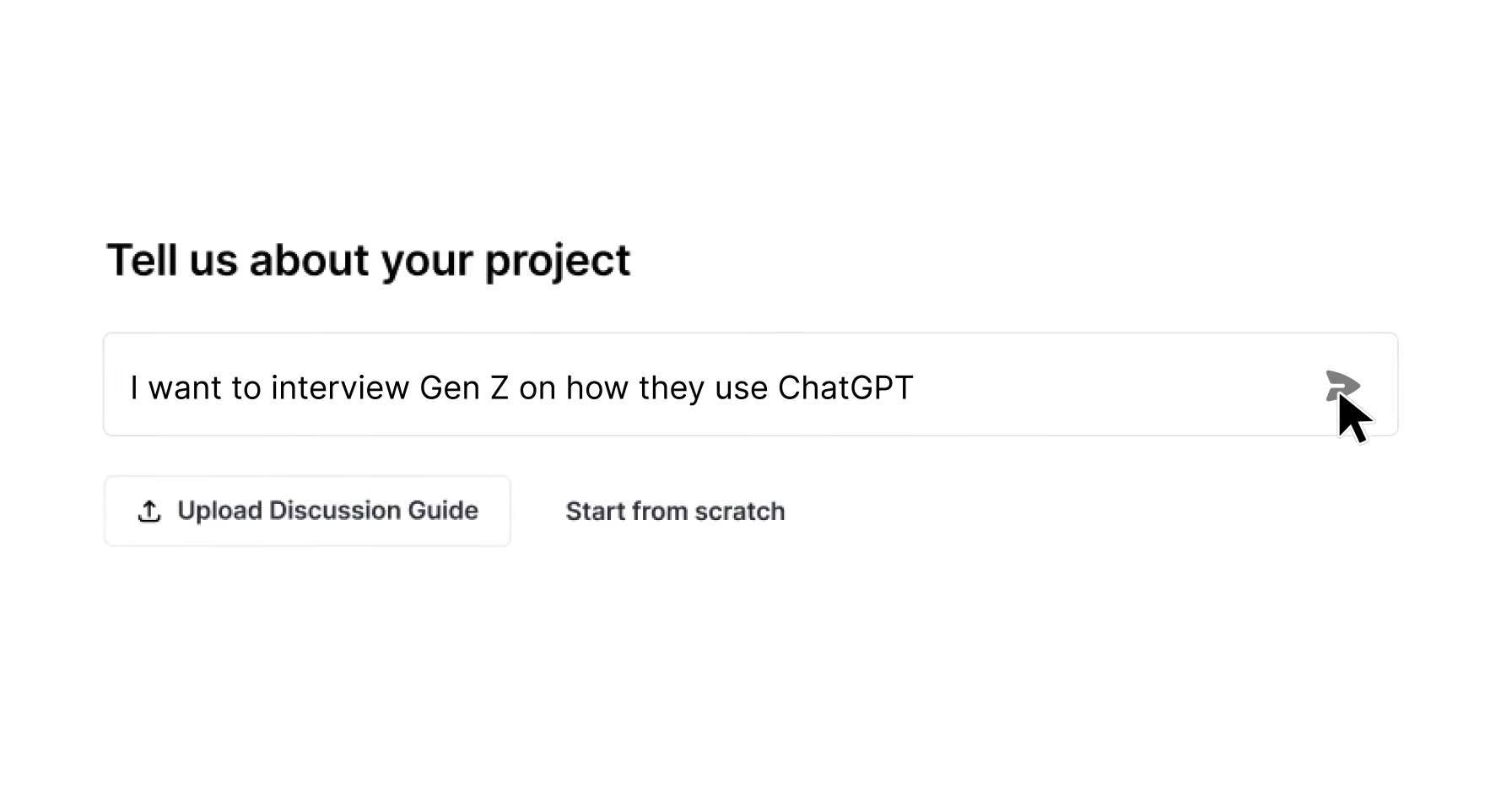
- Start by writing a single primary research question and no more than three supporting sub-questions before opening any AI tool.
- Next, specify the decision the research must inform and the stakeholder who owns that decision so the work ties directly to a business outcome.
- Then define what a successful insight looks like, such as a directional finding, a ranked priority list, or a validated hypothesis, so you know when the question has been answered.
- Document scope boundaries by listing what the study will not investigate to prevent scope creep during execution.
- Finally, align on the methodology type, such as in-depth interviews, concept testing, or a usability study, so the method matches both the research question and the decision type.
Example prompt template: “We need to understand [specific behavior or belief] among [defined audience] so that [team] can decide [specific decision] by [date]. The study must not address [out-of-scope topic].”
Step 2: Design the Study Guide with Guardrails
A well-structured discussion guide acts as the primary control mechanism for AI-moderated interviews. Biased question design in AI qualitative research amplifies errors at scale, as flawed discussion guides are executed faithfully across 200 interviews instead of 10. Guardrails built into the guide prevent leading questions, double-barreled prompts, and scope drift from spreading across your entire sample.
- Open with broad, non-leading questions before narrowing to specific concepts or stimuli so participants set the frame in their own words.
- Flag any question that contains an assumption and rewrite it as a neutral probe that does not hint at a preferred answer.
- Set explicit probing depth limits, such as no more than three follow-up levels on any single topic, to balance depth with coverage.
- Include skip logic and branching rules that keep the interview on-topic while still allowing unexpected disclosures to surface.
- Run an internal Auto-QA pass to catch ambiguous or leading language before launch and adjust the guide based on that feedback.
Example prompt template: “Review this discussion guide for leading questions, double-barreled items, and jargon. Flag each issue, explain why it is problematic, and suggest a neutral rewrite. Do not introduce new topics beyond [defined scope].”
Step 2.5: Implement Human-in-the-Loop Oversight Across the Workflow
Human-in-the-loop oversight forms the structural mechanism that separates rigorous AI qualitative research from automated content generation. HITL workflows produce documented audit trails through logging of human overrides, reviewer decisions, and evidence reviewed, supporting accountability, compliance, and reproducibility requirements in regulated or enterprise qualitative research settings. The researcher shifts from doing every manual task to guiding and validating what AI produces at each stage.
- Assign a named human reviewer to every AI output before it advances to the next workflow stage so accountability is explicit.
- Use confidence thresholds that route low-confidence AI outputs to mandatory human review while allowing high-confidence, low-risk outputs to pass with sampling audits.
- Maintain reviewer playbooks with concrete “approve if” and “reject if” rubrics and standardized reason codes so reviewers apply consistent standards.
- Log every human override with the original AI output, the corrected version, and the reason for the correction to build a complete review history.
- Schedule weekly calibration sessions so reviewers compare decisions, reduce inconsistency, and catch quality drift early.
Example prompt template: “Flag any coded segment where confidence is below 80%. For each flagged item, return the original quote, the proposed code, the confidence score, and the specific reason for uncertainty so a human reviewer can make the final call.”
Step 3: Recruit High-Quality Participants at Scale
Participant quality sets the ceiling for any qualitative study. Industry reports indicate that AI-moderated recruitment can substantially reduce costs, but cost reduction only creates value when quality is verified, not assumed. That verification requires both upfront matching and real-time monitoring. Listen Labs’ Listen Atlas orchestration layer handles upfront matching by connecting participants across behavioral and intent data in a network of 30M verified respondents across 45+ countries, while Quality Guard handles real-time monitoring by watching every interview for fraud, low-effort responses, and repeat respondents. This two-layer approach enabled Microsoft to obtain verified global customer stories for its 50th anniversary celebration within a single day, a process that previously took 6–8 weeks.
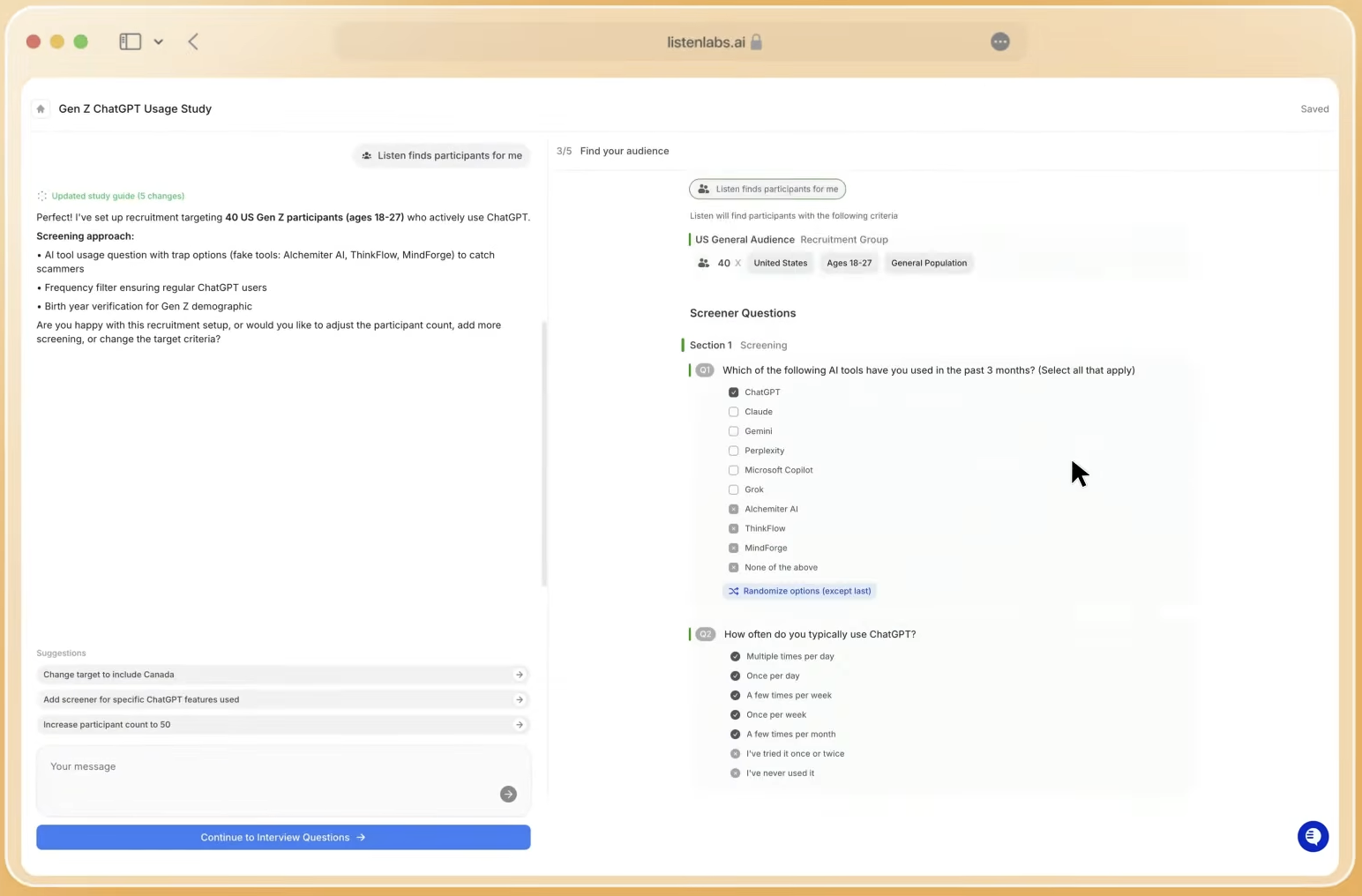
- Define screening criteria based on behavior and intent, not only self-reported demographics, to reach participants who actually match the use case.
- Set participant frequency limits, and cap participation at three studies per month per respondent to eliminate professional survey-takers.
- Use real-time quality monitoring across video, voice, content, and device signals so fraudulent profiles are detected before they contaminate the dataset.
- Engage a dedicated recruitment operations team for audiences below 1% incidence rate, such as enterprise decision-makers or healthcare workers.
- Allow self-recruitment from your own user base when studies require existing customers or active users.
Example prompt template: “Screen for participants who have [specific behavior] in the last [timeframe], exclude anyone who has completed more than [N] research studies this month, and flag any profile where self-reported demographics do not match behavioral signals.”
Step 4: Conduct Adaptive Interviews with Traceable Data Capture
AI-moderated interviews create value through adaptive follow-up that probes deeper on interesting or short answers the way a trained human interviewer would. AI-moderated interviews generate 3–5x more usable insights per respondent than static surveys, according to multiple 2025–2026 reports. Rich, traceable data capture at this stage makes downstream analysis auditable and defensible.
- Enable dynamic follow-up questions that respond to participant answers rather than following a fixed script so conversations feel natural.
- Capture video, audio, text, and screen recordings simultaneously to preserve multimodal context for later review.
- Combine qualitative open-ended questions with quantitative formats such as Likert scales, NPS, and MaxDiff within the same session.
- Timestamp every response segment so downstream codes and themes can be traced back to the exact moment in the interview.
- Support 100+ languages with automatic transcription and translation so global studies run without quality loss.
Example prompt template: “When a participant gives an answer shorter than [N] words or uses vague language like ‘it is fine’ or ‘I do not know,’ generate a follow-up probe that asks for a specific example or asks them to describe the last time they experienced [topic].”
Building a Defensible Audit Trail for AI Qualitative Studies
As you execute these interviews, every interaction needs to be logged in a traceable audit trail that makes your findings verifiable and defensible. An audit trail serves as the documentary backbone of any AI-assisted qualitative study. An audit trail for qualitative research must include dated entries recording design decisions, coding decisions, theme-level decisions, reflexive notes on positionality, and a specific log of AI involvement detailing what the tool suggested versus what was accepted or rejected and the grounds for those choices. Without this record, stakeholders cannot reproduce or confidently challenge the findings.
- Log every AI suggestion alongside the human decision, such as accepted, rejected, or modified, with a reason code for each choice.
- Record the AI model name, version, and prompt template used at each workflow stage so reviewers can understand the technical context.
- Store logs in append-only, tamper-proof storage with cryptographic integrity verification to protect against silent edits.
- Export logs promptly to your organization’s own systems because many AI providers retain native logs for only 30 days.
- Run a periodic tabletop test by picking a real finding and reconstructing every AI interaction that contributed to it to verify trail completeness.
Example prompt template: “For every theme you generate, return: the theme label, the codes that compose it, the number of source quotes supporting it, three representative verbatim quotes with participant ID and timestamp, and a confidence score. Flag any theme supported by fewer than [N] distinct participants.”
Step 5: Apply First-Pass AI Coding Then Validate
AI first-pass coding compresses what traditionally took weeks for 40 one-hour interviews into hours, but the output should be treated as a draft, not a final finding. The reliable 2026 workflow for AI qualitative analysis is hybrid: AI acts as a copilot handling 70–80% of mechanical work including summaries, code suggestions, and pattern detection, while humans validate every theme and review low-confidence outputs. Listen Labs’ Research Agent processes interview data objectively, identifies patterns across hundreds of responses, and links every insight directly to the underlying response data so researchers can verify before reporting. Anthropic used Listen Labs to understand Claude user churn, completed 300+ interviews in 48 hours, and surfaced churn drivers five times faster than previous methods, with a prioritized list of 10 must-fix items delivered directly to the product strategy team.
- Upload all transcripts and request broad summaries of key topics before applying any codebook so you see the landscape first.
- Have AI generate 4–6 candidate themes with descriptions, clustered codes, representative quotes, and confidence scores to seed your framework.
- Manually code a random 15–20% sample of AI-coded segments without seeing AI labels, then compare agreement, and treat below 85% agreement as a trigger for full codebook review.
- Merge, split, or retire codes based on human review before advancing to theme development so the structure reflects real data.
- Run the same coding prompt two or three times and compare outputs to detect inconsistency before you finalize the codebook.
Example prompt template: “Apply the attached codebook to these transcripts. For each coded segment, return the participant ID, the exact quote, the assigned code, and a confidence score from 0–100. Flag all segments below 75 confidence for human review. Do not infer codes not present in the codebook.”
Privacy and Compliance Requirements Across the Study Lifecycle
Before you advance to emotional intelligence analysis, confirm that your privacy and compliance framework is active and enforced. Privacy protection in AI qualitative research functions as both a legal obligation and an ethical baseline. The EU AI Act applies from 2 August 2026, with certain provisions, including high-risk obligations under Article 6, applying from 2 August 2027. Consent, encryption, and compliance need to be designed into the study before the first participant is recruited.
- Obtain explicit, layered consent before every session by disclosing that the interview is AI-moderated, describing what data is collected, explaining storage and deletion timelines, and providing a clear opt-out mechanism.
- Keep participant data out of model training or fine-tuning unless this use is explicitly disclosed and separately consented to by participants.
- Anonymize transcripts before sharing them with analysis tools and redact PII at the connector boundary rather than after the fact.
- Apply a clear retention schedule, such as raw recordings for 90 days, verbatim transcripts with identifiers for 6 months, anonymized transcripts for 12–24 months, and consent records for the duration of retention plus 3 years.
- Verify that every tool in the research stack holds current SOC 2 Type II, GDPR, ISO 27001, ISO 27701, and ISO 42001 certifications, and confirm that Listen Labs maintains all five.
Example prompt template: “Before processing these transcripts, confirm: (1) all names, locations, and identifying details have been redacted, (2) the data will not be used for model training, (3) outputs will be stored in [compliant environment], and (4) the processing purpose is limited to [defined research objective].”
Step 6: Layer Emotional Intelligence Analysis for Added Rigor
What participants say and what participants feel represent different data points that both matter. Transcripts capture spoken content, while emotional intelligence analysis captures the underlying emotional response. Platforms like Listen Labs layer on auto-recruiting, transcription, sentiment tagging, and insight summarization so teams jump from question to findings in hours, not weeks, and emotional signal analysis adds a rigor layer that pure text coding cannot match. Listen Labs’ Emotional Intelligence feature analyzes tone of voice, word choice, and subconscious micro-expressions across 50+ languages, built on Ekman’s universal emotions framework, with every emotion label traceable to the exact timestamp, verbatim quote, and reasoning behind it.
- Analyze tone of voice, word choice, and facial micro-expressions at the same time to surface emotions that transcripts alone miss.
- Quantify emotions per question and per concept, including anger, anticipation, disgust, fear, joy, sadness, trust, and surprise, to support cross-segment comparison.
- Pinpoint moments of confusion, hesitation, friction, and delight with timestamp-level precision for creative testing and usability studies.
- Obtain explicit consent before emotion analysis begins because participants who consent to a voice interview have not automatically consented to facial cue analysis.
- Cross-reference emotional signals against verbatim responses to identify gaps between stated and felt reactions, which often become the most actionable insight category for brand and concept research.
Example prompt template: “For each concept shown in the study, return: the dominant emotion per participant segment, the timestamp of peak emotional intensity, the verbatim quote associated with that moment, and a side-by-side emotional breakdown across all concepts tested. Flag any concept where confusion or disgust exceeds [threshold]%.”
Step 7: Synthesize, Report, and Iterate
The final stage converts verified findings into stakeholder-ready deliverables and feeds insights back into the research knowledge base for future studies. Industry studies suggest that researchers using AI shift more time toward strategic work such as study design, synthesis, and stakeholder communication. Listen Labs’ Research Agent handles the full analysis workflow from raw data to final output, generating slide decks, memos, highlight reels, and charts in under a minute, with every insight linking directly to the underlying response data. Skims used Listen Labs to validate campaign direction with thousands of high-income buyers overnight and gained qualitative clarity that translated customer reactions into insights leadership could trust, securing board-level buy-in before launch.
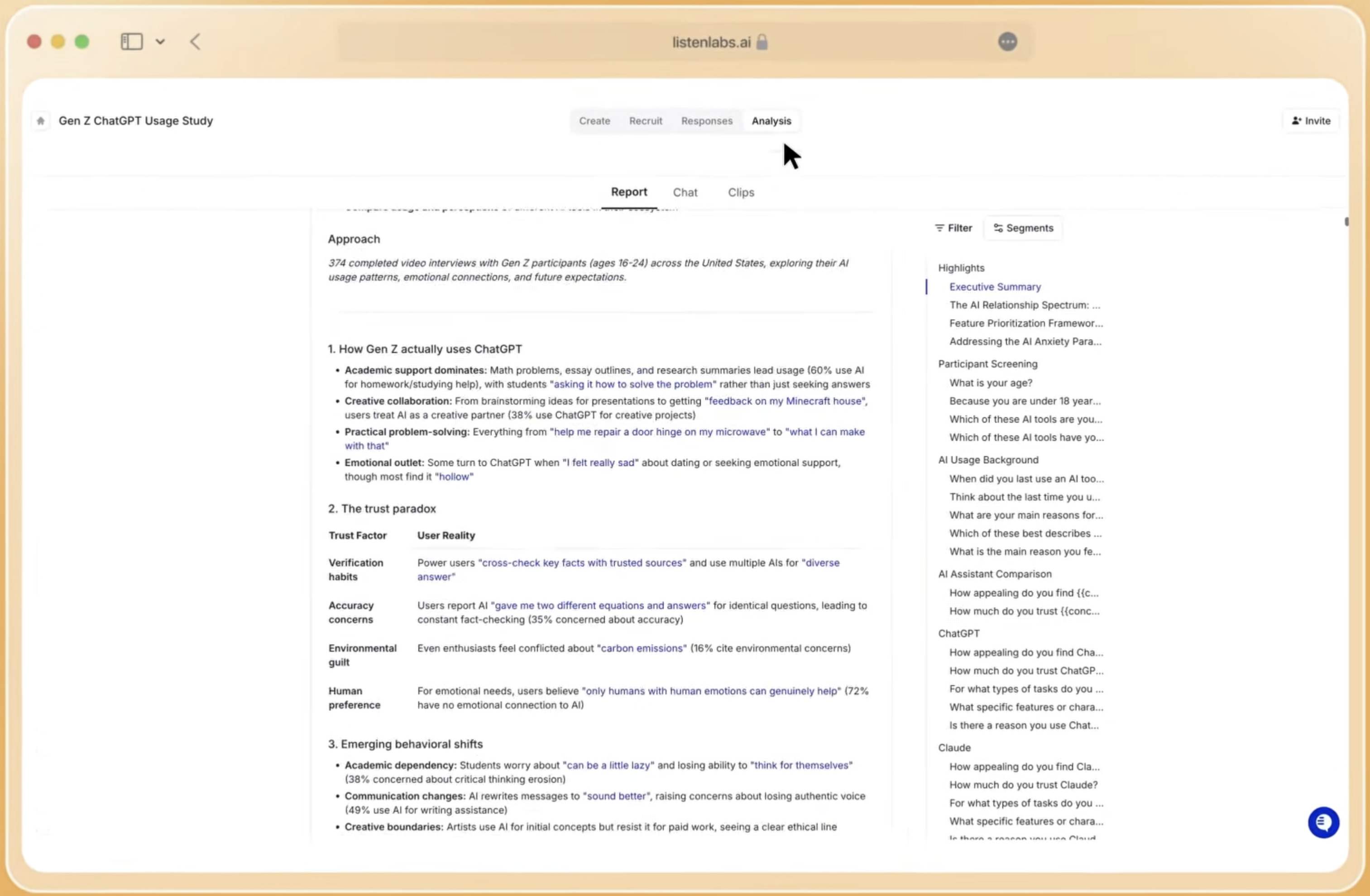
- Generate automated key findings, themes, and personas from interview data, then have a human researcher independently re-derive the top three themes from raw transcripts to verify alignment.
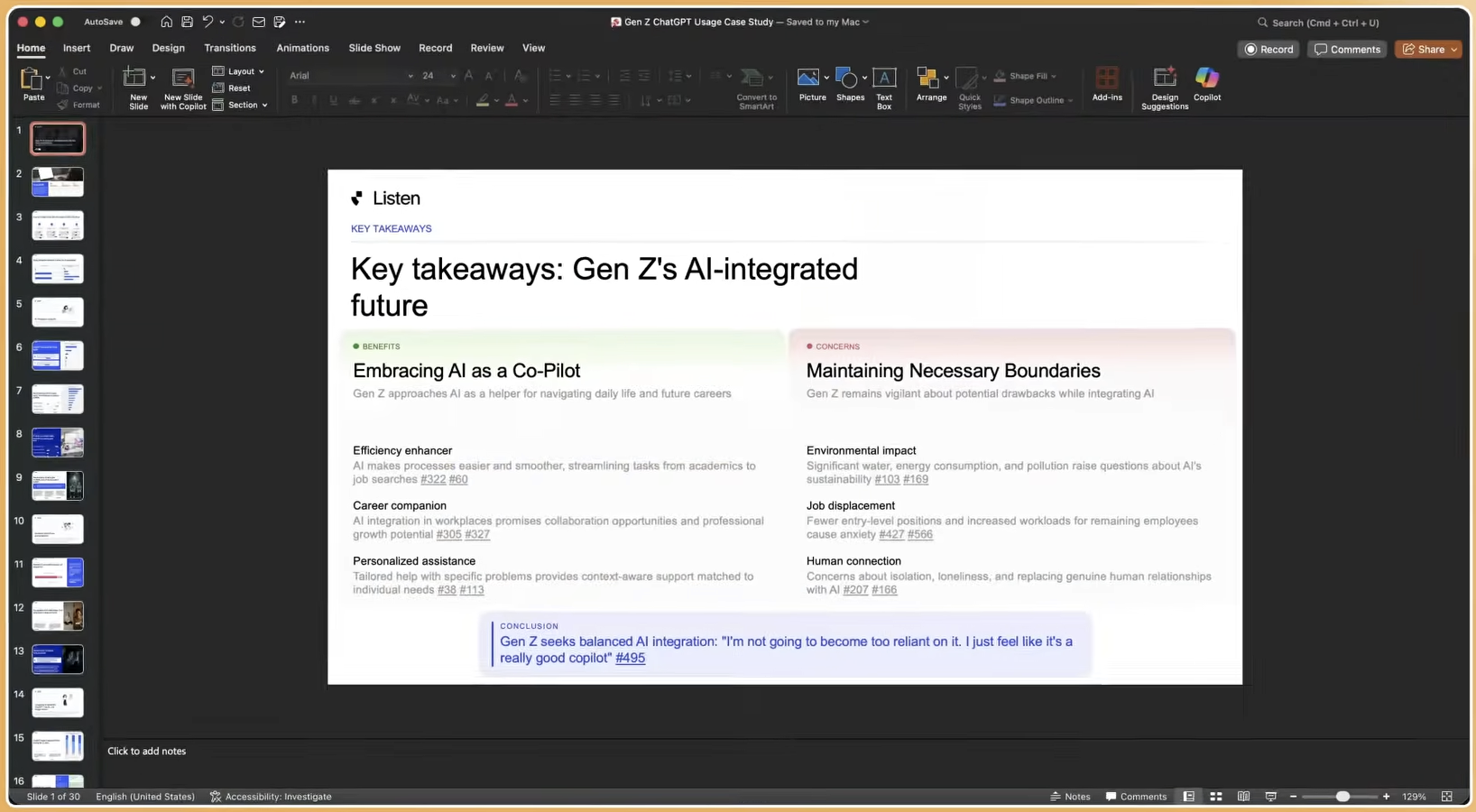
- Produce one-click deliverables such as branded slide decks, memo-style reports, video highlight reels, and statistical charts calibrated to each stakeholder’s format preference.
- Store all study outputs in a centralized knowledge base, such as Mission Control, so findings are queryable across studies and institutional knowledge compounds over time.
- Track customer sentiment, needs, and pain points across studies to identify longitudinal trends instead of treating each study as a one-off event.
- Document AI assistance in the methods section of every report by naming the tool, model version, and the verification steps applied.
Example prompt template: “Generate a findings memo that includes: the top five themes with prevalence counts, three verbatim quotes per theme, one disconfirming case per theme, and a recommended next action for each finding. Flag any theme supported by fewer than [N] participants as exploratory rather than conclusive.”
Verification Checklist
Before you share findings with stakeholders, use the verification checklist below to confirm that every quality control from Steps 1–7 has been executed. This checklist acts as your final audit gate and helps ensure that no step was skipped and that your study meets the rigor standards required for enterprise decision-making.
- Research objectives are written, approved, and scoped before any AI tool is activated.
- Discussion guide has passed human review for leading questions, double-barreled items, and jargon.
- Participants are sourced from verified, non-commodity panels with real-time fraud monitoring active.
- Participant frequency limits are enforced so no respondent has completed more than three studies this month.
- Explicit, layered consent is collected before each session, covering AI moderator identity, recording, data retention, and model training exclusion.
- All PII is redacted before transcripts enter any analysis tool.
- A named human reviewer is assigned to every AI output at each workflow stage.
- AI coding has been validated against a 15–20% human-coded sample with agreement documented.
- Every theme links to source quotes with participant ID and timestamp.
- Emotional signal analysis consent is separate from general interview consent.
- Audit trail entries are complete, including date, stage, AI suggestion, human decision, and reason code.
- Logs are stored in append-only, tamper-proof storage and exported to organizational systems.
- AI assistance is disclosed in the methods section with tool name, model version, and verification steps.
- At least one human researcher has independently re-derived the top themes from raw transcripts.
- Deliverables are stored in a centralized knowledge base for cross-study querying.
See how Listen Labs executes every item on this checklist in a live walkthrough of the platform.
Frequently Asked Questions
How do you prevent AI from hallucinating codes or fabricating quotes in qualitative analysis?
Hallucinated codes and fabricated quotes are a documented failure mode of general-purpose language models applied to qualitative data. Effective mitigation relies on three structural controls that work together. First, every AI-generated code or theme must link directly to a verbatim source quote with a participant ID and timestamp, and any output without that link is rejected. Second, a human researcher manually codes a random 15–20% sample of AI-coded segments without seeing the AI labels, then compares agreement, and any result below 85% triggers a full codebook review. Third, the same coding prompt is run two or three times and outputs are compared for consistency before any theme is accepted. Listen Labs’ Research Agent follows this traceability principle so every insight links directly to the underlying response data and the platform flags low-confidence outputs for mandatory human review instead of surfacing them as findings.
What consent language is required when using AI to moderate qualitative interviews?
Consent for AI-moderated interviews needs four specific elements presented in plain language before the session begins. Participants must know that the interview is conducted by an AI system rather than a human researcher, understand what data is collected including verbatim transcripts, audio, and video, and see clear details on storage location, access controls, and deletion timelines. They also need a clear opt-out mechanism that allows withdrawal at any point without consequence. If the platform analyzes emotional signals such as facial micro-expressions or tone of voice, that use must be disclosed separately because consent to a voice interview does not automatically cover emotion analysis. Consent records should be timestamped with the specific version of the consent notice presented and stored separately from interview data. Listen Labs captures affirmative consent before every session and supports consent versioning so re-consent workflows trigger when privacy practices change.
What data security certifications should an AI qualitative research platform hold?
Enterprise procurement teams treat SOC 2 Type II, GDPR compliance, ISO 27001, ISO 27701, and ISO 42001 as baseline requirements for any AI research platform entering their stack. SOC 2 Type II confirms that security controls have been independently audited over a sustained period rather than at a single point in time. ISO 27001 covers information security management, ISO 27701 extends that standard to privacy information management, and ISO 42001 addresses AI management systems specifically. GDPR compliance is mandatory for any study involving EU-based participants, regardless of where the research organization is headquartered. Listen Labs holds all five certifications, applies 256-bit encryption to participant data, and does not use customer data for AI model training.
Can product managers or marketing teams run AI qualitative studies without a research background?
Product managers and marketing teams can run AI qualitative studies when the platform design guides them through research best practices. Listen Labs allows non-researchers to describe research goals in natural language and then drafts structured objectives, discussion guide questions, and probing context automatically. The AI-assisted study co-design feature handles methodology selection, question sequencing, and logic branching, while Auto-QA flags issues in the guide before launch. Recruitment, moderation, analysis, and deliverable generation all run inside the same platform. The result is that a product manager or brand manager can initiate and receive results from a qualitative study without managing screeners, scheduling, transcription, or coding. For organizations with existing research teams, Listen Labs functions as a force multiplier that frees researchers from logistics so they can focus on strategic interpretation rather than replacing research expertise.
How does AI qualitative research handle emotional nuance that transcripts miss?
Transcripts capture what participants say but not hesitation, a frown during a concept reveal, or the flat affect that accompanies a polite but unconvinced response. Listen Labs’ Emotional Intelligence feature addresses this gap by analyzing tone of voice, word choice, and subconscious facial micro-expressions at the same time. Built on Ekman’s universal emotions framework, which is widely used in clinical psychology and UX research, the system quantifies emotions including anger, anticipation, disgust, fear, joy, sadness, trust, and surprise per question and per concept. Every emotion label is traceable to the exact timestamp, verbatim quote, and the reasoning behind the classification so researchers can verify why a specific moment was flagged as confusion or delight instead of accepting a black-box output. The feature works across 50+ languages and integrates with the Research Agent for natural-language queries, charts, and highlight reels of emotionally significant moments.
How does Listen Labs compare to using separate tools for recruitment, moderation, and analysis?
The fragmented research stack, where one tool handles recruitment, another handles scheduling, another handles interviews, another handles transcription, and another handles analysis, introduces delay, cost, and quality loss at every handoff. Listen Labs replaces those vendors with a single end-to-end platform that covers AI-assisted study design, global participant recruitment from a verified network spanning 45+ countries, AI-moderated video interviews with dynamic follow-ups, automated analysis, and one-click deliverables including branded slide decks, memos, video highlight reels, and statistical charts. Mission Control then stores every study’s findings in a centralized knowledge base, enabling cross-study queries and trend tracking so institutional knowledge compounds instead of being lost between projects. The result is a research cycle that compresses from 4–6 weeks to under 24 hours at roughly one-third of the cost of the traditional multi-vendor approach.
Conclusion: Turn AI Qualitative Research Best Practices into Enterprise Reality
The seven-step framework above, from objective definition and guardrailed study design through human-in-the-loop oversight, verified recruitment, adaptive interviews, auditable coding, emotional intelligence analysis, and synthesized reporting, reflects the current standard for rigorous AI qualitative research in 2026. Each step preserves the methodological integrity that makes consumer insights actionable while removing the time, cost, and scale constraints that once forced a trade-off between depth and breadth.
Listen Labs is the only end-to-end platform that operationalizes every step of this framework within a single system. Study design, participant sourcing from 30M verified respondents across 45+ countries, AI-moderated interviews in 100+ languages, emotional intelligence analysis, Research Agent synthesis, and Mission Control knowledge management all connect with full traceability, enterprise-grade security, and the certifications enterprise procurement requires. Microsoft, Anthropic, P&G, Skims, Robinhood, Google, Sony, and Nestlé have already made this shift. The framework above compresses what traditionally took 4–6 weeks into a 24-hour cycle, the speed increase enterprises like these have already operationalized.
See how these best practices apply to your next study and schedule a walkthrough with the Listen Labs research team.