Written by: Anish Rao, Head of Growth, Listen Labs | Last updated: July 20, 2026
Key Takeaways for Time-Strapped PMs
- Traditional research methods force PMs to choose between depth and speed, often requiring 4–6 weeks and multiple vendors for a single qualitative study.
- Listen Labs is the only platform that collapses the full research lifecycle, including recruitment, AI-moderated interviews, emotional analysis, and deliverables, into under 24 hours while maintaining enterprise-grade compliance.
- Key evaluation criteria for AI research tools include speed, qualitative depth at scale, fraud prevention, emotional signal capture, and minimal operational burden across fragmented stacks.
- PMs without dedicated research headcount or facing backlogs gain the most from end-to-end AI platforms that eliminate handoffs and enable sprint-cycle validation.
- Ready to run qual at scale in hours instead of weeks? Book a demo with Listen Labs to see how the platform closes the research gap in a single working day.
Evaluation Criteria for AI Research Tools
Before comparing platforms, establish the criteria. The ten dimensions below map directly to PM constraints and are used throughout this guide. These criteria separate tools that automate isolated tasks from platforms that compress the entire research lifecycle.
- Research speed, elapsed time from study brief to actionable deliverable
- Qualitative depth at scale, ability to run adaptive, probing interviews across large samples simultaneously
- Participant quality and fraud prevention, screening rigor, behavioral verification, and real-time monitoring
- Emotional signal capture, detection of tone, micro-expressions, and subconscious cues beyond transcripts
- Methodological flexibility, support for IDIs, concept tests, usability studies, diary studies, and mixed methods
- Global and multilingual reach, geographic coverage, language support, and localization
- Analysis effort, share of synthesis work handled automatically versus manually
- Deliverable speed and transparency, time to stakeholder-ready output and traceability to source data
- Security and compliance, SOC 2, GDPR, ISO certifications, and data handling policies
- Total operational burden, number of tools, handoffs, and vendor relationships required
Qualitative analysis often consumes a substantial portion of the total project timeline on traditional research engagements. Most of that time goes into manual coding and theme clustering rather than data collection. Criteria 7 and 10 therefore carry disproportionate weight for time-constrained PMs.
Category-by-Category Platform Comparisons
The analysis below compares platform categories for a representative 30-respondent qualitative study, focusing on operational burden, time requirements, and PM task ownership. The key differentiator is operational load, meaning how many tools and handoffs each approach requires to move from research question to actionable insight.
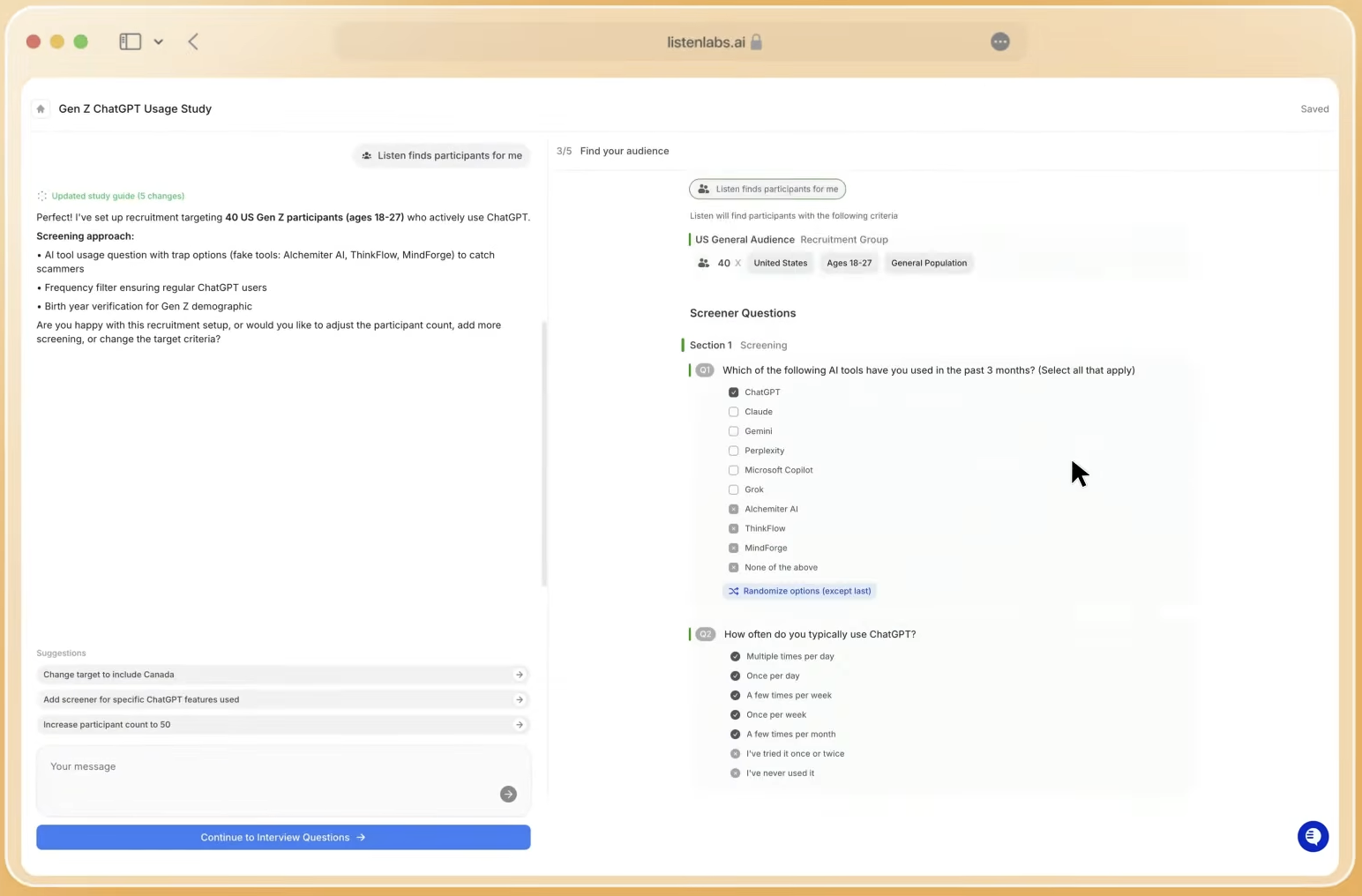
Listen Labs handles the entire lifecycle through a single platform. Listen Atlas, its AI orchestration layer, matches and recruits from a verified network of 30 million respondents across 45+ countries. Once participants are recruited, Quality Guard monitors every interview in real time for fraud, low-effort responses, and repeat participants, with a hard limit of three studies per month per participant to eliminate professional survey-takers. During these monitored sessions, the AI moderator conducts adaptive video interviews with dynamic follow-up questions across 100+ languages. Emotional Intelligence analyzes three signal layers, tone of voice, word choice, and subconscious micro-expressions, with every emotion quantified per question and traceable to the exact timestamp, verbatim quote, and AI reasoning behind it, built on Ekman's universal emotions framework. Research Agent then handles the full analysis workflow from raw data to final output, with every insight linking directly to the underlying response data. Mission Control stores all findings as a queryable institutional knowledge base, so teams never re-research a question already answered. This end-to-end integration contrasts sharply with traditional approaches.
Traditional research agencies deliver high methodological quality but traditional focus groups alone cost $4,000–$12,000 per 90-minute session and take 3–5 weeks. Full qualitative cycles routinely match this extended timeline. The PM's operational burden is high, including briefing, review cycles, stakeholder alignment, and long periods of waiting between steps.
Survey tools combined with panel providers such as SurveyMonkey or Qualtrics paired with Prolific or Respondent scale to large samples but sacrifice depth entirely. These setups provide no follow-up questions, no probing, and limited ability to surface unexpected findings. Recruitment and moderation remain separate contracts, which increases coordination work. Human moderators are limited in the number of high-quality conversations they can conduct concurrently, and each conversation involves substantial costs for recruiting, scheduling, transcription, and synthesis. Large-sample qualitative research becomes economically impractical without AI support.
Analysis and repository tools such as Dovetail organize research that has already been conducted elsewhere. These tools do not recruit participants, conduct interviews, or generate new insights. They address criteria 7 and 8 only, leaving the other eight criteria unresolved and still dependent on separate vendors or tools.
Human-moderated testing platforms such as UserTesting rely on a human-dependent moderation model. A 20-person full-service in-depth interview study with human moderators costs $25K–$75K and takes 6–12 weeks. Parallel execution is not possible at scale, which creates a hard ceiling on sample size and turnaround speed.
Best-Fit Scenarios for Different PM Teams
Enterprise insights teams with research backlogs face a structural problem. Many researchers struggle to keep up with the volume of requests from their organization. Listen Labs functions as a force multiplier, enabling the same team to run significantly more studies per quarter without proportional headcount increases. Microsoft used Listen Labs to collect global customer stories for its 50th anniversary within a single day.
UX researchers running sprint-cycle validation need results before the next planning session. A Perspective AI panel of 180 product and research teams found that median time-to-insight for customer discovery collapsed from 12 weeks in 2024 to 18 hours in Q1 2026. Listen Labs' screen-sharing and usability testing capabilities, combined with Emotional Intelligence that flags hesitation and friction at timestamp level, make it directly applicable to prototype and concept testing within a sprint. These capabilities keep UX teams aligned with agile delivery schedules.
PMs without dedicated research headcount represent the fastest-growing research segment. The Maze 2026 Future of User Research Report found that product managers now conduct 39% of research studies, overtaking dedicated researchers in many organizations. Listen Labs' natural-language study design means a PM can describe research goals conversationally and have the platform handle study design, recruitment, moderation, and analysis automatically. This shift lets PMs validate decisions without waiting for scarce research resources.
Agencies and consultancies operating on client timelines measured in days rather than weeks can use Listen Labs to run bespoke studies for each engagement without building a dedicated research operations function. The platform's ability to recruit audiences below 1% incidence rate, including enterprise decision-makers, healthcare workers, and engineers, addresses the niche sourcing challenge that typically extends agency timelines.
Operational Considerations and Risks
Switching to an AI research platform requires stakeholder alignment on what “quality” means. Teams accustomed to small-sample human-moderated studies may initially question findings from 50 or 100 AI-moderated interviews. The evidence supports confidence at larger samples. With 5-10 interviews teams obtain directional signals, while 12-15 interviews usually reach thematic saturation for patterns that can be acted on.
Compliance and data governance remain non-negotiable for enterprise adoption. Listen Labs holds SOC 2 Type II, GDPR, ISO 27001, ISO 27701, and ISO 42001 certifications, with 256-bit encryption and a policy against using customer data for AI model training.
Objective risks exist across all platform categories and should be evaluated honestly. These risks cluster into five areas that affect data quality and delivery speed.
- Shallow data risk, where survey tools and unmoderated studies produce stated attitudes that often diverge from actual behavior
- Slow manual workflows, where traditional agencies and human-moderated platforms cannot compress timelines below 2–3 weeks regardless of budget
- Hidden recruitment complexity, where panel and recruitment platforms solve sourcing but leave moderation, analysis, and deliverables as separate problems requiring additional tools and handoffs
- Fraud and panel quality, where screener fraud is endemic in online panels because respondents learn to answer screeners strategically, and platforms without real-time behavioral monitoring cannot detect this at scale
- Overestimating automation, where Kantar's practice guidance notes that the quality of AI output is highly dependent on the quality of inputs throughout the research process, including prompts, sample design, and screener rigor, so AI cannot compensate for poor study design
See how Listen Labs addresses each of these risks in a live walkthrough of the platform.
Decision Framework and Checklist for PMs
Use the checklist below to match platform type to your constraints. The more items you check, the stronger the case for an end-to-end AI research platform over a fragmented stack.
- You need results in less than one week, not 4–6 weeks
- You need more than 15 interviews per study to achieve segment-level confidence
- You lack dedicated research headcount or face a growing backlog
- You need to capture emotional signals beyond what transcripts reveal
- You operate across multiple markets or languages
- You spend more than 2 hours per study on recruitment logistics
- Your synthesis currently takes more than one day per study
- Stakeholders require traceable, source-linked findings rather than summarized reports
- You need enterprise-grade security and compliance certifications
- You are currently using three or more separate tools to complete a single research cycle
If you checked seven or more items, a fragmented stack of point solutions is costing you time, quality, and institutional knowledge. The average custom research project touches six or more tools, and fragmented stacks cause context loss including the reasoning behind screener quotas, added probes, and why certain findings were elevated or omitted. An end-to-end platform removes those handoffs entirely.
Frequently Asked Questions
How quickly can an AI research tool deliver results for a 30-respondent study?
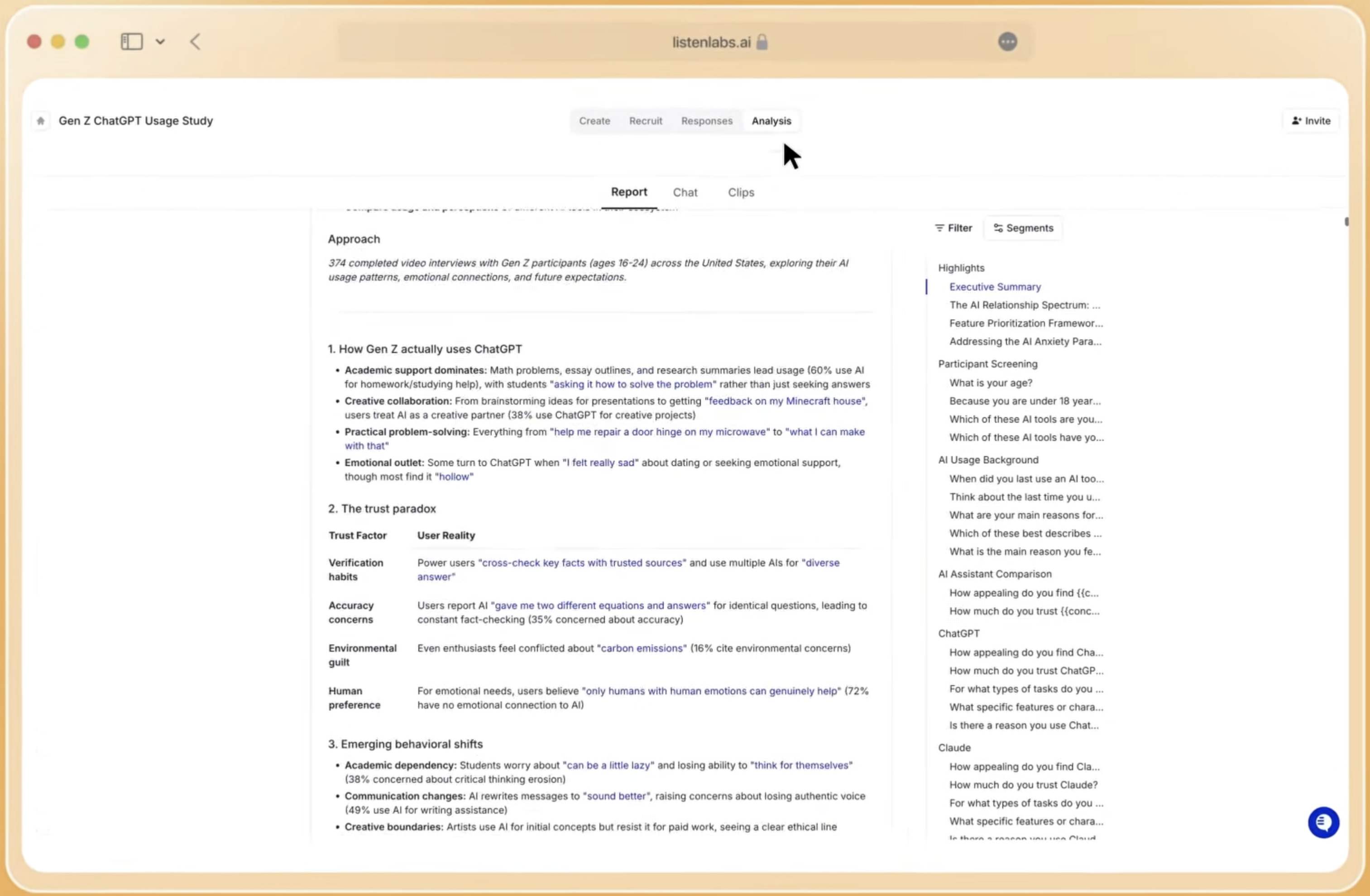
Listen Labs delivers results for a 30-respondent study in less than 24 hours. The platform handles recruitment from its global respondent network, runs AI-moderated video interviews in parallel, and generates stakeholder-ready deliverables, including slide decks, memos, video highlight reels, and statistical charts, automatically through the Research Agent. The PM's total time investment is approximately 30 minutes for study design and 30 minutes reviewing synthesized output. Traditional human-moderated equivalents require the same multi-week timeline mentioned earlier, with the majority of that time spent on recruitment coordination, scheduling, and manual synthesis.
Where do platforms source participants and how do they prevent fraud?
Participant sourcing and fraud prevention vary significantly across platform types. Listen Labs uses Listen Atlas, an AI orchestration layer that recruits from the verified global network described earlier, matching on behavioral and intent data rather than self-reported demographics alone. Quality Guard monitors every interview in real time across video, voice, content, and device signals to detect fraud, low-effort responses, AI-generated scripts, and mismatched profiles. Participants are capped at three studies per month to eliminate professional survey-takers. A dedicated recruitment operations team adds a human review layer for hard-to-reach segments, including audiences below 1% incidence rate. Panel-only platforms such as Prolific, User Interviews, and Respondent solve sourcing but do not provide real-time in-interview quality monitoring or integrated moderation. Commodity quantitative panels carry the highest fraud risk because they rely on self-reported screeners without behavioral verification.
How does emotional signal capture differ between AI-moderated interviews and traditional methods?
Traditional research methods capture only what participants say, through transcripts, survey responses, and self-reported ratings. Critical emotional signals such as a moment of hesitation, a suppressed frown, or vocal tension never enter the dataset. Listen Labs' Emotional Intelligence addresses this gap by analyzing three signal layers simultaneously, tone of voice, word choice, and subconscious micro-expressions. Built on Ekman's universal emotions framework, the same standard used in clinical psychology and UX research, it tracks anger, anticipation, disgust, fear, joy, sadness, trust, and surprise. Every emotion label is quantified per question and concept, and every label is traceable to the exact timestamp, verbatim quote, and the AI reasoning behind it. This structure means a PM can ask which concept triggered the most confusion and receive a side-by-side emotional breakdown across stimuli, segments, and markets, with clip-level evidence. The feature is available across 50+ languages and integrates directly with the Research Agent for natural-language queries and highlight reels of emotionally significant moments.
What multilingual and compliance capabilities should PMs require for global research?
For global research programs, PMs should require native multilingual interview support, not post-hoc translation, so that participants respond in their preferred language without friction or cultural distortion. Listen Labs supports 100+ languages for interview moderation with automatic transcription and translation, and covers 45+ countries across the Americas, Europe, APAC, and MEA. On compliance, enterprise-grade requirements include SOC 2 Type II, GDPR, ISO 27001 for information security management, ISO 27701 for privacy information management, and ISO 42001 for AI management systems. Listen Labs holds all five certifications, uses 256-bit encryption, and does not use customer data for AI model training. PMs evaluating platforms for regulated industries or cross-border data transfers should verify each certification independently and confirm that data residency requirements can be met before committing to a platform.
Conclusion: Selecting an AI Research Platform That Matches Your Workflow
The evaluation reduces to a structural question about your stack. Count how many separate tools, vendors, and handoffs your current research process requires, and what each handoff costs in time, context, and quality. With qual-at-scale, the old trade-off between depth and scale is no longer a barrier, but only on platforms that handle the full lifecycle without fragmentation.
Listen Labs is the only platform that replaces recruitment vendors, moderation tools, transcription services, analysis repositories, and report-writing workflows with a single end-to-end solution. Its global respondent network, Quality Guard fraud prevention, Emotional Intelligence built on Ekman's framework with timestamp-level traceability, Research Agent for one-click deliverables, and Mission Control institutional knowledge base combine to deliver consultant-quality outputs in under a day. Enterprises including Microsoft, Google, Anthropic, Procter & Gamble, Skims, and Nestlé run production research on the platform at scale.
Ready to see how this model fits your team? Schedule a personalized demo to see qual-at-scale in action for your organization.