
Written by: Anish Rao, Head of Growth, Listen Labs | Last updated: July 24, 2026
Key Takeaways
- Traditional surveys measure known metrics at scale but cannot explain the “why” behind customer behavior.
- AI-moderated interviews deliver adaptive depth, emotional signals, and unexpected themes at survey-like speed and scale.
- Listen Labs compresses the full research lifecycle to under 24 hours while maintaining research-grade quality and fraud prevention.
- Hybrid programs that start with AI interviews and follow with targeted surveys provide both statistical confidence and explanatory power at lower total cost.
- See Listen Labs match your goals to the right method in a live walkthrough of the platform.
How Surveys and AI Interviews Actually Differ
Traditional surveys present a fixed set of questions to large respondent pools, producing structured, quantifiable data suited to measuring known patterns across defined populations. AI-moderated interviews run adaptive, conversational sessions where the AI probes dynamically based on each participant’s responses. This approach surfaces motivations, emotional drivers, and context that explain why customers behave the way they do. Traditional surveys may tell us what people do, but it takes a conversation to understand why.
Quick Reference: Matching Research Objectives to Method
The research objective determines whether surveys or AI-moderated interviews fit best. Surveys are the correct tool when a specific metric such as NPS or CSAT must be tracked consistently over time, when the question set is fully defined and closed-ended, when statistical representativeness across a large population is required, or when outputs feed quantitative models such as conjoint or Van Westendorp pricing studies. These scenarios share a common requirement: the research question is already known, and the goal is measurement rather than discovery. Surveys retain a clear advantage for known-question quantitative reporting at fixed sample sizes, brand trackers requiring locked batteries at n=400+, demographic segmentation with quota fills, and large-scale internal pulse surveys at n=10,000+.
AI-moderated interviews are the stronger choice when the goal is to understand the “why” behind a behavior, when answer options are unknown in advance, when the study involves exploratory discovery, concept testing, churn diagnosis, or win/loss analysis, or when both statistical confidence and qualitative nuance are required in a single study. With qual-at-scale, the old trade-off between depth and scale no longer blocks ambitious research questions.
See how we match your research goals to the right method in a live walkthrough of the platform.
Research Speed and Time-to-Insight
A typical enterprise qualitative research cycle runs four to six weeks from study design to final report. Internal prioritization, budget approval, and team backlog can stretch that to six months. According to Perspective AI’s 2026 State of AI Customer Discovery Tools report, median time-to-insight compressed from 21 days to 6 days. Listen Labs compresses the full research lifecycle, including study design, recruitment, moderation, analysis, and deliverables, to under 24 hours.
The speed advantage compounds at the organizational level. Gartner analysis found that untimely risk response in strategic initiatives delays product launches by an average of five weeks per year, costing an average $5 billion revenue company $99 million annually in opportunity cost. This time compression pairs with richer responses. A University of Mannheim between-subjects study found that AI-moderated interview respondents produced longer responses with approximately 51% more unique words and higher lexical diversity than static survey responses, while covering a broader range of unique themes. A separate Human Highway study found that AI-moderated responses were longer than traditional survey responses with more distinct concepts per response.
Depth of Insight from AI Conversations
Depth of insight matters as much as speed. Surveys are structurally limited to the questions researchers think to ask. A 12-question survey produces at most 12 data points per respondent, and Pew Research analysis of survey response patterns found that open-ended survey questions suffer from high non-response and low-quality single-word answers. AI-moderated interviews operate differently. The AI probes five to seven laddering levels per topic, following each participant’s actual responses rather than a fixed script.
Analysis of 10,000+ AI-moderated interviews shows an average response length of 180 words per question, with 73% of responses including unprompted elaboration beyond the direct question. Critically, the Mannheim study confirmed that AI moderation changes response richness without distorting content. The same thematic framework applied across both methods with comparable relative importance.
Listen Labs’ AI moderator applies this adaptive depth across every session simultaneously, conducting what amounts to thousands of parallel in-depth interviews. With AI-moderated interviews, talking to users at scale is no longer the hard part. The challenge is understanding what they mean. The Research Agent addresses that challenge by automating theme extraction, segmentation, and deliverable generation.
Sample Quality and Fraud Prevention
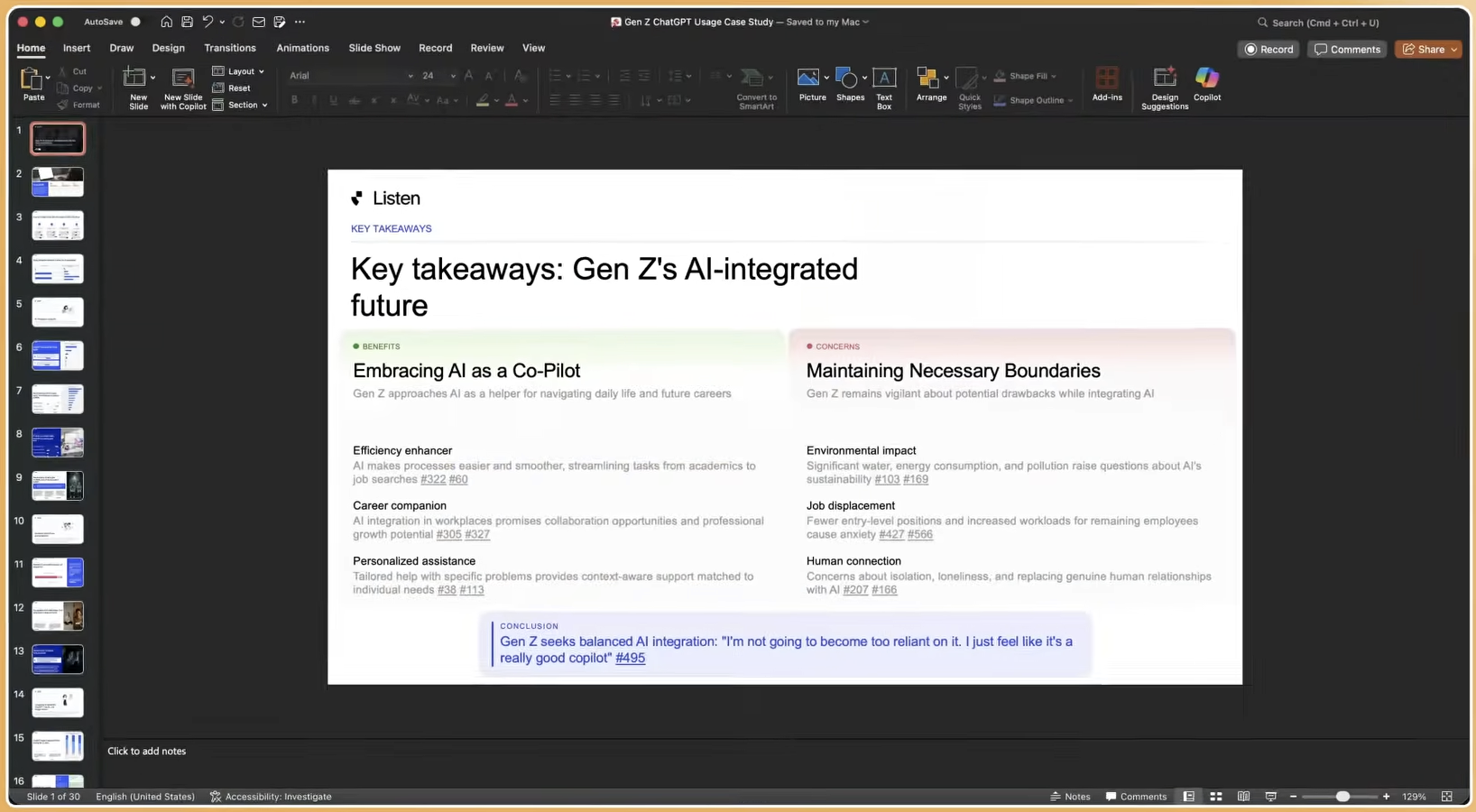
Sample quality directly affects research reliability. Commodity survey panels carry a well-documented fraud problem. Researchers are discarding on average 38% of survey data due to quality concerns, according to Kantar. The same pattern appears in completion behavior. Industry analysis indicates 3% of devices complete 19% of all surveys.
Listen Labs addresses this through Quality Guard, a multi-layer system that combines behavioral matching on intent and past actions rather than self-reported demographics, real-time AI monitoring across video, voice, content, and device signals, and a hard cap of three studies per month per participant to eliminate professional respondents. This technical layer works in tandem with sourcing strategy. The 30M verified respondents in Listen Atlas are sourced exclusively from high-quality, non-commodity panels, not the same pools that produce 38% fraud rates. For hard-to-reach segments such as enterprise decision-makers, healthcare workers, and audiences below 1% incidence rate, a dedicated recruitment operations team adds a human review layer to ensure profile accuracy. Perspective AI’s 2026 report documented an 87% completion rate for AI interviews versus 34% for human-led video studies on the same recruit pool.
Global and Multilingual Research at Scale
Global qualitative research often stalls on logistics and cost. Traditional multilingual qualitative research requires in-country partners, local moderators, transcription services, and translation vendors. Traditional bilingual moderator approaches involve high costs and extended timelines. Most enterprise programs respond by studying only three to four priority markets and extrapolating findings globally.
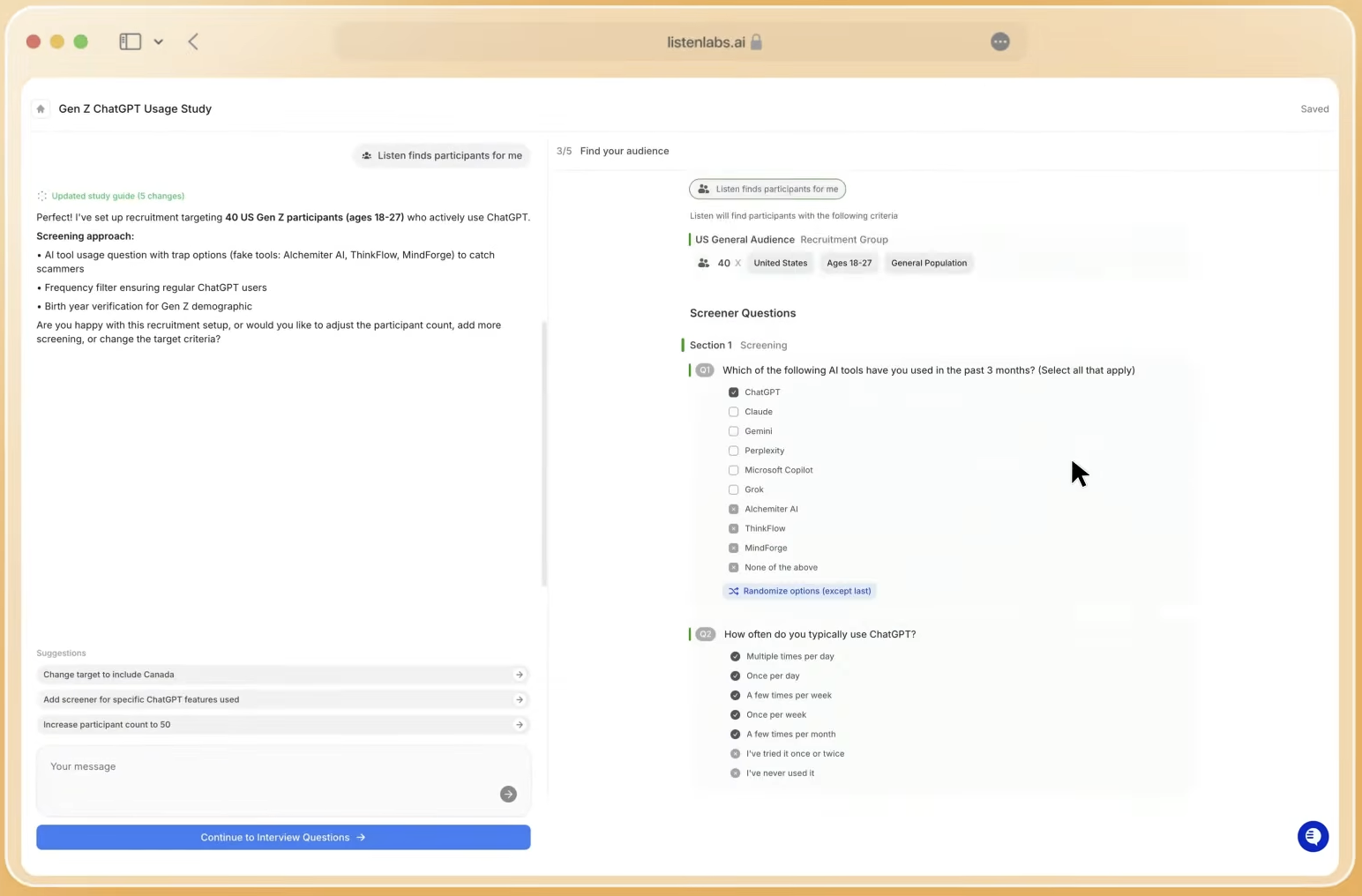
Listen Labs conducts native-language AI-moderated interviews across 100+ languages in 45+ countries, with automatic translation and transcription included. A three-language qualitative study with 20 participants per language using AI-moderated native-language interviews can complete fieldwork in 24 hours and deliver findings in three to five days total. This capability enables enterprise teams to develop distinct consumer understanding across markets such as Tokyo, Jakarta, Mumbai, and São Paulo rather than treating entire regions as single data points.
Emotional-Signal Capture in Customer Conversations
Emotional signals often explain behavior that stated preferences cannot. Surveys capture what participants choose to report. They cannot detect the hesitation before a positive answer, the micro-expression of confusion during a concept description, or the tonal shift that signals genuine enthusiasm versus polite agreement. Surveys measure stated preferences and produce scores but do not capture hesitation, emotional context, tone shifts, or the reasoning behind choices that drive real purchase decisions.
Listen Labs’ Emotional Intelligence layer analyzes three simultaneous signal streams, including tone of voice, word choice, and subconscious micro-expressions, built on Ekman’s universal emotions framework, the same standard used in clinical psychology and UX research. This foundation enables the system to track eight core emotions (anger, anticipation, disgust, fear, joy, sadness, trust, and surprise) across 50+ languages with clinical-grade accuracy. Every emotion is quantified per question and concept, and every label is traceable to the exact timestamp, verbatim quote, and the reasoning behind it, which keeps findings auditable rather than opaque. The system integrates directly with the Research Agent, allowing researchers to query emotional patterns in natural language, generate charts comparing emotional responses across segments, and create highlight reels of emotionally significant moments. Two concepts may both receive positive ratings in a survey, yet Emotional Intelligence reveals which one triggered genuine delight and which produced flat or confused responses.
Analysis Effort and Total Cost of Ownership
Analysis workload and total cost shape how much research teams can realistically run. Traditional qualitative research requires manual coding, multi-vendor coordination, and significant analyst time to move from raw transcripts to stakeholder-ready deliverables. A traditional qualitative study with 20 in-depth interviews costs $15,000–$40,000 including recruiting, scheduling, moderation, and analysis. Survey platforms add their own cost layer, and a typical study from a general consumer panel takes several weeks.
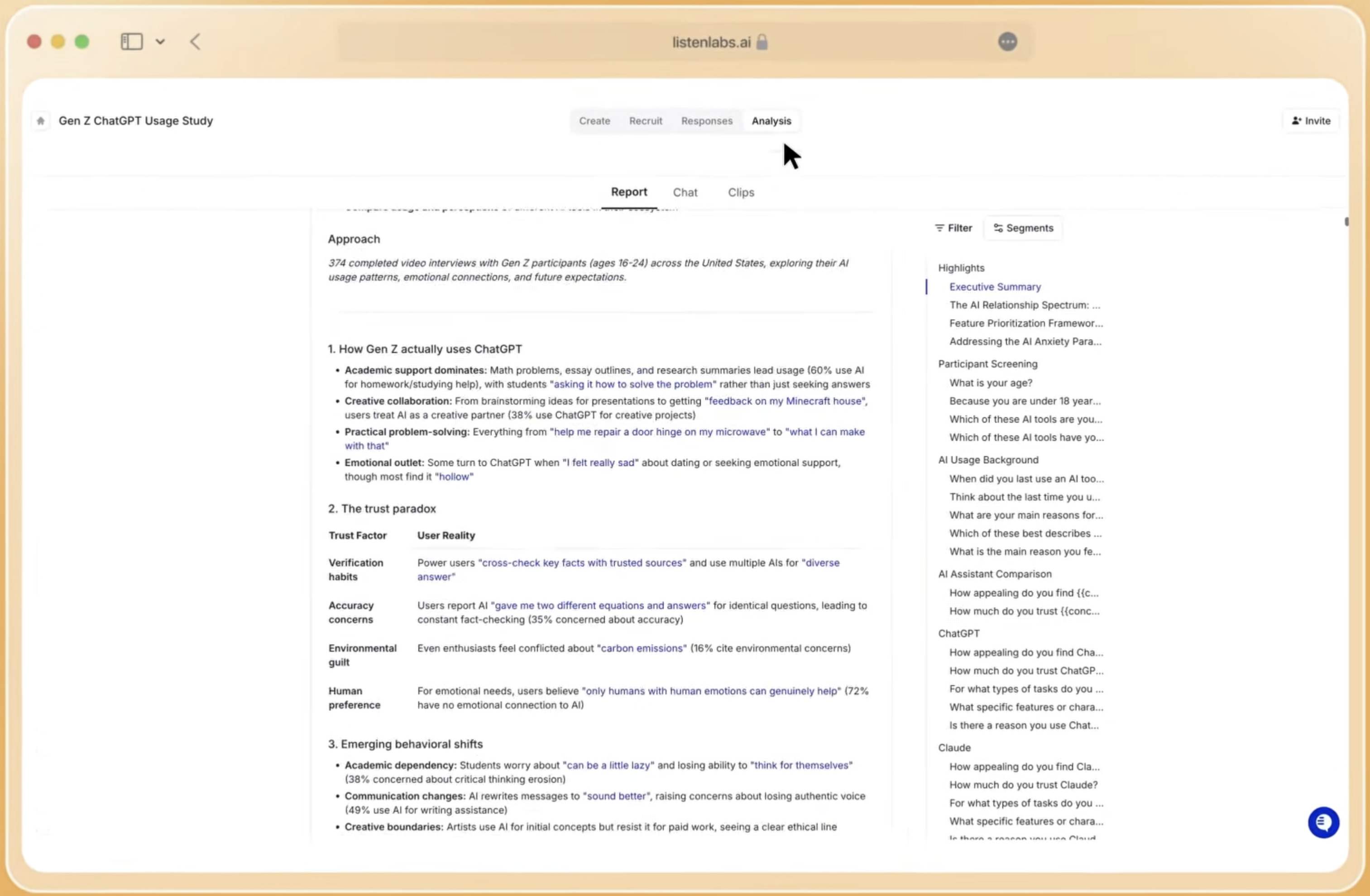
Listen Labs replaces multiple vendors and tools with a single end-to-end platform. The Research Agent generates automated key findings, theme analysis, consultant-quality slide decks, memo-style reports, video highlight reels, statistical charts, and segmentation breakdowns, deliverables that traditionally require days of analyst time. This automation compresses analysis cycles. One researcher ran a full buying intent analysis across three user segments in under a minute, a task that would typically require manual coding and cross-tabulation. The speed and automation combine to reduce total cost. Enterprises run more studies at one-third the cost of traditional approaches, as confirmed by Microsoft’s Director of Data Science: “I can reach out to hundreds of users at one third of the cost.”
Compare your current research costs with a live cost-per-insight breakdown in a platform demo.
When Surveys Remain the Right Tool
Surveys still play a critical role in modern research stacks. Surveys are the correct primary method for longitudinal tracking studies where question consistency across waves is essential to preserve trend analysis. NPS, CSAT, and CES programs depend on locked question batteries that produce statistically comparable data over time. Surveys also remain appropriate for large-scale demographic segmentation studies requiring quota fills at n=400 or above, for pricing research using conjoint or Van Westendorp methodologies that require structured choice interfaces, and for regulatory or compliance contexts where standardized question administration is a requirement. According to Perspective AI’s 2026 report, many research teams still conduct survey studies but at reduced volumes.
When AI Interviews Deliver Clear Advantage
The inverse scenarios, where AI interviews outperform surveys, are equally clear. On the other side of the decision matrix, AI-moderated interviews deliver a clear advantage for exploratory research where answer options are not yet known, concept and prototype testing where emotional and motivational reactions matter, churn diagnosis where the goal is to understand why customers leave rather than count how many, and win/loss analysis where context and sequence are essential. Multiple independent studies show respondents disclose more sensitive information to AI interviewers than to human moderators because there is no perceived social judgment, which allows AI conversations to probe disclosures that surveys cannot follow up on.
Any study that needs both statistical confidence and qualitative nuance, such as concept testing at n=200, segmented churn analysis, or global brand perception research, belongs in this category. Switching to Listen Labs AI-moderated interviews let Chubbies capture hundreds of candid, one-to-one conversations overnight. Anthropic’s Director of Product Strategy confirmed the same pattern at enterprise scale: “Listen Labs lets us understand user churn with a level of clarity and speed we’ve never had before,” following 300+ user interviews completed in 48 hours that surfaced churn drivers five times faster than previous methods.
Hybrid Methodology: AI Interviews First, Then Targeted Surveys
Hybrid programs combine the strengths of both methods in a single workflow. The most effective enterprise research programs use AI-moderated interviews and surveys as complementary layers rather than competing alternatives. The recommended sequence runs 50–150 AI-moderated interviews to surface themes, emotional drivers, and unexpected findings, then deploys a targeted survey to measure the prevalence of those themes across a larger population. A hybrid approach of AI interviews followed by a targeted survey can be completed more quickly and at lower cost than sequential traditional qualitative and quantitative phases, which often take eight to twelve weeks.
Microsoft used this approach to collect global customer stories for its 50th anniversary celebration within a single day. P&G deployed Listen Labs to conduct 250+ interviews with quantified themes and verbatim proof, directly shaping product and brand strategy in hours rather than weeks. Skims validated campaign direction with thousands of high-income buyers overnight, enabling board-level buy-in before a global launch. Anthropic identified where former Claude users migrate and delivered a prioritized list of ten must-fix items from 300+ interviews in 48 hours. Each of these programs used AI interviews to generate the explanatory layer that surveys alone could not provide, then used quantitative methods where statistical representativeness was required. Despite these proven results, teams evaluating AI-moderated interviews often raise similar questions.
Addressing Common Objections
Quality of moderation, data security, and team impact are the most common concerns. The most frequent concern about AI-moderated interviews is whether the AI matches the quality of a trained human moderator. A 2025 ACL study by Wuttke and colleagues randomly assigned participants to AI or human interviewers using identical guides. Listen Labs’ in-house research team, with 50+ years of combined expertise, continuously reviews and refines the methodology, ensuring the platform maintains research-grade rigor across every study type.
Data security concerns center on compliance and model training. Listen Labs holds SOC 2 Type II, GDPR, ISO 27001, ISO 27701, and ISO 42001 certifications. Customer data is never used for AI model training, and all data is protected with 256-bit encryption. Enterprise SSO is supported.
Teams also ask whether AI replaces researchers or augments them. Listen Labs is designed as a force multiplier for existing research teams. Researchers who have adopted AI-moderated interviews report conducting substantially more research per quarter without adding headcount. The platform handles logistics, moderation, and analysis so researchers can focus on strategic interpretation and stakeholder engagement.
Decision Checklist for Your Next Study
Survey-first or interview-first decisions follow a simple pattern. When the research goal is to measure a known metric consistently over time, the right tool is a survey. When the goal is to understand why a metric moved, or to discover what questions to ask in the first place, AI-moderated interviews are the stronger choice. When the timeline is under 24 hours, when the audience spans multiple languages or markets, when emotional signals matter alongside stated responses, or when the study requires both depth and a sample large enough to segment by cohort, Listen Labs is the appropriate platform. When both measurement and explanation are needed, the hybrid sequence of AI interviews first and a targeted survey second delivers the most complete picture at the lowest total cost and fastest turnaround.
Frequently Asked Questions
Can I use AI to do surveys?
AI enhances surveys by generating question drafts, analyzing open-ended responses at scale, and flagging low-quality completions. However, using AI to conduct surveys differs from using AI to conduct interviews. A survey remains a fixed-instrument tool regardless of whether AI assists in its design or analysis, and it cannot follow up on a participant’s answer or probe for deeper context. AI-moderated interviews, by contrast, conduct adaptive conversations that adjust in real time based on each participant’s responses. Listen Labs supports both approaches. The platform can incorporate survey-style quantitative questions such as Likert scales, NPS, and MaxDiff within an AI-moderated interview, combining structured measurement with conversational depth in a single session.
Does a survey count as research?
Surveys count as valid research and remain widely used. They are particularly effective for measuring known patterns across large populations, tracking metrics over time, and producing statistically comparable data. The limitation is scope rather than legitimacy. Surveys answer “how many” and “what percentage” with high precision, but they cannot reliably answer “why” or surface motivations and emotional drivers that participants did not anticipate being asked about. For enterprise consumer insights teams, surveys and AI-moderated interviews serve complementary research functions rather than competing ones.
Is the AI interviewer as good as a trained human?
For the majority of enterprise research needs, including concept testing, churn diagnosis, brand perception, product feedback, and exploratory discovery, AI-moderated interviews deliver comparable depth to trained human moderators at dramatically greater speed and scale. Listen Labs’ AI applies consistent methodology across every session, conducts five to seven levels of laddering per topic, and never introduces fatigue, hypothesis attachment, or interviewer variability. The platform’s in-house research team, with over 50 years of combined expertise, continuously refines the methodology. For highly sensitive or politically complex topics where cultural nuance and real-time human judgment are paramount, human moderation remains valuable as a complement. Listen Labs is designed to augment research teams, not replace them, freeing researchers to focus on strategic analysis while the platform handles logistics and moderation at scale.
How do you prevent fraud in AI interviews?
Listen Labs’ fraud prevention is detailed in the Sample Quality section above. In brief, the platform sources from verified, non-commodity panels, Quality Guard monitors every session in real time, and participants are capped at three studies per month. A dedicated recruitment operations team and behavioral matching on intent and past actions further improve accuracy. This system produces what Listen Labs calls a zero-fraud guarantee, backed by a reputation scoring flywheel that strengthens with every study completed.
Conclusion: Choosing the Right Approach for Your Next Study
Choosing the right method starts with the question you need to answer. Traditional surveys deliver standardized metrics at scale and remain the right tool for longitudinal tracking, large-sample quantitative benchmarking, and regulatory compliance. AI-moderated interviews deliver statistical confidence plus adaptive depth, surfacing the emotional drivers, unexpected themes, and contextual motivations that surveys structurally cannot reach. The historic trade-off between depth and scale no longer applies when both methods are available and correctly matched to the research objective.
Listen Labs removes the operational barriers that have historically made that match difficult. The platform combines a 30M verified respondent network, Quality Guard fraud prevention, native 100+ language interviews, Emotional Intelligence signal capture, and automated deliverables, all delivered with the cost and speed advantages detailed above. Enterprise teams at Microsoft, P&G, Anthropic, Skims, and Nestlé have replaced weeks-long research cycles with same-day insight programs without adding headcount.
See Listen Labs in action and learn how to compress your research cycle from weeks to hours while multiplying your team’s output.