Written by: Anish Rao, Head of Growth, Listen Labs
Key Takeaways From This Brand Tracking Framework
- Traditional automated brand tracking tools confirm metric shifts but cannot explain the human reasons behind them, which limits action.
- A stable core of five to eight KPIs with locked wording, consistent quotas, and fixed sample sizes protects trend integrity across waves.
- AI-moderated conversational interviews add adaptive open-ended probes and emotional signal analysis without altering core question wording or breaking longitudinal data.
- Automated theme extraction and traceable video clips turn every metric movement into stakeholder-ready explanations linked to real respondent quotes.
- Listen Labs integrates directly with existing Qualtrics and Decipher dashboards to add the diagnostic layer without migration or baseline resets, so you can see the integration architecture in action.
Step 1: Lock a Stable Core KPI Set and Add a Flexible Diagnostic Layer
Enterprise brand tracking programs should lock a stable core of five to eight metrics, including unaided awareness, aided awareness, consideration, preference, and three to five differentiating brand attributes, before wave one, never changing their wording, scale anchors, or position in the survey flow. That fixed core becomes your trend line, the longitudinal data you track wave over wave. Everything else, including rotating questions and timely probes, serves a diagnostic purpose rather than a tracking one.
The diagnostic layer lives in a separate rotating module that covers timely topics such as a new campaign, a competitor move, or a cultural moment. Industry-standard guidance recommends that at least 80% of brand metrics remain constant across waves while a flexible rotating module handles wave-specific changes.
Consider a hypothetical CPG snack brand running quarterly tracking. Its locked core covers unaided awareness, aided awareness, consideration, purchase intent, and three attribute ratings: “better-for-you,” “great taste,” and “worth the price.” Its rotating module in Q3 adds two questions about a new sustainability campaign. The campaign questions appear only that quarter. The five core metrics run identically every wave.
Step 2: Use Screeners and Quotas That Protect Trend Integrity
Teams must hold the audience definition and quotas steady each wave, because shifting the sample definition causes data drift that confounds whether brand perception moved or the respondent pool changed. The practical standard is to keep demographic and behavioral quotas within 5% variance across waves.
Teams should pilot any new item with 30–50 respondents before it enters the main instrument, which confirms that respondents interpret the question as intended. Once a brand tracker is committed to, question wording must never be changed, even minor edits such as “brand X” versus “X brand,” because any alteration breaks the time series and prevents valid longitudinal comparisons.
For the hypothetical snack brand, screeners qualify adults 18–54 who purchased a salty snack in the past 30 days, with quotas balanced by gender, age band, and region. Those screener criteria are documented and locked. If the brand later wants to add a “health-conscious shopper” behavioral qualifier, it pilots the new screener on a parallel sample before replacing the existing one.
Step 3: Run Continuous Sampling Without Creating Respondent Fatigue
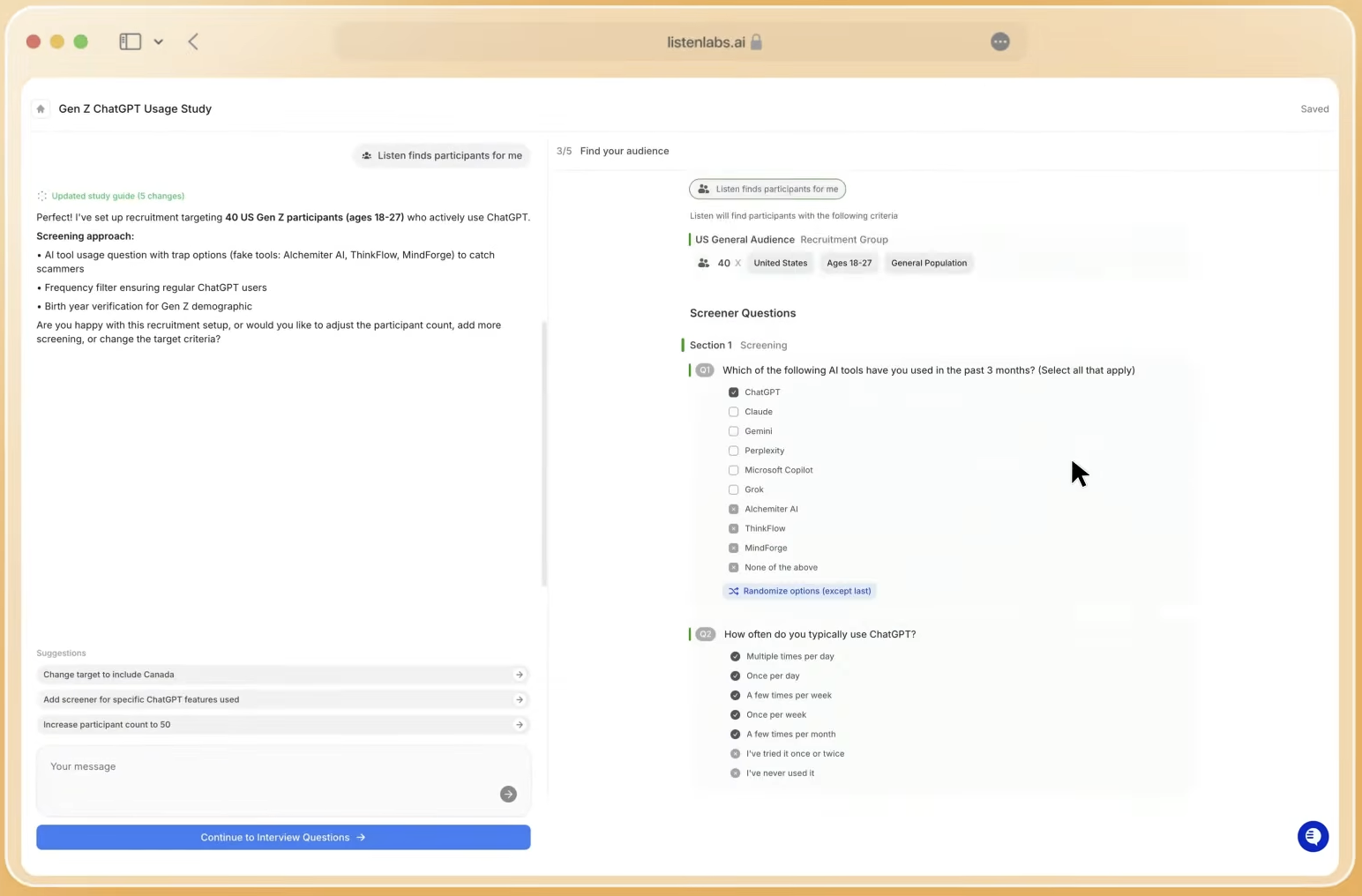
A stable 400-respondent sample every wave produces more reliable wave-to-wave comparisons than fluctuating samples ranging from 200 to 800. Consistency in sample size matters as much as consistency in question wording.
Participation frequency limits control respondent fatigue. Listen Labs’ Quality Guard caps participation at three studies per month per respondent, which eliminates professional survey-takers and preserves response quality across continuous waves. According to Hanover Research, 77% of companies conduct brand tracking and have reported an average ROI of seven times, yet many programs still run on cadences too slow to detect shifts from campaigns still in market.
The hypothetical snack brand moves from biannual to monthly waves of 400 respondents, drawn from Listen Labs’ network of 50M+ verified respondents. Rolling three-month averages smooth wave-to-wave noise while preserving the ability to detect genuine five-point shifts in awareness or consideration.
Step 4: Add Real-Time Moderation While Keeping Core Wording Fixed
The moderation layer separates a pure-quant automated tracker from a conversational tracker. In a conversational system, an AI moderator probes dynamically on open-ended answers, asking why a respondent rated consideration low or what specifically changed in their perception of the brand, while the wording of every core question stays fixed.
Traditional surveys may tell us what people do, but it takes a conversation to understand why. The AI moderator operationalizes that principle at scale. It reads each response in real time and generates a follow-up probe tailored to what the respondent actually said, instead of following a pre-written script past an incomplete answer.
For the snack brand, when a respondent rates “worth the price” at 3 out of 7, the AI moderator asks what would need to change for the brand to feel worth it. That probe is dynamic. The core question, the 7-point “worth the price” scale, remains identical in every wave.
Teams that want to see adaptive moderation in action alongside an existing tracker can walk through a live wave with the Listen Labs team and watch how the AI moderator probes in real time.
Step 5: Measure Emotional Signals Next to Every KPI
Emotional Intelligence analyzes three layers of signal, tone of voice, word choice, and subconscious micro-expressions, surfacing nuanced emotions that transcripts alone miss. The framework is built on Ekman’s universal emotions model, the same standard used in clinical psychology and UX research, tracking anger, contempt, disgust, enjoyment, fear, sadness, and surprise.
Every emotion is quantified per question and concept, with every label traceable to the exact timestamp, verbatim quote, and AI reasoning behind it. For the snack brand, the team can query which respondent segment showed the most confusion when discussing the new packaging and receive a side-by-side emotional breakdown by demographic, with each data point linked to the clip that produced it.
Step 6: Automate Theme Extraction and Generate Traceable Clips
AI-moderated interviews make talking to users at scale straightforward, but teams still need help understanding what those users mean. The Research Agent addresses that challenge by automating theme coding across all open-ended responses and linking every theme to the verbatim quotes and video moments that produced it.
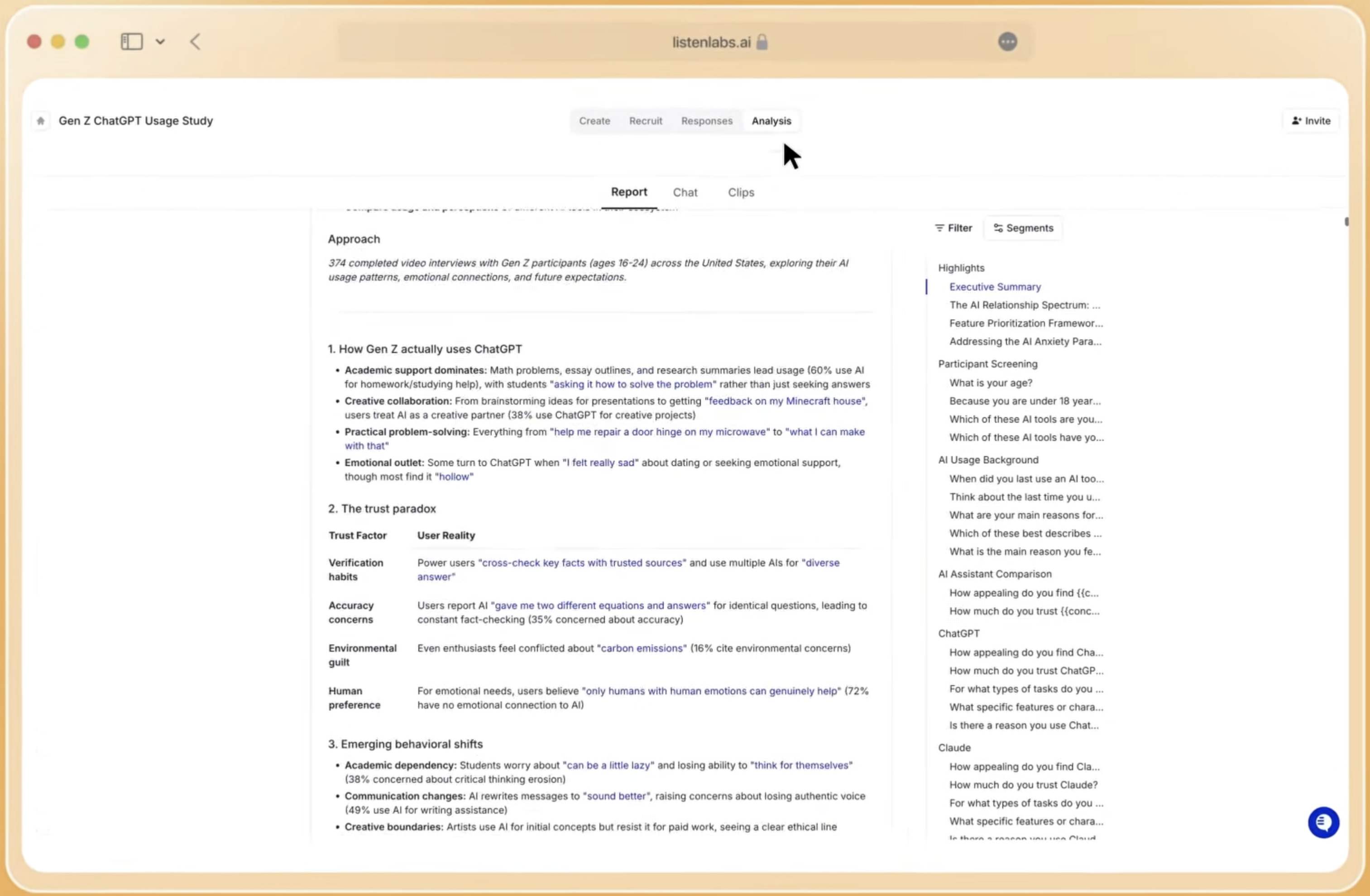
The process for the snack brand works as follows:
- The Research Agent codes all open-ended responses into themes automatically after each wave closes.
- Themes are charted alongside the core KPIs so the team sees, for example, that “price-value concern” rose from 12% theme share to 19% in the same wave that purchase intent dropped two points.
- Any stakeholder can click the “price-value concern” theme and access the verbatim quotes and video clips that constitute it, with no manual analysis required.
This diagnostic gap is not hypothetical. One well-known clothing brand, famous for its big logos, was quietly losing customers. Its legacy tracker caught the drop but could not explain it. Listen Pulse found it was not price, it was style. A growing group of customers felt the big logos were too loud for their changing lifestyles. This example illustrates how the conversational layer surfaces insights that quantitative metrics alone cannot reveal.
Step 7: Plug Into Existing Qualtrics or Decipher Dashboards
The architecture treats the conversational layer as additive, not disruptive. The quantitative core runs first in identical form, feeding the same variable names into the same dashboards the insights team already uses. The open-ended conversational module runs after the core and appends diagnostic context to each wave’s data export. No trend line resets. No baseline interruption.
For the snack brand, the Qualtrics dashboard continues displaying unaided awareness, consideration, and the three attribute scores exactly as before. A new panel in the same dashboard now shows the top five themes from that wave’s conversational layer, each linked to the Research Agent for deeper exploration. The VP of Consumer Insights presents both the metric and the mechanism in the same slide.
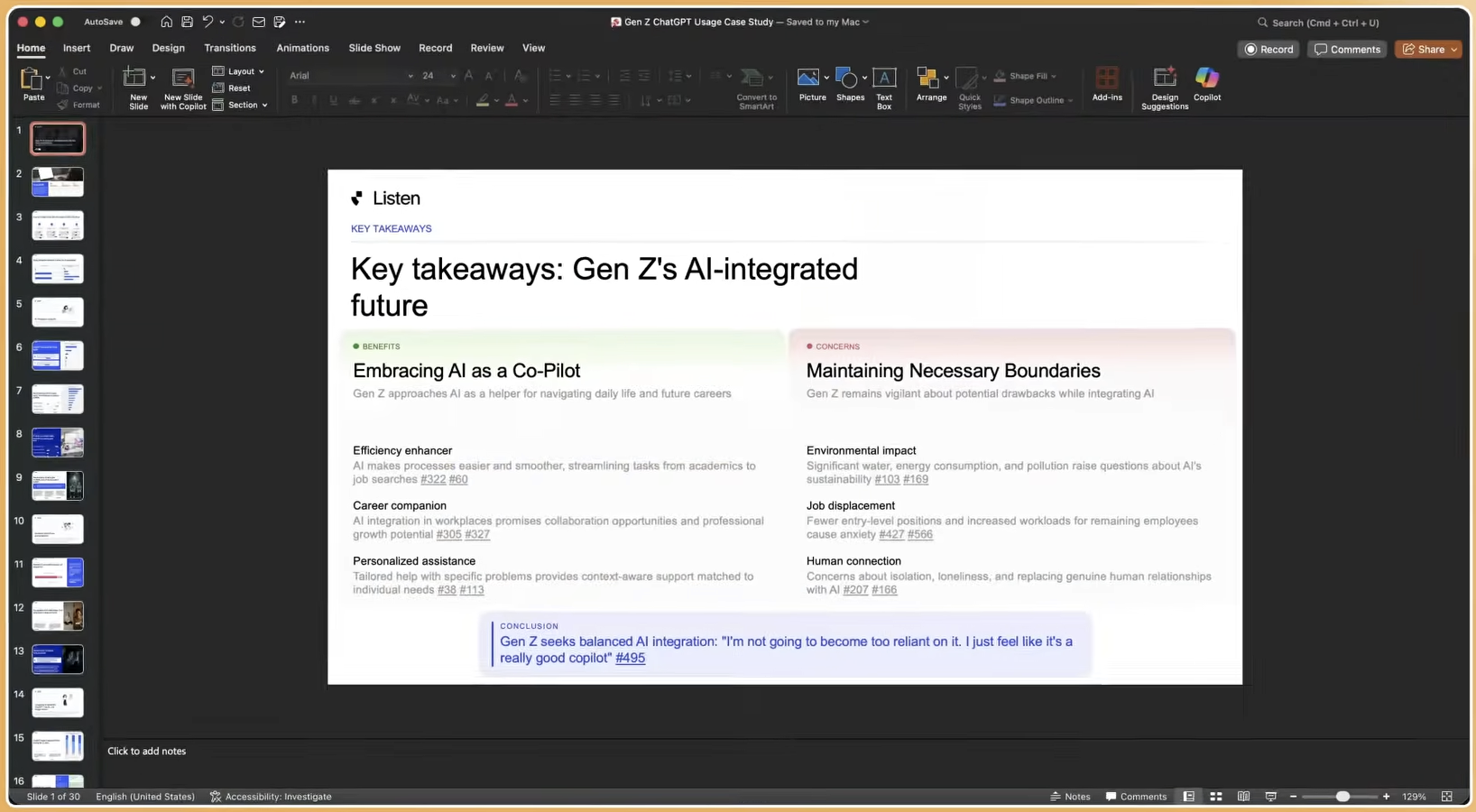
If your team is already running a Qualtrics or Decipher tracker and wants to add the diagnostic layer without disrupting reporting, you can schedule a walkthrough to see how the conversational module plugs into your existing dashboard.
Frequently Asked Questions
How long does it take to launch a first automated conversational wave?
Most enterprise teams complete study design, screener configuration, and quota setup within one to two weeks, particularly when an existing quantitative tracker provides the locked core question set. The first wave of interviews typically closes within 24–48 hours of launch, with automated theme analysis and the Research Agent report available immediately after fieldwork closes. Teams migrating from a legacy agency tracker can run a parallel wave alongside the existing instrument to validate comparability before fully transitioning.
What does a conversational tracker typically cost compared to a legacy agency tracker?
Legacy agency brand trackers from firms such as Kantar, Ipsos, and Nielsen typically cost $50,000–$500,000 or more annually. Listen Labs operates on a subscription model in which enterprises pay for platform access and spend credits per participant recruited, with credit cost varying by audience difficulty. Enterprise teams running continuous tracking on Listen Labs report running more studies at approximately one third of the cost of traditional research approaches. The cost differential widens further when the conversational layer eliminates the need for separate qualitative studies to diagnose metric movements.
How does Listen Labs handle data privacy and security for brand tracking programs?
Listen Labs maintains enterprise-grade security with 256-bit encryption. Customer data is never used to train AI models. The platform holds SOC 2 Type II, ISO 27001, ISO 27701, and ISO 42001 certifications and is GDPR compliant. Participant data collected during brand tracking waves is handled under the same security architecture, with enterprise SSO available for team access management. Organizations with specific data residency requirements should discuss those constraints during the demo and pilot process.
When should a brand tracking program be expanded, and when should it be retired?
A tracker warrants expansion when the core KPI set no longer covers the brand’s competitive frame, for example when a new category entrant requires adding a competitor to the benchmarking set or when a new audience segment becomes strategically relevant. Expansion should always be piloted before the new elements enter the locked core. A tracker warrants retirement when the brand’s positioning has changed so fundamentally that the existing trend line no longer reflects the current competitive context, or when the program has not produced a decision in more than two consecutive quarters. In both cases, the Research Library preserves all historical findings so institutional knowledge is not lost when the instrument changes.
Turn Every Metric Movement Into Actionable Insight
The seven steps above form a repeatable architecture for automating brand tracking studies without sacrificing the diagnostic context that makes metrics actionable. The stable core, five to eight KPIs with locked wording, consistent quotas, and a fixed 400-respondent sample, protects the trend line. The conversational layer, AI-moderated open-ended interviews, emotional signal analysis, automated theme extraction, and traceable video clips, delivers the explanation in the same wave. Integration with Qualtrics or Decipher ensures the insights team presents both the number and the reason to stakeholders without rebuilding existing reporting infrastructure.
“The why is what differentiates customer research that’s alright from customer research that’s outstanding.” Listen Pulse is built on that principle. Every KPI movement arrives with the verbatim quote, the emotional signal, and the video clip that explains it.
Listen Labs serves leading enterprises including Microsoft, Procter & Gamble, Nestlé, and Skims, and has conducted over one million AI-moderated customer interviews since launch. The platform compresses a research cycle that traditionally takes four to six weeks into less than 24 hours, delivering the cost efficiency described earlier.
To see how the seven-step framework applies to your existing brand tracking program, you can book a demo with the Listen Labs team.