
Written by: Anish Rao, Head of Growth, Listen Labs | Last updated: July 23, 2026
Key Takeaways for Enterprise Research Leaders
- Enterprise research teams work in a fragmented ecosystem where agencies, survey tools, panels, and repositories each cover only part of the lifecycle. This fragmentation forces constant trade-offs between depth, speed, and scale.
- AI-moderated interviews with adaptive probing and multimodal Emotional Intelligence deliver 3–5× more insight per respondent than surveys while maintaining enterprise-grade quality controls and fraud prevention.
- Listen Labs is the only platform that unifies study design, global recruitment from 30 million verified respondents, AI moderation, quantitative formats, automated analysis, and cross-study knowledge management in a single certified workflow.
- Full research cycles that once took 4–6 weeks are compressed to under 24 hours, with traceable insights, one-click deliverables, and SOC 2 Type II, GDPR, ISO 27001, ISO 27701, and ISO 42001 compliance.
- Teams that want to clear their research backlog can book a demo with Listen Labs and see how the platform performs against specific requirements.
The Broken Traditional Research Process
Enterprise qualitative research still runs on a slow, manual model. A standard qualitative research cycle takes 4–6 weeks from study design to final report. In large organizations, prioritization queues and budget approvals often stretch that timeline to six months.
Traditional moderated qualitative research costs hundreds of dollars per participant and takes several weeks. A fully loaded 60-minute moderated interview that covers recruit, incentive, moderator, transcription, and coding typically runs several hundred dollars per session.
The workflow is also structurally fragmented. One vendor manages recruitment, another handles scheduling, a third runs transcription, and a fourth supports analysis. Each handoff adds delay, cost, and quality risk. Commodity quantitative panels intensify the problem. Professional survey-takers, incentive-driven responses, and fraudulent profiles force research teams to spend significant time on quality assurance before analysis even begins.
The deepest structural flaw is the forced choice between depth and scale. Qualitative data methods lack in speed and sample size, but make up for it tenfold in their ability to uncover nuance and complexity in human decision-making. Yet running qualitative interviews at scale has historically been operationally impossible without proportional cost increases. Traditional in-depth interviews typically cap at 15–30 conversations before timelines and budgets break, while surveys scale to thousands of respondents but collapse nuance into closed-ended fields.
Decision-Stage Introduction: Matching Research Tasks to AI Capabilities
Given these structural limitations in traditional approaches, enterprise research teams need a clear framework for matching research tasks to specific AI capabilities. Different research tasks require different platform features, and these distinctions help teams separate essential capabilities from nice-to-have options.
In-depth interviews, for example, require adaptive follow-up probing and emotional signal capture to uncover the reasons behind participant responses. These capabilities must remain consistent across large sample sizes. Concept testing builds on conversational depth and adds stimulus presentation logic, monadic or sequential randomization, and quantified emotional response by concept so teams can compare reactions across multiple ideas.
Brand perception studies extend these needs further. They require multilingual reach, cross-market comparability, and the ability to detect subconscious reactions that self-reported ratings miss. Usability studies represent another specialization. They need screen-sharing, prototype integration, and timestamp-level friction detection as participants interact with real interfaces.
The platform category that handles all four task types within a single workflow, without separate vendors for recruitment, moderation, analysis, and delivery, determines which teams can actually clear a research backlog instead of simply redistributing it.
Study Setup and Recruitment Across Platform Types
Traditional research agencies handle study design with experienced researchers but often require weeks of back-and-forth before fieldwork begins. Survey tools offer self-serve study setup but remain structurally limited to closed-ended question formats. Panel and recruitment platforms such as Prolific, User Interviews, and Respondent solve participant sourcing but hand off to separate moderation and analysis tools, which reintroduces fragmentation. Analysis repositories like Dovetail organize completed research but do not conduct new studies.
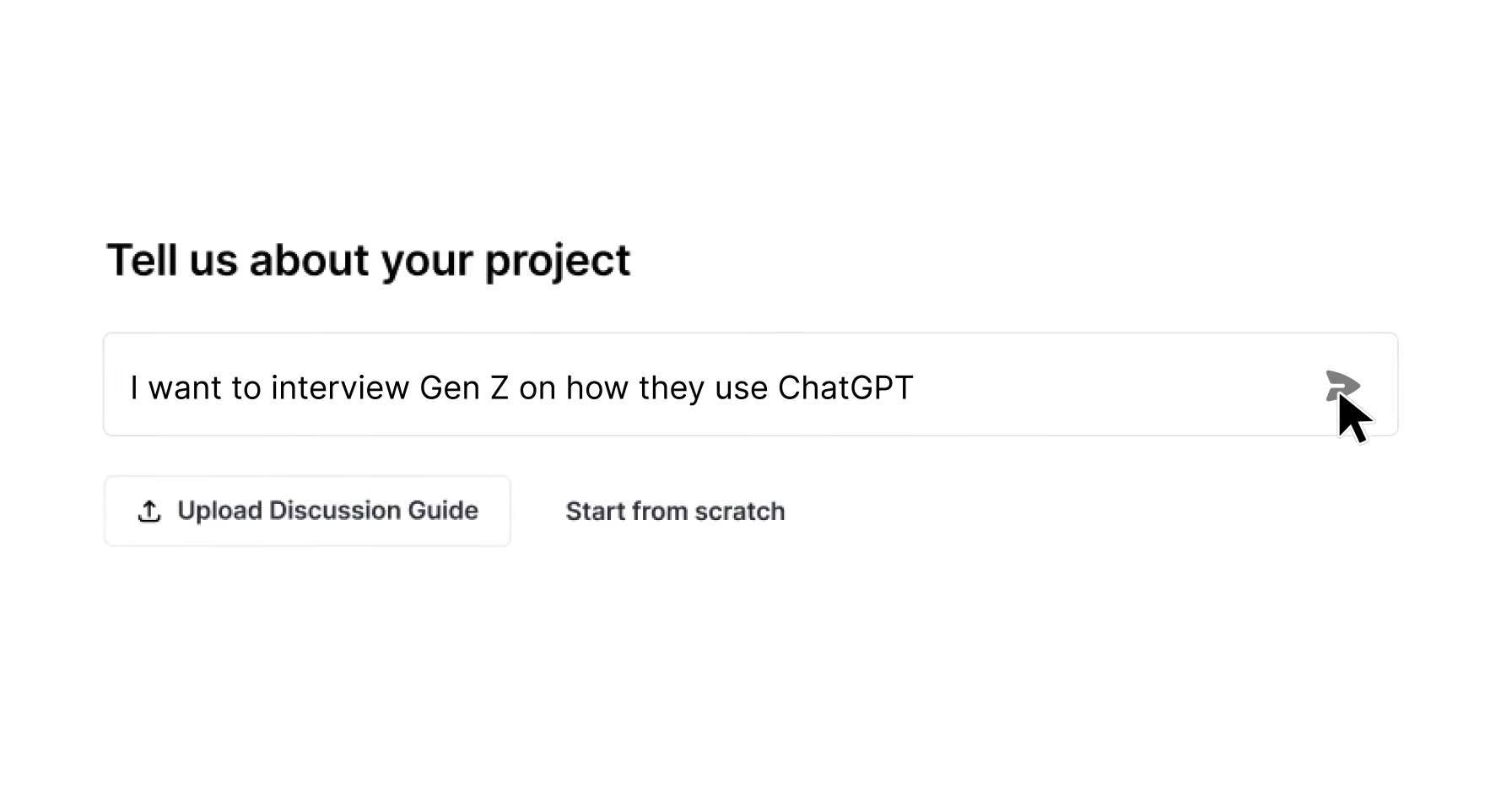
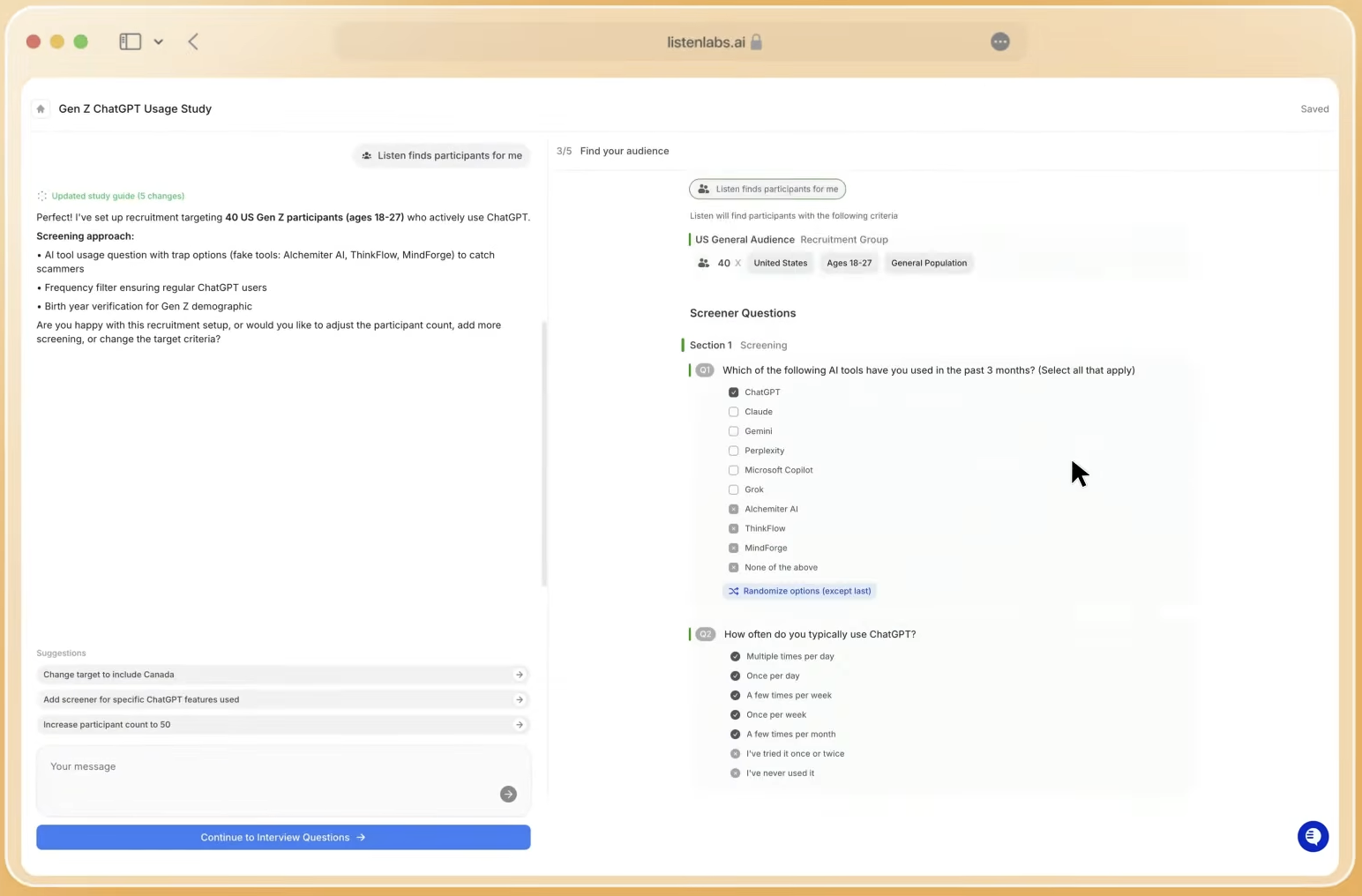
Listen Labs handles study design through an AI co-design layer. Researchers describe goals in natural language and receive structured objectives, questions, and probing context in seconds. Recruitment draws from a global panel of 30 million verified respondents across 45+ countries, spanning the Americas, Europe, APAC, and MEA. Listen Atlas, an AI orchestration layer, automatically matches and bids on participants across multiple panel partners based on behavioral and intent signals rather than self-reported demographics alone.
A dedicated recruitment operations team manages hard-to-reach segments including enterprise decision-makers, healthcare workers, and audiences below 1% incidence rate. Quality Guard monitors every interview in real time for fraud, low-effort responses, AI-generated scripts, and repeat respondents. Participant frequency is capped at three studies per month to eliminate professional survey-takers.
Moderation, Data Quality, and Qualitative Depth
Human-dependent moderation models, including traditional agencies and platforms like UserTesting, produce high-quality individual sessions but cannot scale effectively. Human moderation is limited to a few interviews per moderator per day and typically constrains the scale of traditional studies. Moderator fatigue introduces systematic inconsistency. Human moderators introduce leading questions that increase with fatigue.
Survey tools remove moderation entirely, which removes the depth advantage mentioned earlier. Static surveys cannot ask adaptive follow-ups, so they miss conditional reasoning and emotional nuance.
Listen Labs conducts AI-moderated video interviews with dynamic follow-up questions calibrated to each participant’s response. The system applies the same probing logic a trained human interviewer uses, and it does so consistently across every session regardless of volume. Listen Labs’ Emotional Intelligence analyzes three signals, tone of voice, word choice, and subconscious micro expressions, using Ekman’s universal emotions framework to detect anger, anticipation, disgust, fear, joy or happiness, sadness, trust, and surprise. Every emotion label is traceable to the exact timestamp, verbatim quote, and reasoning behind it. The platform supports emotional analysis in 50+ languages and interview moderation in 100+ languages.
The broader affective computing market context reinforces why this capability matters. Multimodal emotion AI approaches that combine voice tone, facial expressions, and text can reduce emotion misclassification compared to single-input systems. Listen Labs applies all three modalities at once.
Quantitative Support, Analysis Workflow, and Deliverables
Survey tools generate quantitative outputs efficiently but cannot deliver qualitative depth. Analysis repositories require teams to import research from external sources before any synthesis occurs. Traditional agencies produce high-quality reports but need weeks of manual writing and carry high analyst labor costs.
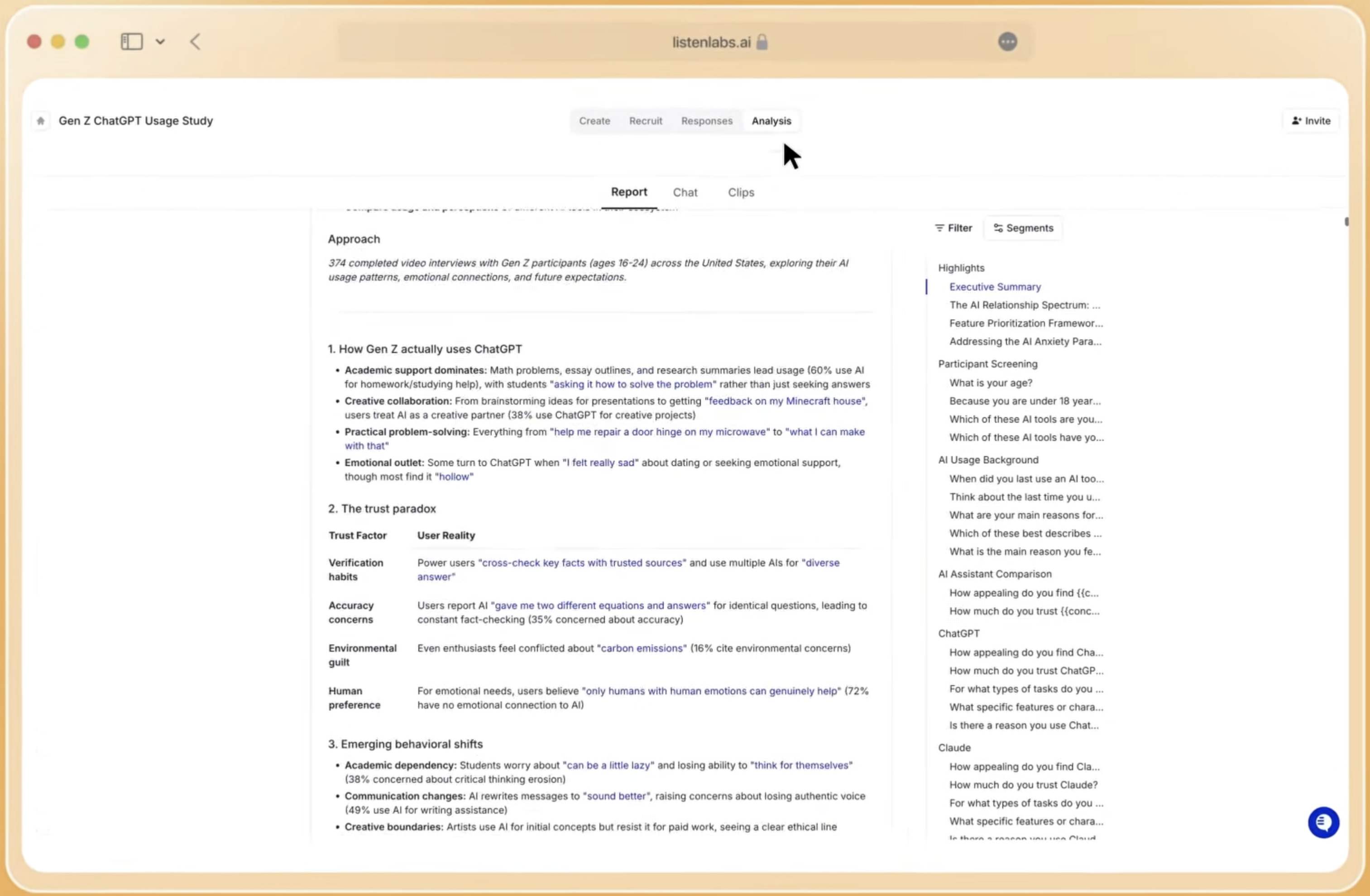
Listen Labs combines qualitative interview moderation with quantitative formats such as Likert scales, NPS, sliders, and MaxDiff within a single study. Research Agent handles the full analysis workflow, from raw data to final output. Researchers ask questions in natural language and receive answers, charts, statistical tests, and segmentation breakdowns.
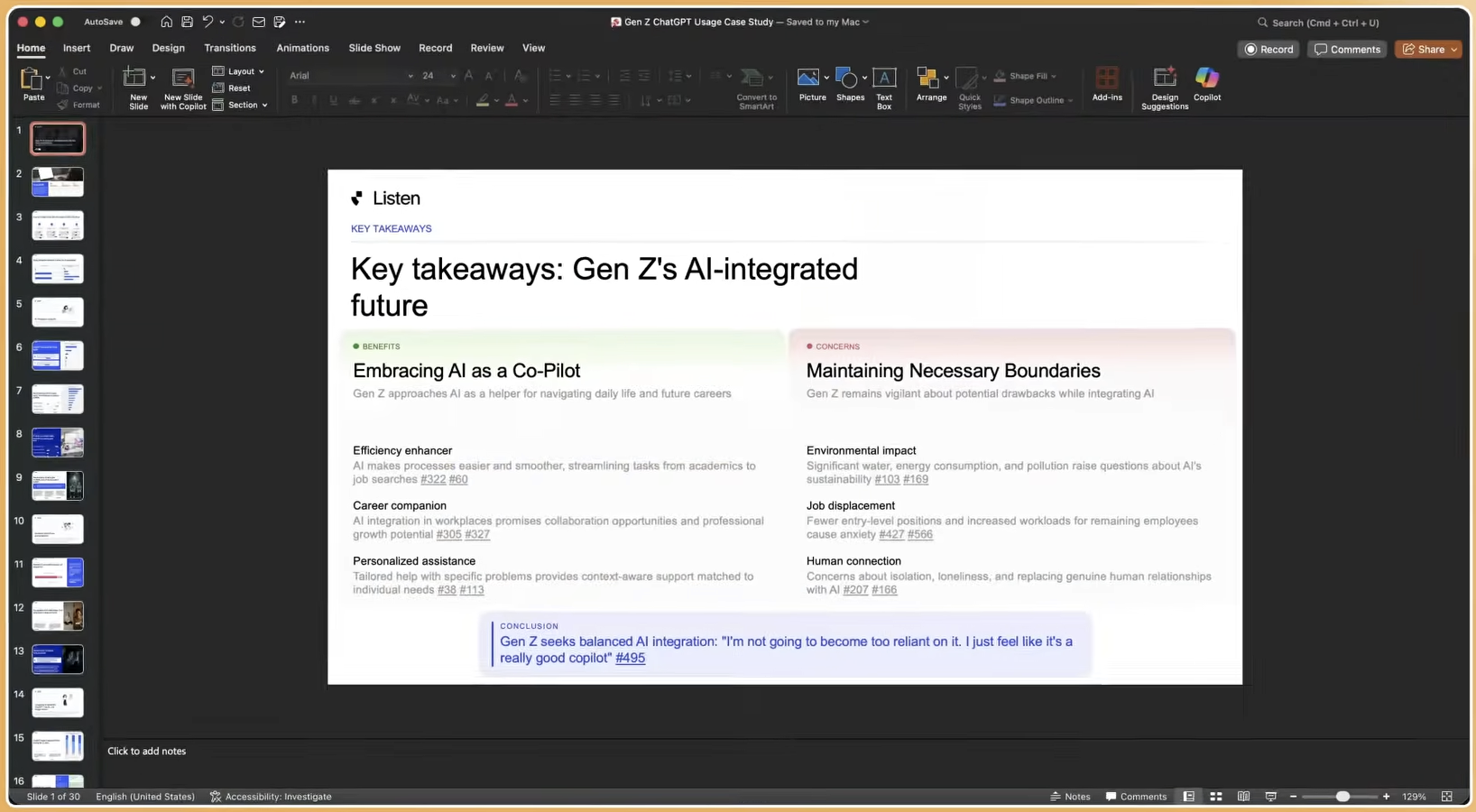
One-click deliverables include consultant-quality slide decks, memo-style reports, video highlight reels, and custom reports. Every insight links directly to the underlying response data. This creates a traceable chain from finding to verbatim quote to timestamped video clip. The entire analysis-to-deliverable workflow completes within the same sub-24-hour timeline described earlier.
The productivity impact of AI-augmented analysis is well documented. AI-augmented qualitative research tools reduced median time-to-insight by 84% for a 30-interview study, from 31.4 working days in the 2024 baseline to 9.2 working days in 2026, with the largest reduction in analysis time falling 91%.
Cross-Study Knowledge Management and Governance
Most platform categories produce siloed outputs. Survey tools export data files. Analysis repositories store past research but do not connect findings across studies automatically. Traditional agencies deliver reports that live in email threads and shared drives. Over time, the institutional knowledge problem compounds. Research teams repeatedly re-investigate the same questions because prior findings remain inaccessible.
Listen Labs’ Mission Control serves as a source of truth for all research conducted on the platform. Cross-study queries return answers from past research in seconds. Trend tracking monitors customer sentiment, needs, and pain points across time. Each new study grows the knowledge base instead of creating another isolated deliverable.
On governance, enterprise procurement and legal teams require specific certifications before any AI platform can handle participant data at scale. Enterprise AI customer research platforms require SOC 2 Type II certification and GDPR compliance to meet procurement, legal, and compliance reviews. Listen Labs holds SOC 2 Type II, GDPR, ISO 27001, ISO 27701, and ISO 42001 certifications. Customer data is never used for AI model training. Enterprise SSO is supported.
The majority of EU AI Act rules come into force on 2 August 2026. High-risk AI system obligations, including technical documentation, apply later. Annex III systems start on 2 December 2027 and Annex I systems start on 2 August 2028. These requirements align with the certification stack Listen Labs already maintains.
Scenario-Based Best-Fit Use Cases for Listen Labs
With the technical capabilities and governance requirements established, the next step is understanding how these features translate into practical value for different research team profiles. The following scenarios map platform requirements to specific research team profiles.
- Consumer Insights Leader at a Fortune 500 CPG or tech company: This leader typically runs 3–5 studies per quarter with a team of 10–20 researchers and faces a backlog of 30+ unfulfilled internal requests. The priority is multiplying study output without headcount growth. Listen Labs compresses the full research cycle, from study brief through verified global recruitment, AI-moderated interviews, and automated deliverables, within the 24-hour cycle described earlier. Microsoft used this workflow to collect global customer stories for its 50th anniversary celebration within a single day.
- UX Research Lead at a mid-to-large tech company: This role needs to validate concepts and run usability studies within sprint cycles. Listen Labs supports screen-sharing, prototype integration, and timestamp-level friction detection. These capabilities enable usability studies with 50–100+ participants instead of the traditional 5–10.
- Product Manager or Brand Manager without a dedicated research team: This profile needs consumer insight without deep research methodology expertise. Listen Labs’ AI-assisted study design accepts natural-language goal descriptions and handles study design, recruitment, moderation, and analysis automatically.
- Consultancy or agency conducting client research under tight timelines: These teams require fast turnaround, global reach, and access to niche audiences. Listen Labs’ dedicated recruitment operations team sources enterprise decision-makers, healthcare workers, and audiences below 1% incidence rate across 45+ countries.
Regardless of which scenario matches a team profile, successful implementation requires addressing four operational considerations. First, stakeholder alignment on AI-moderated methodology creates internal buy-in before launch. This alignment then enables effective change management for research teams that move from fragmented vendor stacks to a unified workflow.
In parallel, procurement and legal teams need to complete compliance review of certification documentation. Listen Labs streamlines this step with the full certification stack described earlier. Finally, teams running ongoing research programs must evaluate repeatability requirements for global tracking work. Listen Labs supports these programs with clone-past-study functionality, version control, and cross-study trend tracking in Mission Control.
Teams ready to map Listen Labs to a specific research program can book a demo and walk through their use case with the team.
Risks and Limitations of Current Options
Survey tools produce shallow data by design. Closed-ended questions with no adaptive follow-up cannot surface the conditional reasoning that drives most consumer decisions. AI-moderated interviews produce 3–5× the depth per respondent compared to surveys while achieving completion rates of 40–87%.
Commodity panels carry documented fraud risk. Without real-time behavioral monitoring, device fingerprinting, and IP verification, research findings built on panel data remain vulnerable to challenge in internal stakeholder reviews. Participant authenticity demands video-verified real human respondents combined with multi-layer fraud detection including face matching, device fingerprinting, IP or VPN checks, and scripted language detection.
Emerging AI interview platforms vary significantly in recruitment infrastructure, moderation depth, and enterprise readiness. Platforms built by engineering teams without in-house research methodology expertise often produce technically functional but methodologically shallow outputs. The absence of a verified proprietary panel forces reliance on commodity sources, which reintroduces the fraud and quality problems that AI moderation alone cannot solve.
Analysis repositories solve the storage problem but not the generation problem. Teams using Dovetail or similar tools still require separate vendors for recruitment, moderation, and transcription before any analysis can begin.
Practical Decision Framework and Checklist
Teams can use the following checklist to evaluate AI customer research platforms against program requirements. Each item stands alone so decision-makers can score platforms quickly.
- Confirm whether the platform handles the full research lifecycle within a single workflow. This includes study design, recruitment, moderation, analysis, and deliverables.
- Check whether the platform requires external vendors for any lifecycle stage. External dependencies reintroduce delays and coordination overhead.
- Review the recruitment infrastructure for real-time fraud detection, behavioral matching beyond self-reported demographics, and participant frequency limits.
- Assess whether AI moderation supports adaptive follow-up probing calibrated to each participant’s response instead of a fixed script.
- Verify that the platform captures emotional signals such as tone of voice, facial micro expressions, and word choice in addition to transcript content.
- Ensure the analysis engine produces traceable insights linked to verbatim quotes and timestamped video clips rather than summaries without source attribution.
- Confirm support for mixed-methods studies that combine qualitative interviews with quantitative formats in a single session.
- Validate that the platform holds SOC 2 Type II, GDPR, ISO 27001, ISO 27701, and ISO 42001 certifications.
- Check for cross-study knowledge management and trend tracking so each study contributes to a cumulative insight base instead of an isolated deliverable.
- Confirm coverage of required languages and geographies for global research programs and the ability to reach niche or hard-to-find audiences, including enterprise decision-makers and audiences below 1% incidence rate.
Frequently Asked Questions
How quickly can Listen Labs deliver research results?
Listen Labs compresses the full research cycle, from study design through verified global recruitment, AI-moderated interviews, automated analysis, and deliverable generation, to under 24 hours. This timeline applies to studies ranging from targeted concept tests to large-scale multi-market consumer interviews. The Research Agent generates slide decks, memos, highlight reels, and statistical charts in under a minute once interviews are complete.
How does Listen Labs ensure participant quality and prevent fraud?
Three layers of protection operate simultaneously. First, Listen Labs works exclusively with high-quality, non-commodity panel sources, which removes professional survey-takers. Second, Quality Guard applies real-time AI monitoring across video, voice, content, and device signals to detect fraud, low-effort responses, AI-generated scripts, and mismatched profiles. Third, a dedicated recruitment operations team adds a human review layer, and participants are capped at three studies per month to eliminate panel fatigue and repeat respondents. Listen Atlas, the AI orchestration layer, matches participants on behavioral and intent data rather than self-reported demographics alone.
What makes AI-moderated interviews different from running a survey?
Surveys deliver structured, quantitative data through pre-set questions with no ability to follow up or probe deeper. Listen Labs conducts conversational interviews where the AI adapts in real time and asks follow-up questions based on each participant’s response. This approach uncovers unexpected findings, emotional nuance, and rich context that surveys structurally cannot capture.
The platform also layers Emotional Intelligence on top of transcript content. It analyzes tone of voice, word choice, and subconscious micro expressions to surface what participants feel, not just what they say. The result is qualitative depth at quantitative sample sizes, delivered in hours rather than weeks.
Can Listen Labs support multilingual and multi-market research programs?
Listen Labs supports 100+ languages for interview moderation, with automatic translation and transcription across all supported languages. Emotional Intelligence is available across 50+ languages. The platform’s global panel, described earlier, enables market-specific quotas, branching logic, and localized stimuli across all supported regions. This structure enables true cross-market comparability within a single study instead of requiring separate vendor engagements per region.
How does Listen Labs handle enterprise security and data governance?
Listen Labs maintains enterprise-grade security with 256-bit encryption and the full certification stack described earlier. Customer data is never used for AI model training. Enterprise SSO is supported. Every insight generated by the Research Agent links back to the underlying response data, creating a full audit trail from finding to verbatim quote to timestamped video clip. This traceability chain satisfies procurement, legal, and senior stakeholder scrutiny without requiring the research team to manually assemble source documentation.
Conclusion: Choosing a Platform That Ends the Depth-versus-Scale Trade-Off
Across eight evaluation criteria, including research speed, insight depth, sample quality, participant sourcing, methodological flexibility, global reach, analysis workflow, and governance, only end-to-end AI interview platforms meet enterprise requirements simultaneously. Traditional agencies deliver depth but not speed or scale. Survey tools deliver scale but not depth. Panel platforms deliver sourcing but not moderation or analysis. Repositories deliver organization but not generation.
With qual-at-scale, the old trade-off between depth and scale is no longer a barrier. Listen Labs is the only platform that covers the full research lifecycle, including AI-assisted study design, 30 million verified respondents via Listen Atlas, Quality Guard fraud prevention, AI-moderated interviews with Ekman-based Emotional Intelligence across 50+ languages, automated analysis via Research Agent, and cross-study knowledge management via Mission Control, within a single enterprise-grade, certified platform. The result is a process that used to take 4–6 weeks delivered in under 24 hours at roughly a third of the cost, with the qualitative depth that enterprise decisions require.
Microsoft, Procter & Gamble, Google, Anthropic, Skims, and Nestlé have already made this shift. Book a demo to see how Listen Labs performs against your research backlog, your audience requirements, and your governance standards.