
Written by: Anish Rao, Head of Growth, Listen Labs | Last updated: July 18, 2026
Key Takeaways for 2026 AI Qualitative Platforms
- Enterprise teams choosing AI tools for qualitative research in 2026 navigate a mix of point solutions and integrated platforms that span design through reporting.
- Eleven clear evaluation criteria – research speed, insight depth, sample quality, sourcing, flexibility, global reach, language support, analysis effort, reporting transparency, governance, and scalability – allow direct comparisons across tools.
- General-purpose LLMs and analysis-only tools cover isolated workflow stages and still require separate vendors for recruitment, moderation, and deliverables, which reintroduces delays and quality risks at every handoff.
- Listen Labs stands out as the only end-to-end platform that combines verified global recruitment, AI-moderated interviews with emotional intelligence, automated traceable analysis, and stakeholder-ready outputs within a single day while holding SOC 2, GDPR, and ISO certifications.
- See the 24-hour research cycle in action, and watch how Listen Labs compresses the entire qualitative research lifecycle from brief to deliverable.
Evaluation Criteria for 2026 AI Qualitative Tools
The eleven criteria reflect operational realities and governance requirements that have matured significantly since 2024. Perspective AI’s analysis of the research workflow identifies methodological defensibility, depth per response, scale without headcount, and time-to-insight as the four most critical evaluation criteria for working researchers in 2026. The Greenbook GRIT 2025 report confirms that AI adoption among insights professionals has moved from experimental to operational, which makes governance and auditability newly urgent for enterprise procurement teams.
Research speed measures the elapsed calendar time from study brief to stakeholder-ready deliverable, a primary constraint for teams facing quarterly planning cycles. Greenbook’s GRIT 2025 timing benchmarks show the median time-from-question-to-decision for AI-moderated qualitative studies dropped from 6.2 weeks to 2.1 days. That speed only matters when insights are defensible, so depth of insight evaluates whether a tool captures the reasoning behind an answer, not just the answer itself.
Depth depends on who you interview, which makes sample quality and participant sourcing critical for assessing fraud controls, behavioral verification, and the breadth of accessible audiences. Once you have quality participants, methodological flexibility determines whether the platform supports the study formats your research questions require. For global organizations, reach and language support show whether a platform can execute multi-market studies without supplementary vendors.
After fieldwork, analysis effort measures how much of transcription, coding, and theme synthesis runs automatically. Those automated insights must remain defensible, so reporting transparency requires every finding to link back to a verbatim source. Enterprise procurement then adds governance and security requirements that cover data privacy certifications and AI audit trails. Finally, scalability assesses whether sample size can expand without proportional cost or headcount increases.
Study Design Stage: AI Co-Design vs Point Tools
General-purpose large language models such as ChatGPT, Claude, and Gemini now draft discussion guides and research objectives quickly. They perform well on speed and accessibility but score low on methodological defensibility and scalability. These models have no access to proprietary research data, no understanding of which question types produce analyzable outputs at scale, and no connection to recruitment or moderation infrastructure. A researcher who relies on a general-purpose LLM for study design still needs separate tools for every subsequent stage.
Specialized study design tools add structure through templates, branching logic, and quota controls, yet they remain disconnected from moderation and analysis layers. The handoff between design and fieldwork introduces delay and quality risk because context often gets lost between systems.
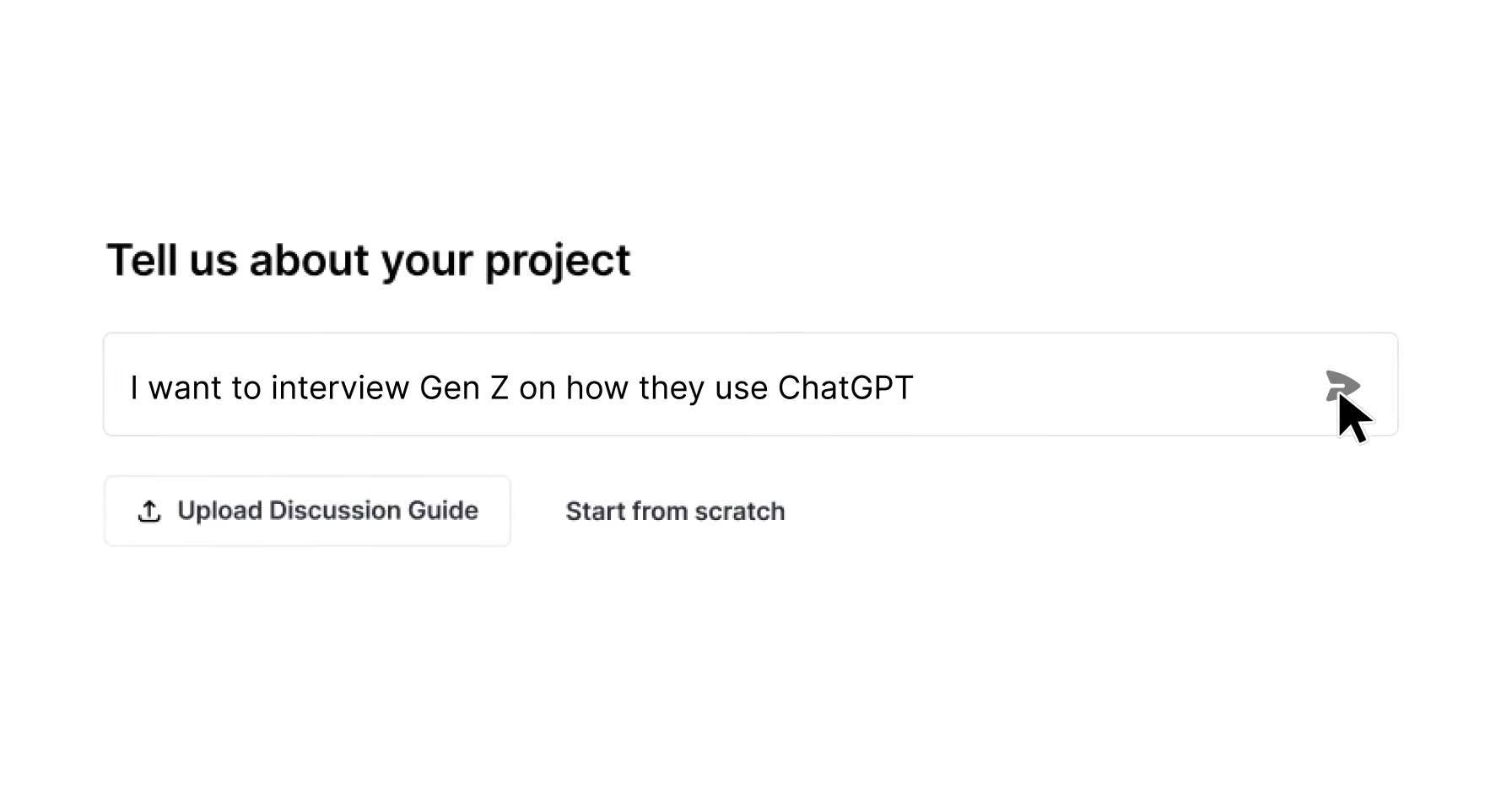
Integrated platforms like Listen Labs treat study design as the first stage of a connected workflow. The AI co-design layer accepts natural-language research briefs and generates structured objectives, discussion questions, and probing context informed by tens of thousands of completed studies. Auto-QA flags issues before launch. Advanced stimuli support for images, video, PDFs, live URLs, and prototypes, along with logic controls such as monadic randomization, branching, skip logic, and piping, are available natively. This coverage removes the need for supplementary tools at the design stage.
Recruitment Stage: Panel Quality and Global Sourcing
Commodity quantitative panels, which many survey platforms still use by default, introduce well-documented quality risks such as professional survey-takers, incentive-driven responses, and fraudulent profiles. The Insights Association’s 2025 Pricing Benchmarks report a median recruitment cost of $185 per qualitative complete in 2022 versus $24 in 2026 across the AI-moderated cohort, yet cost reduction only creates value when quality holds.
Niche recruitment platforms including Prolific, User Interviews, and Respondent solve participant sourcing for many standard audiences but do not provide moderation, analysis, or delivery. Each platform requires a separate vendor relationship and introduces a handoff that adds days to the research cycle. Hard-to-reach segments, such as enterprise decision-makers, healthcare workers, and audiences below 1 percent incidence rate, often require dedicated recruitment operations that these platforms cannot reliably support.
Listen Labs’ recruitment infrastructure, Listen Atlas, eliminates both the multi-vendor handoff problem and the hard-to-reach segment gap. Its global panel of 30 million verified respondents spans more than 45 countries and over 100 languages. An AI orchestration layer automatically matches and bids across multiple consumer and B2B panel partners alongside Listen Labs’ proprietary database.
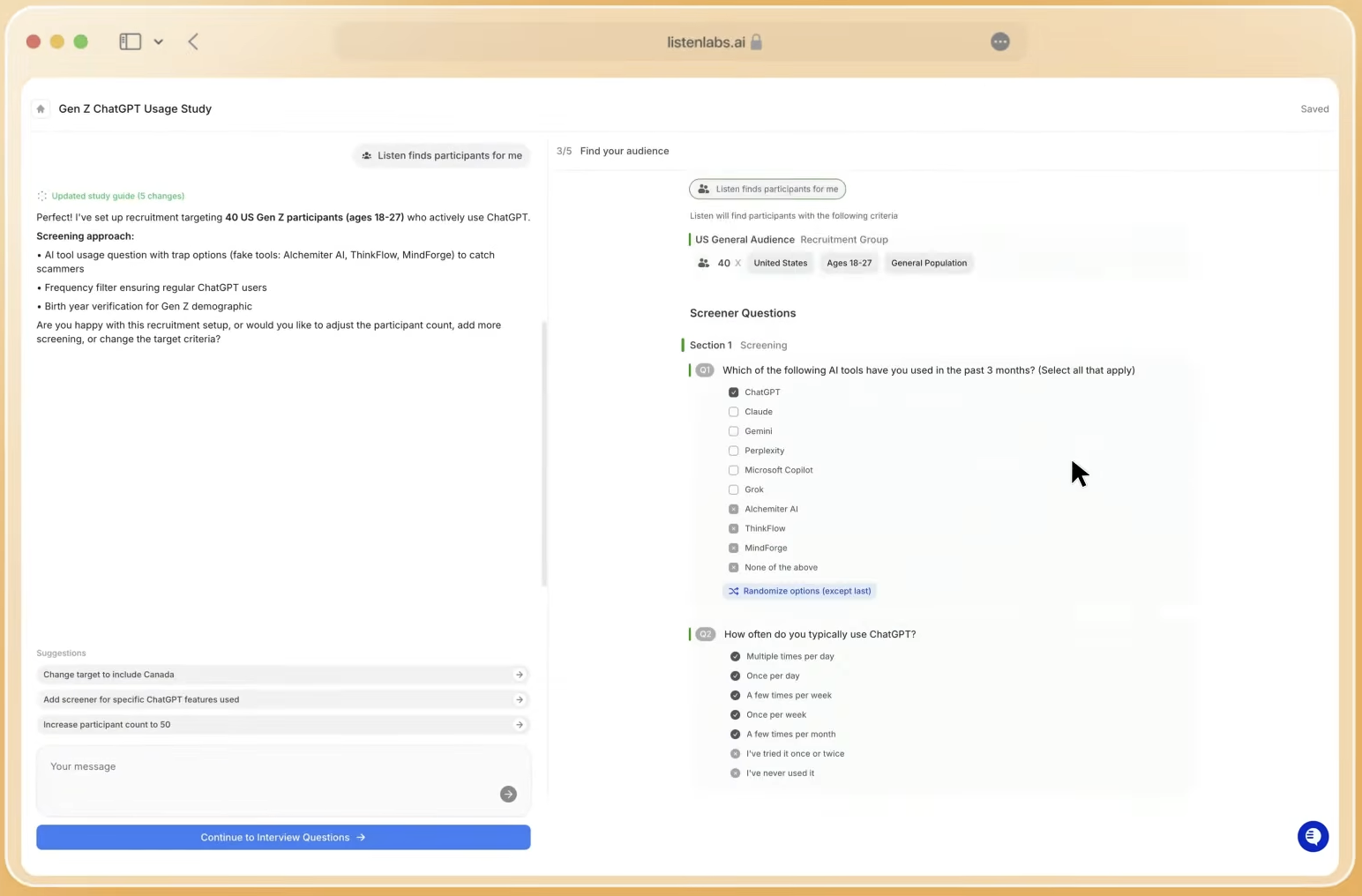
Quality Guard adds three enforcement layers. The first layer uses behavioral matching on intent and past actions rather than self-reported demographics. The second layer applies real-time quality control across video, voice, content, and device signals. The third layer caps participation at three studies per month per respondent, which removes professional survey-takers. A dedicated recruitment operations team handles sourcing for segments below 1 percent incidence rate. Listen Labs has run over 1 million AI-powered customer interviews for companies including Microsoft, Perplexity, and Sweetgreen, with quality controls applied consistently at that scale.
Moderation Stage: AI Interviews with Emotional Intelligence
The moderation stage historically forced a trade-off between depth and scale. Human moderation caps throughput at four to six interviews per moderator per day. A senior human moderator costs roughly $1,500 per in-depth interview at a full-service firm, which makes a 200-person multinational study exceed $300,000 and take a quarter. AI moderation reshapes both the economics and the timeline.
Listen Labs conducts AI-led video interviews with dynamic follow-up questions that probe deeper on short or interesting answers, mirroring the adaptive behavior of a trained human interviewer. AI can schedule and conduct interviews, analyze transcripts for themes, and generate quantitative insights from qualitative interviews within a single platform. The Emotional Intelligence layer adds a dimension unavailable in transcript-only tools. It analyzes tone of voice, word choice, and subconscious micro-expressions using Ekman’s universal emotions framework, then quantifies emotions per question and per concept with timestamp-level traceability.
Switching to Listen Labs AI-moderated interviews let Chubbies capture hundreds of candid, one-to-one conversations overnight. The speed advantage scales across use cases, with Microsoft collecting global customer stories for its 50th anniversary within a day and Anthropic’s Claude Code team completing more than 300 user interviews in 48 hours while surfacing churn drivers five times faster. Consumer brands see similar results. P&G delivered over 250 interviews with quantified themes that shaped product and brand strategy in hours, and Skims validated campaign direction with thousands of high-income buyers overnight.
Other AI-moderated platforms, including Outset, Conveo, Perspective AI, and User Intuition, deliver meaningful speed and cost advantages over human moderation. Platforms such as Perspective AI, Outset, Conveo, and User Intuition deliver 200–1,000 or more completed interviews in 24–48 hours at approximately $20 per interview. The primary gaps relative to Listen Labs involve panel breadth, fraud controls, and the absence of an integrated end-to-end workflow. These platforms typically require separate recruitment vendors, separate analysis tools, and separate reporting layers, which recreates the fragmentation that integrated platforms aim to remove.
See AI moderation and Emotional Intelligence in action, and book a demo to explore how Listen Labs’ Quality Guard controls ensure participant quality at scale.
Analysis and Reporting Stage: From Raw Data to Boardroom
Analysis-only tools such as Dovetail and NVivo AI organize and tag research that teams have already conducted elsewhere. They function as repositories and coding environments but do not conduct interviews, recruit participants, or generate deliverables automatically. Teams with large transcript libraries gain value from these tools. Teams that need to move from brief to boardroom-ready output treat them as one stage in a multi-vendor workflow.
AI-native platforms reduce coding time by approximately 95 percent, from 5–8 days to 1–2 hours, and reduce theming and clustering time by approximately 90 percent, from 3–5 days to 30 minutes. Perspective AI’s 2026 AI Research Productivity Report, based on 217 AI-moderated studies, documented a 91 percent reduction in analysis time, with transcription, quote retrieval, coding, and theme synthesis now running automatically as interviews close.
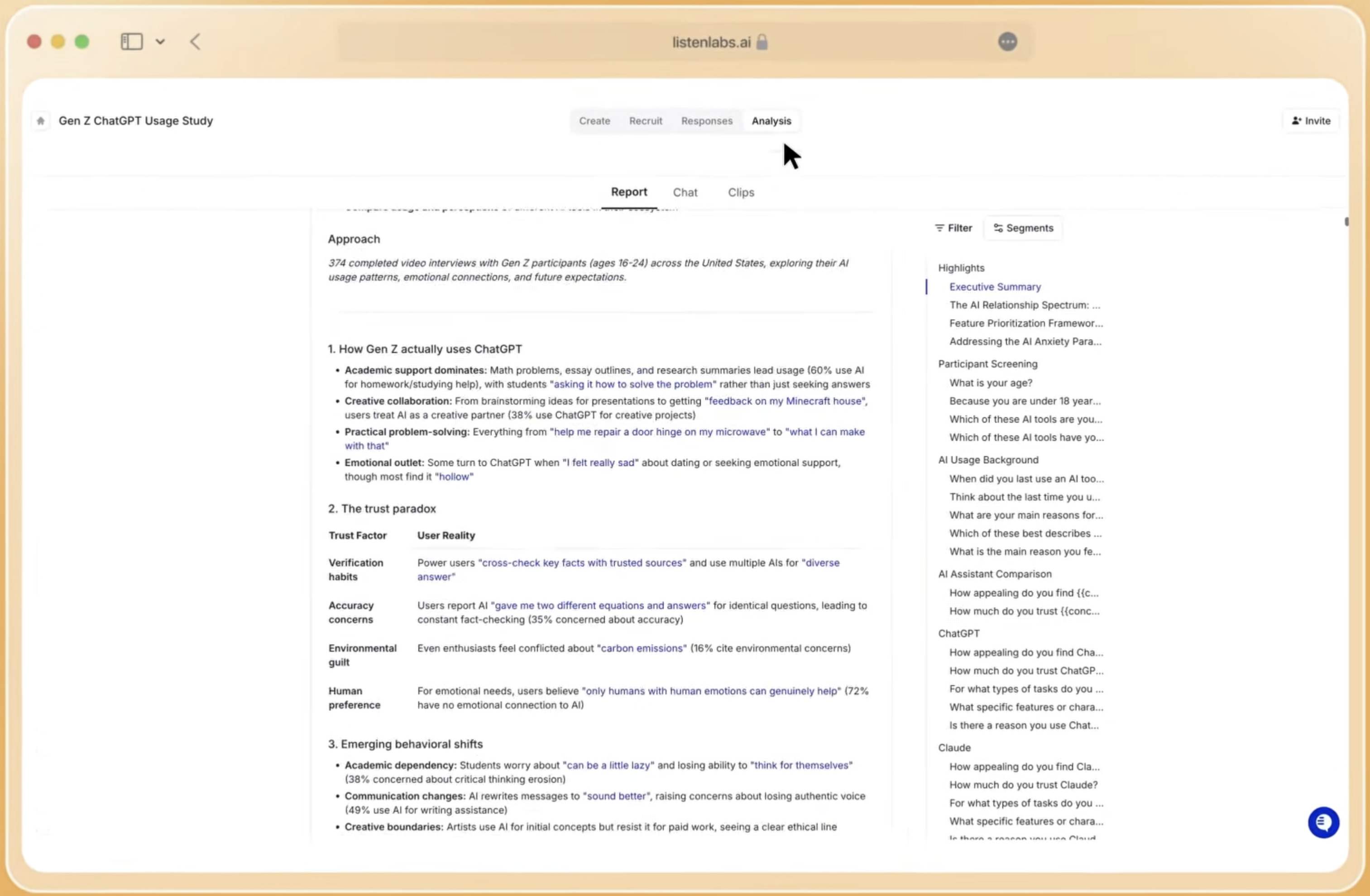
Listen Labs’ Research Agent manages the full analysis workflow from raw data to final output. Every insight links directly to the underlying response data, which satisfies the traceability requirement that enterprise governance teams now treat as a baseline standard. Research Agent generates a slide deck in a company’s branded template and a downloadable report, along with video highlight reels, statistical charts, segmentation breakdowns, and natural-language query responses, all in under a minute. Mission Control extends this capability by serving as a cross-study knowledge base that lets teams query findings from past research in seconds and track customer sentiment over time.
Responsible AI, Audit Trails, and Enterprise Governance
Enterprise procurement teams in 2026 treat governance as a non-negotiable evaluation criterion. The European Commission published an update to the ERA Living Guidelines on the Responsible Use of Generative AI in Research on 8 May 2026, adding operational recommendations on transparency, accountability, and the management of hidden prompts in AI systems. Marc Busch’s May 2026 evaluation framework identifies privacy, transparency, export portability, and reproducibility as the four durable principles that outlast specific tools, with explicit zero-retention contracts and disclosed model versions as minimum requirements.
Listen Labs holds SOC 2 Type II, GDPR, ISO 27001, ISO 27701, and ISO 42001 certifications. Customer data is never used to train AI models. Every emotion label, theme, and finding produced by the platform is traceable to the exact timestamp, verbatim quote, and reasoning behind it. Platform controls for enterprise AI research tools must include mandatory citations that link every claim, theme, or finding directly to original source data, preventing fabrication. Listen Labs’ architecture enforces this requirement natively. Enterprise SSO is supported, and the platform’s ISO 42001 certification addresses AI-specific management system requirements that extend beyond standard information security frameworks.
Persona-Based Best-Fit Guidance
Consumer insights leaders at Fortune 500 enterprises, the primary audience for this review, face research backlogs that stretch 4–6 weeks per study and limit quarterly output to a handful of projects. The 84 percent time-to-insight reduction documented in Perspective AI’s 2026 report enables a 6.2x increase in studies per researcher per quarter at constant headcount. For this persona, Listen Labs is the only platform that addresses speed, quality, scale, and governance together without supplementary vendors.
UX research leads at mid-to-large technology companies need faster feedback loops to keep pace with sprint cycles. Qual-at-scale is ideal when research requires large sample sizes or broad geographic reach, with AI tools engaging hundreds or thousands of participants remotely and asynchronously. Listen Labs’ screen-sharing and usability testing capabilities, combined with mobile screen recording on iOS, make the platform directly applicable to UX research workflows.
Product managers and marketing leaders without dedicated research teams gain from Listen Labs’ natural-language study co-design, which translates a plain-language research brief into a structured study guide without requiring methodology expertise. Self-serve access supports smaller organizations, while enterprise teams move through a demo and pilot process.
Agencies and consultancies operating under client-driven timelines, often measured in days, benefit from Listen Labs’ global reach, niche audience sourcing, and the ability to deliver consultant-quality reports automatically. The platform’s coverage across more than 45 countries and support for over 100 languages removes the need for local fieldwork partners on multi-market engagements.
Decision-Framework Checklist for Tool Selection
The following questions help match tool categories to organizational constraints:
- Does the tool cover the full workflow, including design, recruitment, moderation, analysis, and reporting, or only one stage?
- Can it recruit verified participants from your target audience without a separate vendor?
- Does it support the sample sizes your research questions require, such as 50, 200, or 500 participants and beyond?
- Is every finding traceable to a verbatim source, timestamp, or original recording?
- Does it hold SOC 2, GDPR, ISO 27001, and ISO 42001 certifications?
- Can it operate in the languages and geographies your studies require?
- Does it capture emotional signals beyond transcript text?
- Can it deliver stakeholder-ready outputs such as slide decks, highlight reels, and memos without manual formatting?
- Does it build institutional knowledge across studies, or does each project start from zero?
People Also Ask
Which AI is best for qualitative research? The answer depends on workflow scope. General-purpose LLMs assist with study design but require separate tools for every other stage. Analysis-only platforms like Dovetail organize existing transcripts but do not conduct interviews. End-to-end AI interview platforms like Listen Labs cover the full lifecycle, including recruitment, moderation, analysis, and reporting, in a single platform, which makes them the most complete solution for enterprise teams that need speed, scale, and governance together.
Can ChatGPT do qualitative data analysis? ChatGPT and similar general-purpose LLMs can assist with first-pass coding and theme identification on uploaded transcripts. They lack proprietary research data to inform question quality, have no recruitment or moderation infrastructure, and produce outputs that are not automatically traceable to source quotes. For enterprise use cases that require auditability, fraud-controlled samples, and stakeholder-ready deliverables, a purpose-built platform provides capabilities that general-purpose LLMs cannot match.
Frequently Asked Questions
How quickly can Listen Labs deliver results? Listen Labs compresses the entire research cycle, including study design, recruitment, moderation, analysis, and deliverables, into a single day. Traditional qualitative research takes 4–6 weeks from study brief to final report, and in enterprise settings with internal prioritization backlogs, the process can stretch to 6 months.
How does Listen Labs ensure participant quality? Quality Guard applies three enforcement layers. The first layer uses behavioral matching on intent and past actions rather than self-reported demographics. The second layer applies real-time AI monitoring across video, voice, content, and device signals to detect fraud, low-effort responses, and mismatched profiles. The third layer sets a participant frequency cap of three studies per month per respondent. A dedicated recruitment operations team adds human review for hard-to-reach segments. Listen Labs does not work with commodity quantitative panels.
Does Listen Labs support multilingual research? The platform supports more than 100 languages for interview moderation, with automatic translation and transcription across all supported languages. Emotional Intelligence is available across over 50 languages. The global panel spans more than 45 countries across the Americas, Europe, APAC, and MEA, which enables multi-market studies without local fieldwork partners.
What security certifications does Listen Labs hold? Listen Labs maintains SOC 2 Type II, GDPR, ISO 27001, ISO 27701, and ISO 42001 certifications. Customer data is encrypted at 256 bits and is never used to train AI models. Enterprise SSO is supported.
How complex is implementation? Enterprise teams move through a demo and pilot process. The AI co-design layer accepts natural-language research briefs, so researchers without platform experience can launch studies quickly. Listen Labs’ in-house research team, with more than 50 years of combined expertise, works as a thought and execution partner throughout onboarding and ongoing use.
Conclusion: Building the Right AI Research Stack in 2026
Point solutions such as general-purpose LLMs, analysis repositories, and standalone recruitment platforms address individual stages of the qualitative research workflow but reintroduce fragmentation, delay, and governance risk at every handoff. AI-moderated interview platforms that cover only moderation still require separate vendors for recruitment and reporting. An integrated end-to-end platform removes the trade-offs between speed, depth, sample quality, and enterprise governance.
Listen Labs is the only platform that sources verified participants from a 30-million-person global network, conducts AI-moderated interviews with adaptive probing and emotional signal capture, automates analysis with full source traceability, and delivers consultant-quality reports, slide decks, and video highlight reels, all with a same-day turnaround and the full suite of enterprise security certifications in place.
Join Microsoft, Google, and P&G, and book a demo to see how enterprise teams are running more qualitative research in a day than they previously completed in a quarter.