
Written by: Anish Rao, Head of Growth, Listen Labs | Last updated: August 7, 2026
Key Takeaways
- AI-moderated qualitative interviews deliver results in under 24 hours at one-third the cost of traditional agency-led methods while maintaining comparable depth.
- Listen Labs combines study design, global recruitment, AI moderation with emotional intelligence, automated analysis, and deliverables in a single end-to-end platform.
- Traditional methods retain value for audit-grade statistical claims, regulated categories, and longitudinal brand tracking with pre-2024 baselines.
- Enterprise teams achieve 40–60% lower total cost and 5x faster research cycles with a hybrid model that pairs thin quarterly panel trackers with continuous AI interview layers.
- Listen Labs acts as a force multiplier for research teams, helping organizations compress research cycles without sacrificing rigor.
>
Evaluation Criteria and Workflow Components
The evaluation below examines Listen Labs against traditional methods across the core components of brand research workflows. These components connect directly to the nine criteria that matter most for enterprise consumer insights programs.
- Research cycle time
- Cost per completed interview
- Sample quality and fraud prevention
- Emotional-signal capture
- Global and multilingual reach
- Methodological rigor
- Transparency of analysis
- Quantitative integration
- Long-term knowledge retention
The following sections walk through each workflow component and explain how it affects these criteria in practice.
Side-by-Side Evaluation Across Core Components
The subsections below compare Listen Labs and traditional agency-led research across the main stages of a study, from design through knowledge management. Each stage influences multiple evaluation criteria, such as speed, cost, rigor, and long-term value.
Study Design and Setup Speed
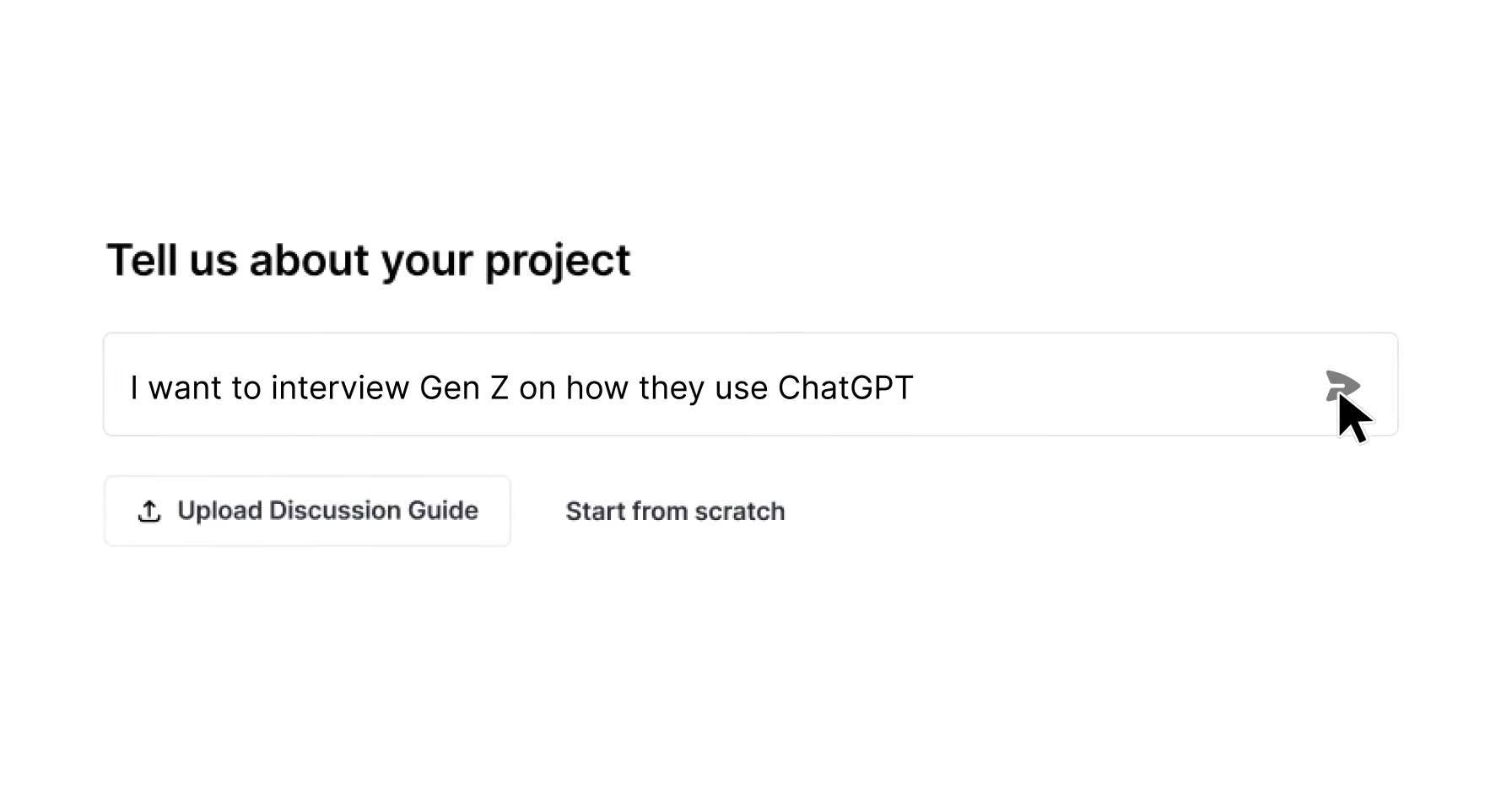
Traditional agency-led studies require sequential sign-off across a research team, a panel vendor, and often a third-party moderator before a single interview is fielded. This sequence slows research cycle time and increases coordination cost. Listen Labs uses AI-assisted study co-design instead. A researcher describes objectives in natural language and the platform drafts structured questions, probing context, branching logic, and stimuli configuration in seconds. Auto-QA then flags issues before launch, which reduces rework and shortens the path to fielding.
Participant Sourcing and Sample Quality
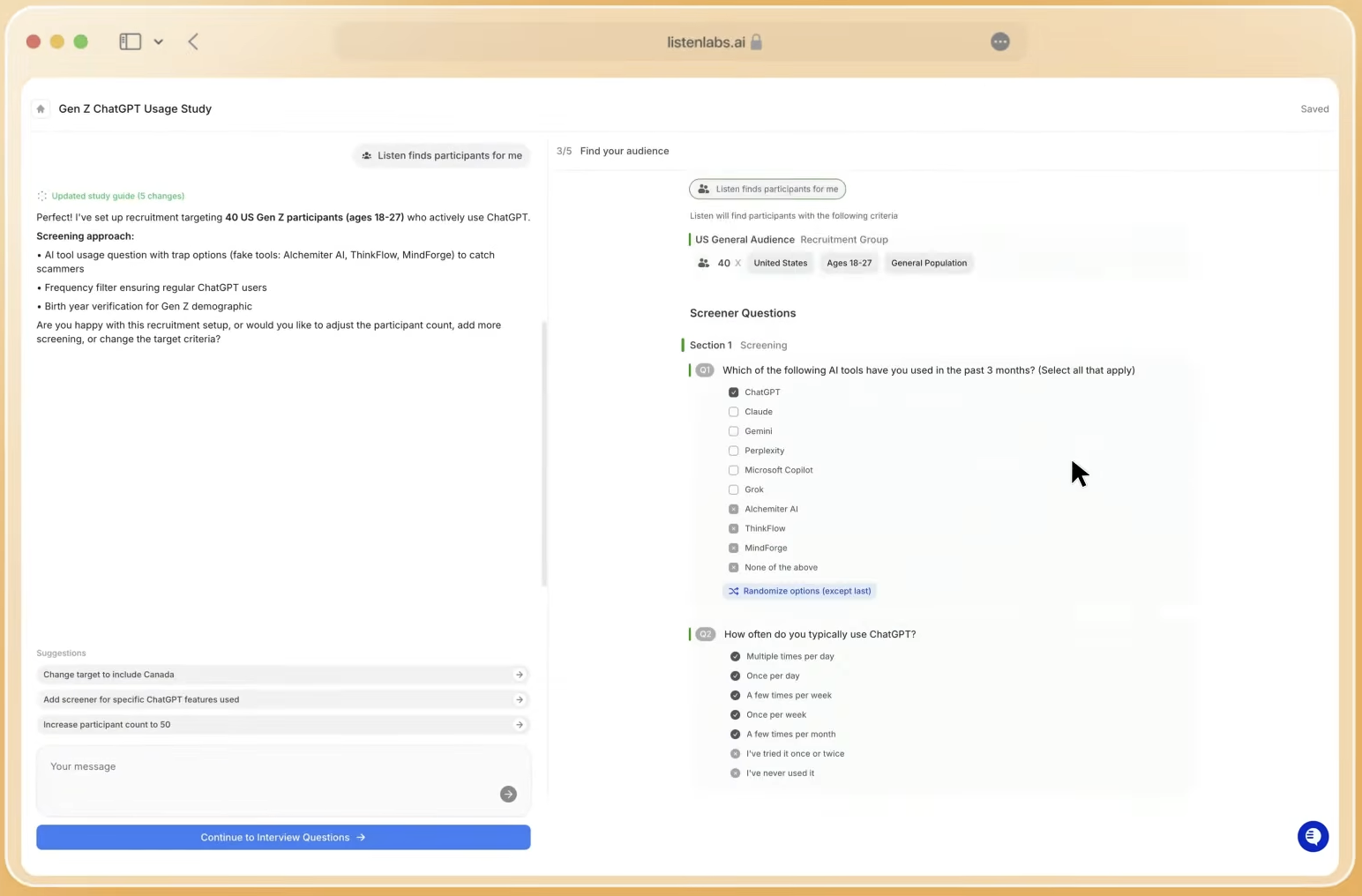
Agency-led recruitment often draws from third-party panel providers with variable quality controls. ESOMAR’s annual industry report has flagged recruiting cost inflation and panel quality concerns, including fraud, inattentive respondents, and AI-bot answers in open-ends, for three consecutive years. Listen Labs sources participants from a 30M verified respondent network across 45+ countries. An AI orchestration layer matches on behavioral and intent data rather than only self-reported demographics. A dedicated recruitment operations team supports audiences below 1% incidence rate, which improves feasibility for niche segments.
Moderation Approach and Consistency
Human moderators bring contextual judgment but introduce variability across sessions and cannot run more than one interview simultaneously. Capacity limits slow scale and increase cost per completed interview. Listen Labs’ AI-moderated interviews conduct personalized conversations with dynamic follow-up questions, compressing weeks into hours while maintaining consistent probing depth across every participant. This consistency improves methodological rigor and reduces moderator bias.
Data Quality Controls and Fraud Prevention
Traditional methods rely on screener questionnaires and moderator judgment to filter low-quality participants. These tools help but often miss subtle fraud patterns at scale. Listen Labs’ Quality Guard monitors every interview in real time across video, voice, content, and device signals. The system limits participants to three studies per month and builds a reputation score across every completed interview. This compounding quality flywheel addresses sample quality and fraud prevention more systematically than commodity panels.
Qualitative Depth and Emotional Signals
AI-moderated brand interviews produce 180–400 words of open-ended feedback per response with 3–7 dynamic follow-ups, compared to 8–15 words and no follow-ups in classic one-shot survey trackers, a 12–20x increase in depth per Forrester’s qualitative renaissance findings. This depth directly improves emotional-signal capture and the quality of insights that teams can act on.
Quantitative Integration Within Interviews
Agency-led qualitative studies are typically separate engagements from quantitative surveys, which requires a second vendor and a second timeline. This separation slows research cycle time and complicates analysis. Listen Labs combines Likert scales, NPS, sliders, MaxDiff, and open-ended qualitative questions within a single interview session. Teams receive mixed-method data from one fielding, which improves quantitative integration and shortens decision timelines.
Analysis Workflow and Transparency
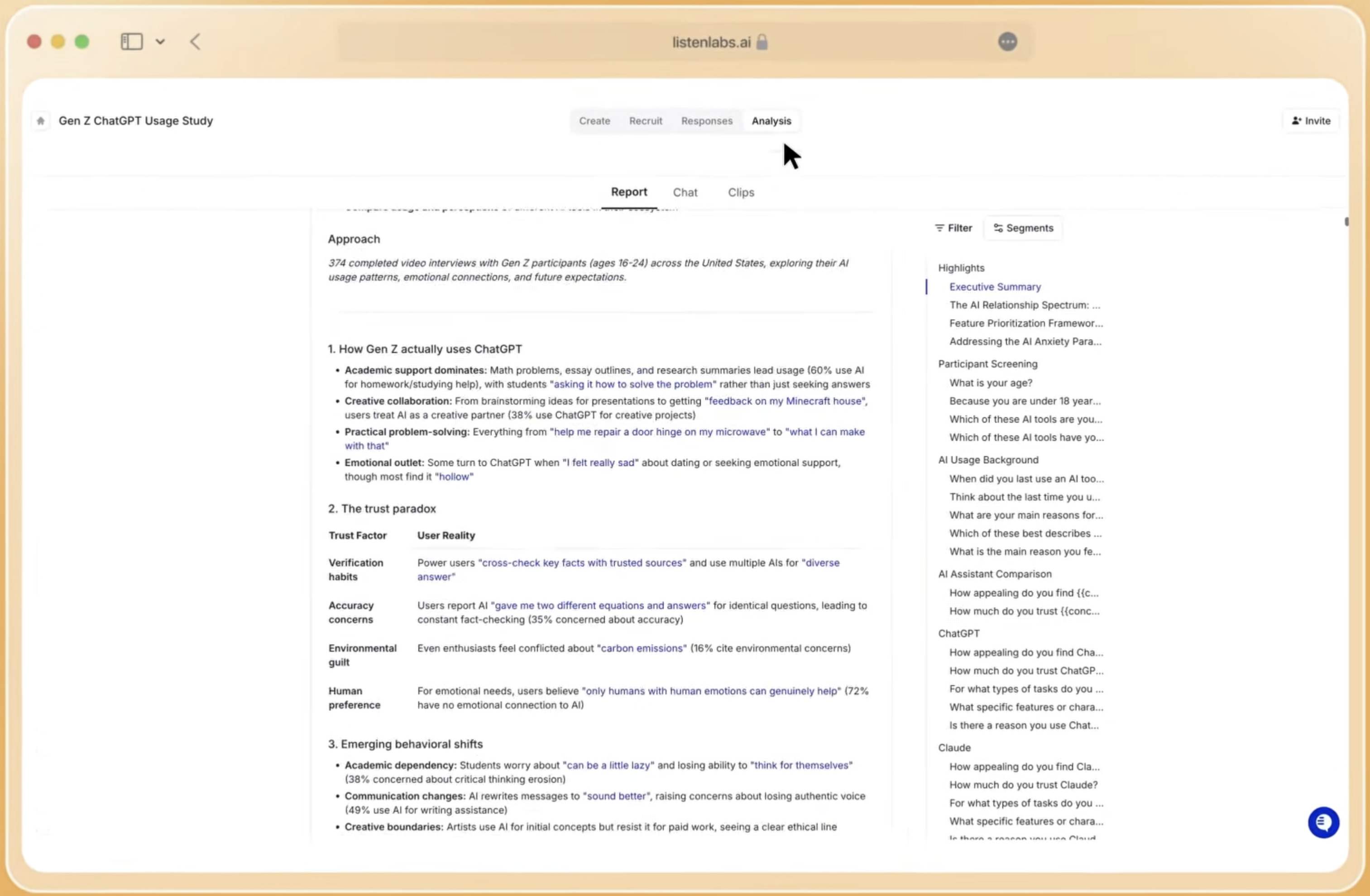
Manual analysis of qualitative data is time-consuming and subject to confirmation bias. Analysts often struggle to review every response in depth, which affects transparency of analysis. Listen Labs’ Research Agent processes all interview data objectively, identifies themes across hundreds of responses, and generates slide decks, memos, highlight reels, and statistical charts in under a minute. Researchers can inspect source quotes and timestamps, which keeps the analysis traceable.
Deliverable Creation and Stakeholder Readouts
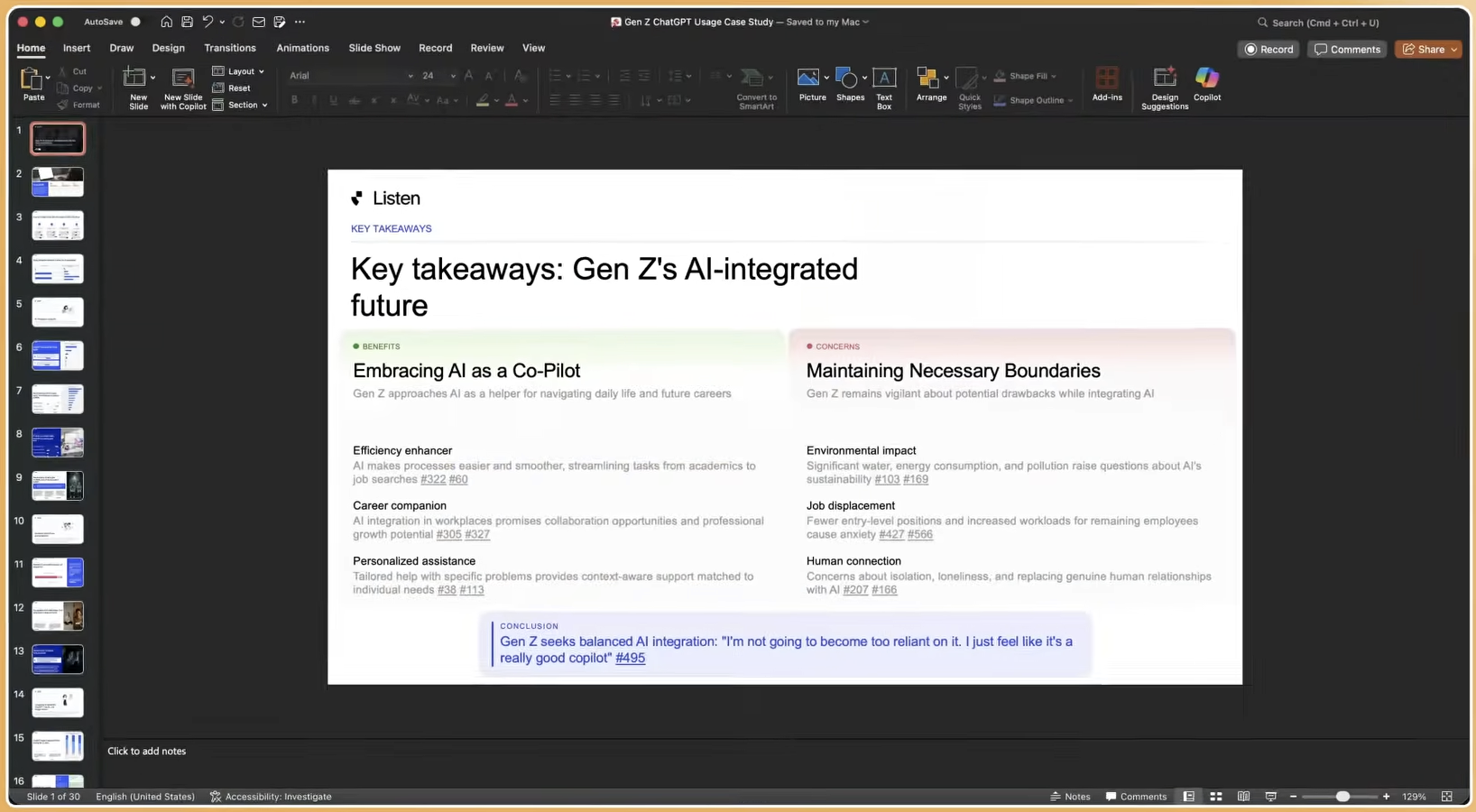
Traditional agencies produce final reports after analyst review cycles that add days or weeks to the timeline. These cycles increase cost and delay stakeholder decisions. Listen Labs generates consultant-quality deliverables automatically. Researchers can also query the data in natural language for custom segmentations and comparisons, which supports faster stakeholder readouts and follow-up questions.
Cross-Study Knowledge Management
Research findings from agency-led studies typically live in scattered slide decks and individual researchers’ memories. This fragmentation weakens long-term knowledge retention and forces teams to re-field similar studies. Listen Labs’ Mission Control serves as a persistent organizational knowledge base. Teams can run cross-study queries and track trends, which allows them to answer many questions from past research in seconds instead of commissioning new projects.
Where AI Excels: Speed, Scale, and Emotional Intelligence
Listen Labs has run over 1 million AI-powered customer interviews for companies including Microsoft, Perplexity, and Sweetgreen, achieving the speed and cost advantages outlined above at enterprise scale. A continuous AI brand interview program can go from kickoff to first wave of data in 5–10 business days, compared to 8–16 weeks for a classic panel tracker.
Scale operates in parallel with this speed. Listen Labs’ 30M verified respondent network spans 45+ countries and supports interviews in 100+ languages with automatic translation and transcription. Teams can run global brand perception studies and multilingual creative testing within a single platform and a single timeline. As Listen Labs CEO Alfred Wahlforss stated, companies use the platform for large decisions and can run hundreds of one-on-one interviews at scale.
Listen Labs’ Emotional Intelligence layer captures signals that transcripts alone miss. Built on Ekman’s universal emotions framework, the same standard used in clinical psychology, it analyzes tone of voice, word choice, and subconscious micro-expressions. The system quantifies emotions including joy, trust, surprise, fear, disgust, anticipation, sadness, and anger at the question and concept level. Every emotional label is traceable to the exact timestamp, verbatim quote, and reasoning behind it. For creative testing, this precision highlights where viewers light up or disengage. For brand perception studies, it surfaces how consumers feel about a brand versus competitors, not just what they report feeling.
AI brand research interviews can reveal statistical patterns and qualitative depth with a few hundred participants, with data collection often completed in days. Traditional surveys typically require much larger samples and longer timelines for reliable brand tracking.
Despite these AI advantages, traditional methods retain structural value in specific scenarios where their established frameworks provide unique benefits.
Where Traditional Methods Still Hold Value
Traditional panel-based brand trackers from vendors like Nielsen, Kantar, YouGov, Ipsos, or BrandIQ can be statistically weighted for representativeness using demographic weighting, post-stratification, and calibration models built over 20+ years. These methods enable defensible claims such as “unaided awareness moved from 23% to 26% in the U.S. 18–54 demographic, statistically significant at 95% confidence.”
Certain regulated categories such as pharma and financial services in some jurisdictions still require audit-grade panel methodology for claims substantiation. Switching from panel trackers to AI interviews mid-trend-line also requires rebaselining, because AI methods lack longitudinal comparability against pre-2024 historical tracker data. For final launch validation that requires retailer-ready evidence, regulatory support, or sensory testing involving taste, texture, or fragrance, calibrated human-moderated methods retain a structural advantage.
Scenario-Based Guidance for Common Team Profiles
This section outlines four common team profiles and how each can apply AI-moderated interviews. Readers can match their situation to the closest scenario and use it as a starting point for planning.
Enterprise insights teams managing a growing backlog of brand perception, concept testing, and creative testing requests benefit most directly from AI-moderated interviews. A mid-size CPG brand replacing 50% of its exploratory studies with AI research saves $680K annually in direct costs, triples concept-testing volume from 3–5 to 30–50 concepts per study, and shortens each product launch cycle by 3–4 weeks.
UX research leads needing faster feedback loops can use Listen Labs to run 50–100+ participant studies instead of 5–10. Screen-sharing and mobile recording capabilities support realistic task flows within sprint timelines rather than between them.
Product and marketing leaders without dedicated research teams can describe their objectives in natural language and have the platform handle study design, recruitment, moderation, and analysis automatically. This approach removes the need for deep methodology expertise while still delivering structured insights.
Explore which scenario fits your team’s research backlog in a personalized demo.
Operational and Long-Term Considerations
Successful adoption of AI-moderated interviews depends on both stakeholder alignment and operational readiness. Stakeholder alignment is the most common implementation friction point when teams introduce AI-moderated interviews alongside existing agency relationships. To address internal skepticism, research teams benefit from a phased validation approach. They run AI studies in parallel with one traditional study to demonstrate comparable output quality before committing to a full transition.
Beyond methodology validation, enterprise adoption also requires satisfying security and compliance requirements. Listen Labs maintains enterprise-grade security with 256-bit encryption and holds SOC 2 Type II, GDPR, ISO 27001, ISO 27701, and ISO 42001 certifications, which address the compliance concerns of Fortune 500 legal and security teams.
Brand teams reallocating 60–75% of legacy tracker spend to a continuous AI layer can run 20+ distinct studies per year on the same $800K annual budget, versus 4–5 studies previously, while reducing time-to-insight from 90 days to 48–72 hours. For ongoing global programs, Listen Labs’ multilingual support and cross-study knowledge base in Mission Control enable institutional knowledge to compound across every study rather than reset with each agency engagement.
While these operational advantages are significant, enterprise teams also need a clear view of the limitations and risks inherent in both AI and traditional approaches.
Risks and Limitations
Rigid survey instruments, whether fielded through traditional agencies or basic AI tools, produce shallow data regardless of sample size. The depth advantage of AI-moderated interviews depends on adaptive follow-up capability. Platforms that run scripted question sequences without dynamic probing replicate the limitations of surveys rather than true interviews.
Greenbook’s GRIT report tracks AI and automation as the number-one emerging method in qualitative research for the third consecutive year, with async AI-moderated formats accounting for roughly 80% of new study starts inside large research organizations in 2026. This rapid adoption does not remove the risk of selecting underpowered platforms. Fraud in commodity panels remains a documented problem. Research teams using first-party customer panels for AI-moderated qualitative studies achieve one-eighth the recruiting cost of external panels while addressing the fraud and quality issues flagged by ESOMAR. These points connect to a single theme: platform choice and sample source matter as much as the AI label.
The misconception that faster tools automatically produce better research is the most consequential risk for enterprise teams. Speed is a delivery advantage, not a methodology guarantee. Listen Labs is built by researchers with more than 50 years of combined in-house expertise, and the platform’s study design, quality controls, and analysis engine reflect that methodological foundation rather than only engineering velocity.
Decision Framework for Choosing AI, Traditional, or Hybrid
Matching the right approach to a given research goal works best with a simple decision framework. Four questions guide that choice.
- What decision does this study inform? Exploratory brand perception, concept screening, and creative testing favor AI-moderated interviews for speed and depth. Final claims validation for regulated categories or audit-grade trend reporting favors calibrated panel methods.
- How final is the stimulus? Early-stage concepts and multiple variants benefit from AI’s iteration speed. Final-stage materials that require statistical representativeness for external reporting benefit from a weighted panel layer.
- What is the audience? General population and defined consumer segments are well-served by Listen Labs’ 30M network. Audiences below 1% incidence rate are handled by Listen Labs’ dedicated recruitment operations team.
- What are the internal capabilities? Teams with established research infrastructure can run hybrid programs, using a thin quarterly panel tracker for trend lines plus a continuous AI conversation layer for qualitative depth. Teams without dedicated researchers can use Listen Labs’ end-to-end platform with AI-assisted study design.
Frequently Asked Questions
How quickly can Listen Labs deliver results compared to traditional qualitative research?
As detailed earlier, Listen Labs compresses the entire research lifecycle to less than 24 hours compared to the 4–6 week traditional timeline. In enterprise settings with internal prioritization and budget approval cycles, traditional projects can extend to six months. The critical difference is that this speed advantage applies to the complete cycle, not just data collection, which allows research to inform time-sensitive business decisions that traditional methods would miss entirely.
How does Listen Labs ensure participant quality and prevent fraud?
Listen Labs uses three layers of quality control. First, it sources participants exclusively from high-quality, non-commodity panels, avoiding professional survey-takers. Second, Quality Guard monitors every interview in real time across video, voice, content, and device signals to detect fraud, low-effort responses, AI-generated scripts, and mismatched profiles. Third, a dedicated recruitment operations team adds human review, and participants are limited to three studies per month to eliminate panel fatigue and repeat respondents. This multi-layer approach addresses the fraud and inattentiveness concerns that ESOMAR has flagged in traditional panel-based research for three consecutive years.
Can AI-moderated interviews capture the emotional depth that human moderators provide?
Listen Labs’ Emotional Intelligence layer goes beyond what most human moderators capture in a transcript. It analyzes tone of voice, word choice, and subconscious micro-expressions simultaneously, built on Ekman’s universal emotions framework used in clinical psychology and UX research. Every emotion is quantified per question and concept and traceable to the exact timestamp and verbatim quote. For creative testing, concept comparison, and brand perception studies, this produces emotional signal data that transcript-only methods, human or AI, cannot surface. Human moderators retain an advantage in high-context, high-stakes sessions that require real-time judgment calls and stakeholder management, which is why Listen Labs is designed to multiply the output of existing research teams rather than replace them.
What security and compliance certifications does Listen Labs hold?
Listen Labs maintains enterprise-grade security with 256-bit encryption and holds SOC 2 Type II, GDPR, ISO 27001, ISO 27701, and ISO 42001 certifications. Customer data is never used for AI model training. The platform also supports enterprise SSO. These certifications satisfy the compliance requirements of Fortune 500 legal, security, and procurement teams across regulated industries.
Which research scenarios still favor traditional methods over AI-moderated interviews?
Three scenarios retain a structural advantage for traditional methods. First, final claims validation for regulated categories, especially pharma and financial services, where audit-grade panel methodology is required for legal or regulatory substantiation. Second, longitudinal brand tracking programs with pre-2024 historical baselines, where switching methods mid-trend-line requires rebaselining and breaks comparability. Third, in-person sensory testing involving taste, texture, or fragrance, where physical presence is a methodological requirement. For other brand perception, concept testing, creative testing, and customer journey research, AI-moderated interviews deliver comparable or superior depth at significantly lower cost and faster cycle times. The recommended approach for most enterprise teams is a hybrid model that combines a reduced-cadence weighted panel tracker for statistical representativeness with a continuous AI interview layer for qualitative depth and exploratory research.
Conclusion: Building a Hybrid Brand Research Stack
Evidence from 2026 enterprise deployments shows that AI-moderated qualitative interviews deliver comparable depth to traditional agency-led methods at one-third the cost and in less than 24 hours. These interviews also add emotional intelligence capabilities that transcript-only methods cannot match. Traditional panel-based methods retain value for audit-grade statistical claims, regulated category research, and longitudinal trend lines with pre-existing baselines. The optimal configuration for most Fortune 500 consumer insights teams is a hybrid stack that combines a thin quarterly panel tracker for representativeness with a continuous AI interview layer for depth, speed, and scale.
Listen Labs is an end-to-end platform that covers the entire research lifecycle, including study design, global recruitment from a 30M verified network, AI-moderated interviews with Emotional Intelligence, automated analysis, and consultant-quality deliverables, without requiring separate vendors for each step. Enterprises including Microsoft, P&G, Anthropic, Skims, and Robinhood have used Listen Labs to run research 5x faster, at one-third the cost, with the qualitative depth their decisions require. Listen Labs acts as a force multiplier for existing research teams, keeping headcount constant while dramatically increasing output.
See how Listen Labs fits into your current research stack and what your team’s output could look like in 2026.