
Written by: Anish Rao, Head of Growth, Listen Labs | Last updated: July 22, 2026
Key Takeaways for Enterprise Research Teams
- Delve AI is a coding tool that processes transcripts after recruitment, moderation, and transcription are complete.
- Listen Labs is a full-lifecycle platform that manages participant sourcing, AI-moderated interviews, emotional signal capture, analysis, and deliverable generation in under 24 hours.
- Listen Labs scales beyond the traditional n=12 ceiling with a 30M-person global panel, fraud controls, and adaptive AI moderation that produces deeper conversational data.
- Listen Labs captures multimodal emotional signals, generates stakeholder-ready deliverables automatically, and retains cross-study knowledge through Mission Control.
- Consumer Insights Leaders facing growing backlogs can see how Listen Labs compresses weeks of research into a single business day.
Evaluation Criteria for Qualitative Research Tools
Ten criteria structure the side-by-side comparison in this article. Each criterion reflects a real operational constraint that Consumer Insights Leaders face when choosing between a coding-only tool and a full-lifecycle platform.
- Research cycle time
- Ability to scale beyond small samples
- Participant quality and fraud controls
- Depth of conversational insight
- Capture of emotional signals beyond transcripts
- Analysis objectivity and speed
- Deliverable generation
- Cross-study knowledge retention
- Security and compliance
- Total operational burden on research teams
Research Cycle Time from Brief to Insight
Delve AI qualitative software begins its work only after a research team has already recruited participants, conducted interviews, and produced transcripts. Cloud-native QDA tools such as Delve prioritize ease of use and real-time collaboration with feature sets centered on coding and thematic analysis rather than end-to-end study execution including participant sourcing or automated reporting. That upstream work is substantial and slow. Industry data published by dscout and UserTesting shows that the median enterprise research project takes 6–8 weeks end to end, with recruiting, scheduling, and manual coding as the primary bottlenecks.
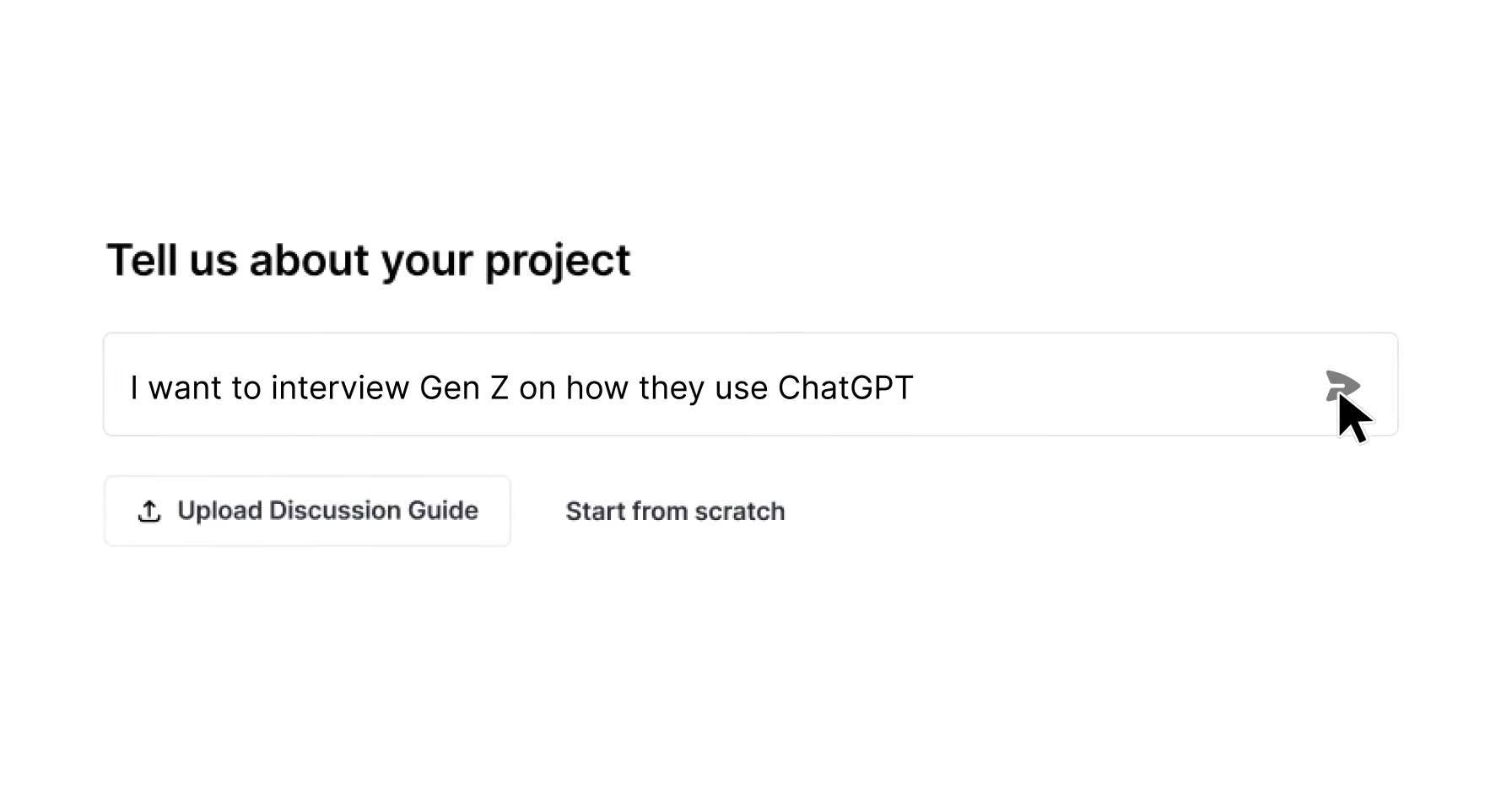
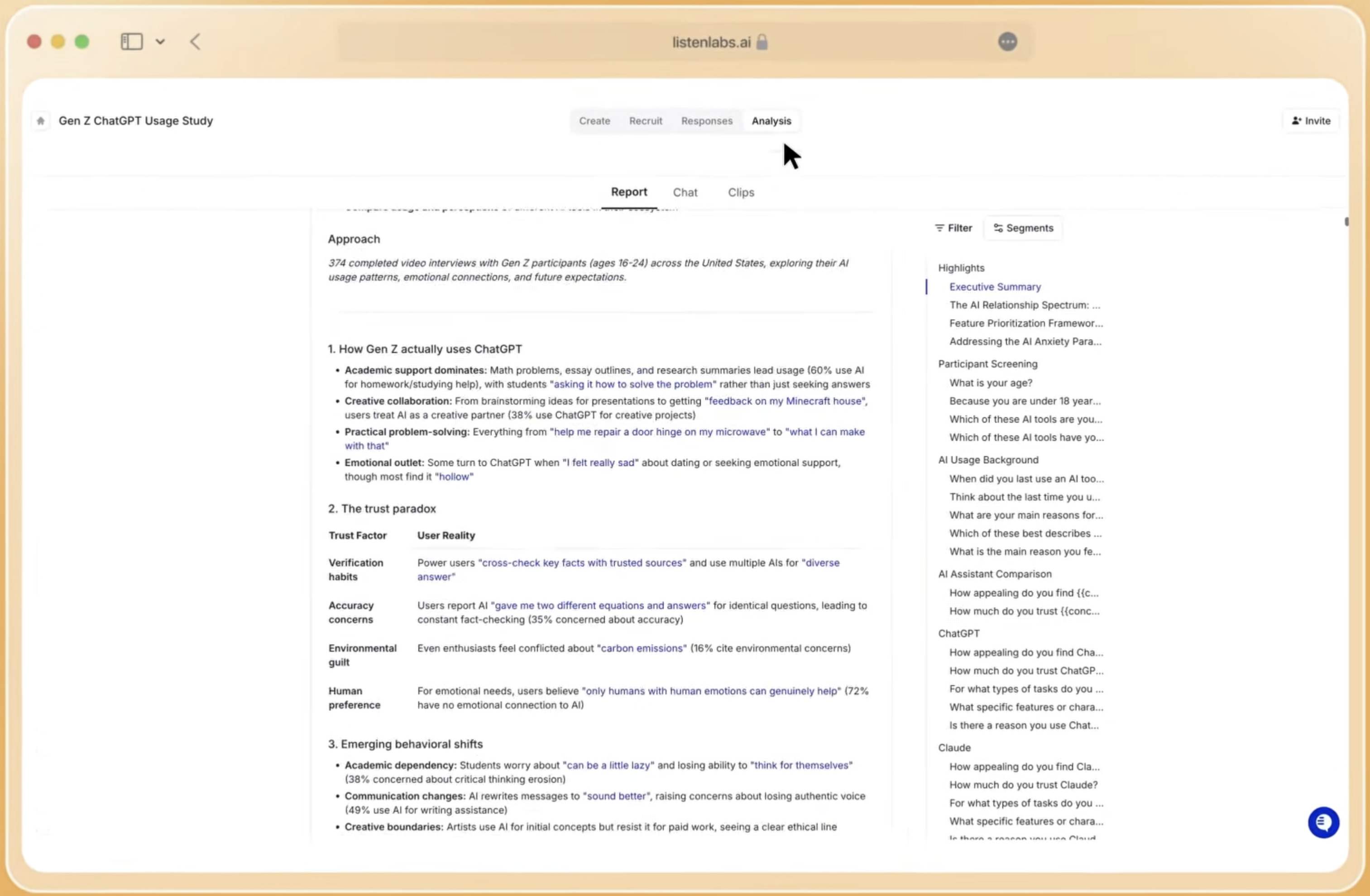
Listen Labs compresses this entire cycle into a single business day. AI assists with study design, recruits participants from a 30M-person global network, conducts AI-moderated video interviews with dynamic follow-up questions, analyzes all responses, and handles the full analysis workflow from raw data to final output, all in under 24 hours. Listen Labs has run over 1 million AI-powered customer interviews for companies including Microsoft, Perplexity, and Sweetgreen, demonstrating that this cycle time holds at enterprise scale.
Scaling Qualitative Research Beyond Small Samples
Delve’s workflow depends on samples that a human team can recruit and moderate manually. Traditional qualitative research has been sample-constrained at an n=12 ceiling because every interview required a human moderator who can comfortably run only three to five 60-minute sessions per day. Studies constrained to 12 participants cannot support credible segmentation. Splitting four segments across 12 interviews yields roughly three interviews per cell, which produces hunches rather than findings.
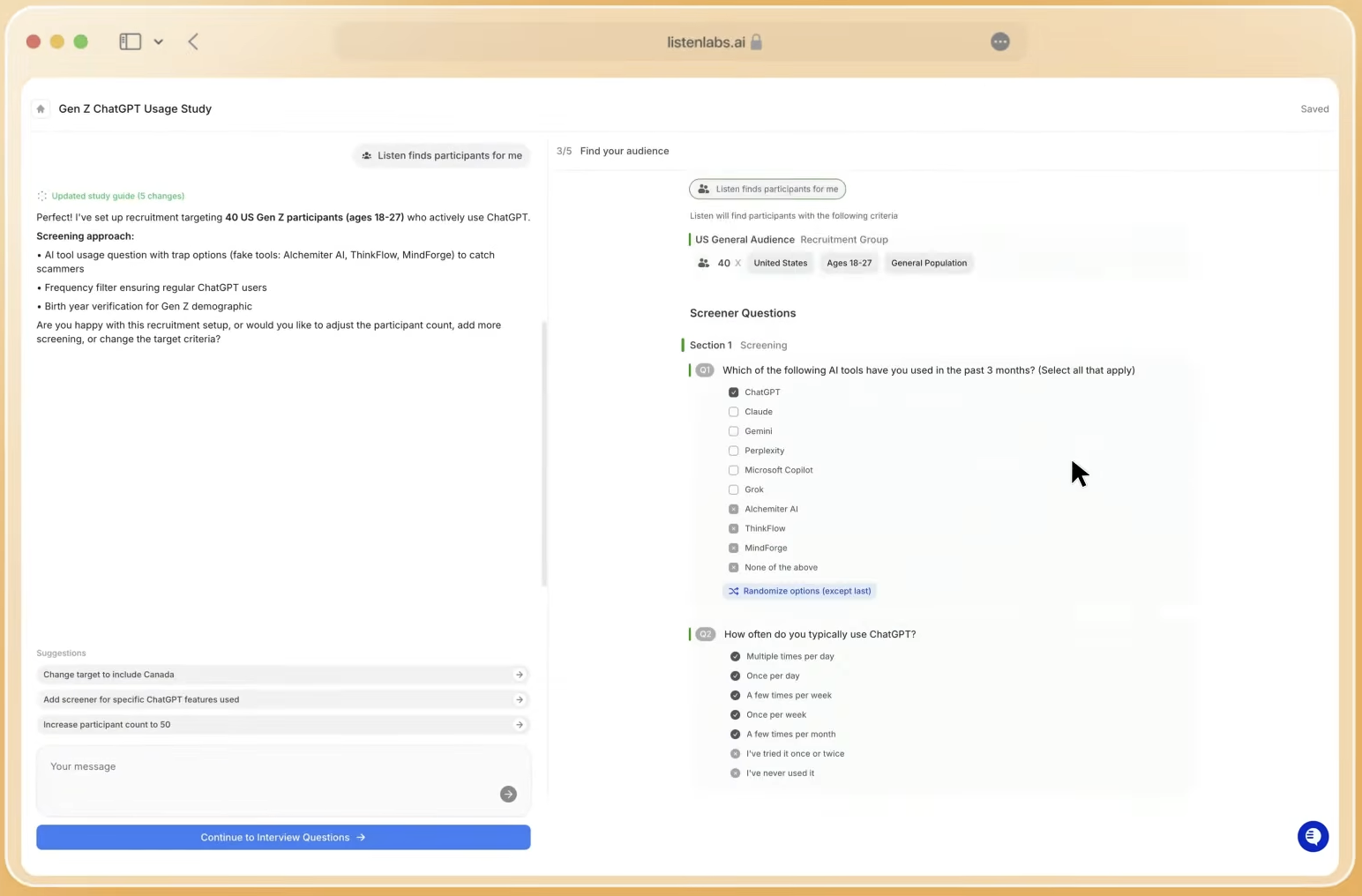
Listen Labs removes that ceiling entirely. Its Listen Atlas panel spans 30M verified respondents across 45+ countries and 100+ languages, with an AI orchestration layer that matches and sources participants across multiple panel partners simultaneously. Median study sizes among AI-moderated research users have grown substantially in recent years. At larger scales, teams gain the statistical confidence needed for segment-level analysis, cohort comparison, and rare-signal detection, which are not achievable at the sample sizes Delve’s upstream workflow typically produces.
Participant Quality, Fraud Controls, and Recruitment Depth
Delve AI qualitative software has no built-in participant sourcing infrastructure. Quality control depends entirely on whatever recruitment method the team used before uploading transcripts. AI tools for qualitative research improve data quality by using machine learning to analyze response patterns, typing speeds, webcam behavior, and linguistic markers to detect fraudulent or low-effort participants in online studies, but Delve does not apply these controls because it never touches the interview itself.
Listen Labs addresses fraud at the source through Quality Guard, a real-time monitoring layer that analyzes video, voice, content, and device signals during every interview. This automated screening is reinforced by a three-study-per-month participant cap that eliminates professional survey-takers who might otherwise slip through algorithmic detection. For hard-to-reach segments such as enterprise decision-makers, healthcare workers, and audiences below 1% incidence rate, a dedicated recruitment operations team adds human review so quality holds even when automated sourcing becomes difficult. The reputation scoring system compounds over time, so every study strengthens audience quality and creates a flywheel that coding-only tools cannot replicate.
Depth of Conversational Insight During Interviews
Delve analyzes transcripts that already exist. The quality of the conversational data it receives is fixed at the moment the human interviewer finished the session. If a moderator failed to probe a hesitant answer or missed an unexpected signal, that gap remains permanent in the transcript Delve receives.
Listen Labs conducts the interviews directly. Its AI moderator generates dynamic follow-up questions based on each participant’s actual responses, probing short or ambiguous answers the same way a trained human interviewer would. AI-moderated interviews maintain adaptive probing, generating follow-up questions from participants’ actual spoken answers rather than forcing responses into pre-set survey options, thereby preserving qualitative data characteristics while removing the one-at-a-time moderator constraint. Structured AI interviews can produce more codable themes per respondent than matched short-answer surveys.
Capturing Emotional Signals Beyond the Transcript
Conversational depth matters most when paired with accurate emotional signal capture. Delve’s scope remains limited to the transcript. Everything that happens in the space between words, such as a frown, a moment of hesitation, or a shift in vocal tone, stays invisible. Multimodal emotion analysis models combining audio, video, and text can achieve higher accuracy on emotion tasks compared to unimodal systems. Transcript-only tools operate in the lower-accuracy unimodal range by design.
Listen Labs’ Emotional Intelligence layer analyzes three simultaneous signal streams: tone of voice, word choice, and subconscious micro-expressions. Built on Paul Ekman’s universal emotions framework, the same standard used in clinical psychology, it quantifies emotions including joy, trust, anticipation, fear, sadness, disgust, anger, and surprise at the question and concept level. Every emotional label is traceable to the exact timestamp, verbatim quote, and reasoning behind it. A 2025 npj Artificial Intelligence paper on foundation model disruption in affective computing confirms a shift toward large pre-trained foundation models in which affective-computing abilities emerge without specialized annotated affective data, reducing time and cost in emotion-analysis workflows. This capability is available across 50+ languages and integrates directly with the Research Agent for natural-language queries and highlight reels of emotionally significant moments.
Analysis Objectivity and Speed at Scale
Delve’s AI features suggest codes, identify themes, and learn from researcher coding decisions while keeping the human analyst in primary control. That human-in-the-loop design is methodologically defensible, but it preserves the time cost. Inter-rater reliability in manual coding achieves only 60–80% agreement on complex codebooks, with consistency degrading further at scale across multiple coders and large datasets. Manual coding of interview transcripts is time-intensive, while AI-assisted analysis with human review can reduce the effort required.
Listen Labs’ analysis engine processes all interview data objectively, identifying patterns and themes across hundreds of responses without human bias. It separates signal from noise using proprietary data from tens of thousands of prior studies, a dataset that no coding-only tool has access to. A 2026 AI Research Productivity Report found that analysis time fell 91% in AI-augmented workflows.
See Listen Labs’ analysis engine process a live study from interview to themed output.
Automatic Deliverable Generation for Stakeholders
Delve’s output is coded data and thematic structures. Translating that output into a stakeholder-ready slide deck, memo, or highlight reel requires additional researcher time and separate tools. Researchers spend the bulk of their time in analysis: finding patterns, quantifying insights, testing significance, adding macro context, and formatting results for stakeholders who each need something different.
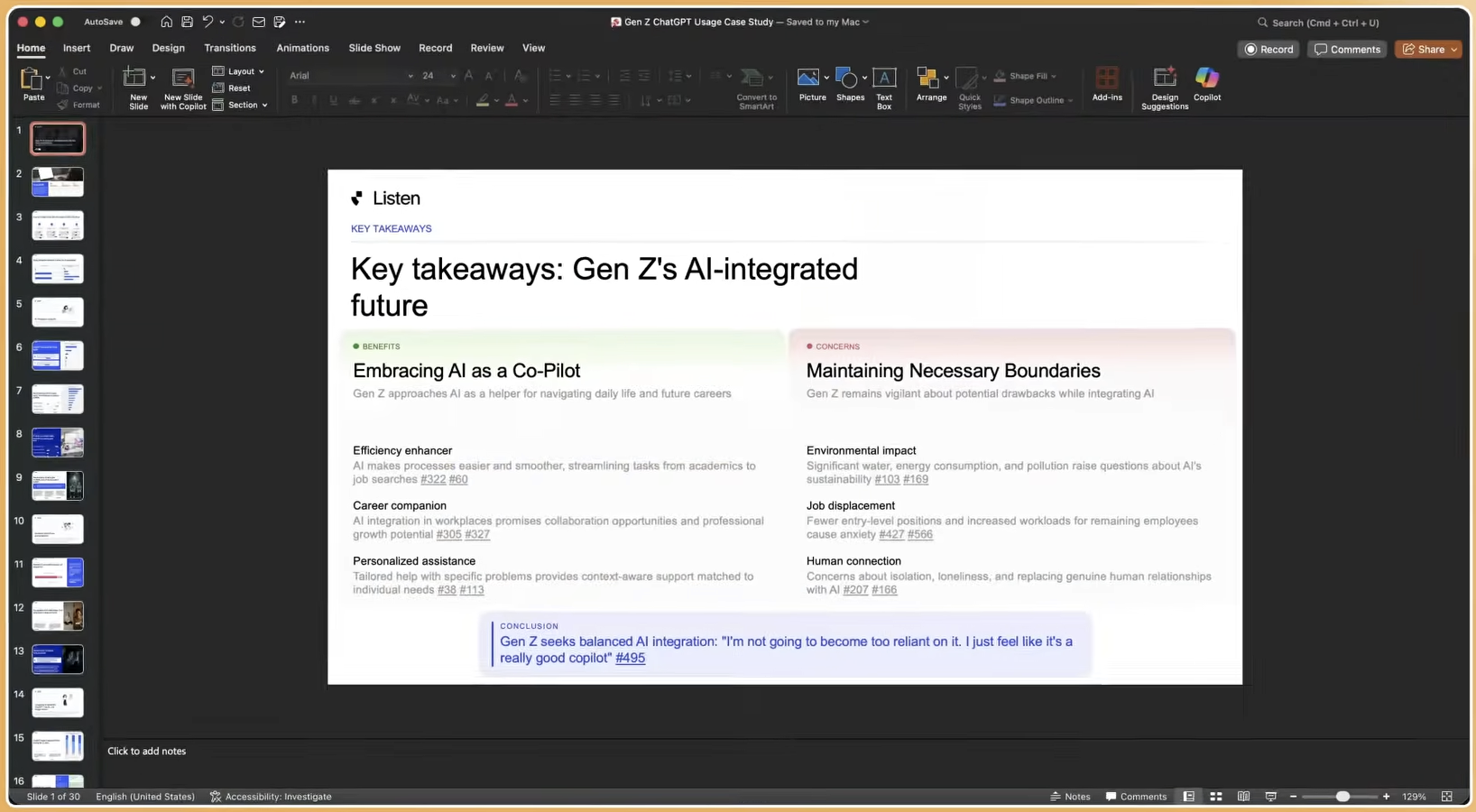
Listen Labs’ Research Agent removes that final-mile burden. Research Agent generates a slide deck in a company’s branded template and a downloadable report, alongside memos, video highlight reels, statistical charts, segmentation breakdowns, and custom outputs based on any natural-language question, all in under a minute. The Director of Data Science at Microsoft summarized the impact clearly: “We were able to collect those user video stories within a day. Our leadership team was very thrilled at both the speed and the scale that Listen Labs enabled. I can reach out to hundreds of users at one third of the cost.”
Cross-Study Knowledge Retention with Mission Control
Delve operates at the project level. Insights from one study do not automatically inform the next. Research findings accumulate in scattered reports and individual researchers’ memories, so teams repeatedly re-research the same questions because institutional knowledge is not systematically preserved.
Listen Labs’ Mission Control serves as the organization’s source of truth for everything ever learned from customers across all studies. Cross-study queries return answers in seconds without digging through old reports. Each new study grows the knowledge base, enabling trend tracking across time, segment comparison across programs, and institutional knowledge building that compounds with every research cycle.
Enterprise-Grade Security and Compliance Coverage
Delve is a lighter-weight cloud tool designed for ease of onboarding. Its enterprise security posture does not match the certifications required by Fortune 500 procurement and legal teams. When evaluating AI tools for qualitative research, organizations should verify data security and privacy compliance with applicable regulations, as qualitative data is sensitive and must meet protection requirements.
Listen Labs holds SOC 2 Type II, GDPR, ISO 27001, ISO 27701, and ISO 42001 certifications, covering operational security, privacy compliance, and AI governance. Customer data is encrypted at 256-bit and is never used for AI model training, which addresses the two most common legal objections in enterprise procurement. Enterprise SSO support integrates with existing identity management systems. This combination satisfies the procurement requirements of the Fortune 500 enterprises, including Microsoft, Google, Sony, Procter & Gamble, and Nestlé, that currently use the platform.
Total Operational Burden on Research Teams
A team using Delve still needs a separate recruitment vendor, a scheduling tool, a moderation setup, a transcription service, and a reporting layer before Delve’s coding features become relevant. Platforms like Listen Labs layer on auto-recruiting, transcription, sentiment tagging, and insight summarization so teams jump from question to findings in hours, not weeks. Every vendor handoff in the Delve workflow introduces delay, cost, and quality risk. Listen Labs replaces the entire stack with a single platform, removing the coordination overhead that keeps research teams perpetually backlogged.
Best-Fit Use Cases for Listen Labs and Delve
Consumer Insights Leaders managing large backlogs and limited headcount benefit most from Listen Labs’ full-lifecycle automation. UX research groups that need to test with 50–100+ users per sprint rather than 5–10 gain both speed and sample depth. Product managers and brand teams without dedicated research staff can describe goals in natural language and receive structured studies, recruited participants, moderated interviews, and synthesized outputs without methodology expertise. Agencies and consultancies operating on client timelines measured in days rather than weeks use Listen Labs to deliver findings that previously required months of fieldwork.
Delve suits teams that already have transcripts in hand, have completed recruitment and moderation through other means, and need a structured environment for collaborative coding. It functions as a useful tool within a larger workflow but cannot serve as that workflow’s foundation.
Operational and Long-Term Considerations for Platform Adoption
Moving from a fragmented multi-vendor stack to a single platform requires stakeholder alignment across research, IT, legal, and procurement. Listen Labs’ enterprise certifications address the compliance dimension. The platform’s subscription model, with credits per participant varying by audience difficulty, provides predictable budgeting for continuous programs rather than one-off projects. Reductions in time-to-insight have enabled teams to run more studies per researcher per quarter at constant headcount, supporting a move toward continuous discovery cadence. For global programs, Listen Labs’ 100+ language support and 45+ country reach remove the localization complexity that typically multiplies cost and timeline in multi-market research.
Risks, Limitations, and Common Misconceptions
Teams evaluating Delve AI qualitative software sometimes overestimate what coding automation achieves in isolation. Faster coding does not produce faster insights if recruitment still takes three weeks. AI tools can achieve strong coding accuracy on well-structured data but accuracy tends to be lower on messy data involving sarcasm, multilingual content, or domain-specific jargon. Teams also underestimate recruitment complexity, because sourcing verified, fraud-free participants for niche audiences is a specialized operation that commodity panels handle poorly.
Another misconception is that faster analysis automatically produces better research. AI-generated codes in thematic analysis should be treated strictly as an initial starting point that researchers must review, merge, split, relabel, and verify against source passages rather than accepted as a final conclusion. Listen Labs addresses this by grounding its analysis in proprietary data from tens of thousands of completed studies, providing a calibrated baseline that general-purpose coding tools lack.
Decision Framework for Choosing Between Delve and Listen Labs
Teams with existing transcripts, a stable multi-vendor workflow, and a primary need for structured collaborative coding will find Delve serviceable as a point solution. The tool is accessible, onboards quickly, and reduces manual coding time within its defined scope.
Teams that need to run more studies without adding headcount, reach global audiences at scale, capture emotional signals alongside verbal responses, and deliver stakeholder-ready outputs within a business day require a full-lifecycle platform. Listen Labs is the appropriate choice when the constraint is total research throughput rather than coding speed. Enterprise teams at Microsoft, Procter & Gamble, Skims, and Anthropic have each validated this use case at scale.
Frequently Asked Questions
How quickly can Listen Labs deliver results compared with Delve workflows?
Listen Labs delivers results in under 24 hours from study design to final deliverables, including recruited participants, completed AI-moderated interviews, analyzed themes, and stakeholder-ready outputs. A Delve workflow requires separate upstream steps such as recruitment, scheduling, moderation, and transcription before coding can begin, which places the realistic end-to-end timeline at 4–6 weeks for a typical enterprise study.
How does Listen Labs source participants differently from tools that require manual recruitment?
Listen Labs operates Listen Atlas, a global panel of 30M verified respondents across 45+ countries and 100+ languages. An AI orchestration layer automatically matches and sources participants across multiple panel partners simultaneously. A dedicated recruitment operations team handles hard-to-reach segments including enterprise decision-makers, healthcare workers, and audiences below 1% incidence rate. Delve has no built-in sourcing infrastructure, so teams must arrange recruitment independently before uploading transcripts.
What sample quality and fraud protections does Listen Labs provide beyond transcript coding platforms?
Listen Labs’ Quality Guard monitors every interview in real time across video, voice, content, and device signals to detect fraud, low-effort responses, AI-generated scripts, and mismatched profiles. Participants are capped at three studies per month to eliminate professional survey-takers. A reputation scoring system compounds across every interview the platform runs, continuously improving audience quality. Transcript coding platforms like Delve apply no fraud controls because they receive data only after interviews are complete.
How does AI moderation in Listen Labs differ from Delve’s post-interview analysis?
Listen Labs conducts the interview itself. Its AI moderator generates dynamic follow-up questions based on each participant’s actual responses, probing short or ambiguous answers adaptively throughout the conversation. Delve analyzes transcripts that were produced by a separate interview process. The quality and depth of the conversational data Delve receives is fixed before it ever touches the file, while Listen Labs shapes that data in real time.
How much analysis effort remains when using Listen Labs versus Delve?
With Delve, researchers must review AI-suggested codes, merge and relabel themes, verify quotes against source passages, and then separately produce deliverables in other tools. With Listen Labs, the Research Agent automatically generates key findings, themed analysis, slide decks in branded templates, memos, video highlight reels, statistical charts, and segmentation breakdowns in under a minute. Researchers can also query the data in natural language for custom outputs. The remaining human effort shifts from mechanical coding to strategic interpretation and stakeholder communication.
Does Listen Labs support multilingual research at the same scale as Delve?
Listen Labs supports 100+ languages for interview moderation, with automatic translation and transcription across all supported languages. Its Emotional Intelligence layer is available across 50+ languages. The platform covers 45+ countries with localized participant sourcing. Delve supports analysis of transcripts in multiple languages but has no built-in infrastructure for multilingual recruitment, moderation, or localized emotional signal capture.
What enterprise security certifications does Listen Labs hold?
Listen Labs holds SOC 2 Type II, GDPR, ISO 27001, ISO 27701, and ISO 42001 certifications. All customer data is encrypted at 256-bit. Customer data is never used for AI model training. Enterprise SSO is supported. These certifications satisfy the procurement and legal requirements of Fortune 500 enterprises across tech, CPG, retail, and food and beverage sectors.
How complex is implementation and how scalable is the platform for continuous programs?
Listen Labs is designed for enterprise deployment with dedicated onboarding support. The platform handles study design, recruitment, moderation, analysis, and deliverable generation within a single interface, which removes the integration complexity of a multi-vendor stack. For continuous research programs, Mission Control accumulates institutional knowledge across every study, enabling cross-study queries and trend tracking without additional configuration. Organizations currently running 12 studies per quarter can scale to 60+ studies at constant headcount once the full-lifecycle platform replaces fragmented point solutions.
Conclusion: Selecting a Platform for Enterprise Consumer Insights
Delve AI qualitative software reduces manual coding effort on transcripts it receives. It does not source participants, conduct interviews, capture emotional signals, or generate stakeholder-ready deliverables. Teams that adopt it still carry the full weight of every upstream and downstream task in the research lifecycle, which keeps studies small, slow, and fragmented.
Listen Labs removes every one of those constraints through its full-lifecycle platform. It delivers the complete research workflow, from participant sourcing through stakeholder-ready deliverables, in under 24 hours. This speed, combined with the scale and depth covered in the preceding sections, represents a structural shift from incremental coding improvements to end-to-end research transformation. Enterprise teams at Microsoft, Procter & Gamble, Anthropic, and Skims have each validated this capability at scale.
For Consumer Insights Leaders whose teams are overwhelmed by growing backlogs and whose stakeholders are waiting weeks for answers that should arrive in hours, the choice between a coding tool and a full-lifecycle platform determines whether they achieve incremental relief or structural transformation.
See how Listen Labs delivers end-to-end consumer insights in under 24 hours.