
Written by: Anish Rao, Head of Growth, Listen Labs | Last updated: July 29, 2026
Key Takeaways for Enterprise Research Leaders
- Generative AI now supports the full qualitative research lifecycle, from study design and participant recruitment to adaptive AI interviews, emotional-signal analysis, and automated deliverable generation. This approach compresses hundreds of interviews into under 24 hours.
- Human researchers maintain strategic control at every stage while AI accelerates execution. Built-in checkpoints preserve methodological rigor and prevent bias from scaling.
- Listen Labs combines a 30M+ verified global panel, adaptive AI moderation in 100+ languages, traceable multimodal emotional analysis, and one-click consultant-quality deliverables within SOC 2, GDPR, and ISO 42001-compliant architecture.
- Enterprise-grade safeguards, including zero-retention policies, explicit prohibitions on training-data use, and informed-consent mechanisms, reduce hallucination, privacy, and data-retention risks associated with generative AI.
- Teams can compress study design from days to minutes and run hundreds of rigorous, emotionally intelligent interviews in under 24 hours. Talk with the Listen Labs team about your next study.
Designing Studies with Generative AI Co-Pilots
AI-assisted study co-design compresses what traditionally required days of internal alignment into minutes while keeping the researcher in full methodological control. Teams that restructure workflows around AI rather than bolt AI onto legacy processes achieve up to 84% reductions in time-to-insight, with planning time remaining a human-led stage.
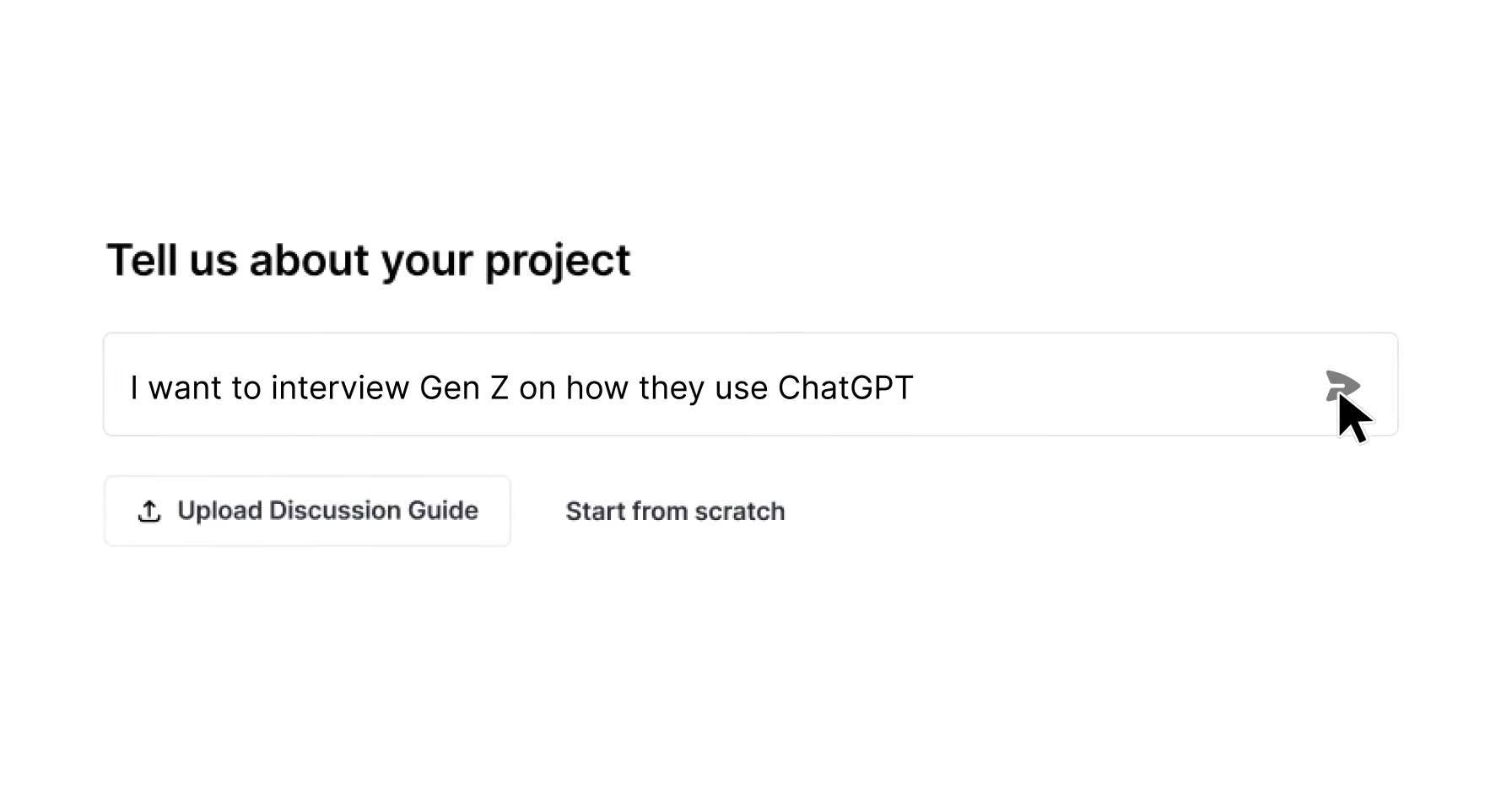
A repeatable study design workflow on Listen Labs:
- State objectives in natural language. Describe the research goal (for example, “Understand why first-time buyers abandon checkout on mobile”) and Listen Labs’ AI drafts structured objectives, screener criteria, and a discussion guide.
- Human checkpoint: review and refine the guide. The researcher edits question order, adjusts probing context, and sets branching logic, quotas, and stimuli such as images, video, prototypes, or live URLs.
- Run Auto-QA. The platform flags ambiguous questions, leading phrasing, and structural issues before launch. This step is what research practitioners identify as essential for preventing bias from scaling at interview volume.
- Human checkpoint: final approval. The researcher signs off on the guide before any participant sees it.
Sample prompt for step one: “Draft a 45-minute IDI guide for US men aged 25–45 evaluating three new grooming product claims. Include a warm-up, four concept-reaction sections with monadic rotation, and a closing priorities exercise.”
Teams that want to compress study design from days to minutes can see Listen Labs’ AI co-design in action.
Sourcing High-Quality Participants at Scale
Participant quality is the single largest source of downstream error in consumer insights work. Qual-at-scale is only viable when AI tools can engage hundreds or thousands of participants remotely and asynchronously with verified quality, a condition that commodity panels routinely fail to meet.
Once your study design is finalized, the next critical step is recruiting participants who can provide genuine insights that match your target audience. Listen Labs’ Listen Atlas recruitment workflow supports that step.
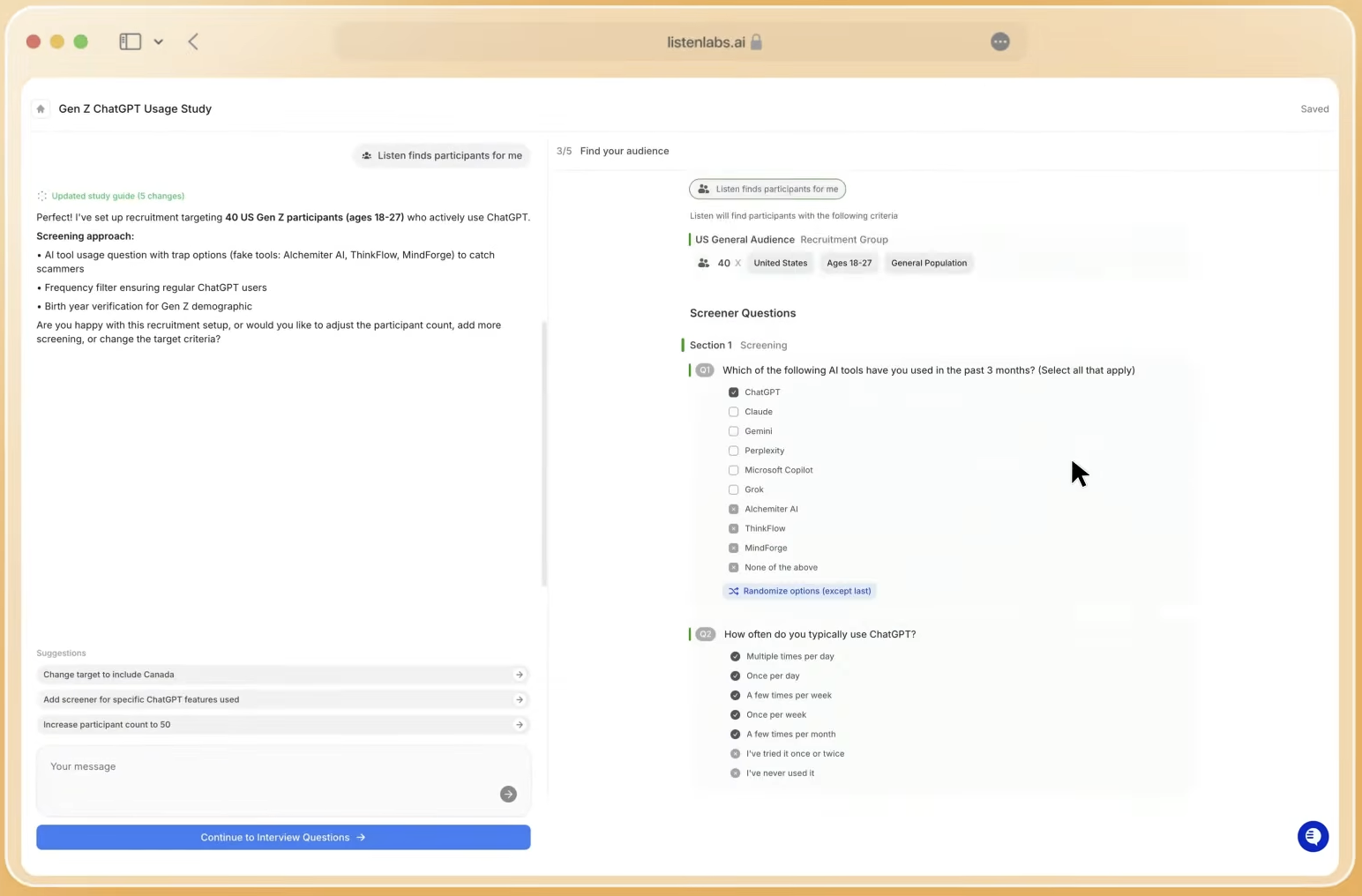
Listen Labs’ Listen Atlas recruitment workflow:
- Define the audience. Specify demographics, behavioral criteria, incidence rate, and geographic markets across 45+ countries and 100+ languages.
- AI orchestration. Listen Atlas automatically matches and bids across Listen Labs’ proprietary database and vetted panel partners, prioritizing behavioral and intent signals over self-reported demographics.
- Quality Guard activation. Real-time monitoring across video, voice, content, and device signals detects fraud, low-effort responses, AI-generated scripts, and mismatched profiles before they enter the dataset. This multi-signal approach catches quality issues that single-channel screening would miss. Additionally, participants are capped at three studies per month, which removes professional survey-takers who can distort results through over-familiarity with research protocols.
- Human checkpoint: profile spot-check. The recruitment ops team reviews a stratified sample of approved profiles, especially for audiences below 1% incidence rate such as enterprise decision-makers, healthcare workers, or engineers.
- Launch. Confirmed participants receive interview invitations with plain-language disclosure of AI moderation and a clear opt-out mechanism, satisfying informed-consent requirements for AI-moderated research under GDPR and comparable frameworks.
Running Adaptive AI Interviews at Enterprise Scale
Ninety-two percent of participants report top comfort levels in AI-moderated sessions, equivalent to human-moderated sessions, and 32% explicitly state they feel less judged by an AI moderator. This pattern supports higher candor on sensitive topics. Switching to AI-moderated interviews allowed Chubbies to capture hundreds of candid, one-to-one conversations overnight, a result impossible with human moderation at equivalent cost.
Adaptive interview workflow on Listen Labs:
- Configure interview parameters. Set question types such as open-ended IDI, Likert, NPS, or MaxDiff, along with stimuli display order and probing depth thresholds.
- AI moderation at scale. Listen Labs conducts hundreds of personalized video interviews simultaneously, with smart follow-ups that probe short or ambiguous answers in the same way a trained human interviewer would.
- Human checkpoint: mid-field guide refinement. After the first 20–30 interviews, the researcher reviews emerging patterns and adjusts probing context or adds clarifying questions for the remaining field.
- Edge-case review. The researcher flags and manually reviews interviews where participants raised unexpected topics, expressed distress, or produced anomalous response patterns.
- Rich data capture. Every session produces video, audio, transcript, and screen recordings, including iOS mobile, plus quantitative data from embedded scales. This combination delivers qualitative depth and quantitative breadth in a single instrument.
Sample adaptive probe prompt: “If the participant describes a product as ‘fine’ or ‘okay,’ ask: ‘What would need to change for it to feel genuinely great rather than just acceptable?’”
Every session produces structured data, yet the richest signals often extend beyond what participants explicitly say.
Capturing Emotional Signals Beyond Transcripts
Transcripts record what participants say. They do not record a frown during a price reveal, a moment of hesitation before endorsing a claim, or the vocal flattening that signals disengagement. Listen Labs’ Emotional Intelligence feature analyzes three simultaneous signal layers, tone of voice, word choice, and subconscious micro expressions, to surface emotions that transcripts alone miss.
Emotional-intelligence analysis workflow:
- Activate Emotional Intelligence at study launch. The feature runs automatically across all recorded interviews with no additional setup.
- Framework-anchored detection. Every emotion is classified using Ekman’s universal emotions framework, anger, anticipation, disgust, fear, joy or happiness, sadness, trust, and surprise, the same standard used in clinical psychology and UX research. This structure ensures methodological defensibility.
- Quantification per question and concept. Every emotion label is traceable to the exact timestamp, verbatim quote, and AI reasoning behind it. Researchers see evidence rather than a black-box score.
- Human checkpoint: cultural and contextual verification. The researcher reviews emotion labels for culturally specific expressions or ambiguous micro expressions, particularly in non-English markets, because AI performance on culturally nuanced non-English data can require additional human verification.
- Research Agent integration. Researchers query emotional data in natural language, for example “Which concept triggered the most confusion among women 35–50 in Germany?”, and generate charts, comparisons, and highlight reels of emotionally significant moments.
Listen Labs’ Emotional Intelligence is available across 50+ languages, making it a traceable multimodal emotion solution built for global consumer insights programs.
Maintaining Reflexivity and Avoiding Hallucinations
Girdwood and Manikonda (2026) identify hallucinated outputs and privacy or ethical concerns as major risks of AI in qualitative research. A 2025 PLOS One study tested an AI system for thematic analysis and compared its outputs to human analysis. Structured human oversight at every synthesis stage remains the primary mitigation.
Bias-controlled synthesis workflow:
- Define the codebook before AI coding. Each code requires a clear name, a two-to-three-sentence definition, inclusion and exclusion criteria, and example quotes. A well-structured codebook is the single most important factor in achieving consistent AI coding output.
- Run AI thematic analysis. Listen Labs’ analysis engine processes all interview data and identifies patterns and themes across hundreds of responses without human confirmation bias.
- Human checkpoint: codebook audit. The researcher reviews AI-generated codes for missing categories, over-merged themes, and minority-view suppression. A stratified spot-check of 10–20% of coded responses across demographic segments, confidence levels, and data sources is the recommended validation standard.
- Outlier and quote verification. Every AI-generated summary is checked against source transcripts to confirm that quotes are not misattributed, altered, or drawn disproportionately from early interviews.
- Document the audit trail. Teams record the model version, prompts used, human-AI division of labor, and any modifications made during review. Girdwood and Manikonda (2026) recommend adapting reporting checklists like COREQ or SRQR to include AI disclosure details for publication-grade transparency.
Sample synthesis prompt: “Identify the five most frequently expressed barriers to product trial. For each barrier, provide three verbatim quotes from different participant segments and flag any theme that appears in fewer than 10% of interviews as a minority view.”
Generating Reproducible Deliverables with Research Agent
Listen Labs’ Research Agent handles the full analysis workflow from raw data to final output, with every insight linking directly to the underlying response data. This structure makes findings auditable and reproducible rather than opaque summaries.
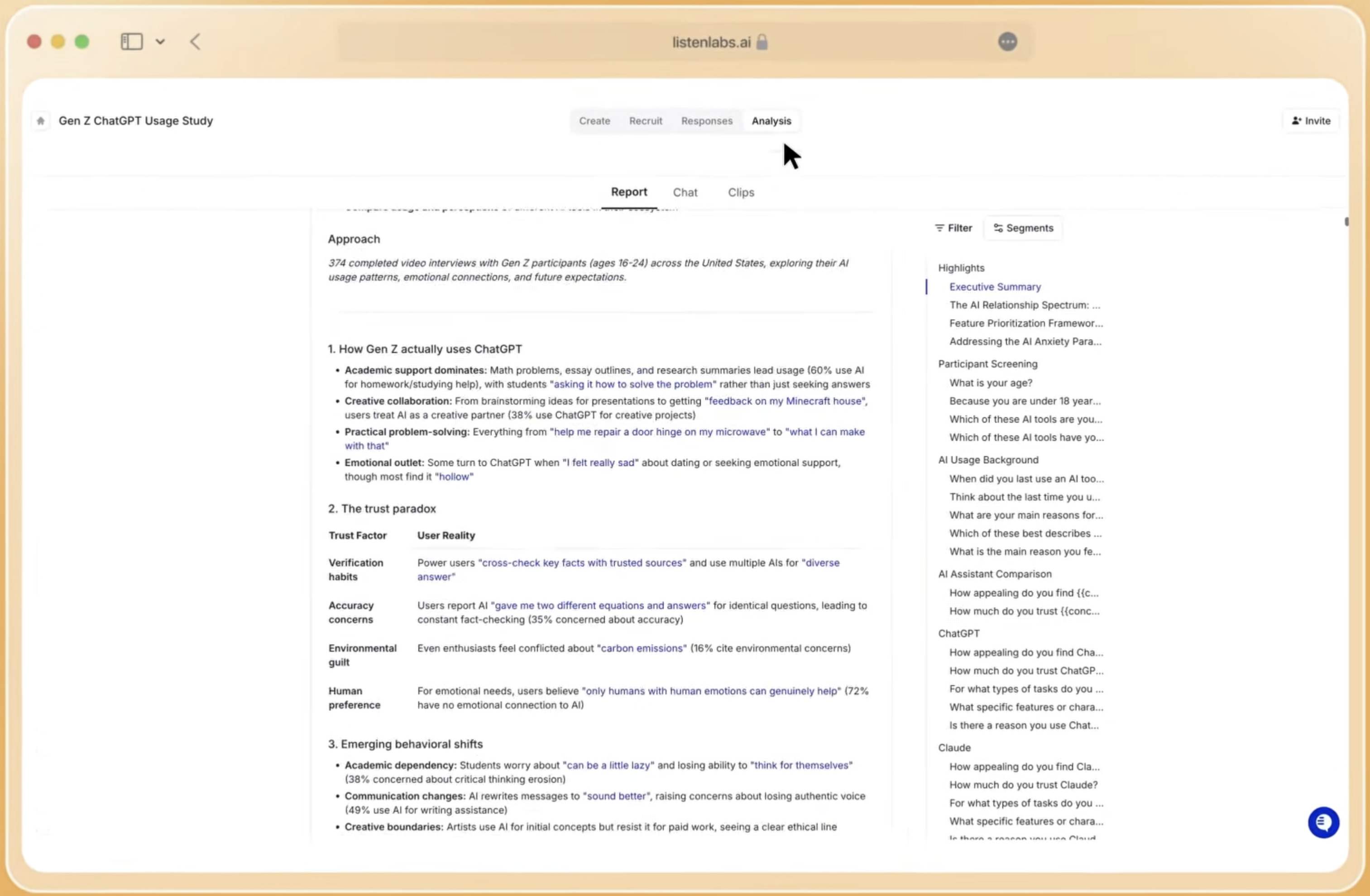
One-click reporting workflow:
- Select deliverable type. Choose from slide decks, memo-style reports, video highlight reels, statistical charts, segmentation breakdowns, or custom natural-language reports.
- AI generation. Research Agent generates a slide deck in your company’s branded template and a downloadable report in under a minute, including automated key findings, theme analysis, and persona summaries.
- Human checkpoint: strategic framing and approval. The researcher adds interpretive context, adjusts emphasis for the specific stakeholder audience, and approves the final deliverable before distribution.
- Video highlight reels. Automatically generated clips surface the most emotionally significant or thematically relevant interview moments, giving stakeholders direct access to the participant voice.
Research Agent’s ability to compress weeks of manual report writing into minutes enables enterprise teams to reach hundreds of users at a fraction of traditional research costs without sacrificing consultant-quality output.
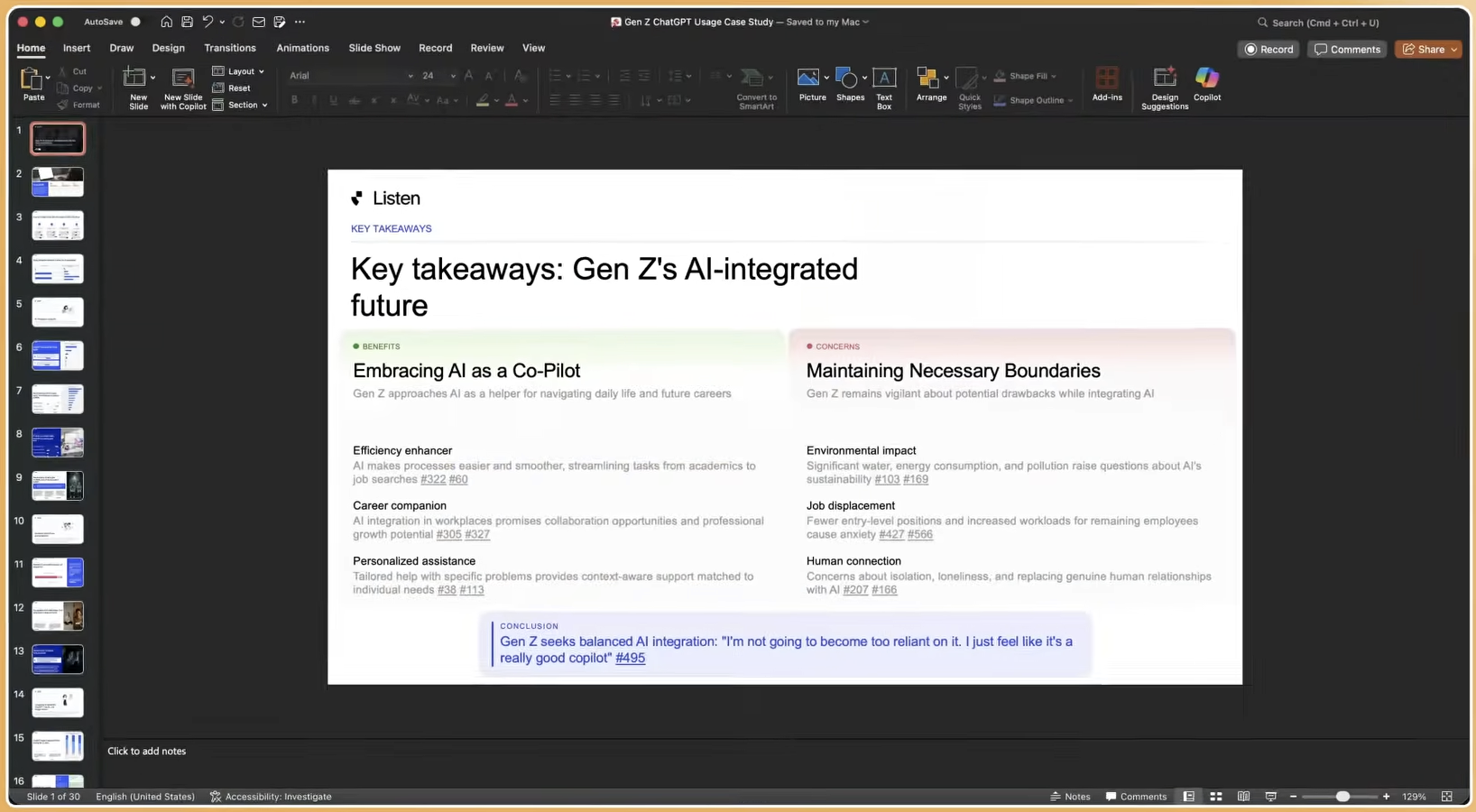
Teams can schedule a walkthrough of Research Agent to see a board-ready deliverable generated in real time.
Enterprise Privacy and Governance Controls
Informed consent for AI-moderated research must include plain-language disclosure that the interview is conducted by an AI system, an explanation of data collected and storage timelines, and a clear opt-out mechanism. Listen Labs builds these requirements into every study by default.
Data handling and compliance workflow:
- Pre-study consent configuration. Every participant receives plain-language disclosure of AI moderation, data use, retention timelines, and opt-out rights before the interview begins, satisfying GDPR’s requirements for freely given, specific, informed, and unambiguous consent.
- Data minimization and encryption. All data is encrypted at 256-bit to prevent unauthorized access during transmission and storage. Beyond encryption, customer data is never used for AI model training, which keeps insights proprietary. Listen Labs also operates a zero-retention policy for identifiable respondent data beyond the analysis period, reducing long-term privacy exposure.
- Human checkpoint: PII review. Transcripts are reviewed to confirm that direct identifiers have been removed before any AI coding or summarization step, consistent with Girdwood and Manikonda’s (2026) recommendation to fully de-identify data before upload to AI analysis systems.
- Compliance verification. Listen Labs holds SOC 2 Type II, GDPR, ISO 27001, ISO 27701, and ISO 42001 certifications. Enterprise SSO and role-based access controls are standard.
- Cross-border data transfer documentation. For multi-market studies, data processing agreements with third-party panel partners are maintained and available for audit, addressing cross-border disclosure requirements identified by privacy regulators in 2026.
Risks and Mitigations for GenAI Qualitative Programs
Three categories of risk require active management in any generative AI qualitative research program.
Hallucination and fabricated outputs. Jeremy Y. Ng’s 2026 Frontiers in Artificial Intelligence guide warns that GenAI systems can provide incorrect or misleading information, including false references or inaccurate summaries, and that automation bias, over-relying on AI outputs in place of researcher judgment, amplifies this risk. Mitigation: teams require every AI-generated insight to link to a traceable verbatim quote and timestamp, and conduct mandatory human review of all synthesized themes against source transcripts before any deliverable is approved.
Loss of interpretive depth. A systematic review of 192 empirical studies found that generative AI is currently better suited to descriptive coding and topic-based summaries than to interpretive or pattern-based thematic analysis, with human oversight remaining central in 71.9% of studies. Mitigation: teams position AI as the executor of procedural tasks and the human researcher as the interpreter of meaning, cultural context, and strategic implication.
Data retention and privacy exposure. The UK Information Commissioner’s Office has noted that erasing personal data from a generative AI model may not be possible without retraining or deleting the model entirely, which creates extended retention risks when participant data is uploaded to general-purpose AI tools. Mitigation: enterprises use only platforms with contractual zero-retention commitments, explicit prohibitions on training-data use, and defined deletion timeframes, all of which Listen Labs provides by default.
Frequently Asked Questions
Is AI-moderated qualitative research methodologically equivalent to human-moderated research?
For the majority of consumer insights use cases, including concept testing, brand perception, product feedback, creative testing, and usability research, AI-moderated interviews deliver comparable methodological rigor to human moderation, with the added advantage of eliminating interviewer variability and social desirability bias. Listen Labs’ AI moderator is built and continuously refined by an in-house research team with 50+ years of combined expertise. The platform is trusted by enterprises including Microsoft, P&G, Anthropic, and Skims for studies where quality of insight directly informs product and brand strategy. Human moderation retains advantages in highly exploratory research, sensitive clinical topics, and studies where rapport-building is central to data quality. A hybrid approach, AI for volume and human for targeted depth, is the recommended standard for complex programs.
How does Listen Labs prevent low-quality or fraudulent participants from contaminating results?
Listen Labs operates three independent quality layers. First, Listen Atlas only sources from high-quality, non-commodity panels, so professional survey-takers are excluded. Second, Quality Guard monitors every interview in real time across video, voice, content, and device signals, detecting fraud, AI-generated scripts, low-effort responses, and mismatched profiles before they enter the dataset. Third, a dedicated recruitment ops team adds human review for hard-to-reach segments, and participants are capped at three studies per month to prevent panel fatigue. This architecture produces what Listen Labs calls a zero-fraud guarantee, a standard that commodity quant panels cannot meet.
What types of consumer insights studies can Listen Labs support?
Listen Labs supports the full range of qualitative and mixed-methods study types that consumer insights, UX, and product teams run. These include concept and prototype testing, usability testing with screen sharing and iOS mobile recording, creative and ad testing, brand perception and competitive research, consumer journey mapping, multi-market segmentation studies, pricing research, and survey open-end analysis. The platform handles both one-off studies and continuous customer intelligence programs, with Mission Control serving as a cross-study knowledge base that compounds institutional learning over time.
How does Listen Labs handle emotional analysis across different languages and cultures?
Listen Labs’ Emotional Intelligence feature is available across 50+ languages and analyzes three simultaneous signal layers, tone of voice, word choice, and subconscious micro expressions, using a clinically validated framework. The platform’s traceability infrastructure gives researchers the evidence needed to verify or challenge any classification. For culturally specific expressions or markets where AI performance on nuanced non-English data requires additional scrutiny, this infrastructure makes human verification fast and systematic rather than a full manual re-analysis.
Can Listen Labs integrate with our existing research team’s workflow, or does it replace it?
Listen Labs functions as a force multiplier for existing research teams, not a replacement. The platform removes logistical and procedural work such as recruitment coordination, scheduling, moderation, transcription, first-pass coding, and report formatting that consumes most of a research team’s time. This shift frees researchers to focus on study strategy, stakeholder communication, interpretive analysis, and the human judgment that AI cannot replicate. Enterprises including Microsoft and P&G use Listen Labs alongside their existing research functions, multiplying study output without proportional headcount increases. Teams can also bring their own participants, use their own screeners, and export data into existing repositories.
Conclusion
Generative AI in qualitative research delivers full value when humans retain strategic control at every stage and AI executes the procedural work at scale. The lifecycle from study design through emotional-intelligence analysis to board-ready deliverables is now compressible to under 24 hours on a platform that handles every stage without fragmenting across vendors, compromising participant quality, or creating compliance exposure.
This combination of verified global reach, multilingual AI moderation, emotional intelligence, and automated reporting, all within enterprise-grade compliance architecture, makes Listen Labs the only platform that handles the full qualitative research lifecycle without vendor fragmentation or quality compromise.
Teams ready to run hundreds of rigorous, emotionally intelligent interviews in under 24 hours can talk to Listen Labs’ research specialists about their next program.