
Written by: Anish Rao, Head of Growth, Listen Labs | Last updated: July 30, 2026
Key Takeaways for Enterprise Insights Leaders
- Enterprise research teams face a structural bottleneck. Qualitative interview demand grows faster than human moderators can support, which creates weeks-long delays between study design and final insights.
- AI-enabled scaling removes the traditional depth-versus-scale tradeoff by automating moderation, recruitment, transcription, and analysis while still capturing open-ended depth and emotional nuance.
- This six-step framework compresses a typical 4–6 week qualitative cycle into under 24 hours and improves research quality, speed-to-insight, stakeholder collaboration, cost control, and global reach at the same time.
- Key success metrics include cycle time under 24 hours, high completion rates, consistent themes across AI and human review, and clear stakeholder usage of deliverables in product and brand decisions.
- Listen Labs automates the entire workflow, from study design to one-click deliverables, while maintaining enterprise-grade compliance. See how your team can run continuous discovery at scale.
Why AI-Enabled Scaling Reshapes Enterprise Research
AI-enabled scaling collapses the depth-versus-scale tradeoff by automating the most time-intensive stages of the qualitative research lifecycle. With qual-at-scale, the old trade-off between depth and scale is no longer a barrier. Enterprise insights teams feel this shift across five dimensions.
Research quality improves because AI moderators apply identical probing protocols to every participant without fatigue or confirmation bias. Speed-to-insight compresses from a 4–6 week cycle to under 24 hours. Stakeholder collaboration accelerates when findings arrive before the decision window closes instead of after it passes. Cost control becomes manageable because AI-moderated research delivers results at roughly one third of the cost of traditional approaches. Global reach expands as AI platforms run across languages and time zones at the same time.
An HBR April 2026 analysis notes that continuous, real-time qualitative insight becomes operationally feasible for the first time with AI moderation at scale. For a VP of Consumer Insights managing a backlog of unfulfilled research requests, that shift is structural, not incremental. The following six-step framework shows how to operationalize that shift and compress a traditional 4–6 week qualitative cycle into under 24 hours while maintaining research rigor.
See how Listen Labs compresses your research cycle to under 24 hours.
Step 1: Turn Business Decisions into AI-Assisted Study Objectives
Required inputs:
- The business decision the research must inform, such as go or no-go on a product claim, campaign direction, or pricing tier
- The stakeholder who owns the decision and their timeline
- Any prior research or hypotheses already in circulation
Key decision points: Teams decide whether the objective requires exploratory depth, evaluative comparison, or longitudinal tracking. Each objective type maps to a specific study structure and sample size requirement.
On Listen Labs, researchers describe goals in natural language. The AI then drafts structured objectives, discussion guide questions, and probing context in seconds. The platform’s Auto-QA flags ambiguous or leading questions before launch, which reduces the back-and-forth that usually adds days to study design.
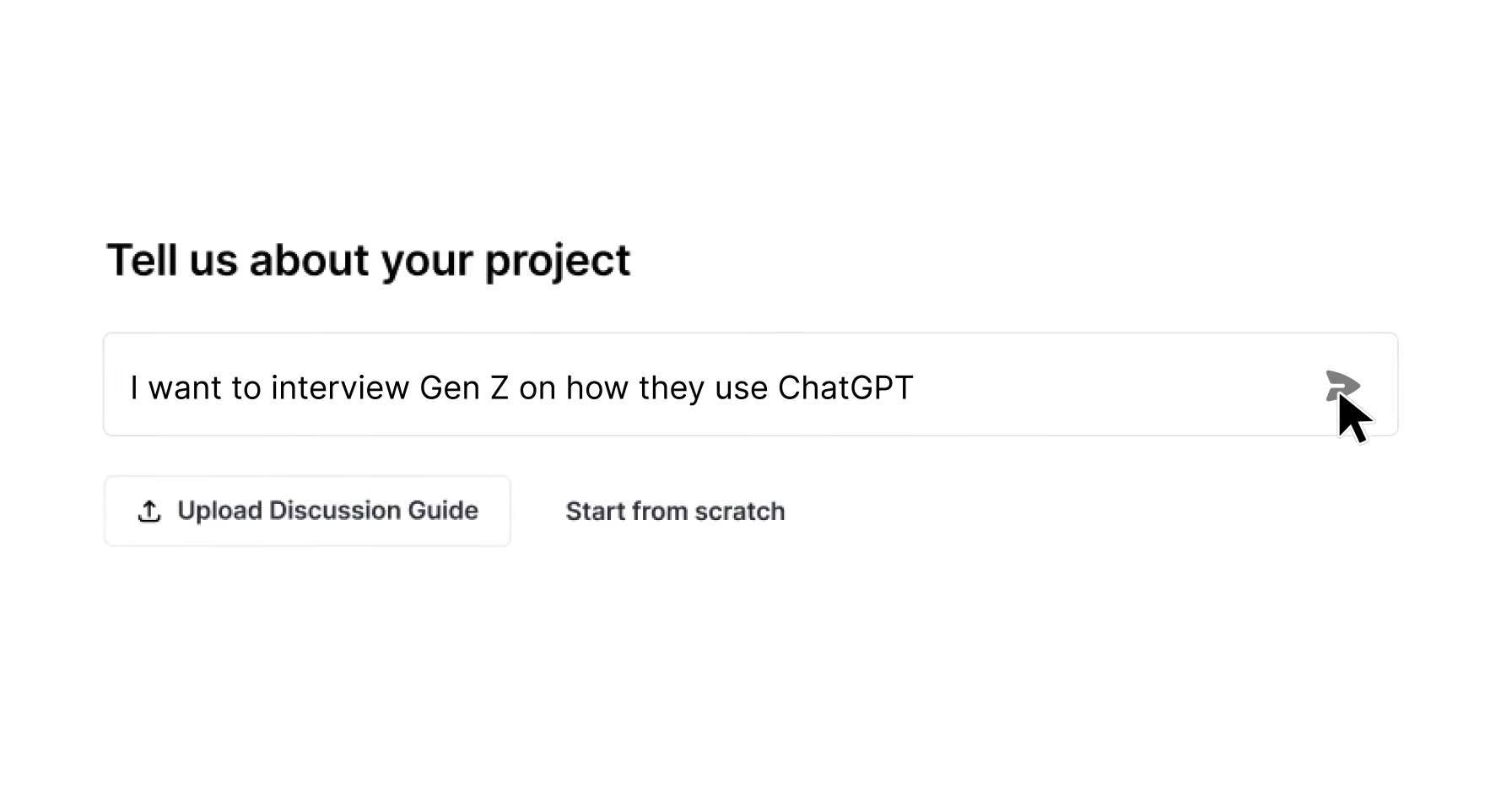
Typical timeline: 30–60 minutes from brief to approved study guide.
Coordination needs: Alignment with the decision-owning stakeholder on success criteria before fieldwork begins prevents scope creep and post-delivery disputes about relevance.
Step 2: Set Audience Targets and Enforce Quality Standards
Required inputs:
- Target persona definition, including demographics, behavioral qualifiers, purchase history, role, or usage context
- Incidence rate estimate for the target population
- Quota structure when multiple segments are required
- Screener logic, including disqualifying conditions
Key decision points: High-incidence audiences, such as general consumers or broad age ranges, fill quickly and use fewer recruitment credits. Low-incidence audiences, including enterprise decision-makers, healthcare workers, or consumers below 1 percent incidence, require dedicated recruitment operations and longer sourcing windows. Realistic incidence expectations at this stage prevent timeline surprises later in the study.
Teams must define quality criteria before recruitment begins because changing standards mid-study invalidates comparisons across participants. These criteria include minimum response length, video-on requirements, device type, and interview language. Listen Labs’ Quality Guard enforces these standards by monitoring every session in real time across video, voice, content, and device signals to detect fraud, low-effort responses, and mismatched profiles.
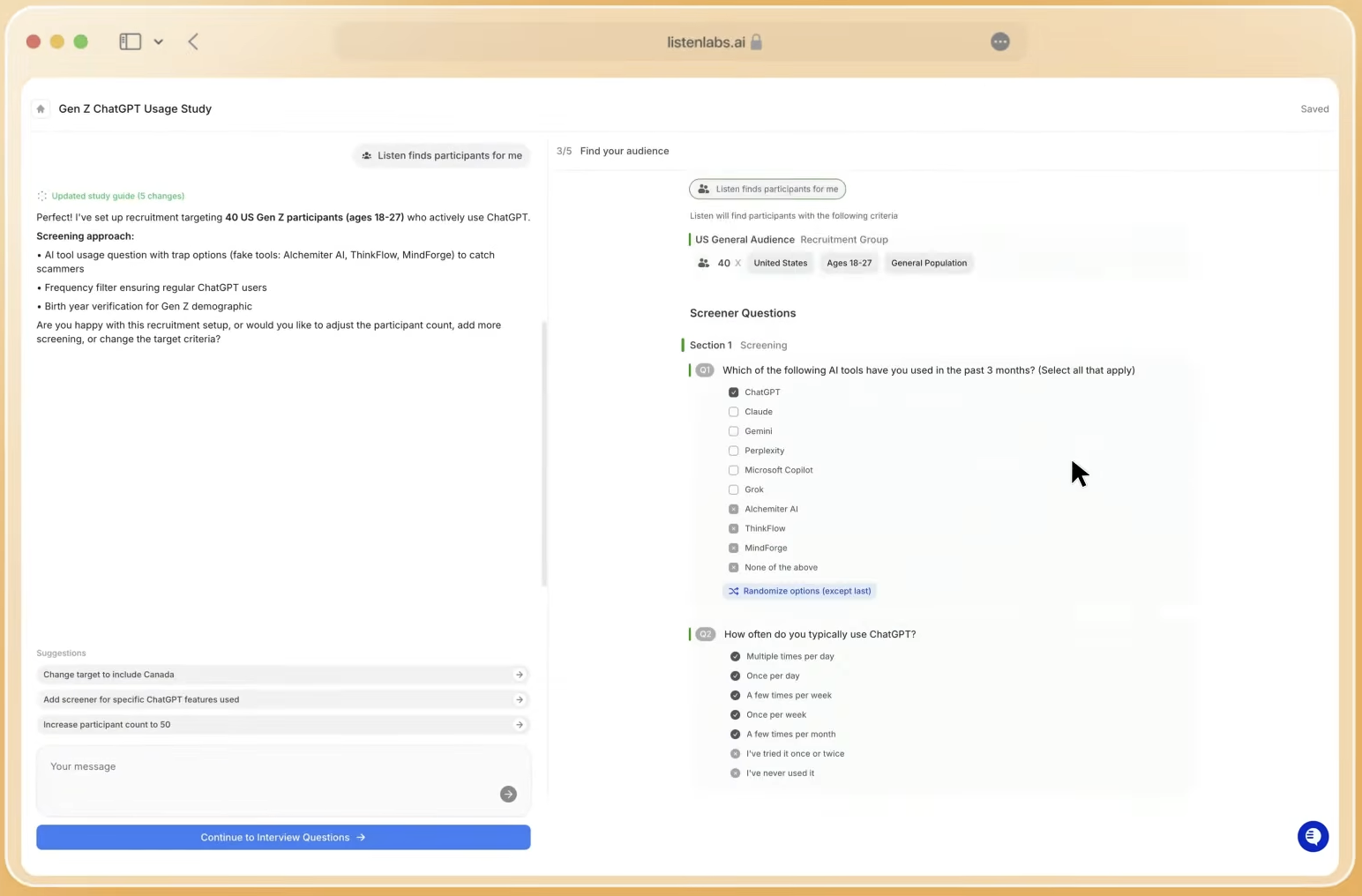
Typical timeline: 15–30 minutes to configure screener and quota logic.
Coordination needs: Legal or compliance review of screener language for regulated industries such as healthcare and financial services should occur at this stage, not after data collection.
Step 3: Source Participants at Scale with Behavioral Matching
Required inputs:
- Finalized screener and quota structure from Step 2
- Target sample size and geographic distribution
- Timeline for fieldwork completion
Key decision points: Choosing between a proprietary panel and open commodity panels directly affects data quality. Listen Labs’ Quality Guard reduces fraudulent responses through behavioral matching on intent and past actions instead of self-reported demographics alone.
Listen Atlas, the Listen Labs AI orchestration layer, automatically matches and bids across a network of 30 million verified respondents in more than 45 countries. Dedicated recruitment operations supplement this network for hard-to-reach segments. Participant frequency limits, capped at three studies per month per respondent, remove professional survey-takers from the sample.
Typical timeline: For audiences with incidence rates above 20 percent, fieldwork usually fills within hours of launch. Niche B2B or sub-1 percent incidence audiences may require 24–48 hours with recruitment operations support.
Coordination needs: When organizations source from their own customer base, CRM or CDP access and legal approval for outreach must be confirmed before this step.
See how we source hard-to-reach audiences in 24–48 hours.
Step 4: Run Adaptive AI-Moderated Video Interviews at Scale
Required inputs:
- Approved discussion guide from Step 1
- Stimuli to test, such as images, video, audio, PDFs, prototypes, or live URLs
- Mixed-method configuration that defines which questions use open-ended response and which use Likert scales, NPS, MaxDiff, or sliders
Key decision points: Adaptive moderation, where the AI probes deeper on short or unexpected answers, preserves qualitative depth at scale. Across 500+ hours of benchmarked sessions, AI-moderated conversations averaged 3.2 times more probe-driven follow-ups than scripted human-moderated equivalents.
Ninety-two percent of participants report top comfort levels in AI-moderated sessions, which matches comfort levels in human-moderated sessions. For sensitive topics such as pricing frustration, brand embarrassment, or health behaviors, AI moderation often produces more candid responses because participants report feeling less judged.
Listen Labs supports monadic and sequential randomization for stimulus testing, branching and skip logic, piping, and version control within a single study. Interviews capture video, audio, text, and screen recordings, including mobile iOS.
Typical timeline: With a pre-recruited panel, 100–300 simultaneous interviews complete within hours of fieldwork launch.
Coordination needs: Teams must finalize and approve stimulus assets before fieldwork begins. Late-stage stimulus changes require a new study configuration.
Step 5: Use Multimodal Emotional Intelligence to Reveal Unspoken Reactions
Required inputs:
- Completed interview recordings from Step 4
- Defined concepts or stimuli for emotional comparison
- Research questions that require emotional signal data, such as “Which concept triggered the most confusion?” or “Where did participants disengage?”
Key decision points: Transcripts show what participants say, while emotional intelligence shows what they feel. These two data streams often diverge. Written exit surveys and voice analysis can reveal different primary reasons for customer churn, with the dominant pattern tied to prior disengagement expressed through confrontational tone.
Listen Labs’ Emotional Intelligence analyzes three signal layers: tone of voice, word choice, and subconscious micro expressions. The framework uses Ekman’s universal emotions standard, the same framework used in clinical psychology and UX research, to track anger, anticipation, disgust, fear, joy or happiness, sadness, trust, and surprise.
Every emotion is quantified per question and concept, with every label traceable to the exact timestamp, verbatim quote, and AI reasoning behind it. Researchers can see not just that happiness appeared but also why it appeared, at which moment, and in which participant segment. This timestamp-level traceability safeguards quality and turns emotional signal data into an actionable input instead of a decorative metric.
Emotional Intelligence supports more than 50 languages and connects directly to the Research Agent for natural-language queries, charts, and highlight reels of emotionally significant moments.
Typical timeline: Emotional analysis runs automatically alongside transcript processing, so no additional analyst time is required.
Coordination needs: Creative, brand, or UX teams should define the emotional hypotheses they want tested before fieldwork so the analysis aligns with specific stimuli or moments.
Step 6: Turn Raw Interviews into Traceable Findings and One-Click Deliverables
Required inputs:
- Completed interview data and emotional analysis from Steps 4 and 5
- Stakeholder deliverable format requirements, such as slide deck, memo, highlight reel, or statistical chart
- Segmentation variables for comparative analysis
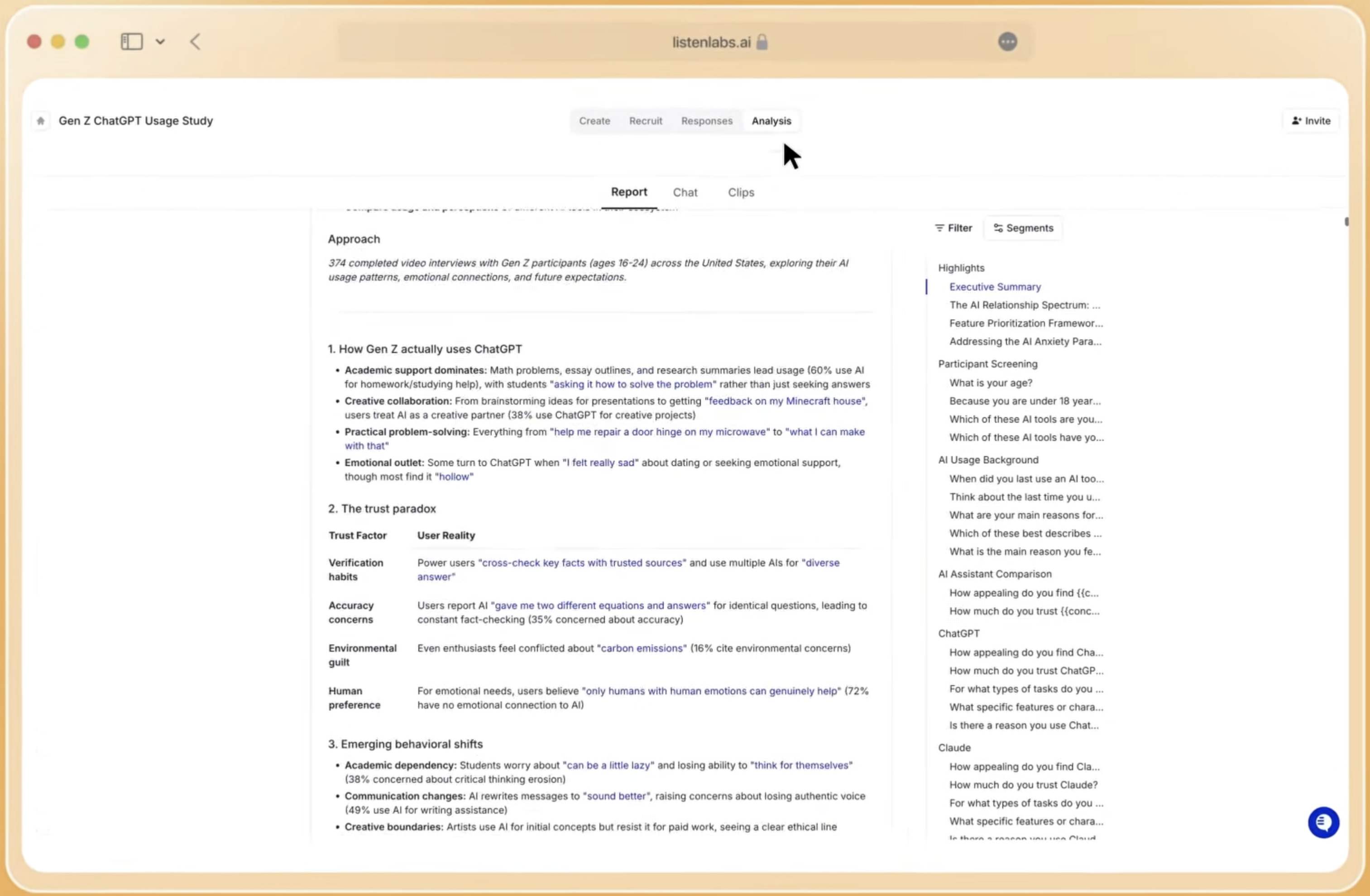
Key decision points: With AI-moderated interviews, talking to users at scale is no longer the hard part. The challenge is understanding what they mean. The Research Agent addresses this challenge by handling the full analysis workflow from raw data to final output.
Researchers ask questions in natural language, such as “What are the top three barriers to purchase among 25–34-year-old women?” or “Which concept scored highest on trust signals?” They then receive answers with supporting verbatims, statistical significance tests, and segment comparisons. Every insight links directly to the underlying response data, which makes findings auditable and defensible in stakeholder reviews.
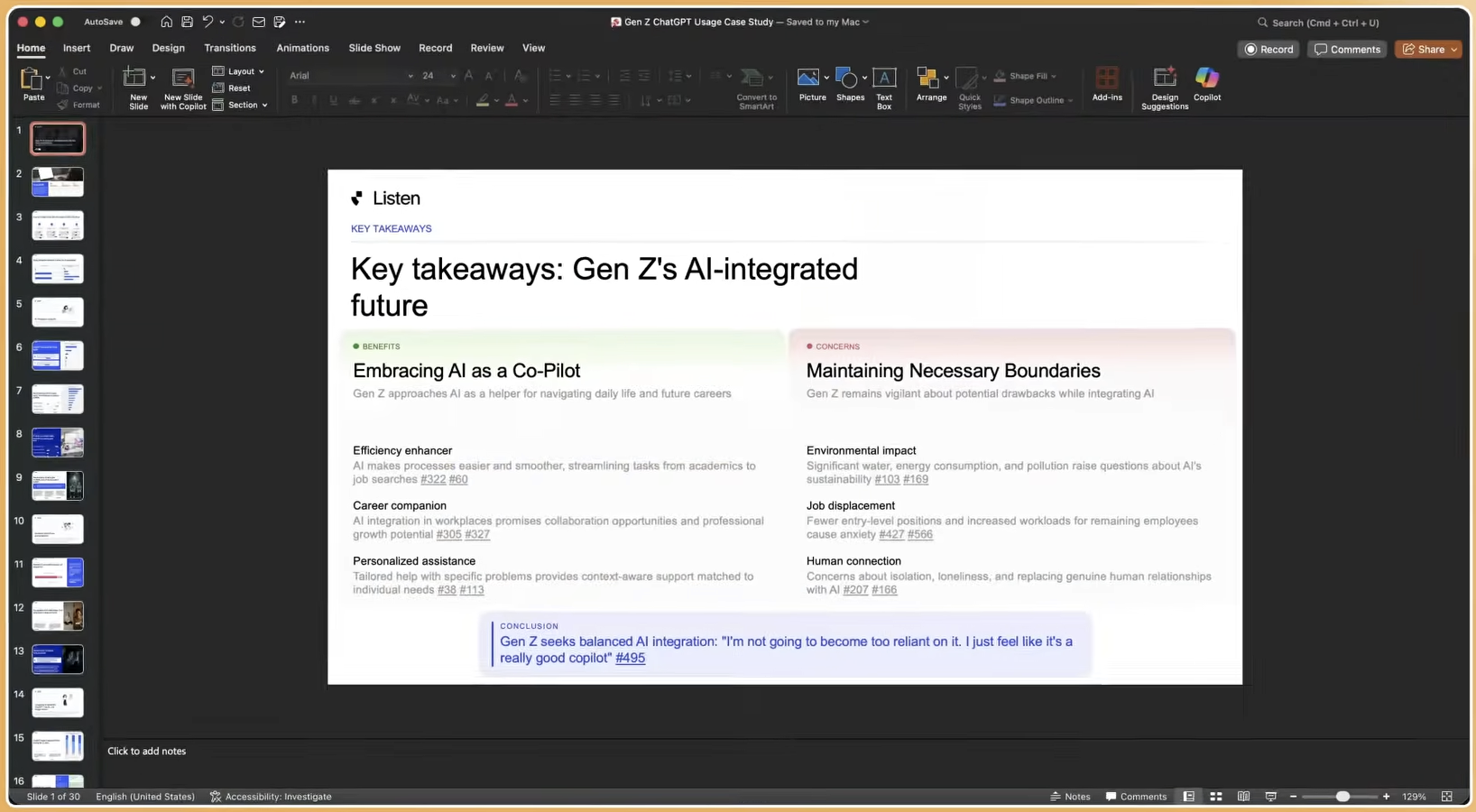
One-click deliverables include consultant-quality PowerPoint slide decks, memo-style reports, video highlight reels, and custom charts, all generated in under a minute. With automated analysis completing in under 60 minutes, the full cycle from study launch to stakeholder-ready deliverable meets the 24-hour benchmark established earlier.
Typical timeline: Automated analysis and initial deliverable generation complete in under 60 minutes after fieldwork closes.
Coordination needs: Teams should confirm deliverable format and branding requirements with stakeholders before analysis begins to avoid reformatting cycles.
Experience one-click deliverables from a live study.
Common Failure Modes in AI-Scaled Qualitative Programs
Four recurring failure modes account for most problems in AI-scaled qualitative research programs.
Unclear objectives produce unfocused discussion guides and unactionable findings. Stakeholder alignment on the specific decision the research must inform before study design begins prevents this issue. A research brief that names the decision, the decision-maker, and the deadline reduces scope drift.
Low-quality respondents undermine data integrity regardless of analysis sophistication. Quality Guard’s real-time monitoring across video, voice, content, and device signals addresses this risk at the data-collection stage. Participant frequency limits and behavioral matching, instead of demographic self-reporting alone, reduce incentive-driven responses before they enter the dataset.
Analysis bottlenecks appear when large volumes of interview data reach human analysts without structured tooling. The Research Agent’s automated theme extraction, segmentation, and natural-language query interface removes the manual coding stage that traditionally adds one to two weeks to a qualitative project.
Stakeholder misalignment surfaces when findings arrive in a format that does not match how decision-makers consume information. Generating multiple deliverable formats, such as a slide deck for leadership, a memo for product teams, and a highlight reel for creative review, solves this without extra analyst time.
How to Track the Impact of AI-Scaled Qualitative Research
Four objective indicators help teams track the performance of an AI-scaled qualitative research program.
- Cycle time: Measure elapsed time from study brief submission to stakeholder delivery. The target benchmark is under 24 hours for standard consumer studies. Track this per study and report quarterly trends to show compounding efficiency gains.
- Completion rate: Measure the share of recruited participants who complete the full interview. General consumer audiences often have higher completion rates than specialized professional audiences. Rates below typical benchmarks signal screener friction or study length issues.
- Finding consistency: Cross-validate themes from AI analysis against a human spot-check of 10–20 percent of transcripts. Consistent theme identification across both methods confirms analytical reliability.
- Stakeholder usage: Track whether deliverables appear in product briefs, brand strategy documents, or investment decisions. Research that does not reach decisions has not succeeded, regardless of methodological quality. Mission Control’s cross-study query capability supports this by making past findings retrievable in seconds instead of buried in shared drives.
Frequently Asked Questions
How long does it actually take to run 1,000 AI-moderated interviews?
For general consumer audiences with higher incidence rates, Listen Labs can complete large volumes of AI-moderated interviews rapidly after study launch. The platform can handle thousands of concurrent sessions, with recruitment, moderation, transcription, and initial analysis running in parallel instead of sequentially. Niche or low-incidence audiences, such as enterprise decision-makers, healthcare workers, or segments below 1 percent incidence, may require 24–48 hours with dedicated recruitment operations support. Smaller studies of 50–100 participants typically complete within a few hours of launch.
What compliance certifications does Listen Labs hold, and how is participant data protected?
Listen Labs holds SOC 2 Type II, GDPR, ISO 27001, ISO 27701, and ISO 42001 certifications. All data is encrypted at 256-bit, and customer data never trains AI models. For regulated industries such as healthcare and financial services, legal teams can review screener language and data handling protocols before study launch. Participants are fully de-identified in analysis outputs, and the platform supports enterprise SSO for access control.
Can Listen Labs reach hard-to-find audiences like enterprise buyers or healthcare professionals?
Yes. The dedicated recruitment operations team partners with niche communities, specialized networks, and micro-creators to source audiences below a 1 percent incidence rate. These audiences include enterprise decision-makers, engineers, healthcare workers, and highly specialized consumer segments. Listen Atlas, the AI orchestration layer, also bids across B2B panel partners such as NewtonX in addition to Listen Labs’ proprietary 30 million-respondent network. Organizations can also bring their own participants from internal CRM or customer databases at reduced cost.
When should a research team repeat a study versus retire it?
Teams should repeat a study when a significant product, brand, or market event has occurred since the last wave. Repetition also makes sense when prior findings support a high-stakes decision more than six months after fieldwork or when a continuous discovery program requires quarterly or annual tracking of sentiment and needs. Teams should retire a study when the business question it was designed to answer has been resolved, when the target audience definition has changed materially, or when Mission Control’s cross-study queries show that another study has already answered the question. The institutional knowledge base in Mission Control makes it possible to check for prior coverage before commissioning new fieldwork.
How does AI emotional intelligence differ from standard sentiment analysis?
Standard sentiment analysis classifies text as positive, negative, or neutral based on word choice alone. Listen Labs’ Emotional Intelligence analyzes three simultaneous signal layers, which include tone of voice, word choice, and subconscious micro expressions, to detect emotions that transcripts miss entirely. A participant might rate a concept as “fine” in text while showing facial micro expressions of disgust and a tense vocal tone, which creates two distinct data points. Emotional Intelligence captures both signals, quantifies each emotion per question and concept, and traces every label to the exact timestamp and verbatim quote that produced it. This traceability makes the output actionable in creative testing, concept comparison, usability testing, and brand research instead of merely descriptive.