
Written by: Anish Rao, Head of Growth, Listen Labs | Last updated: July 22, 2026
Key Takeaways for Evaluating Outset Alternatives
- Enterprise teams are replacing slow 4–6 week research cycles with AI-native platforms that deliver complete studies in under 24 hours.
- Listen Labs combines recruitment, AI-moderated interviews, Emotional Intelligence analysis, and automated reporting in one platform trusted by Microsoft, Anthropic, P&G, Skims, and Robinhood.
- Quality Guard fraud prevention and a 30M+ verified global respondent network reduce panel fraud and sourcing delays that fragmented tools create.
- Automated Research Agent and the Mission Control knowledge base cut analysis time by up to 91% while keeping full traceability to verbatim quotes and participant records.
- Ready to replace your current research stack? Schedule a walkthrough with Listen Labs to experience 24-hour qual at scale.
Evaluation Criteria for Outset Alternatives
Enterprise teams need a consistent framework before comparing platforms. The eleven criteria below reflect how procurement, research operations, and insights leadership evaluate AI-moderated research platforms in 2026, drawing on enterprise RFP rubrics and buyer evaluation frameworks that weight validity and methodology most heavily.
- Research speed: Time from study brief to final deliverable, including recruitment, fieldwork, analysis, and reporting.
- Depth of insight: Whether the platform uncovers motivations and context behind stated preferences, not just surface responses.
- Sample quality and fraud prevention: Real-time controls to eliminate fraudulent respondents, AI-generated scripts, and professional survey-takers.
- Participant sourcing and global reach: Panel size, geographic coverage, and ability to recruit below 1% incidence audiences.
- Methodological flexibility: Support for IDIs, concept testing, usability studies, diary studies, creative testing, and mixed-method designs.
- Language support: Number of languages supported for moderation, analysis, and reporting without per-language setup overhead.
- Analysis effort and bias reduction: Degree to which the platform automates synthesis and reduces human confirmation bias in the analysis layer.
- Reporting transparency: Whether every AI-generated insight traces back to a timestamped verbatim quote and participant record.
- Governance and security: SOC 2 Type II, GDPR, ISO 27001, ISO 27701, and ISO 42001 certifications, data segregation, and enterprise SSO.
- Scalability: Ability to run hundreds or thousands of simultaneous interviews without proportional cost or headcount increases.
- Total operational burden: Number of vendors, tools, and handoffs required to complete a full research cycle.
The following three sections apply these criteria across the research lifecycle, comparing how Listen Labs, Outset, and alternative approaches handle study setup, data collection, and analysis.
Study Setup and Recruitment: How Platforms Get to Field-Ready
The following comparison shows how each platform handles the first phase of research, from business question to fielded study with qualified participants. The key difference is whether recruitment operates as an integrated capability or depends on external coordination.
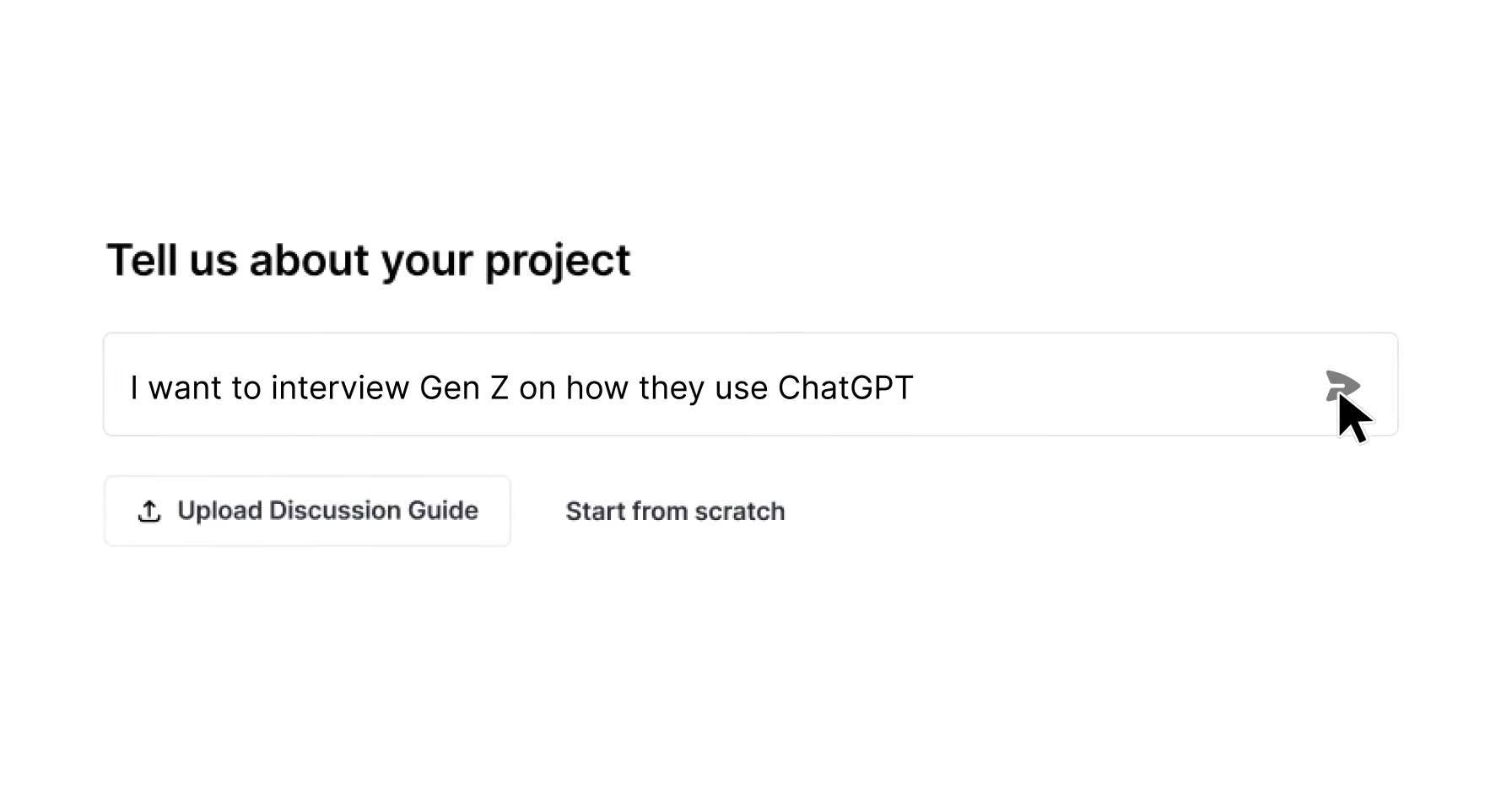
Listen Labs handles study design through an AI co-design layer that converts a natural-language brief into structured objectives, screener logic, branching, quotas, and stimuli configuration in seconds. Recruitment draws from Listen Atlas, a 30M+ verified respondent network spanning 45+ countries and 100+ languages, with an AI orchestration layer that matches and bids across multiple panel partners, including NewtonX for B2B. A dedicated recruitment ops team supports audiences below 1% incidence, so niche segments are sourced without multi-week delays common in traditional IDI recruitment.
Outset provides a capable AI-moderated interview environment with methodology breadth, but its panel access relies on native integrations with third-party global panels rather than a proprietary recruitment infrastructure. Because these integrations require coordination with external vendors, teams sourcing niche or hard-to-reach audiences face additional setup time and operational complexity that integrated platforms avoid.
UserTesting maintains a Contributor Network of millions of participants across numerous countries, but its human-dependent moderation model limits the number of simultaneous sessions and extends turnaround times. Setup requires scheduling coordination, while AI-native platforms remove that dependency.
Panel-only tools such as Prolific, User Interviews, and Respondent solve sourcing but not moderation, analysis, or delivery. User Interviews maintains roughly 7.6M participants and Respondent approximately 4M+, but both require separate tools for every downstream step, which multiplies operational burden.
Traditional agencies take 6–8 weeks for typical qualitative studies, with 2–3 weeks consumed by recruitment alone. Multi-market studies often run sequentially, adding weeks per market because moderator coordination rarely scales in parallel.
Moderation, Data Quality, and Emotional Depth
Listen Labs conducts AI-moderated video interviews with dynamic follow-up questions that adapt in real time based on participant responses. This mirrors the probing behavior a trained human moderator applies while scaling to hundreds of simultaneous 30-minute interviews that deliver both statistical confidence and qualitative nuance. The Emotional Intelligence layer goes further, analyzing three signals, tone of voice, word choice, and subconscious micro-expressions, to surface emotions that transcripts alone miss. Built on Ekman's universal six emotions framework, every emotion is quantified per question and traceable to the exact timestamp and verbatim quote. The emotion analytics market is growing at an 8.93% CAGR through 2031 as enterprises move from one-dimensional sentiment tagging to real-time multimodal inference, and Listen Labs already operates at that standard.
Quality Guard adds a dedicated fraud prevention layer that protects data quality. A 2020 Pew Research study found that traditional speeder and attention checks fail to catch most bogus respondents, which creates a gap that commodity panels cannot close. Quality Guard monitors every interview in real time across video, voice, content, and device signals, builds reputation scores across the platform's entire study history, and limits participants to three studies per month to reduce professional survey-takers.
Outset offers AI moderation with probing depth and visual intelligence capabilities, which makes it a credible qualitative tool. It does not include a proprietary multimodal emotional analysis layer equivalent to Listen Labs' Emotional Intelligence, and its fraud prevention relies on third-party panel controls rather than a platform-native Quality Guard system.
UserTesting uses human moderators, which introduces scheduling constraints, inconsistency across sessions, and a ceiling on simultaneous interviews. Human-moderated sessions cannot match the scale or speed that AI-native platforms achieve.
Survey tools such as SurveyMonkey and Qualtrics scale efficiently but sacrifice depth. They do not support adaptive follow-up, emotional signal capture, or discovery of unexpected findings. Traditional focus groups cost $4,000–$12,000 per 90-minute session and take 3–5 weeks, while also introducing groupthink and social desirability bias that one-on-one AI interviews avoid.
Analysis, Reporting, and Knowledge Management Across Studies
Listen Labs automates the full analysis workflow through its Research Agent. One researcher ran a full buying intent analysis across three user segments in under a minute. The Research Agent generates automated key findings, theme analysis, consultant-quality slide decks in branded templates, memo-style reports, video highlight reels, statistical charts, and segmentation breakdowns. Every output remains traceable to underlying participant data.
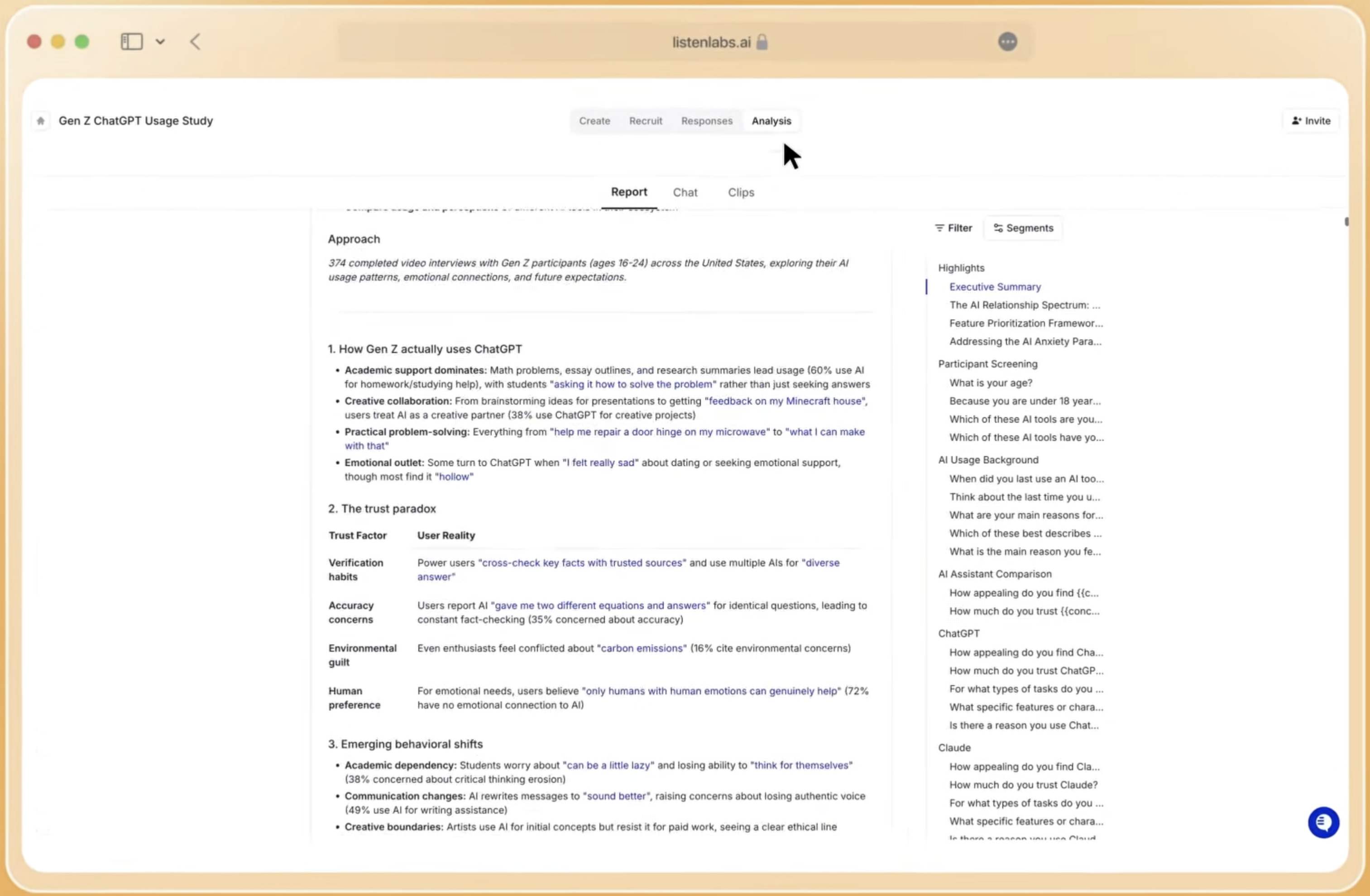
Mission Control extends this capability by serving as a cross-study knowledge repository. Every completed study grows the institutional knowledge base and enables natural-language queries across all past research in seconds. This structure directly addresses the problem of siloed insights that organizations repeatedly re-research.
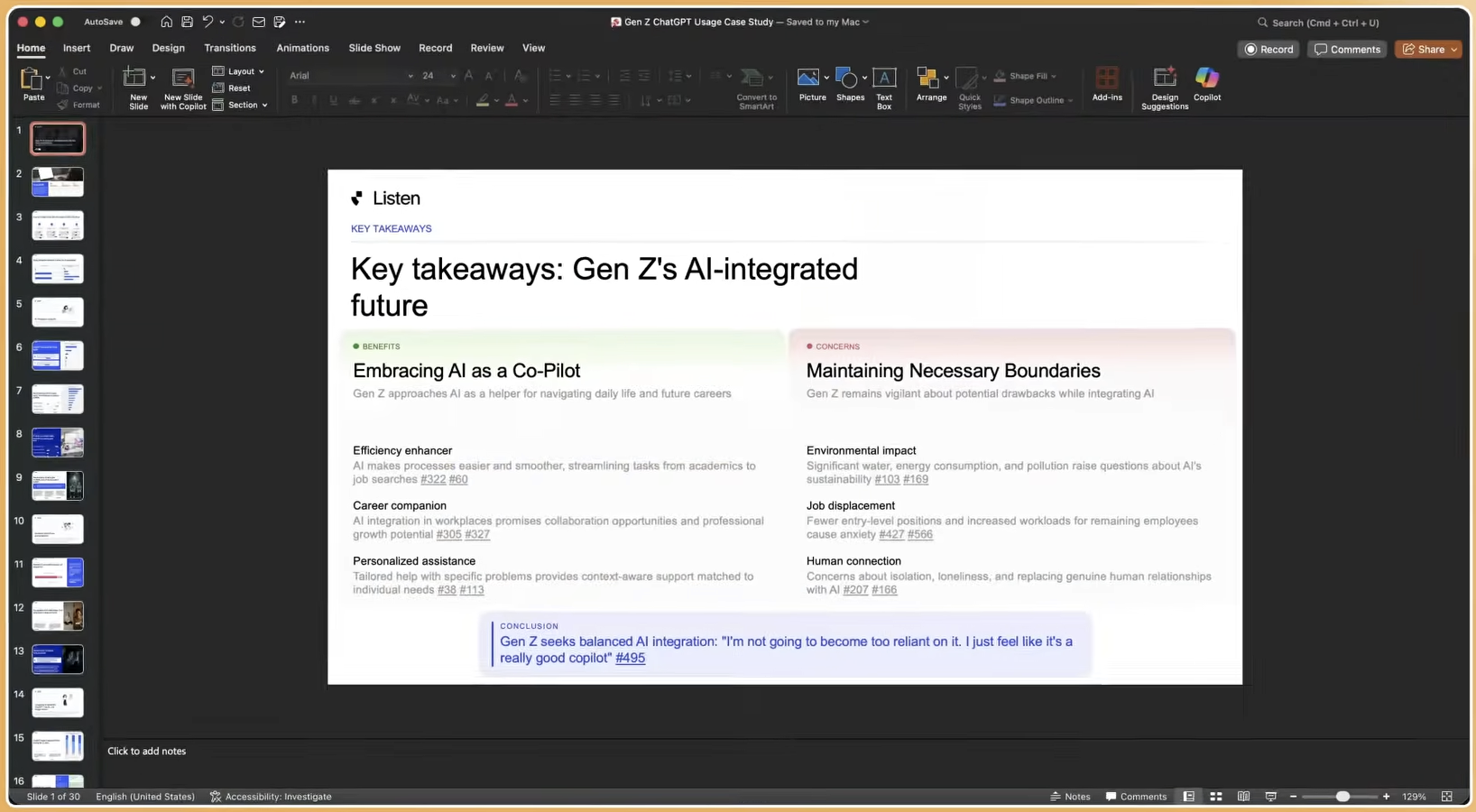
Enterprise case studies from 2026 show how this plays out in practice. Anthropic's Claude Code team ran 300+ user interviews in 48 hours, surfaced churn drivers 5x faster, and delivered a prioritized list of 10 must-fix items. Robinhood received insights 5x faster than traditional methods and revealed integration flows that boosted uptake 30–40%. P&G delivered 250+ interviews with quantified themes that shaped product and brand strategy in hours. Skims validated campaign direction with thousands of premium consumers overnight and secured board-level buy-in. Microsoft collected global customer stories for its 50th anniversary within a day at one-third the cost of traditional methods.
Outset provides analysis capabilities within its platform but does not offer a cross-study knowledge repository equivalent to Mission Control or the same breadth of one-click deliverable formats.
Dovetail organizes and analyzes research conducted elsewhere but does not recruit participants, conduct interviews, or deliver end-to-end results. It addresses one step of the workflow rather than the full cycle.
Traditional agencies produce manual reports that are high-level, slow to deliver, and disconnected from raw data. Agency-led qualitative projects stretch to 4–8 weeks due to sequential, human-gated stages, while AI-conversation timelines run recruitment, fielding, and synthesis in parallel.
See the Research Agent and Mission Control in action, and watch how automated synthesis replaces manual analysis and disconnected tools.
Where Listen Labs Outperforms Outset for Enterprise Teams
Different organizational contexts map to different platform requirements, and several scenarios highlight where Listen Labs delivers the clearest advantage over Outset and fragmented alternatives.
- Consumer insights leaders at Fortune 500 enterprises facing growing research backlogs benefit from Listen Labs' ability to multiply study output with the same team. Running 5–10x more studies per quarter without added headcount directly addresses the bottleneck that frustrates internal product and brand stakeholders.
- UX research heads at mid-to-large tech companies need faster feedback loops to match sprint cycles. Listen Labs' screen-sharing and usability testing capabilities, combined with 50–100+ participant samples instead of the traditional 5–10, provide both speed and statistical confidence.
- Product managers and marketing leaders without dedicated research teams can describe goals in natural language and have the platform handle study design, recruitment, moderation, and analysis automatically. This removes the need for deep methodology expertise.
- Agencies and consultancies running client engagements with tight timelines benefit from Listen Labs' global reach and ability to recruit niche audiences, including enterprise decision-makers and healthcare workers, within hours rather than weeks.
Operational and Long-Term Considerations for Platform Adoption
Switching from a fragmented research stack to an end-to-end platform affects operations, governance, and stakeholder trust, not just feature checklists.
Stakeholder alignment depends on showing that AI-moderated interviews meet the quality bar that internal research teams and senior leadership expect. Listen Labs' in-house research team, with 50+ years of combined expertise, reviews and refines methodology continuously and provides institutional credibility that pure-software vendors lack.
Compliance and data governance remain non-negotiable for Fortune 500 procurement. Listen Labs holds SOC 2 Type II, GDPR, ISO 27001, ISO 27701, and ISO 42001 certifications, with 256-bit encryption and a policy that customer data is never used for AI model training. Enterprise procurement criteria repeatedly center on compliance, traceability, and participant authenticity, and Listen Labs addresses all three natively.
Repeatability and ongoing programs benefit from Mission Control's compounding knowledge base. Each study adds to the institutional record, reduces redundant research, and enables trend tracking across waves. Longitudinal cohort programs often involve recurring interviews on rotating topics, a model Listen Labs supports natively through its platform infrastructure.
Participant trust stays high through transparent consent processes, frequency limits that prevent panel fatigue, and quality controls that protect the research environment for all participants.
Risks, Limitations, and Misconceptions About AI-Moderated Research
Several assumptions about AI-moderated research platforms push enterprise teams toward poor platform decisions.
The belief that faster tools automatically produce better research is incorrect. Speed only helps when the underlying methodology is sound. AI cannot repair invalid inputs, and errors in participant qualification or transcription fidelity cascade into large downstream distortions when qualitative evidence is transformed through summarization and theme generation. Listen Labs addresses this through Quality Guard, dedicated recruitment ops, and an in-house research team that validates methodology.
Overestimating automation creates a related risk. AI outputs should be treated as a starting point rather than finished insight, with every conclusion traceable to a specific raw quote or record. Listen Labs' Research Agent maintains this traceability by linking every AI-generated theme to the exact timestamp, verbatim quote, and participant record.
Hidden recruitment complexity often goes unnoticed when teams evaluate panel-only tools. Recruiting B2B professionals for user interviews typically takes 1–3 weeks through traditional channels, with more specialized audiences requiring additional time. Listen Labs' dedicated recruitment ops team compresses this to hours for most audiences.
Fraud risk in commodity panels is also underestimated. Multi-layer fraud prevention that includes bot detection, duplicate suppression, and continuous engagement monitoring throughout every interview represents the minimum standard for enterprise-grade research. Platforms that rely solely on post-hoc quality checks miss the majority of fraudulent respondents.
The belief that depth requires small samples reflects a legacy constraint of human moderation, not a property of qualitative research itself. Qual-at-scale enables hundreds or thousands of participants to be engaged remotely and asynchronously, delivering both the statistical confidence of large samples and the motivational depth of one-on-one interviews.
Decision Framework: Matching Platforms to Research Goals
The criteria below help enterprise teams align platform choice to their specific constraints and objectives.
- If turnaround time is the primary constraint: Only end-to-end AI platforms with integrated recruitment deliver results in under 24 hours. Fragmented stacks and agency workflows rarely compress below 2–3 weeks regardless of individual tool speed.
- If sample quality and fraud prevention are non-negotiable: Check whether the platform operates its own Quality Guard system with real-time multimodal monitoring, or relies on third-party panel controls that most bogus respondents evade.
- If global reach and multilingual research are required: Confirm panel coverage across target markets and whether the platform supports parallel fieldwork across languages without sequential setup. Listen Labs supports 100+ languages with automatic translation and transcription.
- If emotional depth is required for creative testing, concept comparison, or brand research: Confirm that the platform captures tone, micro-expressions, and word choice, not just transcript sentiment. Multimodal sentiment models achieve varying accuracy on English data, reaching 97.87% on CMU-MOSEI but only 72.15% on multi-party conversational datasets, so implementation quality matters.
- If compliance and data governance are procurement requirements: Confirm SOC 2 Type II, GDPR, ISO 27001, ISO 27701, and ISO 42001 certifications before shortlisting any vendor.
- If the team needs to run ongoing programs rather than one-off studies: Check whether the platform maintains a cross-study knowledge repository that compounds institutional knowledge over time.
- If the team lacks research methodology expertise: Evaluate whether the platform provides AI-assisted study design and an in-house research team as a methodology partner, not just software.
Frequently Asked Questions
How fast can Listen Labs actually deliver results?
Listen Labs compresses the full research cycle, including study design, recruitment, fieldwork, analysis, and reporting, into under 24 hours for most studies. Recruitment typically takes 2–24 hours, fieldwork runs simultaneously across hundreds of participants, and the Research Agent generates deliverables in under a minute after fieldwork closes. Microsoft collected global customer stories within a day, and Anthropic received 300+ user interviews in 48 hours.
How does Listen Labs prevent participant fraud?
Three layers operate simultaneously. First, Listen Labs only works with high-quality, non-commodity panel sources, avoiding professional survey-taker networks. Second, Quality Guard monitors every interview in real time across video, voice, content, and device signals, detecting fraudulent responses, AI-generated scripts, and mismatched profiles. Third, participants are limited to three studies per month platform-wide, which reduces incentive-driven repeat respondents. A dedicated recruitment ops team adds a human review layer for hard-to-reach audiences.
What is Emotional Intelligence and why does it matter for enterprise research?
Emotional Intelligence analyzes multimodal signals to quantify emotions that transcripts miss, as detailed in the Moderation section. It supports 50+ languages and connects directly to the Research Agent for natural-language queries, charts, and highlight reels. Key use cases include creative testing, concept comparison, brand research, and usability testing where emotional response influences business decisions.
Can Listen Labs reach niche or hard-to-find audiences?
Yes. The dedicated recruitment ops team partners with niche communities, micro-creators, and specialized networks to source audiences below 1% incidence rate, including enterprise decision-makers, engineers, healthcare workers, and highly specialized consumer segments. Organizations can also bring their own participants from their existing user base at reduced cost.
Does Listen Labs replace the internal research team?
No. Listen Labs acts as a force multiplier for existing research teams rather than a replacement. The platform enables teams to run 5–10x more studies with the same headcount by automating recruitment, moderation, and analysis, which frees researchers to focus on strategic interpretation and stakeholder communication instead of logistics.
Conclusion: Choosing the Platform That Multiplies Research Output
The core problem with fragmented Outset alternatives is not a single capability gap. The real issue is the operational burden of assembling and managing multiple tools, panels, and vendors for every study. Each handoff introduces delay, cost, and quality risk. Research cycles that once took 4–6 weeks can now complete in 24–48 hours with AI-native platforms, but only when recruitment, moderation, analysis, and delivery operate as a single integrated system rather than a patchwork of point solutions.
Listen Labs covers the entire research lifecycle, from AI-assisted study design and verified global recruitment through AI-moderated interviews with Emotional Intelligence, automated analysis, and consultant-quality deliverables, without requiring a single external vendor. This creates a research operation that multiplies output without multiplying headcount, delivers results before the business context shifts, and builds institutional knowledge that compounds with every study.