
Written by: Anish Rao, Head of Growth, Listen Labs | Last updated: July 27, 2026
Key Takeaways for Choosing Your 2026 Research Stack
- Outset and Respondent serve different roles, moderation versus recruitment, and were not built to work as one system. Teams carry the coordination overhead and deal with data silos.
- Stitching these platforms together stretches research cycles to several weeks, adds hidden fees, and leaves quality gaps that grow over time.
- Listen Labs combines recruitment, AI-moderated interviews, emotional intelligence, automated analysis, and deliverables in one workflow that delivers same-day insights.
- Teams using Listen Labs reach a 30M-person verified global network across 45+ countries and 100+ languages under unified compliance, without juggling multiple vendors or manual synthesis.
- See how Listen Labs eliminates the Outset-versus-Respondent choice and compresses your research cycle into less than a day.
How We Compare Outset, Respondent, and Listen Labs
The eight criteria below reflect the real constraints that consumer insights leaders, UX research leads, and product teams face when they run qualitative studies at scale.
- Research speed, time from study brief to completed insights
- Participant quality, behavioral verification, screener integrity, and profile accuracy
- Fraud controls, real-time detection, frequency limits, and identity verification
- Global reach, country coverage and panel depth across markets
- Language support, interview moderation and analysis across languages
- Analysis effort, manual coding hours versus automated synthesis
- Deliverable creation, time and format of research outputs
- Total cost of ownership, all-in per-study cost including hidden fees and tool subscriptions
Study Setup and Recruitment: Where Workflows Break
Respondent is a dedicated participant recruitment platform. It sources pre-screened participants for qualitative and quantitative studies, manages incentive distribution, and provides access to a panel of opted-in respondents with demographic and behavioral profiles. It does not moderate conversations, analyze transcripts, or generate deliverables.
Outset is an AI-moderated interview platform. It conducts adaptive qualitative conversations at scale but relies on external recruitment sources, including Respondent, Prolific, and User Interviews, to supply participants. Most AI-moderated research platforms integrate with separate participant recruitment panels rather than providing native recruitment, which creates fragmented workflows, extra overhead, and data silos.
The handoff between Respondent and Outset is where friction accumulates. Fragmented workflows with separate panel, recruitment, and interview tools typically require 2–3 weeks to complete a qualitative study due to coordination overhead and handoff delays. Every additional system or manual step adds time, dropout risk, and quality variance at the transition between participant qualification and interview execution.
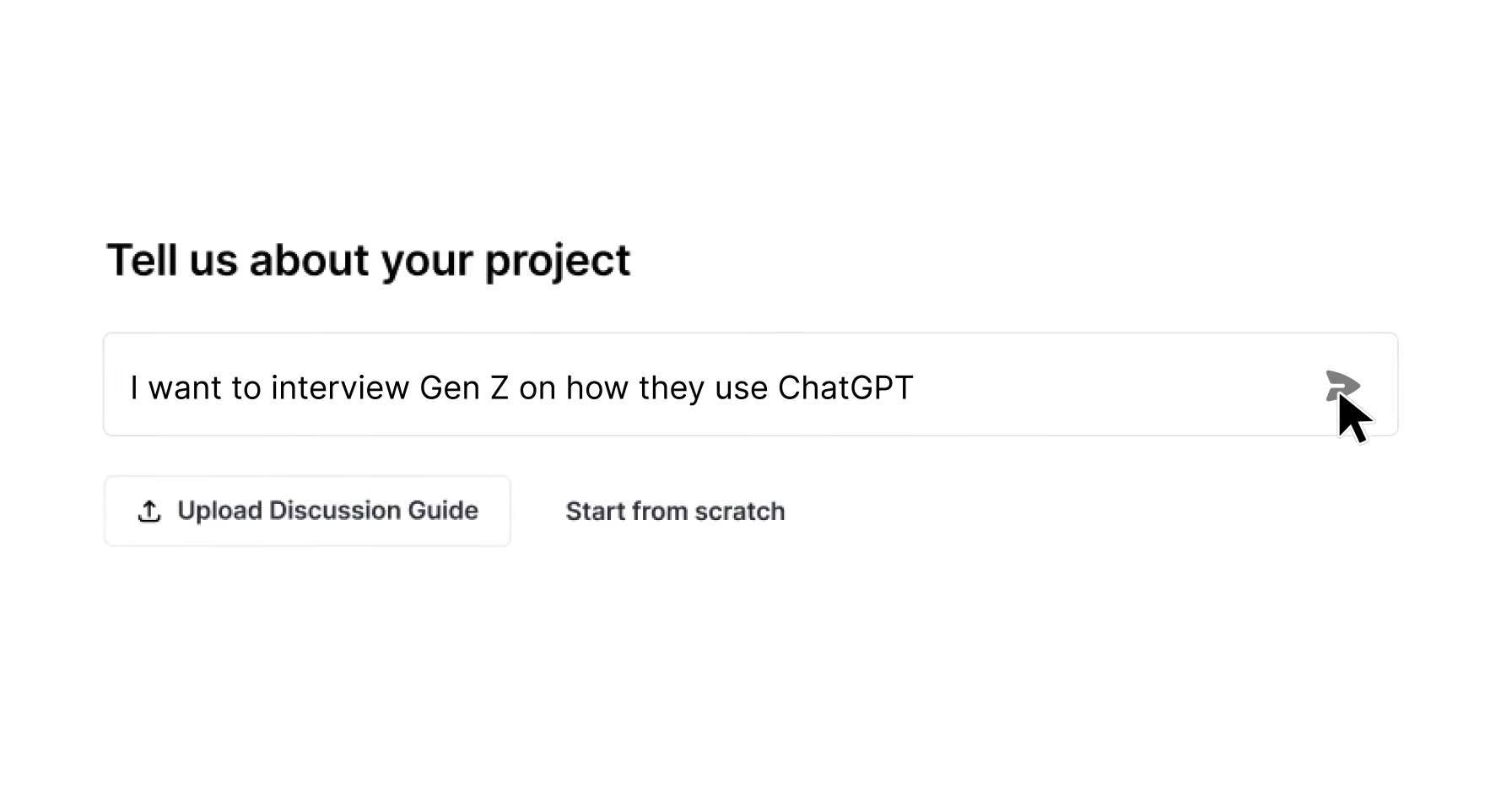
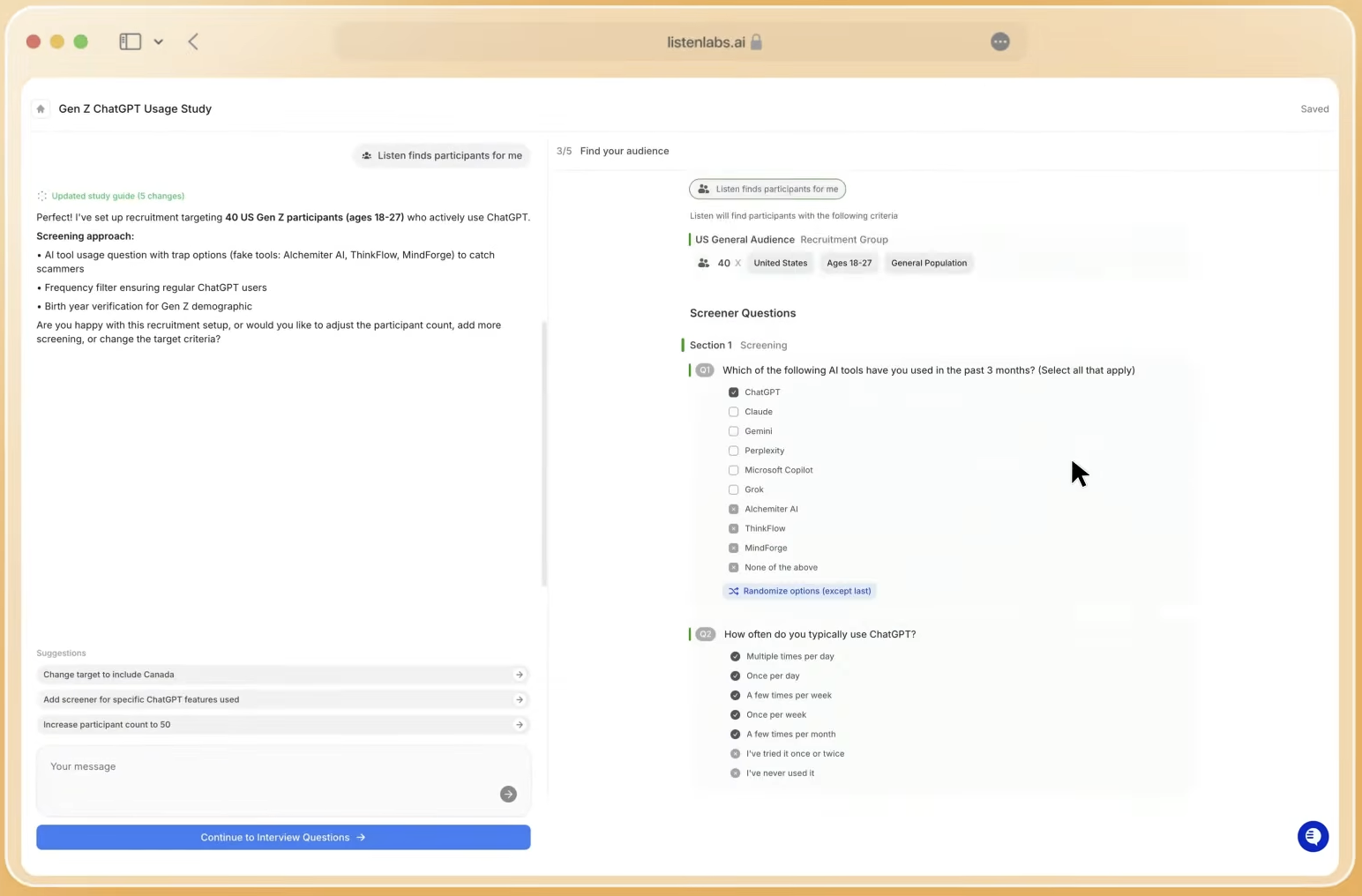
Listen Labs integrates recruitment and moderation in a single workflow. Its Listen Atlas layer draws from a global network of 30M verified respondents across 45+ countries, with an AI orchestration layer that automatically matches and bids on participants across multiple consumer and B2B panel partners. Integrated end-to-end platforms enable qualified participants to move directly from screener into AI-moderated video interviews, achieving completed insights in 24 hours.
Moderation Quality and Emotional Depth
Respondent has no moderation capability. It delivers participants to the door, and a separate tool or human moderator must handle the interview.
Outset conducts AI-moderated interviews with adaptive follow-up questions and supports in-depth interviews, usability tests, and concept evaluations. AI-moderated research platforms use conversational AI to conduct qualitative interviews at the scale and speed of a survey, running natural adaptive conversations with hundreds of participants simultaneously. Outset’s moderation operates independently of its recruitment source, so emotional signals, behavioral context, and participant history from recruitment do not feed into the interview layer.
Listen Labs captures three layers of signal at once: tone of voice, word choice, and subconscious micro-expressions. Its Emotional Intelligence layer, built on Ekman’s universal emotions framework, quantifies emotions including joy, trust, fear, surprise, and disgust at the question and concept level. Every emotional label is traceable to the exact timestamp, verbatim quote, and reasoning behind it. This capability does not exist in any Outset-plus-Respondent setup because neither platform captures or connects emotional data with participant sourcing context.
A 2024 Greenbook GRIT report found that 72% of insights buyers say AI is critical to their stack, yet 41% report their vendor’s AI is glorified survey logic rather than real conversational depth. Listen Labs addresses this gap with adaptive probing that responds to the semantic content of each answer rather than a pre-mapped decision tree.
Data Quality Controls and Fraud Prevention
Participant fraud remains a documented risk across third-party panels. No 2023 ESOMAR study reports 5–15% sample fraud rates on third-party recruitment panels; other 2023–2026 sources estimate 15–30% industry-wide. Industry research shows that attention-check failure rates vary across professionally recruited panels and general-population paid-survey traffic.
Respondent applies screener-level verification before participants enter a study. However, research panels must evaluate conversation quality after the interview, including length, depth, coherence, and consistency with the screener, because participants who pass screening can still deliver low-integrity qualitative data. Respondent does not perform this post-interview quality layer.
Outset applies quality controls within the interview itself but cannot retroactively verify the sourcing integrity of participants recruited through Respondent or other external panels.
Listen Labs’ Quality Guard operates across both layers together. It uses real-time AI monitoring across video, voice, content, and device signals to detect fraudulent responses, low-effort answers, AI-generated scripts, and mismatched profiles during the interview. To prevent professional survey-takers from gaming these checks, participants are limited to three studies per month. For hard-to-reach segments where automated signals may be less reliable, a dedicated recruitment ops team adds a human review layer. Together, these controls create a compounding quality flywheel, where reputation scores build across every interview and stitched Outset-plus-Respondent stacks cannot match this structural advantage.
Analysis, Deliverables, and Mission Control for Past Studies
Outset and Respondent do not provide cross-study knowledge management. Analysis outputs from Outset studies must be exported, coded, and synthesized manually. Respondent contributes no analysis capability. Practitioners budget 4–6 hours of coding per one-hour interview plus 20–30 hours of synthesis per study, which results in 60–90 hours of analyst time for a 10-interview project.
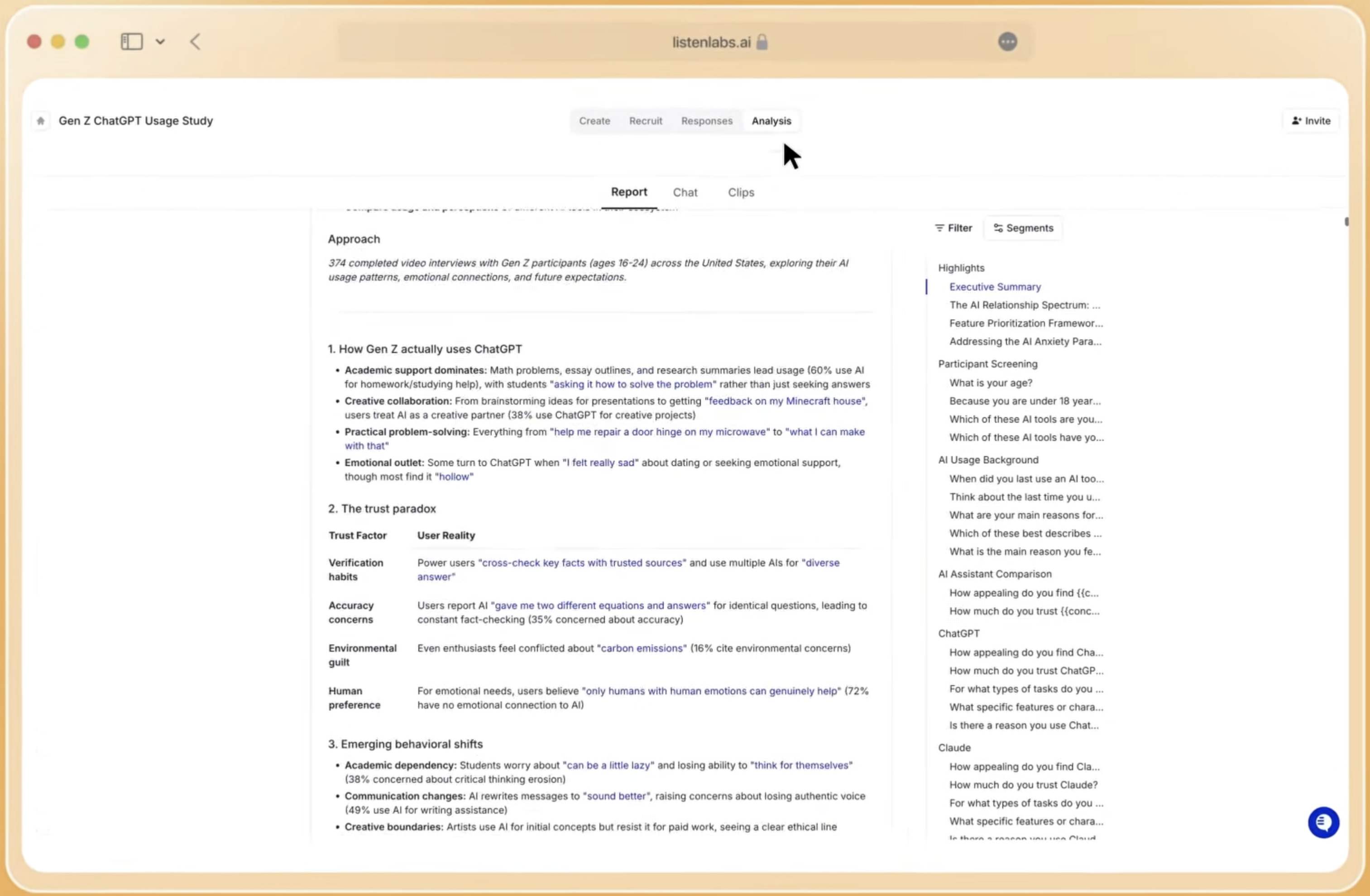
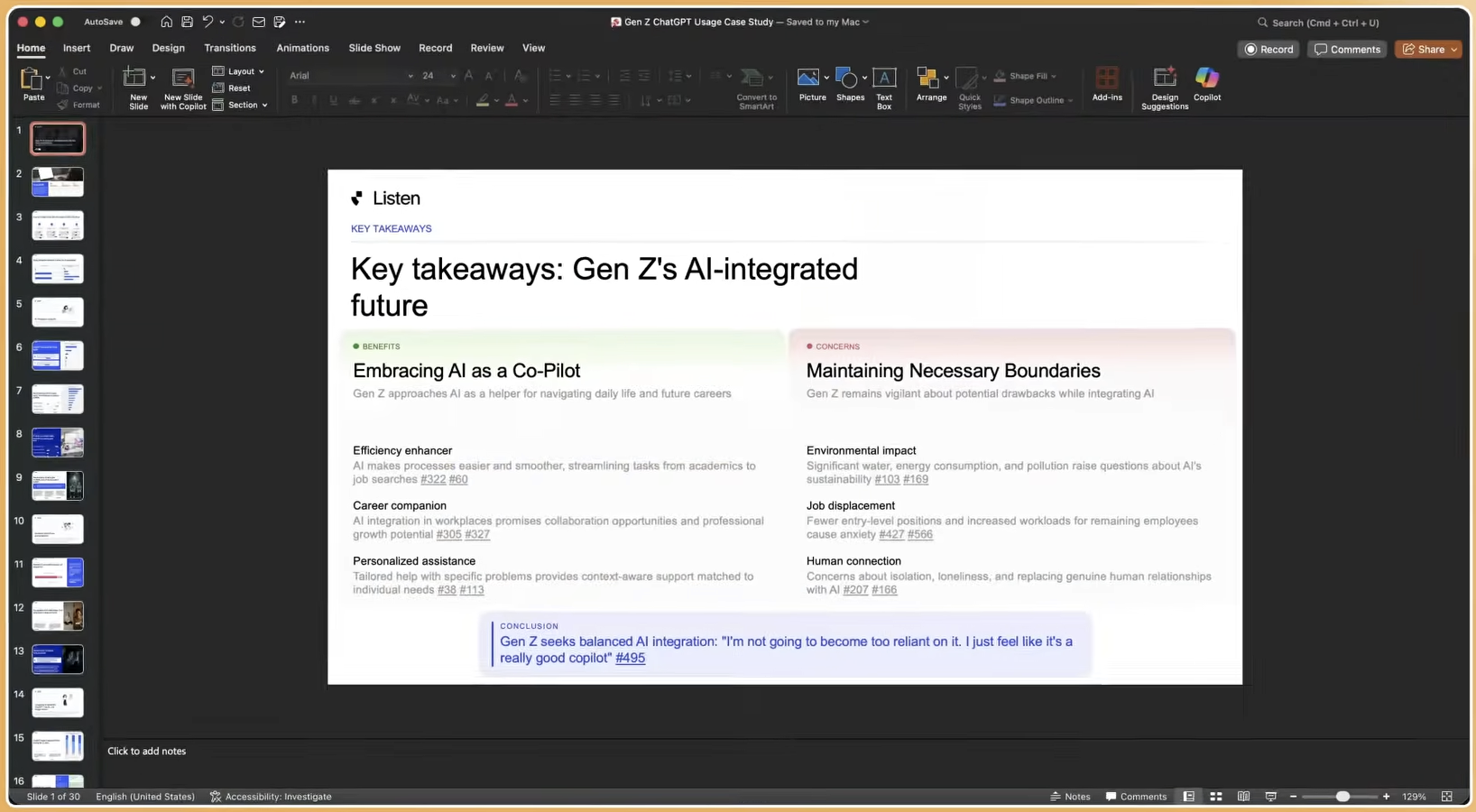
Listen Labs’ Research Agent automates this layer. It generates key findings, thematic clusters, personas, statistical comparisons, and segmentation breakdowns from interview data. One-click deliverables, including consultant-quality slide decks, memo-style reports, video highlight reels, and custom charts, appear in under a minute. Natural-language queries let any team member interrogate the data without research methodology expertise.
Listen Labs’ Mission Control feature extends this capability across studies. Mission Control is a cross-study knowledge management system where every completed study grows an organizational knowledge base. Teams can run cross-study queries, track trends over time, and preserve institutional memory through team turnover. Fragmented Outset-plus-Respondent stacks lack this layer, so findings stay trapped in exports and individual researchers’ heads.
See the Research Agent and Mission Control in action with a personalized demo.
Workflow Integration, Time, and Cost
The operational cost of combining Outset and Respondent goes far beyond subscription fees. A standard qualitative study often takes several weeks from kickoff to final report. Traditional custom qualitative projects follow similar multi-week timelines from kickoff to readout.
The cost structure of a stitched stack compounds quickly. Research panel pricing in 2026 ranges from roughly $5 per consumer survey complete to $300-plus for a single verified B2B interview participant. All-in cost per completed qualitative interview is significantly lower under AI-moderated methods than under traditional moderated methods, but that advantage shrinks when teams pay two vendors and still perform manual synthesis.
Time-from-question-to-decision improves most when every stage sits in one platform. Listen Labs delivers this compression natively, from study brief to completed deliverables in a single same-day workflow, without requiring teams to manage two vendor relationships, two billing cycles, two data exports, or two quality assurance processes.
Best-Fit Use Cases by Team Type
Enterprise consumer insights teams running continuous research programs gain the most from Listen Labs’ end-to-end integration. The ability to run more studies with the same headcount, at roughly a third of the cost of traditional methods, directly addresses the backlog that defines this team’s core constraint. For example, Microsoft used Listen Labs to collect global customer stories for its 50th anniversary celebration within a day, showing how large enterprises can compress timelines while keeping global reach.
UX research leads at mid-to-large product companies need faster feedback loops than a stitched Outset-plus-Respondent stack can provide. Screen-sharing, prototype testing, and usability studies with 50–100 or more participants, rather than the 5–10 typical of human-moderated sessions, run natively within Listen Labs.
Product managers and marketing leaders without dedicated research teams rarely have capacity to manage two vendor relationships, coordinate data handoffs, or perform manual synthesis. Listen Labs’ AI-assisted study design, integrated recruitment, and automated deliverables make end-to-end research accessible without deep research expertise.
Agencies and consultancies operate on client timelines measured in days, not weeks. These teams cannot absorb the multi-week cycles that stitched stacks typically produce. Listen Labs’ rapid turnaround and global reach across 45+ countries and 100+ languages support niche audience sourcing and fast readouts that client engagements demand.
Operational Needs for Always-On and Global Programs
Teams running always-on or multi-market research programs face extra complexity when they rely on separate tools. Language support becomes a primary constraint. Nielsen Norman Group research shows that AI-moderated interviews can handle language changes without translators, but this capability varies across platforms and is not guaranteed in a stitched stack where the recruitment panel and the moderation tool may cover different languages.
Listen Labs supports 100+ languages for interview moderation with automatic translation and transcription, and its Emotional Intelligence layer operates across 50+ languages. This unified multilingual capability lives in a single platform under one compliance framework: SOC 2 Type II, GDPR, ISO 27001, ISO 27701, and ISO 42001 certifications. Teams using Outset and Respondent separately must verify compliance posture across both vendors on their own.
Many organizations now run always-on AI intake conversations in production. This shift toward continuous research infrastructure favors platforms that can sustain ongoing programs without per-study vendor coordination.
Risks and Limitations of a Stitched Stack
Teams evaluating this stack should account for the following documented risks.
- Shallow data from rigid methods. Outset’s moderation quality depends on study design. Without adaptive probing calibrated to emotional and behavioral signals, interviews can produce surface-level responses that miss the motivations behind consumer behavior.
- Slow manual workflows. Qualitative synthesis still accounts for a large share of total project time in traditional studies. Outset and Respondent do not automate this layer.
- Hidden recruitment complexity. Respondent’s per-head fees, management fees, and incentive costs accumulate quickly. A 30-interview consumer study using separate recruitment panels can cost several thousand dollars in recruitment alone.
- Fraud risk at the panel level. Combining stylometric LLM detection, context-specific follow-ups, and verbal-style attention checks keeps detected fraud below 5% on owned audiences and below 10% on third-party panels, but this outcome requires deliberate implementation that a stitched stack does not provide by default.
- Overestimating automation. A 2026 Nielsen Norman Group study found that AI-moderated interviews are best for collecting structured input at scale when questions are already known, and are not a replacement for in-depth human-led semistructured interviews. Teams should calibrate study design with this limitation in mind.
Decision Framework for Outset, Respondent, and Listen Labs
The framework below maps research goals and operational constraints to the configuration that fits best.
Use Outset alone when your organization already has a high-quality participant source, such as a proprietary customer list, needs AI moderation at scale, and has internal capacity to handle analysis and deliverable creation manually.
Use Respondent alone when your organization has existing human moderators or a separate interview tool, needs flexible participant sourcing across consumer or B2B segments, and is not ready to adopt AI moderation.
Use Outset and Respondent together when your organization can absorb multi-week timelines, has budget for two vendor relationships plus manual synthesis, and does not require cross-study knowledge management or emotional signal capture.
Use Listen Labs when your organization needs rapid results, requires verified participants across global markets without managing a separate recruitment vendor, needs emotional intelligence and automated deliverables in a single platform, and runs ongoing or multi-market research programs that depend on institutional knowledge management.
Listen Labs is the only option in this framework that removes the Outset-versus-Respondent choice entirely. Leading enterprises globally, including Microsoft, Google, Sony, Anthropic, Robinhood, Procter & Gamble (P&G), Skims, Levi’s, and Nestlé, have already adopted this integrated approach rather than managing separate recruitment and moderation vendors.
Evaluate Listen Labs against your current research stack with a tailored walkthrough.
Frequently Asked Questions
How long does it take to get results from Outset, Respondent, and Listen Labs?
Outset and Respondent used together typically produce results in 2–6 weeks. Respondent’s recruitment phase alone takes 1–2 weeks for standard consumer audiences and longer for niche or B2B segments. Outset’s moderation runs after recruitment completes, and manual synthesis follows moderation. Listen Labs compresses the entire cycle, including study design, recruitment, moderation, analysis, and deliverables, into a single rapid workflow by running all stages within one integrated platform.
How does participant sourcing differ between Respondent and Listen Labs?
Respondent is a dedicated recruitment panel that sources opted-in participants with demographic and behavioral profiles. It does not conduct interviews or analyze data. Listen Labs’ Listen Atlas layer draws from a global network of 30M verified respondents across 45+ countries, with an AI orchestration layer that automatically matches participants across multiple consumer and B2B panel partners. A dedicated recruitment ops team handles hard-to-reach segments including enterprise decision-makers, healthcare workers, engineers, and audiences below 1% incidence rate. Organizations can also bring their own participants at reduced cost.
What quality controls does Listen Labs apply that a stitched Outset-plus-Respondent stack does not?
Listen Labs’ Quality Guard applies real-time monitoring across video, voice, content, and device signals during every interview. It detects fraud, low-effort responses, AI-generated scripts, and mismatched profiles as they occur rather than after fieldwork ends. Participants are capped at three studies per month to eliminate professional survey-takers. A reputation score builds across every interview, which compounds quality over time. A stitched Outset-plus-Respondent stack applies screener-level checks through Respondent and interview-level moderation through Outset, but these systems do not share data or apply unified quality logic across both stages.
Can Listen Labs support multilingual and global research programs?
Listen Labs supports 100+ languages for interview moderation with automatic translation and transcription. Its Emotional Intelligence layer operates across 50+ languages. The platform covers 45+ countries across the Americas, Europe, APAC, and MEA. All of this operates under a single compliance framework, SOC 2 Type II, GDPR, ISO 27001, ISO 27701, and ISO 42001, without requiring teams to verify compliance posture across multiple vendors.
What deliverables does Listen Labs produce compared to Outset and Respondent?
Respondent produces no research deliverables. Outset produces interview transcripts and basic analysis outputs that require manual synthesis before they become stakeholder-ready. Listen Labs’ Research Agent generates consultant-quality slide decks, memo-style reports, video highlight reels, statistical charts, segmentation breakdowns, and custom reports based on natural-language queries, all in under a minute. Mission Control stores every finding in a cross-study knowledge base, so teams can query past research in seconds and track customer sentiment over time without re-running studies.
Conclusion: Why Integrated Beats Stitched in 2026
Outset moderates and Respondent recruits. Neither platform was designed to do what the other does, and stitching them together creates a research stack that is slower, more expensive, and more fragmented than the problem it was meant to solve. The multi-week cycle, the hidden recruitment fees, the manual synthesis burden, and the absence of cross-study knowledge management reflect structural limits of a two-vendor approach.
Listen Labs removes this tradeoff. A single platform handles study design, global participant recruitment from a 30M-person verified network, AI-moderated interviews with emotional signal capture, automated analysis, and consultant-quality deliverables, all under one workflow and compliance framework.
Enterprise teams at Microsoft, Procter & Gamble, Anthropic, Skims, and Robinhood have already made this shift. See how Listen Labs can eliminate this choice for your research program.