
Written by: Anish Rao, Head of Growth, Listen Labs
Why Teams Compare ListenAI, Listen Labs, And Outset
-
AI-moderated research now sits in the mainstream, with 95% of researchers using AI tools regularly or experimentally according to Qualtrics’ 2026 report.
-
QuestionPro ListenAI works as a module inside the QuestionPro Research Suite and supports video, audio, and written responses with automated analysis and reporting.
-
ListenAI asks teams to manage recruitment and respondent quality themselves and does not include emotional intelligence analysis or cross-study knowledge management.
-
Listen Labs offers a standalone, end-to-end platform with built-in global recruitment, emotional intelligence analysis, and AI-generated deliverables such as slide decks and highlight reels.
-
Ready to experience the difference in your own workflow? Book a demo with Listen Labs to see how the platform can reshape your research process.
What Is AI-Moderated Research?
AI-moderated research is a qualitative method where an AI moderator runs one-on-one interviews, asks open-ended questions, and adapts follow-up probes based on each participant’s responses. It delivers the conversational depth of human interviews at the speed and scale of a survey.
The category fills a previously empty quadrant in the research toolkit. Teams now achieve human-quality depth with survey-grade reach, often running 80 conversations for the cost and calendar time of three live Zoom calls. AI conversations capture 3–5x more usable insight per respondent than surveys because they ask follow-up questions that static questionnaires cannot.
How QuestionPro ListenAI Works: A Step-By-Step Breakdown
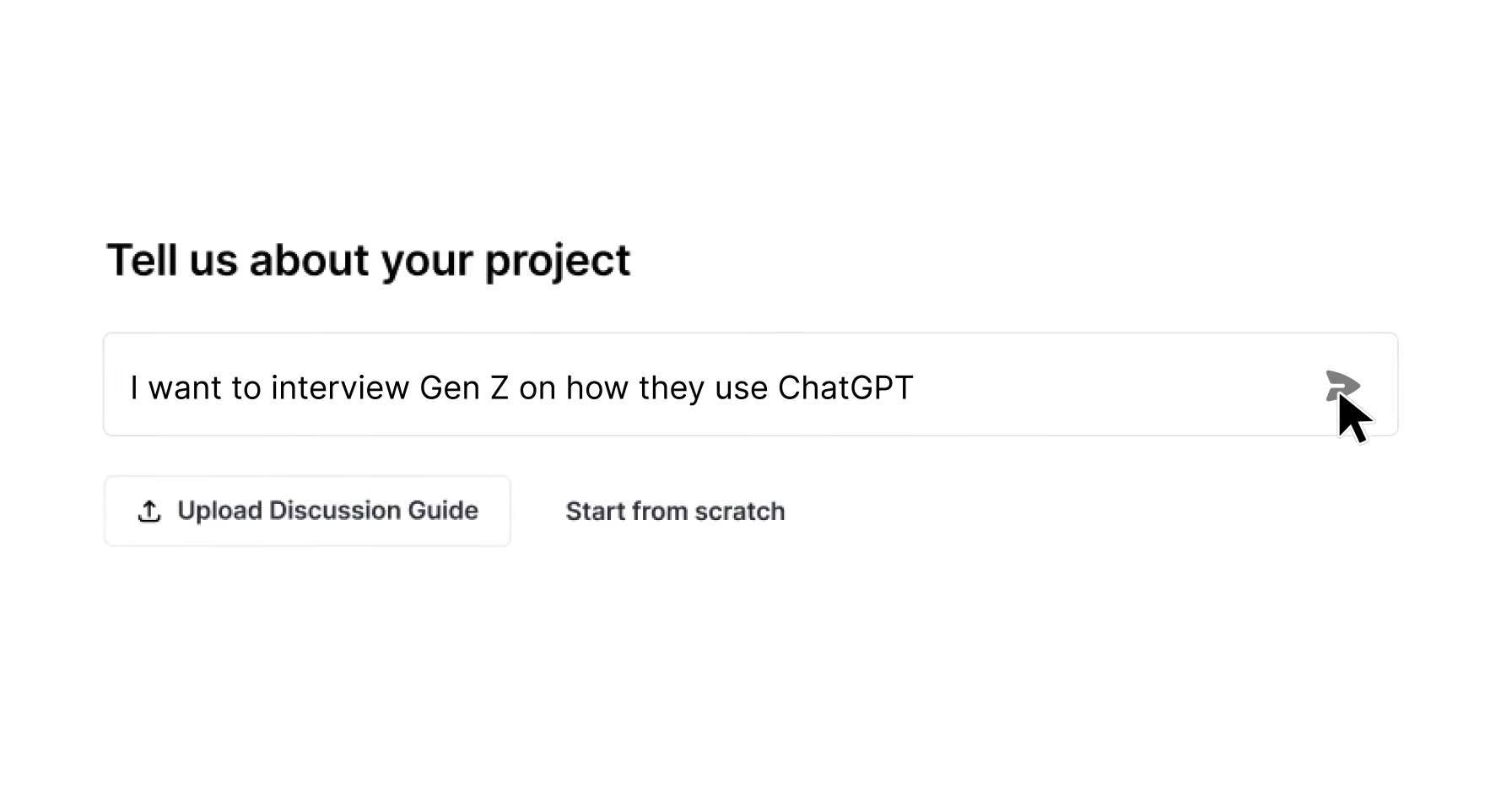
ListenAI is an AI-moderated interview platform inside the QuestionPro Research Suite. It carries a study through four stages, plan, collect, analyze, and activate, without requiring exports between steps. The workflow unfolds in a clear sequence.
-
Project Setup: The researcher states what they want to learn in plain language. ListenAI uses that brief to draft a structured discussion guide with objectives, questions, and follow-up logic for the researcher to review and edit.
-
Interview Plan Creation: The researcher refines the guide, sets response format preferences such as video, audio, or text, and configures language settings. ListenAI supports multiple languages in a single study, so participants can respond in their preferred language.
-
Participant Sessions: Participants complete interviews asynchronously. Video captures tone, expression, and hesitation, audio lowers friction while keeping natural voice, and written responses are fast and low-pressure for participants who prefer typing.
-
Dynamic Moderation: The AI moderator asks one question at a time and probes when an answer is vague, short, or unexpectedly interesting, giving every participant consistent and unbiased treatment.
-
Analysis and Reports: After each interview, ListenAI automatically generates summaries, themes, quotes, clips, and recommendations. Across multiple interviews, it builds an executive summary and clusters recurring patterns in a theme explorer. Researchers can export an executive summary, a full report, highlight clips, or raw data.
ListenAI connects to the broader QuestionPro Research Suite, so teams can view qualitative and quantitative data in a single reporting environment. ListenAI is currently in beta and open for testing via a QuestionPro account manager or a demo request on the ListenAI page.
When To Use ListenAI, Traditional Surveys, Or Human Moderation
Each method plays a specific role in a modern research stack. Traditional surveys work best for statistically powered measurement such as NPS tracking, brand trackers, and demographic segmentation, but they cannot probe in real time. Open-ended survey questions show high non-response and low-quality response rates, with many respondents skipping them or writing a single word.
Human moderation delivers the richest nuance and remains essential for sensitive topics, co-design sessions, and strategic executive interviews. However, traditional qualitative studies often cost $15,000–$50,000 per project and take 4–8 weeks from kickoff to insights. AI moderation fills the middle ground by offering adaptive conversation at lower cost and higher scale.
How To Set Up A ListenAI Study: Practical Tips
The research instrument largely determines the quality of an AI-moderated study. Vague or hypothesis-laden interview scripts cause the AI to surface patterns that mirror design flaws instead of real consumer behavior. The practices below work together as a simple sequence.
-
Write a single-sentence research objective. If the objective does not fit in one sentence, revisit the brief with stakeholders before interviewing.
-
Draft open-ended, non-leading questions. Use the AI to create a first draft, then edit every question so it stays open-ended, serves a clear research purpose, and avoids leading language. A practical guide usually includes 6–10 core questions with 2–3 follow-up probes for each.
-
Write explicit probe instructions. Writing “probe as needed” gives the AI no real guidance. Effective probe instructions stay specific, for example, “If the participant describes a frustration, ask them to recall a specific moment when that frustration felt most intense.”
-
Run a pilot before scaling. Run 5–10 pilot sessions before opening the full sample. The cost of piloting stays low, while the cost of scaling a flawed study runs high. Review early transcripts for confusing questions, dead-end probes, and length drift.
-
Target 10–20 minutes per session. Engagement drops after 20 minutes and data quality degrades significantly beyond 30 minutes.
Explore how Listen Labs handles recruitment and analysis.
Limitations Of ListenAI And What To Watch For
ListenAI’s own documentation clearly describes where the tool falls short, and teams need to factor these limits into study design.
-
No non-verbal cue capture. ListenAI processes spoken content but does not capture non-verbal cues such as hesitation, eye contact, or silence, which a human moderator can observe in the room.
-
Strong dependency on guide quality. Confirmation bias in the interview guide persists through automation, and at high volume the same design error can repeat across hundreds of interviews before detection.
-
Participant quality handled outside the platform. ListenAI does not include proprietary recruitment infrastructure. It offers researchers the option to use Listen’s own global panel of 30M+ verified respondents, bring their own participants via Direct Link, or combine both, which can introduce variability in respondent quality.
-
Limited fit for sensitive or strategic conversations. Human moderation works better for sensitive topics such as health experiences, financial stress, trauma, workplace conflict, and identity-related topics because human moderators can notice discomfort, slow down, rephrase questions, and create a safer environment. QuestionPro advises against using ListenAI for highly sensitive or strategic conversations.
-
Ongoing need for human judgment in analysis. QuestionPro cautions teams not to treat AI summaries as final truth and recommends reviewing transcripts, checking quotes in context, and comparing themes before making decisions.
ListenAI, Listen Labs, And Outset: How They Differ
ListenAI functions as a module within the QuestionPro Research Suite, while Listen Labs and Outset operate as standalone platforms. That structural difference shapes how each product fits into a research ecosystem.
On recruitment, ListenAI asks researchers to source participants through existing panels or their own lists, which reintroduces fragmentation and quality risk. Outset addresses this through integrations with more than 25 panel partners, including Prolific and User Interviews. Listen Labs goes further with a built-in network of 50M+ verified respondents across 45+ countries and 120+ languages. Its AI orchestration layer, Quality Guard, matches participants on behavioral and intent signals rather than self-reported demographics. It also monitors every interview in real time for fraud and low-effort responses, and limits participants to three studies per month to reduce professional survey-takers.
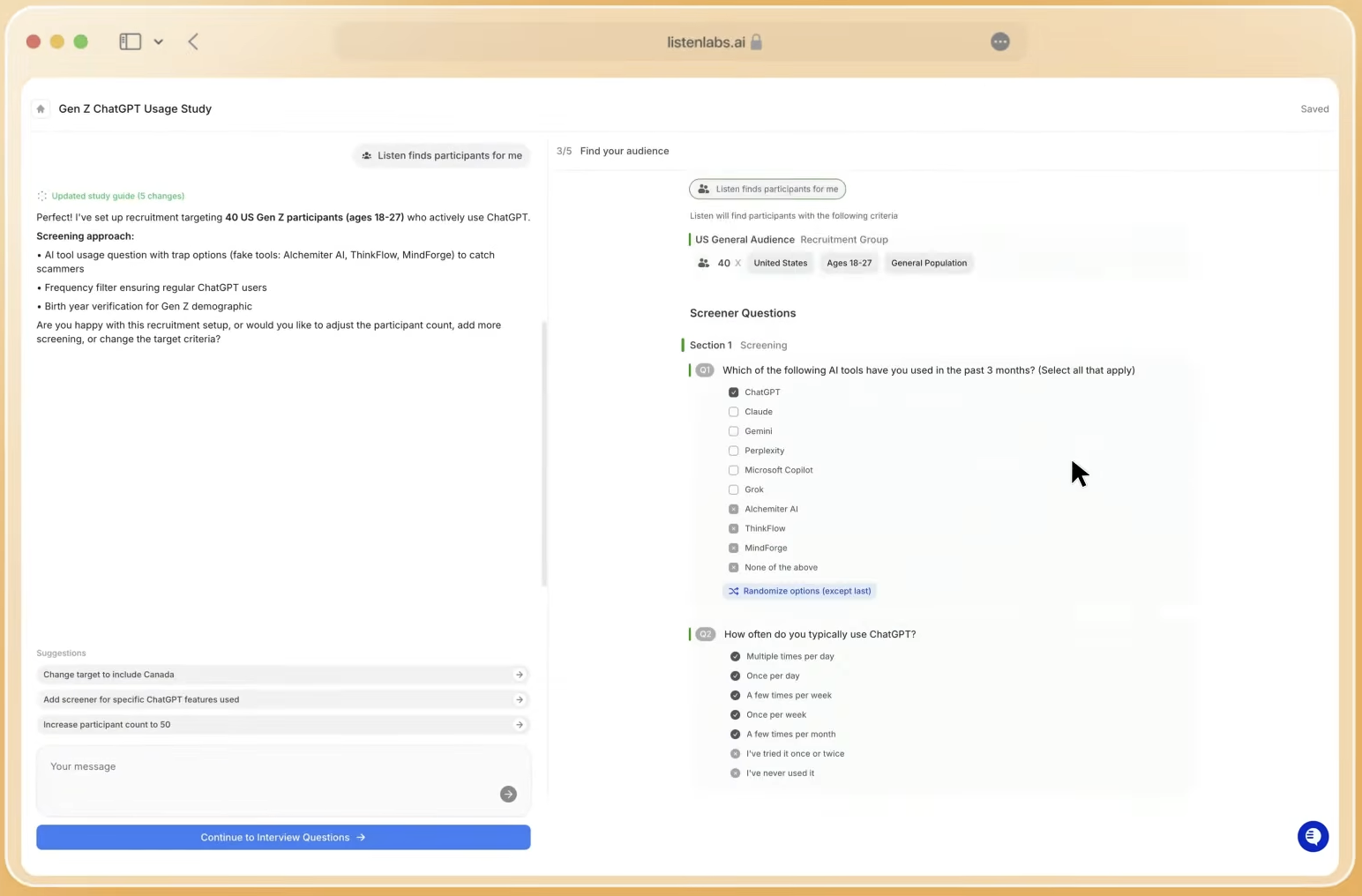
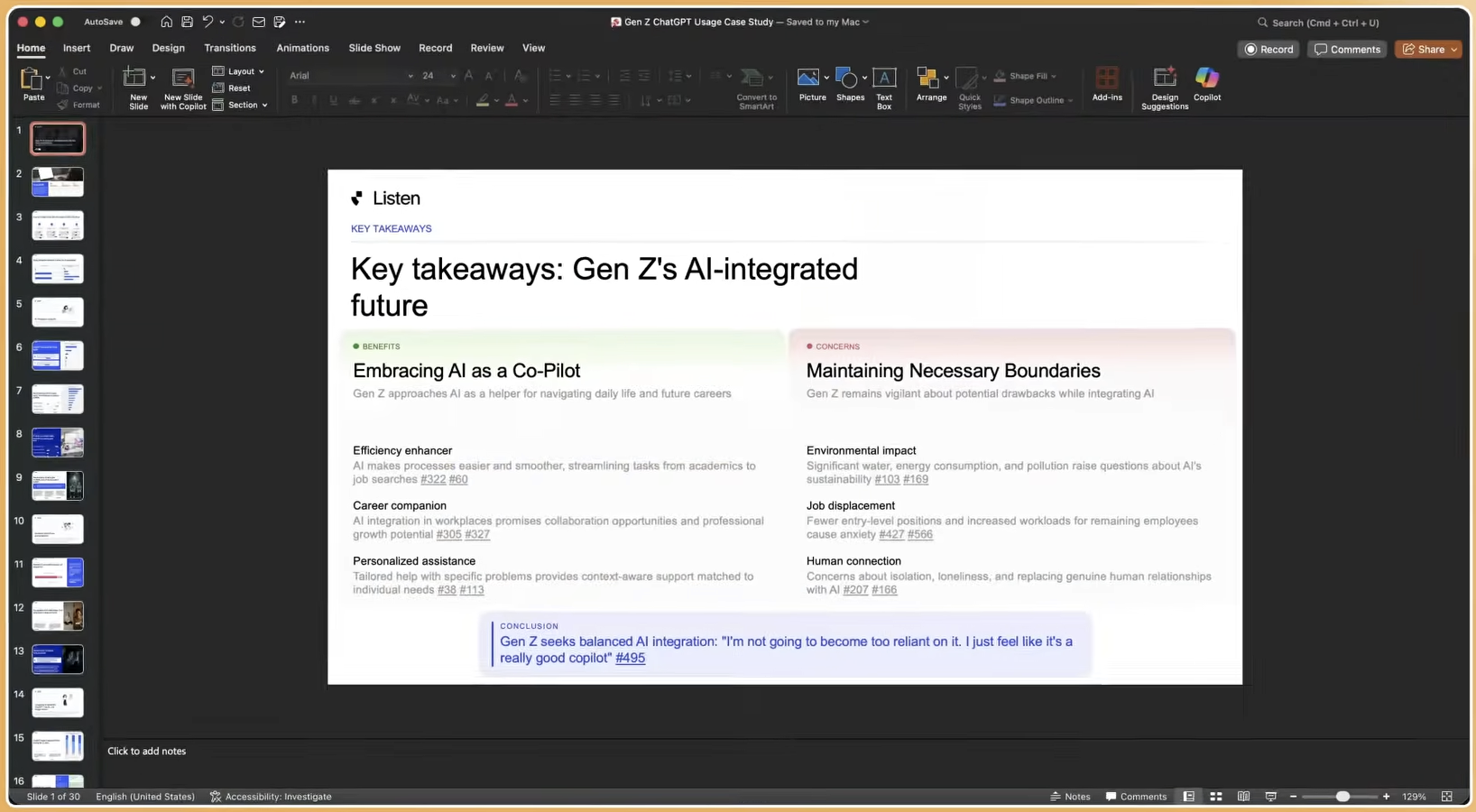
On analysis and outputs, ListenAI generates summaries, themes, quotes, clips, and executive summaries. Listen Labs’ Research Agent produces consultant-style slide decks, memos, highlight reels, and stat tests in under a minute. Its Emotional Intelligence layer analyzes tone of voice, word choice, and subconscious micro-expressions, using Ekman’s universal emotions framework, to surface what participants feel as well as what they say. Research Library supports cross-study queries in natural language, so insights compound across every study the team has already run. Outset focuses on automated synthesis, highlight reels, and chat-with-data analysis for teams that prefer to manage panels themselves.
See Listen Labs in action for your use case.
Best Practices For Success With AI-Moderated Research
Regardless of platform, the same core principles guide effective AI-moderated research.
-
Start with a clear, single-sentence objective. Ambiguous objectives produce ambiguous data at any sample size.
-
Build a detailed interview guide with specific probe instructions. Semi-structured guides with explicit probing logic consistently outperform rigid question lists. Many teams default to structured mode because it feels safer, even when it limits learning.
-
Pilot before scaling and treat themes as hypotheses. Review the first 5–10 transcripts critically before opening the full field. Plan 2–4 hours of human synthesis time per study and treat auto-generated themes as starting points rather than finished deliverables.
-
Combine AI-moderated interviews with quantitative surveys. A common pattern uses interviews first to discover themes, then a survey to measure how widespread each theme is.
-
Reserve human moderation for specific cases. Human moderators still handle emotionally heavy topics, co-design sessions, senior executive interviews, and the ambiguous minority of transcripts that need deeper follow-up.
Frequently Asked Questions
Is It Okay To Use Surveys In Qualitative Research?
Surveys function as a quantitative instrument. They can include open-ended text fields, but those fields usually generate low-quality, single-word responses because there is no mechanism to probe or follow up. Qualitative research requires adaptive conversation, including the ability to ask “why” based on what a participant just said. AI-moderated interviews provide that adaptive conversation at scale, because the AI probes each response in a way that mirrors a trained human interviewer. Surveys still serve as the right choice for statistically powered measurement tasks such as NPS tracking, brand trackers, and demographic segmentation.
Can You Use ChatGPT For Qualitative Data Analysis?
General-purpose large language models like ChatGPT can help with tasks such as initial coding or summarizing transcripts, but they lack the research-specific infrastructure that makes purpose-built platforms reliable. They lack access to the interview recordings, a traceable connection between themes and the specific responses that generated them, sentiment analysis calibrated to research contexts, and an audit trail. Purpose-built platforms like Listen Labs generate themes that link to exact timestamps, verbatim quotes, and the reasoning behind each label, which creates a standard of evidence that general-purpose LLMs do not match. For any finding that will inform a business decision, traceability remains essential.
What Is The Difference Between An AI Survey And An AI-Moderated Interview?
An AI survey is a static questionnaire delivered digitally. Participants see pre-written questions and select or type responses, with no adaptation based on what they say. An AI-moderated interview is a dynamic, one-on-one conversation where the AI reads each response and asks follow-up questions based on what the participant actually said. When a participant gives a vague answer, the AI probes for specificity. When they raise an unexpected topic, the AI can explore it. The result is qualitative data with the depth of a human interview and the scale of a survey, which static questionnaires cannot provide.
How Much Does AI-Moderated Research Cost Compared To Traditional Methods?
AI moderation costs significantly less than human moderation. Traditional qualitative studies that include recruiting, scheduling, moderating, transcribing, and analyzing typically cost $15,000–$50,000 per study and take 4–8 weeks. AI-moderated interviews run at a fraction of that cost per session, scale to hundreds of participants without proportional cost increases, and produce automated analysis outputs that remove weeks of manual coding. The cost per insight often falls to 5–10x lower because synthesis is automated and scheduling overhead disappears. Listen Labs specifically delivers results at one third the cost of the traditional research approach, compressing a 4–6 week cycle to less than 24 hours.
Conclusion: Matching Platforms To Your Research Needs
AI-moderated research now represents a mature and rapidly growing category. Traditional qualitative research typically takes 4–6 weeks, while Listen Labs delivers insights with the same sub-24-hour turnaround described earlier, at a fraction of the cost. QuestionPro ListenAI offers a credible option for teams already embedded in the QuestionPro ecosystem who want to add qualitative depth to their existing workflow. Its limits around proprietary recruitment, emotional intelligence, and cross-study knowledge management remain manageable for teams with strong panel relationships and modest volume requirements.
Enterprise consumer insights teams running high volumes of studies across multiple markets face a different challenge. The fragmentation that ListenAI asks researchers to manage externally often mirrors the fragmentation that slows research down in the first place. Purpose-built platforms like Listen Labs remove that fragmentation. Recruitment, moderation, emotional analysis, deliverable generation, and cross-study intelligence all operate within a single platform. Trusted by Microsoft, P&G, Nestlé, Skims, and roughly 15% of the Fortune 100, Listen Labs turns a process that used to take weeks into one that delivers results with the same 24-hour turnaround mentioned earlier.
Ready to run your next study in hours instead of weeks? Book a demo to run your next study in hours.