
Written by: Anish Rao, Head of Growth, Listen Labs | Last updated: August 6, 2026
Key Takeaways for Enterprise Research Teams
- AI-moderated interviews compress traditional 4–6 week qualitative research cycles to under 24 hours while keeping consultant-grade rigor.
- Clear, narrow objectives and a single-topic discussion guide with adaptive probes give the AI moderator structure and focus.
- Layered quality controls across sourcing, live monitoring, and human review manage fraud risk at enterprise scale.
- Emotional signal capture across tone, word choice, and micro-expressions adds quantifiable sentiment data beyond transcripts.
- Listen Labs automates recruitment, moderation, analysis, and deliverables, so teams can launch their first study in hours. Book a demo to see the full workflow.
Step 1: Define Narrow, Testable Objectives for the Study
Clear objectives prevent AI-moderated studies from drifting into scope creep and producing unfocused data. Before opening any platform, the research lead and primary business stakeholder align on a single decision the study will inform, such as a product feature, campaign direction, or pricing tier.
Required inputs include a one-sentence research question, a list of decisions that depend on the answer, and a deadline tied to a business milestone. These inputs feed directly into a validation checkpoint. If the team cannot state what they will do differently based on the findings, the objective remains too broad. This alignment meeting takes 30–60 minutes and prevents days of rework later.
Step 2: Build a Single-Topic Discussion Guide with Adaptive Probes
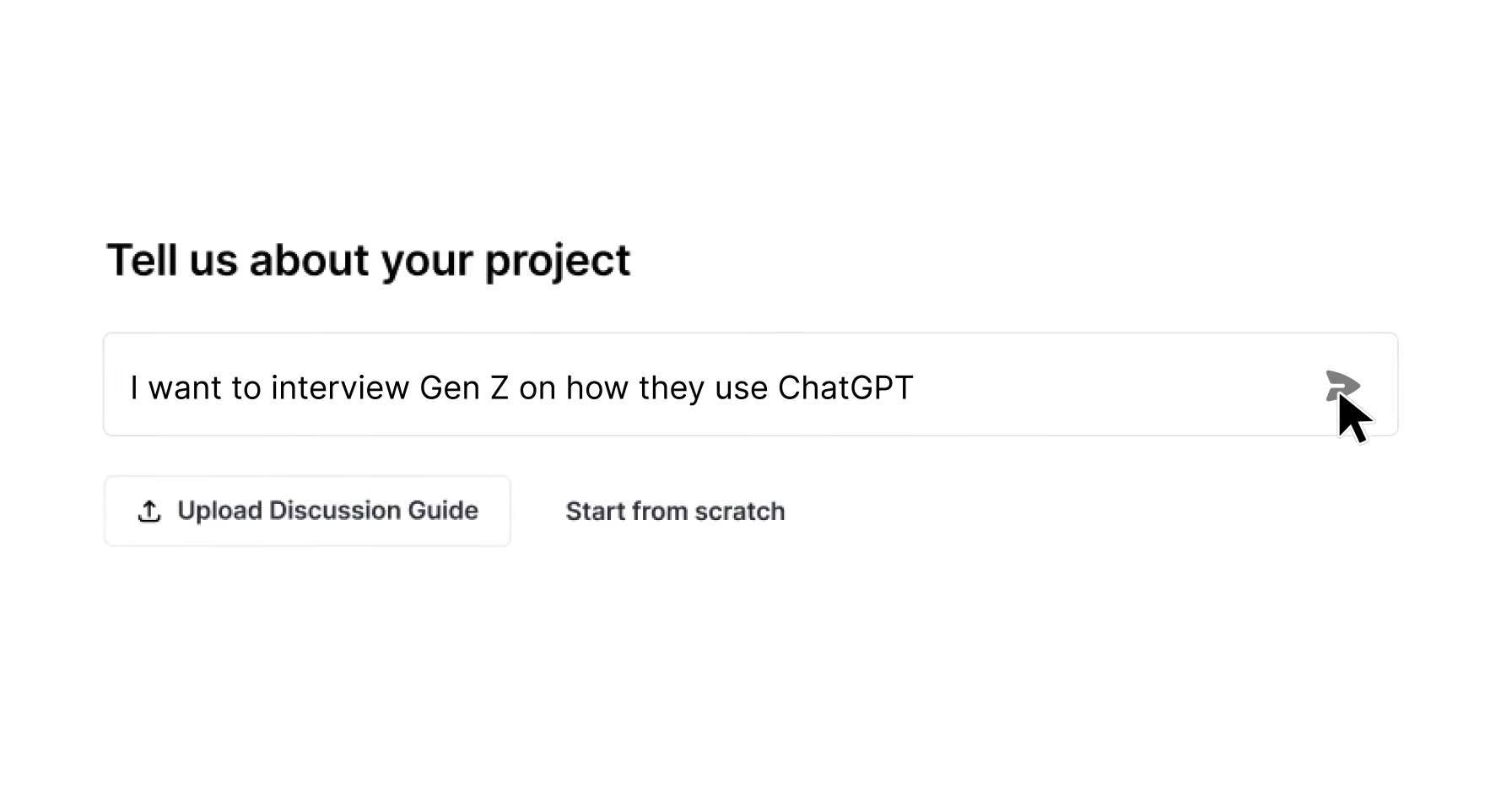
A discussion guide for an AI moderator follows different rules than a human-moderated script. Because AI can schedule and conduct interviews, analyze transcripts for themes, and generate quantitative insights, the guide must support intelligent branching without a human in the room.
Use these best practices when constructing the guide:
- Limit the guide to one core topic with five to eight primary questions.
- Write adaptive probe instructions for each question, for example, “if the participant mentions price, ask what price point would feel fair and why.”
- Sequence questions from broad context-setting into specific concept evaluation.
- Include at least two open-ended narrative questions to surface unexpected themes.
- Run the draft through an auto-QA check before launch to catch ambiguous phrasing.
This collaborative review process typically involves three roles. The research lead drafts the initial guide. A subject-matter expert reviews for domain accuracy. Legal reviews any regulated topics. The full cycle from first draft to approved guide usually takes two to four hours.
Step 3: Configure Tone, Pacing, and Follow-Up Logic for the AI Moderator
AI moderator configuration shapes whether participants feel heard or interrogated. Tone settings should match the study context. A usability test benefits from a neutral, task-focused voice. A brand perception study works better with a warmer, conversational tone.
Pacing logic controls how long the AI waits before prompting a follow-up and how it handles short or evasive answers. Follow-up logic should instruct the AI to probe deeper on responses below a minimum word threshold and to flag emotionally charged language for sentiment tagging. These configuration choices directly affect participant comfort and candor. 92% of participants report top comfort levels in AI-moderated sessions, and 32% explicitly state they feel less judged with AI moderation, which supports more honest responses when tone is set correctly.
To complete this configuration step, the research lead provides a tone brief, defines pacing parameters, and lists sensitive topics that require softer follow-up language. This preparation typically takes one to two hours.
Step 4: Pilot 15–30 Interviews to Validate Flow and Data Quality
Pilot interviews reveal issues that do not appear on paper. A pilot cohort of 15–30 interviews, drawn from the same panel as the full study, surfaces ambiguous questions, pacing problems, and unexpected topic branches before launch.
During the pilot, the research lead reviews a random sample of transcripts for comprehension failures, checks drop-off rates by question, and confirms that adaptive probes trigger correctly. If more than 20% of participants misinterpret a question, that question needs revision before scaling. The pilot also establishes a baseline completion rate and average interview duration, which inform the full-study timeline estimate.
Required inputs include the finalized discussion guide, a recruited pilot cohort, and a review rubric. The decision checkpoint is clear. Proceed to full launch only when completion rate, response depth, and probe accuracy all meet pre-set thresholds. The pilot phase typically takes 24–48 hours, including participant completion and review.
Ready to run your first pilot? Book a demo to see how Listen Labs configures and launches pilot studies in hours.
Step 5: Implement Multi-Layer Quality Controls Across the Study
Scaling to hundreds of interviews introduces fraud risk that rarely appears in a ten-person human-moderated study. A robust quality control system operates across three layers at the same time.
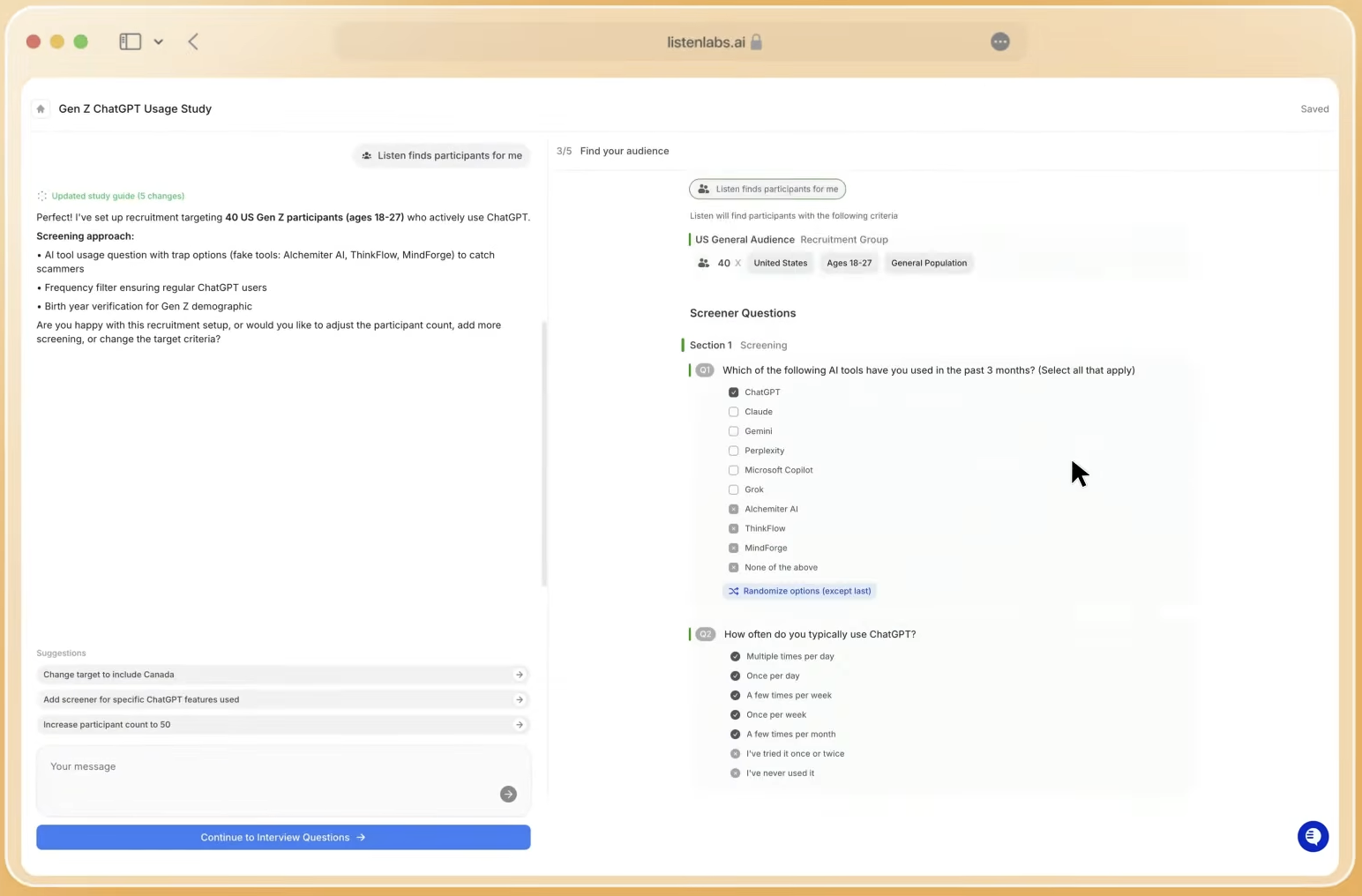
- Panel sourcing controls: Recruit only from verified, non-commodity panels. Listen Labs’ Quality Guard applies behavioral matching on intent and past actions, not just self-reported demographics, and limits participants to three studies per month to reduce professional survey-takers.
- Real-time interview monitoring: AI monitors video, voice, content, and device signals during each session to detect fraudulent responses, AI-generated scripts, low-effort answers, and mismatched participant profiles.
- Human review layer: A dedicated recruitment operations team reviews flagged sessions and manages sourcing for hard-to-reach segments, including audiences below 1% incidence rate such as enterprise decision-makers and healthcare workers.
Implementing these three quality layers requires clear audience specifications, defined fraud detection thresholds, and a flagging protocol for borderline cases. The exclusion rule is simple. Any session flagged across two or more quality dimensions is removed from analysis. Unlike other steps, quality monitoring runs continuously throughout the full study.
Step 6: Capture and Quantify Emotional Signals from Each Interview
Emotional signal capture reveals what participants feel, not just what they say. Transcripts may show positive ratings for a concept while micro-expressions reveal confusion or hesitation that predict post-launch rejection.
To operationalize emotional signal capture at scale, platforms must automate the workflow from recruitment through analysis. Listen Labs layers on auto-recruiting, transcription, sentiment tagging, and insight summarization so teams move from questions to findings in hours, not weeks. Listen Labs’ Emotional Intelligence feature analyzes three signal layers, including tone of voice, word choice, and subconscious micro-expressions, using Ekman’s universal emotions framework, the same standard used in clinical psychology and UX research. Every emotion label is quantified per question and traceable to the exact timestamp, verbatim quote, and reasoning behind the classification.
For enterprise use cases such as creative testing, concept evaluation, and brand research, emotional quantification converts subjective impressions into statistically comparable metrics across segments and markets. Required inputs include video-enabled interview sessions and a defined set of emotional dimensions that align with the study objective. The process runs automatically, and results appear alongside transcript analysis.
Step 7: Run Automated Analysis and Generate Stakeholder Deliverables
Automated analysis turns large volumes of interview data into decisions. With AI-moderated interviews, talking to users at scale becomes straightforward, and the main challenge shifts to understanding what they mean. Once interviews are complete, the Research Agent processes all response data to identify themes, generate key findings, run statistical comparisons across segments, and create stakeholder-ready deliverables.
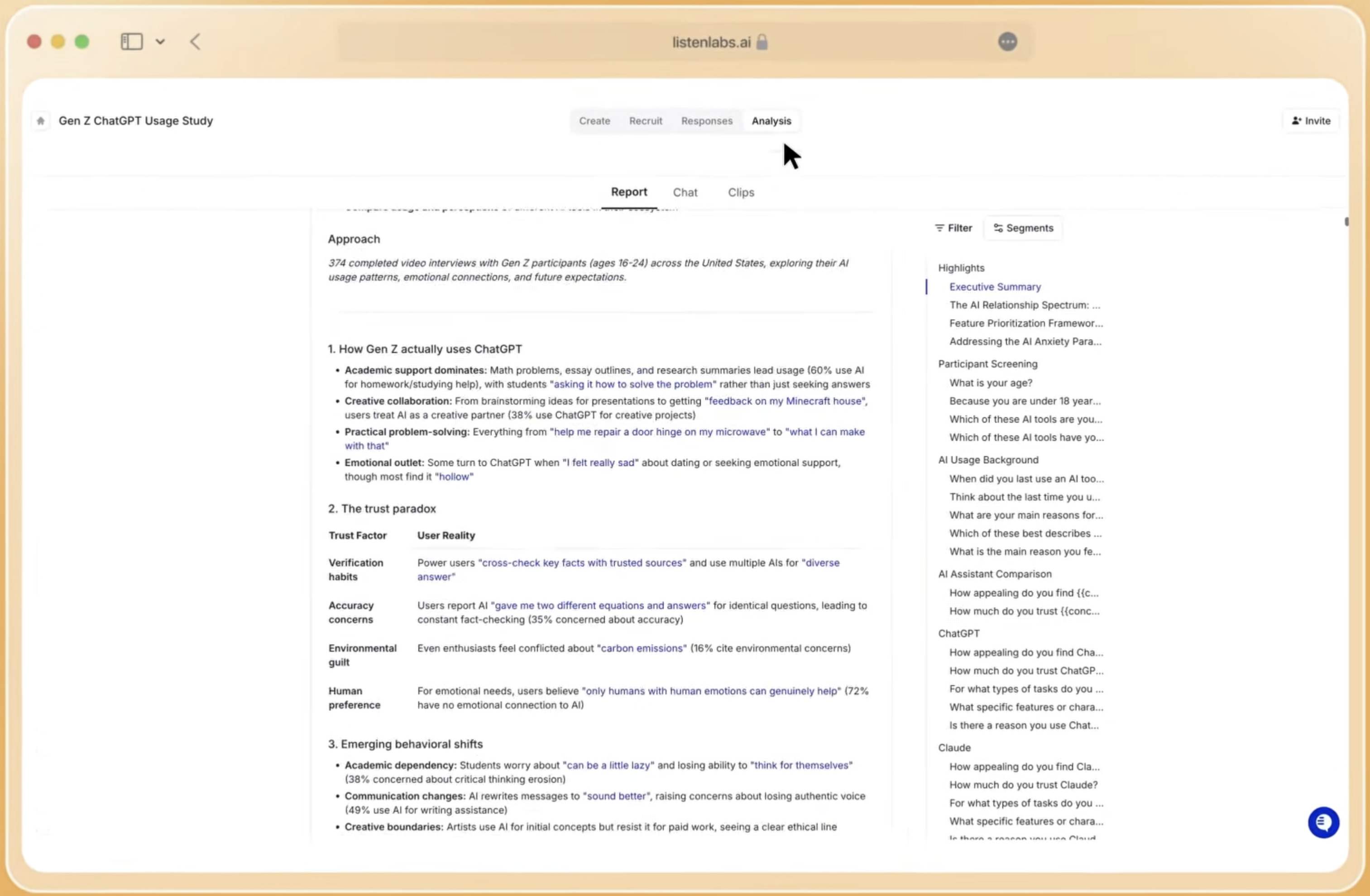
The platform’s speed advantage becomes clear when you look at the range of outputs it can produce at once. Deliverables generated in under a minute include:
- Consultant-quality PowerPoint slide decks
- Memo-style written reports
- Video highlight reels of the most emotionally significant moments
- Statistical charts and segmentation breakdowns
- Custom reports generated from natural-language queries
Every insight links directly to the underlying response data, so stakeholders can drill into any finding without returning to raw transcripts. Anthropic used this workflow to surface churn drivers from 300+ user interviews in 48 hours, five times faster than their previous process, and delivered a prioritized list of ten must-fix product items to the product team. P&G uses the same approach to run interviews with quantified themes and verbatim proof that support internal decision-making.
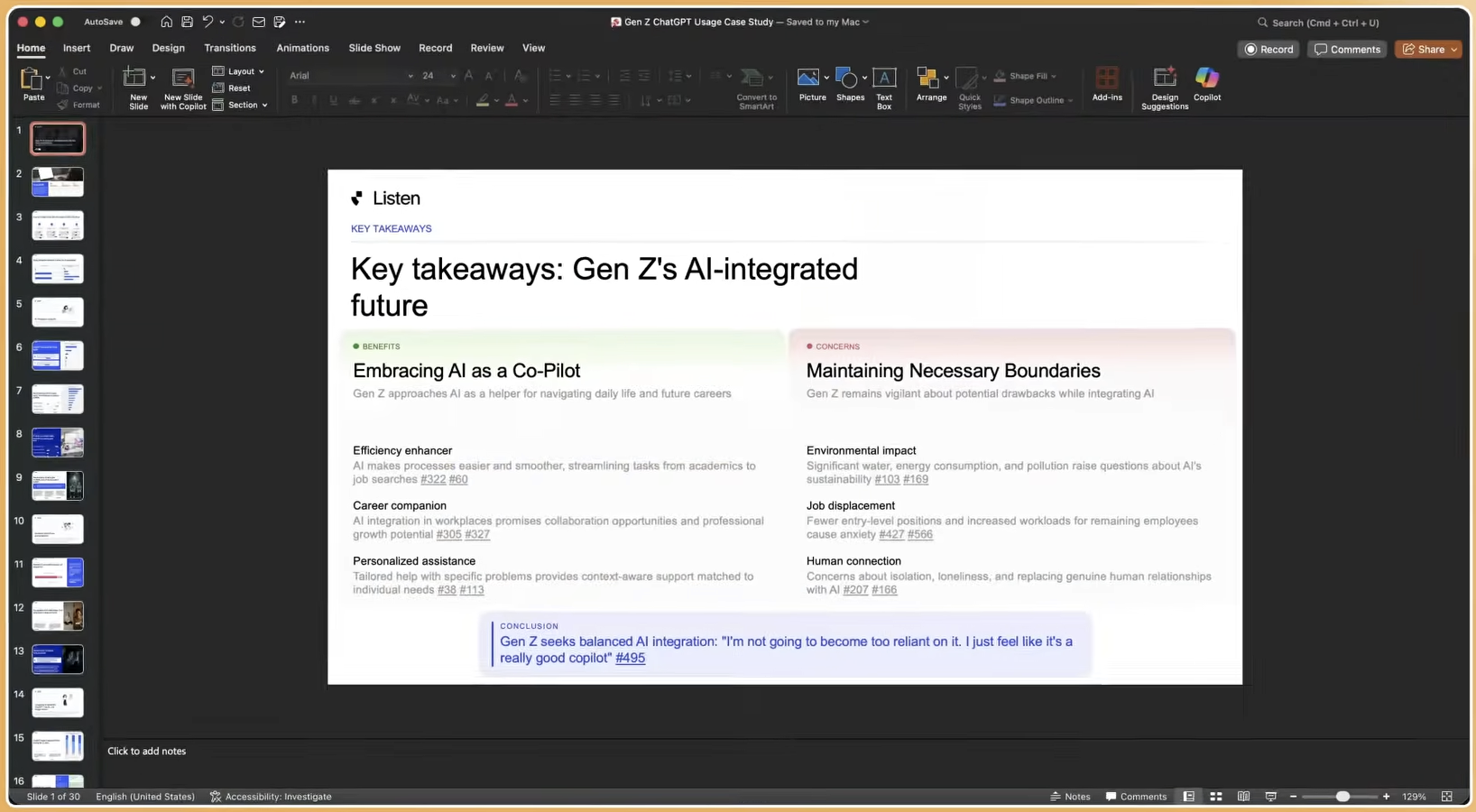
See the full analysis workflow in action. Book a demo and watch Listen Labs turn raw interview data into a board-ready slide deck in under 24 hours.
Frequently Asked Questions
How long does a complete AI-moderated study take from brief to deliverables?
A well-scoped study, from finalizing objectives through receiving automated analysis, typically completes in under 24 hours once the discussion guide is approved and the participant cohort is recruited. The pilot phase in Step 4 adds 24–48 hours if the team chooses to run one before scaling. Studies that target niche or hard-to-reach audiences may require more recruitment time, but interview and analysis durations remain consistent. Traditional 4–6 week research cycles come from sequential vendor handoffs, manual scheduling, and human analysis, all of which an end-to-end AI platform removes.
What skills does an internal team need to run AI-moderated interviews?
A research lead with experience writing discussion guides and interpreting qualitative data can run the full process. The platform automates recruitment, moderation, transcription, and analysis. Teams without a dedicated researcher can describe their objectives in natural language and receive a structured discussion guide draft from the AI, which a subject-matter expert or product manager then reviews. Legal review remains recommended for studies that cover regulated topics, sensitive demographics, or markets with specific data privacy requirements.
How does the platform handle data privacy and security?
Listen Labs maintains enterprise-grade security with 256-bit encryption, and customer data is never used for AI model training. The platform holds SOC 2 Type II, GDPR, ISO 27001, ISO 27701, and ISO 42001 certifications that cover information security, privacy management, and AI management systems. Enterprise SSO supports access control. For studies conducted in the European Union or other regulated markets, the platform’s compliance posture satisfies standard procurement and legal review requirements without extra configuration.
When should a study be rerun versus retired?
Teams should rerun a study when a significant product, pricing, or market change has occurred since the last wave, when the original sample was too narrow to generalize, or when stakeholders need to track sentiment over time. A study can be retired when the decision it was designed to inform has been made and is unlikely to be revisited, or when Mission Control, the platform’s cross-study knowledge base, already contains sufficient data to answer the question from prior research. Trend-tracking studies benefit from a scheduled cadence, such as quarterly or biannual, rather than ad hoc reruns, which allows the platform to surface directional shifts in customer sentiment automatically.
Can AI-moderated interviews reach niche or low-incidence audiences?
AI-moderated interviews can reach highly specific audiences at scale. Listen Labs’ global panel of 30 million verified respondents spans 45+ countries and 100+ languages, and a dedicated recruitment operations team handles sourcing for audiences below 1% incidence rate. This coverage includes enterprise decision-makers, licensed healthcare workers, engineers with specific technology stacks, and highly specialized consumer segments. For organizations that want to study their own user base, the platform supports self-recruitment at a reduced cost, with the same quality controls applied to externally sourced participants.
Conclusion: Scale Research Without Sacrificing Rigor
The seven-step process, from defining narrow objectives through automated analysis, removes the structural bottlenecks that force enterprise research teams to choose between depth and speed. Microsoft collected global customer stories for its 50th anniversary within a single day. Anthropic compressed a multi-week churn analysis into 48 hours using 300+ user interviews. P&G now runs interviews with quantified themes and verbatim proof as a repeatable input to decision-making.
The methodology is repeatable, the quality controls are auditable, and the deliverables are stakeholder-ready. The remaining question is whether your team has the infrastructure to run this process consistently.
Start your first AI-moderated study in under 24 hours. Book a demo with Listen Labs and see the full seven-step process applied to your next research brief.