Written by: Anish Rao, Head of Growth, Listen Labs
Retail insights teams have lived with a false choice for years. Small, human-moderated studies deliver rich stories but cannot guide category-wide decisions. Large surveys reach thousands of shoppers but rarely explain why people choose one brand, shelf, or store over another. AI moderation removes that trade-off. The six-step process below shows how enterprise retail teams now run 200–500 video interviews in under a day, with the emotional depth of classic qual and the consistency leaders expect from quant.
Key Takeaways
- Retail insights teams face a persistent gap: rich qualitative methods do not scale, while scalable methods lack motivational depth, creating backlogs and delayed decisions.
- Precise objectives, validated scales, and branching interview guides with embedded stimuli create a stable foundation for consistent, comparable qualitative research at scale.
- High-quality participant sourcing with behavioral screening and AI fraud detection protects data integrity while enabling studies of 100–1,000+ interviews in days rather than weeks.
- AI-moderated video interviews combined with automated thematic analysis and natural-language querying deliver consultant-grade insights and emotional intelligence in under 24 hours for most retail studies.
- Listen Labs turns these capabilities into an always-on intelligence asset—see how retail teams compress full qualitative programs into under a day without sacrificing depth.
Step 1: Set Retail Decisions and Choose Validated Measurement Scales
Every scalable qualitative program starts with a sharp decision statement. Vague briefs such as “understand the store experience” create unfocused guides and weak findings. Clear briefs name the decision, the audience segment, and the behavioral or perceptual question at stake.
Typical stakeholders here include the VP of Consumer Insights, the relevant category or brand manager, and a representative from the team that will act on findings. A grocery chain testing three new shelf layouts across two regions needs enough interviews per layout per region to support comparison, often 40–50 per cell. An apparel brand evaluating loyalty program messaging may need 100–200 interviews to segment by tenure and spend tier.
Validated scales keep measurement consistent across waves and markets so teams can track shifts over time. The Retail Brand Experience (RBE) scale is a 22-item, seven-dimensional instrument developed in 2016 and later validated by Baharuddin et al. (2024) via PLS-SEM with 500 respondents, showing strong psychometric properties in retail contexts. For perceived value, the PERVAL scale developed by Sweeney and Soutar (2001) breaks value into emotional, social, and two functional dimensions, helping teams pinpoint which value driver underperforms.
Embedding these scales as structured quantitative modules inside a qualitative guide lets teams track scores over time while still probing open-ended motivations. Realistic timing for this step is two to three days for a well-resourced team with aligned stakeholders. With objectives and scales locked, the next move is turning them into an interview guide the AI moderator can run consistently across hundreds of sessions.
Step 2: Build an AI-Ready Interview Guide with Clear Branching and Stimuli
A retail interview guide for AI moderation differs from a traditional discussion guide because every branch must be explicit. The AI moderator follows conditional paths. If a participant mentions a negative checkout experience, the guide branches into detailed probes on friction points. If the experience was positive, it branches into drivers of satisfaction and loyalty intent.
Stimuli such as shelf renders, packaging concepts, loyalty program mockups, store layout images, or live URLs sit directly in the interview flow. A grocery chain testing new shelf layouts can show a rendered image, collect open-ended reactions, then ask RBE subscale items. An apparel brand can present two loyalty tier structures in a monadic design, randomizing order to control for primacy effects.
Stakeholders at this stage usually include the insights lead, a moderator or research strategist, and the brand or category team checking stimuli for accuracy. Version control matters. Teams should lock stimuli and wording before fieldwork to keep interviews comparable. Most teams complete this step in two to four days, including review cycles.
Step 3: Recruit Verified Retail Shoppers and Protect Data Quality
Participant quality shapes every downstream insight in scaled qualitative research. AI-moderated interviews lower cost per complete, but only when the panel excludes professional survey-takers and fraudulent profiles.
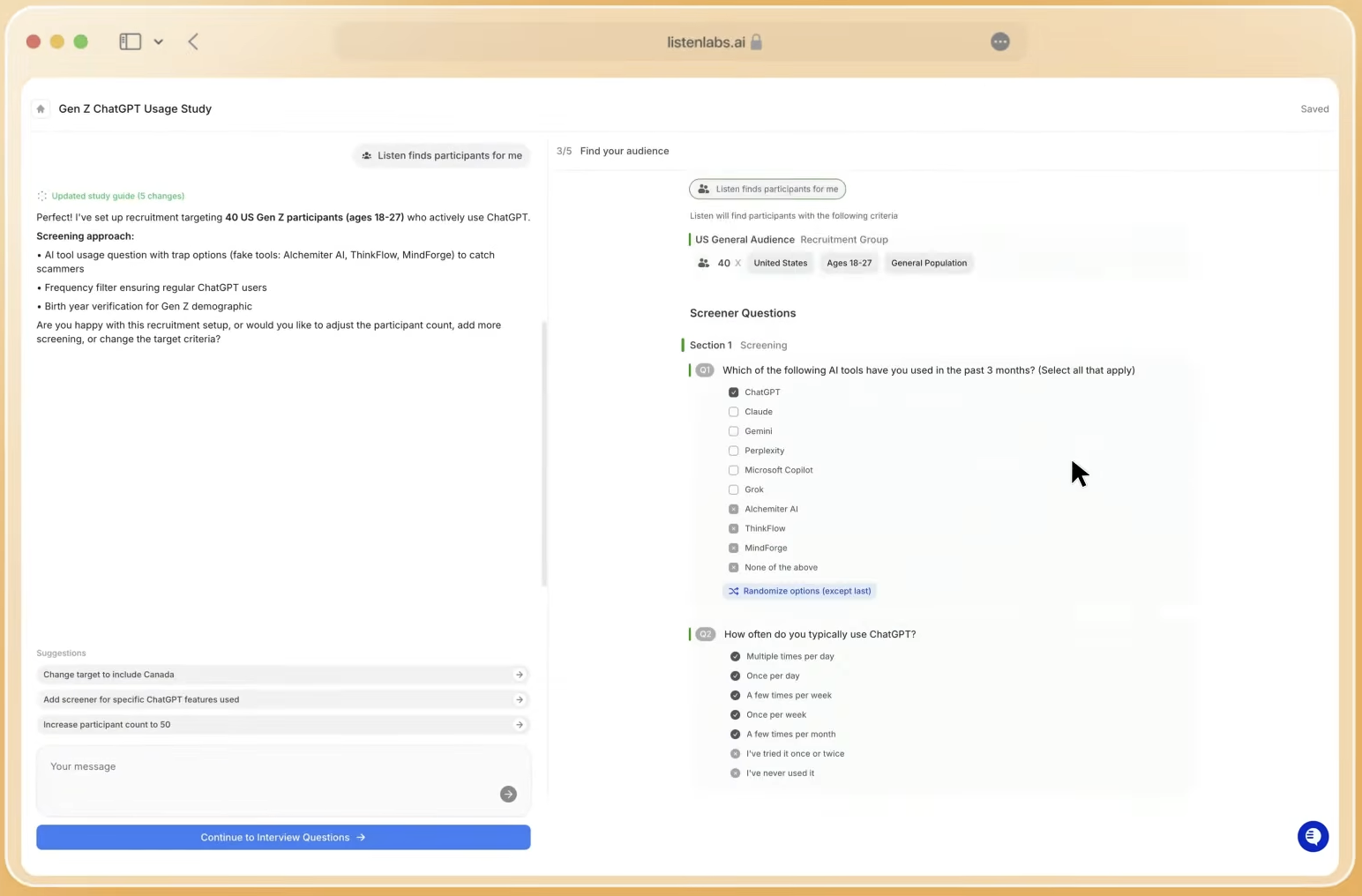
Behavioral and frequency controls protect that quality. Listen Labs’ Quality Guard uses real-time AI across video, voice, content, and device signals to flag fraud, low-effort responses, AI-generated scripts, and mismatched profiles. Participants are capped at three studies per month to avoid fatigue and professional respondents. Listen Atlas, the AI recruitment orchestration layer, matches participants on behavioral and intent data, not just self-reported demographics, across a verified network of 30M respondents in 45+ countries and 100+ languages.
Key decisions here involve incidence rate and sample frame. A study targeting loyalty members who shopped in-store at least four times in the past 90 days may see an 8–12% incidence rate, so a pool of 800–1,200 prospects is needed to yield 100 qualified completions. A study targeting general grocery shoppers in a single metro may see incidence above 40%. Listen Labs’ dedicated recruitment operations team sources segments below 1% incidence, including enterprise decision-makers and highly specialized consumer profiles, then hands them directly into the AI-moderated interview flow.
Step 4: Run AI-Moderated Video Interviews That Adjust in Real Time
AI moderation keeps interviews consistent across hundreds of sessions in a way human moderators cannot match. Studies show that AI-moderated interviews can deliver qualitative data as rich as human-led sessions while cutting costs and increasing volume. Researchers have noted that the AI asks open, curious follow-ups instead of leading questions, which produces unusually detailed responses.
Listen Labs’ AI moderator captures spoken content, tone of voice, word choice, and subconscious micro-expressions at the same time. The Emotional Intelligence layer, built on Ekman’s universal emotions framework, quantifies emotions such as joy, trust, surprise, confusion, and frustration per question and per stimulus. Every label ties back to an exact timestamp and verbatim quote. A retailer testing two loyalty messaging directions can see not only which option wins on stated preference, but which one sparks genuine enthusiasm instead of polite approval.
With qual-at-scale, the old trade-off between depth and scale is no longer a barrier. Studies of 200–300 AI-moderated interviews typically complete in 24 hours, while studies of 500–1,000 participants complete in three to five days depending on recruitment parameters.
Step 5: Use Automated Thematic Analysis and Ask Questions in Plain Language
Manual coding of qualitative transcripts often takes several hours of analyst time for each hour of interview material. A 100-interview study with 20-minute interviews can demand dozens of coding hours before synthesis even starts. AI-assisted analysis of the same dataset runs in minutes.
Listen Labs’ Research Agent ingests all interview data and surfaces themes, sentiment patterns, and segment differences automatically. One researcher ran a full buying intent analysis across three user segments in under a minute. Natural-language querying replaces manual coding bottlenecks. An analyst can ask “What are the top three friction points mentioned by shoppers who rated checkout experience below 3?” and receive a structured answer with supporting verbatims and video clips, without code or spreadsheets.
Teams using scaled qualitative research often report more themes than matched survey samples, with segmentation that remains stable across cohorts. The Research Agent also runs statistical significance tests across segments. A finding such as “loyalty members with 2+ years tenure are 2.3x more likely to cite staff recognition as a key retention driver” arrives with the evidence needed for merchandising or marketing leadership.
Step 6: Turn Insights into Deliverables and a Living Knowledge Base
The final step turns analyzed data into decision-ready outputs and preserves findings for future work. Listen Labs’ Research Agent creates consultant-quality PowerPoint decks, memo-style reports, video highlight reels, statistical charts, and segmentation breakdowns in under a minute. Every deliverable links back to the underlying response data so stakeholders can drill into any claim.
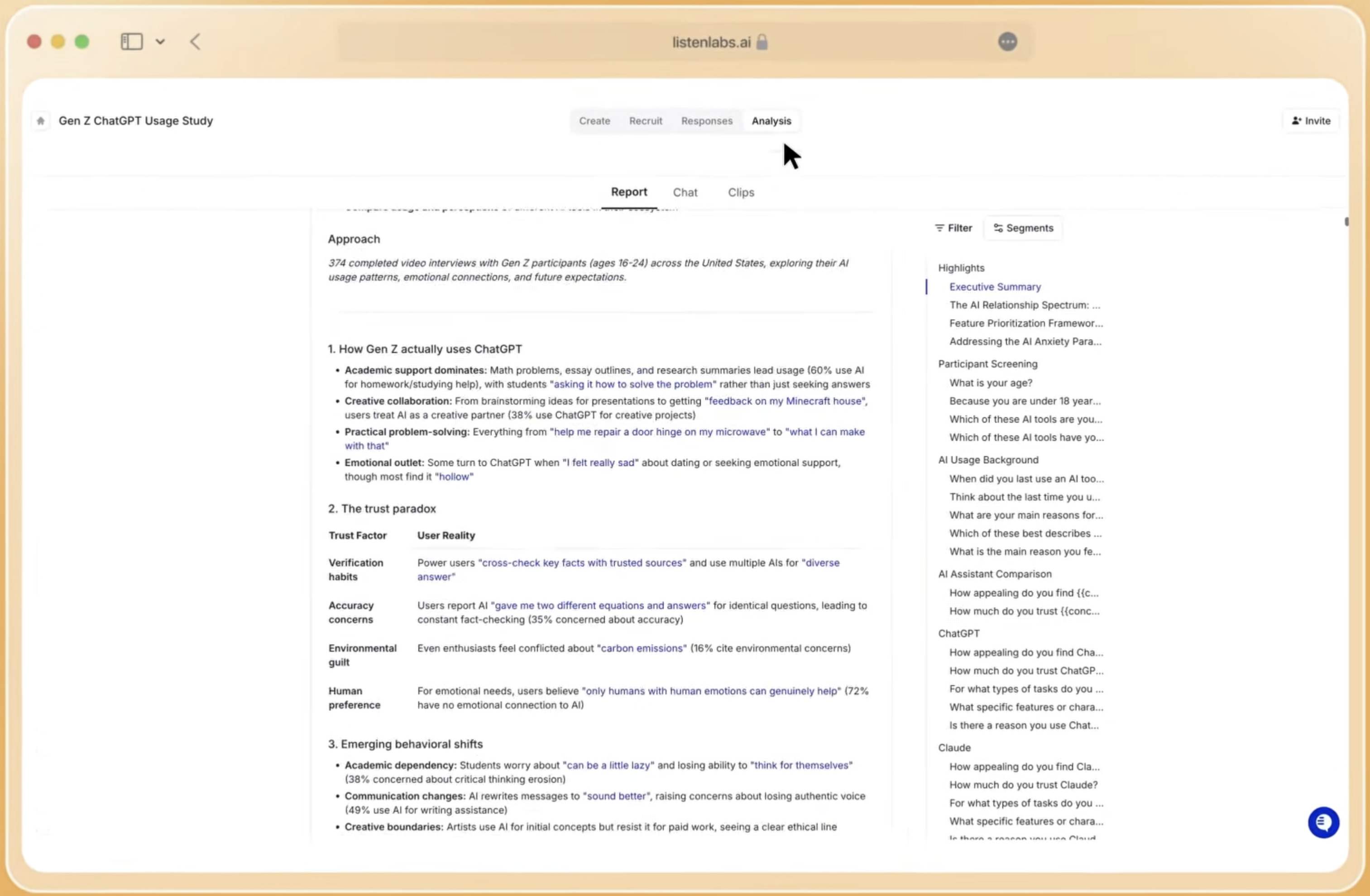
Highlight reels work especially well for retail leadership. A 90-second compilation of shoppers describing checkout friction, with emotional overlays that show frustration peaks, communicates urgency in a way a slide alone cannot. Trend reports track how themes shift across waves, allowing a grocery chain to see whether a shelf redesign improved navigation confidence over three months.
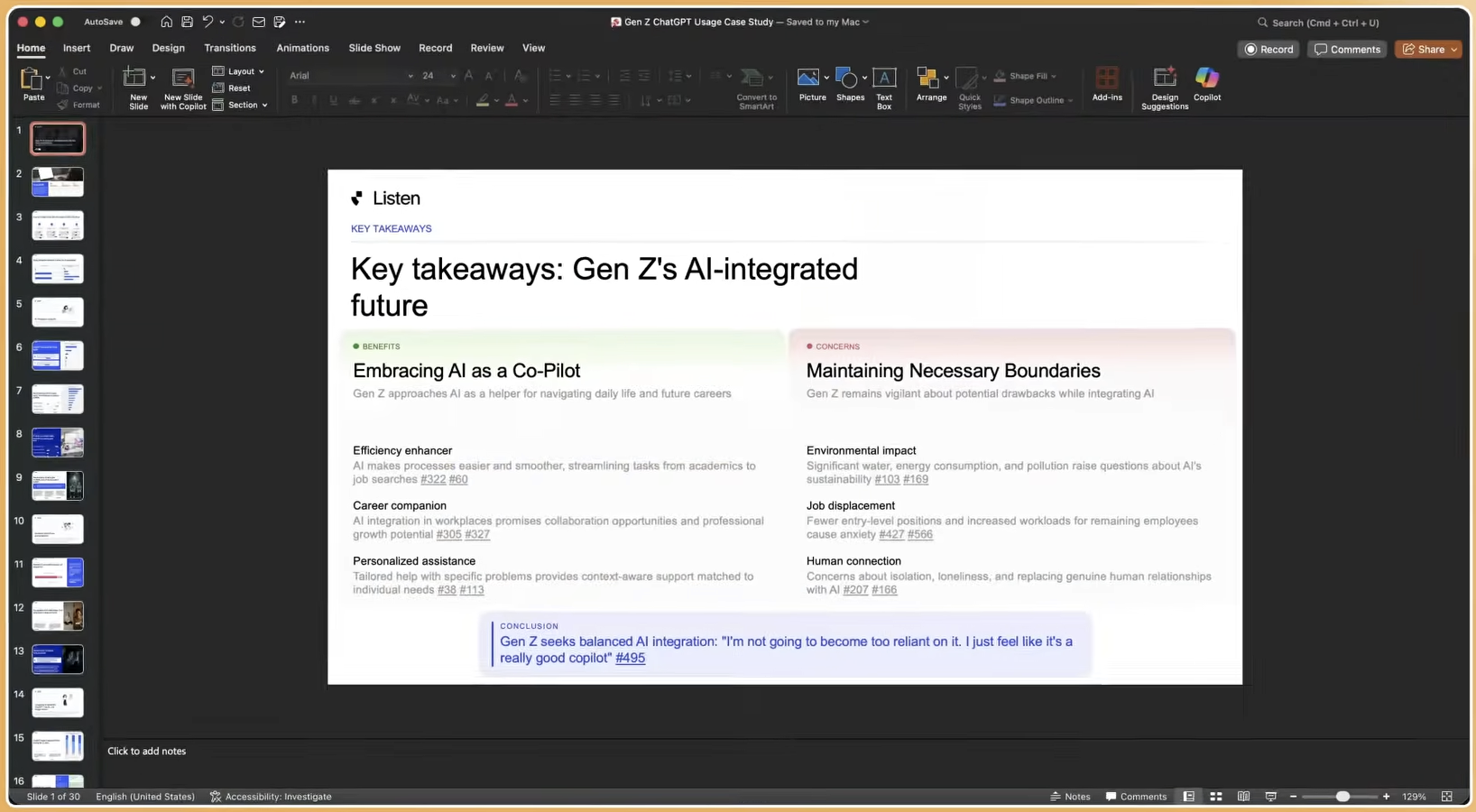
Mission Control, Listen Labs’ institutional knowledge base, stores every study, theme, verbatim, and finding in a searchable repository. Cross-study queries surface answers from past research in seconds, which prevents teams from re-running studies that already answered the question 18 months earlier. Each new study compounds the value of the knowledge base, turning research into a proprietary asset that grows with every cycle.
Common Challenges in Scaling Retail Qual and How to Fix Them
Three challenges appear again and again in scaled retail qualitative programs.
Unclear objectives create guides that try to answer too many questions at once, which leads to shallow coverage of each topic. A guide with more than eight primary questions often signals this problem. A 30-minute stakeholder alignment session before guide development, combined with a single-decision-per-study rule, keeps each project focused.
Low-quality respondents generate data that looks complete but lacks authenticity, with short, generic answers that meet length thresholds but reveal little motivation. Early-warning signs include average response length below 60 words per open-ended question and high rates of identical phrasing across participants. Behavioral screening criteria such as verified purchase history, loyalty membership, and store visit frequency improve authenticity far more than demographics alone.
Analysis bottlenecks emerge when teams accept automated themes without review. Researchers should audit 15–20 raw AI-generated transcripts themselves before relying on automated theme extraction to confirm that synthesized findings match participant language. A 30-minute transcript review step in the workflow usually provides enough validation before final deliverables.
Objective Success Metrics for Scaled Retail Qual Programs
Measuring the effectiveness of a scaled qualitative program requires metrics at both the study level and the program level. The five metrics below show whether the program delivers faster insights, higher-quality data, and real business impact, not just more interviews.
- Study cycle time: Days from approved brief to delivered report. Baseline is 4–6 weeks for traditional methods. Target is under 24–72 hours for AI-moderated studies of 100–300 interviews.
- Completion rate: Percentage of recruited participants who complete the full interview. AI-moderated studies achieve 40–87% completion rates, often exceeding the ~34% rates seen in human-led video studies.
- Thematic consistency: Whether the same core themes appear across independent sub-samples from the same study, which confirms saturation. Thematic saturation typically arrives at 9–17 interviews for relatively homogeneous populations with narrow objectives.
- Downstream usage: Whether findings appear in merchandising planograms, loyalty redesigns, marketing briefs, or store operations decisions within 30 days of delivery. This metric shows whether insights arrive fast enough and in a format cross-functional teams can use.
- Knowledge base query volume: Number of cross-study queries run against Mission Control per quarter, indicating whether the institutional knowledge base functions as a live resource instead of a static archive.
Advanced Tactics for Always-On, Multi-Market Retail Programs
Enterprise retail teams running always-on programs across markets face two extra layers of complexity: localization and emotional signal integration.
Multi-market localization requires more than translation. A loyalty messaging study running in the US, Germany, and Japan needs culturally adapted probing logic, locally relevant stimuli, and segment definitions that reflect different retail norms. Listen Labs supports 100+ languages for interview moderation with automatic translation and transcription, and its recruitment network spans 45+ countries. Hybrid recruitment that combines first-party customer lists with a vetted panel, plus global multilingual support, enables rich datasets across North America, Europe, and APAC without translation degradation or quality loss.
Emotional signal integration adds data that spoken responses alone cannot provide. Two shelf concepts may earn identical stated preference scores while triggering very different emotional reactions, with one sparking curiosity and the other causing confusion. Listen Labs’ Emotional Intelligence layer, available across 50+ languages, quantifies emotions per question and per stimulus with timestamp-level precision. Retail teams can see exactly where in a journey or concept presentation emotional friction occurs. This data flows into the Research Agent for natural-language queries and highlight reel creation, turning emotional intelligence into a daily tool instead of a specialist add-on.
Frequently Asked Questions
How long does a scaled retail qualitative study take from brief to report?
The full cycle from approved brief to delivered report, including guide design, recruitment, fieldwork, analysis, and deliverable generation, runs in under 24 hours on Listen Labs for standard retail consumer audiences, as detailed in Step 4. This timeline compares to 4–6 weeks for traditional agency-led qualitative research and 6–12 weeks for programs that rely on in-person shop-alongs or ethnographic fieldwork.
What sample sizes are appropriate for retail qualitative studies at scale?
Sample size depends on the number of segments that require comparison and the confidence level stakeholders need. For initial category or segment exploration, 30–50 interviews usually surface primary themes. For reliable comparison across two or three segments, such as loyal versus lapsed shoppers or three store formats, 40–50 interviews per segment form a practical minimum.
For board-level decisions or multi-market tracking programs, 200–500 interviews per wave provide the statistical confidence needed to quantify theme prevalence and track shifts over time. Studies below 200 total interviews rarely support credible segmentation across more than two cohorts.
How does Listen Labs handle privacy compliance and data security for retail research?
Listen Labs holds SOC 2 Type II, GDPR, ISO 27001, ISO 27701, and ISO 42001 certifications. All data is encrypted at 256-bit, and customer data is never used for AI model training. For programs involving loyalty member data or first-party customer lists, Listen Labs supports bring-your-own-participant recruitment so brands can interview their own customers inside the secure platform environment. Enterprise SSO is available for teams that require single sign-on access controls.
Can AI-moderated interviews reach hard-to-find retail audiences, such as high-frequency luxury shoppers or specific loyalty tier members?
Yes. Listen Labs’ dedicated recruitment operations team sources audiences below 1% incidence by working with niche communities, micro-creators, and specialized networks beyond the core 30M-person panel. For retail-specific audiences such as high-income shoppers, category-exclusive buyers, or specific loyalty tiers, behavioral screening criteria like verified purchase history, spend thresholds, and visit frequency apply at the recruitment stage instead of relying on self-reported demographics. Brands can also bring their own customer lists for direct recruitment at reduced cost.
When should a retail insights team repeat or expand a scaled qualitative study?
Teams should repeat studies when they make a significant change to the variable being measured, such as a shelf redesign, loyalty program restructure, or new store format rollout, and need to see whether shopper perception has shifted. A minimum interval of 60–90 days between waves usually allows behavioral change to register.
Expansion makes sense when initial findings reveal unexpected segments or sub-themes that need deeper exploration, or when a program moves from exploratory to tracking mode and requires larger per-segment sample sizes to detect meaningful shifts. Always-on programs with monthly or quarterly waves are increasingly common among enterprise retail teams using AI-moderated platforms because the cost and time per wave stay low enough to support continuous measurement.
Conclusion: Turning Retail Qual into a Continuous Advantage
The depth-versus-scale trade-off that constrained retail qualitative research for decades came from human-moderation limits, not from the method itself. A repeatable six-step process that includes precise objectives with validated scales, structured guide design with branching logic and stimuli, quality-controlled recruitment from a verified global network, AI-moderated video interviews that capture verbal and emotional signals, automated thematic analysis with natural-language querying, and deliverables that feed an institutional knowledge base removes that constraint.
Qualitative data methods make up for limitations in speed and sample size tenfold in their ability to uncover nuance and complexity in human decision-making. Retail insights leaders now decide how quickly to build the infrastructure for continuous qualitative learning. Listen Labs provides that infrastructure end-to-end, from study design and global recruitment through AI moderation, automated analysis, and institutional knowledge building, compressing a process that once took 4–6 weeks into one that delivers consultant-quality results in under 24 hours.
See how Fortune 500 retail teams run continuous insights programs without adding headcount.